Introduction
The codling moth, Cydia pomonella (Linnaeus) (Leipidoptera; Tortricidae), is a pest of temperate pome fruit production and a key pest in apple (Malus pumila Miller; Rosaceae), pear (Pyrus Linnaeus; Rosaceae), and walnut (Juglans Linnaeus; Juglandaceae) orchards worldwide (Dyck Reference Dyck2010). The larvae directly infest fruit of host plants (Geier Reference Geier1963), and can cause 80% damage in untreated orchards (Vreysen et al. Reference Vreysen, Carpenter and Marec2010). Many pest management techniques have been used to control codling moth populations, including insecticides (Dunley and Welter Reference Dunley and Welter2000), pheromone-based mating disruption (Witzgall et al. Reference Witzgall, Stelinski and Thompson2008), pathogen auto dissemination (Pultar et al. Reference Pultar, Kocourek, Berankova, Stara, Kuldolva and Hrdy2000), and sterile insect technique (Dyck Reference Dyck2010; Vreysen et al. Reference Vreysen, Carpenter and Marec2010). Increased regulation of insecticide application and the evolution of insecticide resistant populations of codling moth (Dunley and Welter Reference Dunley and Welter2000) have left a need for alternative, environmentally friendly integrated pest management techniques.
One unique approach to codling moth control in the interior fruit-producing valleys of British Columbia, Canada, where it is an introduced species, has been the establishment of the Okanagan-Kootenay Sterile Insect Release (SIR) Programme that was started in 1992 (Dyck et al. Reference Dyck, Graham and Bloem1993) with the goal of codling moth eradication. Released sterile or sub-sterile moths subsequently mate with viable wild moths, and produce either no offspring or sterile offspring, respectively (Vreysen et al. Reference Vreysen, Carpenter and Marec2010). Although eradication of codling moth has not yet been achieved in British Columbia, SIR in combination with other integrated pest management tactics (Judd and Gardiner Reference Judd and Gardiner2005), has provided control of this key pest of pome fruit production (Bloem et al. Reference Bloem, Carpenter, McCluskey, Fugger, Arthur and Wood2007) while substantially decreasing insecticide use (Dyck Reference Dyck2010). Since the implementation of SIR in British Columbia, organophosphate insecticide applications have been reduced by 82% and codling moth populations have declined by 95% in the 3200-ha initial treatment area (Bloem et al. Reference Bloem, Carpenter, Bloem, Tomlin and Taggart2004).
The SIR Programme facility, located in Osoyoos, British Columbia, mass rears codling moth larvae on a sawdust-based, agar-free diet (Brinton et al. Reference Brinton, Proverbs and Carty1969). Adults emerge directly from the diet and are sterilised via exposure to 250 Gy gamma radiation before release (Bloem et al. Reference Bloem, Carpenteer and Dorn2006a) into pome fruit orchards at a sterile:wild ratio of ~40:1 (Judd and Gardiner Reference Judd and Gardiner2005). Pre-sterilisation and post-sterilisation, adult moths are held in Petri plates at 2 °C for 24–78 hours to immobilise them during irradiation, storage, and transport to the target area (Bloem et al. Reference Bloem, Carpenteer and Dorn2006a). To ensure maximal mating success of sterilised moths in order to optimise the effectiveness of the SIR Programme, released moths need to be competitive with feral moths in flight, mate finding, and mating behaviours (Judd et al. Reference Judd, Arthur, Deglow and Gardiner2011; Carpenter et al. Reference Carpenter, Blomefield and Vreysen2012).
Recapture rates of sterile moths in the SIR Programme are lowest in the spring and are frequently lower than the desired 40:1, sterile:wild ratio (Judd et al. Reference Judd, Gardiner and Thistlewood2004). This could be due to several factors including reduced mobility and pheromone responsiveness of moths at lower ambient temperatures in the spring than the summer (Judd et al. Reference Judd, Gardiner and Thistlewood2004). Subsequent studies showed that codling moth mobility, as measured by an actograph bioassay, is higher at 20 °C and 25 °C than at 15 °C. There is also a shift in the circadian pattern of maximum activity at the tested temperatures with activity occurring in the afternoon at 15 °C and later in the evening at the warmer temperatures (Bloem et al. Reference Bloem, Carpenter and Dorn2006b). Under spring field conditions, wild codling moths mate earlier in the day than moths mass reared for release as part of the SIR Programme, suggesting that wild moths are better able to adapt to declining temperatures in the transition to evening (Judd et al. Reference Judd, Cockburn, Eby, Gardiner and Wood2006a). Oriented flight response of male codling moths at different temperatures to synthetic pheromone positioned in a wind tunnel follows a non-linear curve, as response increases with temperature but plateaus at the highest temperatures tested (15–25 °C). Although codling moth flight response increases with temperature, there is no difference in the temperature threshold of wild versus mass-reared moths and no evidence that pheromone responsiveness is lower in mass-reared than wild moths at low temperature (Judd and Gardiner Reference Judd and Gardiner2006).
Codling moths released as part of the SIR Programme are held at 2 °C for 24–78 hours before release (Bloem et al. Reference Bloem, Carpenteer and Dorn2006a). Several lines of evidence suggest that the cold storage period could affect the quality of released moths. The effect of cold storage on codling moth mobility varies with rearing technique. Mass-reared codling moths that are reared under diapause conditions as larvae are less mobile after cold storage as adults, whereas cold storage does not impact the mobility of moths mass reared under non-diapause conditions (Bloem et al. Reference Bloem, Carpenter and Dorn2006b). The length of the cold storage period before moth release may be a contributing factor in differences in mating rates of released wild versus mass-reared moths in a mark-recapture study. Wild moths held at 2 °C for three hours before release were more competitive than SIR Programme moths reared either under diapause or non-diapause conditions that experienced 24 hours of cold storage treatment as adults before release (Judd et al. Reference Judd, Arthur, Deglow and Gardiner2011).
All previous studies that examined the relationship between moth success and cold storage conditions were done in conjunction with other factors. In the current study, we test the hypothesis that cold storage treatment of adult codling moths affects moth flight capacity. Female and male codling moths that experience cold storage treatment at 2 °C for 24 hours before the bioassay are compared with similarly treated moths held at 24 °C before flight using a computer-linked flight mill assay (Evenden et al. Reference Evenden, Whitehouse and Sykes2014). Flight mills have been used previously to test the effect of sex, mated status, and age of codling moths on flight capacity (Schumacher et al. Reference Schumacher, Weyeneth, Weber and Dorn1997b) and to illustrate trade-offs between flight and fitness in this species (Gu et al. Reference Gu, Hughes and Dorn2006). Here, we use a flight mill bioassay as a way to isolate the effect of cold storage treatment of SIR Programme-reared moths on subsequent flight behaviour in the absence of a confounding factor of pheromone response. We further disentangle the components that can contribute to changes in flight behaviour of SIR Programme moths by using mass-reared moths that do not experience irradiation treatment before cold storage.
Materials and methods
Insects
Trays of sawdust-based rearing diet (Brinton et al. Reference Brinton, Proverbs and Carty1969) containing mature codling moth larvae were couriered weekly from the SIR Programme mass-rearing facility (Osoyoos, British Columbia) to the University of Alberta (Edmonton, Alberta, Canada). Trays of diet containing codling moth larvae were placed in a growth chamber at 24 °C under a 16:8 light:dark photoregime. Pupae were extracted from the larval diet, separated by sex, and placed individually into 30-mL translucent cups (Solo Cup Company, Lake Forest Illinois, United States of America) fitted with a dental wick to deliver water to emergent moths. Pupae were checked daily for moth eclosion and moths were held under similar conditions in separate chambers for male and female moths. Unsterilised moths aged one to two days old were used in the bioassay.
Temperature treatment
Two-day post eclosion, individual codling moths were transferred from cups in which they had access to a water source to 30-mL cups without access to water in preparation for the pre-flight temperature treatment. Moths were held for 24 hours before the flight bioassay either under rearing conditions of 24 °C (16:8 light:dark hours) or under a cold storage treatment 2 °C (24 dark hours) that mimicked the conditions of moth immobilisation used by the SIR Programme rearing facility (Bloem et al. Reference Bloem, Carpenteer and Dorn2006a). Temperature treatment was staggered by moth sex so that only one sex of moths was exposed to temperature treatments on a given day.
Flight protocol
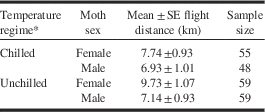
Male and female moths that experienced the different temperature regimes were immediately subjected to the flight assay using computer-linked flight mills (Evenden et al. Reference Evenden, Whitehouse and Sykes2014). Moths were prepared for the flight bioassay when they were two to three days old, which corresponds with the age of moth release in the SIR Programme (Bloem et al. Reference Bloem, Carpenteer and Dorn2006a). After the 24-hour temperature treatment, individual moths were weighed to the nearest 0.01 mg (XS105; Mettler Toledo, Columbus, Ohio, United States of America), chilled using a cold pack and tethered to a thin ~3-cm-long copper wire to the moth pronotum with low-temperature mastercraft heavy-duty glue (Canadian Tire, Edmonton, Alberta, Canada), so that wing movement was not impeded. Moths (9–11 replicates) were flown on each day and male and female moths were flown on alternate days until ~50 moths of each sex in each treament were tested (Table 1). On each day of flight, a random sample (>70 of each sex from each temperature regime) of the tethered moths were not flown but were kept as control moths. Control moths were treated in the same manner as the flown moths, but instead of being attached to the flight mill, moths were held in perforated microcentrifuge tubes (0.2 mL) and placed in the flight mill room under the same conditions as the flown moths for the duration of the bioassay. Tethered moths were transferred to an environmental chamber housing the flight mills that was maintained at 24 °C with a 16:8 hour light:dark photoregime. Each wire harness was attached to the distal end of a flight mill arm at ~100° by wire insulation. Flight assays occurred during the eight-hour scotophase. Each rotation of the mill arm was detected by a small magnetic transmitter/receiver situated on the mill casing that registered a signal to the attached computer. The computer recorded each revolution (94.2 cm) as moths propelled the arm. The output from the software (LabViewTM; National Instruments Corporation, Austin, Texas, United States of America) provided the total distance flown and flight duration. At the end of the eight-hour flight period, moths were removed from the flight mills, tethers were detached, moths were reweighed, and each was stored at −20 °C until lipid extraction. Weight loss during flight was calculated as the difference in weight before and after flight. Moths that were dead at the end of the eight-hour flight period were not included in subsequent analyses.
Mean (±standard error) flight distance of codling moths subjected to the flight bioassay after exposure to different temperature regimes for 24 hours before flight.

* Chilled and unchilled moths were kept at 2 °C and 24 °C, respectively, for 24 hours before the flight bioassay.
Lipid extraction
The energetic condition of flown and control moths was assessed by lipid extraction (Elliott and Evenden Reference Elliott and Evenden2009) using petroleum ether (Fisher Chemical, Fair Lawn, New Jersey, United States of America). Moth appendages were removed and moths were dried in an oven at 60 °C for 24 hours, and weighed to the nearest 0.01 mg. Moths were placed individually into perforated 0.2-mL microfuge tubes and submerged in petroleum ether in a Soxhlet apparatus (45/50 Pyrex; Fisher Scientific, Ottawa, Ontario, Canada). After a six-hour extraction period, moths were again dried at 60 °C for 24 hours and then weighed. Lipid mass remaining after flight was calculated as the difference in dry weight before and after extraction.
Statistical analyses
All data analyses were conducted in R version 3.3.0 (R Core Development Team 2016). In all analyses, model simplification was achieved through removal of non-significant factors based on stepwise regression of the full model and comparison of Akaike information criterion values for model performance, until the most parsimonious model remained. Before analyses, data were evaluated for normality and heteroscedasticity using Shapiro–Wilks tests and visualisation techniques (R Core Team 2016).
Flight capacity was analysed with a linear model that specified total flight distance as the dependent variable. Total flight distance was cube root transformed before analysis to improve normality. Fixed factors in the original model were specified as temperature treatment (chilled or unchilled), moth sex, and pre-flight weight, with all possible interaction terms.
The energetic condition of experimental moths was assessed in two separate linear models. In the first model, body lipid content remaining after the bioassay was the dependent variable with fixed factors specified as temperature treatment, flight treatment (flown or control), and moth sex, with all possible interaction terms. In the second model, weight loss during the bioassay was the dependent variable with fixed factors specified as temperature treatment, flight treatment, and moth sex, with all possible interaction terms.
Results
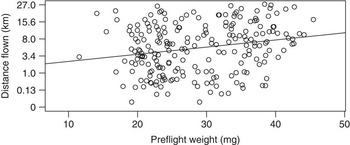
The average moth flight distance across treatments ranged from 6.93–9.73 km (Table 1). Pre-flight weight significantly impacted total flight distance (F(1,213)=10.53, P=0.0014). Although there was large variation in the distance flown, heavier moths were, on average, able to fly farther than lighter moths over the eight-hour flight period (Fig. 1). There was no significant effect of the pre-flight temperature treatment on the distance flown (F(1,213)=0.7298, P=0.3939). There was no significant effect of moth sex on flight distance (F(1,213)=2.7072, P=0.1014).
The effect of pre-flight weight on codling moth flight capacity, as measured by distance flown on laboratory flight mills in an eight-hour flight bioassay (F(1,213)=10.53, P=0.0014, on flight distance data transformed by cube root). The y-axis is back transformed to reflect the actual distance flown by each moth.

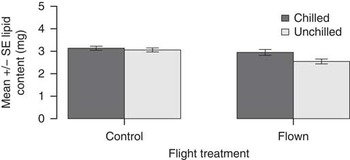
Moths that flew had less body lipid content remaining after the bioassay than control moths that were not allowed to fly (F(1,498)=11.7655, P=0.0007) (Fig. 2), indicating that adult codling moths, at least in part, use lipids to power flight. Interestingly, temperature regime before flight influenced the lipid content of moths after the bioassay (Fig. 2). Moths that were chilled before initiating flight retained more lipid at the end of the bioassay than moths that were not chilled (F(1,498)=4.9638, P=0.0263). Codling moth adults are not obviously sexually dimorphic, and females and males retained a similar body lipid content after the bioassay (F(1,498)=2.7133, P=0.1001).
Mean (±standard error) lipid content of codling moths subjected to either 2 °C or 24 °C for 24 hours before the bioassay. Flown moths were attached to flight mills during the eight-hour bioassay, whereas, control moths were tethered and held under the same conditions but were not given the opportunity to fly. Both flight treatment (F(1,498)=11.7655, P=0.0007) and pre-bioassay temperature regime (F(1,498)=4.9638, P=0.0263) affected moth lipid content measured after the bioassay.

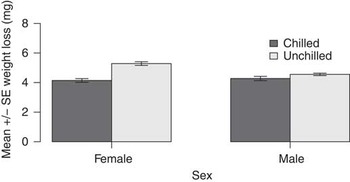
An interaction effect between temperature treatment before the bioassay and moth sex significantly (F(1,501)=13.0234, P=0.0003) influenced the amount of weight moths lost during the bioassay (Fig. 3). Although chilled moths of both sexes lost less weight during the bioassay than unchilled moths, the difference in weight loss was greater for females than males, so that unchilled female moths lost the most weight in the bioassay (Fig. 3). There was a marginally non-significant effect of flight treatment on moth weight loss during the bioassay (F(1,501)=3.6785, P=0.0557) that showed moths that flew on the flight mills lost more weight than control moths that did not fly.
Mean (±standard error) weight loss during the bioassay of male and female codling moths subjected to either 2 °C or 24 °C for 24 hours before the bioassay. There was a significant interaction effect between pre-bioassay temperature regime and moth sex (F(1,501)=13.0234, P=0.0003) that illustrated cold storage affected female weight loss more than male weight loss during the bioassay.

Discussion
The condition of mass-reared insects released in SIR Programmes is crucial to the efficacy of the control tactic as insects must be fit enough to seek, locate, and copulate with wild conspecifics for the programme to work (Carpenter et al. Reference Carpenter, Blomefield and Vreysen2012). Several bioassays have tested the activity level and competitiveness of codling moths mass reared at the SIR Programme facility in Osoyoos, British Columbia ranging from infrared actographs in which insects in a vial trigger the receiver when their movement intercepts the infrared beam (Bloem et al. Reference Bloem, Carpenteer and Dorn2006a, Reference Bloem, Carpenter and Dorn2006b), to operational mark-recapture field studies (Judd et al. Reference Judd, Arthur, Deglow and Gardiner2011). A bioassay consisting of a 16-cm-high flight cylinder was developed as an easy quality control technique for mass-reared codling moths (Carpenter et al. Reference Carpenter, Blomefield and Vreysen2012). Although computer-linked flight mills have been used previously to assess factors that influence the flight capacity of codling moths in general (Schumacher et al. Reference Schumacher, Weber, Hagger and Dorn1997a, Reference Schumacher, Weyeneth, Weber and Dorn1997b; Gu et al. Reference Gu, Hughes and Dorn2006), our study is the first to test flight capacity of mass-reared codling moths using this technique.
In general, codling moths are considered to be fairly sedentary insects as the majority of individuals in tested populations conduct relatively short, within habitat dispersal flights as measured in field (Mani and Wildbolz Reference Mani and Wildbolz1977) and laboratory (Schumacher et al. Reference Schumacher, Weyeneth, Weber and Dorn1997b) bioassays. Some individuals, however, are genetically pre-disposed (Schumacher et al. Reference Schumacher, Weber, Hagger and Dorn1997a) to conduct long distance between habitat flights (Schumacher et al. Reference Schumacher, Weyeneth, Weber and Dorn1997b). The flight capacity of the mass-reared codling moths measured on flight mills in the current study is variable (Fig. 1) with the mean flight distance ranging between 7–10 km (Table 1). A small number of moths are capable of flying up to 30 km during the eight-hour bioassay. The total distance flown on the flight mills was influenced by the pre-flight weight of the moths and, although the relationship is fairly weak, heavier moths flew farther than lighter moths (Fig. 1). Schumacher et al. (Reference Schumacher, Weber, Hagger and Dorn1997a) found a high genetic correlation between codling moth body weight and flight capacity in a recently collected field strain but this genetic correlation was negative in a laboratory strain. This difference was interpreted as a trade-off between flight and reproductive fitness in the field collected codling moths (Schumacher et al. Reference Schumacher, Weber, Hagger and Dorn1997a; Gu et al. Reference Gu, Hughes and Dorn2006). The relationship between body weight and flight in other tortricid moths is variable, large male Choristoneura conflictana (Walker) (Lepidoptera: Tortricidae) fly farther than small moths (Elliott and Evenden Reference Elliott and Evenden2009), whereas small male Choristoneura fumiferana (Clemens) (Sanders Reference Sanders1983) and Epiphyas postvittana (Walker) (Lepidoptera: Tortricidae) (Gu and Danthanarayana Reference Gu and Danthanarayana2000) fly farther than large males. Although pre-flight weight did influence flight distance in our bioassay, there was no direct effect of moth sex on flight capacity, which is similar to findings of previous flight mill studies of codling moth (Schumacher et al. Reference Schumacher, Weyeneth, Weber and Dorn1997b).
Early in the implementation of SIR Programme for codling moth control in British Columbia, low recapture rates of sterile moths in pheromone-baited monitoring traps, particularly in the spring, indicated a less than the desired 40:1 sterile:wild ratio in treated orchards (Judd et al. Reference Judd, Gardiner and Thistlewood2004). This lack of field competitiveness of the mass-reared moths led to research examining the various components of the rearing and release process that could impact moth competitiveness in the field. Several characteristics of the mass-rearing process can affect the mobility, flight behaviour, and mating competitiveness (Vreysen et al. Reference Vreysen, Carpenter and Marec2010). The level of irradiation that moths receive as adults affects mobility of codling moths as measured in an actograph bioassay (Bloem et al. Reference Bloem, Carpenteer and Dorn2006a). Mobility decreases in a linear fashion with increased radiation treatment from 0 to 250 Gy and this effect is greater for moths that are not reared through diapause as larvae (Bloem et al. Reference Bloem, Carpenteer and Dorn2006a). In general, codling moths that are mass reared at constant high temperatures that preclude the initiation of larval diapause are less competitive under field conditions (Bloem et al. Reference Bloem, Bloem and Knight1998, Reference Bloem, Carpenter, Bloem, Tomlin and Taggart2004) especially in the spring (Judd et al. Reference Judd, Thistlewood, Gardiner and Lannard2006b), despite having similar longevity and mating success in the laboratory (Bloem et al. Reference Bloem, Bloem and Fielding1997). The enhanced competitiveness of mass-reared codling moths reared under diapause conditions, however, disappears when evaluation occurs across several orchards (Judd et al. Reference Judd, Arthur, Deglow and Gardiner2011), suggesting that environmental features of the orchard contribute to the success of the SIR Programme in general.
Less is known about the effects of moth cold storage that mass-reared moths experience before release on subsequent moth activity. In the current study, storage of moths at 2 °C for 24 hours before the bioassay did not influence codling moth flight capacity on the flight mills as compared with moths held at 24 °C before flight. These results are similar to those of an actograph assay in which activity of mass-reared codling moths did not differ with cold storage treatment at 2 °C for zero, 24, 48, or 72 hours before the assay if the moths were reared without a larval diapause. There was, however, a negative effect of cold storage on the activity of adult mass-reared codling moths in the actograph assay if they were reared under diapausing conditions as larvae (Bloem et al. Reference Bloem, Carpenter and Dorn2006b). Cold storage of mass-reared false codling moth, Thaumatotibia leucotreta (Meyrick) (Lepidoptera: Tortricidae), adults at 3–4 °C for two hours significantly reduced the number of released males recaptured in pheromone-baited traps positioned in a South African citrus orchard compared with males held at 25 °C before release (Boersma and Carpenter Reference Boersma and Carpenter2016). Flight distance of false codling moths was also affected by cold storage, as chilled moths were captured in traps closer to the release site than moths held at 25 °C before release (Boersma and Carpenter Reference Boersma and Carpenter2016). As codling moth flight in our study was only conducted at the relatively high temperature of 24 °C, future studies should assess the effect of cold storage on subsequent flight capacity at lower temperatures or under spring-like field conditions to definitively determine if cold storage alters competitiveness of codling moths in field releases in the spring (Judd and Gardiner Reference Judd and Gardiner2006; Judd et al. Reference Judd, Arthur, Deglow and Gardiner2011).
Chilling moths before release in the SIR Programme may actually increase moth quality as chilled moths retained more fat and lost less weight during the bioassay than moths held at 24 °C for 24 hours before the bioassay (Figs. 2–3). It has long been known that moths use fat to power sustained flight (Van Handel Reference Van Handel1974; Judge et al. Reference Judge, Mullins and Eaton1991) and the current study shows that codling moths also use fat, at least in part, to power flight; control moths retained more fat after the bioassay than moths that were flown on the flight mills (Fig. 2). It appears that cold storage of codling moths before the bioassay reduced moth metabolism before flight and allowed moths to retain more lipid fuel and weight throughout the bioassay than moths held at 24 °C before experimentation. The locomotor activity of codling moths, like most insects, increases with temperature (Bloem et al. Reference Bloem, Carpenteer and Dorn2006a), and so cold storage during the handling and delivery of mass-reared moths appears to be crucial to maintaining the quality of moths released into orchards in the SIR Programme. Cold storage of mountain pine beetles, Dendroctonus ponderosae Hopkins (Coleoptera: Curculionidae), at 4 °C also resulted in more lipid retention and higher quality beetles than those stored at 24 °C before experimentation (Chubaty et al. Reference Chubaty, Hart and Roitberg2014). Over consecutive flights, higher lipid content will likely lead to greater dispersal capacity, as has been demonstrated with other insects flown in flight mill assays (Elliott and Evenden Reference Elliott and Evenden2009; Evenden et al. Reference Evenden, Whitehouse and Sykes2014). What remains unclear is whether the long-distance flight capacity displayed by mass-reared codling moths on flight mills is correlated with mating competitiveness under field conditions.
In this study, we have illustrated that the cold storage treatment, used currently in the SIR Programme, does not affect flight capacity of codling moths measured during an eight-hour flight mill bioassay after removal from the temperature treatment. Cold storage for 24 hours before the bioassay actually results in moths with higher fat stores that use energy more efficiently than moths that are not chilled. In order to avoid confounding effects of radiation exposure on flight capacity, this study was conducted on mass-reared moths that were not exposed to gamma radiation. As exposure to gamma radiation affects locomotor activity of mass-reared codling moths (Bloem et al. Reference Bloem, Carpenteer and Dorn2006a), a similar study on the flight capacity of irradiated moths held under various cold storage treatments (Boersma and Carpenter Reference Boersma and Carpenter2016) should be conducted in the future. The results also suggest that shipment of mass-reared codling moths in chilled containers from the SIR Programme facility in British Columbia to other apple producing countries implementing SIR Programmes around the world (Bloem et al. Reference Bloem, Carpenter, Blomefield and Harrison2010) should not affect codling moth flight capacity upon release.
Acknowledgements
The authors thank the Okanagan-Kootenay Sterile Insect Release Programme for providing codling moths. This work was supported through a Discovery Grant to M.L.E. from the Natural Sciences and Engineering Research Council of Canada.