During the 2009-2010 pandemic H1N1 influenza season, the US public health system was charged with coordinating the distribution of all monovalent H1N1 vaccine in this country. This task was accomplished through the extraordinary efforts of local health department staff; in many cases, the staff provided far more vaccinations than are usually given during a regular influenza season. This work was also made possible by use of local public health resources that may not be available in the future, as budget cuts to state and local public health decrease staffing and infrastructure. With many health departments facing such budget cuts, the gap between immunization goals and the public health resources available to attain them is likely to continue widening, including during pandemics. Given these limitations, options for providing an increased number of influenza immunizations with limited resources must be considered.
The intranasal live attenuated influenza vaccine (LAIV, MedImmune, LLC) is approved by the US Food and Drug Administration for use in eligible persons aged 2 to 49 years. The vaccine is administered by 1 spray into each nostril. The package insert states that the vaccine is to be given by a health care provider.1 However, 70% of those participating in the pivotal adult efficacy study that was conducted before FDA licensure was given actually self-administered the vaccine.Reference Nichol, Mendelman and Mallon2 Self-administration could allow for vaccination of large numbers of people under the direction of limited staff. To test the utility and practicality of self-immunization to vaccinate large numbers of people, we held mass immunization events in Louisville, Kentucky, using self-administration of influenza vaccine.
Methods
In collaboration with the medical director and staff of the immunization division of the Louisville Metro Department of Public Health and Wellness, we developed a basic script for teaching self-administration of intranasal LAIV to a group of lay persons. This description included the goals of the project and the potential adverse effects and contraindications with use of the vaccine. Following this, a nurse demonstrated the administration of LAIV using a placebo version of the vaccine.
We used a 3-tiered approach to evaluate the self-vaccination process. This process began with a mock clinic in September 2008 with 25 graduate students from the University of Louisville School of Public Health and Information Sciences. Staff of the health department set out vaccine and supplies on 3 rows of tables for the participating students to use. One nurse then talked the students through the process of self-immunization as a group. Immediately after the mock clinic event, the students provided feedback regarding problems or concerns that they had with the experience in a group question-and-answer session.
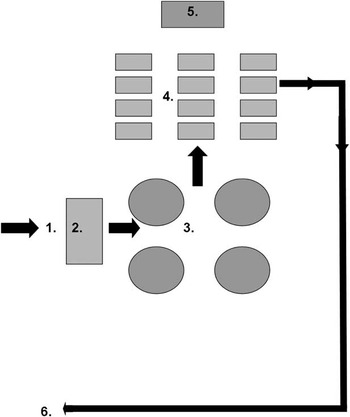
On October 15, 2008, we invited community first responders and Louisville Metro Government employees to participate in a pilot study. We advertised this event by direct contact with first responder groups, such as police and fire departments, and mass e-mail notices to local government employees. The event was advertised as providing strictly LAIV via a self-immunization process. We worked with our health department emergency preparedness division to devise an appropriate flow strategy for this event (Figure 1).
Figure 1Self-Immunization Clinic Flow.
1. Entrance; 2. Sign-in table, where clients read or hear basic information about vaccine and eligibility for receiving LAIV from a screener and are given paperwork to fill out; 3. Tables for completing paperwork; 4. Immunization tables, where clients listen to a brief oral presentation from the nurse educator, observe a demonstration and follow along with a step by step demonstration that clients complete until they have self-vaccinated, and fill out post-survey; 5. Nurse educator speaking site; 6. Exit
A subsequent event was held on November 23, 2008, which was open to the general public. Again, this event provided solely self-administered LAIV vaccine, which was provided free of charge. This open event was advertised using local media including television, radio, and newspapers, which noted that only LAIV was being offered. The physical setup and patient flow pattern was essentially the same as for the October event. In both events, persons who were unable to self-vaccinate would be offered LAIV given by a health care provider.
Participants were initially greeted at the door and told the appropriate ages for receiving the LAIV. They were then given forms to complete before participating in the study. These forms included descriptions of the limitations and LAIV contraindications for participants in this study. Persons had to be healthy and 18 to 49 years of age. Participants received a brief consent form, which indicated their understanding of the information that, while the vaccine to be received was a standard FDA-approved formulation, the method of delivery was not FDA approved. Participants were then directed to a separate space with tables and chairs for seating up to 30 people, where the health department medical director reviewed for each group of participants the purpose of the study and the indications and contraindications to receiving the vaccine. A nurse then led the participants through self-administration of vaccine as a group, in a process that took approximately 2 minutes. When participants finished performing the self-immunization, they were asked to fill in a brief postimmunization survey.
The University of Louisville Institutional Review Board reviewed and approved this study.
Results
Mock Clinic Feedback
Initial feedback from students in the School of Public Health Students after the mock clinic provided specific recommendations about making the description of vaccine self-administration more “user-friendly.” More specific instructions were requested throughout the self-immunization process. The script was broken down into individual steps in a “Simon says” fashion, in which participants are told to carry out the specific step being described and go no further. Participants were guided through using the vaccine first in the right nostril, then the left, to clarify the need for 1 spray to be delivered to each nostril. Specific instruction was also given on how to dispose of the syringe in containers for medical waste that were placed in front of the students. The script's descriptions of contraindications were modified to be more easily understood by the lay public. More boxes of facial tissues were made available, and a recommendation to use the tissue after each nostril spray was added to the script. No significant changes to the setup of the pilot event clinic flow or self-immunization process were found to be necessary for the subsequent open clinic.
Pilot and Open Clinic Results
A single nurse was able to direct 89 people through the process of self-administration of the vaccine in the pilot event and 122 people in the open event. Both events last 3 hours. Patients were immunized in groups ranging from 1 to 25. At the fastest pace in either event, 49 persons were immunized in the first hour of the second event. Each presentation by the medical director and nurse lasted a total of 3 to 4 minutes. The processes of explaining the immunization and guiding patients through self-administration took between 1½ to 2½ minutes (see video at http://www.youtube.com/watch?v=uJeJz4ExcRA). All staff present at the events, including the nurse, agreed that the process could be used to immunize several times the numbers served.
All but 2 persons who were eligible to receive LAIV were able to self-administer the vaccine. One person had physical limitations that made her unable to self-vaccinate, and another reported having an anxiety disorder and was uncomfortable with self-administration of vaccine.
All participants in both of the latter events completed a postevent questionnaire. Of these, 96% reported that they believed that they had performed the self-administration of the vaccine correctly, and the same number reported that they would like to receive influenza immunization by self-vaccination in the future. No adverse events occurred immediately after self-administration or on passive reporting after the event. Also, 81% of participants reported having no medical work background, and 29% reported never receiving any type of influenza immunization previously, including 40% of those attending the open community clinic.
Comment
In the case of a pandemic, when demand for influenza vaccine is higher than normal and the goal will be to vaccinate as many people as quickly as possible, the community vaccine delivery system will be severely stressed. Using the staffing model provided by the US Department of Health and Human Service's Agency for Healthcare Research and Quality sample, it is estimated that for Louisville's population of 721 000, we would need 174 eight-hour clinic events, with 17 vaccinators per clinic, or 5916 staff shifts, with 118 patients vaccinated per 4-hour shift.3 Many communities will be unable to provide such resources. Our self-immunization clinic vaccinated 122 patients in 1 three-hour event, with considerable “down time” for the nurse responsible for vaccination. This approach appears to be a practical method of providing mass immunization quickly with very limited medical staff.
The self-immunization clinic has limitations. A nurse who is comfortable with group teaching must be available. LAIV is not licensed for persons over age 49 years, and children cannot be expected to self-administer the vaccine efficiently. Some adults may not be comfortable with self-vaccination, or may have physical limitations that prevent them from effectively performing it. Also, it is unclear how many people may prefer injectable influenza vaccine to the nasal spray. In addition, LAIV is not licensed for self-administration. It is currently licensed “for intranasal administration by a health care provider.”1 In a review of the pivotal adult study of LAIV, the study's authors reported that a nonrandomized comparison of self-administration to administration by a medical provider suggested that both methods of administration had similar effectiveness.Reference Ambrose and Wu4 The efficacy of the 2 methods has not been compared in a randomized controlled trial, however, and our study did not follow up with subjects during the influenza season to document the effectiveness of the vaccination. Taken together, these limitations indicate that self-immunization should only be considered in a pandemic scenario.
In a pandemic setting, the cumulative public health utility of immunizing many more persons is likely to far outweigh the risk. In addition, 96% of those surveyed reported that they would like to self-vaccinate as the method of receiving influenza immunization in the future, and 29% reported never receiving any type of influenza immunization in the past. It is possible that some of our participants found this method of immunization more agreeable, and would consent to receiving vaccination when previously they had not.
The process of self-immunization provides a potential option for vaccinating several thousand adults using minimal medical personnel in a very short period of time.
Disclosures
MedImmune, LLC, provided free LAIV vaccine for this study. MedImmune, LLC, did not participate in the design and conduct of the study or in the collection, management, analysis, and interpretation of the data. MedImmune, LLC, staff did not participate in either manuscript preparation or approval.
Funding and Support
Pfizer provided research funding (Dr Woods).





 You have
Access
During the 2009-2010 pandemic H1N1 influenza season, the US public health system was charged with coordinating the distribution of all monovalent H1N1 vaccine in this country. This task was accomplished through the extraordinary efforts of local health department staff; in many cases, the staff provided far more vaccinations than are usually given during a regular influenza season. This work was also made possible by use of local public health resources that may not be available in the future, as budget cuts to state and local public health decrease staffing and infrastructure. With many health departments facing such budget cuts, the gap between immunization goals and the public health resources available to attain them is likely to continue widening, including during pandemics. Given these limitations, options for providing an increased number of influenza immunizations with limited resources must be considered.
The intranasal live attenuated influenza vaccine (LAIV, MedImmune, LLC) is approved by the US Food and Drug Administration for use in eligible persons aged 2 to 49 years. The vaccine is administered by 1 spray into each nostril. The package insert states that the vaccine is to be given by a health care provider.1 However, 70% of those participating in the pivotal adult efficacy study that was conducted before FDA licensure was given actually self-administered the vaccine.Reference Nichol, Mendelman and Mallon2 Self-administration could allow for vaccination of large numbers of people under the direction of limited staff. To test the utility and practicality of self-immunization to vaccinate large numbers of people, we held mass immunization events in Louisville, Kentucky, using self-administration of influenza vaccine.
Methods
In collaboration with the medical director and staff of the immunization division of the Louisville Metro Department of Public Health and Wellness, we developed a basic script for teaching self-administration of intranasal LAIV to a group of lay persons. This description included the goals of the project and the potential adverse effects and contraindications with use of the vaccine. Following this, a nurse demonstrated the administration of LAIV using a placebo version of the vaccine.
We used a 3-tiered approach to evaluate the self-vaccination process. This process began with a mock clinic in September 2008 with 25 graduate students from the University of Louisville School of Public Health and Information Sciences. Staff of the health department set out vaccine and supplies on 3 rows of tables for the participating students to use. One nurse then talked the students through the process of self-immunization as a group. Immediately after the mock clinic event, the students provided feedback regarding problems or concerns that they had with the experience in a group question-and-answer session.
On October 15, 2008, we invited community first responders and Louisville Metro Government employees to participate in a pilot study. We advertised this event by direct contact with first responder groups, such as police and fire departments, and mass e-mail notices to local government employees. The event was advertised as providing strictly LAIV via a self-immunization process. We worked with our health department emergency preparedness division to devise an appropriate flow strategy for this event (Figure 1).
Self-Immunization Clinic Flow.
1. Entrance; 2. Sign-in table, where clients read or hear basic information about vaccine and eligibility for receiving LAIV from a screener and are given paperwork to fill out; 3. Tables for completing paperwork; 4. Immunization tables, where clients listen to a brief oral presentation from the nurse educator, observe a demonstration and follow along with a step by step demonstration that clients complete until they have self-vaccinated, and fill out post-survey; 5. Nurse educator speaking site; 6. Exit
A subsequent event was held on November 23, 2008, which was open to the general public. Again, this event provided solely self-administered LAIV vaccine, which was provided free of charge. This open event was advertised using local media including television, radio, and newspapers, which noted that only LAIV was being offered. The physical setup and patient flow pattern was essentially the same as for the October event. In both events, persons who were unable to self-vaccinate would be offered LAIV given by a health care provider.
Participants were initially greeted at the door and told the appropriate ages for receiving the LAIV. They were then given forms to complete before participating in the study. These forms included descriptions of the limitations and LAIV contraindications for participants in this study. Persons had to be healthy and 18 to 49 years of age. Participants received a brief consent form, which indicated their understanding of the information that, while the vaccine to be received was a standard FDA-approved formulation, the method of delivery was not FDA approved. Participants were then directed to a separate space with tables and chairs for seating up to 30 people, where the health department medical director reviewed for each group of participants the purpose of the study and the indications and contraindications to receiving the vaccine. A nurse then led the participants through self-administration of vaccine as a group, in a process that took approximately 2 minutes. When participants finished performing the self-immunization, they were asked to fill in a brief postimmunization survey.
The University of Louisville Institutional Review Board reviewed and approved this study.
Results
Mock Clinic Feedback
Initial feedback from students in the School of Public Health Students after the mock clinic provided specific recommendations about making the description of vaccine self-administration more “user-friendly.” More specific instructions were requested throughout the self-immunization process. The script was broken down into individual steps in a “Simon says” fashion, in which participants are told to carry out the specific step being described and go no further. Participants were guided through using the vaccine first in the right nostril, then the left, to clarify the need for 1 spray to be delivered to each nostril. Specific instruction was also given on how to dispose of the syringe in containers for medical waste that were placed in front of the students. The script's descriptions of contraindications were modified to be more easily understood by the lay public. More boxes of facial tissues were made available, and a recommendation to use the tissue after each nostril spray was added to the script. No significant changes to the setup of the pilot event clinic flow or self-immunization process were found to be necessary for the subsequent open clinic.
Pilot and Open Clinic Results
A single nurse was able to direct 89 people through the process of self-administration of the vaccine in the pilot event and 122 people in the open event. Both events last 3 hours. Patients were immunized in groups ranging from 1 to 25. At the fastest pace in either event, 49 persons were immunized in the first hour of the second event. Each presentation by the medical director and nurse lasted a total of 3 to 4 minutes. The processes of explaining the immunization and guiding patients through self-administration took between 1½ to 2½ minutes (see video at http://www.youtube.com/watch?v=uJeJz4ExcRA). All staff present at the events, including the nurse, agreed that the process could be used to immunize several times the numbers served.
All but 2 persons who were eligible to receive LAIV were able to self-administer the vaccine. One person had physical limitations that made her unable to self-vaccinate, and another reported having an anxiety disorder and was uncomfortable with self-administration of vaccine.
All participants in both of the latter events completed a postevent questionnaire. Of these, 96% reported that they believed that they had performed the self-administration of the vaccine correctly, and the same number reported that they would like to receive influenza immunization by self-vaccination in the future. No adverse events occurred immediately after self-administration or on passive reporting after the event. Also, 81% of participants reported having no medical work background, and 29% reported never receiving any type of influenza immunization previously, including 40% of those attending the open community clinic.
Comment
In the case of a pandemic, when demand for influenza vaccine is higher than normal and the goal will be to vaccinate as many people as quickly as possible, the community vaccine delivery system will be severely stressed. Using the staffing model provided by the US Department of Health and Human Service's Agency for Healthcare Research and Quality sample, it is estimated that for Louisville's population of 721 000, we would need 174 eight-hour clinic events, with 17 vaccinators per clinic, or 5916 staff shifts, with 118 patients vaccinated per 4-hour shift.3 Many communities will be unable to provide such resources. Our self-immunization clinic vaccinated 122 patients in 1 three-hour event, with considerable “down time” for the nurse responsible for vaccination. This approach appears to be a practical method of providing mass immunization quickly with very limited medical staff.
The self-immunization clinic has limitations. A nurse who is comfortable with group teaching must be available. LAIV is not licensed for persons over age 49 years, and children cannot be expected to self-administer the vaccine efficiently. Some adults may not be comfortable with self-vaccination, or may have physical limitations that prevent them from effectively performing it. Also, it is unclear how many people may prefer injectable influenza vaccine to the nasal spray. In addition, LAIV is not licensed for self-administration. It is currently licensed “for intranasal administration by a health care provider.”1 In a review of the pivotal adult study of LAIV, the study's authors reported that a nonrandomized comparison of self-administration to administration by a medical provider suggested that both methods of administration had similar effectiveness.Reference Ambrose and Wu4 The efficacy of the 2 methods has not been compared in a randomized controlled trial, however, and our study did not follow up with subjects during the influenza season to document the effectiveness of the vaccination. Taken together, these limitations indicate that self-immunization should only be considered in a pandemic scenario.
In a pandemic setting, the cumulative public health utility of immunizing many more persons is likely to far outweigh the risk. In addition, 96% of those surveyed reported that they would like to self-vaccinate as the method of receiving influenza immunization in the future, and 29% reported never receiving any type of influenza immunization in the past. It is possible that some of our participants found this method of immunization more agreeable, and would consent to receiving vaccination when previously they had not.
The process of self-immunization provides a potential option for vaccinating several thousand adults using minimal medical personnel in a very short period of time.
Disclosures
MedImmune, LLC, provided free LAIV vaccine for this study. MedImmune, LLC, did not participate in the design and conduct of the study or in the collection, management, analysis, and interpretation of the data. MedImmune, LLC, staff did not participate in either manuscript preparation or approval.
Funding and Support
Pfizer provided research funding (Dr Woods).