


INTRODUCTION
New Zealand has experienced a prolonged, widespread epidemic of meningococcal disease since 1991. The peak of cases occurred in 2001 when over 17 cases/100 000 were reported. The rate of disease in 2003, the year prior to this study, was 14·2 cases/100 000 [Reference Dyet1, Reference Martin and McDowell2]. A serogroup B strain with porA type (P1.7-2,4) has dominated the epidemic, accounting for 72% of all confirmed cases of meningococcal disease 2003 whereas only 12% of such cases were caused by serogroup C. The rates of disease caused by serogroup B have been highest in the younger age groups. The age distribution of disease has been similar across the country.
For the period 1997–2003 the relative risk (RR) of developing meningococcal disease caused by any meningococcal strain in the Otago district (population 174 000) compared with the rest of New Zealand was 1·33 [95% confidence interval (CI) 1·12–1·59, P=0·001]. In the 15–19 years age group, the RR for Otago was 2·77 (95% CI 2·02–3·79, P<0·0001). In 2002, Otago had a localized outbreak of serogroup C disease and 27% of isolates were serogroup C. During the period 2001–2003 the 15–19 years age group in Otago experienced an average rate of 42·7 cases/100 000 of serogroup B disease compared with 15·4 cases/100 000 in the same age group in the rest of New Zealand, corresponding to an RR of 2·78 (95% CI 1·82–4·24, P<0·0001). For serogroup C, the Otago rate was 27·4 cases/100 000 compared with 2·2 cases/100 000 for the rest of the country – giving a RR of 12·45 (95% CI 6·56–23·70, P<0·0001).
MeNZB™ is a meningococcal group B outer membrane vesicle (OMV) vaccine prepared from a B:4:P1.7-2,4 meningococcal strain (NZ98/254). This vaccine has been studied in several clinical trials in infants to adults [Reference Oster3]. All results show that the vaccine is safe in all age groups and that MeNZB elicits a strain-specific serum bactericidal antibody response against outer membrane proteins after three doses of vaccine.
The meningococcal group C (MenC) conjugate vaccine Menjugate™, consists of oligosaccharides conjugated to the carrier protein, CRM197, a non-toxic diphtheria toxin. This vaccine elicits serum bactericidal antibodies against the group C capsular polysaccharide after a single dose.
In a recent immunogenicity study conducted in Norway [Reference Aaberge4] one dose of a MenB/MenC combination vaccine was administered to adults followed by two doses of MenB vaccine only. The study indicated that the combination of the OMV vaccine MenBvac™ and Menjugate was safe and immunogenic and elicited serum bactericidal antibodies against both vaccine strains. MenBvac, the ‘parent vaccine’ of MeNZB, is produced in a similar manner, but is based on a different strain (44/76) typing as B:15:P1.7,16.
Several studies have attempted to clarify the question of increased risk of meningococcal disease in the college population. Carriage rates among university students in halls of residence have been shown to increase rapidly during the first week of term and to continue to rise over the course of the next few months [Reference Neal5]. Independent associations for acquisition of meningococci in a study among 2500 university students were frequency of visits to the hall bar, active smoking, being male and intimate kissing [Reference Neal5] and other studies also suggest that a campus bar environment might facilitate meningococcal transmission [Reference Imrey6].
Bruce et al. [Reference Bruce7] reported that students living in the same building as other students had an incidence rate of 5·1 vs. 1·4/100 000 for the general population of 18- to 23-year-old non-students. Other studies have shown that meningococcal carriage is more common in young adults [Reference Caugant8]. The case-fatality rate of meningococcal disease in New Zealand between 1999 and 2003 was 5·3% in the 15–19 years age group [Reference Martin and McDowell2] confirming the suggestion from the United States that this is an important target group for a vaccination programme [Reference Harrison9].
The combination of two efficacious serogroup B and C vaccines could be beneficial in an epidemic situation where elevated rates of serogroup B disease caused by the vaccine-specific strain is combined with elevated incidence of serogroup C meningococci. In this study a combination of MeNZB and Menjugate was for the first time concomitantly administered. This explorative study investigated the immunogenicity and safety of such a combination when administered in a single injection for the prevention of serogroup B and serogroup C meningococcal disease. The study also investigated the carriage of meningococci in residents of a residential college.
METHODS
Vaccines
MeNZB
The meningococcal group B vaccine MeNZB™, manufactured by Chiron Vaccines (Novartis Vaccines, Siena, Italy), is prepared from a B:4:P1.7-2,4 meningococcal strain (NZ98/254) by fermentor growth and extraction of the bacteria with the detergent deoxycholate. Intact and fragmented OMVs are purified by ultracentrifugation and adsorbed to aluminum hydroxide. One dose (0·5 ml) of MeNZB contains 25 μg outer membrane protein, 1·65 mg aluminum hydroxide, 4·5 mg NaCl (tonicity-modifying agent) and 5 mm histidine (pH buffering agent).
Meningococcal B/C combination vaccine (MeNZB+MenC)
The MeNZB+MenC combination vaccine was prepared by reconstituting the meningococcal serogroup C conjugate lyophilized vaccine with the full liquid MeNZB vaccine immediately prior to administration. One dose (0·5 ml) of MeNZB+MenC contained 25 μg group B outer membrane protein, 10 μg meningococcal C oligosaccharide, 12·5–33·3 μg diphteria toxoid (CRM197), 1·65 mg aluminum hydroxide and water for injection up to 0·5 ml.
Subjects
The study was carried out in a 330-room university hall of residence. In total, 91% of the residents were first-year university students, who came from all parts of New Zealand and many overseas countries. In the year before the study two cases of serogroup C meningococcal disease occurred in the same hall within a 3-week period. All residents and staff at that time were offered quadrivalent (A, C, Y, W 135) meningococcal polysaccharide vaccine.
Healthy 17- to 24-year-old university students who had given written informed consent prior to study entry were eligible for participation in the study. Participants were excluded if they had experienced a hypersensitivity reaction following any previous vaccinations, had an acute or chronic systemic illness or had received immunosuppressive therapy or blood products within 3 months prior to vaccination. Earlier immunization with meningococcal B or C vaccine of any kind, previous suspected disease caused by N. meningitidis or close contact with a patient with meningococcal disease were also reasons for exclusion.
Meningococcal carriage
In the first part of this study (Part A) all students residing in the same hall were invited to participate. At screening they were asked a few questions regarding risk factors associated with carriage of meningococci related to their social behaviour, such as smoking habits, alcohol intake and bar visits, and a pharyngeal swab was obtained, according to WHO recommendations [Reference Bisno10]. Swabs were immediately placed in Amies transport medium in a biobottle and held at room temperature pending delivery to the Institute of Environmental Science and Research (ESR) where the swabs were subcultured onto New York City medium. Pure cultures of identified Neisseria spp. were frozen at −70°C in glycerol broth pending further identification. A rapid sugar test using the API NH test was used to identify isolates to the species level. Group, PorB and PorA types were determined on all confirmed N. meningitidis isolates. A combination of serological and genetic typing methods was used. At the end of the study, about 5 months later, the risk factor assessment was repeated and another pharyngeal swab was taken with meningococci recovered as above.
Administration
For the second part of the study (Part B) a subset of volunteers from Part A was randomly assigned 2:1 to receive either a first dose of MeNZB, a second dose of the combined MeNZB+MenC vaccine and a third dose of MeNZB (MeNZB+MenC group), or three doses of MeNZB. It was estimated that at least 60 subjects should complete the trial. One of the measures for immunogenicity was the percentage of subjects who showed at least a fourfold increase in serum antibody titres against the vaccine strain. Calculations showed that for a sample size of 40 MeNZB+MenC subjects and 20 MeNZB subjects, the precision attainable when 80% of the subjects showed a fourfold increase in serum bactericidal assay (SBA) would be between 64·3% and 90·9% for MeNZB+MenC subset and between 56·3% and 94·3% for the MeNZB subset as measured by the Clopper–Pearson 95% CI. The vaccines were administered intramuscularly in the deltoid region of the non-dominant arm with an interval of 6 weeks between each of the three vaccinations.
Immunogenicity
A total of 57 subjects were enrolled in this phase I/II, single centre, observer-blind, controlled, randomized study in which 18 subjects received three injections of MeNZB only and 35 subjects received three injections of MeNZB+MenC. Blood samples (two tubes of ~15 ml) for serological assays were collected before the first vaccination, 6 weeks after the second and 4 weeks after the third vaccination.
SBA
The SBA is an assay that measures the ability of serum antibodies to induce lysis of bacteria in the presence of complement. The vaccine strain, NZ98/254, was used as the target strain in serogroup B SBA. Analyses were performed according to established protocols [Reference Martin11].
The meningococcal serogroup C strain C11 (C:16:P1.7-1,1) was used as target strain for measurement of antibodies against the C capsular antigen. In both assays, human serum without detectable antibodies against the target strain was used as complement source. Bacterial survival in the final reaction mixture was measured after incubation for 30 min at 37°C for the serogroup C assay [Reference Santos12] and following 1 h for the serogroup B assay [Reference Martin11]. Twofold serum dilutions were tested, and titres were reported as the reciprocal value of the highest serum dilution resulting in ⩾50% killing of bacteria [Reference Maslanka13].
ELISA
IgG antibodies measured against OMVs from the vaccine strain B:4:P1.7-2,4 and against C polysaccharide were analysed by ELISA. The OMV-ELISA was a standard ELISA assay with the mean IgG unit value for each serum at dilution of 1:200 directly determined using a standard unit curve [Reference Kurstak14].
Safety monitoring
Following each vaccination the subjects were observed for 30 min for evidence of immediate reactions. They were instructed to complete a diary card to record local reactions (i.e. erythema, swelling, induration and pain at the injection site), systemic reactions (i.e. nausea, malaise, myalgia, arthralgia, or headache) and body temperature (sub-lingual) for 7 days including the day of the vaccination. Any other adverse event (AE) was also collected during this 7-day period and was monitored until diagnosis or resolution. Active surveillance of study subjects was set up through phone interviews and follow-up visits. Any local or systemic reaction that had not resolved after a week was recorded as an AE. All subjects were followed up for 4–6 weeks after the last vaccination and all serious adverse events (SAEs) were collected throughout the trial.
Ethics
This study was conducted in accordance with the Declaration of Helsinki and Good Clinical Practice (GCP) according to International Conference on Harmonization (ICH) guidelines. The study was reviewed and approved by the Southern Region Ethics Committee of the New Zealand Ministry of Health. Before enrolment, all subjects gave signed informed consent.
Statistical methods
Part A
Exploratory analyses were performed to identify demographic and vaccine-related risk factors for carriage. Each risk factor was analysed using univariate analysis methods. Multiple logistic regression analysis was used to explore which risk factors were associated with N. meningitidis carriage at the beginning of term. Factors which had a P value of <0·10 in the univariate analysis or factors that were considered clinically relevant were included in the multiple logistic regression model. In calculating the odds ratio only subjects that were non-carriers at baseline were included.
Part B
This study reports on the first administration of MeNZB concomitantly with Menjugate and the study was therefore of explorative nature. For measurement of serum bactericidal antibodies elicited against both the B vaccine and the C vaccine, the percentage of subjects with SBA titres ⩾1:8 was determined at each time-point for both vaccine groups with associated 95% Clopper–Pearson CIs.
The SBA geometric mean antibody titres (GMTs) with 95% CIs and median, minimum and maximum values were also calculated for each vaccine group, and, for those receiving the MeNZB vaccine only, also the geometric mean antibody concentrations (GMCs) of vaccinees' sera, as measured by ELISA (IgG).
The GMTs and 95% CIs were constructed by exponentiating (base 10) the least square means of the logarithmically transformed (base 10) titres and their 95% CIs obtained from a one-way analysis of variance (ANOVA) with a factor for vaccine group.
The incidence of pre-specified and unspecified local and systemic reactions as well as other AEs, were calculated by maximum severity after each vaccination. All statistical analyses were performed using SAS® version 8.2 or higher (SAS Institute, Cary, NC, USA).
RESULTS
No payment made to the subjects for participation in the study. Overall 209 subjects were enrolled in the study and 200 subjects completed Part A investigations on pharyngeal carriage of meningococci (no subject was exposed to vaccine in part A). Fifty-seven of the enrolled subjects volunteered to participate in Part B (immunogenicity) with 38 assigned to the MeNZB+MenC group and 19 to the MeNZB™ group. This number was less than the planned 60 subjects but it proved very difficult to recruit volunteers when the only reward for committing to 24 weeks participation was immunization. All of the 57 randomized subjects received their first vaccine dose. The second dose was administered to 55 students (36 subjects in the MeNZB+MenC group and 19 subjects in the MeNZB™ group). The third vaccine dose was received by 53 students (35 subjects in the MeNZB+MenC group and 18 in the MeNZB™).
Percentage of subjects with bactericidal N. meningitidis serogroup B (NZ98/254 strain) antibody titre ⩾1:8, as measured by SBA
Before vaccination, the percentage of subjects with an SBA titre of ⩾1:8 against NZ98/254 strain was 18% (95% CI 8–34) in the MeNZB+MenC group and 16% (95% CI 3–40) in the MeNZB group. At 4 weeks after the third dose, the percentage of subjects with SBA titres ⩾1:8 against the NZ98/254 strain increased to 82% (95% CI 65%−93) in the MeNZB+MenC group and to 78% (95% CI 52–94) in the MeNZB group (Table 1).
Subjects with serum bactericidal antibody (SBAb) titre ⩾1:8 against NZ98/254 strain and strain C11

N, Total number of subjects in group.
Percentage of subjects with bactericidal N. meningitidis serogroup C antibody titre ⩾1:8 (SBA)
Before vaccination the percentage of subjects with an SBA titre of ⩾1:8 against serogroup C was 47% in both groups [MeNZB+MenC group (95% CI 31–64); MeNZB group (95% CI 24–71]. At 4 weeks after the third dose all subjects (100%, 95% CI 90–100) in the MeNZB+MenC group had SBA titres ⩾1:8 against N. meningitidis serogroup C while in the MeNZB group 67% (95% CI 41–87) achieved this antibody level (Table 1).
GMTs against the vaccine strain NZ98/254 as measured by SBA
Before vaccination, SBA GMTs in the MeNZB+MenC and MeNZB groups were 2·33 (95% CI 1·49–3·65) and 1·82 (95% CI 0·97–3·43), respectively. After the third dose an elevenfold increase had been achieved in the MeNZB+MenC group (GMT 25, 95% CI 15–42) and a tenfold increase in the MeNZB™ group (GMT 18, 95% CI 8·97–37).
GMTs against N. meningitidis serogroup C as measured by SBA
Before vaccination GMTs against N. meningitidis serogroup C for the MeNZB+MenC and the MeNZB group were 6·85 (95% CI 4·59–10) and 6·15 (95% CI 3·49–11), respectively. At 4 weeks after the third vaccination titres, respectively, they were increased 33-fold in the MeNZB+MenC group (GMT 225, 95% CI 124–409) while only increased twofold in the MeNZB group (GMT 15, 95% CI 6·81–35).
IgG GMCs against serogroup B meningococci as measured by ELISA
Before vaccination, GMCs against the NZ98/254 strain in the MeNZB+MenC and MeNZB groups were 9·48 (95% CI 4·35–21) and 13 (95% CI 4·19–38), respectively. At 4 weeks after the third vaccination GMC titres had increased to 110 (95% CI 99–122) in the MeNZB+MenC group and to 111 (95% CI 96–128) in the MeNZB group.
Safety
The overall frequency, duration and severity of local and systemic reactions were similar between the two vaccination groups. The most frequent local reaction was pain (experienced by 97% of the subjects in the MeNZB+MenC group and by 100% in the MeNZB group), followed by swelling (29% in the MeNZB+MenC group and 47% in the MeNZB group), induration (26% in the MeNZB+MenC group and 42% in the MeNZB group) and erythema (21% in the MeNZB+MenC group and 47% in the MeNZB group). Severe local reactions reported in the MeNZB+MenC group were injection-site pain (11%) and swelling (3%). In the MeNZB group severe pain was experienced by 21% of the subjects and severe induration or swelling was experienced by 5% (Table 2).
Local (injection site) reactions, by vaccination

1st inj.: MeNZB+MenC (N=38), MeNZB (N=19); 2nd inj.: MeNZB+MenC (N=36), MeNZB (N=19); 3rd inj.: MeNZB+MenC (N=35), MeNZB (N=18).
Subjects in the MeNZB+MenC group received MeNZB only at the 1st and 3rd dose.
The most frequent systemic reaction was headache (45% of the subjects in the MeNZB+MenC group and 37% in the MeNZB group), followed by myalgia, arthralgia, malaise and nausea. The most frequent severe systemic reactions reported in the MeNZB+MenC group were headache (11%) and malaise (8%), whilst myalgia, arthralgia and nausea were experienced by 5% of the subjects. Severe systemic reactions reported in the MeNZB group were myalgia (11%), headache and nausea (each experienced by 5%) (Table 3). In particular, there was no higher reactogenicity following the second dose between the two groups apart from a slightly higher systemic reactogenicity in the MeNZB+MenC group. Only one subject (MeNZB+MenC group) experienced fever (39·2°C); on the same day the subject reported the only SAE of the study (influenza-like illness assessed as unrelated to the vaccination).
Systemic reactions and sublingual temperature, by vaccination
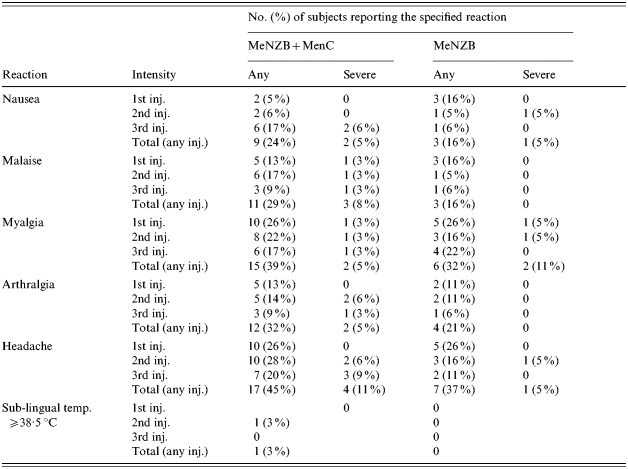
1st inj.: MeNZB+MenC (N=38), MeNZB (N=19); 2nd inj.: MeNZB+MenC (N=36), MeNZB (N=19); 3rd inj.: MeNZB+MenC (N=35), MeNZB (N=18).
Subjects in the MeNZB+MenC group received MeNZB only at the 1st and 3rd dose.
Other AEs, possibly or probably related, were experienced by 29% and 26% of the subjects in MeNZB+MenC and MeNZB groups, respectively, and mostly consisted of local and systemic reactions ongoing past the 7-day observation period and were transient and mild or moderate in severity. No deaths or AEs leading to a subject's withdrawal from the study were recorded during the study.
Rates and risk factor assessments for N. meningitidis carriage
For the non-vaccinated enrolled population overall carriage rates for any strains of N. meningitidis remained similar at the beginning and end of the study (i.e. 19% and 22%, respectively) while for the vaccinated subset of subjects the overall carriage rate decreased from 40% to 21% (Table 4). The predominant strains isolated were of the B and Y serogroups, with the Y:14:P1.5,2 strain being the most common. The B:4:P1.7-2,4 epidemic vaccine target strain was isolated from pharyngeal swabs of only four subjects upon study entry (Table 5). Table 6 shows the odds ratios for the acquisition of meningococcal carriage of all subjects over the period of the study.
N. meningitidis carriage rates
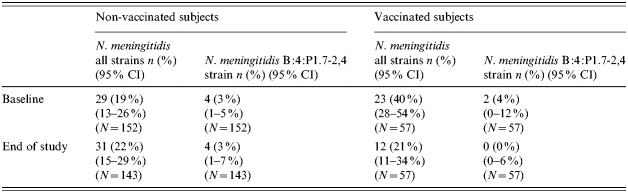
CI, Confidence interval.
N. meningitidis strains represented in more than 2% of subjects at the beginning and at the end of term
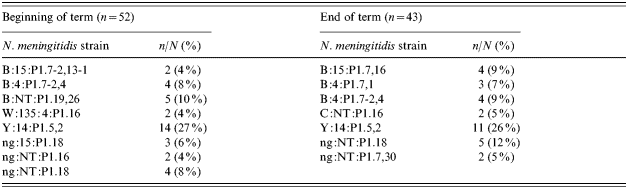
ng, Non-groupable; NT, non-typable.
Summary of risk factors for acquisition of carriage of N. meningitidis
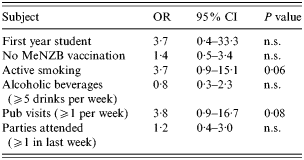
OR, Odds ratio; CI, confidence interval; n.s., not significant.
DISCUSSION
After receiving three doses of MeNZB either alone (MeNZB group) or combined with one dose (second) of MenC conjugate vaccine (MeNZB+MenC group), healthy university students aged from 17 to 24 years did not show a significant difference in percentage of subjects achieving a titre of ⩾1:8 against N. meningitidis serogroup B strain NZ98/254. By 4 weeks after completion of the immunization schedule, the percentage of subjects with SBA titres ⩾1:8 against the serogroup B vaccine strain NZ98/254 was 82% for the MeNZB+MenC group and 78% for MeNZB group.
The percentage of subjects with an SBA titre ⩾1:8 against serogroup C meningococci at baseline was similarly high for the two groups (47%) suggesting that the study population had been previously exposed to serogroup C meningococci. (The majority of these subjects had not been resident in the hall when two cases of serogoup C disease occurred in the hall within 3 weeks and a vaccination campaign with quadrivalent polysaccharide vaccine was carried out in August 2003.) At 4 weeks after the third vaccination all subjects in the MeNZB+MenC group had attained SBA titres against serogroup C meningococci ⩾1:8. The percentage of subjects reaching an SBA titre against serogroup C meningococci ⩾1:8 increased to 67% after the third dose in the group receiving MeNZB only. Tests that use whole live cells such as the SBA or a preparation of outer membrane proteins (ELISA) contain a number of antigen targets, some of which are shared across strains. Thus, antibody circulating in a serum may recognize an antigen on the target strain resulting in killing of the organism as in the SBA, or an elevation of anti-IgG in ELISA. The target strain for the C vaccine is C 60E which has the PorA type P1.7-1,1. A small number of students carried a strain with this PorA type during the course of this study and it would not be surprising that some may have naturally acquired serum bactericidal antibodies against P1.7-1,1 since the PorA is immunodominant. The IgG ELISA test is not specific in that a number of antigen-antibody interactions may occur regardless of capsular or PorA strain types.
In a previous study [Reference Aaberge4], Menjugate was administered together with the first dose of the parent OMV vaccine MenBvac. In this study Menjugate was administered together with the second dose of MeNZB. As expected, the immunogenicity and safety profiles of the combined vaccine preparation were not influenced by administration at the second dose instead of at the first dose. Table 7 compares the results of the geometric mean SBA titres against N. meningitidis serogroups B and C in this study with the results of an earlier Norwegian study using a different vaccine schedule and a different OMV component. These results indicate very similar antigenic responses between the two studies suggesting that the timing of the dose of MenC vaccine has little effect on the antigenic response.
Geometric mean SBA titres against N. meningitidis

* Aaberge et al. took blood at 6 weeks after the last vaccination for the serology and this study used 4 weeks after the last vaccination as the time for venesection.
Reactogenicity and other safety profiles were similar between the MeNZB+MenC and MeNZB™ groups and were consistent with those of previous studies. In particular, there was no major difference between the two groups in the percentage of subjects experiencing each local and each systemic reaction following the second vaccination. No deaths, no AE leading to a subject's withdrawal and no vaccine-related SAE occurred during the study. The percentage of subjects experiencing possibly/probably related AE in the MeNZB+MenC and MeNZB groups were similar.
For the non-vaccinated population (152 subjects) overall carriage rates remained similar at the beginning and at the end of the study (i.e. 19·1% and 21·7%, respectively) while for the vaccinated subset of 57 subjects, overall carriage rates decreased from 40·4% to 21·1%. The predominant strains isolated at any time-point were of the B and Y serogroups, with the Y:14:P1.5,2 strain being the most common (26·3% of 95 isolates).
Analysis of risk factors for the acquisition of carriage of meningococci over the course of the study did not indicate a statistically significant association with cigarette smoking, drinking alcohol or social activities.
There was a significant reduction in carriage rates in the vaccinated population when compared with the non-vaccinated population (Table 4). At the beginning of the study and before any vaccination occurred, the odds ratio for carriage in the subjects who volunteered for the vaccine group compared with the non-vaccinated population was 2·9 (95% CI 1·4–5·9, P>0·0015). At the end of the study the odds ratio was 0·9 (95% CI 0·4–2·0, n.s.) The numbers in the study were too small to detect the significance of the reduction in carriage of the epidemic strain in vaccinated subjects (two carriers at the beginning and none at the end) compared with four at both occasions in the non-vaccinated subjects. This finding indicates an area for further study regarding the possible protective action of vaccination against carriage of meningococcus in the oropharynx.
In conclusion, the administration of three doses of MeNZB separately or in combination with a single dose of Menjugate is immunogenic and generally well tolerated by healthy subjects aged 17–24 years old. Neither the immune response nor the safety profile of MeNZB was impacted by the concomitant administration of Menjugate. The reduction in carriage rates in the vaccinated groups was not observed in the unvaccinated student population.
ACKNOWLEDGEMENTS
This study was sponsored by Chiron Vaccines. We thank Karin Gewert at Writewise AB for skilful assistance and the ESR staff, Anne Glennie for undertaking the serum antibody testing, Moana Ngatai, Paul Blatchford and Lisa McCallum for the identification of the meningococcal types, and Glenys Roome and Susan Weggery for help in organizing the students.
DECLARATION OF INTEREST
P. O. and E. Y. are employees of Novartis Vaccines, (formerly Chiron)



