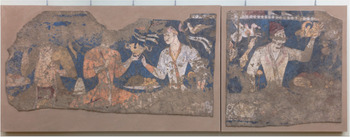
Clothed in splendid silk kaftans and accompanied by unique beribboned creatures, four men sit cross-legged between bowls abounding with fresh fruits (Figure 1). A man wearing a cantaloupe-colored kaftan holds a golden camel-protomed object out to another man in a white kaftan with a floral wreath placed on top of his head.Footnote 1 To the far left, a man has unbuttoned his tawny-colored kaftan, baring his pale stomach. On the opposite far right, a fourth man with broad shoulders and a narrow waist raises a rhyton. This attendee dressed in white tilts back his head as a stream of red liquid flows from the gold ram-protomed vessel directly down into his mouth.
Wall painting with banqueters, XXIV:1 Panjikent, Tajikistan, Sogdian, c. 740–750 CE.
Source: State Hermitage Museum, St. Petersburg; Panjikent Archaeological Expedition, inv. no. SA-16235. Photograph © State Hermitage Museum. Photo by Leonard Kheifets, Pavel Demidov.
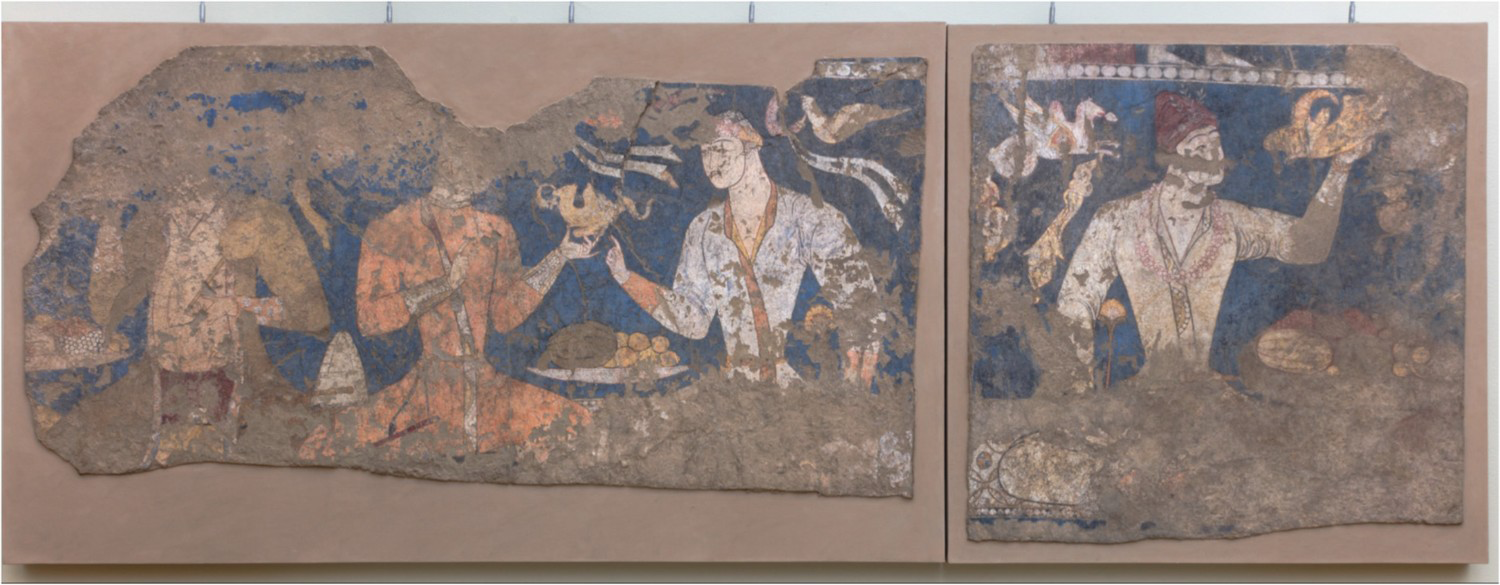
These four men, clothed in the latest Sogdian fashion, appear to revel. The party guests converse with one another, their hands waving as they conduct lively discussions. The two central guests exchange words, while the guest baring his midriff appears to have surpassed the others in the quantity of wine he has imbibed, and is relaxing in a joyful drunken state. The handsome guest lifting the rhyton catches the outpouring stream of red wine in his open mouth without a stray drop staining his brilliant white kaftan. In this article, I argue that the scene depicted is a drinking game, and this guest dressed in white is taking his turn to drink from the rhyton.
The image, an eighth-century CE Sogdian wall painting from sector XXIV, room 1 (hereafter XXIV:1) at Panjikent,Footnote 2 is famous in pre-Islamic Central Asian art. However, with the notable exception of the eminent Sogdian art scholar Boris I. Marshak, scholarship has not recognized the pleasure or humor expressed in this painting.Footnote 3 Discussions have typically focused on the figure holding the rhyton, scrutinizing his actions in isolation from the other attendees and the painting’s architectural setting. This decontextualization has affected interpretation, with the result that the use of the rhyton in Sogdiana has commonly been associated with a ritualistic practice, sometimes loading to speculation that the figure drinking from the rhyton is a priest.Footnote 4 Each iteration of this interpretation cites a 1966 article by Dorothy Shepherd on silver rhyta. The author reads each animal protome of a rhyton as the personification of a deity; indicates that the liquid flowing from it should be haoma, a beverage drunk in ancient Zoroastrian rituals; and ultimately links the use of the rhyton in greater Iran with a Zoroastrian rite.Footnote 5
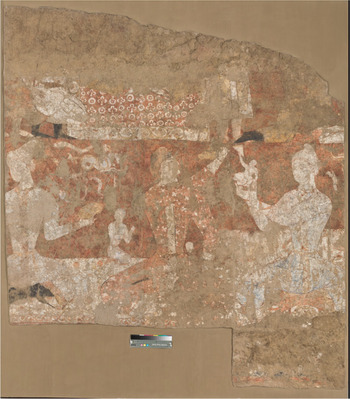
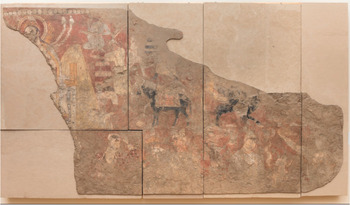
This article argues that the wall painting with a rhyton scene from XXIV:1, alongside two other contemporary wall paintings from Panjikent that also depict a man drinking from a rhyton, XXV:12 (Figure 2) and XXV:28 (Figure 3),Footnote 6 does not represent a religious ritual, but the parameters and protocols of a lively drinking game suitable for multiple kinds of celebrations.Footnote 7 This paper will first introduce the space in which these paintings were found and outline the key visual distinctions between a formal banquet and a drinking party according to wall paintings from Panjikent. It will then consider how guests drank from a rhyton, and suggest how the game might have been played based on a close study of the paintings’ details.
Wall painting with banqueters, XXV:12 Panjikent, Tajikistan, Sogdian, c. 740–750 CE.
Source: The State Hermitage Museum, St. Petersburg; Panjikent Archaeological Expedition, inv. no. SA-16238. Photograph © State Hermitage Museum. Photo by Leonard Kheifets, Pavel Demidov.
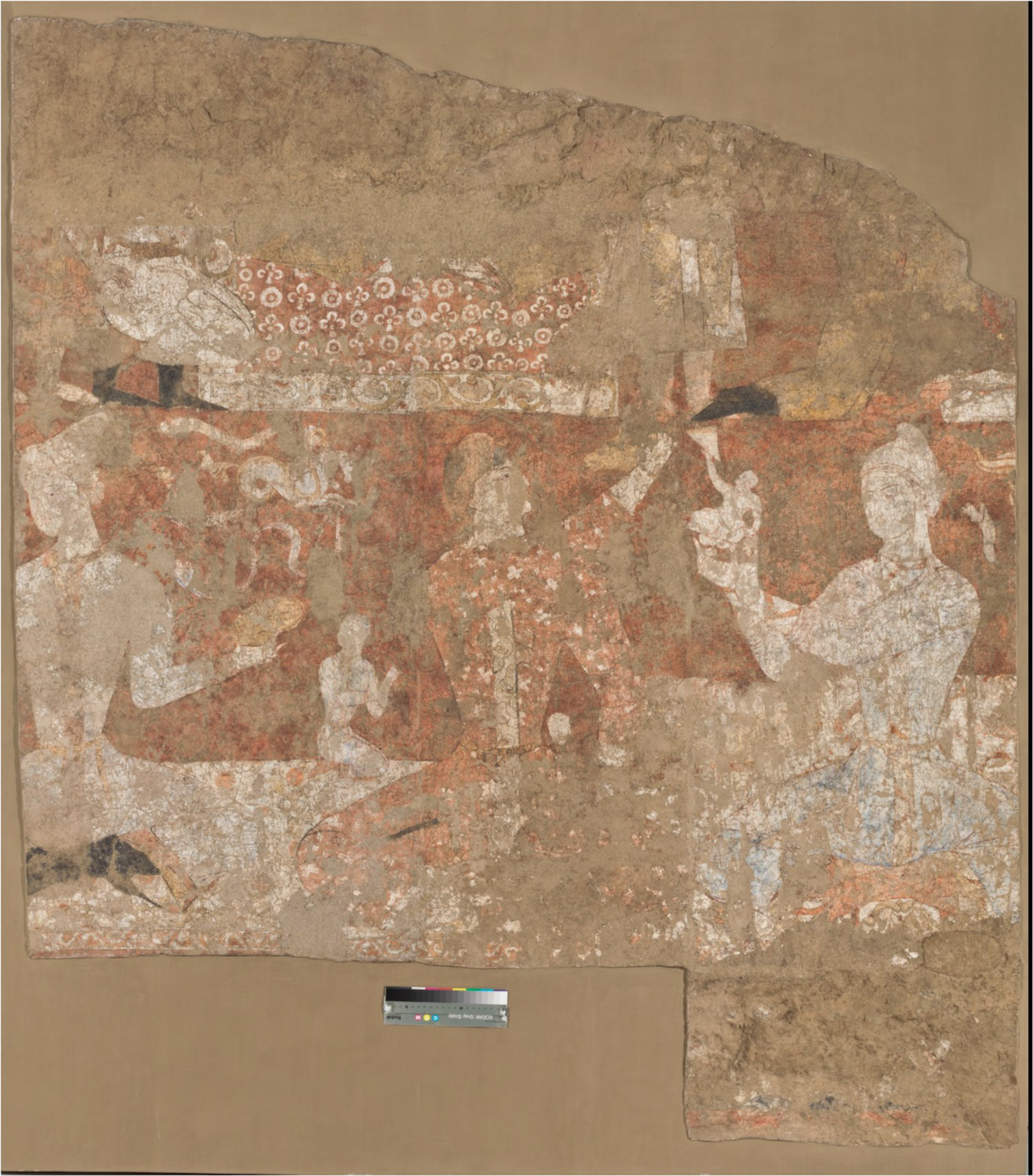
Wall painting with banqueters, XXV:28 Panjikent, Tajikistan, Sogdian, c. 700–722 CE.
Source: The State Hermitage Museum, St. Petersburg; Panjikent Archaeological Expedition, inv. no. V-2738, 2739, 2740, 2741, 2742. Photograph © State Hermitage Museum. Photo by Leonard Kheifets, Pavel Demidov.

Sufa-Lined Gathering Rooms
The wall paintings under study were excavated at the Sogdian city of Panjikent in present-day northwestern Tajikistan. Eighth-century CE Panjikent was not particularly large or wealthy, but for modern art historians and archaeologists, Panjikent is spectacular. Since excavations began in 1946, a large number of well-preserved wall paintings have been discovered in the palatial citadel, the temple complex, and notably in private homes in the residential area of the city.Footnote 8 All of the rhyton scene wall paintings were excavated from gathering rooms lined with a sufa, a built-in bench, in private homes.Footnote 9 The painted banqueters were positioned just above the sufa in a register that wrapped around all four walls of the room.Footnote 10 The rhyton scenes were part of larger multi-register painting programs, most of which are only fragmentarily preserved.Footnote 11 Visitors, seated on the bench with their backs to the wall, would have looked out to see the paintings decorating the room around them, with the rhyton scene positioned directly behind fellow banqueters lining the sufa. This view taken in from across the room would have made it impossible to study any figure in isolation. Rather, groups of figures within one’s viewing range would have been taken in together, inviting comparison with the real banqueters seated directly in front of them at eye level. These images would have acted as idealized representations of the guests and the actions intended for the space, while the registers above could be unconnected.Footnote 12 This separation of subject in the lowest painting register from those higher is typical for gathering room painting programs, for example the placement of independent tale and fable panels on the lowest painting register with an epic narrative in the register above, as in VI:41 and XXI:1 Panjikent.Footnote 13
The Formal Banquet and the Drinking Party
Details of party guests depicted in the wall paintings from Panjikent are often included in surveys of Sogdian art. Discussions usually label the banquet as representative of quotidian imagery;Footnote 14 highlight the luxurious silks worn and their influences;Footnote 15 speculate on the collective occupational identity of banqueters;Footnote 16 or include Sogdian representations of the banquet alongside that of the hunt in studies mapping the long tradition of razm u bazm in the visual culture of greater Iran.Footnote 17 Banquet scenes are typically addressed as a single category, but it is possible to identify two distinct types of festivities attended by party guests—always male in SogdianaFootnote 18—represented in wall paintings.Footnote 19 A differentiation can be proposed based on seating posture, the normative ways in which the kaftan can be styled, and the social activity in which the guests are engaged.
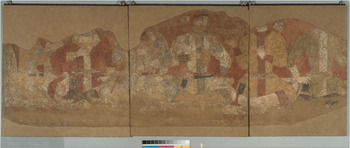
The first type of festivity is a formal banquet, exemplified by the row of banqueters from XVI:10 Panjikent (Figure 4).Footnote 20 At the formal banquet, attendees sit rigidly upright and turn their heads stiffly to speak with one another. They sit at a regular interval with their knees overlapping one another. Most attendees wear their kaftan closed with the lapels turned up and buttoned closed around the neck. Only select guests have the privilege to open the lapels of the kaftan, which expose a contrasting color of the inner lining and a tunic worn underneath. Each attendee sips a beverage from a personal drinking vessel.
Wall painting with formal banqueters, XVI:10 Panjikent, Tajikistan, Sogdian, c. 700–722 CE.
Source: The State Hermitage Museum, St. Petersburg; Panjikent Archaeological Expedition, inv. no. SA-16215, 16216, 16217. Photograph © State Hermitage Museum. Photo by Leonard Kheifets, Pavel Demidov.

The second type of festivity represented is a less formal banquet, which I call a rhyton scene and here interpret as the drinking party. These scenes with a rhyton are illustrated in the first and lowest of multiple painting registers in rooms XXIV:1 (Figure 1), XXV:12 (Figure 2), and XXV:28 (Figure 3) at Panjikent. The attendees sit in more relaxed postures, turning more freely to neighbors with some torsos in a three-quarter view, while extending their arms to indicate a more animated conversation. The guests are seated with more space between one another, often at irregular intervals, with servants, entertainers, or fruit dishes placed in between. At first glance, the figures in the rhyton scene appear quite similar to those attending the formal banquet. The attendees all have round faces with small features and are clean shaven, except for a thin mustache; all wear a belted two-toned kaftan, with one fabric for the trim and one for the body; and this garment accentuates the idealized masculine body type of broad shoulders and a wasp-thin waist. Upon closer study, however, the range of ways in which the kaftan can be styled varies. In the rhyton scenes attendees do not wear the kaftan closed high around the neck, as most attendees do at the formal banquet. Rather, the kaftan is worn with at least one lapel pulled open, exposing the lining of the right front panel of the garment. As common as wearing only one lapel pulled open is wearing the kaftan with two lapels pulled open in the rhyton scenes. This manner of styling the kaftan with two lapels open is exceptional among the group attending a formal banquet.Footnote 21 In the rhyton scenes the figures with two lapels unbuttoned do not wear undergarments, but expose a bare chest. Unique to the drinking party is wearing the kaftan unbuttoned and baring the midriff (Figure 1).
Scanning differences in accessories, no guest wears weaponry to the drinking party; all guests simply wear a thin tool case or a small purse. If a guest unbuttons only one lapel, the cap consistently remains on the head, usually with bangs visible on the forehead (Figures 2 and 3). The ability to open two lapels corresponds with removing the cap (Figures 1 and 3). Thereafter, a fresh floral wreath is placed on the head in place of the removed cap, exposing a popular undercut hairstyle. In XXIV:1 (Figure 1), the guest actively drinking from the rhyton has recently received his wreath: he wears his kaftan with two lapels open, but his cap still covers his hair with the wreath temporarily strung around his neck.
In addition to seating posture and the range of ways in which the kaftan is styled, the drinking party is indicated by the social activity taking place. Attendees in the rhyton scene do not uniformly hold and drink from an individual cup or shallow bowl like the attendees of the formal banquet. Rather a rhyton—and sometimes multiple rhytaFootnote 22—is used and shared among all the attendees. The stream of liquid flowing from the rhyton in the paintings is always red, most likely red wine,Footnote 23 a popular beverage in Sogdian culture.Footnote 24
Drinking from the Rhyton
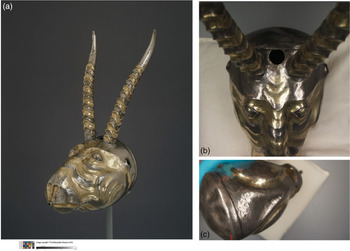
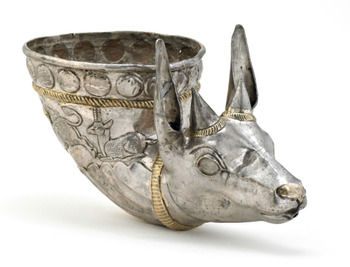
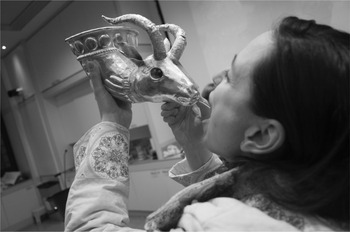
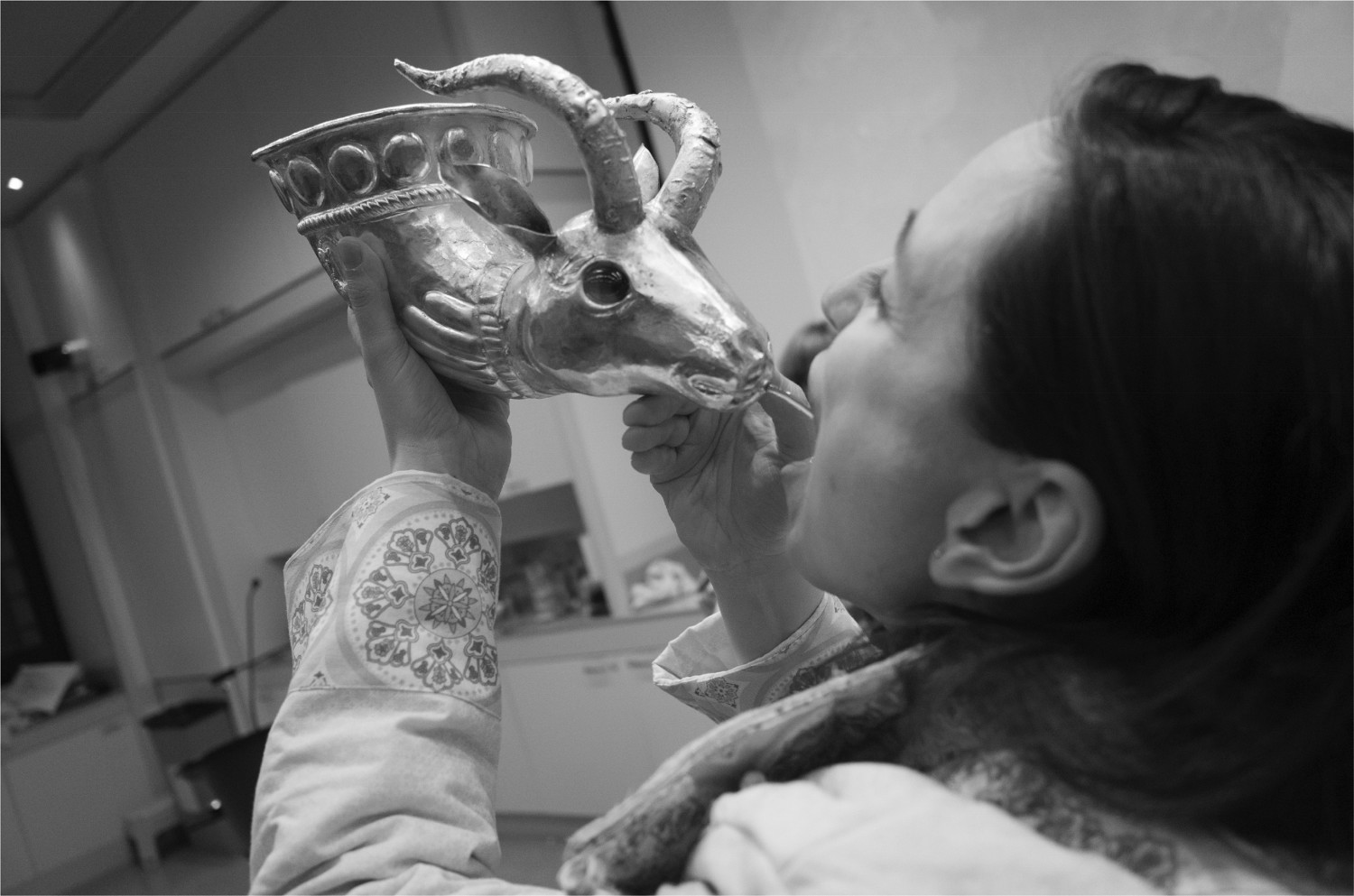
The following discussion of how party guests in Sogdiana would have used the rhyton is based on my observations of the eighth-century wall paintings under discussion, close studies of sixth- to eighth-century silver rhyta (Figures 5 and 6),Footnote 25 and experimentation with a replica of a Sogdian rhyton (Figure 7).Footnote 26 Despite the survival of several sixth- to eighth-century rhyta from Central Eurasia—silver,Footnote 27 ceramic,Footnote 28 and even a unique agate stone versionFootnote 29—the technique of drinking from a rhyton is rarely addressed.Footnote 30 Not addressed at all is how the guest drinking from the rhyton might have interacted with the unique rhyton form, and how fellow guests filling the room might have interacted—or perhaps interfered—with the current rhyton drinker.
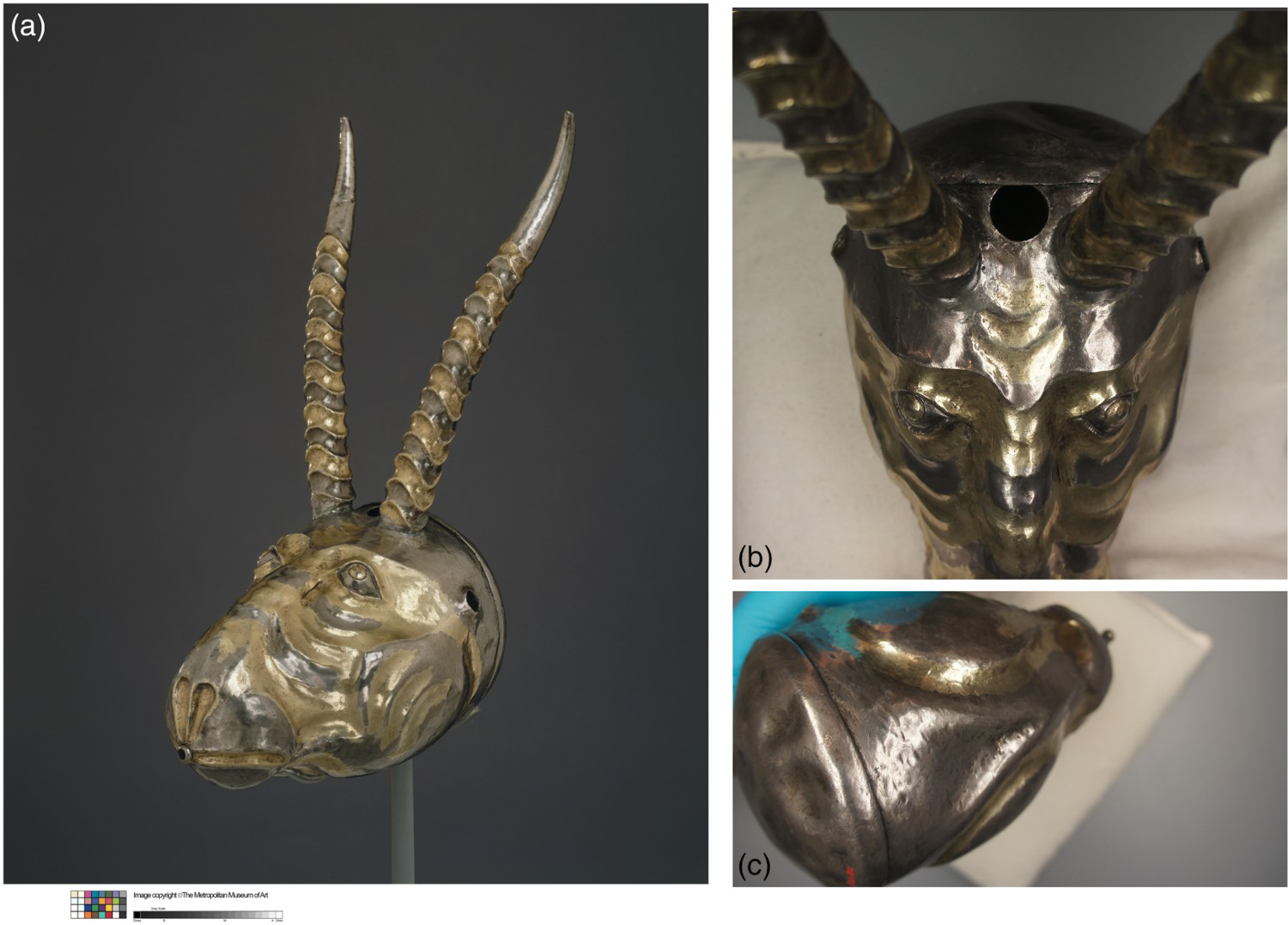
Silver rhyton in the form of a head of a saiga antelope, hoard said to be found in the region around Lutsk, Ukraine, produced Greater Iranian or Central Asian, sixth to eighth century CE.
Source: Metropolitan Museum of Art, New York; Rogers Fund 1947, acc. no. 47.100.82.
(a) Silver rhyton in the form of a head of a saiga antelope.
(b) Detail of the lid and ventilation hole on the silver rhyton in the form of a head of a saiga antelope.
Photograph by Betty Hensellek; Courtesy of the Department of Ancient Near Eastern Art of the Metropolitan Museum of Art, New York.
(c) Detail of the indentations on the underside of the silver rhyton in the form of a head of a saiga antelope.
Photograph by Betty Hensellek; Courtesy of the Department of Ancient Near Eastern Art of the Metropolitan Museum of Art, New York.
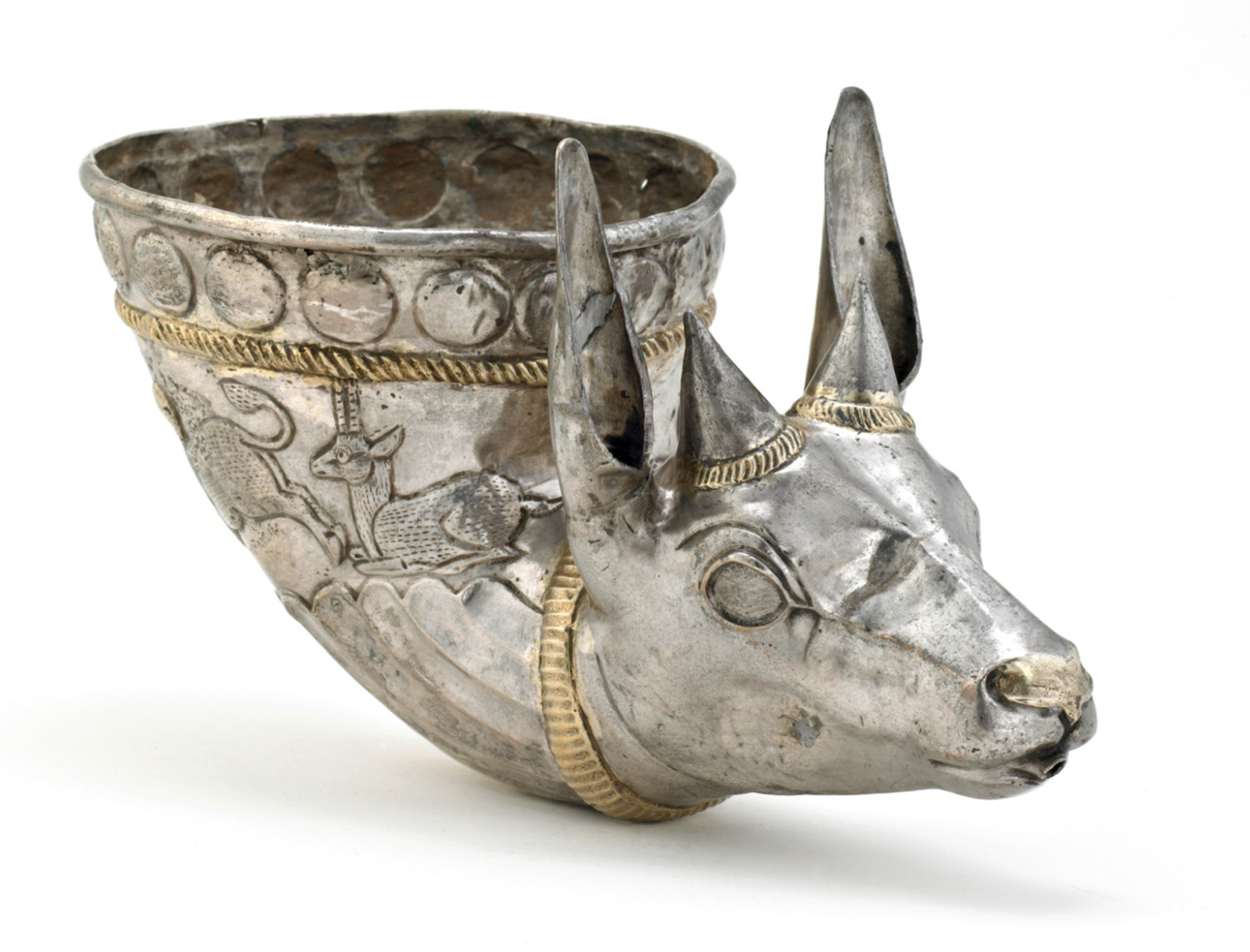
Horn-shaped silver rhyton terminating in the head of a gazelle, Greater Iranian or Central Asian, sixth to eighth century CE.
Source: Freer Gallery of Art and Arthur M. Sackler Gallery, Smithsonian Institution, Washington DC; Gift of Arthur M. Sackler, S1987.33.
Drinking from the replica rhyton created by Majid Abedi in Tabriz, Iran, March 2018.
Source: Courtesy of Monica Eisner.
The rhyta depicted in the Sogdian wall paintings are of two distinct types: a truncated horn terminating in the large head of a wild animal, or in the shape of a wild animal, whether the full body or simply the head.Footnote 31 For the former type, the opening in the upper neck of the horn is wide and the spout at the bottom, from which the wine is dispensed, is small, allowing only a narrow stream of liquid to pass through. The wide opening at the top would allow for the rhyton to be filled by pouring liquid from another spouted container directly into this opening. A cap, or most simply and probably the drinker’s thumb, would need to be placed on the small spout to prevent the liquid from draining during filling. For the latter type, a wide opening and narrow spout likewise characterize the vessel. However, because the wide opening is not positioned higher than the spout, a lid is needed to seal the wide opening, like that of a surviving silver rhyton in the shape of the head of a saiga antelope (Figure 5a and b).
To fill this type of rhyton, the drinker’s thumb would need to be placed on the spout while directed towards the floor. Upon filling the vessel, the lid could be attached to the wide opening and then the rhyton safely tilted upright. As a detail on the saiga antelope rhyton confirms, a ventilation hole at the top of the vessel would allow for air to replace the dispensed liquid, and thus pour from the spout smoothly.Footnote 32 Filling either rhyton type would require two people, most likely the drinker seated holding the rhyton steady and plugging the spout, and an attendant, who could fill the rhyton from above. After being filled, the rhyton could not be set down, because not only would the spout need to remain plugged, but the vessel would also roll over, being footless.
To hold either rhyton type, one would need to place the neck of the animal’s head into the palm of the hand. The four fingers would support the neck of the vessel and the thumb of the same hand could plug the spout. The rhyton in the form of an antelope’s head indeed has ergonomic indentations along the underside of the vessel’s neck, which provide a secure grip (Figure 5c).
To prepare to drink from the rhyton, the drinker would need to curl the arm in, holding the animal’s mouth ten or fifteen centimeters from their own mouth. This position would stage a kind of confrontation between the drinker and the animal forming the rhyton. On the rhyta in the paintings and on most surviving rhyta of the greater region, the spout is placed directly between the lips of the animals (Figures 5 and 6), not in the chest as was standard on earlier rhyta of the Achaemenid and Parthian periods.Footnote 33 Thus, the drinker needed to stare into the eyes of the beast, many of which on surviving first millennium CE rhyta are large and would originally have been inlaid with stone (Figure 6). The resulting image of the drinker coming face to face with the animal might have been humorous for fellow attendees, whose snickers could throw off the concentration of the drinker. To begin drinking, the thumb would be released and wine would begin to flow, appearing as though the beast were spitting into the guest’s open mouth.
As with the techniques used to drink from a Spanish porrón, catching the stream of wine in one’s mouth is only the first of several steps needed to take in mere seconds (Figure 7). The second is determining when and how often to swallow the contents to allow for the continuous flow of wine, which is surprisingly difficult without bringing the lips together. Third is extending the arm to place the rhyton at a greater distance away from the mouth. This movement and the continual decrease in liquid held by the rhyton shifts the curve of the wine stream falling from the spout. One could then shift the hand away from the spout with confidence, as the drinkers do in the paintings (Figures 1, 2 and 3).
The Drinking Game
The exact rules of the drinking game cannot be reconstructed. Perhaps attendees followed a set of instructions, as for example deduced from inscriptions on a Tang era drinking game set from Dantu, Jiangsu province, China,Footnote 34 or perhaps the rules were suggested and modified by the host and fellow attendees, as is often the case when drinking together from a Spanish porrón. One’s turn typically ends when all of the wine in the vessel is drunk, or more often, when one’s calculations are misjudged or concentration is lost—usually by the fault of fellow guests—and wine begins to splash outside of the mouth. At this point, the first player having emptied some of the wine from the rhyton, it would be possible to tilt the vessel back slightly—not requiring the thumb to continuously stop the small spout—in order to pass the vessel to a neighbor.Footnote 35
Looking carefully at the dress and accessories of the painted attendees, further protocols and parameters of the game are revealed. Unlike the formal banquet, and indeed all other activities for which a kaftan is worn in eighth-century Sogdiana, no guest wears a garment under the kaftan at the drinking party. By not wearing an undergarment one can quickly undo the frogging of the kaftan or remove the kaftan entirely if wine begins to splash outside of the mouth and drip onto the neck and chest. Despite taking this precaution of eliminating undergarments, the majority of guests wear light-colored kaftans. Only two figures stand out in darker colors, both red. Playing a game that hinges on miscalculations and distractions that cause spilled red wine would put any light colored garment in danger. Choosing to wear a light-colored kaftan, and in particular brilliant white, would have been a way to show off one’s skill. A red kaftan, on the other hand, would be more forgiving, able to hide stains. Wearing red would have been ideal for either first-time attendees or guests content with their lack of talent for drinking from a rhyton. The actions of the attendees depicted on XXV:12 (Figure 2) are particularly revealing in this regard: the figure on the far right, who wears light blue, presumably an experienced rhyton-drinking host or guest, holds a small figurine, or perhaps a rhyton itself.Footnote 36 This figurine appears to be a model demonstrating how to drink from the rhyton. Thus, the experienced drinker in the light-colored kaftan uses this model to teach the game to a first-time rhyton-drinking guest in a red kaftan.
The folding out of the kaftan’s lapels appears to play a role at the drinking party. Comparatively, at the formal banquet the way one’s kaftan lapels are styled is indicative of one’s social position: most guests wear their kaftans buttoned closed around the neck, while only a few have the privilege to open both lapels. This opening of the lapels corresponds with wearing the most gold-encrusted accoutrements, sitting further forward than other guests in attendance, and occupying a seat in the room from where one can always see and be seen by everyone in the space.Footnote 37 At the drinking party, it seems that the lapels were used light-heartedly and as part of the game. Turning out the lapel of a garment type shared among all attendees would have been an easy means of keeping score in a game underway. At the drinking party this appears to be an indication of those who are leading the game. In XXIV:1 (Figure 1) both figures who wear two lapels open also wear bright white kaftans. In XXV:12 (Figure 2), all of the kaftans are worn with only one lapel turned out. This suggests the start of the game, especially because here the guest in red is actively learning how to drink from the rhyton. In XXV:28 (Figure 3) a number of guests wear one lapel open, but the guest on the far left appears to be doing well in the game, having two lapels pulled open and a wreath placed on his head.
An added challenge of the game might include putting on a bracelet at one’s turn. At the formal banquet attendees wear small gold bracelets on each wrist, but at the drinking party, there is only evidence for the drinker with the rhyton wearing a gold bracelet (Figures 1 and 2). Perhaps the single bracelet was made of a heavy material such as iron, which would make extending the arm for the purpose of a game even more strenuous and difficult.
Winning any drinking game poses a greater challenge than simply possessing the aptitude for the physical or mental task at hand. As the game progresses and more alcohol is consumed, the task of catching the wine in one’s mouth becomes increasingly difficult. The key to winning, or merely surviving the game, hinges on finding balance and self-restraint in order to not become completely inebriated.Footnote 38 The bodily consequences of consuming too much alcohol are shared among all human beings, and most of these are humiliating, unpleasant and potentially dangerous. The game with the rhyton presents an exceptional challenge, because one’s skill at drinking from the rhyton might be directly correlated with the amount of wine one is required to consume—maximally the entire rhyton in a single turn. For those guests new to the game or with poor hand–eye–mouth coordination, their clothing and seat pillows would soak up more alcohol than consumed. As the game progressed, this natural balancing mechanism would allow for those less coordinated to catch up with the more skilled rhyton-drinkers, whose mental and physical agility would slowly dwindle. However, the act of spilling wine, and especially of staining the clothes, could have given the illusion to fellow guests of one being more drunk than one really was. An early Islamic treatise describing mechanical devices used for drinking games discusses a figurine giving this illusion as a prank. One would discard one’s wine dregs into the goblet held in the hand of a small figurine. Once filled to capacity, the other hand of the figurine would raise, at which point one would pass the figurine to an unaware guest and instruct them to continue feeding it their wine dregs. At the next filling the figurine would spill the accumulated liquid contents onto the unsuspecting guest.Footnote 39
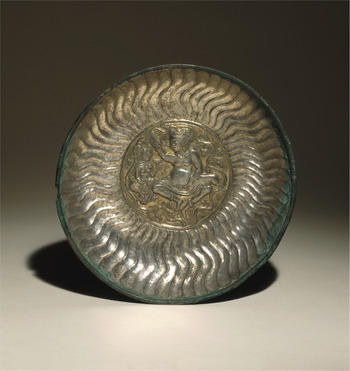
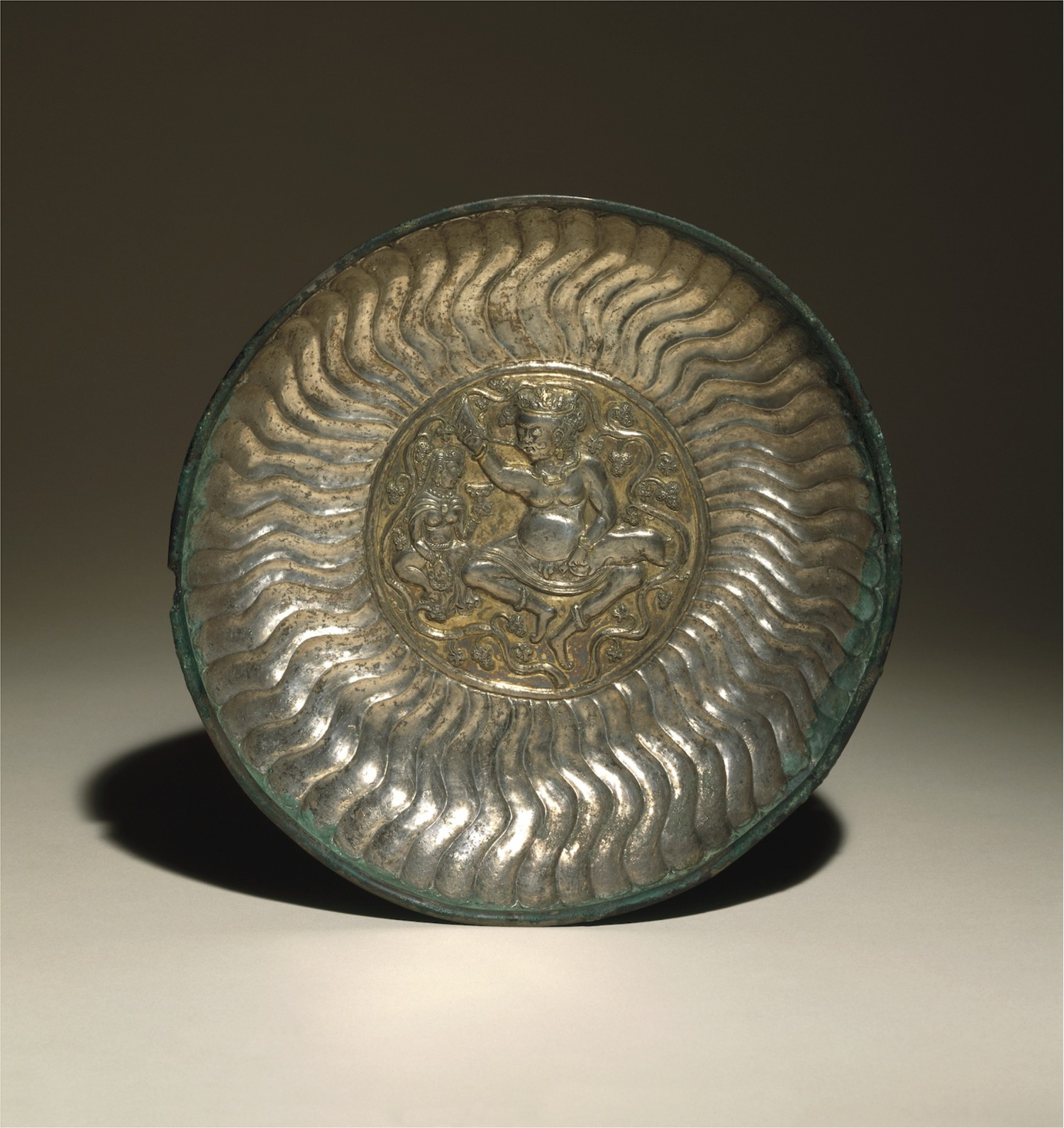
Alternatively, there may have been penalties for those spilling and splashing wine. In ancient and modern games, penalties often revolve around drinking more. At the Greek symposium this type of penalty included drinking neat wine or wine mixed with sea water.Footnote 40 In the Tang and Five Dynasties period in China, numerous poems recount an over-sized vessel called the gong 觥, which attendees needed to use as a punishment during drinking games.Footnote 41 This sort of penalty would have been particularly reasonable for the rhyton game because it would force the less coordinated players to drink as much as the skilled rhyton-drinkers. In XXIV:1 (Figure 1), the guest on the far left appears to be representing a penalty position. This guest has removed his belt, an action taken in battles in Central Asia to symbolically and physically demonstrate defeat, for example as depicted in a narrative on a wall painting in a neighboring home (XXII:1) at Panjikent.Footnote 42 He has furthermore unbuttoned his kaftan, which not only prevents him from utilizing the lapels, but has also transformed his body. This attendee no longer sports the idealized body figure of a narrow waist and broad shoulders that other attendees with the properly worn kaftans still maintain. Instead he sits half-naked exposing a pot belly, a body type shared with Dionysiac, Kubera-like figures, many of whom are depicted joyfully drinking from a rhyton on banqueting vessels and associated objects (Figure 8).Footnote 43 After a certain amount of wine, one would have likely come to terms with this position. Having reached a point at which one’s physical appearance and mental state could be compared to a deity—possibly the Sogdian god WahšuFootnote 44—could have been a humorous point of drunken pride.Footnote 45
Silver plate with the image of a man drinking from a rhyton, said to be from near Tank, Pakistan, Gandharan, fourth to sixth century CE.
Source: The British Museum, London; Gift of Mansel Longworth Dames in 1937, acc. no. 1937,0319.1. Photograph © Trustees of the British Museum. All rights reserved.
Conclusion
I would like to emphasize that I am not claiming that the rhyton was part of a drinking game on all occasions, and certainly not for all cultures or across time.Footnote 46 This argument reconsiders the largely unexamined ritualistic interpretation for the use of the rhyton specifically within the context of eighth-century Sogdiana. In this study, I have looked at the wall paintings in their fuller painting programs. This approach has established that the rhyton drinkers’ dress, accoutrements and actions are interconnected with—and should not be read without—the other figures within the given wall painting register, and makes sense of the placement of these wall paintings in the gathering rooms of private homes. This study furthermore considers the distinct form of the rhyton in the period: that is, an animal’s head dispensing liquid through its mouth, rather than the animal’s head as a decorative detail built into a fixed horn shape.
Finally, one might consider that a drinking game is in fact a social ritual. In studies of the ancient world, the term ritual usually connotes a religious or cultic activity with a divine subject. However, many social activities are likewise practiced and defined by a key set of consistent actions and behaviors, albeit with human subjects, constituting a ritual by definition. Banqueting, drinking parties, and the ensuing drinking games in the ancient world, as today, are prescribed with protocols that make appropriate, for example, what one should wear, what and how one eats and drinks, how and where one sits, and how one interacts with others. The wall paintings discussed here appear to be models for the parameters of such an occasion, in that they demonstrate how, in theory, the social ritual works correctly.
Thus, the two interpretations for the use of the rhyton in Sogdiana, the religio-ritualistic and ludic, are not mutually exclusive. The religious ritual and the social ritual in the ancient world, as today, cannot be entirely separated from one another. However, this is not to say that I believe that the rhyton scenes have an ambiguous meaning, but rather that subjects of the divine and the human realms can overlap one another. This appears to happen in the rhyton scene from XXIV:1 (Figure 1), where the artist may have made an allusion to a Sogdian deity through the dress, body type, and posture of the figure holding the rhyton. The interpretation of the rhyton scenes as a drinking game introduces a new and significant dimension of Sogdian culture into the known pictorial repertoire. The scenes reveal that like the activities of the eighth-century Sogdians themselves, the subject matter of the wall paintings decorating their homes were not always about recounting a linear pictorial narrative, religious veneration, or moral didacticism, but also about conviviality, fun, and humor.
Note on transliteration:
All Russian terms are transliterated according to the American Library Association and Library of Congress, but without the diacritical circumflex over ts for ц, iu for ю, and ia for я; the breve ĭ for й; and the dotted ė for э; authors’ names originating in the Cyrillic script are given according to this system with any variation by publication given in parentheses in the bibliography.
I would like to thank Benjamin Anderson, Henry Colburn, and Michael Seymour for close readings of and lively discussions about this paper. Thank you to the anonymous reviewer for suggestions that improved this paper; to Kim Benzel for giving me the opportunity to present this material interactively to the Friends of the Department of Ancient Near Eastern Art at the Metropolitan Museum of Art in April 2018; to Majid Abedi, who so beautifully and swiftly created a replica of a Sogdiana rhyton, a model that has been invaluable for experimenting with and better understanding how such a rhyton would have functioned; and lastly to Maryam Kheradmand, Raheleh Kheradmand Amir Koushei, and Akram Mohammadizadeh for connecting me with and facilitating logistics and communication with the artist.