Medical technology has improved our ability to care for sick children in the neonatal intensive care unit (NICU) and pediatric intensive care unit (PICU). However, this technological dependence creates challenges during a vertical evacuation. Espiritu et al. outlined these difficulties in their description of evacuating a NICU during Hurricane Sandy in 2012. Reference Espiritu, Patil and Cruz1 Training health-care workers can mitigate the negative impact disasters have on the populace. Reference Allen, Parnillo and Will2 However, a survey of tertiary care pediatricians revealed that many have not received training for pediatric disasters. Reference Mortelmans, Maebe and Dieltiens3
While there is literature available on the effectiveness of disaster training, only a small number of these addresses the needs of pediatric populations who are uniquely impacted by disasters. Behar et al. demonstrated that pediatric practitioners who participated in a tabletop exercise after receiving a didactic had a greater feeling of comfort with pediatric disaster management compared with those who only received a didactic. Reference Behar, Upperman and Ramirez4 Femino et al. used a full-scale exercise to identify opportunities for improvement in their NICU evacuation plan. Reference Femino, Young and Smith5 Using a full-scale exercise has been shown to be an effective method of evaluating regional pediatric disaster plans. Reference Burke, Kim and Bachman6 This study sought to implement pediatric vertical evacuation training and evaluate its effectiveness by using a full-scale exercise to compare outcomes in those who received training to those who did not.
Methods
Training
The institution’s emergency preparedness division created pediatric vertical evacuation training sessions that took place over a 6-wk period. The goal was to target members of the health-care organization who would be responsible for managing a vertical evacuation of critically ill pediatric patients. Training participants included hospital administrators, admitting department staff, NICU and PICU nurses, rotating residents, attendings, physician assistants, NICU fellows, nursing assistants, emergency department (ED) physicians and nurses, respiratory therapists, unit clerks, patient transport team members, hazardous materials team members, and hospital police. There was no formal randomization of participants to the training intervention. A staff member’s likelihood of receiving training was solely dependent on the chance they were working when a training was scheduled.
The training consisted of didactic and hands-on sessions. Didactics covered hospital incident command structure, emergency operations plan, evacuation theory, and use of a pediatric evacuation toolkit, respectively tailored for clinical and administrative personnel. The hands-on sessions focused on the use of evacuation equipment for staff in the NICU, PICU, and ED (Med Sled® Des Peres, Missouri). The content of the training and the evacuation toolkits were adapted from the Massachusetts Department of Public Health Hospital Evacuation Toolkit and are publicly available. 7
Scenario
The exercise named “Get Up and Go!” occurred on an unannounced day within a month after the completion of training. It simulated a power failure that occurred during an upgrade of the emergency outlets in the NICU and PICU. There were 8 simulated patients in the NICU; of these, 2 were intubated, 2 were receiving noninvasive ventilation, and 4 were on room air. There were 8 patients in the PICU simulated by mannequins and emergency medicine residents. Two of these patients were intubated mannequins and 2 were mannequins receiving noninvasive ventilation. The emergency medicine residents simulated 4 patients on room air, 2 of which were ambulatory and the other 2 were nonambulatory. The institution opened the emergency operations center and decided to evacuate these simulated patients. These patients were transported from the NICU on the 3rd floor and the PICU on the 4th floor, down their respective assigned stairways using evacuation baskets for the infants, and larger evacuation devices for the older patients. An Assembly Point was established in the ED as a temporary care area for these patients before evacuation to a neighboring hospital. The exercise lasted approximately 6 h. The staff on duty in the NICU, PICU, and ED participated in the evacuation exercise, while senior nurses and physicians along with additional house staff cared for actual patients. Hazardous material team members conducted just in time training on the use of evacuation equipment in the NICU, PICU, and ED Assembly Point.
Evaluation
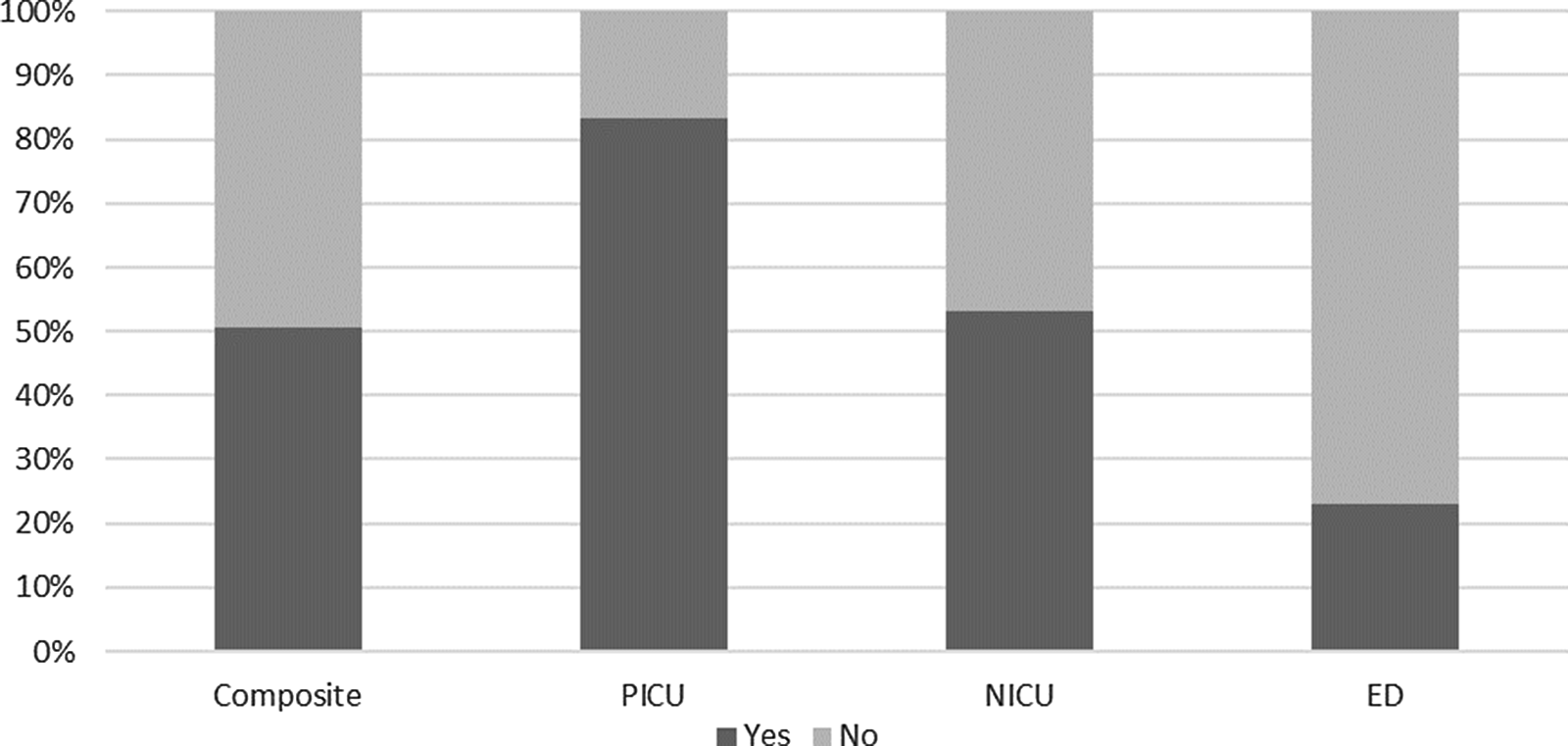
At the conclusion, exercise participants completed a de-identified evaluation tool, which was the source of the data reported in this study (Figure 1). This evaluation tool was a modified version of one previously used for an emergency preparedness exercise within the institution. Reference Kohlhoff, Crouch and Roblin8 Pearson chi-squared testing was used to analyze the data and determine statistical significance. Testing was performed using STATA Version 10 (StataCorp, College Station, Texas, USA).
Percentage of staff who received training.

Results
Eighty-four evaluations were received from exercise participants. Forty-three (51%) received training in pediatric evacuation and 41 (49%) did not. Sixty-eight respondents identified their clinical area. Twenty-six (38%) were from the PICU, 15 (22%) were from the NICU, and 27 (39%) were from the ED. Twenty-two (84%) of PICU practitioners, 8 (53%) of NICU practitioners, and 6 (22%) of Assembly Point/ED practitioners received training (Figure 1).
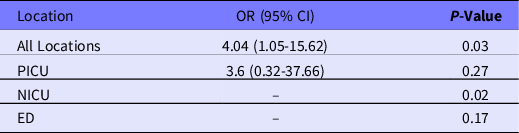
Overall, staff who received training were more likely to feel prepared compared with staff who did not (odds ratio [OR], 4.05; confidence interval [CI]: 1.05- 15.62; Table 1). Within each unit, most of the staff members who received specific training felt prepared (PICU 77%, NICU 100%, Assembly Point/ED 100%). Unlike the ED staff, pediatric practitioners who did not receive training tended to feel less prepared (PICU 50%, NICU 43.9%, Assembly Point/ED 73.4%).
Statistical relationship between training and preparedness by location

Drill participants also evaluated various aspects of the team’s ability to meet the exercise objectives. Most respondents reported that the team identified a clear leader (PICU 80%, NICU 100%, Assembly Point/ED 100%), and knew the procedures for evacuating patients (PICU 100%, NICU 80%, Assembly Point/ED 80%).
Limitations
While the findings from this study contribute important pediatric perspectives to the disaster literature, there are some noteworthy limitations. First, the methodology did not randomize staff to receive training and assess its effectiveness by evaluating each group separately. Such an approach would have allowed a separate and objective assessment of the relationship between training and performance, as opposed to self-reporting and evaluating both groups together. Randomizing staff to the intervention was not feasible due to the inability to mandate training and exercise participation. Second, the fluid nature of the exercise and real-world constraints limited some aspects of the evaluation methodology. There were staff members who had fluid roles in the exercise that required them to be in multiple locations, while others had to leave to deal with actual emergencies. This made it impractical to assess the total number of exercise participants and to perform pre and post testing. For these reasons, surveying perceived preparedness was the most feasible way to report the experiences of trained and untrained participants. There is also precedence for using provider perception of preparedness as a primary measure of training effectiveness in the disaster medicine literature. Reference Adini, Israeli and Bodas9 Last, this study was limited in scope in that it did not examine the effectiveness of this training in achieving skill retention over time.
Discussion
Based upon a review of the literature, this is the first study to implement pediatric disaster training and evaluate its effectiveness by using a full-scale exercise to compare outcomes in those who received training with those who did not.
There was a statistically significant increase in perceived preparedness among all evaluation respondents who received training compared with those who did not. However, this relationship between training and preparedness was not found among trained and untrained cohorts within each unit. This is likely due to insufficient power in the sub-group analysis. A majority of NICU, PICU, and ED Assembly Point staff met the major exercise objectives, which were to identify a unit leader and to demonstrate knowledge of the evacuation plan.
The institution’s ED conducts regular preparedness trainings and disaster drills throughout the year, while the NICU and PICU do not. The pediatric units had a greater percentage of staff who received event-specific training and achieved exercise objectives on par with the regularly trained ED providers. This outcome demonstrates the effectiveness of training. An alternative perspective is that the ED received the least amount of event-specific training yet had a greater percentage of staff who felt prepared irrespective of training. The ED staff also achieved exercises objectives at rates close to those of the pediatric units. These findings reflect the importance of ongoing all-hazards based training in providing personnel with the skills needed to manage a disaster they may not have specifically prepared for. While the American Board of Emergency Medicine includes preparedness and mass casualty management in the 2016 Model of the Clinical Practice of Emergency Medicine, the American Board of Pediatrics has not. Reference Counselman, Babu and Edens10 As disasters become more commonplace in an ever-changing world, emergency preparedness will need to become a basic competence for pediatricians.
On any day, there are clinicians with various levels of training and experience available to respond to a disaster. This study was conducted under such real-world conditions and highlights the challenges in training a large and professionally diverse group on pediatric evacuation. The first was achieving a balance between providing enough details of the overall process, while tailoring it to meet the needs of each group. For example, hospital administrators were trained from a coordination perspective within the context of hospital incident command structure. Clinical staff needed to understand the overall hospital disaster response, while focusing on the clinical nuances of pediatric evacuation, which included in-services on evacuation equipment. Second, the small training team relative to the large number of providers was a rate limiting factor in the ability to reach more personnel, particularly in the ED, which has a larger roster than the NICU and PICU. Last, the training could not be mandated, and as such, there were staff members who were unable to participate because they were not scheduled to work when sessions occurred. In other cases, clinical duties precluded staff participation. These factors contributed to the inability to provide more evaluation respondents with training.
Conclusions
This study used a full-scale pediatric evacuation exercise to demonstrate that training is effective in increasing perceived preparedness in pediatric providers. Pediatric disasters are infrequent events fraught with high risk due to the unique physiologic, anatomic, and developmental attributes of children. Reference Mortelmans, Maebe and Dieltiens3 Training pediatric providers in basic disaster competencies may serve to mitigate the risks associated with caring for children in disasters.
Ethical Approval
SUNY Downstate Health Sciences University’s Institutional Review Board reviewed the study proposal (IRB # 678170-1) and deemed it exempt.