Introduction
Parasitic alteration of host behaviour to facilitate dissemination has been reviewed by numerous researchers (Webster, Reference Webster2007; Poulin, Reference Poulin2010; Holland & Hamilton, Reference Holland and Hamilton2013). Some studies have reported evidence of behavioural changes in mice infected with Toxocara canis larvae related to the dose and parasite load in the brain (Cox & Holland, Reference Cox and Holland2001a, Reference Cox and Hollandb). However, before reaching the central nervous system, larvae pass through the musculature of the host, causing a decrease in muscle strength (Chieffi et al., Reference Chieffi, Aquino, Paschoalotti, Ribeiro and Nasello2009a).
Toxocara canis and Toxocara cati are helminth parasites in dogs and cats, respectively. They are distributed worldwide, occurring mainly in developing countries (Overgaauw, Reference Overgaauw1997; Chieffi et al., Reference Chieffi, Santos, Queiroz and Lescano2009b). Toxocara canis transmission in dogs occurs by ingestion of embryonated eggs found in the environment, predation of paratenic hosts, transmammary and/or transplacental routes, and by females swallowing young adults of the parasite after licking their offspring (Overgaauw, Reference Overgaauw1997; Queiroz & Chieffi, Reference Queiroz and Chieffi2005). In feline T. cati transmission, transplacental transmission and swallowing young adults of the parasite have not been described (Sprent, Reference Sprent1956; Coati et al., Reference Coati, Schnieder and Epe2004).
Other animals, including humans, acting as paratenic hosts can become infected with these roundworms without developing adult worms. In this case, larvae migrate into the tissues and can remain in a latent stage and survive for a long time (Holland & Hamilton, Reference Holland and Hamilton2013). However, there are some reports in the literature describing adults and children harbouring adult T. cati and T. canis specimens in their gut (Wiseman & Lovel, Reference Wiseman and Lovel1969; Eberhard & Alfano, Reference Eberhard and Alfano1998), likely due to accidental ingestion of young adults of the parasites.
Donovick & Burright (Reference Donovick and Burright1987) suggested that immunopathological reactions to T. canis may be both a cause of changes in behaviour and a symptom of infection. A history of T. canis exposure may alter reactions to subsequent exposures, which can change a broad spectrum of behaviours in mice, including reactivity to taste and exploration of the environment. Altered patterns of learning performance in mice and rats have been observed following infection with T. canis (Olson & Rose, Reference Olson and Rose1966; Dolinsky et al., Reference Dolinsky, Burright, Donovick, Glickman, Babish, Summer and Cypess1981). However, there are no reports concerning behavioural changes in laboratory rats (Rattus norvegicus) infected with T. cati. The present study evaluated behavioural changes and muscle strength in male and female rats experimentally infected with T. canis or T. cati in acute and chronic stages of infection.
Materials and methods
Collection of adult worms and eggs of Toxocara
Toxocara canis adults were recovered from naturally infected stray dogs captured by the Center for Zoonosis Control in Guarulhos, São Paulo. Worms were placed in a glass receptacle containing saline solution and stored at 4°C until use. Toxocara cati adults were obtained from three cats (approximately 2 months old) that had been donated to the Institute of Tropical Medicine in São Paulo. Cats were maintained in individual 60 × 60 × 60 cm cages for 35 days. After this period, faecal samples were collected and examined by the sedimentation technique (De Carli, Reference De Carli and De Carli2007). After confirming the presence of T. cati eggs, cats were treated with Endal Plus® tablets (20 mg praziquantel and 230 mg pyrantel pamoate) at a dose of one tablet per 4 kg weight. Adult worms were collected from cat faeces and female worms were dissected to obtain T. cati eggs.
Toxocara canis and T. cati females were dissected in Petri dishes containing acidified water (pH 3), and uteri were removed and cut open to release eggs. The recovered eggs were concentrated by centrifugation at 1500 rpm for 5 min. The pellet containing the eggs was transferred to an Erlenmeyer flask containing approximately 200 ml of 2% formalin sealed with a hydrophobic cotton lid. The flask was placed in an incubator at 28°C for approximately 30 days. Throughout the time period, it was manually agitated twice daily to ensure oxygenation of the eggs to promote development of larvae up to the third stage. After 30 days, which is the length of time required for third-stage larval formation, the eggs were washed three times in saline to remove the formalin solution and prepared for infection of rats.
Maintenance and experimental infection of rats
Six- to 8-week-old male and female R. norvegicus (Wistar) were obtained from the Main Animal Center at the São Paulo University Medical School. Rats were separated into two groups of five specimens each and maintained in 49 × 34 × 16 cm polypropylene cages. Food and water were provided ad libitum. Cages were inspected daily and cleaned twice a week. Cages were housed in a room equipped with temperature control (19°C/23°C), an extractor fan and a device to control 12 h light/dark periods. A total of 50 6- to 8-week-old female R. norvegicus (Wistar) were divided into three groups, including two groups of 20 rats infected with 300 T. canis or T. cati eggs and a third group of 10 uninfected controls. All rats were marked with a yellow smear of saturated picric acid to differentiate among individuals in each cage. The same protocol was repeated for 50 male rats, to determine possible sex differences. The mean count of three microscope slides containing 50 µl of the egg culture solution was used to adjust the parasite dose to 300 eggs in 0.2 ml of a water solution for each rat (Lescano et al., Reference Lescano, Queiroz and Chieffi2004). Infection of rats was performed orally using a gavage needle. An equivalent amount of saline solution was similarly administered to rats in the control group.
Assessment of rat muscular strength
At 5, 15 and 42 days post infection (DPI), muscle strength in the forelimbs of female and male rats was evaluated using a grip strength meter (Ugo Basile, Comerio, Italy; cat. no. 47 105/47 106). In the apparatus, the rat is placed over a base plate in front of a T-shaped grasping bar fitted to a forced transducer connected to a peak amplifier. When pulled by the tail, the rat grasps at the bar until the pulling force overcomes its grip strength. When the rat loses its grip, the peak pull-force achieved by the forelimbs is shown on a liquid crystal display in grams and transformed to Newtons (N). Muscle strength was determined three times successively for each rat prior to and post infection. Body weights of all rats were also recorded.
Assessment of rat behaviour and locomotion
At 40 and 70 DPI, acute and chronic phases of infection, respectively, a 5-min elevated plus-maze (EPM) test was performed. The apparatus used in this experiment was made of plywood and consisted of two open (50 cm long × 10 cm wide) and two enclosed (50 cm long × 10 cm wide, with 40 cm high walls) arms connected by an open central area (10 × 10 cm) arranged such that the two arms of each type were opposite each other and extended from a central platform elevated 50 cm above the ground (Handley & Mithani, Reference Handley and Mithani1984). Rats were initially placed on to the central platform of the maze, facing an open arm. Behaviour variables recorded included the number of entries into open (EOA) and closed arms (ECA) and the percentage of entries and time spent in open arms. The test apparatus was thoroughly cleaned with 5% ethanol between rats. A rat was considered to have entered an arm when all four limbs left the central area of the maze. Since this anxiety test reflects rats' unconditioned aversion to heights and open spaces, the percentage of entries and time spent in open arms provide some measure of fear-induced inhibition of exploratory activity (Montgomery, Reference Montgomery1955; Pellow et al., Reference Pellow, Chopin, File and Briley1985, Pellow & File, Reference Pellow and File1986; Guaraldo et al., Reference Guaraldo, Chagas, Konno, Kom, Pfiffer and Nasello2000; Carola et al., Reference Carola, D'Olimpio, Brunamonti, Mangia and Renzi2002).
Spontaneous locomotor activity was measured using an animal activity cage (model 7430, Ugo Basile). The apparatus consisted of a transparent acrylic cage (35 × 23 × 20 cm) with a set of horizontal sensors to register locomotor activity and a set of vertical sensors to register standing activity (rearing). One day after the EPM test, each rat was placed alone inside the cage and locomotion and rearing were recorded for 5 min. During this period, immobility, grooming and faecal pellets were also recorded (Hall, Reference Hall1934; Guaraldo et al., Reference Guaraldo, Chagas, Konno, Kom, Pfiffer and Nasello2000; Lemos et al., Reference Lemos, Amaral, Dong, Bittencourt, Caetano, Pesquero, Viel and Buck2010).
Recovery and identification of larvae
At the end of the experiment, all rats were euthanized to confirm infection, and the musculature and central nervous systems were digested with 0.5% HCl for 24 h at 37°C. The supernatants were centrifuged for 2 min at 1500 rpm. Two millilitres of the sediments were collected and thoroughly mixed, and 0.1 ml samples were viewed under a light microscope for larval identification (Xi & Jin, Reference Xi and Jin1998).
Data analysis
Data are expressed as the mean ± SD. Analysis of variance for repeated measures followed by post hoc tests to adjust for multiple comparisons were used to compare muscle strength and body weight. Significant interactions resulted in use of analysis of variance for each time point (5, 15 and 42 DPI). The Kruskal–Wallis test was performed for EPM behaviour and locomotor activity tests. P values less than 0.05 were considered statistically significant, and all analyses were performed using SPSS v.17 (SPSS Inc., Chicago, Illinois, USA).
Results
Muscle strength
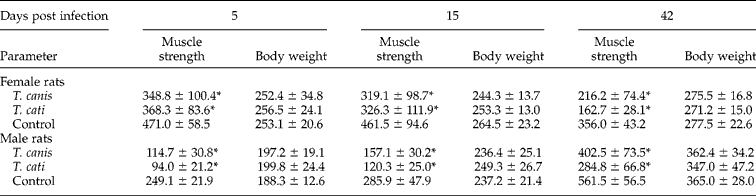
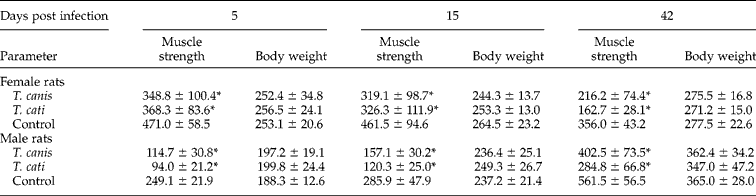
Muscle strength in female R. norvegicus was significantly decreased in infected animals at the three time points compared to controls (5 DPI: T. canis P= 0.01 and T. cati P= 0.03; 15 DPI: T. canis P= 0.009 and T. cati P= 0.01; and 42 DPI: T. canis P= 0.00 and T. cati P= 0.00). At 42 DPI, a significant difference between infected groups was also observed, with a greater decrease in the T. cati-infected group (T. canis versus T. cati P= 0.03; table 1). In male R. norvegicus rats, there were significant decreases in muscle strength between infected and control groups (5 DPI: T. canis P= 0.02 and T. cati P= 0.01; 15 DPI: T. canis P= 0.02 and T. cati P= 0.01; and 42 DPI: T. canis P= 0.04 and T. cati P= 0.01). No difference between infected groups was observed (table 1). No differences in body weight were verified between infected and control rats (table 1).
Relationship between muscle strength (Newtons) and body weight (g) (mean±SD) of female and male rats infected with T. cati or T. canis on days 5, 15 and 42 post infection; *significant differences with P < 0.05.
Behaviour and locomotion
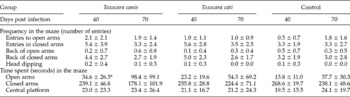
Mean and standard deviations of entry frequency into open and closed arms, back of the open and closed arms, head dipping and time spent in the arms and centre by female R. norvegicus at 40 and 70 DPI are shown in table 2. Rattus norvegicus females infected with T. canis (34.6 ± 26.3 s, P= 0.028), but not T. cati (23.2 ± 19.6 s, P= 0.31), spent more time in the open arms than the control group (13.8 ± 11.0 s). No statistically significant differences were observed between infected and control R. norvegicus males. Frequency of horizontal and vertical movements, time spent grooming, immobility and number of faecal pellets at 41 and 71 DPI were not statistically significant among groups.
Behaviour (mean±SD) of female R. norvegicus infected with T. cati or T. canis on days 40 and 70 post-infection in an elevated plus-maze; *significant differences at P < 0.05.

Discussion
Knowledge concerning the biology, epidemiology and physiopathology of infection of natural and paratenic hosts by T. cati is lacking compared with available information on T. canis (Fisher, Reference Fisher2003). This study improves the current understanding of several important aspects of host–parasite relationships established between T. cati and R. norvegicus, which is a common paratenic host for this ascarid. Few ecological relationships are as intimate as those between parasites and their hosts. Coexistence over time has allowed these organisms to create mutually beneficial adaptation mechanisms (Poulin, Reference Poulin1995). Behavioural changes could be considered adaptations that facilitate parasite transmission, primarily when prey–predation mechanisms are involved.
Chieffi et al. (Reference Chieffi, Aquino, Pasqualotti, Ribeiro and Nasello2010) observed that R. norvegicus infected with varying amounts of embryonated T. canis eggs (300 and 2000 eggs) showed a decrease in muscle strength in the forelimbs only 30 days after inoculation, although the number of eggs did not influence changes in strength. The authors affirmed that successive muscle strength measurements may result in more intense muscle fatigue in infected rats. In the present study, changes in muscle strength in female and male R. norvegicus experimentally infected with T. cati or T. canis were evaluated 5, 15 and 42 days post infection. Both males and females infected by T. canis or T. cati had impaired muscle strength throughout the experimental period. However, females infected with T. cati showed greater loss of strength at 42 days post infection compared with the group infected with T. canis. Differences in muscle strength observed in rats infected with T. cati and T. canis are likely related to differences in larval migration patterns in rodents (Lescano et al., Reference Lescano, Queiroz and Chieffi2004; Santos et al., Reference Santos, Lescano, Castro and Chieffi2009) in that T. cati larvae show a predilection for muscles compared with T. canis larvae.
In mice infected with T. canis, several studies have reported changes in exploratory behaviour and learning performance (Dolinsky et al., Reference Dolinsky, Burright, Donovick, Glickman, Babish, Summer and Cypess1981; Burright et al., Reference Burright, Donovick, Dolinsky, Hurd and Cypress1982; Hay et al., Reference Hay, Arnott, Aitken and Kendall1986; Donovick & Burright, Reference Donovick and Burright1987; Rodgers & Johnson, Reference Rodgers and Johnson1995; Ramos et al., Reference Ramos, Berton, Pierre and Chauloff1997; Rodgers et al., Reference Rodgers, Cao, Dalvi and Holmes1997). In the present study, although a statistically significant difference was observed in entry frequency into open arms of the EPM by females infected with T. canis 40 DPI compared with the control group, no significant difference was observed at 70 DPI. Similar divergence has been reported by researchers working with rodents infected by Toxoplasma gondii. Hrdá et al. (Reference Hrdá, Votýpka, Kodym and Flegr2000) also verified transient behavioural changes.
Based on the results of the EPM test (table 2) and according to researchers who have studied anxiety levels using this type of apparatus (Handley & Mithani, Reference Handley and Mithani1984; Pellow & File, Reference Pellow and File1986), we suggest that infection by T. canis had an anxiolytic effect on female R. norvegicus. However, the influence of the oestrous cycle on this behaviour cannot be entirely discarded. Walf & Frye (Reference Walf and Frye2007) demonstrated that female mice in the dioestrus phase (low levels of oestradiol and progesterone) spend less time than males in open arms and spend more time than males during the proestrus phase (high levels of oestradiol and progesterone). However, discrepancies between authors in this regard have been noted (Mora et al., Reference Mora, Dussaubat and Díaz-Vélis1996; Marcondes et al., Reference Marcondes, Miguel and Melo2001).
The present results show that spontaneous movement tests in the activity cage revealed no differences among the three groups of rats. This finding is in disagreement with that observed by Chieffi et al. (Reference Chieffi, Aquino, Pasqualotti, Ribeiro and Nasello2010), who verified significant differences in female R. norvegicus behaviour 30 days following infection with 2000 embryonated T. canis eggs, using the open-field test. These differences may be related to the number of eggs used to achieve infection and the infection period. Another factor that may have influenced results is differences in equipment. Behaviour in the open field was evaluated in a circular arena surrounded by a wooden wall (Chieffi et al., Reference Chieffi, Aquino, Pasqualotti, Ribeiro and Nasello2010) in which the floor of the apparatus was divided into 46 areas by circles and radial segments. In the present experiment, an activity cage was used to analyse behaviour in the open field. Unlike the arena, the activity cage consisted of transparent acrylic walls with no divisions marked on the floor. The absence of markings on the floor does not allow researchers to determine the frequency and length of time that the rat remained in the centre of the apparatus.
The study of behavioural changes resulting from host–parasite relationships is extremely important because it increases understanding of the mechanisms parasites use to perpetuate their species. Knowledge of these mechanisms is necessary to develop measures for control and prevention of diseases related to parasitic infections.
Acknowledgements
We thank the Center for Zoonosis Control of Guarulhos, São Paulo, for providing Toxocara canis adult worms and BioMed Proofreading for English revision.
Financial support
This work was supported by the Coordenação de Aperfeiçoamento de Pessoal de Nível Superior (CAPES).
Conflict of interest
None.
Ethical standards
All procedures were performed strictly according to the guidelines for animal experimentation, as stipulated in the Guide for the Care and Use of Laboratory Animals (National Institutes of Health Publication Number 86–23, Bethesda, Maryland, USA). The experimental protocol was approved by the Research Ethics Committee on Animal Experiments of the São Paulo Institute of Tropical Medicine (process no. 003/08).