Most parties in established democracies maintained organizational stability before political cleavages thawed after the Second World War. According to a cross-national survey, 61 per cent of 158 parties in 53 countries in 1950–62 were sustained until 1979, and only 18 per cent disappeared after mergers, splits, electoral defeats or absence of the leadership.Footnote 1 On average, only 1.4 parties in elections were newly established out of the 22 OECD democracies surveyed in 1960–2002.Footnote 2
New democracies, however, clearly show different features from those observed in established ones. In the post-communist states, about five or six parties that have newly emerged entered elections and gained support rates of 19 per cent on average.Footnote 3 In Korea, the emergence of new parties is also common. In the six general elections since Korea's democratization began in 1987, a total of 53 parties have competed in the elections, while a total of 32 parties have done so in the five presidential elections to date. Only three parties among them all have endured.
In new democracies, why do political parties frequently emerge and disappear? This phenomenon might be explained structurally, as open party competition is a characteristic feature in many new democracies.Footnote 4 Disparities between democratic institutions and political legacies which make electoral competitions unpredictable might be another reason. However, it is too soon to conclude that party politics of new democracies are unstable. Some parties re-enter the competition, or sustain themselves through a merger or a simple change of name. In fact, splits and mergers are a routine part of electoral competition in new democracies.
Second, the absence of spontaneous party formation might make organizational changes significant electoral strategies. Many new democracies had experienced authoritarian or communist regimes for fairly long periods. Under such governance, governing parties were strengthened and opposition parties (or forces) weakened. Variation from the official ideology was rarely allowed, and thus electoral confrontations centred around how many voters could be mobilized organizationally.
In the case of Korea, the Democratic Liberal Party (DLP) and the Democratic Party (DP) came into existence as a result of party mergers after the 1987 democratization.Footnote 5 Both parties have governed Korea at some point over the past 20 years of the country's democracy (the former in 1988–97 and the latter in 1998–2007). The DLP was characterized by a low homogeneity among members due to the fact that each party in its merger had different historical and social bases of support, which made the merger itself problematic. The DP on the other hand had a homogeneous background, representing the forces of democracy in the democratic transition. Oddly, the DP, a relatively cohesive party with electoral victories under its belt, experienced organizational instability (such as frequent splits and mergers), while the DLP remained relatively stable, with a change of the party name only after the party was formed.
These facts lead one to ask the following questions: why did the DP split when it was relatively homogeneous, while the DLP maintained its organizational stability without drastic change despite being a party of low homogeneity? Why did the DP split despite its two presidential election victories?
Answering these questions is important for the following reasons. First, it will help us to understand how democracy is consolidated in new democracies. Many new democracies have reached a fairly high level of ‘procedural democracy’ with regular elections, governmental alternations, and so forth.Footnote 6 However, consolidation and institutionalization of democratic procedures are separate matters. Second, answers to the above question should also help us gain insight into the necessary conditions for political stability.Footnote 7 The frequency in which new parties emerge seems to have an explanatory pattern, which is necessary to study in order to find out if politics of new democracies are stable.
From this perspective, Korea is a meaningful case to analyse the organizational stability of ‘the party as organization’. This study compares the two parties that have at one point ruled since 1987. This focus might seem rather narrow. However, the inclusion of other parties – while helpful for purposes of generalization – poses its own set of problems. First, in Korea, other parties emerged and disappeared before and after elections. For them, organizational developments cannot be identified as none of them survived for very long. Second, the cross-national analysis would hamper the generalization of organizational changes in each party. Organizational perspective itself includes numerous different conditions and exogenous variables among countries.
This study is divided into six sections. The first reviews the literature on the nexus between the party stability and party institutionalization. The second section outlines this study's research design. The third section examines the formation and settlement processes of the two ruling parties, with how they evolved in two elections. Their contrasting organizational modes of before and after the elections are presented in the fourth section. The fifth then presents the different processes of institutionalization of the two parties, with the author's findings reported in the final section, along with implications for future studies.
PARTY STABILITY IN PARTY INSTITUTIONALIZATION
Many studies consider party stability as a constant variable from the perspective of system institutionalization. Huntington sees political institutionalization as a process by which organizations and procedures acquire values and stability.Footnote 8 Mainwaring and Scully point out that it is difficult to sustain democracy without any institutionalized party system.Footnote 9 Studies of Korean politics also analyse party competition and its instability in the light of the party system.Footnote 10
The party system approach, however, fails to show changes and differences of individual political parties. It focuses on inter-party relations while viewing intra-party changes as a secondary issue, and tends to contain descriptive accounts of either the party system or individual parties.Footnote 11 As a result, the previous studies have not provided sufficient answers to the question, ‘Why do some parties repeatedly revolve around a fast cycle of establishment, split, and then merger while others do not?’
Therefore, a distinction between institutionalization of a ‘party system’ and institutionalization of a ‘party’ needs to be made. Hence, this study distinguishes the party system as a result of a ‘set of patterned interactions in the competition among parties’ from institutionalization of an individual party.Footnote 12 Stability or freeze at the level of the party system does not mean stability or freeze of individual parties.Footnote 13 Even though institutionalization and a strong party tend to go together – except in the USAFootnote 14 – the institutionalization of a party system cannot be reduced to that of a party.
Second, the party system approach is premised on ‘evenness’ and overlooks differences among parties.Footnote 15 Diverse types of parties may co-exist within a party system and each different party may show different characteristics. For example, despite the emergence of a catch-all party system, characteristics of a catch-all party might not appear at the level of individual parties.Footnote 16 Therefore, analysis of each individual party is needed in terms of party institutionalization, not party system institutionalization.
Heuristics of these distinctions relates to the following. First, new democracies have not experienced an autogenous evolution of party politics. Parties in new democracies have an institutional, rather than societal, origin.Footnote 17 Thus, from the outset, the party in public office appears to occupy the leading position, if only by default, and the very first incentives for organization-building originated from the party in public office.
Second, the distinctions have methodological usefulness. The perspective of party institutionalization dismantles each party into several layers, which helps one to understand intra-party relationships (such as how parties were founded, how they settled their hierarchies, and how they distributed incentives). How they organize relates to representation with the development of stable political organizations and channels of diverse interests in a society. Even institutionalized party systems can be structured on the basis of different kinds of linkages between a party and its constituency.Footnote 18 Variations of organizational features and party linkages are more important for democratic consolidation. Although they might not play a very large role in the actual transition to democracy, parties play a crucial role in the consolidation of democracy.Footnote 19
From this perspective, party institutionalization in new democracies is more essential than party system institutionalization. Dix points out that an examination of the various dimensions of party institutionalization should provide one significant clue as to whether democracy has solid potential for survival and sees party stability as one index.Footnote 20 How do organizations and procedures of a party acquire values and stability? Theses questions relate to the ‘process’ of party institutionalization, especially stability of a party. Thus this study sets organizational stability as a critical and prior variable among all other variables of party institutionalization.
CONDITIONS OF PARTY STABILITY
Party stability refers to the maintenance of an organization itself. Stability is achieved by overcoming organizational crises such as splits or defection of members. It includes party renewal such as the change of a party's name or the reshuffling of party posts. In contrast, party instability refers to party reorganization such as splits, mergers, or the formation of another party.
Such a definition may conflict with other definitions. According to Hug, a party that is created from the splitting of an existing party shall be considered a new party.Footnote 21 In Korea, members that defect from an existing party frequently establish a new party in order to take part in an election. However, this same new party may soon after merge with the party from which its members defected. New parties cannot be considered as new entrants distinct from the existing parties. Thus separate criteria are needed to tell whether a party with a new name is different from an existing party.
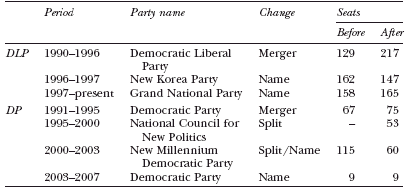
This study applies the standards presented by Janda in ‘Deciding Party Identity after Split, Merger, or Name Change’.Footnote 22 This study subscribes to the view that parties which maintain existing resources and merely change their names are identical and conceptualizes these as successor parties.Footnote 23 (Successor parties of the DLP and the DP will be presented in Table 5 of the fifth section.)
In terms of ‘the party as organization’, each party is composed of three layers: majority members at the lowest layer, active members in the central party in the middle, and the leadership at the top. Relationships among the three layers are distinguished vertically and horizontally. A vertical relationship is defined by a relationship between upper and lower levels of an organization while a horizontal relationship relates to the scope and relationships with forces outside the party.Footnote 24 The processes forming these relationships are defined as vertical organization mode and horizontal organization mode, respectively. The degree of vertical organization is an indicator of the level of penetration of a party organization and the degree of horizontal organization is an indicator of diffusion of a party organization.Footnote 25
The relationship between the horizontal and vertical modes can be offsetting. Each organization mode in the ‘process’ of institutionalization refers to the way a party controls its internal affairs. Thus different relationships can form between the leadership, middle organization and lower organization. For the vertical organization mode, the leadership has the initiative to control, mediate and decide internal matters such as conflicts, nominations and recruitment. This brings each layer of party organization close to each other, and makes most party affairs controllable. On the other hand, a horizontal organization mode causes a party to develop a tendency to depend on outside resources. Its formation and electoral campaign can come from other political organizations, and candidates are also recruited from outside among notables, not party members. Therefore, the elimination of outside resources can be vital to a party's sustainability.
Analysis of memberships in the lowest layer, however, could be controversial in new democracies concerned about the weakness of memberships. Most parties in Korea also tend to have ‘paper membership’ (i.e. an involuntary membership with documentary registration only). Therefore, this study sought an alternative to this: the number of members nominated in general elections. A high rate of nomination of the party members constitutes an indicator of a highly vertical organization mode while a horizontal organization mode relates to recruitment and nomination of candidates from external human resources.
The two modes affect parties in different ways. A vertical organization mode affects the development of incentive distribution systems such as major official posts and nominees. A positive function of a vertical organization mode can help to resolve intra-party discontent through distribution of incentives. It also enables the leadership to garner opportunities to expand bases of intra-party support, which can increase their control over crises. On the contrary, a horizontal organization mode facilitates innovation of a sluggish party organization through external recruitment and expansion of relationships with external influences.Footnote 26 Despite these positive functions of external recruitment, a horizontal organization mode less concerned with party discipline or loyalty is prone to weaken the organizational homeostasis and can expose the party to instability that the leadership may find hard to control.
According to Panebianco, more cohesion is observed with a higher level of mutual dependency among different layers.Footnote 27 However, a merger changes the characteristics of a party. Even changes of a layer may influence other layers, and thus, a merger directly affects the whole party, especially the party cohesion. If a party after a merger can reorganize its organization with a successful vertical organization, it can form a more coherent relationship. This is because coherent central party power may obtain higher control over internal affairs and as a result become relatively immune to conflicts or crises. In other words, vertical organization mode and internal cohesion have a positive relationship.
Figure 1 shows the relationship between vertical organization mode and internal cohesion. Setting the state of a complete organization as 1, a vertical organization's relationship to internal cohesion is represented as a1–a2, a real line going upward to the right. A party locates itself between Z1 and Z2 according to the degree of vertical organization. A party closer to Z2 has a higher rate of nomination of members and is a highly vertical party organization. Thus, the size of the vertical organization mode and internal cohesion is aligned as P1 < P2 < P3.
A Party's Controllability over Crisis C 28

Source: Reproduced from Panebianco, Political Parties, p. 57.
The degree of vertical organization mode results in each leadership's difference with the ‘controllable scope’. Vertical organization mode tends to strengthen party cohesion, and thus widens controllable scope. Party leadership with higher internal cohesion has room to intervene in each layer of organization when they face internal conflict and division which may weaken party cohesion. Thus, vertical organization mode can enhance organizational stability while a party with horizontal organization mode has a higher probability of experiencing organizational crises such as defection, split and extinction.
The larger controllable scope brings more organizational stability compared to a party with smaller controllable scope. For example, when crisis C arises and damages internal cohesion, a party may come up with different organizational sequences according to the size of the controllable scope. The identical crisis C of Figure 1 becomes uncontrollable to the party P1 while P3 with higher internal cohesion finds this controllable and solvable. P2 finds crisis or stability according to its station towards crisis C located in the party demarcation where internal cohesion is damaged or maintained.
Thus, the hypotheses of this study are as follows:
H1: The higher the rate of vertical organization mode is, the more stable party organization is.
A high degree of vertical organization mode around the leader contributes to party stability. The vertical organization mode refers to that with incentive distribution to members, which is measured as the nomination rate of members. This strengthens its internal cohesion within the party hierarchy. Thus, the party leadership becomes autonomous to crises with its control over partisan discontents.
The two other hypotheses deal with the leadership. A party with concentration on one leader finds more stability of organization, which is measured by selections and reshuffles of central party officials. One strong leader is necessary for a party to deal with various crises. At the same time, leaders will be able to control upper and lower level organizations after shifts of the leadership.
H2: The more concentrated one is on one leader, the more stable party organization is.
H3: The more stable the shift of the leadership is, the more stable party organization is.
The leadership is more important after a party merger where the leaderships of more than two parties are combined. A merger may bring about power-sharing in the party and internal power struggles, which create a higher probability that organizational stability will be weakened. Division of the leadership power for a party facing crises has a higher probability of contributing to further division rather than control. Stable alternation of the leadership refers to the situation where the existing balance of intra-party power is maintained without conflicts or divisions over selection of the leadership. Despite a change of leader, candidate selections and reshuffles of party posts to maintain the balance of power may decrease conflicts and divisions. Therefore, the stable shift of the leadership enhances party stability.
THE CASE OF SOUTH KOREA
Merger-led Conflicts, Settlement and Dissimilar Organization Mode
Party merger was the starting point of institutionalization for both the DLP and the DP, which meant an overlap of the ‘controllable scope’ over the former leaderships. Mergers among legislative parties in 1990 and 1991 established the DLP and the DP. The DLP was the result of a merger among the Democratic Justice Party (DJP faction), the Unified Democratic Party (UDP faction) and the New Democratic Republican Party (UDRP faction). The DP was created through the merger of the New Democratic Unification Party (NDUP faction) and the Democratic Alliance Party (DAP faction).
The foremost problem emerging from the two cases was conflict and division surrounding composition of official posts (in case of the DPL) and the leadership (in the case of the DP). The DLP (composed of three factions) disintegrated over the selection of the official posts of the central party. The leadership was formed via clandestine agreements among representatives, and there was no conflict arising from this. Rather, each faction's share of the official posts became an issue: each one was ready to rebel at the first sign of inequality or disadvantage. The DLP's early decision was a construction of the so-called ‘tripartite interim management system’ among three top-ranking executives and the distribution of official posts based on the shares by factions.Footnote 29
Unlike the DLP, the DP had a dispute over who the leader was to be. Factions found it difficult to choose between Kitaek Lee and Daejung Kim, former representatives of the party before the merger who had dismantled the first round of merger negotiations in 1990. Negotiation surrounding the merger resumed immediately after defeat in the local elections in June 1991. Criticism centring on responsibility for electoral defeat strengthened the rationale of the democratic force calling for a merger of the opposition parties and retirement of their leaders. As a result, the DP was established in September 1991 upon agreement that ‘Daejung Kim and Kitaek Lee co-represent the party with the former, as elder, to be registered as legal representative at the National Election Commission’, and that ‘members of the Supreme Council as a collegial body are to be constructed upon 5 to 5 shares between factions’.Footnote 30 The DP decided to organize the leadership based upon the same number of allotments among factions as under the merger agreement.
Issues faced by both parties were identical but the consequent internal conflicts and resolution process evolved differently. The DLP concentrated on selection of personnel at the lower organization. Selection of the Executive Committee and local party organizers was a conflictual issue necessitating a prolonged mediation. Selection of the personnel of the Executive Committee took four months and ended with the party members finally agreeing to allot 13, 4 and 5 persons among the DJP, DP and NDRP, respectively. The selection of local party organizers was also problematic, as the previous organizers of each faction realized that the new personnel selection would mean a loss of their official posts (in particular, the majority DJP faction predicted that the loss would be enormous).Footnote 31
The principle to entitle MPs to the status of local party organizer led to strong protests from members of the lower organizations. Rebellion and disobedience were revealed in two ways. One was the continued activities of DJP faction members as local organization organizers who were left out of the selection, and the other was organization of private gatherings of members such as the ‘Scholarship Foundation’, the ‘DJP Affinity Group’ and the ‘Democratic Alpine Club’. In other words, the DLP found itself facing a possible split due to internal disturbances.
The DLP sought to resolve these problems through direct engagement and control of the central party (i.e. vertical organization mode). This took the form of the Central Disciplinary Committee's issuing of a warning letter to each local organization in discord. Activities specifically designated as subjected to warnings included ‘appropriation of the former party name, presentation of a wreath or gift with the name of a local organizer by a person who is not an organizer and refusal of transfer of the list of party members’.Footnote 32 The adamant will of the central party to resolve internal conflicts aggravated by the defection of members led the party to take strong measures such as reshuffling the official posts, consolidation efforts towards private gatherings and internal audits. Facing a crisis of dissolution, coherent responses and mediation of the central power brought about a successful conflict resolution.
While for the DLP the party merger worked as a momentum to expose conflicts and disagreements among lower organizations, it was still a concern for the DP to reach agreements and settle disagreements within the upper organization. The leadership went to Daejung Kim's NDUP faction, breaking up an early agreement that the leadership would be based on the principle of the same number of allotments among different factions. The numbers were six and four persons between the NDUP and DAP factions for major official posts and 42 and 28 people by factions for the Steering Committee. The merger agreement was broken and the NDUP faction prevailed.
The DP could not make thoroughgoing preparations of local organizations. The more serious problem was not the rebellion from members of the lower organization but the scarcity of local organizers. What this meant was that after the merger, vertical control or mediation was not necessary for the DP. Aligned with this, the DP employed two horizontal strategies for organization of local party (i.e. horizontal organization mode). One was the ‘open recruitment from other parties by advertising in the newspapers’ for local party organizers and the other was the creation of the ‘Special Preparatory Committee for External Recruitment’, which aimed to recruit from external human sources.Footnote 33 The aim here was to complement organizational weakness through external recruitment. They did not consider an expansion of the membership base or the empowerment of the lower organizations. More specifically, the recruitment of outsiders with higher winning potential was a noted attempt at a horizontal organization mode.
Open recruitment of local party organizers closed on 25 October with a high competition rate of up to 3 to 1. The ‘Special Committee on the Strengthening of the Organization’ constructed after open recruitment distributed the same numbers between the NDUP and DAP factions and selecting principles developed into factional disruptions. The NDUP faction was in the position to ‘select the first team of organizers with current representatives or from non-competing districts’ and to ‘separate selections of local party organizers from party nomination for the fourteenth general election in 1992’. On the other hand, the DAP faction opposed separating selections of local organizers from party nomination.Footnote 34 The DAP faction, concerned about ‘exposure of the party's regional disparity’, opposed the selection policy. The disagreement prolonged selection processes. The conflicts intensified and were revealed in the form of ‘anonymous letters’ containing the list of secret designates for local organizers.Footnote 35
Unable to narrow the stances between the factions, the DP's selections were even more prolonged and, with the election approaching, nomination became a central issue. As a result, conflicts within the DP's leadership lessened as the election drew near. Nevertheless, the DP entered the election without vertical maintenance of local organizations.
Differences in Organizational Mode: The General and Presidential Elections of 1992
After establishment, the DLP and the DP had members running in the fourteenth general election in March and presidential election in December 1992. Both elections marked a critical turning point in terms of party institutionalization as they brought issues of candidate nomination and shift in the leadership to the table. Characteristics of candidate nomination can be stated as a process of party organization, and a shift in the leadership shows a stable transfer of the central power.
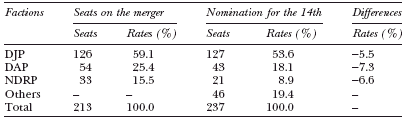
General Election. In the general election, the DLP held on to the nomination rate by factions (Table 1). Seats were divided among the DJP (59.1 per cent), the DAP (25.4 per cent) and the NDRP (15.5 per cent), respectively, and those nominated among them were the DJP (53.6 per cent), the DAP (18.1 per cent) and the NDRP (8.9 per cent). This means that the numbers were reduced by 5.5 per cent, 7.3 per cent and 6.6 per cent, respectively, from the early shares of the establishment. Absolute reduction in shares by factions came from the fact that 19.4 per cent of nominees came from outside rather than from changes of shares themselves. Aside from the rate of external recruitment, the DLP tended to maintain its initial balance of power and made nominations with a vertical organization mode.
Seats by Factions on the DLP's Establishment and the Number of Nominees for the Fourteenth General Election

Note: Numbers refer to seats and rates of the nominees for the thirteenth general election and candidates nominated within his/her faction before the fourteenth general election. Others refers to MPs before the tenth assembly, those nominated for the first time, and others nominated by other parties. Total number of seats for the fourteenth general election is 237 seats.
Source: National Election Commission, General Election Data for the 14th National Assembly, 1992 (in Korean).
The DP's nomination results were different from the DLP's. Basically, this difference comes from the fact that the number of the DP's MPs in the thirteenth general election came to only 78 persons (70 from the NDUP faction and 8 from the DAP faction). However, the matter of who would be nominated in the fourteenth general election was another question. The DP tried to recruit new people who appeared to have a higher probability of winning. Starting with the establishment of the ‘Special Committee on the Strengthening of the Organization’, the DP's nomination direction headed towards the recruitment of people with a higher probability of winning. Party affiliation was not important.
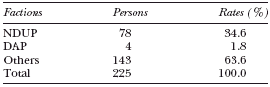
Table 2 shows the DP's nomination process (i.e., horizontal organization mode). Of the nominees, 63.6 per cent came from representatives from before the thirteenth National Assembly, nominees from other parties, and the externally recruited. Having nominated 63.6 per cent of their members from people who were not from the factions or who did not have any party affiliation, the DP found the composition of human resources within the organization had changed. On the other hand, nominees from the NDUP faction came to 34.6 per cent, overrunning the 1.8 per cent of the DAP faction, breaking the principle of the same number allotment agreed upon earlier in the merger.
DP's Nominated Candidates for the Fourteenth General Election by Factions

Note: Total number of seats is 237 seats.
Source: National Election Commission, General Election Data for the 14th National Assembly, 1992 (in Korean).
Presidential Election. After the fourteenth general election, both parties nominated presidential candidates through competition at the party conventions in April and May, respectively. Youngsam Kim won the DLP leadership with 66.3 per cent. In the process, instability within the DLP increased, bringing about ‘the DLP crisis’ characterized by extreme conflicts between the DJP and the DAP factions, as well as the defection of representative Jongchan Lee, another candidate. On the other hand, in a nomination competition – which lasted for two days and included nominations for Supreme Council members – Daejung Kim was elected as the DP's presidential candidate (after having received 60.4 per cent of the vote). The DP's preparations for the presidential election after Kim's election went well and without dispute.
The nomination processes of these two parties were meaningful in view of post-merger party institutionalization. There were changes of factional shares of the two parties’ leaderships after each party elected a presidential candidate. Shares within the DLP were 5, 3 and 2, as agreed upon establishment. Reshuffles of the upper party right after the 1992 presidential election when the DLP won did not mean expansion of the DAP faction where presidential candidate Kim was affiliated. After the DAP faction's take-over of central power within the DLP party, it should be noted that the share of the DJP faction was enlarged.
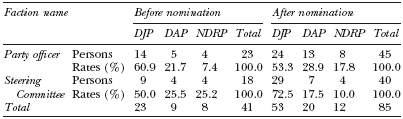
As shown in Table 3, the total number of officers from the DAP faction increased from 9 to 20 persons (still about less than half of them). The DJP faction's share increased from 23 up to 53 persons while the whole number of the executive members decreased. Thus, selection of the personnel after leadership change did not lead to conflicts among factions. The heart of the central power shifted from the DJP to the DAP faction but the share by factions resulted in a win for the DJP faction. This means that the DLP maintained the balance of power after the leadership shift.
Changes in Party Official Positions Shared by Factions after the Fourteenth Presidential Candidate Nomination

Source: The Democratic Liberal Party, Five Years of the Democratic Liberal Party, 1995 (in Korean).
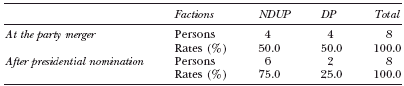
Contrary to this, the DP's share by factions after losing the presidential election came to strengthen the NDUP faction. The principle of same number allotment was broken and six out of eight leadership members came from the NDUP faction as shown in Table 4. The NDUP took absolute ascendancy in the DP's balance of power. This means that the DP had a considerable proportion of external recruits (i.e. a horizontal organization mode).
Changes of Factional Composition of DP's Leadership after the Fourteenth Presidential Candidate Nomination

Source: Reproduced from Hyunwoo Kim, History of Movement for Korean Political Parties.
The two parties chose different organizational modes in the two elections. The DLP focused on the vertical organization mode (without many external recruits) and succeeded, to a certain degree, in keeping the balance of power among factions after the nomination of their presidential candidate. However, the DP chose the horizontal organization mode (focusing on recruits of notables with higher probabilities of winning), and changes of the internal balance of power occurred once their presidential candidate had been decided upon.
Institutionalization in the Two Parties
The two parties' organization modes can be identified in the successor parties which followed. The DLP changed its name twice – to the New Korea Party in 1996 and to its current party name, the Grand National Party, in 1997 – while the DP split into two – the DP and the National Council for New Politics, the latter coming after the return of Daejung Kim, who reversed his decision to retire (which he had announced upon losing the presidential election). The DP changed its name twice while repeating splits and mergers afterwards.
Table 5 shows successor parties corresponding to Janda's criteria. The DLP's successor parties are the New Korea Party and the Grand National Party while the DP's successor parties are the National Council for New Politics, the New Millennium Democratic Party and the current DP. After the merger, both parties succeeded with changes of party names but the evolution of each took a different form. The DLP's successor parties may have achieved a certain level of institutionalization with high organizational stability through the stable shift of central power and the balance of power while the DP's repeated changes in human resource composition over elections are characterized by a high rate of external recruitment.
Successor Parties of the DLP and the DP

Note: Produced based on the changes of party affiliations of the representatives.
Source: Reproduced from National Election Commission, General Election Data for the fourteenth National Assembly, 1988; 1992; 1996; 2000 (in Korean).
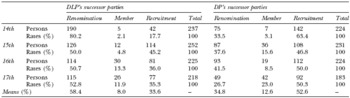
Table 6 shows nomination rates of the former candidates, party members and newly recruited figures in general elections from 1992 to 2004. The DLP's successor parties renominated 58.4 per cent of the former candidates on average and the DP's successor parties, 34.8 per cent. On the other hand, the DP's nomination through external recruitment reached 52.6 per cent on average, higher than the 19 per cent of the DLP's successor parties. On the whole, the DLP selected more candidates with relatively strong party identities while the DP nominated about 50 per cent of new notables regardless of party affiliation. This indicates that the difference of the two parties' organization modes has been institutionalized. The DLP's successor parties institutionalized a vertical organization mode and the DP's successor parties a horizontal organization mode, respectively.
National Election Nomination of the DLP, the DP and their Successor Parties

Note: Renomination refers to the nomination of the former candidates from the thirteenth to sixteenth general elections except proportional representative candidates. Member refers to party activists within the organization that had not been nominated before. Total number of seats varies in each election. It was 237 for the fourteenth, 253 for the fifteenth, 227 for the sixteenth, and 243 for the seventeenth.
Source: Reproduced from National Election Commission, General Election Data for the Fourteenth National Assembly, 1988; 1992; 1996; 2000 (in Korean).
This result comes from the fact that the DLP's successor parties consistently maintained homogeneity of human resources through the vertical organization mode while the DP's successor parties consistently kept changing human resource composition by recruiting from outside the party. This means that the DLP has maintained homogeneity of human resources by institutionalization of the vertical organization mode after a stable shift of the leadership in 1992. Contrary to this, the DP's successor parties institutionalized the horizontal organization mode. As a result, the DP split over division of the leadership despite the 2003 presidential election victory, whereas the DLP maintained organizational stability regardless of the electoral results.
CONCLUSION
The main finding of this study is that party stability is dependent on organization modes. A party can be considered stable: (1) when the internal relationship from lower to upper organizations institutionalizes a strong vertical organization mode; (2) when the central party power is concentrated on the leadership; and (3) when the leadership has been safely shifted after elections.
In the case of Korea, the DLP met these conditions more closely, and thus showed more stability than the DP. The evolution of the DP contrasted with that of the DLP. The DLP has maintained organizational stability despite electoral defeats both in the 1997 and 2002 presidential elections while the DP repeatedly went through defection, splits and mergers, despite its two electoral victories.
This study concludes that party institutionalization is dependent on organization modes of individual parties which have so far influenced party stability. This organizational stability, of course, does not guarantee a high level of party representation or democracy. However, party institutionalization based on vertical organization is necessary not only for members but also for voters as they seek to find channels to represent their interests. It shows the instability of linkages among members, voters and parties in new democracies.
Such weak party institutionalization might worsen political institutionalization in new democracies. In most cases, democratic procedures and party politics were enforced simultaneously, and thus they have not experienced spontaneous party evolution. Therefore, the unstable organizational changes have a tendency only to make parties just a tag for MPs to take part in elections. Split and merger of MPs without partisan support can damage the functionality of parties. It reminds us that a higher level of political institutionalization can be achieved when parties maintain party stability.