Introduction
Swainson's spurfowl Pternistis swainsonii (Smith, 1836) (Phasianidae: spurfowls) is endemic to southern Africa. In South Africa it has undergone a major southward range expansion and can now be found east of approximately 23°E and south as far as 30°S in the Eastern Cape, Free State, Gauteng, Limpopo, Mpumalanga, Northern Cape and North West Provinces. It is absent from the coastal lowlands of KwaZulu-Natal Province (Little, Reference Little, Hockey, Dean and Ryan2005). Its preferred habitat in South Africa is dense grassland in proximity to cultivated lands, where it exploits crops and associated insects. While some authors refer to Swainson's spurfowl as one of the most water-dependent perdicine birds in Africa (del Hoyo et al., Reference del Hoyo, Elliot and Sargatal1994; Little, Reference Little, Hockey, Dean and Ryan2005), a study in Limpopo Province, South Africa, revealed no or little reliance on easily accessible drinking water and birds seldom drank (Jansen & Crowe, Reference Jansen and Crowe2002).
The Orange River francolin Scleroptila levaillantoides (Smith, 1836) (Phasianidae: francolins) is found in two distinct geographical areas on the African continent (del Hoyo et al., Reference del Hoyo, Elliot and Sargatal1994). While it is a frequent to common bird in Ethiopia and Somalia, numbers appear to have declined in its southern population, especially in South Africa and Namibia. This is thought to be mainly due to habitat pressure following the conversion of natural grass- and woodland habitats into farmland, despite the fact that, like Swainson's spurfowl, it will forage at the edges of cultivated land (Little et al., Reference Little, Crowe and Barlow2000). The natural range of Orange River francolin in South Africa used to be restricted to north-western Northern Cape Province (del Hoyo et al., Reference del Hoyo, Elliot and Sargatal1994), but it has expanded to include north-eastern Eastern Cape Province, and Free State and North West Provinces, as well as the region east of the highveld of Mpumalanga and Gauteng Provinces (Little et al., Reference Little, Crowe and Barlow2000; Little, Reference Little, Hockey, Dean and Ryan2005).
Only incidental findings on helminth parasites of both these gamebirds in South Africa have been published. Oosthuizen & Markus (1967) collected Subulura sp. from a single Swainson's spurfowl, while the only record pertaining to helminths of S. levaillantoides is that of Bennett et al. (1992) who reported Microfilaria sp. when cataloguing haematozoa of sub-Saharan birds.
This paper reports on helminths collected from the gastrointestinal tract (GIT) of five Swainson's spurfowl and a single Orange River francolin in Free State Province, South Africa and describes a new nematode, Tetrameres swainsonii, from the proventriculus of the former.
Materials and methods
Five Swainson's spurfowl, a single second-year male and four adult females (at least third-year), and a single adult male Orange River francolin were collected during a gamebird hunt in the vicinity of Petrus Steyn (27°39′S; 28°8′E), Free State Province, in August 2007. The habitat in the survey area was made up primarily of cereal plantings (maize) and sunflower, in a mosaic of grazing land.
Within 4 hours of being shot, the entire GIT was removed from the birds and placed in a plastic tray. The crop was ligated at the entrance of the oesophagus and the entrance to the proventriculus. The proventriculus was separated from the gizzard, and the small intestine was separated from the gizzard and caeca. The GITs of the various birds were placed in individual containers, stored at 2°C overnight and then fixed in 70% ethanol.
Subsequently, the crop, proventriculus, gizzard, small intestine and caeca were washed separately over a 150 μm sieve and, together with the residue, examined under a stereoscopic microscope. Helminths in the gizzard usually only became visible after removal of the lining.
All helminths were stored in 70% ethanol. For identification purposes, nematodes were cleared in lactophenol and studied under a standard microscope. Intensity of infection, mean intensity of infection, mean abundance and prevalence are used in accordance with Margolis et al. (Reference Margolis, Esch, Holmes, Kuris and Schad1982).
Results
All five Swainson's spurfowl harboured nematodes and a total of six species, Acuaria gruveli (Gendre, 1913), Cyrnea parroti Seurat, 1917, Gongylonema congolense Fain, 1955, Subulura dentigera Ortlepp, 1937, S. suctoria (Molin, 1860) and T. swainsonii n. sp., was recovered. Their habitat, prevalence, mean intensity of infection and mean abundance are listed in table 1. A single host harboured a total of four species, a second three, and three birds had two nematode species each. The mean species richness was 2.6 (SD = 0.9). The intensity of infection ranged from 3 to 68, with a mean intensity of 19 (SD = 27.7). The second-year male had the highest species diversity as well as highest intensity of infection.
Nematodes recovered from five Swainson's spurfowl Pternistis swainsonii in Free State Province, South Africa.

Two nematode species were recovered from both the gizzard and caeca, and a single nematode species from the proventriculus and crop, respectively. No helminths were found in the small intestine.
With the exception of a single C. eurycerca Seurat, 1914 in its gizzard, the Orange River francolin harboured no helminth parasites.
The presence of A. gruveli in Swainson's spurfowl constitutes both a new host record and a new geographical record for this parasite, while C. parroti, G. congolense and S. suctoria are new parasite records for this host. This is the first report of S. dentigera from a host other than helmeted guineafowl Numida meleagris (Linnaeus, 1758) (Phasianidae: guineafowls). Cyrnea eurycerca is recorded from Orange River francolin as well as from South Africa for the first time.
Tetrameres swainsonii n. sp
Description
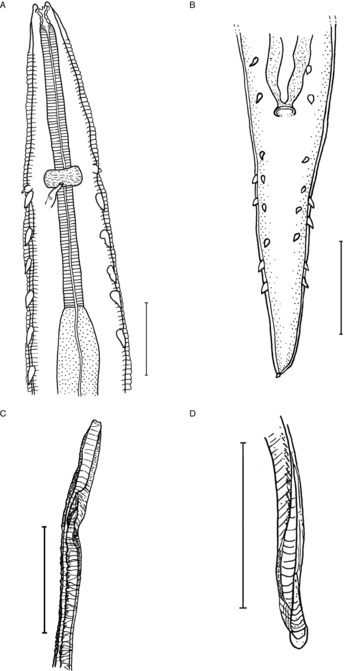
Tetrameres swainsonii is described from four males and one female from a single Swainson's spurfowl. Males were found free in the lumen of the proventriculus, while the female was dissected from the proventricular glands. All measurements are in micrometres unless otherwise stated (fig. 1).
Tetrameres swainsonii n. sp. male. (A) Ventral view of anterior extremity illustrating the position of the deirids, nerve ring, excretory pore and first pair of body spines. (B) Ventral view of posterior extremity showing the arrangement of the caudal spines. (C) Proximal end of the single spicule, lateral view. (D) Distal end of the spicule, lateral view. Scale bars = 100 μm.

Female. Bright red in situ as typical for the genus, damaged; only buccal capsule, 24 deep and 16 wide, maximum body width (3 mm) and length (4 mm) as well as egg length and width could be measured. Eggs (n = 10), length 49 (SD = 2.98), between 43 and 52, width 32 (SD = 1.47), between 30 and 34; polar filaments not seen. Body globular with anterior and posterior extremities forming short protuberances; surface divided into four segments by four conspicuous longitudinal cuticular grooves; each segment with numerous transverse striations.
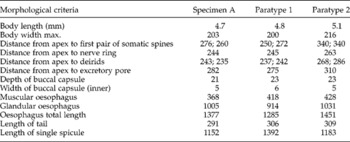
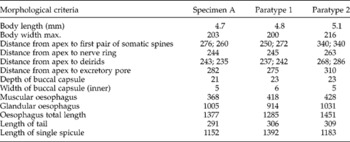
Male. Measurements of holotype male given in text, those of two paratypes and a further specimen in table 2. Body elongated, tapered at both ends, 5.1 mm long and 188 wide. Cuticle striated transversely as well as longitudinally. Cuticular spines arranged in two lateral rows, one dorsal and one ventral to inconspicuous lateral alae; 41 spines per row in holotype, 40 to 43 in paratypes; first pair of spines at 269 and 285 from anterior extremity. Deirids with apical spines at 261 and 251 from anterior extremity. Nerve ring and excretory pore at 252 and 265 from apex, respectively. Deirids at approximately centre of nerve ring with first pair of cuticular spines in close proximity, but posterior to deirids. Excretory pore in same vicinity, sometimes slightly anterior, slightly posterior or on same level as first pair of cuticular spines (fig. 1A). Depth of buccal capsule 19, inner diameter 6. Oesophagus divided into muscular and glandular parts, 412 and 914, respectively; total length of oesophagus 1326. Single spicule, slender, 1384 long, trough-shaped with spatulate, almost square tip (fig. 1D); proximal tip slightly angled away from longitudinal axis (fig. 1C). Gubernaculum absent. Tail 330 long, with short pointed tip. Eight pairs of caudal spines arranged in two ventral and two lateral rows, containing four spines each (fig. 1B).
Morphological characteristics of Tetrameres swainsonii n. sp. males from Swainson's spurfowl Pternistis swainsonii. All measurements in micrometres unless otherwise indicated.
Specific diagnosis
Tetrameres swainsonii n. sp. is characterized by two rows of body spines, starting just posterior to the deirids situated at the level of the nerve ring. The single spicule is 1152 to 1392 long, and 16 caudal spines are arranged in two ventral and two lateral rows, each bearing four spines.
Host
Swainson's spurfowl Pternistis swainsonii (Smith, 1836).
Habitat
Males occur free in the lumen of the proventriculus, females are sedentary in proventricular glands.
Locality
Vicinity of Petrus Steyn (27°39′S; 28°8′E), Free State Province, South Africa.
Etymology
The specific epithet swainsonii refers to the host.
Deposition of type specimens
Holotype male: 2008.6.20.1, allotype female, paratype males: 2008.6. 20.2–5.
Taxonomy of Tetrameres
To date three species belonging to the genus Tetrameres have been described from avian hosts in South Africa, Tetrameres paradisea Ortlepp, Reference Ortlepp1932 from Stanley's crane Anthropoides paradiseus (Lichtenstein, 1793) (Gruidae: cranes), Tetrameres prozeskyi (Ortlepp, Reference Ortlepp1964) from red-billed and southern yellow-billed hornbills Tockus erythrorhynchus (Temminck, 1823) (Bucerotidae: typical hornbills) and Tockus leucomelas (Lichtenstein, 1842) (Bucerotidae: typical hornbills), respectively, and Tetrameres numida Junker & Boomker, 2007 from helmeted guineafowl. Tetrameres paradisea is similar to the new taxon in that it has two rows of cuticular spines and possesses a single spicule. However, Ortlepp (Reference Ortlepp1932) illustrates three cuticular spines anterior to the deirids, with the latter placed well anterior to the nerve ring, whereas in the present specimens, the first pair of cuticular spines only appears posterior to the deirids, and both the first pair of cuticular spines and the deirids are in the immediate vicinity of the nerve ring. Moreover, the spicule length of T. paradisea only reaches 690 as opposed to a minimum length of 1152 in the present specimens.
In T. prozeskyi a single spicule measuring 230–260 is usually present and in those instances where a second spicule was found, it was shorter than the first (Ortlepp, Reference Ortlepp1964). A further distinguishing feature between T. prozeskyi and T. swainsonii n. sp. is the presence of four rows of cuticular spines in the former (Ortlepp, Reference Ortlepp1964) versus two rows in the latter. Only 12 caudal spines were reported for T. prozeskyi as well as for T. paradisea (Ortlepp, Reference Ortlepp1932, Reference Ortlepp1964) as opposed to the 16 caudal spines seen in the new taxon.
Like T. swainsonii n. sp., T. numida is characterized by two rows of cuticular spines, but the arrangement of the first pair of spines, the deirids and the nerve ring is distinctly different from that seen in the present specimens (Junker & Boomker, Reference Junker and Boomker2007a). The first pair of cuticular spines of T. numida is situated anterior to the deirids, which are approximately at the level of the second pair of cuticular spines, and the nerve ring is distinctly posterior to the deirids. Only 12 caudal spines are described for T. numida and, although additional ventral spines may occasionally be present, the two lateral rows consistently carried three spines each. In addition, T. numida possesses a right and a left spicule, ranging from 106 to 170 and from 1699 to 2304, respectively (Junker & Boomker, Reference Junker and Boomker2007a).
Of the 54 species of Tetrameres listed by Junker & Boomker (Reference Junker and Boomker2007a), only T. paradisea, Tetrameres grusi Shumakovitsh, 1946, Tetrameres pattersoni Cram, 1933 and Tetrameres puchovi Gushanskaja, 1949 share the combination of two rows of cuticular spines and a single spicule with the present specimens. However, the spicules of T. grusi (638–783) and of T. puchovi (307–309) (Skrjabin & Sobolev, Reference Skrjabin and Sobolev1963) are distinctly shorter than those of T. swainsonii n. sp. (1152–1392). Moreover, the caudal spines of T. grusi are arranged in several irregular rows, and several pairs of cuticular spines originate anterior to the nerve ring (Skrjabin & Sobolev, Reference Skrjabin and Sobolev1963), whereas in T. swainsonii n. sp. the first pair of cuticular spines emerges posterior to the nerve ring. The distance from the apex to the deirids is 160 in T. puchovi (Skrjabin & Sobolev, Reference Skrjabin and Sobolev1963), which is considerably shorter than that observed in the new taxon, namely 235–286.
Tetrameres pattersoni is closest to T. swainsonii n. sp. in spicule length, with a single, strongly chitinized spicule of length 1200–1500; but it differs in the arrangement of caudal spines in three lateral and four subventral pairs, as opposed to four pairs each in the new taxon. The distance of the deirids from the apex, which is less than half that seen in T. swainsonii n. sp., namely 83–112 (Skrjabin & Sobolev, Reference Skrjabin and Sobolev1963), clearly separates T. pattersoni from T. swainsonii n. sp.
Discussion
The single second-year male Swainson's spurfowl yielded the largest number of helminth species as well as individuals. Phasianid chicks are reported to rely heavily on insect food in the early stages of their lives (del Hoyo et al., Reference del Hoyo, Elliot and Sargatal1994). Chicks of grey partridge Perdix perdix Linnaeus, 1758 (Phasianidae: partridges) in Europe, for example, consume a diet consisting of 80% insect matter for the first 2 weeks after hatching (del Hoyo et al., Reference del Hoyo, Elliot and Sargatal1994). Arthropods only make up approximately 7% of the crop weight of adult P. swainsonii, reaching a maximum of up to 20% in summer (del Hoyo et al., Reference del Hoyo, Elliot and Sargatal1994). Higher intake of live food by juvenile versus adult birds is likely to increase exposure to infected intermediate hosts, which, in turn, would result in higher worm burdens. However, because of the small sample size it is not possible to establish whether our findings are due to chance or reflect a true pattern in the helminth community of Swainson's spurfowl.
Only nematodes were collected from Swainson's spurfowl and the single Orange River francolin. This is noteworthy, especially taking into account that all nematodes collected from these two hosts are heteroxenous; that is, their life cycles include various arthropod intermediate hosts, such as orthopterans and coleopterans (Anderson, Reference Anderson1992), which in addition serve as intermediate hosts for cestodes and acanthocephalans (Moore, Reference Moore1962; Reid, Reference Reid1962). Moreover, helmeted guineafowl collected at the same locality during the course of this study harboured nematodes and cestodes as well as acanthocephalans (Davies et al., in review), thereby confirming their presence in the environment.
While Swainson's spurfowl had a markedly less diverse helminth fauna than helmeted guineafowl at the study site, the former seem to be more suitable hosts of the gizzard nematode A. gruveli, since it was collected from all five spurfowl, but was absent in more than 40 helmeted guineafowl (Davies et al., in review). Other galliform birds recorded as final hosts of A. gruveli include double-spurred spurfowl Pternistis bicalcaratus (Linnaeus, 1766) ( = Francolinus bicalcaratus) (Phasianidae: spurfowls) in Togo (Quentin & Seureau, Reference Quentin and Seureau1983), common quail Coturnix coturnix (Linnaeus, 1758) (Phasianidae: quails) in the Palearctic region (Baruš & Sonin, Reference Baruš and Sonin1983) and red-legged partridge Alectoris rufa (Linnaeus, 1758) (Phasianidae: partridges) in Spain (Tarazona et al., Reference Tarazona, Sanz-Pastor and Camara1979), suggesting that perdicine birds feature more prominently in the life cycle of this parasite than do guineafowls.
A possible explanation for the presence/absence of helminths in Swainson's spurfowl versus helmeted guineafowl at the same locality might be a difference in their dietary preferences, which in turn would influence the probability of exposure to intermediate hosts of certain parasites. Moreover, differences in the immune competence of the two bird species might result in a higher resistance in guineafowl. Similarly, morphological differences between hosts, such as the nature of the gizzard lining, could prevent establishment of, for example, A. gruveli in guineafowl, but allow colonization of spurfowl.
Cyrnea parroti, G. congolense and S. suctoria collected from Swainson's spurfowl are also commonly found in other galliform birds (Junker & Boomker, Reference Junker and Boomker2007b). Contrary to this, S. dentigera had hitherto been recorded from helmeted guineafowl only.
Cyrnea eurycerca, which was present in the single Orange River francolin, seems a relatively common parasite in francolins and spurfowls, and has previously been collected from black francolin Francolinus francolinus (Linnaeus, 1766) (Phasianidae: francolins) in Italy, grey francolin Francolinus pondicerianus (Gmelin, 1789) (Phasianidae: francolins) in India and double-spurred spurfowl in Togo (Marconcini & Triantafillu, Reference Marconcini and Triantafillu1970; Jehan, Reference Jehan1974; Seureau & Quentin, Reference Seureau and Quentin1983).
The low prevalence and intensity of infection of T. swainsonii n. sp. in Swainson's spurfowl is in keeping with data obtained for T. numida from helmeted guineafowls in Limpopo Province, as well as in the present study area (Junker & Boomker, Reference Junker and Boomker2007a; Davies et al., in review). Similarly, only two of 158 bobwhite quail Colinus virginianus (Linnaeus, 1758) (Phasianidae: quails) examined in northern Florida harboured T. pattersoni, and intensity of infection ranged from 0 to 1 (Moore & Simberloff, Reference Moore and Simberloff1990).
The overall low helminth diversity and intensity of infection seen in Swainson's spurfowl at the study site might be attributable to several factors. First, they occur in pairs or small family groups rather than in large flocks (Little, Reference Little, Hockey, Dean and Ryan2005; Jansen & Crowe, Reference Jansen and Crowe2006), which would facilitate parasite transmission (Moore et al., Reference Moore, Simberloff and Freehling1988). Jansen & Crowe (Reference Jansen and Crowe2002) reported a covey size ranging from 1 to 4. Second, the birds were collected in winter, when the volume of their diet consists mainly of grass seeds, weed seeds and agricultural seeds, while invertebrates play a minor role (Jansen & Crowe, Reference Jansen and Crowe2006). In terms of crop volume, 5.74% is made up of invertebrates during the summer months and 3.64% during the winter months (Jansen & Crowe, Reference Jansen and Crowe2006). Third, much of their habitat consisted of cultivated lands, the insect fauna of which might be depauperate because of low habitat diversity and the use of pesticides. In addition, while Swainson's spurfowl from a cereal-crop habitat, similar to that found in the current study area, ingested the greatest number and volume of invertebrates, when compared to savanna and a cotton habitat, more than 90% of the total number of invertebrates consumed consisted of lepidopteran larvae (Jansen & Crowe, Reference Jansen and Crowe2006). The latter, however, have not been reported as intermediate hosts for nematode species recovered from Swainson's spurfowl and would thus have no influence on helminth diversity or intensity of infection in these birds.
Acknowledgements
We thank Mr J.P. Wales for access to ‘The Jimmy Wales Shoot’ for collection of gastrointestinal tracts. The research was supported financially by the Centre of Excellence in Birds at the Percy FitzPatrick Institute (funded by the South African Department of Science and Technology and the National Research Foundation), the University of Cape Town's Research Committee, and the Department of Veterinary Tropical Diseases, University of Pretoria. K.J. was supported by a University of Pretoria Postdoctoral Fellowship Grant.