Big Five personality traits exhibit robust associations with, and may predict, depressive and anxiety disorders in youth and adults (Tackett, Reference Tackett2006; Klein et al. Reference Klein, Kotov and Bufferd2011). Cross-sectional studies show that neuroticism is elevated, whereas extraversion and conscientiousness are reduced, in depression and anxiety (Kotov et al. Reference Kotov, Gamez, Schmidt and Watson2010). Prospective studies demonstrate that higher neuroticism, and lower extraversion and conscientiousness predict subsequent depressive and anxiety symptoms and episodes, although only a few studies have examined conscientiousness (Gershuny & Sher, Reference Gershuny and Sher1998; Tackett, Reference Tackett2006; Dougherty et al. Reference Dougherty, Klein, Durbin, Hayden and Olino2010; Hakulinen et al. Reference Hakulinen, Elovainio, Pulkki-Råback, Virtanen, Kivimäki and Jokela2015; Newton-Howes et al. Reference Newton-Howes, Horwood and Mulder2015; Jeronimus et al. Reference Jeronimus, Kotov, Riese and Ormel2016). Studies predicting the first onset of disorders are especially important, as effects cannot be attributed to the influence of prior or concurrent disorders (Tackett, Reference Tackett2006; Klein et al. Reference Klein, Kotov and Bufferd2011). However, only a limited number of such studies have been conducted, primarily focusing on depression with only a few examining anxiety disorders. Most of these studies found that neuroticism predicted first onsets of these disorders, but effects for extraversion were weaker (de Graaf et al. Reference de Graaf, Bijl, Ravelli, Smit and Vollebergh2002; Kendler et al. Reference Kendler, Gatz, Gardner and Pedersen2006; Weiss et al. Reference Weiss, Sutin, Duberstein, Friedman, Bagby and Costa2009; Kendall et al. Reference Kendall, Zinbarg, Mineka, Bobova, Prenoveau, Revelle and Craske2015; Zinbarg et al. Reference Zinbarg, Mineka, Bobova, Craske, Vrshek-Schallhorn, Griffith, Wolitzky-Taylor, Waters, Sumner and Anand2016). Only one study considered conscientiousness, finding that low conscientiousness predicted depression onset (Wilson et al. Reference Wilson, Vaidyanathan, Miller, McGue and Iacono2014), and no studies have considered agreeableness or openness.
The Big Five traits may be parsed into narrower facets, which account for additional variance in predicting behavior (Paunonen & Ashton, Reference Paunonen and Ashton2001). It is important to explore whether facets within the same general trait exhibit differential associations with psychopathology. If relationships between general traits and internalizing disorders are primarily due to the influence of a subset of facets, inclusion of other facets may dilute and obscure understanding of personality–psychopathology associations (Watson et al. Reference Watson, Stasik, Ellickson-Larew and Stanton2015a). Unfortunately, only a handful of studies have examined trait–disorder relationships at the facet level.
Cross-sectional studies examining facets of neuroticism, extraversion, and conscientiousness suggest that some facets have stronger associations with internalizing disorders than others (Bienvenu et al. Reference Bienvenu, Samuels, Costa, Reti, Eaton and Nestadt2004; Naragon-Gainey et al. Reference Naragon-Gainey, Watson and Markon2009; Uliaszek et al. Reference Uliaszek, Hauner, Zinbarg, Craske, Mineka, Griffith and Rose2009; Rector et al. Reference Rector, Bagby, Huta and Ayearst2012; Spinhoven et al. Reference Spinhoven, Elzinga, van Hemert, de Rooij and Penninx2014; Watson et al. Reference Watson, Stasik, Ellickson-Larew and Stanton2015a). The neuroticism and extraversion facets with the strongest links to depressive disorders are depressivity and low positive emotionality, respectively.Footnote †Footnote 1 In contrast, in social phobia, the neuroticism, extraversion, and conscientiousness facets with the strongest associations are anxiousness (neuroticism), low sociability and assertiveness (extraversion), and low competence (conscientiousness). Few studies have examined facet-level associations with generalized anxiety disorder (GAD) and specific phobia.
Only a small handful of studies have examined facets as predictors of change in depressive and anxiety symptoms and disorders, with most focusing on facets of a single general trait. These studies indicate that depression is predicted by depressivity, anxiousness, and low positive emotionality (Krueger, Reference Krueger1999; Naragon-Gainey & Watson, Reference Naragon-Gainey and Watson2014; Spinhoven et al. Reference Spinhoven, Elzinga, van Hemert, de Rooij and Penninx2014; Kopala-Sibley et al. Reference Kopala-Sibley, Danzig, Kotov, Bromet, Carlson, Olino, Bhatia, Black and Klein2016), whereas anxiety is predicted by anxiousness, low positive emotionality, and sociability (Krueger, Reference Krueger1999; Spinhoven et al. Reference Spinhoven, Elzinga, van Hemert, de Rooij and Penninx2014; Kopala-Sibley et al. Reference Kopala-Sibley, Danzig, Kotov, Bromet, Carlson, Olino, Bhatia, Black and Klein2016).
Only one study has examined facets as predictors of first onsets of depressive and anxiety disorders (Zinbarg et al. Reference Zinbarg, Mineka, Bobova, Craske, Vrshek-Schallhorn, Griffith, Wolitzky-Taylor, Waters, Sumner and Anand2016). This study focused exclusively on neuroticism, neuroticism facets, and neuroticism-related cognitive styles such as anxiety sensitivity, dysfunctional attitudes, and negative inferential style. After accounting for neuroticism as a whole, few facets or cognitive styles had independent effects on first onsets of depressive or anxiety disorders. However, the depressivity facet uniquely predicted first onsets of depression.
These studies suggest that associations between personality traits and internalizing disorders may be limited to a subset of facets. However, no longitudinal studies have examined facets from all three general traits consistently associated with depressive and anxiety disorders (Kotov et al. Reference Kotov, Gamez, Schmidt and Watson2010). Additionally, few previous studies have determined whether facets predict internalizing psychopathology over and above the effects of their corresponding general traits. Furthermore, only one study examined prediction of first onsets. Finally, previous studies have not examined the incremental predictive power of traits and facets over and above pre-existing subthreshold symptoms and internalizing disorders.
We examined whether the Big Five traits and facets of neuroticism, extraversion, and conscientiousness predict first lifetime onsets of depression, GAD, social phobia, and specific phobia in a community sample of early-to-mid adolescent females. This population is at elevated risk for onset of internalizing disorders (Hankin et al. Reference Hankin, Abramson, Moffitt, Silva, McGee and Angell1998), and is particularly relevant because personality plays a greater role in early- as opposed to late-onset disorders (Durbin & Hicks, Reference Durbin and Hicks2014; Wilson et al. Reference Wilson, Hicks, Foster, McGue and Iacono2015). We adjusted for the effects of baseline subthreshold symptoms and other internalizing disorders to ensure that associations between personality and disorder onsets are not explained by preexisting psychopathology.
The aim of the paper is to examine associations of general traits and facets with first onsets. At the facet level, we focused on neuroticism, extraversion, and conscientiousness, as these are the general traits that are most consistently associated with internalizing disorders (Kotov et al. Reference Kotov, Gamez, Schmidt and Watson2010). Although data on traits and facets predicting first onsets of internalizing disorders are limited, we had several hypotheses. We expected neuroticism and low extraversion and conscientiousness to independently predict first onset of depression (Hakulinen et al. Reference Hakulinen, Elovainio, Pulkki-Råback, Virtanen, Kivimäki and Jokela2015; Jeronimus et al. Reference Jeronimus, Kotov, Riese and Ormel2016). At the facet level, we hypothesized that depressivity and low positive emotionality would predict first onsets of depression (Spinhoven et al. Reference Spinhoven, Elzinga, van Hemert, de Rooij and Penninx2014; Zinbarg et al. Reference Zinbarg, Mineka, Bobova, Craske, Vrshek-Schallhorn, Griffith, Wolitzky-Taylor, Waters, Sumner and Anand2016). We also predicted that neuroticism and low extraversion would independently predict onset of anxiety disorders, including GAD, social phobia, and specific phobia (Gershuny & Sher, Reference Gershuny and Sher1998; Naragon-Gainey et al. Reference Naragon-Gainey, Watson and Markon2009; Spinhoven et al. Reference Spinhoven, Elzinga, van Hemert, de Rooij and Penninx2014). We expected that anxiousness and most extraversion facets (except possibly low positive emotionality) would predict onsets of social phobia (Naragon-Gainey et al. Reference Naragon-Gainey, Watson and Markon2009; Rector et al. Reference Rector, Bagby, Huta and Ayearst2012). However, we did not have sufficient basis to hypothesize which facets would predict GAD and specific phobia onsets. Lastly, we predicted that the hypothesized facets would contribute unique variance over and above their corresponding general traits in predicting first onsets of depressive and anxiety disorders.
Method
Participants
The initial sample consisted of 550 females aged 13.5–15.5 from Suffolk County, New York (see Nelson et al. Reference Nelson, Perlman, Hajcak, Klein and Kotov2015). Girls were included if they spoke English, did not have intellectual disability, and at least one biological parent was available. As the primary aim of the larger study is the prediction of the first onset of depressive disorders, adolescents with a history of major depressive disorder (MDD) or dysthymic disorder were excluded. Adolescents were initially administered the Patient Health Questionnaire (PHQ-9; Cannon et al. Reference Cannon, Tiffany, Coon, Scholand, McMahon and Leppert2007) via telephone to screen out depression, followed by the Kiddie Schedule for Affective Disorders and Schizophrenia for School-Age Children, Present and Lifetime Version (K-SADS-PL; Kaufman et al. Reference Kaufman, Birmaher, Brent, Rao, Flynn, Moreci and Ryan1997) in the baseline visit. Study procedures were approved by the Stony Brook University Institutional Review Board. The final sample averaged 14.4 (s.d. = 0.63) years of age. Participants were primarily non-Hispanic Caucasian (80.7%). 85.8% lived with both parents, and for 33.6%, both parents had a college degree.
Procedure
At baseline, 550 adolescents completed diagnostic and personality assessments in-person. Of these, 26 adolescents (three with social phobia and one with specific phobia) were excluded from the current analyses due to incomplete personality data. Eighteen months later, adolescents completed the K-SADS focusing on the period since the baseline assessment.Footnote 2 Follow-up data were available on 492–496 of the 524 participants with complete baseline personality data (numbers vary due to missing data at follow-up).
Personality measures
Big Five Inventory (BFI; John & Srivastava, Reference Kaufman, Birmaher, Brent, Rao, Flynn, Moreci and Ryan1999). The BFI is a measure of the Five Factor model of personality. It assesses general traits (neuroticism, extraversion, conscientiousness, agreeableness, and openness), but not facets. BFI items are rated on a 5-point scale (disagree strongly – agree strongly). Scales range from six–nine items. Three items (two from extraversion and one from openness) were dropped due to corrected item-total correlations of <0.15. The BFI's 3-month test–retest reliability is good with a mean correlation of 0.85 (range 0.80–0.90) (John & Srivastava, Reference John, Srivastava, Pervin and John1999). In our sample, internal consistency for the BFI scales ranged from 0.76–0.83, with a mean alpha of 0.80.
Faceted Inventory of the Five Factor Model (FI-FFM; Naragon-Gainey et al. Reference Naragon-Gainey, Watson and Markon2009; Watson, et al. Reference Watson, Stasik, Ellickson-Larew and Stanton2015a, Reference Watson, Nus and Wu2017). The FI-FFM is a measure of Big Five domains and facets. Items are rated on a 5-point scale (strongly disagree–strongly agree). Scales include seven–ten. Two-week test–retest reliability correlations range from 0.64 to 0.82 (mean = 0.74), and facet scales exhibit specific associations with their corresponding Big Five trait. In our sample, internal consistency of the scales ranged from 0.79 to 0.87 (mean alpha = 0.83).
A subset of FI-FFM neuroticism, extraversion, and conscientiousness facet scales was selected based on prior evidence of associations with depressive and anxiety disorders and empirical analyses of facet structure (e.g., Naragon-Gainey & Watson, Reference Naragon-Gainey and Watson2014). The neuroticism facet scales included depression (a disposition toward sad affect, loneliness, and guilt) and anxiety (a disposition toward worry, apprehension, and fearfulness). In our paper, we refer to these facets using labels that are more common in the facet literature: depressivity and anxiousness, respectively. The extraversion facets included ascendance (tendency to enjoy being the focus of attention or in leadership positions), sociability (pleasure from being around others), positive temperament (being energetic, joyful, and playful), and venturesomeness (pleasure from stimulating experiences). The conscientiousness facets included self-discipline (ability to remain task focused despite distraction), dutifulness (being reliable), deliberation (carefully considering actions or decisions), achievement striving (setting high goals and working toward them), and order (tendency to be organized and tidy). One item from the deliberation scale was dropped as it showed a corrected item-total correlation of <0.15.
Temperament and Affectivity Inventory (TAI; Watson, et al. Reference Watson, Stasik, Chmielewski and Naragon-Gainey2015b). The TAI was designed to assess stable individual differences in specific types of temperamental emotionality. It contains 12 factor analytically derived scales. Items are rated on a 5-point scale (strongly disagree-strongly agree). In the current paper, we used the 12-item TAI anger scale (proneness to frustration and hostility) as a third neuroticism facet. Two-week retest correlation for the anger scale is 0.86 (Watson et al. Reference Watson, Stasik, Chmielewski and Naragon-Gainey2015b). Internal consistency was alpha = 0.88 in our sample.
Adolescent psychopathology
The K-SADS-PL (Kaufman et al. Reference Kaufman, Birmaher, Brent, Rao, Flynn, Moreci and Ryan1997) was used to assess psychopathology. The K-SADS exhibits good convergent validity with clinician, parent and self-report measures, and has good interrater reliability (Dougherty et al. Reference Dougherty, Klein, Olino, Hunsley and Mash2008). Interrater reliability in the current study was established using videotapes of 48 K-SADS interviews and ranged from moderate to excellent (kappa = 0.64–0.81; lowest for social phobia, highest for depressive disorders).
At baseline, lifetime diagnoses included depression not otherwise specified (depression NOS; N = 34), panic disorder (N = 3), specific phobia (N = 73), social phobia (N = 55), GAD (N = 21), and obsessive–compulsive disorder (OCD; N = 9). Of the 148 adolescents with anxiety or depressive diagnoses at baseline, 36 had multiple disorders. The baseline K-SADS was also used to determine subthreshold depression and anxiety, which we used as covariates. By 18-month follow-up, we observed 49 first onsets of depressive disorder (19 with MDD, four with dysthymia, 20 with depression NOS, and six with both dysthymia and MDD), 73 first onsets of specific phobia, 40 of social phobia, 28 of GAD, 14 of panic disorder, and three of OCD. Due to the small number of first onset cases, panic disorder and OCD were not examined further.Footnote 3
Data analysis
Sample sizes of the index and comparison groups varied for each disorder, as we excluded cases with the disorder at baseline.Footnote 4 There were 49 first onsets of depressive disorders compared with 414 never depressed participants; 28 first onsets of GAD compared with 443 never diagnosed with GAD; 40 first onsets of social phobia compared with 405 never with social phobia; and 73 first onsets of specific phobia compared with 351 never with specific phobia.
We used logistic regression to explore bivariate associations of general traits, facets, and covariates from the K-SADS at baseline (baseline subthreshold levels of symptoms of the disorder being predicted and other baseline internalizing diagnoses) with first onsets of depressive disorder, GAD, social phobia, and specific phobia by follow-up. The resulting odds ratios (OR) reflect the average increase in the odds of experiencing the first onset of a disorder for each one-standard deviation increase in the corresponding personality measure. In light of the number of analyses, alpha was set at 0.01 for bivariate associations. Multivariate logistic regression was used to examine unique associations of traits and facets with first onsets. Multivariate analyses were conducted if at least one facet was significant at an alpha level of 0.01 in the bivariate analyses. Facets in the same domain were entered as covariates if they exhibited an association at the 0.10 level. Regardless of bivariate association, the general trait, subthreshold symptoms, and other antecedent disorders were included as covariates in all multivariate models. Alpha was set at 0.05 for multivariate effects.Footnote 5
Results
Depression
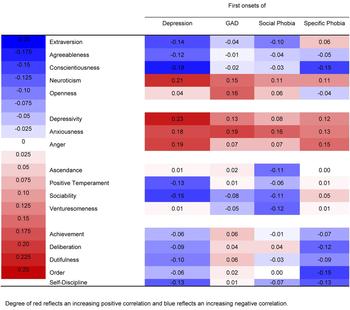
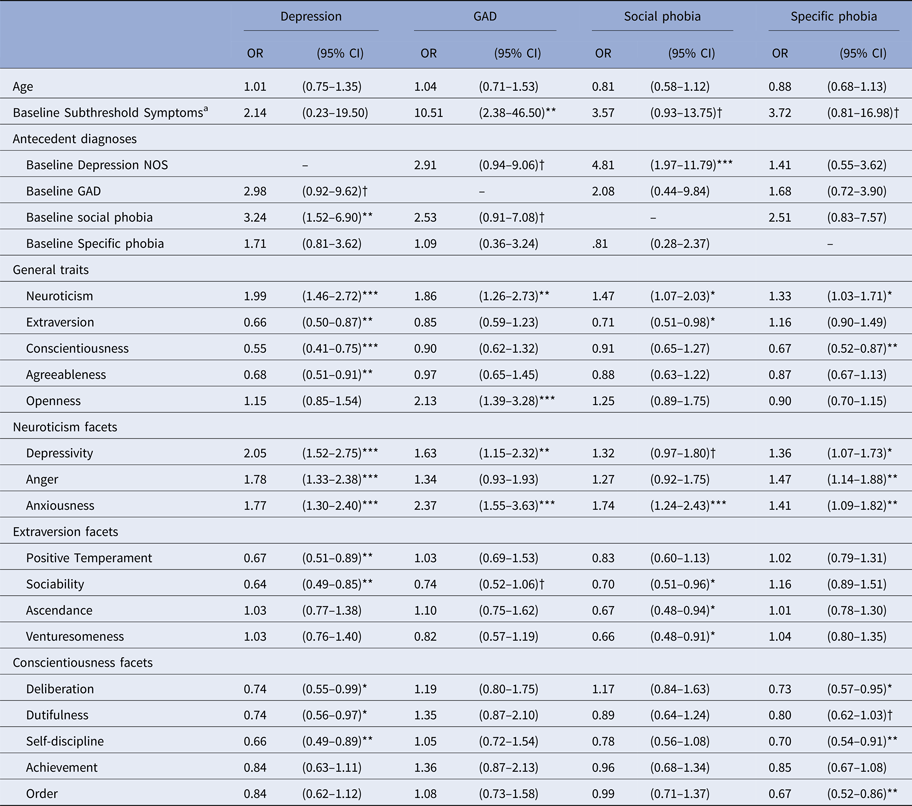
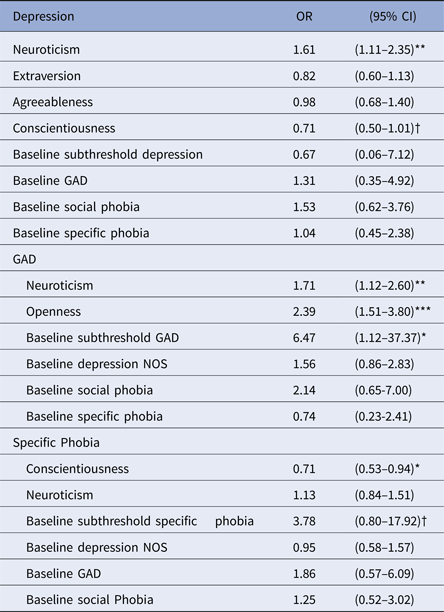
Bivariate results can be found in Table 1 and Fig. 1. At the level of general traits, the first onset of depression was predicted by higher neuroticism, and lower extraversion, conscientiousness, and agreeableness. To examine independent effects of general traits on first onset of depression, we conducted a multivariate analysis with traits and baseline clinical risk factors as covariates. Only neuroticism was a unique predictor of first onset of depressive disorders (Table 2).
Point-biserial correlation effect sizes for associations between traits, facets, and first onsets of depression and anxiety disorders.

Big Five traits, facets, demographic, and clinical predictors in adolescents who developed first onsets of internalizing disorders compared with adolescents never diagnosed with internalizing disorders over the 18-month follow-up

†p < 0.10, *p < 0.05, **p < 0.01, ***p < 0.001 Continuous predictors (age and personality variables) were standardized z-scores. OR = odds ratio, CI = 95% confidence intervals.
a Baseline subthreshold diagnosis indicates that symptoms were present at baseline, but not enough for a diagnosis and this variable corresponds to the diagnostic outcome at follow-up for each disorder (i.e. subthreshold depression at baseline predicting follow-up first onset of depression).
Logistic regressions of baseline clinical predictors and general personality traits on first onsets of depressive and anxiety disorders over the 18-month follow-up

†p < 0.10, *p < 0.05, **p < 0.01, ***p < 0.001; OR, odds ratio; CI, 95% confidence intervals.
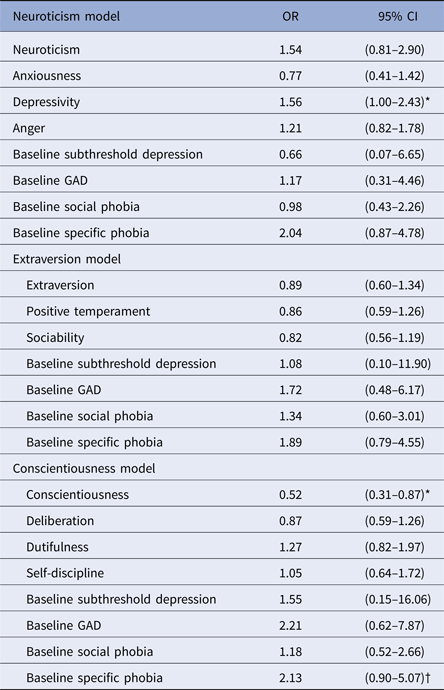
At the facet level, bivariate analyses revealed that first onset of depression was significantly predicted by all three facets of neuroticism – depressivity, anger, and anxiousness. Of the extraversion facets, low positive temperament and sociability predicted depression onset, but ascendance and venturesomeness did not. Of the conscientiousness facets, low self-discipline predicted first onset of depression, low deliberation and dutifulness were significant at a trend level (p < 0.05) and achievement and order were not associated. We then conducted three multivariate logistic regressions to examine unique associations in which facets identified as significant in bivariate analyses were entered along with their corresponding general trait and clinical covariates in predicting first-onset depression (Table 3). These are highly conservative analyses, as they partial out all variance shared with the general trait, all the other facets, and baseline subthreshold symptoms and other internalizing disorders. For neuroticism, only depressivity exhibited a unique effect in predicting first onset of depressive disorders. None of the traits or facets was unique predictors in the extraversion and conscientiousness models.
Logistic regressions of facets on first onsets of depressive disorders while controlling for clinical risk factors

†p < 0.10, *p < 0.05, **p < 0.01, ***p < 0.001; OR, odds ratio; CI, 95% confidence intervals.
GAD
In bivariate analyses of general traits, the first onset of GAD was predicted by neuroticism and openness (Table 1 and Fig. 1). A multivariate analysis found that both neuroticism and openness independently predicted first onset of GAD when entered together with baseline clinical covariates (Table 2).
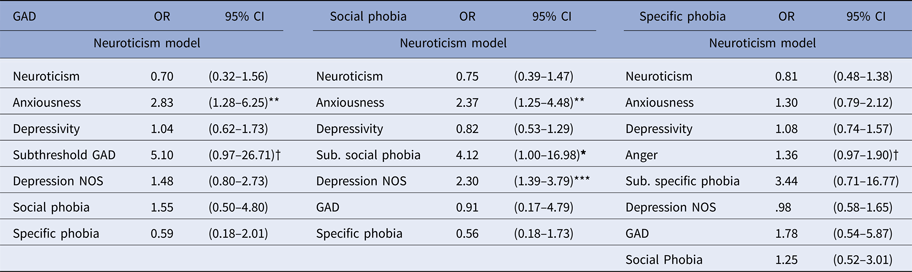
Among the neuroticism facets, first onset of GAD was associated with depressivity and anxiousness, but not anger. None of the extraversion or conscientiousness facets were significantly associated with GAD. We conducted multivariate logistic regressions examining depressivity and anxiousness while covarying the corresponding general trait and clinical risk factors (Table 4). Only anxiousness was a unique predictor of first onset of GAD.
Logistic regressions of facets on first onsets of anxiety disorders while controlling for clinical risk factors

†p < 0.10, *p < 0.05, **p < 0.01, ***p < 0.001; OR, odds ratio; CI, 95% confidence intervals. Sub., subthreshold.
Social phobia
In bivariate analyses of general traits, first onset of social phobia was predicted by neuroticism and extraversion, but only at a trend level (p < 0.05) (Table 1 and Fig. 1); therefore, a follow-up logistic regression was not conducted. Of the neuroticism facets, social phobia was significantly predicted by anxiousness. Of the extraversion facets, ascendance, sociability, and venturesomeness predicted social phobia onset at a trend level (p < 0.05). None of the conscientiousness facets predicted social phobia. We conducted a follow up logistic regression for social phobia first onsets and the domain of neuroticism. Depressivity and anxiousness facets, the general trait, and other clinical risk factors were predictors (Table 4). In the neuroticism model, anxiousness uniquely predicted first onset of social phobia.
Specific phobia
In bivariate analyses of general traits, the first onset of specific phobia was predicted by conscientiousness, and neuroticism showed a trend (p < 0.05) (Table 1 and Fig. 1). When, conscientiousness, neuroticism, and clinical risk factors were included in a multivariate model, only conscientiousness uniquely predicted specific phobia onset (Table 2).
At the facet level, first onset of specific phobia was significantly predicted by anxiousness and anger, with a non-significant trend for depressivity (p < 0.05). No extraversion facets predicted specific phobia. Of the conscientiousness facets, order and self-discipline predicted specific phobia onset and deliberation reached a trend-level of significance. Multivariate analyses of first onset of specific phobia with facets, their corresponding general traits, and baseline clinical risk factors as predictors found that none of the facets were significant independent predictors in either the neuroticism or conscientiousness models (Table 4; conscientiousness model not pictured).
Discussion
Personality is thought to play a major role in the development of psychopathology, but only a limited number of studies have examined whether it predicts first lifetime onsets of internalizing disorders, with particularly few investigating anxiety disorders. Moreover, existing studies have focused on neuroticism and extraversion, and few considered the other Big Five traits, particularly conscientiousness, which has robust cross-sectional associations with most internalizing disorders (Kotov et al. Reference Kotov, Gamez, Schmidt and Watson2010). Even less is known about relationships at the facet level. In fact, only one study examined contributions of facets to first onsets of internalizing disorders and it was limited to neuroticism (Zinbarg et al. Reference Zinbarg, Mineka, Bobova, Craske, Vrshek-Schallhorn, Griffith, Wolitzky-Taylor, Waters, Sumner and Anand2016). We examined general traits and facets as predictors of first onsets of depressive disorders, GAD, and social and specific phobias over 18 months in adolescent girls. Overall, personality traits contributed significantly to prediction of first onsets of internalizing disorders over and above clinical predictors. Additionally, the neuroticism facets of depressivity and anxiousness provided further incremental prediction over and above the general traits.
Consistent with past findings (Wilson et al. Reference Wilson, Vaidyanathan, Miller, McGue and Iacono2014; Hakulinen et al. Reference Hakulinen, Elovainio, Pulkki-Råback, Virtanen, Kivimäki and Jokela2015; Newton-Howes et al. Reference Newton-Howes, Horwood and Mulder2015; Jeronimus et al. Reference Jeronimus, Kotov, Riese and Ormel2016) and our hypotheses, we found that first onsets of depression were predicted by higher neuroticism and lower extraversion and conscientiousness. Additionally, low agreeableness predicted depression onsets, which has less precedent in the literature (Kotov et al. Reference Kotov, Gamez, Schmidt and Watson2010). In multivariate analyses partialling out common variance amongst traits and controlling for clinical risk factors, neuroticism was the only general trait to uniquely predict first onsets of depression.
In bivariate analyses, a number of neuroticism, extraversion, and conscientiousness facets predicted first onset of depression. In particular, all neuroticism facets and lower positive temperament and sociability predicted depression onsets, which is consistent with the limited research available (Naragon-Gainey et al. Reference Naragon-Gainey, Watson and Markon2009; Spinhoven et al. Reference Spinhoven, Elzinga, van Hemert, de Rooij and Penninx2014). We also conducted multivariate analyses examining which facets in each trait domain uniquely predict depression onsets and may explain the general trait–disorder associations. Consistent with our hypotheses and Zinbarg et al.’s (Reference Zinbarg, Mineka, Bobova, Craske, Vrshek-Schallhorn, Griffith, Wolitzky-Taylor, Waters, Sumner and Anand2016) findings, after controlling for general neuroticism, other neuroticism facets, and clinical risk factors, depressivity continued to account for significant unique variance in predicting first onsets of depression.
Based on prior research (Jeronimus et al. Reference Jeronimus, Kotov, Riese and Ormel2016), we hypothesized that first onsets of GAD would be predicted by neuroticism and low extraversion. While GAD onset was indeed predicted by neuroticism, low extraversion was not significant. However, we found that GAD onsets were also predicted by openness, which was unanticipated and requires replication. Our facet level analyses for GAD were exploratory as there are no existing longitudinal data on this question. We found that the depressivity and anxiousness facets of neuroticism significantly predicted the first onset of GAD. In multivariate analyses controlling for the general trait, other neuroticism facets, and clinical risk factors, anxiousness uniquely predicted first onsets of GAD.
Following past research (Gershuny & Sher, Reference Gershuny and Sher1998), we hypothesized that first onsets of social phobia would be predicted by neuroticism and low extraversion. We failed to confirm these hypotheses, observing only trend-level effects in bivariate analyses. At the facet level, bivariate analyses supported our hypotheses regarding anxiousness (Naragon-Gainey et al. Reference Naragon-Gainey, Watson and Markon2009; Rector et al. Reference Rector, Bagby, Huta and Ayearst2012; Spinhoven et al. Reference Spinhoven, Elzinga, van Hemert, de Rooij and Penninx2014; Watson et al. Reference Watson, Stasik, Ellickson-Larew and Stanton2015a). After controlling for the relevant general trait and clinical risk factors, anxiousness continued to uniquely predict first onsets of social phobia. However, our hypotheses regarding extraversion facets were not supported, with several extraversion facets reaching only trend levels of significance.
Finally, in bivariate analyses, first onsets of specific phobia were predicted by conscientiousness, which was consistent with prior cross-sectional evidence (Kotov et al. Reference Kotov, Gamez, Schmidt and Watson2010); however, the effect of neuroticism on first onset of specific phobia was only a non-significant trend. In a multivariate model, conscientiousness continued to contribute unique variance in predicting onsets of specific phobia. Although there are few data on the association between facets and specific phobia, our results were consistent with prior evidence of links with neuroticism facets (e.g. anxiousness, depressivity, and anger; Bienvenu et al. Reference Bienvenu, Samuels, Costa, Reti, Eaton and Nestadt2004), and we observed novel associations with conscientiousness facets. However, these facets did not explain unique variance over and above their corresponding general traits and clinical risk factors in predicting specific phobia onsets.
Our results demonstrate the importance of considering personality facets in developmental models of internalizing psychopathology. Specifically, our findings indicate that neuroticism-internalizing disorder associations may arise from distinct pathways that are better captured by facets than by general traits. Thus, first onsets of depression and GAD were predicted by neuroticism. However, in multivariate analyses, depressivity was a unique predictor of depression, whereas anxiousness was a unique predictor of GAD and social phobia. Personality has been proposed to distinguish between disorders, but past research suggests that traits at the higher domain level are not effective for detecting the emergence of specific expressions of psychopathology (Ormel et al. Reference Ormel, Rosmalen and Farmer2004). Our results suggest that depression and anxiety may differ at the facet level of neuroticism prior to onset, which may have implications for understanding etiological differences. Additionally, there is a trend to study constructs at multiple levels of analysis, but this might be difficult to do with heterogeneous traits. Facets may be useful for helping to break down individual differences into more tractable components that may more easily bridge to biobehavioral systems. In addition to refining understanding of etiopathogenesis, facets may be useful as targets for intervention in translational models that emphasize personality (Zinbarg et al. Reference Zinbarg, Uliaszek and Adler2008; O'Leary-Barrett et al. Reference O'Leary-Barrett, Castellanos-Ryan, Pihl and Conrod2016). For instance, behavioral activation might be the best intervention for those with high levels of depressivity, whereas exposure might be emphasized for those with high levels of anxiousness. Future research should explore differential prediction of treatment efficacy as a function of facets (e.g., Bagby et al. Reference Bagby, Quilty, Segal, McBride, Kennedy and Costa2008).
This study has many strengths including a longitudinal design and large sample at a critical developmental period, focusing on first lifetime onsets of four common internalizing disorders, examining personality at both the general and facet level, and controlling for pre-existing subthreshold symptoms and other internalizing disorders. Our finding that depressivity uniquely predicts first onset of depression is consistent with a recent study (Zinbarg et al. Reference Zinbarg, Mineka, Bobova, Craske, Vrshek-Schallhorn, Griffith, Wolitzky-Taylor, Waters, Sumner and Anand2016). However, to our knowledge, the present study is the first to examine all five general traits and the facets of extraversion and conscientiousness and to adjust for clinical risk factors in predicting the first onsets of both depression and anxiety disorders.
Our study also had limitations. First, similar to most of the literature, we relied exclusively on self-report personality inventories. Future studies should incorporate other methods such as informant reports and momentary assessments. Second, we did not include facets of agreeableness and openness, as prior studies have not found strong links between these general traits and internalizing disorders (Kotov et al. Reference Kotov, Gamez, Schmidt and Watson2010). Third, a consensus on the structure of personality at the facet level does not yet exist (Naragon-Gainey & Watson, Reference Naragon-Gainey and Watson2014), so we may have excluded facets that others would consider important. Unfortunately, this will be a limitation for all studies in this area until a consensus facet model is established. Fourth, participants were still early in the risk period for onset of internalizing disorders; hence, some non-cases will have onsets in the future. Therefore, our findings may underestimate the effects of personality on onset of psychopathology. Fifth, it is likely that by excluding participants who screened positive for a history of depression prior to the initial assessment, we may have eliminated some cases with the strongest trait vulnerabilities, thereby attenuating the size of the effects. Sixth, we cannot generalize these results to more socioeconomically and racially diverse samples, males, younger children, adults, or clinical samples. Seventh, our multivariate models were quite conservative due to the inclusion of many competing personality and clinical covariates. Also, multivariate models with many correlated predictors must be interpreted cautiously as small changes can influence results. However, these models were necessary to attempt to disentangle common variance among higher (general trait) and lower (facet) levels of the personality hierarchy. Eighth, as the sample is relatively young, many first onsets of depression did not meet full criteria (Depression NOS), but were included as there is evidence that minor depression is a highly robust predictor of future onset of MDD (Cuijpers et al. Reference Cuijpers, de Graaf and van Dorsselaer2004). Ninth, our primary aim was to examine personality–psychopathology associations within diagnostic categories. We could not address the specificity of traits or facets between disorders, as we would have had to exclude all subjects with a baseline condition (N = 148). This is a considerable reduction in sample size and also would bias the sample in favor of resiliency. Lastly, as our primary aim was to examine predictors of internalizing disorders, we are unable to draw conclusions about other forms of psychopathology, such as externalizing and psychotic disorders.
The aims of this study were to determine which general traits and facets of personality predict first onsets of internalizing disorders and to examine whether facets contribute unique variance over and above their corresponding general trait. This study was intended to clarify which facets within a particular domain may explain longitudinal associations between general traits and disorders. We found that several general traits and facets predicted onsets of depressive and anxiety disorders, and that most were consistent with past results from cross-sectional research, as well as the limited number of longitudinal studies. Most notably, even after controlling for neuroticism, depressive disorders were uniquely predicted by depressivity, and GAD and social phobia were uniquely predicted by anxiousness. Traits at the general level may be useful for broad research questions and interventions, whereas facets can contribute to understanding why psychopathology is expressed in one form rather than another, and for developing more precisely tailored interventions.
Supplementary material
The supplementary material for this article can be found at https://doi.org/10.1017/S0033291717002719.
Acknowledgements
This work was supported by the National Institute of Mental Health (R.K., grant number RO1 MH093479).