Far away in the frozen lands beyond the northern forests the Lapps, a Mongolian people, had drifted westward as far as Lapland, but they played no part in the main current of history (H. G. Wells Reference Wells1922: 233).
Swedish dogs! <spits> Your blood is tainted by generations of race mixing with Laplanders! You're basically Finns (“Advanced Gay,” Community, NBC Television, 3 Nov. 2011).
In the earliest description of the races of the world, Frenchman François Bernier described four: Europeans, Africans, Asians—and Lapps (Reference Bernier2001 [1684]). In a letter to Bernier praising this “New Division of the World,” the philosopher and statistician Gottfried Wilhelm von Leibniz recounted how he too had heard that “a certain traveler had divided humans into certain tribes, races, or classes. He gave one particular race to the Lapps and Samoyedes” (Bernasconi Reference Bernasconi2001b: 13). For centuries, Lapps provoked anxiety and fascination among Swedish rulers and philosophers from Kant to Rousseau. Yet despite the fame of its Lapp population, Sweden became the model of a homogenous, modern nation-state. H. G. Wells's breezy dismissal notwithstanding, the Lapp category played a key part in the development of anthropometric techniques and European notions of race and population.
This essay problematizes Swedish homogeneity through a case study of the interrelationships among the science of “lappology,” the Swedish state, and Swedish nationhood. For centuries, Lapps were understood as the nomadic reindeer herders of Lapland in the Nordic Arctic regions of Norway, Finland, and Russia. Today, however, the Lapp category no longer exists; it was replaced in the 1980s by Sámi/Saami, a category of self-identity that recognizes their indigenous sovereignty and diverse cultural and economic pursuits.
This rise and fall of the Lapp classification helps unpack the nation-state concept: how did nations come to conceive of themselves as homogenous despite widespread awareness of minorities within their state borders? Homogeneity is one of the defining features of the modern nation-state (Anderson Reference Anderson1983; Gellner Reference Gellner1983), an ideal that was widely shared in a world society of shared norms and convergent institutional forms in the eighteenth and nineteenth centuries (Meyer et al. Reference Meyer, Boli, Thomas and Ramirez1997; Wimmer and Feinstein Reference Wimmer and Feinstein2010). As multiethnic empires crumbled, many central state functions were developed to assimilate internal others to achieve homogeneity, whether linguistically (Weber Reference Weber1976), ethnically (Brubaker Reference Brubaker1992), militarily (Mann Reference Mann1993), economically (Pred Reference Pred1995), or bureaucratically (Scott Reference Scott1998).
We know relatively little about how national feelings took on ethnic characteristics, however, obscuring Western Europe's particular successes in creating national ethnicities. Scholars have long recognized that the categories of race, ethnicity, and nationality are so contextually dependent as to make formal distinctions impossible. Until recently, though, few scholars explored their interrelationships, located as they are in different fields (Brubaker, Loveman, and Samtov Reference Brubaker, Loveman and Samtov2004; Lie Reference Lie2004; Wimmer Reference Wimmer2008).
I focus on the science behind ethnoracial classification—the measurement of population categories to inscribe the boundaries among castes, races, ethnicities, or nationalities. My project employs the paradoxical case of Sweden to demonstrate the role scientists played in constructing the homogenous ethnic nation and coupling it to the state. Sweden was one of the earliest countries to construct a homogenous nation, one admired by progressives and fascists alike. Its racial identity was crafted by means of, not despite, the fame of its Lapp minority. Furthermore, Lapps were the medium through which Swedish scientific entrpreneurs constructed their country as cosmopolitan and European, projecting national influence abroad long after Sweden had lost geopolitical power. The nation-state ideal was only accomplished by tremendous amounts of scientific labor, bureaucratic work, and national forgetting. Thus the ethnically pure Sweden became classified in both senses: categorized, and encrypted.
Rather than explaining how Sweden came to conceive of its homogeneity, however, contemporary scholars have routinely accepted it, letting that homogeneity explain Sweden's political stability, lack of Feudalism, muscular welfare state, gender egalitarianism, and/or peaceful incorporation of immigrants (e.g., Baldwin Reference Baldwin1989; Ruth Reference Ruth1984). This has parallels in the general acceptance of the term nation-state, which scholars rarely dissect to learn how this unwieldy compound was made real in practice.
Sweden's homogeneity was never a foregone conclusion. The Swedish Empire of the seventeenth century was a multiethnic Baltic conglomeration, incorporating portions of today's Poland, Germany, Estonia, Latvia, Norway, Denmark, Russia, and colonial toeholds in Ghana, Togo, and the United States. Until 1812, Finland was integral to the Swedish realm, as a vast population of non-Indo European language speakers ruled by a local Swedish aristocracy. Roma, Jews, and Russo-German tinkers brought trade and also provoked anxiety (Rogers and Nelson Reference Rogers and Nelson2003), while major export industries depended upon Wallonian immigrants (Buttimer and Mels Reference Buttimer and Mels2006: 12). The imagined homogeneity of Sweden was doubtful even in the early twentieth century because peasants and other recalcitrant folk groups were embarrassments to modern nation-builders (Pred Reference Pred1995).
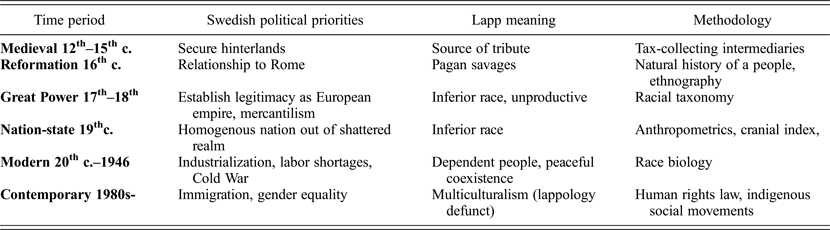
Lapps posed endless puzzles for scientists trying to measure the nation and guide state rule. As Swedish geopolitical considerations shifted, Swedish scientists redefined the content of the Lapp category. These shifts prompted methodological innovations to refine the empirical bases for distinguishing Lapp from Swede. In different historical periods, defining the Lapp was a means to secure Lapland against claims from rival powers, a defense of Swedish Europeanness, a justification for colonization of the region; and finally the foil against which to imagine a homogenous population of ethnic Swedes (see Table 1).
Contexts and Contents of Swedish Lappology

Scientific knowledge about Lapps was produced during five periods: the Reformation, the Enlightenment years when Sweden was a great power in Europe, the nineteenth-century disciplining of the social sciences and formation of nation-states, the twentieth-century wars both hot and cold, and the human rights era beginning in the 1980s. In 1938, these efforts were formalized as the interdiscipline of “lappology.” Three archives testify to its influence: the degree to which Lapps remained key figures to test anthropological ideas, the remarkable lineage of Swedish innovation in ethnoracial classification, and the international diffusion of these techniques.
NATION-STATE SCIENCE
In what follows, I trace a genealogy of lappology through its primary documents, synthesizing insights from Foucaultian biopolitics, state theory, and social studies of science and technology (STS). Lappology (a) distinguished Swedes from what they were not, in part by (b) creating and successfully transmitting scientific knowledge to international audiences. When Swedish scientists explicitly defined the Lapps, they implicitly defined them according to Swedish state concerns. This process was sensitive to meanings ranging from the geopolitical situation of Sweden, the internal domestic meanings of ethnoracial groups, and the norms of international scientific practices.
For lappology and all social sciences, the epistemological referent is the nation-state itself—as in state-istics (e.g., Woolf Reference Woolf1989). Since Max Weber, the role of science has been conceived as an intrinsic function of the modern state (Carroll Reference Carroll2006; Jasanoff Reference Jasanoff2004), with national and sub-national populations conceived out of government funding for universities and scientific associations (Bruce Reference Bruce1988; Gabler and Frank Reference Gabler and Frank2005). Population measurements and ethnoracial classifications bound the peoples of the nation across space and time as surely as did railroads, canals, and telegraph lines, and helped social scientists marshall the human resources of a country while physical scientists helped exploit natural resources (e.g., Carroll Reference Carroll2006; Charland Reference Charland1986; Mukerji Reference Mukerji2009). In science and technology studies, this reflexivity between the goals of scientific inquiry and the social conditions that undergird them is expressed by the concept of co-production, which describes the reflexive relationship between the development of instruments of perception and the data they produce (Jasanoff Reference Jasanoff2004).
As a conceptual device, “the Lapp” was always embedded within the epistemic culture of the Swedish nation-state: the national feeling and social connections of Swedish scientists, state funding for race science, and Sweden's relative political power in Europe. Knowledge about the Lapps—even in the late twentieth century, and even that produced by non-Swedes—was co-produced with knowledge about Swedes in particular and Europeans generally.
I introduce the term “nation-state science” to capture this scientific coproduction of state and nation by the means of ethnoracial classification. A key finding of science and technology studies is that “international” science bears the imprint of national interests: “commitments to nationalism and internationalism in late nineteenth-century science were not mutually exclusive but could operate in a highly synergistic manner” (Manias Reference Manias2009: 733). The human sciences co-produced the concepts and tools by which the populations were conceived and the state was built, while the state was a key funder of some scientific questions over others. STS scholars have described this as “scientific nationalism” (Mizuno Reference Mizuno2010; Sörlin Reference Sörlin, Bravo and Sörlin2002; Wang Reference Wang2002), “national science” (e.g., Crawford Reference Crawford2002; Pruna Reference Pruna1994), or “methodological nationalism” (Chernilo Reference Chernilo2011). As these variations suggest, however, STS does not systematically or consistently distinguish between national cultures, state architectures, and their ethnoracial effects. The concept of “nation-state science” captures the scientific work that helped imagine a national population fitted to state borders.
Michel Foucault is credited with originating the term biopower to describe this fusion of techniques of government to control bodies and populations. Population management as a state goal implicates the production of knowledge in the human sciences: the very conditions in which humans could be both the subject and objects of scientific inquiry were grounded in the conditions of rule (Foucault Reference Foucault1970). Lappologists participated in such an “anatomo- and bio-politics,” scrutinizing Lapp bodies to understand and control the domestic population (Foucault Reference Foucault1978: 140–41). But Foucaultian understandings of biopolitics fall short in not explicitly considering the international contexts of domestic population governance.
This was the original context of the word biopolitics, a word coined not by Foucault but by early-twentieth-century Swedish political scientist Rudolf Kjellén. He introduced the term in a 1916 work as the explicit counterpart to geopolitics, another term he invented that gained wide adoption (Lemke Reference Lemke2011). For Kjellén, the struggles among states for resources—geopolitics—was paralleled by competition among domestic populations. Epistemology, embedded within national cultures and international scientific norms, co-produces ontology—the realities of the nation, the state, and science itself. Nation-state science reclaims this original, explicit union of biopolitics and geopolitics since both have been embedded in cosmopolitan scientific practices, such as Lapp ethnoracial classification.
The next section details the development of ethnoracial classification as an important practice of nation-state science, and shows how shifts in Sweden's political position were accompanied by shifts in the interpretations and techniques of lappology. This illuminates the roles played by both nation and state in the epistemic culture of social science. I describe how methodological innovations are prompted by mismatches between the external, geopolitical concerns of nation-states and the content of their population categories. I also provide a model for understanding the role scientists play in the knowledge-generating capacities of the state.
DOCUMENTING SWEDISH LAPPOLOGY
Lappology's formal institutionalization began in 1938 with the establishment of the Lapp Department at the Nordic Museum in Stockholm.Footnote * This national ethnological (folk) museum is unique in its depicting not only Swedish customs but those of all other Nordic countries as well, founded as it was by the transnational “Scandinavianist” movement during the 1880s. The Lapp Department began publishing Acta Lapponica, an occasional series of conference proceedings, works in translation, and original ethnographic and anthropological monographs. The majority of these were printed in English or German for dispersal to international audiences, though some were foreign works translated into Swedish. The timing and practices reflected the desire to consolidate knowledge about Lapps at a time when the disciplinary boundaries of the specialized humanities, social sciences, and life sciences were firming up (Abbott Reference Abbott2001). “Lapp,” then, functioned as a boundary object that united this broad research program around an increasingly unstable object (Star and Griesemer Reference Star and Griesemer1989).
The timing was also fortuitous because the outbreak of World War II kept Nordic scholars in their own backyard, and so the Lapp Department coordinated research that resulted in an explosion of postwar publications. A similar series from the University of Helsinki, Acta Lapponica Fenniae, joined its sister publication in 1962. The third significant forum for lappology was the Indiana University Publications Uralic and Altaic Series (IUUAS), initiated in 1960 with U.S. government funding for area studies during the Cold War. IUUAS published English translations of works previously available only in Finnish or Swedish, many of which were canonized in the massive cross-cultural database of the Human Relations Area Files (HRAF).
This high-modern crystallization of lappology was short-lived. Sámi political self-consciousness grew through the twentieth century, rejecting the Lapp exonym as pejorative, and claiming domestic and international sovereignty under postwar conceptions of human rights. By 1982, the Nordiska Museet's Lapp Department was renamed the Sámi Collection, and most academic and government documents quickly followed suit. For example, Ernest Manker's 1947 exhibit in the Nordiska Museet, known as “The Lapps,” was re-curated in 1987 as “Sápmi,” the Sámi name for their transnational homeland. Campaigns for sovereignty were bolstered by the 1989 inauguration of Norway's Sámi Parliament, followed by sister institutions in Sweden (1993), Finland (1996), and Russia (2010).
Sweden is an important bellwether for early modern state-building and nationalism, being a “local modernity” that was widely emulated (Stråth Reference Stråth2004). Three characteristics make it especially suited to revealing nation-state-scientific transformations in the longue durée. First, Sweden was a sixteenth-century early mover in administrative centralization, and experienced several transitions in state capacity and national imagining without disruptive internal political revolutions. Second, its early, centralized state garnered the wealth that permitted great advances in sciences and administration, which in turn allowed a small nation with meager colonial experience to participate in Enlightenment racial theorizing. Lastly, the country's early-nineteenth-century imperial dissolution laid the conditions for the rump state to be reconceived as homogeneous, which focused population concerns upon internal others, including Jews, Roma, and Finns, but especially the Lapps.
Sweden's innovations of ethnoracial categorization included the first population register, the first institute for genetics, as well as the establishment of attention-grabbing international prizes for scientific achievement. As we will see next, lappology directly stimulated many scientific techniques that became widely adopted in the human sciences, including ethnography, the cranial index, race biology, and national genetics.
LAPPOLOGY: NATION-STATE SCIENCE
Securing the North through Tribute (Twelfth–Sixteenth Centuries)
The earliest references to Lapps classify them according to livelihood rather than their linguistic or cultural affinities, a category with the practical, occupational character of a caste. They first appear in twelfth to thirteenth-century court records as hunter-fishers whose nomadism posed challenges to taxation for the proto-kings of Scandinavia and northern Russia. Since Lapps could not be taxed by ordinary means, early Swedish kings instituted indirect rule by creating a caste of tax collectors. Each of these birkarlar “had his own Lapps, obliged to pay taxes to him, and they were hereditary in his family” (Itkonen Reference Itkonen1962: 56). Many Lapp groups paid tribute to more than one power, since there were incomplete and overlapping sovereignties in a Lapland “characterized by processes of accommodation, cultural exchange and demographic mixing” (Broadbent Reference Broadbent2010: xi–xii). Taxes were paid in multiple forms, due to the diversity of Lapp economic activities and their contacts with many Nordic trading networks, involving fur trapping, wild reindeer products, fishing, and coins (Mulk Reference Mulk and Äikäs2009; Vahtola Reference Vahtola, Kulonen, Seurujärvi-Kari and Pulkkinen2003).
Sweden's post-reformation state provided the administrative apparatus for direct rule. King Gustav Vasa seized the administrative architecture of the Catholic Church, and used its clergy and population records to institute direct taxation. This centralization of state authority gave sixteenth-century Sweden the ability to wage war on an unprecedented scale, and it briefly established an empire encircling the Baltic sea, and colonial toeholds on three continents (Lockhart Reference Lockhart2004; Tilly Reference Tilly1992; Wittrock Reference Wittrock2004). Gustav I also claimed all the Lapps as subjects, a territorial grab formalized by his son Karl IX, who added the title “King of the Lapps in the Northlands” to the crown (Kvist Reference Kvist and Kvist1992).
Though researchers dispute the origins and causes of reindeer pastoralism (see Sommerseth Reference Sommerseth2011), the practice had largely replaced hunting-gathering by the time of Swedish state expansion in the sixteenth century. This period is marked by a further transition to large-scale herding (Lundmark Reference Lundmark2005; Sommerseth Reference Sommerseth2011: 115, 124; Wallerström Reference Wallerström2000). Crown bailiffs actively prevented Lapp seasonal sedentarism, promoted mass reindeer herding, and barred Swedes from settling in Lapp lands. Thus the iconic feature of Lappishness—nomadic reindeer pastoralism—was the product of contact with the Swedish state (Wallerström Reference Wallerström2000). This caste designation of Lapps was subsequently forgotten as occupation was conflated with cultural group. Also forgotten were the centuries of demographic mixing. This romantic definition of Lapp was enforced from 1762 onwards by removing Sámi from their land if they lost their reindeer herds, for example, or by taxing ethnic Sámi fisherfolk on the Norwegian coast as Finnar (Finns) (Kvist Reference Kvist and Kvist1992: 68). In Sweden, Sámi who converted to Christianity were permitted to own land, and gained the status (and tax categorization) of ordinary Swedes. Until Sámi was recognized as a minority language in Sweden in 2000, only reindeer herders were directly recognized by the Swedish state as Sámi.
Reformation through Pagan Savages (Sixteenth Century)
The Protestant Reformation prompted the authorship of the first natural history of a people. Natural histories were the transitory form of knowledge production between Classical scholarship and what we today recognize as social science (Farber Reference Farber2000; Foucault Reference Foucault1970; Harris Reference Harris1968). By incorporating folktales, hearsay, and travelers' reports into the histories of animals, minerals, and places, humans came to exist not only as subjects—tellers, knowers, authors—but also as objects that might possess their own history to be told by others. The shift to natural histories of populations, the first of which described the differences between Swedes and Lapps, opened the way to a science of man as a strategy to lay claim to northern territories and peoples.
“The History of the Northern Peoples and the Nature of Things” (Historia), the first natural history of a people, was penned by the last Catholic Archbishop of Sweden, Olaus Magnus, from his exile in Rome (Magnus Reference Magnus1972 [1555]). There he discovered that the Church was so ignorant about Sweden that they excluded it from civilization. Magnus spent his remaining years trying to raise an Italian force to reconquer Scandinavia for Catholicism (Johannesson Reference Johannesson1991). His first salvo was the Carta Marina, the first accurate map of Scandinavia. Because it failed to provoke the Vatican to attempt a re-conquest, Magnus then produced the multivolume Historia to explain and elaborate on the map's promises.
Both the map and the Historia bear continuity with Classical scholarship, depicting a haphazard collection of customs, resources, heraldic devices, and landforms. Where the Historia broke with tradition was by including people as objects of knowledge. Swedes were valuable to the Church, he wrote, because of their heroism in war, while Lapps were wanton pagans. The Carta Marina and Historia were a multimedia provocation to reclaim worthy Scandinavian souls and convert or punish savage sorcerers.
Though the Historia failed as a goad to political action, it sold well. The Vatican, beset by the Reformation, had no resources for a faraway kingdom, and Magnus died the last archbishop of Sweden and the only one to have never governed there. Penned in Latin, it was a bestseller widely translated into vernacular languages, especially in selections that focused on Lapp sorcery. Magnus' lurid descriptions of the reindeer-hide drums by which shamans communed with Satan established the Sámi drum as a prize collector's item for curiosity cabinets around Europe (Keil Reference Keil and Kusmenko2004). Collectors were secured a steady supply by their confiscation and sale by the same missionary apparatus that Gustav Vasa appropriated to tax and convert the Lapps. These missionaries—many themselves Sámi—were the authors of ethnographic descriptions of Sámi culture, the first systematic ethnography of a people.
The Historia's success spawned the enduring connection between sorcery and peoples of the north (Moyne Reference Moyne1981), a libel that demanded rebuttal as Sweden became a great power (1561–1721). Where tax documents defined Lapps as a caste, the Historia framed them as pagans and Swedes as Catholic redeemers, should the Crown be reclaimed from Protestant heresy. The combination of ethnographic details and myths of sorcery makes the Historia the foil for all subsequent accounts of the Lapps, spurring advances in empiricism to rebut its inaccuracies.
Writing Culture for Cosmopolitan Legitimacy (Seventeenth–Eighteenth Centuries)
The first ethnography (Kulonen et al. Reference Kulonen, Seurujärvi-Kari and Pulkkinen2005), Lapponia, by the renowned philosopher and philologist Johannes Schefferus, was an attempt to supercede the Historia (Scheffer [Schefferus] Reference Scheffer1704 [1673]). Drawing further upon ethnographic accounts from Northern clergy, Lapponia was a precociously modern work of national imagining that redefined the Lapps as beneficiaries of Sweden's civilizing influence. Queen Christina's minister of missionary activities commissioned Schefferus to rebut pamphlets that, citing Magnus, attributed Sweden's military successes on the continent to sorcery. Schefferus, as the newly-appointed Professor of Eloquence, contributed to the construction of a glorious Swedish past to match its newfound clout on the continent, finding “antiquity corresponding to this new position” (Ellenius Reference Ellenius1957: 73).
Lapponia was written in Latin for a wide audience, and its title page promised “new information about the origin of Lapps, their superstitions, rituals, food, ways of living, and the animals and metals in their land; all carefully illustrated.” The Lapps, Schefferus made clear, were distinct from the Swedes, true practitioners of witchcraft, and recipients of Swedish religion and civilization. He broke with natural history by using as sources only eyewitnesses who had spent time among the Lapps and spoke their languages (Pulkkinen Reference Pulkkinen, Kulonen, Seurujärvi-Kari and Pulkkinen2003a). Lapponia's runaway success was bolstered by continental interest in the new great power astride the Baltic; it was translated into English (1674), German (1675), French (1678), and Dutch (1682) (the first Swedish translation did not appear until 1956, a product of formal lappology).
Today's Sámi scholars miss this union of ethnography and geopolitics in their dismissal of Lapponia as tainted by the now-discredited lappology (e.g., Pulkkinen Reference Pulkkinen, Kulonen, Seurujärvi-Kari and Pulkkinen2003b). Lapponia did not paint anything like the homogenous picture that Sámi revisionists would charge it with. For example, Schefferus distinguished between the Lapps and the “Finns” (today's Sea-Sámi) (Scheffer Reference Scheffer1704). European readers of Lapponia learned that it was difficult to know the truth about the enigmatic Arctic barbarians even through direct observation, but from contrast they learned what the Swedes were not: nomadic, superstitious, uncivilized, wretched, war-hating, weak, or enigmatic. Schefferus' correction was not a homogenization of the Sámi, but of the Swedes. He told his European audiences about a cosmopolitan nation of Christian heroes, and obscured the hardscrabble peasant lives of the vast majority. Lapponia-toting travelers to the north were at such pains to prove the authenticity of their travels that they cribbed freely from Schefferus' descriptions in their eyewitness accounts of Lapps (e.g., Acerbi Reference Acerbi1802; Rae Reference Rae1875).
Lapponia, while hugely influential, did not displace previous accounts. For instance, the last and most widely read natural history, by Georges-Louis Leclerc the Comte de Buffon, synthesized Schefferus' account with the Historia. Published in French in 1749 and first translated into English that same year, the English title virtually defines how the natural history genre collapsed under the weight of scientific curiosity: Buffon's Natural History Containing a Theory of the Earth, A General History of Man, of the Brute Creation, and of Vegetables, Minerals, &c. &c. &c (Buffon Reference Buffon and Barr1810 [1749]). Buffon followed Bernier in classifying Lapps as one of the six human races along with Tartars, South Asians, Ethiopians, Europeans, and Americans. Yet he merely incorporated Schefferus' truth alongside its predecessors.
To Enlightenment philosophers like Buffon, Lapps defied categories of citizen and state that were only then becoming scientifically and politically concrete. While other races had empires, the nomadic indigeneity of the Lapps gave them no raison d'etre in the Enlightenment's politics of nature. Buffon placed Lapps with Native Americans at the bottom of his racial hierarchy, citing the degeneration that occurred in climatic extremes.
Yet Buffon, a mercantilist concerned with marshaling the economic productivity of domestic populations, was disturbed by the Lapps' hardiness. He wrote, “Though they seem to be of a degenerate species they yet are numerous, and the countries they occupy are extensive” (ibid.: 191). Ledger columns in Sweden's national population register grouped unproductive citizens together: prisoners, paupers, and Lapps (Axelsson Reference Axelsson2010). In the face of physical and environmental disadvantages, the hardy Lapps aged with grace despite the harsh climate: “Under all these hardships they are subject to few diseases, and they live to a prodigious age. So vigorous indeed are the old men, that they are hardly to be distinguished from the young” (Buffon Reference Buffon and Barr1810 [1749]: 197). “Useless in warfare,” they nonetheless performed prodigious feats: “Laplanders launch a javelin with so much dexterity, that at the distance of thirty paces they are sure to hit a mark no larger than a silver crown, and with such force, that it will transfix a human body” (ibid.: 195). Worst of all, Lapps passed seamlessly through three kingdoms, immune to conscription or taxation. At a time when the art of government was to maximize domestic resources, the liberty and unproductiveness of the Lapps was disconcerting.
Despite the clarity with which their ethnographers depicted them, Lapps were easily confused with other northerners in practice. In contrast with Lapponia's images of heroic Swedes, poor Swedes were easily mistaken for Lapps, even by census takers: “One of the forms submitted to the Central Bureau of Statistics in the 1860s remarked that it was difficult to differentiate Saami from Finns and Swedes in parts of the far North” (Rogers and Nelson Reference Rogers and Nelson2003: 66). Benjamin Franklin, that cosmopolitan scientist par excellence, described Swedes as having a “swarthy complexion” (Reference Franklin and Bigelow1887 [1751]: 234). Even the Swedish gentry who settled the Crown territories were mistaken for Lapps by foreign observers.
One of the most documented confusions of Swede with Lapp was the scandal of Pierre-Louis Moreau de Maupertuis. Carrying a copy of Lapponia, he led a celebrated scientific expedition to Lapland in 1736 to test Newton's hypothesis that the earth would be flattened at the Poles. While there, he apparently promised a “Lapp maiden” marriage in exchange for some “pleasurable evenings,” and his frank letters to Parisian friends about his love affair caused a sensation (Terrall Reference Terrall2002: 142). De Maupertuis marked his triumph with a portrait of himself in Lapp dress (ibid.: 161–63). His conquest turned to humiliation when the “Lapone” and her sister arrived in Paris months after he had returned in triumph. Voltaire parodied Maupertuis in verse, and saloneuse and novelist Françoise de Graffigny complained, “All Paris is going to his house to see these Lapp women. My God, how could one possibly be a Lapp?” (ibid.: 144). De Graffigny's disdain was due to the women's dowdy appearance that disappointed expectations of skin-clad exotics. Though always called Lapones, they were, he confessed later, “young Swedish ladies,” and daughters of the rector of Torneå (ibid.: 145).
Within decades, Sweden lost most of its multiethnic empire. Its alliance with the doomed Napoleon meant crushing reparations and wrenching national reorientation. The loss of Finland, an integral part of the Swedish realm since the twelfth century, split the realm in half. The transfer of Pomerania to Prussia ended three hundred years of Swedish lands on the continent. As one historian summarized, “The old Sweden had, without really understanding how, become the new, monolingual, monocultural nation-state we have known since then” (quoted in Hecker-Stampehl Reference Hecker-Stampehl2005: 350).
Measuring a Homogenous Nation: Linneaus, Racial Taxonomy and Anthropometry
Carl Linnaeus decisively marked a turning point in how the Lapps were perceived: from being challenges to border maintenance they became symbols of domestic racial impurity. Over a century before Darwin, Linnaeus had first and decisively linked humans to apes and the rest of the natural world (Hrdlïka Reference Hrdlïka1940). He was a bitter opponent of Buffon, whose natural history he supplanted with taxonomic empiricism (Eddy Reference Eddy1994). Historians of science and postcolonial scholars often cite Linnaeus for his model of the human races: Homo rufus (red American), Homo albus (white European), Homo luridus (yellow Asian), Homo niger (black African), and Homo monstrosus. It was in the last, in the subtype Alpini, that he placed the Fennones, as he called the Lapps. They shared this Alpini category with cyclops, Trodgolytes, and Pygmies.
The four-color categorization marks Linneaus' continuity with ancient ideas, but the Monstrosus category asserts his own theories about the effects of climate and hybridization on species (see Frängsmyr Reference Frängsmyr1983). It cemented the Lapps' removal from schemata of representative types and was given credence because of his first-hand experience with them—he had depended upon Lapp guides during his single voyage of scientific discovery to Lapland. Though Lapland was considered part of Sweden, Linnaeus dramatized its exoticness: “I seemed entering on a new world; and when I had ascended it, I scarcely knew whether I was in Asia or Africa, the soil, situation, and every one of the plants, being equally strange to me” (Linneaus 1811 [1792]: 284). Extensive notes on Lapp culture and economy appear in his letters to Anders Celsius, chair of the Swedish Academy and onetime astronomer for de Maupertuis, who reprinted them immediately in the Academy's proceedings (Linnaeus Reference Linnaeus1733).
Linnaeus seems to have identified with the Lapps. On his journey to Lapland he collected his famous “Lapp dress” and a confiscated Sámi shaman's drum. Self-portraits of himself in costume appear in his diary, captioned “A Lapland Fantasy” (Blunt 2001 [1971]: 69–70). This costume was fantastic indeed, consisting of a woman's summer coat, a woman's hat, reindeer boots made solely for trade, and Lapp curios strung from the belt (Fara Reference Fara2004: 25–27). The numerous portraits he commissioned of himself wearing it, and the treasured place it occupied on the wall of his Uppsala office for the rest of his life, indicate the important role this Lapp identification played in Linneaus' professional life.
Linnaeus wore the costume when he appeared on physicians' doorsteps in Leiden during his studies there. As a Swedish scientist, Linnaeus was an almost Lapp-like rarity, with his exotic, Swedish-singsong-accented Latin. He quickly gained a wealthy sponsor for his studies, to whom he dedicated the first of the Linnaeus-as-Lapp engravings (see Figure 1). Once he became a newly minted doctor, he diagnosed himself with the Gnostalgie that he believed caused Lapps to die when removed from their homeland, justifying his return to the scientific backwater of Sweden (Koerner Reference Koerner1999: 66–67). There he met his future wife—wooing her in Lapp costume as well (Blunt Reference Blunt2001 [1971]: 80).
Carolus Linnaeus as Lapp, by Hendrik Hollander, 1853. Image permission: Special Collection, University of Amsterdam Museum Portrait Collection
Linnaeus' Lapp costume is more than the foible his biographers dismiss. Through it he embodied exotic Swedishness and the authority to express it to Europeans. Michel Foucault asks, “What conditions did Linnaeus … have to fulfill, not to make his discourse coherent and true in general, but to give it, at the time when it was written and accepted, value and practical application as scientific discourse?” (1970: xiv). Linneaus' authority on the Lapps, like his identification with them, had credence by virtue of his Swedishness and Sweden's long history as the gateway to this primary race of mankind. His Lapp dress underscored the same empiricism that underpinned his taxonomic innovations. His later descriptions of the Lapps as hairy pygmies, so different from descriptions in his diaries, seem to cater to the beliefs of the continental scientists whose recognition he craved.
Linnaeus has, oddly, been praised for his sympathetic treatment of the Lapps (Bernasconi Reference Bernasconi and Bernasconi2001a; Ellingson Reference Ellingson2001: 133) despite his having demoting them to hybrids or mutants. Though he never made scientific excursions outside of his own country (and indeed he only visited the most southern bits of Lapland), he connected his student “apostles” to prestigious round-the-world voyages and installed them in positions of prestige around Europe.
The greatest of Linnaeus' students was Johan Friedrich Blumenbach, the founding father of physical anthropology (Hrdlïka Reference Hrdlïka1940). His training in Uppsala was both a measure of Linnaeus' fame and an indication of how far Swedish institutions had advanced, that a German would study in Sweden. Blumenbach extended Linnaean taxonomy by developing anthropometric techniques to measure population differences. His 1795 edition of De Generis Humani Varietati (On the natural variety of mankind) suggested five races of mankind: Mongolian, Ethiopian, American, Malay, and Caucasian. His enduring description of the white race was based on the beauty of a female Georgian skull in his collection. On her debut, the Caucasian was always much more than a specific skull shape, being an embodiment of racialized beauty from which Lapps were excluded: “Color white, cheeks rosy, hair brown or chestnut-colored; head subglobular; face oval, straight … to this first variety belong the inhabitants of Europe (except the Lapps and the remaining descendants of the Finns)” (1865 [1775]: 265).
Blumenbach's new taxonomy, grounded in measurements as well as older aesthetics, marked a break with natural histories and the emergence of specialized disciplines of comparative anatomy, physical anthropology, statistics, and ethnography, all pioneered in Göttingen at that time. In the third edition, Blumenbach corrected himself and declared that his new measurements showed that the European racial group constituted “the whole of Europe, including the Lapps, whom I cannot in any way separate from the rest of the Europeans, when their appearance and their language bear such testimony to their Finnish origin” (Blumenbach Reference Blumenbach and Bendyshe1865 [1795]: 99). This hypothesis that Lapps were Finns who had degenerated in the Arctic climate was tied up with ongoing debates about their interrelationships, the meanings of primitivity, and the borders of Europe.
Blumenbach's focus on skull morphology represented a increasing focus on the brain as a marker of nationality. Brain weights were tested as a comparative basis for racial differentiation, but were discarded when they did not yield the expected results: “Skulls of Lapps, of pure blood, exhibit weights of brain very nearly equal to those of our [modern] Italians” (Davis Reference Davis1868: 516). The human skull seemed to hold the promise of answering a host of racial puzzles, as evidenced by the blossoming of national skull studies under such titles as Crania Britannica, Crania Americana, and Crania Polonica (Fabian Reference Fabian2010; Jorion Reference Jorion1982).
Craniometry, a field advanced by the Swede Anders Retzius, provided the next major innovation in physical anthropology's contributions to ethnoracial categorization. Retzius was both a student and later colleague of Linnaeus, and his cephalic index became the most widely used measurement in physical anthropology, displacing brain-weights and the discredited phrenology. He trained under another student of Linnaeus, Sven Nilsson, whose archaeological comparisons of Lapp and Swede skulls had already supported Linnaeus' hypothesis about Lapps' pygmy status (1868 [1838]).
The timeline of the cephalic index's development reveals its role in distinguishing the Swedish population from its neighbors. It débuted in a paper comparing Swedes to Finns and Lapps, Sweden's three largest population groups (Retzius Reference Retzius1843), and appeared next in a paper about the Russian Slavs (Retzius Reference Retzius1844), Sweden's arch-nemesis. Less than a decade after the debut of Retzius' cephalic index, Swedish statistician Carl Edvard Ljungberg introduced the idea of a homogenous national population as an important state goal (Axelsson Reference Axelsson2010). Retzius' subsequent assessments of skulls from collections from South Africa facilitated the cephalic index's adoption by anthropologists of other colonial powers. Though these studies were published in Swedish, they were widely acquired, translated, and reviewed by international societies. Retzius found his greatest audience in the German-language summaries in Müller's Archiv, a key resource for nineteenth-century physicians and scientists.
By the 1880s, the cranial index had received the endorsement of Europe's greatest anthropometricians, Paul Broca in Paris and Rudolf Virchow in Berlin. Virchow was a giant of medical pathology and Retzius' own, most celebrated student (Blanckaert Reference Blanckaert1889). Craniometry promised to answer the puzzle of how contemporary primitives were related to the newly discovered fossil Cro-Magnons. Many believed these fossils to be the stone-age ancestors of Lapps, citing Linnaeus' pygmy categorization (Nilsson Reference Nilsson1868; Pruner-Bey Reference Pruner-Bey and Jones1875; see also Schanche Reference Schanche, Fforde, Hubert and Turnbull2004). This Cro-Magnon/pygmy hypothesis suggested that Lapps once lived across Europe and were thus indicators of European racial purity and degeneracy (Manias Reference Manias2009; Wiwjorra Reference Wiwjorra, Díaz-Andreu and Champion1997).
Allegations of Lapp hybridity in European populations provoked scandal. Armand de Quatrefages was the chair of anthropology at France's national Muséum d'Histoire Naturelle, the institution once directed by de Buffon. After France's defeat by Germany in the Franco-Prussian war, Quatrefages published a study simultaneously in French and English (Reference Quatrefages1871; Reference Quatrefages1872) that alleged, “The mixed Prussian race possessed the tenacity and vengefulness of the Finns, the warlike nature of the early Slavs, the fanatical militarism of the medieval Crusaders, and the superficial affectations of the higher culture of early modern France” (Manias Reference Manias2009: 746). Later he broadened his assertions of Finnic-Lapp influences on the Prussians, positing a Lappish type (“type Laponoïde”) whose presence in European populations indicated lower levels of civilization (1875). Citing Retzius and Blumenbach, Quatrefages asserted that the great civilizations showed no Lappish influence, while the Prussians did, and he accused Prussia of deliberately bombing the Museum to destroy the empirical evidence of French racial superiority.
Retzius' cranial index is today dismissed as “an answer for which there was no question” (Lahr Reference Lahr1996: xiii), while racial determinations of the Lapps are called “scientific myths” (Anderson Reference Anderson1962). Such rejections miss the episteme of the nation-state in the development and deployment of anthropometrics. After losing their empire, Swedish scientists developed a tool for scientifically determining the borders of a population just before the 1848 Spring of Nations unsettled the political legitimacy of other European states. Retzius' work to measure the “pure” Swedish nation implicitly fitted it to its truncated borders. This fate soon befell the territorial empires of Austro-Hungary and the Ottomans, and the great maritime empires after World War II.
The late-nineteenth-century imperial appetite for primitives produced a host of creative lappological methods. Live Lapps were exhibited with live reindeer in London shows as early as 1822 (Qureshi Reference Qureshi2011: 87–88), were centerpieces of the Swedish pavilions at nineteenth-century international exhibitions (Stoklund Reference Stoklund1993: 41), and were the hit exhibit that launched Carl Hagenbeck's career as the father of the modern zoo (Livingstone Reference Livingstone2003: 60). They also featured in the earliest attempts to make photography an anthropometric field technique (e.g., Bonaparte Reference Bonaparte1885; Düben Reference Von Düben1873).
Gentleman-explorer Alexander Humboldt van der Horck, a protégé of Retzius' star student Rudolf Virchow, proposed a method for measuring skull capacity in living subjects using plaster casts. He relayed its difficulties to a packed auditorium at the Geographical Society of New York:
Meeting an old Field Lapp (Nomad), a splendid type of his race, I desired very much to take his face. After great persuasion he yielded on condition that I should not cut off his beard. I therefore stuck the stiff, bristly hairs together with flour paste as well as I could, and after generously oiling him covered his face with the gypsum. After it had hardened I attempted to remove it when, to my horror … with it came the greater part of the old man's whiskers. I had scarcely freed him and washed the blood from his face when he sprang forward and furiously grasped my loaded gun which I took from him with difficulty and succeeded in bringing him to terms (Reference Humboldt van der Horck1876: 223).
The popular appetite for Lapps meant that Humboldt van der Horck's talk received page 2 coverage in the New York Times and brought him invitations to join scientific societies in New York and London.
Due to this popular interest, newspaper reporters took note when the British Association for the Advancement of Science debated Lapps' racial classification in 1871: “The position of the Lapps in classification is still an open question. Agassiz classifies them with the Esquimaux and Samoedes. Prichard, relying upon philological evidence—an unsafe guide when taken alone—maintains that the Lapps are Finns who have acquired Mongolian features from long residence in northern Europe; but according to Mr. Brooks, the Lapps and Finns have scarcely a single trait in common.… [Meanwhile] Isaac Vossius says the Lapps are of low stature, and that pigmies exist among them” (New York Times 1871). Similar accounts were published in publications ranging from the Sydney Morning Herald to the Church of England Magazine. It is striking that the Lapps retained their popular appeal well after colonial empires brought other exotic peoples to European metropoles. What escaped contemporary observers was that these “nomads” had only recently been confined within nation-states.
Once an open frontier, Lapland was formally divided in the latter half of the nineteenth century as an influx of miners, loggers, farmers, and railroads intensified conflicts over land (Kvist Reference Kvist and Kvist1992). This curtailed seasonal reindeer migrations, which compelled many Lapps to take a single national citizenship for the first time. Russia-Finland closed the border to Norway in 1852, and this led many “Norwegian” Sámi to register as Swedish so they could continue using their lands in Finland. When Sweden closed the border to Russia-Finland in 1889, many herders took Swedish citizenship to maintain their access to pastures there. Meanwhile, Sweden continued to encourage farmers to settle in Lapland, further incorporating north with south but also increasing contacts between Swedes and Lapps at the height of scientific efforts to separate them.
The Purity of the Nation: Race Biology and the Creation of the “Pure Lappish Race”
The increased proximity of Swedes and Lapps resulted in measures both legal and scientific to distinguish them. The old policies that saw no conflict between farming and Lapp land use crumbled, even as concern grew that the Lapps were disappearing like the world's other native peoples. As a historian summarized this series of legal changes, “The illusion that all Sámi in Sweden were reindeer pastoralists could not be upheld anymore. When the authorities could not change reality, they changed the definitions” (Lundmark Reference Lundmark2007: 15). Late-nineteenth-century parliamentary acts increasingly curtailed the rights of individual Lapps to own land and transferred Lapp privileges to communal village organizations that could only be joined by reindeer herders. These moves confirmed Lappishness as a collective trait and Swedishness an individual one by stripping rights from Lapps who fished, farmed, or worked for wages instead of engaging in collective reindeer herding. Women received their rights through their fathers or husbands, so a village woman who married a Swede, even one who was ethnically Lapp, would lose her Lapp categorization (Kvist Reference Kvist and Kvist1992). Thus a new separation of Lapps from Swedes was established, with different laws, education systems, and police.
Swedish policy from 1913 was characterized by the expression “a Lapp shall remain a Lapp” (Lapp skall vara Lapp). Lapps were forbidden from settling, were confined to reindeer herding, and intermarriage with Swedes was officially forbidden. This state policy kept the old occupational-caste designation of Lapp while continuing to deny any Lapp-Swede hybridity. Swedish innovations in racial science worked to specify this pure Lappish race, while Swedish political science posited Sweden as the ideal nation-state.
In 1916, Swedish political scientist Rudolf Kjellén published his influential book The State as a Living Form, in which he coined the words geopolitics and biopolitics (Lemke Reference Lemke2011: 9–10). Kjellén's works were widely influential in continental political thought, especially in Germany. Geopolitics, the struggle of states for land and resources, found expression in Nazi theorizing as lebensraum. Kjellén defined biopolitics as the study of the state's “ethnic individuality” as shaped by internal social groups' competition and cooperation, in parallel to the international struggles of states (ibid.). He described the nation-state as an organic body whose health determined the area it covered, and whose homogeneity determined its health. This influential framework posed the Lapps as a threat to Sweden, a challenge answered by reaffirming the Lapps as a separate and inferior genetic race.
The first state institute devoted to race biology was in Sweden, not Nazi Germany, eugenic Great Britain, or the Jim Crow United States. Sweden's Statens Institut för Rasbiologi (SIR) was founded in 1922, the result of lobbying by the charismatic industrialist and Nazi sympathizer Herman Lundborg. He had earlier established the Swedish Society for Race Hygiene to promote, in English, “the contributions made by Swedes within the fields of anthropology, race-biology, genetics and eugenics” (Reference Lundborg and Lundborg1921). SIR was located in Uppsala, home in its time to Linnaeus and Retzius, though independent of the university.
Lundborg believed the Lapps were the greatest threat to the Swedish race. Under his direction, SIR's energy was primarily devoted to investigations of the Sámi. The results were published in two massive volumes, the first of which debuted in 1932, the second in 1941. SIR's authority was based upon a retroactive omniscience of the state to explain the preeminence of Swedish genetic research: “In her clerical and parish records, which, ever since about 1750 or somewhat later, have been meticulously kept by the clergy, Sverige [Sweden] possesses material for researches in race biology unsurpassed and inestimable in its completeness and reliability, even when the nomads of the country, the Lapps, are concerned” (quoted in Schough Reference Schough2007 [1957]: 28). On the basis of these reliable records, any hybridization with the Swedish population could be firmly discounted: “The Lapps, however, are extremely homogenous, from a racial point of view, and probably there are few population groups which might be looked upon as a separate race on equally good grounds” (Lundborg Reference Lundborg, Lundborg and Wahlund1932: 31). SIR's racial descriptions were used in foreign relations materials, such as the Swedish Tourist Association brochure that harked back to Blumenbach's aesthetic considerations: “Are the Lapps a beautiful or an ugly people? An indiscreet question requiring a discrete answer…” (quoted in Schough Reference Schough2007: 26). In 1941, the Board of Agriculture declared that Lapps were incapable of farming due to “reasons of racial biology” (Lundmark Reference Lundmark2005).
Justifying the separateness of Lappish and Swedish populations united older projects such as Linnaean taxonomy and Retzius' cranial index with the new race biology. Swedish nation-state science created the Nordic race, the acme for eugenicists in other countries, and demonstrated Sweden's continuing international influence. While the end of World War II destroyed the credibility of race biology, the rise of human rights law and cultural anthropology provided new platforms for Swedish ideals to be communicated via lappology.
Contemporary: Lapps as Peaceful Dependents
Within Sweden, lappology meant the first translation of Schefferus' Lapponia into Swedish by the Nordiska Museet's Lapp Department in 1957, and a year later the Institute for Race Biology was renamed the Institute for Genetics. Gunnar Myrdal played a key role in prying the institute away from racial eugenics toward more moderate population concerns (Broberg and Tyndén Reference Broberg, Tyndén, Broberg and Roll-Hansen2005), though he continued to describe Sweden's population as racially homogeneous in contrast to other countries, including the United States (Ginsburg Reference Ginsburg1992: 45). In texts written by Swedes for international audiences, the meanings attributed to Lapps continued to express Swedish state interests in promoting its social welfare state as a peaceful, cooperative solution to Cold War tensions and decolonization struggles.
Swedish social scientists reimagined the relationship between Lapps and Swedes as a model of peaceful coexistence. In the flagship British anthropological journal Man, a linguist framed the Lapps as a rare case of cultural contact without conflict (Pehrson Reference Pehrson1950). Though Lapps are the “least European of the Europeans,” another lappologist chided, “we have indeed something to learn from the Scandinavians in respect of their wise tolerance of a people with traditions quite different from their own” (Allison Reference Allison1953: 320). Even today, Sweden's official website explains that while Sámi rights are contested nationally, in municipalities “one can find examples of genuine cooperation” between Sámi and Swede (Åkerström Reference Åkerström2011).
A concurrent but related discourse of Lapp advancement reflected Sweden's postwar labor shortage and its labor market strategy of activating domestic labor through education, especially among women. Although few Lapps could recall the folktales and religious formulae of their childhood, the entrance of Lapps into “university research … stands to gain much when Lapp students with scientific qualifications more frequently associated themselves with other lappologists in these tasks” (Hultkrantz Reference Hultkrantz1955: 94). The first to realize this promise was Israel Ruong, the first Lapp to defend a dissertation in Lapp ethnology. He helped found the first agency to represent herders' interests to the state—the first time “Sámi” was used by a state agency. This Svenska Samernas Riksförbund (Swedish [Realm] Sámi Association) still exists, and represents only Sámi who herd reindeer in accordance with the state definition of Sámi as an occupational caste.
The postwar rise of international human rights supported Sámi efforts to name themselves, gradually but successfully redefining “Lapp” as a pejorative exonym. Sámi began to replace Lapp during the latter half of the twentieth century, as Swedish Sámi organized politically and injected their self-definition into public discourse. The first Sámi memoirs—often transcribed by lappologists and framed as auto-ethnographies—appeared in Swedish and were translated into major European languages. A burst of Sámi activism followed parliamentary revisions of national laws on timber and reindeer management in the early 1970s. Stymied domestically, the Sámi helped establish the United Nations Working Group on Indigenous Populations in 1982 and the International Labor Organization's Indigenous and Tribal Peoples Convention of 1989. These established indigeneity as a sovereign force with which nation-states had to contend (Niezen Reference Niezen2000). National Sámi organizations established their own membership definitions that recognized the loss of language and cultural heritage as factors in determining ethnic membership. Swedish state discourse still hewed to the policy that a “Lapp shall remain a Lapp,” but international anthropological texts were increasingly influenced by Sámi self-definitions. Anthropologists, and especially archaeologists, provided support for Sámi claims for land rights and political autonomy beyond Sweden's narrow state definitions (e.g., Broadbent Reference Broadbent2010; Iregren and Isberg Reference Iregren and Isberg1993).
Though lappology became defunct in the 1980s, there are still two official Sámi categories in Sweden: the official one managed by the SSR that administers Sámi rights for reindeer herders, and the cultural understanding that Sámi are a minority within Sweden. This culminated with the removal of state references of Lapps in 1987 and recognition of the Sámi Parliament by the Swedish government in 1989. In 1998, the Swedish state apologized for its past oppression of the Sámi, and reframed them as a part of a multicultural Sweden. In 2000, parliament recognized Sámi as a national minority language, in response to mandates from the European Union and the European Court of Human Rights. This granted the right to Sámi-language education to some children of non-reindeer-herders. Despite these successes, Sámi indigenous land rights were increasingly eroded between 1981–2006 by court cases and parliamentary redefinitions of hunting rights (Borchert Reference Borchert2001). Only in 2011 were the reindeer grazing rights first proffered in the nineteenth century reaffirmed by the Swedish Supreme Court (Allard Reference Allard2011b). Sweden has not acknowledged Sámi indigenous rights to land, however, as called for by the International Labor Organization's Convention No. 169.
The Sámi still occupy an ambiguous position in Sweden's division of labor in the social sciences between domestic (ethnology) and foreign (anthropology). The Uppsala University chair held by Hugh Beach, renowned anthropologist of the Sámi, is named “Professor of Ethnology, Particularly Non-European.” Ethnologists classified Lapps as topics for anthropology (e.g., Izikowitz Reference Izikowitz1959), while anthropologists neglected these domestic citizens as insufficiently indigenous from centuries of contact. This was dramatized in the early 2000s by a grainy illustration on the webpage of Uppsala University's Department of Cultural Anthropology and Ethnology. Over each continent of a map of the world was superimposed a photograph illustrating anthropological subjects: an Aborigine for Australia, a smiling woman with child for Africa, and for Europe, a Sámi man looking west, with his hat filling Russia's Kola peninsula and his coat extending across Spain, Italy and Greece before abruptly disappearing along the Ural Mountains. This image epitomized the trope of the Sámi representing and demarcating Europe amongst global indigenous peoples.
The enduring paradox that Lapps posed for social scientific thought is a function of the category's intimate relationship to Swedish governance, and that it obscures the achievement of Swedish homogeneity. The lappologist was an apologist of the Swedish state, implicitly describing its geopolitics when explicitly describing the biopolitics of Arctic hunter-gatherers. Only when human rights law provided external support for indigenous sovereignty, and the social sciences recognized their own implication with the nation-state, were the Lapps replaced by the Sámi—an autonomous category with the sovereign prerogatives of self-naming and self-rule.
LAPPOLOGISTS: APOLOGISTS FOR SWEDEN
It may be asked whether the Lapps really have a history (Collinder Reference Collinder1969: 13).
It is true that the nomads have no history; they only have a geography. And the defeat of the nomads was such, so complete, that history is one with the triumph of States (Deleuze and Guattari Reference Deleuze and Guattari1987: 434).
This article contributes to the comparative literatures on nation-building, state formation, and science and technology studies by describing the role social scientists played in constructing population categories, a process dependent on geopolitics and scientific practice. Lappology was embedded within webs of meaning that stretched far beyond Sweden: the geopolitics of Sweden versus continental powers, conceptions of nationhood and nationality unleashed by eighteenth- to nineteenth-century revolutions, and the biopolitics of increasingly invasive scientific methods. In this international context, lappologists contributed to the project of defining the Swedish state in terms of the reach of its peoples, even while describing in the minutest detail the physical characteristics of national bodies. Lappology was thus a prime example of Foucaultian biopolitics, measuring Lapp-as-body to demarcate Lapp-as-species (Foucault Reference Foucault2003: 243).
Changing state boundaries, administrative capacities, and national conceptions led to methodological innovations to describe Lapps, from ethnographies to biometrics. Schefferus used the authority of ethnographic details to discredit Olaus Magnus' descriptions of pagan sorcerers. Linnaeus made use of the Lapps but discarded them when his taxonomic system secured his fame. Retzius debuted his craniometric index via Lapps at a time when national homogeneity was desirable. As the nation became framed by its genetic stock, DNA distinguished Swede from Lapp (Müller-Wille Reference Müller-Wille and Golinski2004). Earlier empirical measures are framed as failures because they simply assumed what they were trying to explain: that Lapps and Swedes were distinct, bounded populations without intermixture. Nation-state science is thus unstable, unable to recognize its epistemic dependence upon state concerns and definitions for the scientific puzzles it is trying to solve.
This story of the state's key role in structuring human science's “ecology of knowledge” (Rosenberg Reference Rosenberg, Oleson and Voss1979) conflicts with influential metaphors of how the state works. Theda Skocpol (Reference Skocpol1979) used the metaphor of penetration to describe the relationship of the state to society, while John Torpey (Reference Torpey2000: 10–12) envisioned states “embracing” the societies they rule ever more tightly. James Scott (Reference Scott1998) described the state use of technologies to make national populations “legible.” Nation-state science, instead, insists that states, their societies, and the scientific techniques to delineate these are co-produced.
My description of ethnoracial classification as a form of nation-state science co-produced with nationhood and state capacities builds upon Scott's influential metaphor in two ways. Firstly, lappology demonstrates that this legibility emerged, not domestically within a single state, but rather in the broader ecology of competing states. As Sweden's empire crumbled, its scientists still found international prestige in their population measurement innovations, based in part on longstanding continental appetites for Lapp knowledge. Put another way, as it lost power geopolitically, Sweden extended its influence biopolitically by creating knowledge that increased the power of all states.
Secondly, however, Scott's metaphor of legibility oversimplifies the role played by scientists. They did not simply describe the Lapps for some singular state; they constructed and reconstructed the Lapps in dialogue with contemporary domestic interests, its geopolitical position, and international scientific norms. We can see this expressed in the different meanings Lapps held for the Nordic countries, the different legal systems that were produced to regulate them, and the impacts this had on the relationship between Lapp recognition and reindeer herding (Allard Reference Allard2011a). Norway's late independence (1905) and abrupt consolidation of Norwegianness prompted harsh Sámi assimilation policies and a lasting social stigma against the identity (Eidheim Reference Eidheim and Barth1969). In Finland, Lapps served as a useful foil for the country's disputed claim to be European. The Lapps of Russia were merely one of a score of northern hunter-gatherer groups in a sprawling empire of minority peoples. And today, under the influence of transnational bodies including the European Union and the Nordic Council, the four Sámi parliaments have discussed reconceiving themselves as one representative transnational body (Toivanen Reference Toivanen2002). Even self-authorship among the Sámi is tied to broader political contexts and contemporary support from transnational bodies—the Sámi category remains dependent upon nation-state science.
The ability of a strong centralized state like Sweden to maintain clear ethnic divides between Lapps and Swedes contradicts Kroneberg and Wimmer's conclusion that “ethnic closure emerges in the context of weakly centralized states” (Reference Kroneberg and Wimmer2012: 222). Sweden was a strongly centralized state from the Protestant Reformation onward, and its elites incited and harnessed populism to speed industrial development in the nineteenth century (Pred Reference Pred1995). Given that sociological models of ethnicity are based almost exclusively on the great multinational empires of the nineteenth century, smaller nations serve as useful tests of the relationships among state, nationhood, and ethnicity. In Japan, for example, the indigenous Ainu and residents of the Kingdom of Ryukyu (Okinawa) also underwent radical redefinitions according to Japan's shifting geopolitical situation (Morris-Suzuki Reference Morris-Suzuki1998), providing us with another example of a strongly centralized state with an active nation-state scientific machinery. Aboriginal groups in Australia still struggle to confirm their indigenous land claims, which are both thwarted and abetted by centuries of social-scientific knowledge that are embedded within contemporary Australian state concerns (Povinelli Reference Povinelli2002).
The scientific work of measuring ethnicity also specifies the geopolitical contexts of cultural holism, the anthropological idea that each culture was a discrete analytical category. This idea was dominant from the nineteenth century onward until it was repudiated in the late twentieth century as an inaccurate metaphor, or an epistemological-methodological conceit, that obscured the interaction among cultures and the influences of colonialism (Stocking Reference Stocking1968; e.g., Thornton Reference Thornton and Marcus1992). The case of the Lapps shows how cultural holism expressed the aspirations of nation-states at the very moments they were developing the administrative and cognitive apparatuses to bound themselves. This was also the moment in which ethnoracial classification emerged as an lively enterprise to scientifically measure population boundaries. Cultural holism, then, was itself a product of nation-state science. Like the “pure Lappish race” before it, cultural anthropologists created concepts embedded in international scientific networks and grounded in contemporary geopolitical epistemics.
Despite the idiosyncratic origin of the designation of Lapps as a primary race of mankind, it provided the foundation upon which Swedish scientists gained entrée into international markets for scientific knowledge. The invention of Sweden's racial purity was a function of its changing value in international markets of their stock—geopolitically and genetically. As Sweden became the representative of the Aryan-cum-Nordic race, that small nation's scientific entrepreneurs in ethnoracial classification could maintain international esteem, and European countries could reimagine their own ethnic purity on the basis of the Swedish ideal.