INTRODUCTION
Projections from bioclimatic aridity zoning of global dry-lands estimate that approximately one-third of the earth's surface area is characterized by hyper-arid, arid and semi-arid climates (Le Houérou Reference Le Houérou1996). Moreover, climate models project that in some regions, such as the Mediterranean Basin, Western United States, Southern Africa and North-eastern Brazil, precipitation will continue to decrease and impact negatively on agricultural production (Bates et al. Reference Bates, Kundzewicz, Wu and Palutikof2008). Indeed, climate change may dramatically alter the distribution of rain-fed crops, and consequently there has been considerable effort to identify water-efficient crops that will aid in agricultural adaptation to climate change (Lobell et al. Reference Lobell, Burke, Tebaldi, Mastrandrea, Falcon and Naylor2008).
Forage sorghum (FS) (Sorghum bicolor (L.) Moench) could be a key crop in agricultural adaptation in areas of reduced precipitation owing to its high yield and drought tolerance (Sanchez et al. Reference Sanchez, Subudhi, Rosenow and Nguyen2002; Oliver et al. Reference Oliver, Pedersen, Grant and Klopfenstein2005; Marsalis et al. Reference Marsalis, Angadi and Contreras-Govea2010). Furthermore, sorghum can be ensiled easily since it resists lodging, is high in water-soluble carbohydrates and has a low buffering capacity (Miron et al. Reference Miron, Zuckerman, Sadeh, Adin, Nikbachat, Yosef, Ben-Ghedalia, Carmi, Kipnis and Solomon2005, Reference Miron, Solomon, Adin, Nir, Nikbachat, Yosef, Carmi, Weinberg, Kipnis, Zuckerman and Ben-Ghedalia2006; Amer et al. Reference Amer, Hassanat, Berthiaume, Seguin and Mustafa2012).
Sorghum cultivars can be divided into three categories based on their use as forage, grain or for dual-purpose (Dahlberg Reference Dahlberg, Smith and Frederiksen2000), with FS exhibiting the highest yields in arid regions (Bean et al. Reference Bean, Baumhardt, McCollum and McCuistion2013).
Recently, the Brazilian Agricultural Research Corporation (EMBRAPA) developed and released new cultivars of FS for field test examinations, including BRS Ponta Negra variety, BRS 655 hybrid, BR 601 hybrid, BRS 506 variety and BRS 610 hybrid. The current authors conducted small-scale studies to evaluate field performance of those five new cultivars in a Brazilian North-eastern semi-arid region and found that they could serve as a feed source for livestock during the dry season since they exhibited on average higher dry matter (DM) yield than the commercial variety FS-5, which is widely grown in arid Mediterranean regions (Miron et al. Reference Miron, Zuckerman, Adin, Nikbachat, Yosef, Zenou, Weinberg, Solomon and Ben-Ghedalia2007a ; dos Santos et al. Reference dos Santos, Pereira, Neves, Rodrigues, Costa and de Oliveira2013a ). Before recommending these new cultivars for commercial use, other experiments were then designed to further investigate their agronomic and ensilage characteristics (i.e. DM partitioning among plant tissues, in vitro DM digestibility, pH, fermentation end products and chemical composition), as well as intake and in vivo digestibility, so that farmers and policymakers had sufficient information about these new varieties and hybrids to address the forage demands by livestock in rapidly changing semi-arid environments.
As a part of an overall strategy to deal with this issue, the present study evaluated agronomic characteristics of five new Brazilian cultivars of FS (BRS Ponta Negra variety, BRS 655 hybrid, BR 601 hybrid, BRS 506 variety and BRS 610 hybrid) and assessed their potential application in silage production. Finally, the impact of these new forages on intake and digestibility in lambs was investigated.
MATERIALS AND METHODS
Experiments location and general information
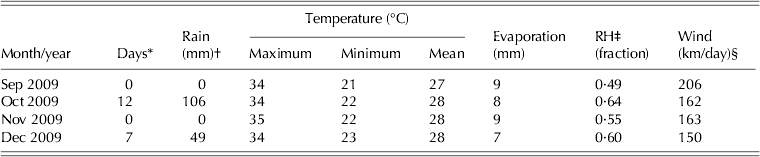
This investigation was conducted from September to December 2009 at the Semi-arid Experimental Station of the Brazilian Agricultural Research Corporation (EMBRAPA) in the municipality of Petrolina, Pernambuco State, Brazil (09°09′S, 40°22′W, 365 m a.s.l.). The soil type in this region is a red-yellow sandy oxisol (dos Santos et al. Reference Dos Santos, Jacomine, Anjos, Oliveira, Lumbreras, Coelho, Almeida, Cunha and Oliveira2013b ), with an average depth of 1·5 m. The climate is typically semi-arid with annual rainfall of 570 mm and average maximum and minimum temperatures of 33 and 21 °C, respectively. Precipitation in the region is low, erratic, and the balance between rainfall and evaporation rate is negative in some months (Table 1). The present study examined five new FS cultivars (BRS Ponta Negra variety, BRS 655 hybrid, BR 601 hybrid, BRS 506 variety and BRS 610 hybrid) with seeds supplied by the sorghum breeding program of EMBRAPA. The study was a randomized complete block design with the five cultivars grown on 25 plots.
Meteorological data during the experimental period

* Rainfall occurrence in days.
† Rainfall in millimetres.
‡ RH, relative humidity (fraction).
§ Wind average speed at 2 m height.
Source: Agro meteorological station in the Experimental Area of Bebedouro, Embrapa Semiarid – Petrolina – Pernambuco State, Brazil.
Plots were 10·5 m2 (5×2·1 m) with plants seeded in four rows (0·70 m centres) at a depth of 5 cm in soil with the following properties: pH (water): 5·6; phosphorus (P): 4·8 mg/dm3; potassium (K): 0·58 cmolc/dm3; aluminium (Al): 0·05 cmolc/dm3; hydrogen (H)+Al: 1·98 cmolc/dm3; calcium (Ca): 1·6 cmolc/dm3; magnesium (Mg): 0·75 cmolc/dm3 and organic matter (OM): 12·03 g/kg. All plots were fertilized prior to planting as dictated by soil tests with a basic application of 166 kg nitrogen (N)/ha, 333 kg P/ha and 250 kg K/ha. Two-side dressing fertilizations were applied, the first on the 30th day, and the second on the 45th day after plant emergence, with the dose equivalent to 60 kg N/ha. Each treatment comprised c. 17 plants/m2, achieved by thinning plots 20 days after emergence. Three litres/ha of Atrazine [2-chloro-4-ethylamino-6-isopropylamino-s-triazine] (Atanor®, Porto Alegre, Rio Grande do Sul, Brazil) (concentration of active: 500 g/l) was applied on all plot areas for weed control immediately after planting. Plots were irrigated as necessary during the experimental period with each plot receiving a total precipitation of 267 mm via sprinklers. Cultivars were harvested when at least 0·6 of plants in each plot reached the soft dough stage of grain maturity. Cuttings were taken at 5 cm above ground level. Only the two central rows in each plot were harvested, with the remainder being discarded. Harvested crop from each plot was collected into baskets and weighed to estimate wet yield/ha. A 400 g sub-sample was taken from each plot and oven-dried at 55 °C for 48 h to estimate DM concentration and yield. Dry samples were ground through a 1 mm screen using a Willey Mill (Tecnal Ltd., São Paulo, São Paulo, Brazil) and stored at room temperature.
Agronomic characteristics measured included: plant height; population density; extent of lodging (EL) and broken stems (EB); DM partitioning of organs (panicle, stem and leaf); dry matter yield (DMY) (t/ha) and digestible dry matter yield (DDMY) (t/ha). Lodging and stem damage were determined by examining plants along 25 m of five adjacent rows in each sub-plot prior to harvest. Digestible DMY was estimated by multiplying the in vitro dry matter digestibility (IVDMD; determined as described below) from each repetition by its respective DMY. Five randomly selected plants within each plot were dissected into panicles, stems and leaves and the amount of DM in each fraction was estimated after oven-drying at 65 °C for 72 h.
Finally, growing degree days (GDDs) were calculated to express daily heat unit accumulation relative to sorghum crop (base temperature of 10 °C) using temperature data as described by McMaster & Wilhelm (Reference McMaster and Wilhelm1997).
Ensiling procedure
At harvest, a silage harvester (Nogueira®, São João da Boa Vista, São Paulo, Brazil) was used to chop plants within each treatment to a length of 1–3 cm and transferred into 18×250-litre plastic barrels. Representative herbage samples from each plot of the five forage cultivars were manually packed into 25 polyvinyl chloride (PVC) mini-silos (five mini-silos×five replications for a total of 25 mini-silos; 10·5 cm in diameter ×35·5 cm high, capacity of 2·5 kg) using a wooden pestle (Sebastian et al. Reference Sebastian, Phillip, Fellner and Idziak1996). The mini-silos were sealed with plastic lids, weighed and stored at room temperature. After 90 days, mini-silos were opened and weighed again to determine DM losses. Ensiled forages (15 g) from both mini-silos and plastic barrels were homogenized for 1 min in 500 ml of distilled water to measure the pH using a pH meter (TEC-5®, Tecnal Ltd., São Paulo, São Paulo, Brazil). Aqueous extracts (10 ml) were acidified with 50 μl of 9·77 mol/l of sulphuric acid (H2SO4) (Kung & Ranjit Reference Kung and Ranjit2001) and frozen before analysis. Thawed extract samples were centrifuged for 15 min at 10 000 g at 4 °C and analysed for acetic, propionic and butyric acids using a Varian HPLC system (Merck Hitachi, Elite Lachrom HTA, Tokyo, Japan) as described by Adams et al. (Reference Adams, Jones and Conway1984). Organic acids were separated using an Aminex HPX-87H column (300×7·8 mm; Bio-Rad, Hercules, CA, USA) with a mobile phase of 0·013 M H2SO4, at a flow rate of 0·5 ml/min. Organic acids were detected using an ultraviolet (UV) detector (Merck Hitachi L-2400) set at 210 nm. For lactic acid, deproteinized supernatant was combined with 0·2 volumes of 17·4 mM malonic acid as an internal standard. Lactic acid was methylated, quantified as described by Kudo et al. (Reference Kudo, Cheng and Costerton1987), and analysed on a Hewlett Packard model 5890A Series Plus II gas–liquid chromatograph (Hewlett Packard Co., Palo Alto, CA, USA) with free fatty acid phase (FFAP) fused silica capillary column, 30 m length, 0·32 mm internal diameter and 1·0-μm film thickness (Phenomenex, Torrance, CA). Ammonia was analysed as described by Weatherburn (Reference Weatherburn1967). Finally, silage sub-samples (500 g) were oven-dried at 60 °C for 72 h, ground through a 1 mm screen using a Willey Mill (Tecnal Ltd., São Paulo, São Paulo, Brazil) and stored at room temperature until further analysis.
Intake and digestibility measurements
All lambs were cared for in accordance with the guidelines of the Brazilian Council on Animal Care (Brazil 2008). Apparent nutrient digestibility of the five sorghum cultivars ensiled in plastic barrels was measured using 25 Santa Inês lambs (initial body weight (BW): 19±1·6 kg) over a 21-day period. Lambs were blocked by weight and randomly assigned to one of five treatments. The first 17 days were used to adapt lambs to the diets in individual metabolic cages equipped with a poly-ethylene sieve tray to separate faeces from urine. Lambs were fed FS only (without concentrate) twice daily at 07·30 and 16·30 h in a manner that assured 0·15 orts at the morning feeding. Water and a trace mineralized salt mixture were available to lambs at all times. Apparent digestibility was determined during the 5-day collection phase, with lambs being fed FS ad libitum as described by da Silva & Leão (Reference da Silva and Leão1979). Faeces, feeds and orts associated with each lamb were sampled daily from the total amount collected each day. Samples were mixed, sub-sampled (400 g fresh faeces, 400 g fresh feeds and 400 g fresh orts per lamb) and stored at −20 °C until analysed.
Chemical analysis
Ground samples were analysed for DM and OM as described by Detmann et al. (Reference Detmann, Souza, Valadares Filho, Queiroz, Berchielli, Saliba, Cabral, Pina, Ladeira and Azevedo2012). A Leco combustion N analyser (FP-428N Determinator, Leco Corporation, St Joseph MI , USA) was used to measure N content. Crude protein (CP) was calculated as N×6·25. Both NDF (with α-amylase and sodium sulphite) and ADF were quantified using an Ankom Fibre Analyser (Van Soest et al. Reference Van Soest, Robertson and Lewis1991) (Ankom Technology Corporation, Macedon, NY, USA). Concentration of hemicellulose was determined by subtracting ADF from NDF. Ether extract (EE) was determined as described by AOAC (1995) (method 920·39) using an Ankom Fat Extractor (Ankom Technology Corporation, Macedon, NY, USA). Gross energy was determined using an adiabatic calorimeter (model 1241; Parr, Moline, IL). Total carbohydrate (TC) and non-fibrous carbohydrate (NFC) were calculated as described by Sniffen et al. (Reference Sniffen, O'Connor, Van Soest, Fox and Russell1992): TCg/kg DM=100−(CP+EE+ash) and NFCg/kg DM=100−(CP+EE+ash+NDF). The concentrations of total digestible nutrients (TDN) were calculated as: TDNg/kg DM=digestible CP+(2·25×digestible EE)+digestible NDF+digestible NFC (Weiss & Wyatt Reference Weiss and Wyatt2000).
In vitro DMD (IVDMD) analysis of the fresh forages and silages was conducted in 100 ml serum bottles and examined in a single run for each forage/silage with triplicate bottles being used per treatment. Plant material (0·5 g) was incubated with 10 ml of rumen fluid mixed with 40 ml of McDougall's buffer (McDougall Reference McDougall1948) for 48 h at 39 °C. Samples were subsequently incubated with 0·1 N hydrochloric acid (HCL) and 2 g/l pepsin for a further 48 h (Tilley & Terry Reference Tilley and Terry1963). Equal volumes of rumen fluid were collected immediately after feeding from three ruminally fistulated bulls fed a mixture of the five FS cultivars. After stirring the three samples, the combined ruminal fluid was used in the IVDMD assay as described above.
Statistical methods
Experiments were analysed using a mixed model approach with fixed effect of cultivar, random effects of blocks (agronomic and silage quality trials) and lambs (digestibility study), and random residual error using the MIXED procedure of SAS Version 9.1 statistical program (SAS 2002). When significant, means across cultivars were compared using Fisher's protected LSD (i.e. the DIFF option of the LSMEANS statement). Significance was declared at P<0·05.
RESULTS
Agronomic characteristics
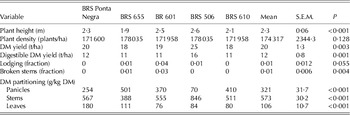
Cultivars ranged in height from 1·9 to 2·6 m, with BRS 506 being 36% taller (P<0·05) than BRS 655, although no difference was observed between BRS 506 and BR 601. Furthermore, BRS 610 and BRS 655 were of similar height (Table 2).
Performance and phenological traits of FS cultivars
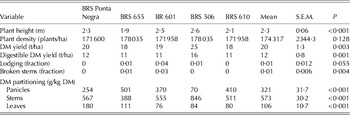
DM, dry matter; S.E.M., standard error of mean; P, probability (if treatments differ at P<0·05); D.F.=16.
At the same plant density, BRS 506 yielded 39 and 45% more (P<0·05) DM and digestible DM, respectively than BRS 655. Dry matter and digestible DM yields were similar among BRS 655, BRS Ponta Negra, BR 601 and BRS 610 (Table 2).
The present study also identified a number of differences (P<0·05) in DM partitioning among plant tissues, with BRS 655 having more DM associated with panicles and less with stems (P<0·05), whereas BRS Ponta Negra possessed the highest (P<0·05) proportion of leaves (Table 2).
Although lodging was similar among the cultivars, BRS 610, BRS Ponta Negra, BRS 655 and BRS 506 exhibited more (P<0·05) resilient stems than BR 601 (Table 2).
Silage quality
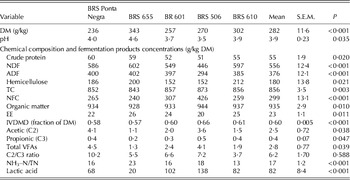
At ensiling, DM content of the cultivars varied from 230 to 340 g/kg (Table 3). Even though they were harvested at the same maturity stage of plant development, BRS 655 possessed higher (P<0·05) DM concentration than the other cultivars (Table 3).
Chemical composition (g/kg DM) and fermentation products concentrations (g/kg DM) of silages produced from sorghum cultivars
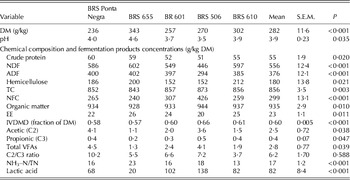
DM, dry matter; NDF, neutral detergent fibre; ADF, acid detergent fibre; IVDMD, in vitro dry matter digestibility; VFAs, volatile fatty acids (excluding iso-butyric, valeric, iso-valeric and n-caproic); TN, total nitrogen; S.E.M., standard error of mean; P, probability (if treatments differ at P<0·05); D.F.=16.
Crude protein content ranged from 50 to 60 g/kg and was higher (P<0·05) in silages produced from BRS Ponta Negra than those produced from BR 601 and BRS 506. BRS Ponta Negra, BRS 655 and BRS 610 were of similar CP content (Table 3).
Contents of NDF and ADF were lower (P<0·05) in BRS 506 than in other cultivars. Moreover, its TC and NFC and IVDMD were higher (P<0·05) than those found in other FS cultivars (Table 3).
The hemicellulose content of silages produced from BRS 610 and BRS 655 was greater (P<0·05) than those for BR 601 and BRS 506. Nonetheless, it is important to note that BRS Ponta Negra had the same hemicellulose content as BRS 655, BR 601, BRS 506 and BRS 610. Organic matter content was higher (P<0·05) in silages from BRS 506 as compared to BRS 655, which, in turn, was similar to BRS Ponta Negra and BR 601. Finally, BRS 655 exhibited higher (P<0·05) EE concentration than BRS 506, with no difference being observed among BRS 655, BR 601 and BRS 610 (Table 3).
As for silage traits, a large variation in fermentation products was observed. For the most part, BRS 655 had the highest (P<0·05) pH among silages, although it did not differ significantly from BRS Ponta Negra. BRS Ponta Negra, BR 601, BRS 506 and BRS 610 exhibited similar terminal pH after ensiling in mini-silos (Table 3).
Acetic acid and total volatile fatty acids (VFA) concentrations in ensiled BRS Ponta Negra were almost four times higher (P<0·05) than those from BRS 655, although there were no differences among BRS 655, BR 601 and BRS 610 (Table 3). BRS Ponta Negra and BRS 506 possessed similar acetic acid concentrations.
The concentration of lactic acid was lower (P<0·05) in silages produced from BRS 655 compared with the other cultivars. In addition, BRS 655 exhibited the highest (P<0·05) ammonia-N concentration. Concentrations of propionic acid in silages obtained from BRS 655 were lower (P<0·05) than those in BRS 506, although there was no difference among BRS 655, BR 601 and BRS 610. Butyric acid was not detected in any of the silage samples (Table 3).
Digestion study
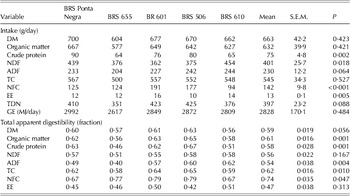
Silages produced from BRS Ponta Negra resulted in higher (P<0·05) CP intake than BRS 655, although no difference was detected among BRS 655, BR 601 and BRS 610 (Table 4). There was no difference in CP intake between BRS Ponta Negra and BRS 506 (Table 4).
Dry matter intake (g/kg) and total apparent digestibility (fraction) of dietary components in lambs fed silage generated using different FS cultivars
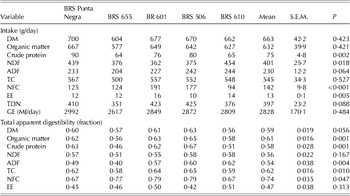
DM, dry matter; NDF, neutral detergent fibre; ADF, acid detergent fibre; TDN, total digestible nutrients; GE, gross energy; S.E.M., standard error of mean; P, probability (if treatments differ at P<0·05); D.F.=16.
Intake of NDF in silages generated from BRS Ponta Negra and BRS 610 was higher (P<0·05) than that found in the other cultivars. The lowest (P<0·05) consumption of NFC was observed in lambs fed BRS 610. In regards to intake of EE, BR 601 resulted in a higher (P<0·05) ingestion than BRS 506, with no differences among BRS 506, BRS 655 and BRS Ponta Negra (Table 4).
Digestibility of organic matter ranged from 0·56 to 0·65 and was greater (P<0·05) in silages produced from BRS 506 than those produced from BRS 655, although no differences were detected among BRS 655, BRS 610 and BRS Ponta Negra (Table 4).
Silages made from BRS 506 resulted in a greater (P<0·05) digestibility of CP than those from BRS 655, even though BRS 506 did not differ from BR 601 and BRS Ponta Negra. It was also found that BRS 655 and BRS 610 had similar CP digestibilities.
Silages produced from BRS 610 exhibited a higher (P<0·05) ADF digestibility than those produced from BRS 655, although no difference was found between BRS 655 and BRS Ponta Negra (Table 4).
Lambs fed BRS 506 exhibited higher (P<0·05) digestibility of TC than those that consumed silages produced from BRS 655, with no difference among BRS 506 and BR 601. Lastly, silages generated from BR 601 had a higher (P<0·05) digestibility of NFC as compared with BRS Ponta Negra and BRS 610, though no difference was detected among BR 601, BRS 506 and BRS 655 (Table 4).
DISCUSSION
There is clear evidence that sorghum can contribute to addressing forage shortages in arid regions as it exhibits high yield even under severe water deficit and can be easily ensiled to serve as feed for livestock during the dry season (Le Houérou Reference Le Houérou2000; Sanchez et al. Reference Sanchez, Subudhi, Rosenow and Nguyen2002; Miron et al. Reference Miron, Zuckerman, Sadeh, Adin, Nikbachat, Yosef, Ben-Ghedalia, Carmi, Kipnis and Solomon2005). The present study examined five new cultivars of FS (BRS Ponta Negra variety, BRS 655 hybrid, BR 601 hybrid, BRS 506 variety and BRS 610 hybrid) planted in a Brazilian semi-arid region in relation to their agronomic characteristics, silage quality, intake and digestibility in lambs.
The mean (±standard deviation – SD) whole-crop DM yield of 20 (±2·8) t/ha in the present study was higher than the range of values reported for 13 cultivars of FS (16–17 t/ha) and six of forage sorghum brown midrib (FS-BMR) (13–16 t/ha) grown in the semi-arid USA (Bean et al. Reference Bean, Baumhardt, McCollum and McCuistion2013). It is possible that higher daily heat unit accumulation observed during the Brazilian north-east growing season (1923 GDDs – °C) compared to that reported by Bean et al. (Reference Bean, Baumhardt, McCollum and McCuistion2013) in the USA (1617 GDD – °C) explains the differences in DM yield/ha, as the cultivars from both experimental sites were fertilized in a similar manner and harvested at almost the same whole plant moisture.
It is also possible that higher resistance to lodging and breaking contributed to the increased DM yield/ha of the Brazilian sorghum since plants less prone to lodging are easier to harvest and exhibit lower field losses (Miron et al. Reference Miron, Solomon, Adin, Nir, Nikbachat, Yosef, Carmi, Weinberg, Kipnis, Zuckerman and Ben-Ghedalia2006). In this respect, the Brazilian cultivars were on average more resistant to lodging than those from the USA as reported by Bean et al. (Reference Bean, Baumhardt, McCollum and McCuistion2013), possibly because the Brazilian FS possessed a more robust cell wall (Carmi et al. Reference Carmi, Umiel, Hagiladi, Yosef, Ben-Ghedalia and Miron2005; Miron et al. Reference Miron, Solomon, Adin, Nir, Nikbachat, Yosef, Carmi, Weinberg, Kipnis, Zuckerman and Ben-Ghedalia2006) as suggested by the higher ADF concentration than that reported for US cultivars (Bean et al. Reference Bean, Baumhardt, McCollum and McCuistion2013). In fact, tropical FS tends to be more lignified and has higher plant cell fractions than temperate FS (Grant et al. Reference Grant, Haddad, Moore and Pedersen1995; Nichols et al. Reference Nichols, Froetschel, Amos and Ely1998; Vogel & Jung Reference Vogel and Jung2001). The lower IVDDM exhibited by the Brazilian FS than that described for both conventional FS and FS-BMR grown in the USA (Bean et al. Reference Bean, Baumhardt, McCollum and McCuistion2013) supports this. It is possible that the high proportion of stems in Brazilian plant tissues have contributed to lower the IVDMD of the whole plant (Pedersen et al. Reference Pedersen, Gorz, Haskins and Ross1982; Carmi et al. Reference Carmi, Umiel, Hagiladi, Yosef, Ben-Ghedalia and Miron2005, Reference Carmi, Aharoni, Edelstein, Umiel, Hagiladi, Yosef, Nikbachat, Zenou and Miron2006).
On the other hand, the digestion study revealed that the mean apparent digestibilities of DM (0·59±0·019) and NDF (0·56±0·022) of the Brazilian north-eastern FS were quite similar to those reported for conventional FS and FS-BMR cultivated in temperate climate (Ward et al. Reference Ward, Redfearn, McCormick and Cuomo2001; Miron et al. Reference Miron, Zuckerman, Adin, Nikbachat, Yosef, Zenou, Weinberg, Solomon and Ben-Ghedalia2007a ; Ledgerwood et al. Reference Ledgerwood, DePeters, Robinson, Taylor and Heguy2009). This evidence supports the hypothesis that in vivo digestibility is more appropriate for comparing the real nutritive value of the cultivars than in vitro essays, most likely because it takes into account voluntary intake, forage degradability in the reticulorumen and absorption of nutrients in the total gastrointestinal tract (Miron & Ben-Ghedalia Reference Miron and Ben-Ghedalia1987)
Within the framework of defining silage quality, pH, DM content, acetic and lactic acids concentrations were within the limits proposed by McDonald (Reference McDonald1981) for well-preserved FS. Moreover, butyric acid was not detected in any of the silages, supporting the hypothesis that enterobacterial and clostridial activities were minimal in ensiled sorghum (Ward et al. Reference Ward, Redfearn, McCormick and Cuomo2001). However, BRS 655 did not ensile well, even though its DM content at ensiling of 343±11·6 g/kg was considered acceptable for the ensiling processes (Newman et al. Reference Newman, Adesogan and Wasdin2009). However, the low concentration of lactic acid in BRS 655 silage is indicative of an increase in heterolactic fermentation, possibly due to a lower availability of fermentable NFC that are used as substrate to produce the lactic acid which lowers silage pH.
BRS 506 exhibited the highest IVDMD and DDM yield/ha among cultivars, probably because it had the lowest NDF and ADF contents and the highest TC and NFC concentrations. However, these chemical properties did not result in the highest DM intake by lambs fed this cultivar. Similarly, DM consumption was not affected by the highest NDF intake in BRS 610 and BRS Ponta Negra silages, possibly because there were no differences in NDF digestibility among cultivars (Van Soest et al. Reference Van Soest, Robertson and Lewis1991; Van Soest Reference Van Soest1994; Grant et al. Reference Grant, Haddad, Moore and Pedersen1995; Jung & Allen Reference Jung and Allen1995).
On average the CP content of Brazilian FS (mean±s.e.m; 55±1·9 g/kg DM) was similar to other cultivars grown at various locations in the world. For example, Miron et al. (Reference Miron, Zuckerman, Adin, Nikbachat, Yosef, Zenou, Weinberg, Solomon and Ben-Ghedalia2007a ) reported FS with a CP content of 47±2·10 g/kg DM and Chaugool et al. (Reference Chaugool, Kondo, Kasuga, Naito, Goto and Ehara2013) described FS with a CP content of 58±1·98 g/kg DM. However, much higher levels have been reported as Contreras-Govea et al. (Reference Contreras-Govea, Marsalis, Angadi, Smith, Lauriault and VanLeeuwen2011) found CP levels as high as 90±2 g/kg DM in a FS cultivar grown in New Mexico (USA). These disparate concentrations of CP may have arisen from differences in cultivar types as the FS from both experiments were ensiled at almost the same DM content and, therefore, harvested at similar maturity.
Silages obtained from BRS 655 resulted in lower intake and digestibility of CP than those generated from BRS Ponta Negra, although they were of similar CP content. It seems that extensive proteolysis and non-protein N formation, probably caused by a higher ammonia-N concentration in silages produced from BRS 655, increased the ruminal ammonia pool and consequently affected forage protein utilization by sheep (Broderick Reference Broderick1995).
It is clear, therefore, that the Brazilian north-eastern FS could play a central role in further intensifying Brazilian grazing livestock systems in a sustainable way, mainly because this forage requires less water to yield DM and digestible DM/ha than other feed sources (such as maize) that could be used in these regions. In fact, the Brazilian cultivars were more water-use efficient and productive than maize grown in a semi-arid climate under sprinkler irrigation in Israel (47±1·3 kg DM/ha/mm water and 12±0·8 t digestible DM/ha for the Brazilian cultivars v. 30·4±2·08 kg DM/ha/mm water and 11·2±0·42 t digestible DM/ha for maize; Miron et al. Reference Miron, Zuckerman, Adin, Solomon, Shoshani, Nikbachat, Yosef, Zenou, Weinberg, Chen, Halachmi and Ben-Ghedalia2007b ) and in the USA (20±1·3 t DM/ha for the Brazilian cultivars v.10·8±0·6 t DM/ha for maize; Marsalis et al. Reference Marsalis, Angadi and Contreras-Govea2010). For these reasons, FS may prove to be a useful feed source to maintain or expand silage feeding systems by producing more forage with less water and on the same amount of land, thereby reducing deforestation pressure and increasing milk/beef production to supply the growing Brazilian demand for food. In practice, growing the variety BRS 506 in Brazilian semi-arid areas or in regions, where precipitation is below normal and irrigation is a limiting factor for silage production, may be significant as compared to BRS Ponta Negra variety, BRS 655 hybrid, BR 601 hybrid and BRS 610 hybrid as it exhibited the lowest NDF and ADF contents and the highest IVDMD. In addition, BRS 506 variety outperformed the other FS in DM and digestible DM yields/ha. However, it should be emphasized that the calculation of yield/ha in the small-scale harvest as used in the present study tends to overestimate crop yields, since this measurement does not consider possible yield losses that may occur in commercial field harvests. These differences in yield can be magnified even further when green herbage with low DM content is ensiled in the large-scale feeding systems, resulting in undesirable fermentation and extensive losses of nutrients (Miron et al. Reference Miron, Solomon, Adin, Nir, Nikbachat, Yosef, Carmi, Weinberg, Kipnis, Zuckerman and Ben-Ghedalia2006).
This study was funded by CNPq/CTAgro Grant No. 555708/2009-8, EMBRAPA and Banco do Nordeste do Brasil Grant No. 7539. The authors are grateful to Kyron Gibbs Jr for his help with the English review.