INTRODUCTION
Over 1500 species of insect pests worldwide (Long and Hensley, Reference Long and Hensley1972) and 220 species in India (David et al., Reference David, Easwaramoorthy and Jayanthi1986) have been reported to attack sugarcane at different growth stages. Over time, new pests have emerged or minor pests have transformed in to regular pests to exploit the crop in isolated habitats (Mahesh et al., Reference Mahesh, Chandran, Srikanth, Nisha and Manjunatha2013; Reference Mahesh, Srikanth, Chandran and Nisha2015). Several defoliators described as minor pests in India include leaf folders (David et al., Reference David, Easwaramoorthy and Jayanthi1986), some of which were catalogued as early as in 1953 in Box's (Reference Box1953) List of Sugarcane Insects. Cnaphalocrocis medinalis Guenée, Marasmia trapezalis Guenée and Neomarasmia suspicalis Walker (Lepidoptera: Crambidae) are the leaf folder pests of sugarcane in India as documented by Nair (Reference Nair1986). Leaf folders have been known to be pests of sugarcane in other countries as well. For example, M. trapezalis had been recorded as an important pest of sugarcane in several countries (Box, Reference Box1953), including Peru (Ayquipa and Sirlopu, Reference Ayquipa and Sirlopu1975), and as a common and widespread minor pest in the South African sugar industry (Way et al., Reference Way, Webster and Leslie2011).
Leaf folders are widely distributed as a serious pest complex in several rice growing countries in Asia, Oceania, Australia and Africa (Islam and Karim, Reference Islam and Karim1997). Outbreaks of leaf folder have been reported in many Asian countries, including India, Korea, Japan, China, Malaysia, Sri Lanka and Vietnam (Dale, Reference Dale and Heinrichs1994; Khan et al., Reference Khan, Abenes and Fernandez1996). Leaf folders are major pests of rice in tropical and sub-tropical India, particularly in areas where modern rice varieties are grown extensively. The leaf folder complex of rice comprises at least eight species in three genera (Khan et al., Reference Khan, Barrion, Litsinger, Castilla and Joshi1988). Among these, C. medinalis and Marasmia patnalis Bradley are major pests in Bangladesh (Islam and Karim, Reference Islam and Karim1997) and India, whereas Cnaphalocrocis ruralis Walker (Varun et al., Reference Varun, Singh, Rawal and Venkatesh2017a) is an occasional pest (Gunathilagaraj and Gopalan, Reference Gunathilagaraj and Gopalan1986; Baby Rani et al., Reference Baby Rani, Amutha, Muthulakshmi, Indira and Mareeswari2007). Recent species diversity and distribution studies of Cnaphalocrocis spp. revealed C. ruralis as the third most important species in rice in south India (Varun et al., Reference Varun, Ramaraju and Chitra2017b). Leaf folder larva folds the leaf blade, glues the leaf edges longitudinally with silk strands and feeds inside the rolled leaf, thereby creating longitudinal white and transparent streaks on the blade, which eventually withers. A single larva can damage a number of leaves, disturbing their photosynthesis and growth, and ultimately reducing the yield by as much as 63–80% in India (Rajendran et al., Reference Rajendran, Rajendran and Sandra1986).
Even though rice is the primary host, leaf folders have also been recorded on a wide range of crops such as maize, wheat, sorghum and sugarcane (Dale, Reference Dale and Heinrichs1994; Khan et al., Reference Khan, Abenes and Fernandez1996). The fact that these leaf folders have been described as sporadic or occasional pests of sugarcane (David et al., Reference David, Easwaramoorthy and Jayanthi1986) and the lack of reports of large-scale damage to the crop suggested that sugarcane serves as an alternative host. Besides cultivated hybrids, germplasm comprising Saccharum and allied genera have also served as alternative hosts to sugarcane pests. For example, the pink borer Sesamia inferens (Walker) (Lepidoptera: Noctuidae) occurred in several accessions of Saccharum spp. for three consecutive years (Mahesh et al. Reference Mahesh, Chandran, Srikanth, Nisha and Manjunatha2013; Reference Mahesh, Srikanth and Chandran2014) causing concern due to deadheart damage and loss of plant stand. Similarly, the leaf miner Aphanisticus aeneus Kerremans (Coleoptera: Buprestidae) occurred in Saccharum spp. accessions as a minor pest (Mahesh et al., Reference Mahesh, Srikanth, Chandran and Nisha2015). Moreover, species of Erianthus, an allied genus of sugarcane, are known to serve as alternative hosts of several sugarcane pests (David et al., Reference David, Easwaramoorthy and Jayanthi1986). Such opportunistic colonization appears to be independent of the extent of cultivation of sugarcane as has been exemplified by the occurrence of these pests in sugarcane germplasm maintained as an island in a predominantly paddy belt.
The first occurrence of C. ruralis in accessions of Erianthus spp. in October 2010 and its continuance thereafter indicated the possibility that the leaf folder may switch over to the entire germplasm and assume the status of a major pest. In view of such risk perception to the germplasm, the present study was undertaken at the Regional Center of ICAR-Sugarcane Breeding Institute (ICAR-SBIRC), Kannur, Kerala State, India, to ascertain the damage pattern and status of the leaf folder in Erianthus spp. and other germplasm collection being maintained at the Centre.
MATERIALS AND METHODS
Study site and field layout
Sugarcane germplasm is maintained at ICAR-SBIRC, Kannur, Kerala State, India (11°52' N, 75°25' E, 11 m MSL), as a crop island since there is no large-scale or commercial cultivation of the crop in Kerala State in general and Kannur in particular (Anonymous, 2015). The Centre maintains a vast collection of germplasm in a field gene bank comprising Saccharum spp., Indian and foreign hybrids, interspecific and intergeneric hybrids, and allied genera including three species of Erianthus, namely E. arundinaceus, E. procerus and E. kanashiroi, the genus that has been receiving much attention as a potential biomass crop and an important genetic resource in sugarcane breeding around the world in the recent years (Sugimoto, Reference Sugimoto2000).
In the first year of occurrence (2010) and thereafter, a survey of the entire germplasm revealed that the leaf folder was restricted to genotypes of Erianthus spp. and, hence, the study was limited to this genus. During the study period (2010–2012), 74 accessions of Erianthus spp., including E. arundinaceus (72), E. procerus (1) and E. kanashiroi (1) (Supplementary Table S1, available online at https://doi.org/10.1017/S0014479718000121), were planted in January each year in single 2 m rows with 90 cm spacing between rows and 10 cm between plants, which led to a population stand of 30–50 canes per accession. Recommended agronomical practices were followed until crop maturity but no insecticides were applied for the control of pests. The accessions were planted in different plots in successive years with randomization of accessions within the plot. Observations of leaf folder incidence were recorded during September–December.
Pest identification and leaf damage
Leaf folder larvae were collected when they were first noticed on Erianthus spp. in October 2010, brought to the laboratory and reared on leaves of Erianthus spp. until pupation and adult emergence. Preserved specimens of the moth were sent to the Insect Biosystematics Laboratory, Department of Agricultural Entomology, Centre for Plant Protection Studies, Tamil Nadu Agricultural University, Coimbatore, India, for identification.
Leaf folding behaviour of the larvae was examined by recording the leaf blade length, leaf fold length, i.e., folded part of the leaf, number of webs spun and the length of individual webs in a leaf from a random sample of infested leaves as per the method described by Islam and Karim (Reference Islam and Karim1997) in rice.
Damage assessment
Each year, leaf folder damage was assessed during its peak period of activity (September–December) using four parameters. The total number of canes (n = 30–50) and the number of leaf folder infested canes were counted and percent of infested canes was computed to represent incidence rate (Equation 1).
 $$\begin{equation}
{\rm{Percent}}\;{\rm{of}}\;{\rm{infested}}\;{\rm{canes}} = \frac{{{\rm{Number}}\;{\rm{of}}\;{\rm{damaged}}\;{\rm{canes}}}}{{{\rm{Total}}\;{\rm{number}}\;{\rm{of}}\;{\rm{canes}}}} \times 100
\end{equation}$$
Second, the total number of leaves (n = 8–10 leaves/plant) and number of leaf folder affected leaves were counted in infested plants and percent of damaged leaves was computed to indicate intensity of damage (Equation 2).
 $$\begin{equation}
{\rm{Percent}}\;{\rm{of}}\;{\rm{damaged}}\;{\rm{leaves}} = \frac{{{\rm{Number}}\;{\rm{of}}\;{\rm{damaged}}\;{\rm{leaves}}}}{{{\rm{Total}}\;{\rm{number}}\;{\rm{of}}\;{\rm{leaves}}}} \times 100
\end{equation}$$
Third, three infested leaves were selected randomly in each accession, categorized on a 1–4 rating based on the extent of leaf area scraped as 1 = up to 25%, 2 = 25 to 50%, 3 = 50 to 75% and 4 = >75%, and the highest damage rating among the three leaves was considered. Further, the damage ratings for the three years were compared and the highest rating was selected. An infestation index was computed using the infestation and intensity parameters as shown in (Equation 3).
 $$\begin{equation}
{\rm{Infestation}}\;{\rm{index}} = \frac{{{\rm{Percent}}\;{\rm{of}}\;{\rm{infested}}\;{\rm{canes}}\; \times \;{\rm{Percent}}\;{\rm{of}}\;{\rm{damaged}}\;{\rm{leaves}}}}{{100}}
\end{equation}$$
Categorization of accessions
Seventy four accessions of the three Erianthus spp. were grouped into three categories based on the infestation index. For each accession, the data sets from the three study years (2010–2012) were sorted on infestation index and the data set with the highest index was selected to account for the variation among years and the possibility of escapes under low natural infestation.
Leaf area vs. leaf folder incidence
Mean leaf area (cm2) for each accession was estimated as the product of leaf blade length and maximum width (cm) from a sample of five leaves and correlated with leaf folder infestation parameters.
Statistical analysis
Non-parametric statistical analysis was applied to the data of infestation parameters as in our earlier studies for assessing the damage of leaf miner (Mahesh et al., Reference Mahesh, Srikanth, Chandran and Nisha2015) and stem borer (Mahesh et al., Reference Mahesh, Srikanth, Chandran and Singaravelu2018). Friedman ANOVA by ranks and Kendall concordance coefficient test for multiple dependent samples were applied to the three-year (2010–2012) data with individual accessions as blocks and years as treatments. Post-hoc analysis was carried out using Wilcoxon matched pairs rank test with a Bonferroni correction that sets a significance level of P < 0.017 for each of the three two-year combinations. Box plots were used for graphical depiction of means and letters were assigned to indicate their significant differences. Pearson's product moment correlations were worked out among leaf blade length, width and area, and leaf fold length and number of webs. The analyses were performed using Stat Soft, Inc.
RESULTS
Pest identity and nature of injury
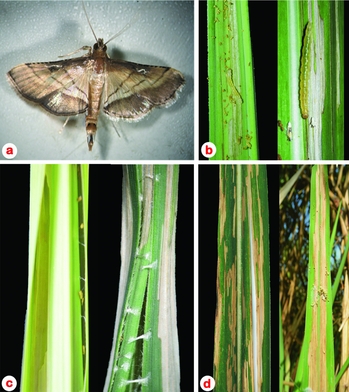
The leaf folder attacking Erianthus collection of the world sugarcane germplasm at Kannur, Kerala State, India, during October 2010 was identified as Cnaphalocrocis ruralis (Walker) (Lepidoptera: Crambidae) (Figure 1a). Following its first occurrence, the leaf folder continued to attack accessions of Erianthus spp. in the subsequent years, building up considerable populations and resulting in significant injury to the foliage. The larvae cause characteristic injury by feeding on chlorophyll-bearing tissues leading to the formation of white and transparent streaks on the leaf blade (Figure 1b). The grown-up larvae fold the leaf longitudinally with the adaxial surface inside the fold and exposing the abaxial surface, the edges being held in place by bands of silk thread at regular intervals (Figure 1c). It is within the protection of this fold that the larva feeds, skeletonizing the leaf on the upper surface (Figure 1d). When the damage is severe, infested leaves become conspicuous, even from a distance, showing patchy appearance of coalesced white streaks, the folded leaves contrasting against healthy leaves. In general, more than 90% of incidence occurs in the top visible leaves. Within the leaf, the folds usually occur in the distal quarter of the leaf blades with a very few in the middle quarter. In a sample of 234 leaves from all the accessions examined for leaf damage pattern, about 3.4% showed damage in 25% of leaf area, 92.7% in 50% of leaf area and 3.9% in 75% of leaf area from the top, whereas no damage was found in the proximal 25% area. Larvae were absent in many folded leaves that showed feeding injury and excreta but no pupa, which indicated that they move from leaf to leaf. In general, each fold enclosed three to five I and II instar larvae but only a single mature larva.
Leaf folder Cnapahlocrocis ruralis on Erianthis spp. (a) Adult, (b) white transparent streaks caused by larvae on the leaf blade, (c) bands of silk thread produced by larvae and (d) leaves skeletonized by larvae.

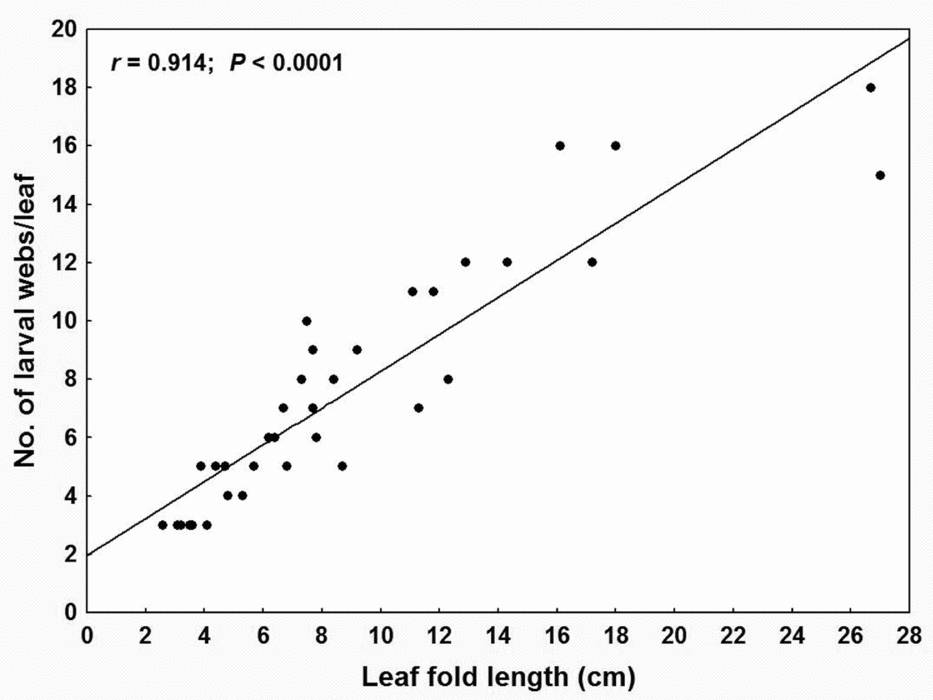
The length of leaf folds measured from a sample of infested leaves (n = 35) varied from 2.6 to 27.0 cm with a mean of 9.1 cm, which roughly constituted 7.3% of the mean length of the leaf blade ( $\bar{x}$ = 124.3 ± 11.0 cm). Each leaf fold had a mean of 7.7 webs (range: 3–18) formed by successive binds spun from silken threads. The overall mean web length, i.e., the distance between two binds, of the 270 webs observed in the sampled leaves was 1.2 cm (range: 0.3–3.3 cm). Leaf length, leaf width and leaf area of the sampled leaves were not correlated with either the leaf fold length or the number of webs. However, the leaf fold length was positively correlated with the number of webs (r = 0.914, df = 33, P < 0.0001) (Figure 2).
Relationship between leaf fold length (cm) and the number of larval webs per leaf in Erianthus spp. infested by the leaf folder Cnaphalocrocis ruralis.

Extent of damage
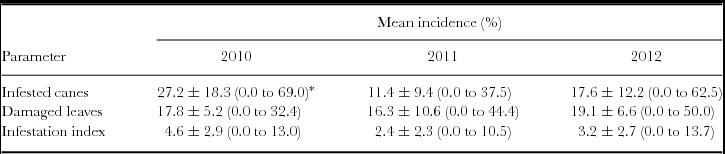
Cnaphalocrocis ruralis infestation varied widely among the accessions of Erianthus spp. in the three experimental years. Attack rates on cane basis (infestation rate) (range: 0.0−69.0%) were generally higher than the attack rates on leaf basis (intensity) (range: 0.0–50.0%); and infestation index ranged from 0.0 to 13.7% (Table 1). Infestation rate and intensity showed variable relationship in 2010 (r = −0.286; P < 0.05), 2011 (r = 0.563; P < 0.001) and 2012 (r = 0.127; P > 0.05). Among the accessions, 90.5% showed a leaf damage rating of 2, 9.5% were in rating 3 but none were in the ratings 1 and 4.
Extent of damage by Cnaphalocrocis ruralis in Erianthus spp. accessions during 2010–2012.

*Figures in parentheses are ranges.
Comparison of attack rates among years
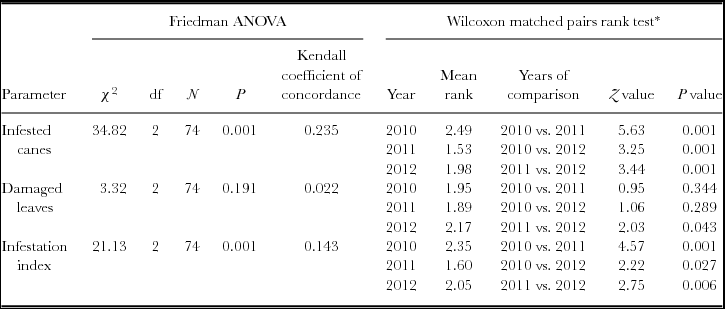
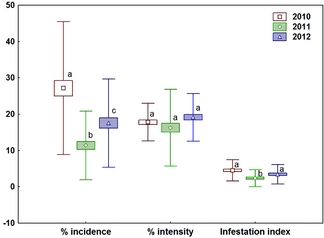
Friedman ANOVA by ranks indicated significant differences among the three years for percent of infested canes and infestation index but not percent of damaged leaves (Table 2). Post-hoc analyses using Wilcoxon matched pairs rank tests with a Bonferroni correction indicated that cane infestation rates differed significantly among all three years and it was significantly highest in 2010 and lowest in 2011 (Figure 3). The lowest infestation index was found in 2011, whereas it was similar in 2010 and 2012.
Non-parametric test statistics for comparison of leaf folder Cnaphalocrocis ruralis infestation parameters among three years (2010–12) in Erianthus spp. accessions.

* Wilcoxon matched pairs rank test significant with a Bonferroni correction (P < 0.017).
Mean infestation parameters of the leaf folder Cnaphalocrocis ruralis in accessions of Erianthus spp. in three consecutive years. Markers represent mean, boxes indicate mean ± SE and whiskers display mean ± SD.

Categorization of accessions
All accessions showed C. ruralis incidence in at least one experimental year indicating that none of the accessions tested was totally free from its injury. When all 74 accessions were considered on the basis of infestation index, 85.1% were placed in low and moderate categories and only 14.9% in high incidence category (Table 3). The lowest infestation index was recorded in accession ERI 2385 (1.02) and the highest in IK 76-44 (13.67) (Table S1).
Categorization of Erianthus spp. accessions on the basis of leaf folder Cnaphalocrocis ruralis infestation index during 2010–2012.

Role of leaf area
Leaf area of Erianthus spp. accessions was not related to infestation rates of cane or leaves but positively and significantly related to infestation index (r = 0.273, df = 72, P = 0.018).
DISCUSSION
A recent revision of the genus Cnaphalocrocis occurring on rice in southern India indicated the distribution of C. ruralis as south-east and south Asia with no mention of hosts (Varun et al., Reference Varun, Singh, Rawal and Venkatesh2017a). Besides, a review of literature indicated that C. ruralis had not been recorded on either cultivated or wild species of sugarcane earlier, though other species of leaf folders have been reported as pests of cultivated sugarcane in India (Box, Reference Box1953; David et al., Reference David, Easwaramoorthy and Jayanthi1986; Nair, Reference Nair1986) and other parts of the world (Ayquipa and Sirlopu, Reference Ayquipa and Sirlopu1975; Box, Reference Box1953; Way et al., Reference Way, Webster and Leslie2011). Thus, the present observation represents the first occurrence of C. ruralis, or for that matter leaf folders, on Erianthus spp. as a new host in India and, obviously, in the world. Cnaphalocrocis ruralis appears to be a minor pest among the leaf folder complex of rice not only in India but also in other rice growing parts of the world. For example, the status of C. ruralis vis-à-vis two other species, namely C. medinalis and M. patnalis, at Madurai, Tamil Nadu State, India, changed only marginally in two decades, i.e., from 1986 to 2007, as evidenced from the increase in its relative proportion from 0.5% during September–October 1985 (Gunathilakaraj and Gopalan Reference Gunathilagaraj and Gopalan1986) to 2.1–4.5% in Madurai, Tamil Nadu State, India (Baby Rani et al., Reference Baby Rani, Amutha, Muthulakshmi, Indira and Mareeswari2007). Although this species was reported to be meager in Coimbatore, Tamil Nadu State, India (Subramanian, Reference Subramanian1990), its proportion appeared to have increased in the recent past (Varun et al., Reference Varun, Ramaraju and Chitra2017b). Cnaphalocrocis ruralis had been described as a sparse pest in comparison with the other two species even in Philippines (Arida and Shepard, Reference Arida and Shepard1986). Cnaphalocrocis medinalis and M. patnalis are known to co-exist in low land irrigated areas where rice is cultivated round the year (Khan et al., Reference Khan, Abenes and Fernandez1996). Supporting this contention, C. medinalis and M. patnalis, but not C. ruralis, were reported earlier on rice from Pattambi, Kerala State, India, a state with high rainfall and irrigated low land (Nadarajan and Skaria, Reference Nadarajan and Skaria1988). The occurrence of these two species in equal proportion in this area (Nadarajan and Skaria, Reference Nadarajan and Skaria1988) corresponds with the observations of Gunathilakaraj and Gopalan (Reference Gunathilagaraj and Gopalan1986) at Madurai, Tamil Nadu State, albeit with the occurrence of a small proportion of C. ruralis. All these observations indicated that C. ruralis is less competitive than the other two species wherever the complex exists. The occurrence of C. ruralis on Erianthus spp. in the present study site, beginning 2010 and continuing till today, suggested the possibility that the other two major species may have an equal probability, if not higher, of attacking Erianthus spp. at Kannur due to their dominant nature observed in rice agro-ecosystems (Baby Rani et al., Reference Baby Rani, Amutha, Muthulakshmi, Indira and Mareeswari2007; Gunathilakaraj and Gopalan, Reference Gunathilagaraj and Gopalan1986; Subramanian, Reference Subramanian1990).
The damage pattern of C. ruralis in Erianthus spp. in the present study showed similarities with that caused by C. medinalis in paddy in an earlier study (Islam and Karim, Reference Islam and Karim1997). In paddy, top leaves accounted for 70% folds as against the 90% in the present study, apparently due to the differences in physical and nutritional suitability. Although the length of the leaf web was similar in both host plants, the percent of leaf length used for the web was higher in paddy obviously due to the smaller leaf size. For the same reason, the number of binds per leaf in paddy was lower than in Erianthus. While leaf tips were bent and folded in paddy, such activity was absent in sugarcane understandably due to differences in leaf texture. Only one leaf blade was involved in a fold in both crops apparently to avoid intra-specific competition besides the spatial separation of leaves in sugarcane. While in paddy, about 82% of leaves were colonized in the distal and proximal mid-quarters of the leaf, 96% of leaves in sugarcane showed infestation in the top 75% area. These observations indicated that leaf folders of the genus Cnapahlocrocis prefer the tender top half of the leaf for colonization. In paddy also, single larva per leaf was the norm and in the case of exceptions only younger instars were observed as in the case of Erianthus in the present study. Leaf folder larvae were observed to move from leaf to leaf depending on their suitability in paddy and this supports the observation of leaf-to-leaf dispersal by C. ruralis in the present study.
The higher infestation rates than the intensity rates (Table 1) suggested greater horizontal dispersal than vertical spread of the folder apparently aided by larval movement. The variable correlations between infestation rate and intensity in different years indicated not only their independence but also minor year-to-year climatological effects, as established by the non-parametric tests (Table 2; Figure 3), besides the influence of variable plant density. Such year-to-year variation in the dynamics of pests colonizing Saccharum spp. collection was observed in the same habitat (Mahesh et al., Reference Mahesh, Srikanth and Chandran2014; Reference Mahesh, Srikanth, Chandran and Nisha2015; Reference Mahesh, Srikanth, Chandran and Singaravelu2016).
The occurrence of C. ruralis in all the accessions of Erianthus examined in the present study at least in one of the three study years indicated that no accession was immune to the leaf folder. The variable correlations between infestation rate and intensity in different years justified the adoption of infestation index as the criterion for grouping accessions into the three categories. The grouping of accessions in low, moderate and high categories (Table 3) is an interim arrangement in view of the first appearance of the pest and lack of information about its economic impact on the host. Although similar categorization was adopted for the leaf miner A. aeneus in Saccharum spp. accessions earlier (Mahesh et al., Reference Mahesh, Srikanth, Chandran and Nisha2015), the same may need modification later if leaf folder activity persists and intensifies.
Low incidence of leaf folder in some accessions of Erianthus in the present study and resistance of selected accessions to top borer Scirpophaga excerptalis (Walker) (Lepidoptera: Crambidae) in an earlier study (Sardana, Reference Sardana2002) suggested multiple pest resistance in this genus. Significant correlations of leaf folder incidence with leaf length and width in paddy indicated that varieties with narrow and long leaves may offer resistance to the pest (Islam and Karim, Reference Islam and Karim1997). However, lack of such correlations of infestation rate or intensity with leaf area in Erianthus spp. ruled out such possibility and suggested the involvement of other morphological characteristics such as leaf thickness, hairiness and wax, and physiological factors, including leaf nutrition and secondary metabolites as possible mechanisms of resistance. Since the pest has chosen Erianthus spp. alone amidst the germplasm collection of more than 3500 accessions, it would be interesting to examine all these aspects through elaborate studies.
Cnaphalocrocis ruralis may possibly have existed on rice in Kerala State, India, including the present study site, in much the same manner as in Tamil Nadu State, India, but may not have been noticed or recorded due to its negligible presence. According to a recent estimate, Kannur, Kerala State, India, has significant acreage (4955 ha) under paddy in different seasons as against the negligible area (3.43 ha) under sugarcane (Anonymous, 2015), to which SBI-RC apparently contributes ≈3 ha area hosting world sugarcane germplasm collection. Yet, it is surprising to note that this species has colonized sugarcane, particularly Erianthus spp. that occupied an extremely small area (≈0.07 ha) representing a very low volume of biomass in the habitat. Erianthus is a wild relative of the genus Saccharum and is well known for high fiber and biomass, tolerance to drought and salinity, and resistance to pests and diseases (Augustine et al., Reference Augustine, Ashwin Narayan, Syamaladevi, Appunu, Chakravarthi, Ravichandran and Subramonian2015). Different Erianthus spp. are known to serve as alternative hosts to several sugarcane borers in northern parts of India, besides supporting sucking pests, such as pyrilla, whitefly, mealybug and mite, generally to lower levels than Saccharum spp. (David et al., Reference David, Easwaramoorthy and Jayanthi1986). Recently, we detected an unidentified species of leaf folder on Erianthus in the experimental plots of SBI, Coimbatore, India. Except for this observation, none of the Erianthus spp. had been reported as hosts to leaf folders hitherto, though cultivated sugarcane hybrids and other millets have been observed to be defoliated by them (David et al., Reference David, Easwaramoorthy and Jayanthi1986). Assuming that all three species of leaf folders are present in Kannur, it is possible that the less competent C. ruralis was seeking alternative hosts and Erianthus spp. emerged as a preferred host vis-à-vis Saccharum spp. and a host of monocot weeds known to harbour leaf folder complex (Khan et al., Reference Khan, Abenes and Fernandez1996).
The leaf folders C. medinalis and N. suspicalis had been reported to occur in young sugarcane crop earlier (David et al., Reference David, Easwaramoorthy and Jayanthi1986). However, in the present study, C. ruralis occurred during September–December coinciding with the grand growth phase of sugarcane in general and Erianthus spp. in particular. Besides the competitive exclusion by the other two major species as suggested above, expansion of host range by C. ruralis could also have been triggered by the declining trend in the area under paddy cultivation in Kerala (Leena Kumari, Reference Leena Kumari2011) and the consequent reduction in food resources for paddy pests. Absence of the leaf folder in the early stages and occurrence only in the grand growth period of Erianthus could be related to the asynchrony in planting time of the two crops, with paddy being cultivated in three seasons spanning the entire year (Leena Kumari, Reference Leena Kumari2011) and sugarcane planted only in January in the present study site. It is possible that the leaf folder emigrates to Erianthus spp. from the first crop of paddy after its harvest during September–October. The greater nutritional suitability of late season Erianthus spp. vis-à-vis its own young stages would be another interesting aspect of investigation.
Leaf folder complex remained non-existent or maintained a low profile in sugarcane even in habitats where both sugarcane and the more preferred paddy are cultivated together as published literature indicates. In the unlikely event of C. ruralis assuming pest status in cultivated sugarcane, Erianthus spp. might provide an avenue to be used as a trap crop in the push–pull strategy to manage the pest. Such a possibility gains support from the evaluation of 28 NG 7, an accession of E. aurundinaceus, as a perimeter trap crop to reduce damage by Chilo sacchariphagus (Bojer) (Lepidoptera: Crambidae) in experimental plots of sugarcane (Nibouche et al., Reference Nibouche, Tibère and Costet2012). The E. aurundinaceus accession acted as a dead-end plant attracting oviposition, hosting young larvae in terminal green leaves but reducing the survival rate of larvae of the borer in stalks. In the present study, IK 76–44 emerged as the most susceptible accession (Table S1) with the highest levels of cane attack rate or incidence (62.5%), leaf attack rate or intensity (21.9%) and infestation index (13.7%). Such a susceptible accession could possibly serve as an ideal trap crop in the management of the pest, provided its attractiveness vis-à-vis other crops, including cultivars of sugarcane, is established in further tests.
Acknowledgements
The authors thank Dr. Bakshi Ram, Director, ICAR-Sugarcane Breeding Institute (SBI), Coimbatore, for logistic support and academic encouragement. The authors also thank Dr. T. Manoharan, Professor and Head, Department of Agricultural Entomology, Tamil Nadu Agricultural University, Coimbatore, India, for establishing the identity of the leaf folder.
SUPPLEMENTARY MATERIAL
To view supplementary material for this article, please visit https://doi.org/10.1017/S0014479718000121