Introduction
The genus Coprinus Pers., described about 200 years ago (Persoon, Reference Persoon1797), was classically characterised by the autolysis of lamellae and the dark pigment of the basidiospores. However, phylogenetic studies have shown this concept of Coprinus to be polyphyletic, and some species, including the type, Coprinus comatus (O.F.Müll.: Fr.) Pers., have been assigned to the Agaricaceae (Redhead et al., Reference Redhead, Vilgalys, Moncalvo, Johnson and Hopple2001). Therefore, modifications have been proposed, with a number of species reclassified into the Agaricaceae and the rest distributed among three other genera in the Psathyrellaceae (Redhead et al., Reference Redhead, Vilgalys, Moncalvo, Johnson and Hopple2001).
Currently, Coprinopsis P.Karst., Coprinellus P.Karst., Parasola Redhead, Vilgalys & Hopple and Coprinus s.s. are considered as having a coprinoid habit which, in addition to the frequent autolytic lamellae and dark basidiospores, is recognised by a highly plicate pileus margin, a saprotrophic habit and the presence of brachybasidia (Redhead et al., Reference Redhead, Vilgalys, Moncalvo, Johnson and Hopple2001; Keirle et al., Reference Keirle, Hemmes and Desjardin2004).
The genera Coprinopsis and Coprinus s.s. have a cutis-like pileipellis with radially arranged, elongated or somewhat inflated cells, and both have remnants of veil on the surface of the pileus or attached to the stipe and appearing as a ring. However, Coprinus is characterised by a more persistent veil with a recurved-floccose appearance on the pileus and sometimes a cottony annulus that adheres basally as a pseudovolva, the absence of pleurocystidia, and peculiar strands suspended in the hollow stipe which extend from the hymenophore primordium, as occur also in Agaricus campestris L. (Levine, Reference Levine1922: 512; Redhead, Reference Redhead2001; Redhead et al., Reference Redhead, Vilgalys, Moncalvo, Johnson and Hopple2001; Vellinga, Reference Vellinga2003). Coprinellus is characterised by a pileipellis that consists of a hymeniderm or cystoderm of globose or piriform cells, hyaline caulocystidia and pileocystidia, and the presence or absence of a veil. Parasola is characterised by a hymeniderm pileipellis, with clavate, loosely arranged cells and the absence of a veil and caulocystidia (Nagy et al., Reference Nagy, Vágvölgyi and Papp2013), with the exception of P. auricoma (Pat.) Redhead, Vilgalys & Hopple, which exhibits thick-walled hairs at the stipe base (Nagy et al., Reference Nagy, Vágvölgyi and Papp2010) and on the pileal surface.
According to Kirk et al. (Reference Kirk, Cannon, Minter and Stalpers2008), coprinoid fungi are widespread, with about 10 known species of Coprinus, 200 of Coprinopsis, 100 of Coprinellus and 20 of Parasola. They occur on several substrates, including bare soil or associated with vegetation, on humus, dung, dead wood or vegetable debris, and are sometimes parasitic on other agarics and plants (Singer, Reference Singer1986; Uljé, Reference Uljé, Noordeloos, Kuyper and Vellinga2005).
In Brazil, there are number of existing records of coprinoid fungi. The first were made by Montagne (Reference Montagne1856) under the generic name Coprinus, with C. consobrinus Mont., C. matutinus Mont. and C. torquatus Mont. from Mato Grosso. Years later, records were made by Rick (Reference Rick1906, Reference Rick1930, Reference Rick1939, Reference Rick1961) from Rio Grande do Sul, Capelari and Maziero (Reference Capelari and Maziero1988) in Rondônia and Pegler (Reference Pegler1997) in São Paulo, among others. More recently, de Meijer (Reference Meijer2006) and Richardson (Reference Richardson2001) reported some species as new to the country from the states of Paraná and Mato Grosso do Sul, respectively, while Rosa and Capelari (Reference Rosa and Capelari2009) and Sobestiansky (Reference Sobestiansky2005) recorded other species from Minas Gerais and Rio Grande do Sul.
In Northeast Brazil, the earliest record was made by Batista (Reference Batista1957), corresponding to Pseudocoprinus brasilianus Bat. Later, Kimbrough et al. (Reference Kimbrough, Alves and Maia1994/1995) and Alves and Cavalcanti (Reference Alves and Cavalcanti1996) recorded Coprinopsis brunneofibrillosa (Dennis) Redhead, Vilgalys & Moncalvo, Coprinopsis jamaicensis (Murrill.) Redhead, Vilgalys & Moncalvo and Coprinopsis nivea (Pers.: Fr) Redhead, Vilgalys & Moncalvo from the state of Pernambuco. Recently, Magnago et al. (Reference Magnago, Oliveira, Furtado, Urrea-Valencia, Neves, Neves, Baseia, Drechsler-Santos and Góes-Neto2013) reported Coprinus xerophilus Bogart from the state of Paraíba, while Gomes and Wartchow (Reference Gomes and Wartchow2014) described Coprinellus arenicola Wartchow & A.R.Gomes; Melo et al. (Reference Melo, Chikowski, Miller and Maia2016) reported Coprinellus angulatus (Peck) Redhead, Vilgalys & Moncalvo, Coprinellus marculentus (Britzelm.) Redhead, Vilgalys & Moncalvo, Coprinopsis cinerea (Schaeff.) Redhead, Vilgalys & Moncalvo, Coprinopsis cothurnata (Godey) Redhead, Vilgalys & Moncalvo, Coprinopsis pseudoradiata (Kühner & Joss. ex Watling) Redhead, Vilgalys & Moncalvo, Coprinopsis stercorea (Fr.) Redhead, Vilgalys & Moncalvo, Coprinopsis vermiculifer (Joss. ex Dennis) Redhead, Vilgalys & Moncalvo and Coprinus patouillardii Quél. from Pernambuco.
Here, we describe a new species from Northeast Brazil, collected in the semiarid region of the state of Ceará, and also examine material from JPB (Thiers, continuously updated) collected in Paraíba.
Materials and Methods
The new species was collected in the Trilha da Galinha Choca, located in the municipality of Quixadá in the state of Ceará, Brazil. This area has a semiarid climate and a high concentration of monolith rocks, the predominant vegetation being represented by Leguminosae, Poaceae, Euphorbiaceae, Asteraceae and Convolvulaceae (Araújo et al., Reference Araújo, Oliveira and Lima-Verde2008).
The exsiccatae named ‘Coprinus xerophilus’ deposited at JPB was collected in the municipality of São José dos Cordeiros in the state of Paraíba, Brazil, also in the semiarid in the Reserva particular do Patrimônio Natural (RPPN) Fazenda Almas. This area represents the best-preserved area of Cariri Paraibano, characterised by vegetation ranging from dense tree savanna to more open areas, and a flora comprising Leguminosae, Euphorbiaceae, Bignoniaceae, Convolvulaceae, Rubiaceae, Cyperaceae and Cactaceae, among other families (Barbosa et al., Reference Barbosa, de Lima, Lima, da Cunha, Agra and Thomas2007).
Macromorphological features of the fresh basidiome were recorded using the usual methods for agarics (Singer, Reference Singer1986). Colour codes follow Kornerup and Wanscher (Reference Kornerup and Wanscher1978). Microscopic observations were made from material mounted in 3% potassium hydroxide, Congo red solution and Melzer's reagent. Measurements and statistics are based on 60 spores. Abbreviations are av., average size of basidiospores measured; Q1, the length to width ratio range, as determined from all basidiospores measured in face view; Q2, the length to width ratio range, as determined from all basidiospores measured in side view; Qm1, the Q value averaged from all basidiospores measured in face view; and Qm2, the Q value averaged from all basidiospores measured in side view. Synonyms are based on Moreno and Heykoop (Reference Moreno and Heykoop1998). The studied materials are deposited at JPB.
Results and Discussion
Coprinellus phaeoxanthus A.R.Gomes & Wartchow sp. nov.
MycoBank no. 817947.
Differs from Coprinellus arenicola in the dull yellow pileus, absence of clamp connections and presence of voluminous pleurocystidia. – Type: Brazil, Ceará, Quixadá, Lagoa do Cedro, Pedra da Galinha Choca, near to a collection of rocks, on sandy soil, 20 iii 2014, F. Wartchow 03/Reference Gomes and Wartchow2014 (JPB 61266 holotypus hic designatus!). Figs 1, 2.
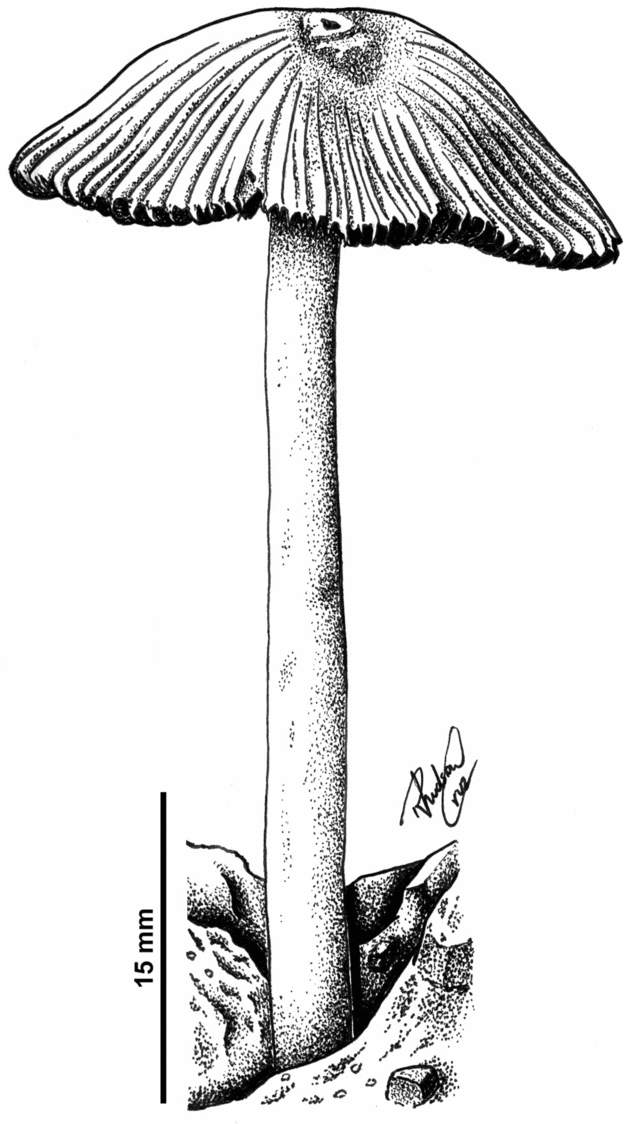
Coprinellus phaeoxanthus A.R.Gomes & Wartchow. Basidioma (holotypus).

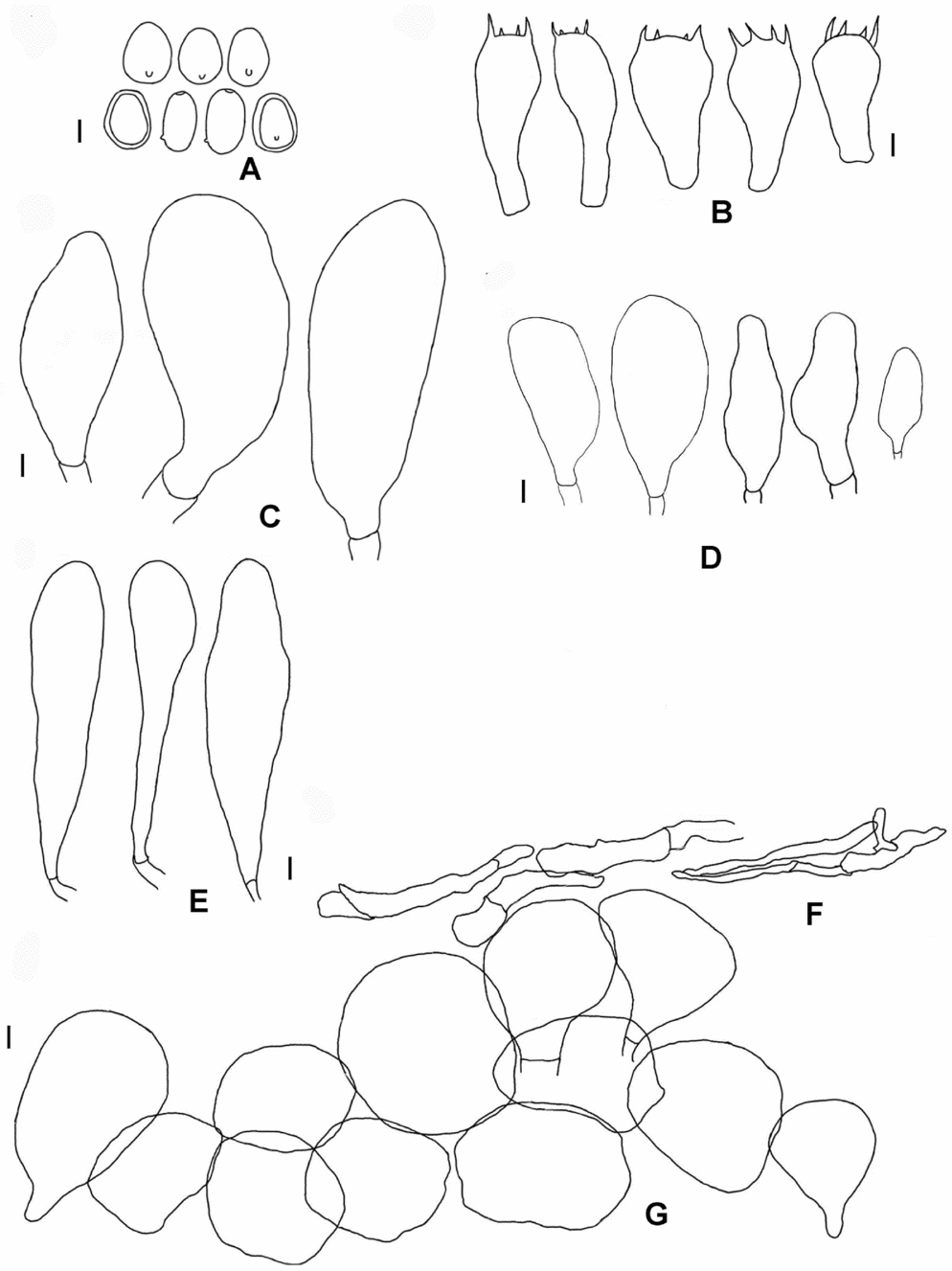
Coprinellus phaeoxanthus A.R.Gomes & Wartchow (holotype). A, Basidiospores; B, basidia; C, pleurocystidia; D, cheilocystidia; E, caulocystidia; F, velar elements; G, pileipellis. Scale bars: 10 µm.

Etymology
From Greek: phaeo, dusky; xanthus, yellow. Referring to the dull yellow pileus.
Macroscopy
Pileus to 27 mm, convex flattened with centre dull yellow (3B3) and whitish at the margin, surface plicate; veil present only as a few plates in centre, pale to white. Lamellae adnexed, greyish (2F1), subclose, 2 mm broad; lamellulae common, having several lengths. Stipe to 45 × 5 mm, central, slightly flattened, whitish (1A2), surface smooth, hollow; context thin.
Microscopy
Basidiospores 7.5–10.5 × 6.1–7.6(–9.2) × 4.5–6.5 µm [av., 9.2 × 6.9 × 6.1 µm; Q1, (1.07–)1.10–1.46(–1.50); Qm1, 1.31; Q2, 1.50–1.82; Qm2, 1.67], dark brown to almost black in 3% potassium hydroxide and reddish brown in Melzer's, flattened, ellipsoid in side view and cordiform in face view with wide base and rounded sides, some tapering toward the germ pore, wall up to 1 µm, hilar appendix visible, germ pore eccentric small, sometimes visible. Basidia 17.5–33.5 × 8.5–13 µm, clavate, four-spored with sterigmata up to 3 µm. Pleurocystidia 37.3–53 × 15.3–22 µm, frequent, utriform to sublageniform, hyaline, thin-walled. Cheilocystidia 26–28.1 × 8.7–10.7 µm, very common, utriform and lageniform sometimes broadly clavate, hyaline, thin-walled. Lamellae trama subregular hyphae 1.5–3.6 µm in width, hyaline or yellowish. Veil 13.3–31.1 × 1.5–5.6 µm, thin-walled elements, slightly elongated, inflated or tapered, yellowish, sometimes shapeless. Caulocystidia 43.5–51 × 5.5–12.2 µm, clavate to slender-clavate, hyaline, thin-walled, clamps lacking. Pileipellis consisting of a hymeniderm of hyaline, globose cells, some with pedicel 19.5–37 × (10.2–)14.8–24.5 µm, wall thickening up to 1.5 µm. Clamps absent in all tissues observed.
Habit
On sandy soil among rocks in the Brazilian semiarid region.
The specimen, collected in sandy soil, has a delicate basidiome typical of many coprinoid fungi, with pileus up to 27 mm, convex flattened and plicate surface with few and sparse remnants of veil. The pileipellis consists of a hymeniderm of subglobose cells, some pedicellate – features typical for the genus Coprinellus (Redhead et al., Reference Redhead, Vilgalys, Moncalvo, Johnson and Hopple2001; Keirle et al., Reference Keirle, Hemmes and Desjardin2004). In addition, the basidiospores are cordiform and flattened.
Another species with cordiform (heart-shaped) basidiospores is Coprinus cardiasporus Bender, which differs primarily in having the veil consisting of (sub)globose to ellipsoid, smooth to granular cells (Enderle et al., Reference Enderle, Krieglsteiner and Bender1986; Uljé, Reference Uljé, Noordeloos, Kuyper and Vellinga2005). Other species currently included in Coprinopsis, i.e. C. cordispora (T.Gibbs) Watling & M.J.Richardson, C. ephemeroides (D.C) G.Moreno and C. patouillardii (Quél.) G.Moreno,Footnote 1 also have cordiform basidiospores (Enderle et al., Reference Enderle, Krieglsteiner and Bender1986; Uljé, Reference Uljé, Noordeloos, Kuyper and Vellinga2005; Melo et al., Reference Melo, Chikowski, Miller and Maia2016). However, these taxa obviously do not belong in Coprinellus, because the pileipellis is a cutis instead of a cellular hymeniderm. In fact, phylogenetic analyses indicate that their position is uncertain, although they do not belong to Coprinellus or Coprinopsis (Padamsee et al., Reference Padamsee, Matheny, Dentinger and McLaughlin2008; Nagy et al., Reference Nagy, Vágvölgyi and Papp2013; Örstadius et al., Reference Örstadius, Rygberg and Larsson2015).
Related to our new species is Coprinellus arenicola Wartchow & A.R.Gomes from the Atlantic Forest of Paraíba, which also possesses cordiform basidiospores of a similar size, measuring 7.6–9.2 × 6.1–7.6 × 4.6–6.1 µm. However, features differentiating it from our new species are reported here: the pileus colour ranges to buff and the basidiospores are somewhat shorter in Q1, (1.07–)1.11–1.28(–1.30), and Qm1, 1.19. In addition, they also differ in the veil elements, with Coprinellus arenicola possessing clamp connections, unlike C. phaeoxanthus. The most distinct feature differentiating the species is the presence of pleurocystidia in the Ceará material; in Coprinellus arenicola, they are completely absent. The presence or absence of pleurocystidia has already been used by Házi et al. (Reference Házi, Nagy, Vágvölgyi and Papp2011) for delimiting species within Coprinellus. The holotype of Coprinellus arenicola was examined, and we confirm the absence of this microstructure in that species.
Coprinus calyptratus Peck, Bull. Torrey. Bot. Club 22: 205–206 (Reference Peck1895). Fig. 3.
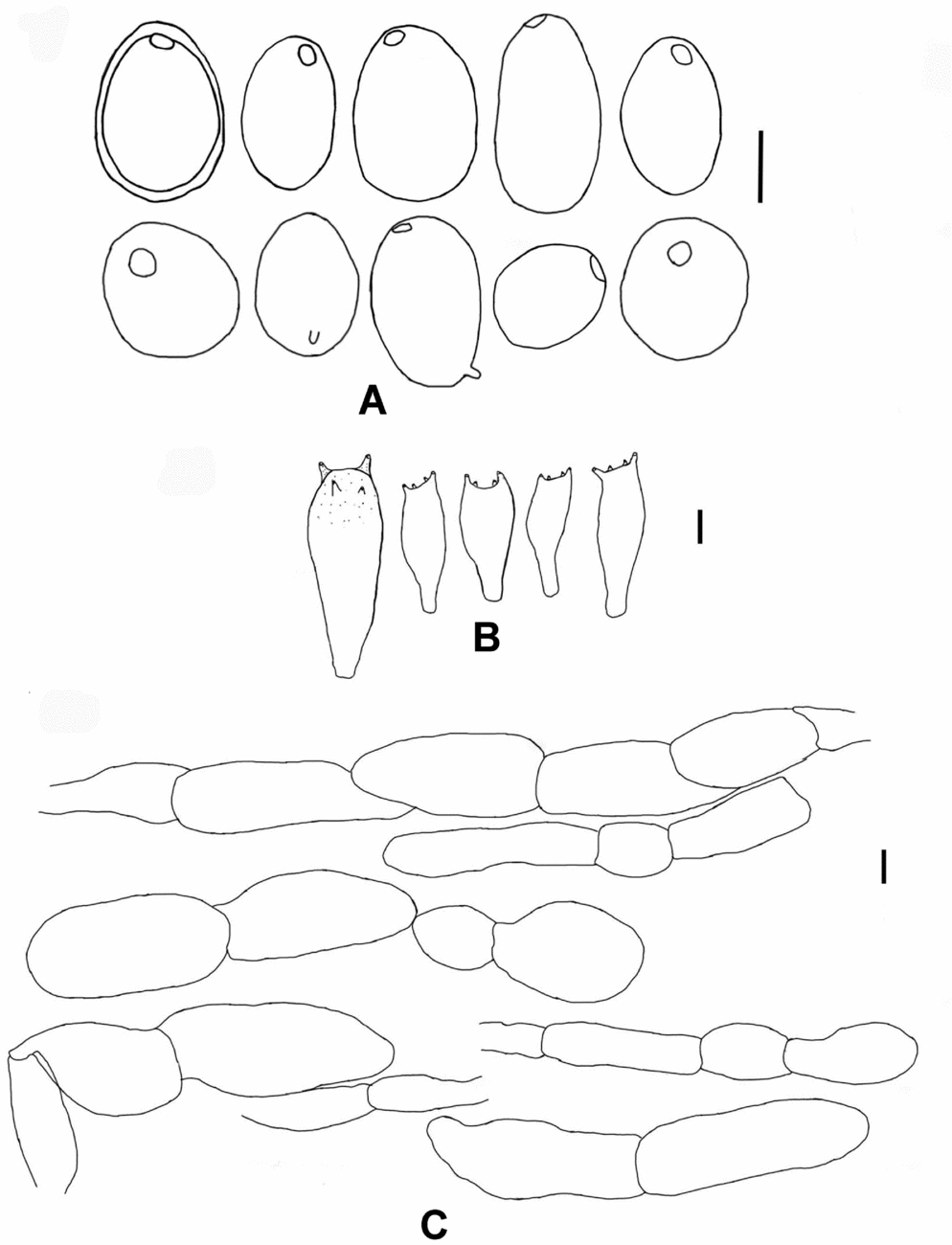
Coprinus calyptratus (JPB 46272). A, Basidiospores; B, basidia; C, velar elements. Scale bars: 10 µm.

= Coprinus vosoustii Pilát, Stud. Bot. Cech. 5: 207 (1942).
= Coprinus asterophorus Long & V.A.M.Mill., Mycologia 37: 120 (Reference Long and Miller1945).
= Coprinus asterophoroides Bogart, Mycotaxon 4: 252–254 (Reference Bogart1976).
Name misapplied to present species
Coprinus xerophilus Bogart sensu Magnago et al., Guide to the Common Fungi of the Semiarid Region of Brazil: 33 (Reference Magnago, Oliveira, Furtado, Urrea-Valencia, Neves, Neves, Baseia, Drechsler-Santos and Góes-Neto2013).
Macroscopy
From Magnago et al. (Reference Magnago, Oliveira, Furtado, Urrea-Valencia, Neves, Neves, Baseia, Drechsler-Santos and Góes-Neto2013: 33): “Pileus 3.5–4.0 cm diam., becoming plane, striate plicate, black with whitish scale remnants from the veil concentrated at the centre; margin revolute to lacerate in older specimens. Hymenophore lamellate, lamellae close, free, deliquescent, black when mature; lamellulae present. Stipe 7.0 cm long. 0.6 cm diam., white to gray at the top, central, cylindric, fibrous to fibrillose, hollow, base slightly bulbous. Spores elliptic, 15.0–22.0 × 9.0–12.0 µm, smooth, dark, thick walled, inamyloid. Habit: solitary on sandy soil.”
Microscopy
Basidiospores 17–21.4(–22.1) × 12.3–14.3(–15.6) × (9.1–)10.4–13 µm [av., 18.8 × 13.7 × 11.5 µm; Q1, (1.22–)1.30–1.45(–1.50); Q2, (1.44–)1.47–1.80(–1.82); Qm1, 1.36; Qm2, 1.64], dark reddish brown, ellipsoid in side view and ovoid in face view with a more flattened base, few differences in frontal and side views, germ pore eccentric up to 2.5 µm in diameter, hilar appendix up to 1 µm, wall up to 1 µm. Basidia 18.5–35.7 × 6.5–12.8 µm, hardly visible due to the collapsed hymenophore, clavate, with brown pigment in apex or from middle part to the apex; sterigmata up to 3 µm in height, brown pigmented, and hyaline at sterigmata end. Cystidia not seen, due to collapsed lamellae. Velar elements 10.2–37.2 × 6.7–16.3 µm, hyaline, ellipsoid to elongated, subglobose, cylindrical cells in chains, with some elements narrower, thin wall, septate, clamp connections not visualised. Pileipellis consisting of indistinct cutis, with radially arranged elongated pale hyphae.
Material examined. Brasil. Paraíba: São José dos Cordeiros, RPPN Fazenda Almas. 7°28′46″S, 36°53′00″W, 735 m, 12 vii 2009, A.C. Magnago et al. 247 (JPB 46272, as ‘Coprinus xerophilus’).
Coprinus calyptratus is reported as occurring in places with a semiarid environment. It has a solitary or gregarious habit, growing on sandy or gravelly soil. In North America, it was described from Kansas (Peck, Reference Peck1895), and later found in the states of Arizona (Long & Miller, Reference Long and Miller1945) and Washington (Bogart, Reference Bogart1976). Moreno and Heykoop (Reference Moreno and Heykoop1998) reported it also from the Czech Republic, Mexico and Spain. The revised exsiccatae has very peculiar features among the coprinii: a large star-like patch remnant of veil on the pileus, concentrated in the centre, and a non-volvate stipe base (agreeing with Moreno & Heykoop, Reference Moreno and Heykoop1998). Magnago et al. (Reference Magnago, Oliveira, Furtado, Urrea-Valencia, Neves, Neves, Baseia, Drechsler-Santos and Góes-Neto2013: 33) also did not report a volvate stipe in their description of ‘Coprinus xerophilus’, now identified as C. calyptratus.
Nonetheless, we conclude that the exsiccatae JPB 46272 (the voucher of Coprinus xerophilus published by Magnago et al., Reference Magnago, Oliveira, Furtado, Urrea-Valencia, Neves, Neves, Baseia, Drechsler-Santos and Góes-Neto2013) is C. calyptratus, presenting a ‘slightly bulbous’ stipe base and a large star-like velar remnant on the pileus (according to Magnago et al., Reference Magnago, Oliveira, Furtado, Urrea-Valencia, Neves, Neves, Baseia, Drechsler-Santos and Góes-Neto2013). Here, we report Coprinus calyptratus for the first time from South America.
Coprinus xerophilus is the most similar species. It differs in the volvate stipe base and the universal veil on the pileus as patches spread across the entire surface, even along the pileal margin (Bogart, Reference Bogart1976; Moreno & Heykoop, Reference Moreno and Heykoop1998; Uljé & Noordeloos, Reference Uljé and Noordeloos2000).
Moreno and Heykoop (Reference Moreno and Heykoop1998) used the degree of dissociation of the veil from the pileus surface when mounted under the microscope as an important feature for delimiting both species: the veil of Coprinus calyptratus is more difficult to dissociate than that of C. xerophilus. However, there is some thought among mycologists that the star-like morphology of the veil remnant is a more reliable character than whether or not it is easy to dissociate under the microscope. We agree with this opinion, confirming the identification of our material as Coprinus calyptratus.
Acknowledgements
We are grateful to the Programa de Pesquisa em Biodiversidade (PPBio Proc. 60/2009) for financial support, and to two anonymous reviewers for the very productive comments. F.W. also thanks CNPq for providing the Produtividade em Pesquisa (Proc. 307922/2014-6) grant.