Introduction
Leptospirosis is 1 of the major emerging zoonotic bacterial diseases. In India, it posed as a public health problem from 1980 onwards. The World Health Organization report states that the highest prevalence is after the rainy season. Reference John1 It is 1 of the most common of the 14 notifiable diseases at the district (province) level communicable disease surveillance system of Kerala state. Reference Kuriakose, Paul, Joseph, Sugathan and Sudha2 Leptospirosis is prevalent in coastal regions. This could be attributed to the presence of rats and contact with flood water. 3,Reference Naing, Reid, Aye, Htet and Ambu4
Kerala state in south India witnessed severe floods during August 2018. It claimed over 483 lives and resulted in the evacuation of over 1000000 people. A literature search revealed a paucity of research conducted to assess the knowledge, attitude and practices regarding leptospirosis in a flood affected population immediately after the flood in Kerala state. Accredited Social Health Activists (ASHA) are village-level health activists who act as the interface between the public health system and the community. This study was conducted to assess the knowledge, attitude, and practices regarding the prevention of leptospirosis among the flood affected population and ASHAs of Chengannur, 1 of the worst hit towns in Kerala, and to analyze the factors responsible and contributing to leptospirosis control in the area post-flood.
Materials and Methods
Study Design
Observational questionnaire-based study.
Target Population
The study was conducted among the flood affected population and ASHA workers in Chengannur town of Kerala state.
Questionnaire
The questionnaire was developed in English, translated into the local language Malayalam, and was validated for face validity by distributing the questionnaire to subject experts in public health with proficiency in Malayalam. It was divided into 3 parts. Part A consisted of socio-demographic information. Part B contained 20 closed ended questions on assessment of knowledge (11 questions), attitude (4 questions), and practice (5 questions) regarding prevention and control of leptospirosis. Part C contained 10 questions for ASHAs, pertaining to their activities.
Data Collection
The data collection was done between June and August, 2019. The data was collected by the principal investigator through distribution of questionnaires. A convenient sampling technique was used. The data collection took about 20-30 minutes per person. Chengannur municipality is divided into 27 wards for administrative purposes. Data collection was done from 23 wards. A total of 4 wards, that were experiencing flood during the data collection were excluded from the survey. A total of 390 participants (302 from the general population and 87 ASHAs) were contacted for the study, of which 51 from the general population refused to participate. All ASHAs contacted participated in the study.
A written informed consent in the local language was obtained prior to the administration of questionnaire. The study protocol was approved by the Institutional Ethics Committee with Reference number IEC/IGIDS/16/2019.
Statistical Analysis
The obtained data was coded and tabulated and analyzed using Statistical Package for Social Sciences (SPSS) Version 16.0 for Windows (IBM Corporation, Armonk, NY). Descriptive statistics were expressed as frequencies and percentages. Inferential analysis was done using Chi Square test in relation to the independent variables. A P value less than 0.05 was considered statistically significant.
Results
The study was conducted among 339 residents in the town. The sample included 252 respondents from the general population and 87 respondents who were ASHA. A total of 8 participants from the general population group who returned incomplete questionnaires were excluded from the study and hence the final sample size was 331 (244 from the general population and 87 ASHAs).
Over 65% of the total respondents were females. Among the entire study sample, there was almost equal distribution of respondents in the age groups of less than 40 years and 40 to 60 years (40% each). About 36% of all the respondents were graduates or had higher educational qualification. All the study participants were exposed to flood waters, among which 99.4% of them had an exposure of 3 days or more.
Table 1a summarizes the response to knowledge-based questions. Table 1b shows the response to the knowledge-based question to symptoms of leptospirosis. There was a significant difference in knowledge score for the symptoms of leptospirosis where ASHA had significantly higher knowledge than general population (P = 0.006).
Response to knowledge-based questions

Response to the knowledge-based question on symptoms of leptospirosis

Table 2 summarizes the response to attitude-based questions. A significant difference in attitude scores was for the question ‘Can leptospirosis be considered a public health problem?,’ where the respondents aged above 60 years considered it more to be a public health problem (P = 0.001).
Response to attitude-based questions

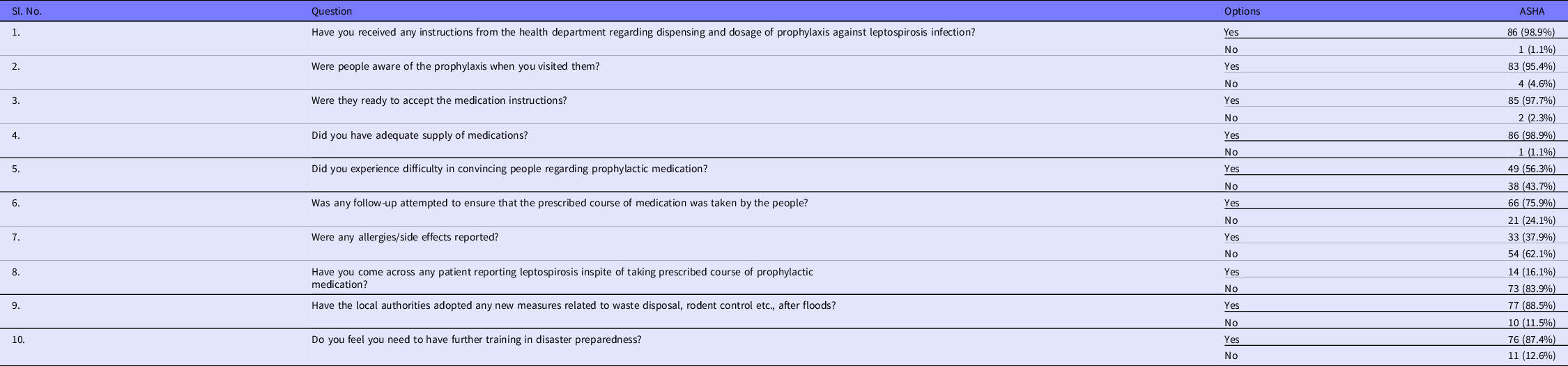
Table 3 summarizes the response to practice-based questions. It was observed that the response to the practice scores in ‘Do you feel your hygiene habits have changed in relation to waste disposal/animal rearing after the flood?,’ and ‘Have you taken prophylaxis?’ was significantly better with ASHA in relation to the general population (P = 0.001). Table 4 summarizes the response to questions asked to ASHA only.
Response to practice-based questions

Response to questions asked to ASHA only

To compare the knowledge, attitude, and practice, the responses were dichotomized into correct and wrong responses. Among the entire study sample, the mean knowledge, attitude, and practice scores, were 9.01 ± 1.08 (maximum score 11), 3.61 ± 0.55 (maximum score 4), and 4.12 ± 1.05 (maximum score 5). There was no significant difference in knowledge and attitude scores between the general population and ASHAs. The practice score was higher among ASHAs (P = 0.001)
Discussion
Leptospirosis is an emerging zoonotic disease of public health importance in many countries including India. The causative organism is a spirochete bacterium: leptospira, which is transmitted by the urine of an infected animal. It is predominantly seen in a moist environment. The primary hosts include the rats, mice and other rodents while secondary hosts include dogs, deer, rabbits, cattle, buffaloes, sheep, and pigs.
Humans get infected through skin contact with contaminated water or soil containing urine from infected animals, or by consuming contaminated food or water. Human to human spread of this disease is unknown. The clinical features are non-specific, with signs and symptoms similar to those seen in many other infectious diseases, such as influenza-like illness, fever, headache, muscle pain, vomiting and abdominal pain. Laboratory tests are required for confirmation of the disease. 3
Kerala, with a population of over 3.3 crore (or 33000000), is globally recognized for its impressive achievements in human development. Within India, Kerala ranks first among Indian states on the Human Development Index (HDI). Human development has also been more equitable in Kerala than in other Indian states. Kerala state is considered as a yardstick in relation to health indicators. Better outreach, decentralized governance, community participation and higher education base have contributed to the ‘Kerala model’ of health. 5–8 The state, however, is highly vulnerable to natural disasters, and changing climatic dynamics given its location along the sea coast and a steep gradient along the slopes of the Western Ghats. Kerala is also 1 of the most densely populated Indian states (860 persons per square kilometer), making it more vulnerable to damages and losses on account of disasters. Floods are the most common natural hazards in the state. 5 Barring a few isolated reports of diseases such as leptospirosis, the post-flood epidemic outbreak was totally prevented and under control following the floods of 2018. Hence, this study was planned in Chengannur, 1 of the most severely affected towns in the floods of 2018. In order to get a comprehensive picture, the study was conducted among the general population as well as the health care personnel involved directly in the control of leptospirosis.
All the respondents answered that rats were the cause of spread of leptospirosis. The results of studies conducted among Trinidian households by Andrea et al., Reference Mohan and Chadee9 risk group residents of South Chennai by Arul, et al., Reference Arulmozhi and Natarajaseenivasan10 and among 3 riverside settlements in Argentina by Ricardo, et al., Reference Ricardo, Bergero, Bulgarella and Previtali11 showed the corresponding scores for the same question as 39%, 17.7% and 71.3% respectively. This observation could be attributed to the terminology of leptospirosis in the local language Malayalam, “Elipani” which can be translated as “Rat fever.”
An important observation is that about 93% of the general population and 100% of ASHAs believed that urine of the infected animal is responsible for its spread. The results of the study conducted in Trinidad, Reference Mohan and Chadee9 Chennai, Reference Arulmozhi and Natarajaseenivasan10 and Argentina, Reference Ricardo, Bergero, Bulgarella and Previtali11 showed corresponding knowledge levels of 6%, 62%, and 46.8%, respectively.
Majority of the respondents (93%) were aware that the disease could be cured. A study conducted among town workers in North Eastern Malaysia, Reference Azfar, Nazri and Rusli12 revealed that knowledge level regarding the curability was 73% among the high-risk exposure group, and in a study conducted in Chennai, India, the awareness regarding the curability of the disease was less than 30%. Reference Arulmozhi and Natarajaseenivasan10
Another significant observation is that only 22% of respondents believed that the organism enters the body through open cuts and wounds and more than 75% believed that the organism enters the body from contaminated food and water. This observation might be due to the fact that all the people exposed to contaminated water during the floods were advised to take a prophylaxis; which was reinforced through health care volunteers, visual and printed media, relief volunteers, and social media: a statement that could convince respondents that the disease enters the body through contaminated water. Over 90% of the entire study sample opined that the disease was life threatening. The results are comparable to studies in Argentina, Reference Ricardo, Bergero, Bulgarella and Previtali11 and Malaysia. Reference Azfar, Nazri and Rusli12
An overall assessment of knowledge scores revealed a significant higher knowledge regarding leptospirosis among the general population and ASHAs. Thus, this can be 1 of the key factors that have resulted in prevention of the epidemic in this locality. All other studies, Reference Mohan and Chadee9–Reference Arbiol, Orencio, Romena, Nomura, Takahashi and Knowledge14 have shown that the knowledge levels were comparatively less. The attitude scores for the general population were comparable with the results of the other studies. Reference Ricardo, Bergero, Bulgarella and Previtali11–Reference Prabhu, Meera, Bharanidharan, Natarajaseenivasan, Ismail and Knowledge13 It was an important observation that over 62% of the general population, and 91% of ASHAs felt their habits in relation to waste disposal/animal rearing changed after the floods.
More than 70% of the study respondents completed the full prescribed course of prophylactic medications. The prophylactic medication distributed by the health care personnel and volunteers were Tablets of Doxycycline (200 mg), once a week for 6 to 8 weeks, per the recommendations in 2015. 15 It is noted that over 95% of the general population and all ASHAs agreed to the use of personal protective equipment while in contact with flooded water. This indicated a high practice score compared to other studies done on the high-risk population. Reference Mohan and Chadee9–Reference Arbiol, Orencio, Romena, Nomura, Takahashi and Knowledge14
All the ASHAs had visited the flood affected population as per instructions from the Primary Health Centers and over 75% of them agreed to have followed up the patients to ensure prophylaxis was taken. An overview of the response to the survey also highlights the role of grass-root level workers like ASHAs in controlling leptospirosis. A promising observation was that over 88% opined that wastes were managed better by local authorities after the floods. This positive attitude and practice regarding proper waste disposal can aid in preventing other epidemics and help in attaining a healthier environment.
The data collection was conducted immediately after the floods; hence only a convenient sampling method could be employed. Although a limitation, that was the best method that could be adapted to the situation.
Conclusion
The knowledge, attitude, and practice regarding leptospirosis control in the flood affected region of Chengannur in Kerala could be considered optimal. There was no difference between the general population and ASHA workers regarding knowledge and attitude, but the practice score was considerably better among the ASHAs which could have probably contributed to the prevention of a leptospirosis outbreak in the region.