Repetitive negative thinking (RNT) has been defined as ‘. . . repetitive thinking about one or more negative topics that is experienced as difficult to control’ (Ehring & Watkins, Reference Ehring and Watkins2008, p. 193), and it has been identified as a transdiagnostic cognitive construct that is characteristic of most emotional disorders (Ehring & Watkins, Reference Ehring and Watkins2008; Harvey, Watkins, Mansell, & Shafran, Reference Harvey, Watkins, Mansell and Shafran2004). Various forms of RNT have been associated with the onset, duration, severity and maintenance of depressive episodes (Nolen-Hoeksema, Reference Nolen-Hoeksema2000; Nolen-Hoeksema, Morrow, & Fredrickson, Reference Nolen-Hoeksema, Morrow and Fredrickson1993; Nolen-Hoeksema, Wisco, & Lyubomirsky, Reference Nolen-Hoeksema, Wisco and Lyubomirsky2008), poor problem-solving (Watkins & Moulds, Reference Watkins and Moulds2005), a range of encoding, memory, and emotional processing biases (Moulds, Kandris, & Williams, Reference Moulds, Kandris and Williams2007; Watkins, Reference Watkins2004; Watkins & Teasdale, Reference Watkins and Teasdale2001), avoidance of negative affect (Borkovec, Alcaine, & Behar, Reference Borkovec, Alcaine, Behar, Heimberg, Turk and Mennin's2004), and inhibition of emotional processing (Fresco, Heimberg, Mennin, & Turk, Reference Fresco, Frankel, Mennin, Turk and Heimberg2002). The relationship between RNT and psychopathology is considered to be reciprocal, where RNT is a contributor to the onset of psychopathology, as well as a maladaptive response to symptoms that serve to maintain and exacerbate them (Martell, Addis, & Jacobson, Reference Martell, Addis and Jacobson2001; Nolen-Hoeksema, Reference Nolen-Hoeksema1991). Our understanding of the common and unique aspects of RNT across disorders has been limited by the use of different measures to index this construct across disorders. For instance, aspects of RNT have been commonly measured by the Ruminative Responses Scale (RRS; Nolen-Hoeksema & Morrow, Reference Nolen-Hoeksema and Morrow1991) for depression, the Penn State Worry Questionnaire (PSWQ; Meyer, Miller, Metzger, & Borkovec, Reference Meyer, Miller, Metzger and Borkovec1990) for generalised anxiety disorder, and the post-event processing questionnaire (PEPQ; Rachman, Grüter-Andrews, & Shafran, Reference Rachman, Grüter-Andrews and Shafran2000; and PEPQ-R; McEvoy & Kingsep, Reference McEvoy and Kingsep2006) for social phobia. Transdiagnostic versus diagnosis-specific aspects of RNT across these measures, and how these aspects may be differentially related to various emotional experiences (e.g., depression, anxiety, anger, shame), are therefore unclear. Increasing our understanding of common and unique aspects of RNT will enable more integrated transdiagnostic models and targeted treatments to be developed.
Researchers have recently developed instruments that index RNT without disorder-specific content (e.g., Ehring et al., Reference Ehring, Zetsche, Weidacker, Wahl, Schönfeld and Ehlers2011). In an initial attempt to identify common versus unique aspects of RNT related to various emotional experiences, McEvoy, Mahoney, and Moulds (Reference McEvoy, Mahoney and Moulds2010) developed the Repetitive Thinking Questionnaire (RTQ). The RTQ was developed by modifying RRS, PSWQ, and PEPQ-R items to remove potential confounds, including items that assess symptoms of particular disorders (e.g., items that ask about concentration or fatigue, in the case of depression) and the use of terms for RNT that are associated with particular disorders. Including items that assess symptoms could artificially inflate associations between RNT and disorders characterised by the particular symptoms. The term ‘worry’ in the items of the PSWQ may inflate associations with generalised anxiety disorder (GAD), given that it is a core feature of that disorder, and introduces method variance that could explain why some studies have found that these items load separately from items on the RRS, which do not contain this term (e.g., Fresco, Heimberg et al., Reference Fresco, Frankel, Mennin, Turk and Heimberg2002; Goring & Papageorgiou, Reference Goring and Papageorgiou2008; Muris, Roelofs, Meesters, & Boomsma, Reference Muris, Roelofs, Meesters and Boomsma2004).
McEvoy et al. (Reference McEvoy, Mahoney and Moulds2010) found that the RTQ consisted of two factors, Repetitive Negative Thinking (RNT) and Absence of Repetitive Thinking (ART). The ART scale consisted of the negative worded items originally derived from the PSWQ and were largely unrelated to all symptom measures. On the other hand, the RNT scale consisted of all other items and was significantly and uniquely associated with depression, anxiety, shame, anger, and general distress. McEvoy et al. also found that the RNT scale of the RTQ was significantly associated with mechanisms theorised to drive engagement in RNT, including metacognitions, cognitive avoidance strategies, and various thought control strategies (e.g., Borkovec et al., Reference Borkovec, Alcaine, Behar, Heimberg, Turk and Mennin's2004; Coles & Heimberg, Reference Coles and Heimberg2005; Wells & Matthews, Reference Wells and Matthews1996). The RNT scale of the RTQ is therefore a promising trans-emotional measure of the RNT construct, although many theoretical questions relevant to this new instrument remain.
The first key question regards the importance of the temporal orientation of RNT; namely, is the construct of RNT the same irrespective of whether the focus of repetitive thought is on an upcoming event or on an event that occurred in the past? Linking this question to the RTQ specifically, it is unknown whether the same factor structure of the original RTQ (which instructed participants to respond with reference to their experiences following a past distressing situation) also emerges when participants are instructed to anchor their responses to RNT in anticipation of a distressing situation. Previous research has found that worry and rumination are highly correlated, load on common factors, are both associated with emotions such as anxiety and depression, and are both more similar than different in terms of the processes that drive them (see Ehring & Watkins, Reference Ehring and Watkins2008). Anticipatory RNT and post-event RNT may therefore be substantially similar constructs, with the same factor structure emerging regardless of participants’ temporal focus. However, few studies have investigated anticipatory RNT independent of the construct of worry. Given that temporal orientation is one of few replicated differences between worry and rumination, with worry being more future-oriented and rumination more past-focused (Ehring & Watkins, Reference Ehring and Watkins2008; Papageorgiou & Wells, Reference Papageorgiou and Wells1999; Watkins, Moulds, & Mackintosh, Reference Watkins, Moulds and Mackintosh2005), it is important to demonstrate that the RTQ is robust in terms of its structure regardless of the temporal orientation of the reference event. The second important question is whether RNT in anticipation of a distressing event is associated with the same array of emotional responses as RNT that occurs in the aftermath of a negative event.
The current study had two aims. The first aim was to examine the structure of the RTQ when completed in anticipation of a stressor. For this purpose, the original RTQ was modified to create an anticipatory version (RTQ-Ant). Given that the original version of the RTQ was comprised of RNT and ART factors, it was hypothesised that the looming version would replicate this structure. The second aim was to replicate the associations between the original past-oriented RTQ with the anticipatory version (RTQ-Ant), to establish its status as an instrument that indexes a trans-emotional construct. Specifically, we hypothesised that the RTQ-Ant would be associated with symptoms of depression and anxiety, as well as with a range of specific emotions (anxiety, anger, shame, and general distress) associated with the reference situation.
Method
Participants
Participants (N = 175, 61% women) were university undergraduate students with a mean age of 19.71 years (SD = 1.97, range = 17–31).
Measures
Repetitive Thinking Questionnaire-Anticipation Version (RTQ-Ant)
The RTQ (McEvoy et al., Reference McEvoy, Mahoney and Moulds2010) is a 31-item measure of perseverative thinking developed from existing measures of rumination, worry, and post-event processing. Items were modified for the original RTQ by removing items that measured symptoms of particular disorders (e.g., ‘depression’) and those that could not be adapted to refer to a specific situation (e.g., ‘I have been a worrier all my life’). In addition, the phrase ‘thoughts or images’ was included in the stems of items and was used to replace terms associated with particular forms of repetitive thinking (e.g., ‘worry’). Given that the original RTQ asked respondents to complete the measure with reference to a recent past distressing event, in order to create an anticipatory version the instructions and some items were modified in the current study so as to refer to an upcoming stressor (i.e., upcoming university exams). For example, the item You have thoughts or images about a past event that come into your head even when you do not wish to think about it again was modified to You have thoughts or images about a future event that come into your head even when you do not wish to think about it again. Ratings were made across a 5-point response scale: not true at all (1), somewhat true (3), or very true (5).
Positive and Negative Affect Scale (PANAS; Watson, Clark, & Tellegen, Reference Watson, Clark and Tellegen1988)
The 10-item Negative Affect subscale of the PANAS was used to measure the range and degree of negative emotions experienced by participants in anticipation of the reference distressing situation. The negative emotions include: distressed, upset, guilty, scared, hostile, irritable, ashamed, nervous, jittery, and afraid, and are rated on a 5-point response scale; very slightly or not at all (1), a little (2), moderately (3), quite a bit (4) or extremely (5). Crawford and Henry (Reference Crawford and Henry2004) have provided evidence of internal consistency (α = .85–.89) and construct validity (including convergent and divergent validity) for the PANAS. For consistency with the original RTQ study, we examined associations between the RTQ-Ant and PANAS total score (Cronbach's α = .90 in the current study), as well as four subscales derived from a factor analysis in the original study. Anxiety included the items nervous, afraid, scared, and jittery. Anger included the items irritable and hostile. Shame included the items guilty and ashamed. General distress included the items distressed and upset. Average scale scores were calculated for each of these factors.
Beck Anxiety Inventory (BAI; Beck, Epstein, Brown, & Steer, Reference Beck, Epstein, Brown and Steer1988)
The BAI consists of 21 items and measures the severity of anxiety symptoms over the previous week. Reliability and validity are established; internal consistency reliability coefficients range from .85 and .94, with a test–retest reliability coefficient of .75.
Beck Depression Inventory (BDI-II; Beck, Steer, & Brown, Reference Beck, Steer and Brown1996)
The BDI-II is a 21-item measure of depression symptoms experienced during the previous fortnight. Internal consistency (α = .92) and test–retest reliability (r = .93 over 1 week) are established (Beck et al., Reference Beck, Steer and Brown1996), and evidence for construct validity has been demonstrated (e.g., Dozois, Dobson, & Ahnberg, Reference Dozois, Dobson and Ahnberg1998; Osman, Kopper, Barrios, Gutierrez, & Bagge, Reference Osman, Kopper, Barrios, Gutierrez and Bagge2004). Support for convergent and discriminant validity has also been reported (Osman, Downs, Barrios, Kopper, Guitierrez, & Chiros, Reference Osman, Downs, Barrios, Kopper, Gutierrez and Chiros1997; Steer, Ball, Ranieri, & Beck, Reference Steer, Ball, Ranieri and Beck1997).
Procedure
Participants were first-year undergraduate psychology students who received credit towards their course requirements for their involvement. Participants were recruited in the weeks leading up to their end of semester university exams, with the questionnaires being completed an average of 18.27 days (SD = 10.51) prior to the first exam in the reference period. The mean number of exams to be sat during the upcoming reference period was 2.87 (SD = 1.21). Participants were instructed to complete the PANAS and RTQ-Ant with reference to their feelings and experiences in anticipation of the upcoming university exams, whereas the BDI-II and BAI were completed with reference to their experience over the preceding 2 weeks. This study received approval from the university's Human Research Ethics Panel.
Results
Factor Analysis
Common factor analysis (i.e., principal axis factor analysis) was used to analyse the 31 RTQ-Ant items. Oblique rotation was used because if multiple factors were derived it was expected that they would be correlated with one another. Common factor analysis was used for consistency with previous research (e.g., Fresco, Frankel, Menin, Turk, & Heimberg, Reference Fresco, Heimberg, Mennin and Turk2002; McEvoy et al., Reference McEvoy, Mahoney and Moulds2010). Moreover, estimates from common factor analysis tend to replicate better with confirmatory factor analysis and our intention was to examine relationships among manifest variables to latent variables (Floyd & Widaman, Reference Floyd and Widaman1995). One bivariate correlation between items was .79 with the next highest being .67, suggesting that item redundancy was not a significant problem. Several methods of estimating the most appropriate number of factors were used. First, Velicer's minimum average partial (MAP) and Horn's parallel analysis (O’Connor, Reference O’Connor2000) were used because they have demonstrated robust estimations in the development of health measures of between 20–50 variables in samples of 100–300 subjects (Coste, Fermanian, & Venot, Reference Coste, Fermanian and Venot1995). In addition, the eigenvalues and scree test were examined. The MAP test, parallel analysis, and scree plot indicated the presence of two factors. Three eigenvalues were greater than 1 (11.63, 1.51, 1.12). Consistent with previous research (e.g., Fresco, Frankel et al., Reference Fresco, Heimberg, Mennin and Turk2002; Goring & Papageorgiou, Reference Goring and Papageorgiou2008; McEvoy et al., Reference McEvoy, Mahoney and Moulds2010), items were removed if no factor loadings exceeded .4, or if the highest loading was not at least .1 higher than their second highest loading. Seven items were removed based on these criteria, resulting in 24 remaining items. The factor analysis was then run again and a further two items cross-loaded and were removed. No remaining items cross-loaded and all loaded more than .4 on their respective factors. The MAP test, parallel analysis, and scree plots with the remaining 22 items again suggested two factors, with two factors yielding eigenvalues greater than 1 (9.55 and 1.27).
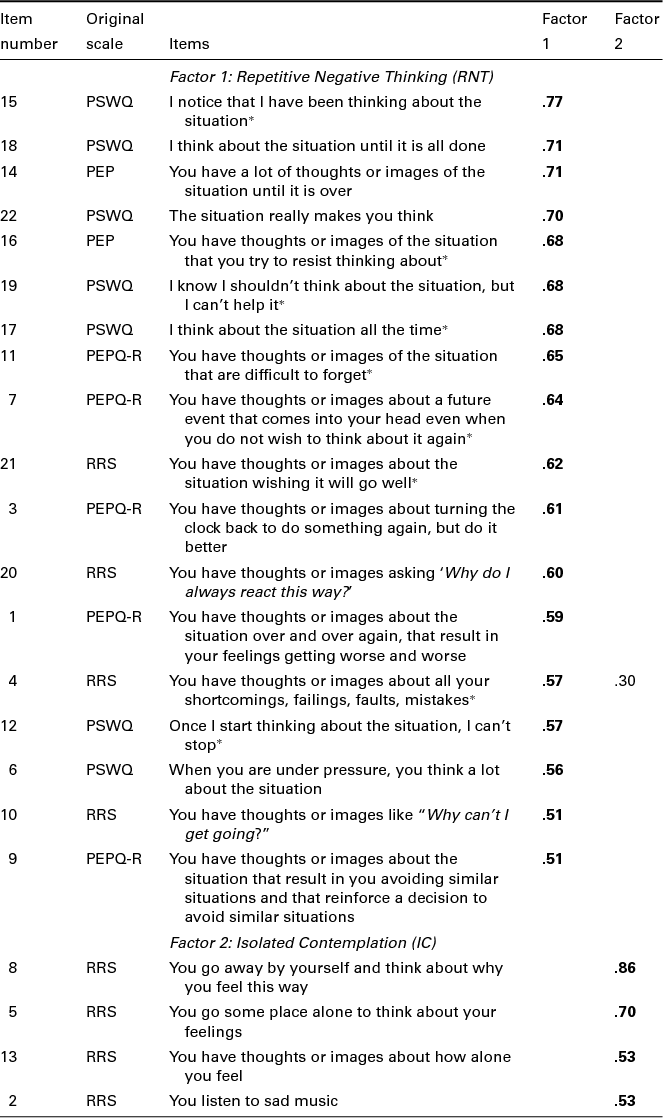
The first factor was comprised of four items originally derived from the RRS, seven from the PSWQ, and seven from the PEPQ-R (18 items). This factor was labelled Repetitive Negative Thinking (RNT) and explained 43.40% of the variance. These items reflected engagement in repetitive thinking (e.g., I think about the situation all the time), negative thoughts about oneself (e.g., You have thoughts about all your shortcomings, failings, faults, mistakes), and ‘why’ questions (e.g., You have thoughts or images like ‘Why can't I get going?’). The second factor was comprised of four RRS items and was labelled Isolated Contemplation (IC), because the items referred to isolating oneself and reflecting on negative feelings, loneliness, and listening to sad music. This factor explained 5.77% of the variance (see Table 1). Four excluded items reflected the absence of RT (There is nothing more you can do about the situation, so you don't think about it anymore; I find it easy to dismiss distressing thoughts about the situation; I don't tend to think about it [the situation]; I don't have enough time to do everything, so I don't think about it). The other five excluded items were: Your thoughts overwhelm you; You have thoughts or images like ‘Why do I have problems other people don't have?’; You have thoughts or images that ‘I won't be able to do my job/work because I feel so badly’; You have thoughts or images about how angry you are with yourself; I am always thinking about something.
Item loadings from Principal Axis Factor Analysis

Note: Values below .25 are suppressed. Bolded factor loadings indicate the respective scale on which each item loaded most strongly. RRS = Ruminative Responses Scale, PSWQ = Penn State Worry Questionnaire, PEPQ-R = Post-Event Processing Questionnaire-Revised. * Items included in the Repetitive Negative Thinking — Anticipation (9 item short scale).
Internal Consistencies and Scale Descriptives
Cronbach's alpha suggested that internal consistency was high for the RNT (α = .94, average inter-item correlation = .46) and IC (α = .79, average inter-item correlation = .49) scales. The RNT and IC scales were moderately correlated with one another (Pearson's r = .60, p < .001). Mean total scores (SDs) for the RNT and IC scales were 47.33 (15.89) and 8.10 (3.76), respectively. Independent samples t tests showed that women scored higher on the RNT scale than men, t(173) = 2.79, p < .01, d = .44, with a similar trend for the IC subscale, t(173) = 1.94, p = .054, d = .31. Mean (SD) scores on the RNT scale were 49.95 (16.75) and 43.21 (13.57) for women and men, respectively. Mean (SD) scores on the IC scale were 8.53 (4.04) and 7.41 (3.19) for women and men, respectively. Women (M = 13.52, SD = 9.55) scored higher than men (M = 9.69, SD = 8.14) on the BDI, t(173) = 2.74, p < .01, d = .43. Likewise, women (M = 13.24, SD = 9.49) scored higher than men (M = 7.63, SD = 6.28) on the BAI, t(173) = 4.31, p < .001, d = .71.
Interestingly, a univariate analysis of variance (ANOVA) with gender as the between-subjects variable, BDI as the dependent variable, and RNT as a covariate, found that the main effect of gender was no longer significant, F(172) = 1.88, p = .17, ƞ2 = .01. When the IC scale was used as the covariate, the main effect of gender just failed to achieve statistical significance, F(172) = 3.87, p = .051, ƞ2 = .02. An ANOVA with gender as the between-subjects variable, BAI as the dependent variable, and RNT scale as a covariate, found that the main effect of gender remained significant, F(172) = 10.34, p < .01, ƞ2 = .06. The main effect of gender also remained significant when IC was the covariate, F(172) = 14.45, p < .001, ƞ2 = .08.
Relationships Between Repetitive Thinking and Negative Emotions
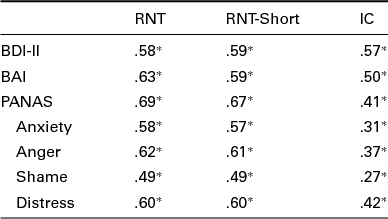
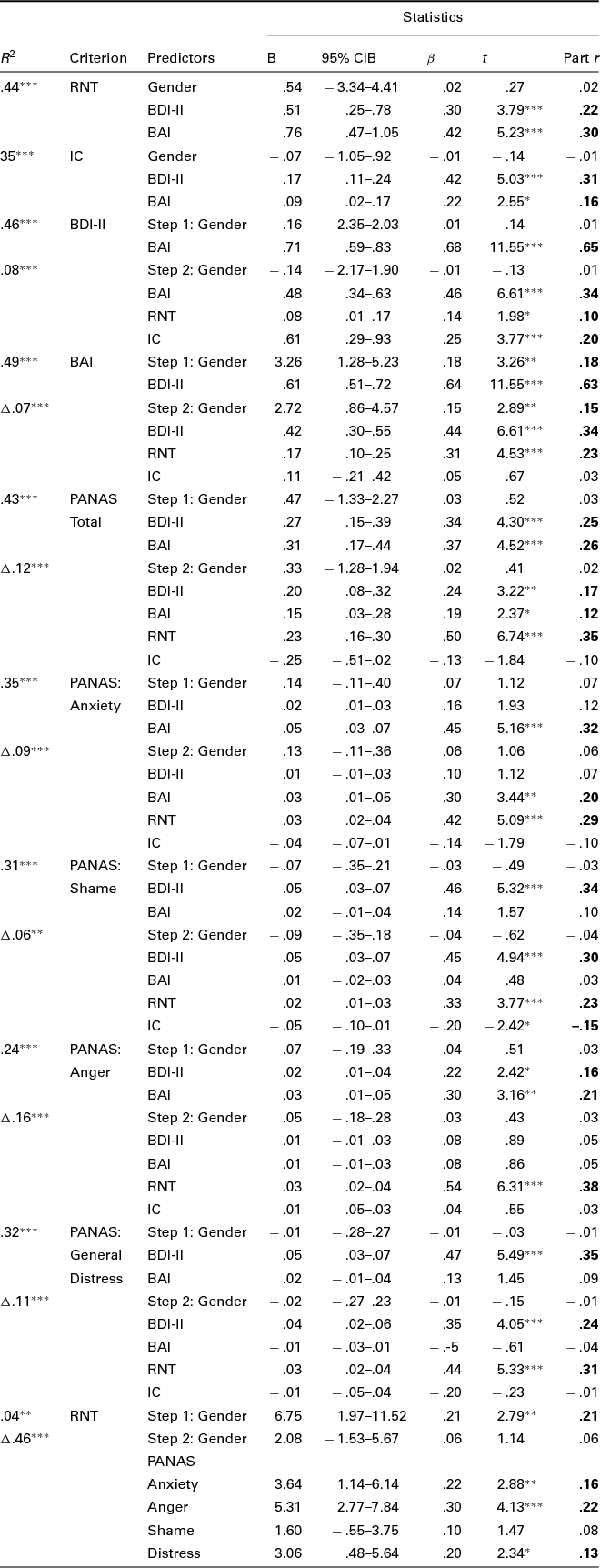
The relationships between the RTQ-Ant subscales and emotions were examined in two ways. First, scale scores were correlated with measures of general depression and anxiety symptoms over the previous 2 weeks (BDI and BAI, respectively). Second, scale scores were correlated with the negative PANAS, which referred specifically to emotions experienced in anticipation of the stressor. In terms of depression and anxiety, scores on the RNT and IC scales were moderately correlated with scores on the BDI and BAI (see Table 2). Likewise, the RNT and IC scales were significantly associated with the PANAS total score and subscale scores, although these associations were generally stronger with the RNT scale. Multiple linear regression (MLR) was then used to predict RNT and IC scales in separate models by simultaneously entering BDI and BAI scores as predictors. Given that scores on the RNT and IC scales significantly differed between men and women, gender was used as a covariate in all models. Both the BDI and BAI remained significant predictors of the RNT and IC scales (see Table 3). Gender did not add to the predictive power of either model. The 95% confidence intervals for the standardised coefficients (betas) were calculated and were found to overlap for the RNT (BDI 95% CI = .14–.45; BAI 95% CI = .26–.58) and IC (BDI 95% CI = .26–.59; BAI 95% CI = .05–.39), suggesting that neither the BDI nor the BAI was a significantly stronger predictor of RNT or IC than the other.
Bivariate Correlations Between the RTQ-Anticipation Subscales and Negative Emotion Scales
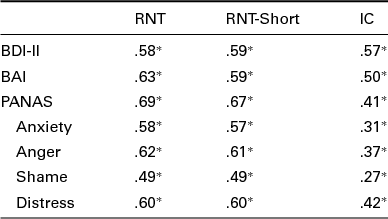
Note: BDI-II = Beck Depression Inventory-II, BAI = Beck Anxiety Inventory, RRS = Ruminative Responses Scale, PANAS = Positive and Negative Affect Scale, RNT = Repetitive Negative Thinking, IC = Isolated Contemplation, RNT-Short = Repetitive Negative Thinking scale — Anticipation (9 item short scale). *p < .001.
Statistics From Multiple Linear Regression (MLR) and Hierarchical MLR Analyses With RTQ-Anticipation Scales and Negative Emotion Scales
Note: Significant part rs are bolded. BDI-II = Beck Depression Inventory-II, BAI = Beck Anxiety Inventory, RRS = Ruminative Responses Scale, PANAS = Positive and Negative Affect Scale, RNT-Ant = Repetitive Negative Thinking — Anticipatory, IC = Isolated Contemplation. * p < .05 ** p < .01 *** p < .001.
Hierarchical MLR was then used to determine whether or not the two scales could uniquely predict each symptom measure (i.e., BDI and BAI) when controlling for the other symptom measure (given the correlation between depression and anxiety symptoms, r = .68, p < .001) and gender. BDI or BAI was entered in Step 1 (whichever was not the criterion variable) along with gender, with the two RTQ scales entered in Step 2. Both the RNT and IC scales uniquely predicted BDI scores, but only the RNT scale uniquely predicted BAI scores. Gender remained a significant predictor of the BAI but not the BDI.
Hierarchical MLR was also used to determine whether each RTQ scale uniquely predicted PANAS scores when controlling for gender, BDI, and BAI. BDI and BAI scores were controlled in this and subsequent analyses to reduce the impact of mood state (over the preceding 2 weeks) on subjective affective states reported with reference to the looming stressor. Gender, BDI, and BAI were entered in Step 1, with the RTQ scales entered in Step 2. Five models were run with the PANAS total score, PANAS-Anxiety, PANAS-Shame, PANAS-Anger, and PANAS-Distress scales as criterion variables, respectively. The RNT scale remained a significant predictor in all five models, being positively associated with each criterion variable. In contrast, the IC scale was only uniquely associated with the PANAS-Shame subscale, with lower IC scores being associated with higher levels of shame (Table 3). Gender did not add explanatory power in any model.
Finally, to determine whether all four emotions contributed unique variance to the prediction of RNT, they were simultaneously entered into a multiple regression equation after controlling for gender, with the RNT scale as the dependent variable (see Table 3). The Anxiety, Anger, and General Distress scales were significantly and uniquely associated with the RNT scale, but the Shame scale was not. The 95% confidence intervals for the standardised coefficients (betas) were calculated and were found to overlap for all scales (Anxiety = .07–.38; Anger = .16–.45; Shame = -.04–.24; General Distress = .03–.36), suggesting that one scale was not a significantly stronger predictor of RNT than any other. Gender did not add explanatory power in this model. This model was not run with the IC as the criterion variable given that it was only uniquely associated with the Shame scale in the earlier regression equations.
RNT-Short Scale
The 10 highest loading items from the original RTQ were highly correlated with the 27-item RNT scale, which provided a short measure that would be particularly useful in clinical settings (McEvoy et al., Reference McEvoy, Mahoney and Moulds2010). Nine of these 10 items loaded on the RNT factor in the anticipatory version, so for consistency with the original scale we examined the psychometric properties of these nine items even though they were not the nine highest loading items in the looming version (Table 1). The RNT-Short scale correlated very highly with the full 18-item RNT scale (r = .97, p < .001), and Cronbach's alpha suggested that internal consistency was excellent (α = .90, average inter-item correlation = .52). The average total score was 23.22 (SD = 8.66) and the average rating on the 5-point scale was 2.58 (SD = .96). As for the total scale, women (M = 24.50, SD = 9.07) scored significantly more highly than men (M = 21.21, SD = 7.61), t(173) = 2.48, p < .05, d = .39. The pattern of correlations with BDI, BAI, and PANAS scales was almost identical to the full 18-item RNT scale (Table 2). The pattern of findings from the multiple linear regression analyses was identical when they were rerun substituting the RNT scale with the RNT-Short scale.
Discussion
Repetitive negative thinking (RNT) has been identified as a trans-emotional construct, but most existing self-report instruments of RNT include diagnosis-specific content. The Repetitive Thinking Questionnaire (RTQ; McEvoy et al., Reference McEvoy, Mahoney and Moulds2010) was developed to measure RNT free of contamination from items specific to particular emotions or diagnoses. The original RTQ instructed respondents to indicate their degree of engagement in repetitive thinking following a recent distressing event. An anticipatory version of the RTQ (the RTQ-Ant) was examined in this study to determine whether the RTQ's structure would be robust when participants completed the measure with reference to their thinking about an upcoming stressor. The first hypothesis was that the two-factor structure derived from the original version would be replicated with the looming version, but this was not the case. None of the items in the Absence of Repetitive Thinking (ART) scale in the original version were retained in the current study. This finding is somewhat surprising, given that all of these items were originally derived from the PSWQ, which on conceptual grounds may be expected to be more relevant to future-oriented RNT (Papageorgiou & Wells, Reference Papageorgiou and Wells1999; Watkins et al., Reference Watkins, Moulds and Mackintosh2005). On the other hand, the negatively worded PSWQ items have been found to be separable from the positively worded items in previous research (Brown, Reference Brown2003; Fresco, Frankel et al., Reference Fresco, Heimberg, Mennin and Turk2002; Fresco, Heimberg et al., Reference Fresco, Frankel, Mennin, Turk and Heimberg2002; Olatunji, Schottenbauer, Rodriguez, Glass, & Arnkoff, Reference Olatunji, Schottenbauer, Rodriguez, Glass and Arnkoff2007), and they have generally not been found to be associated with symptom measures or related constructs (McEvoy et al., Reference McEvoy, Mahoney and Moulds2010; Olatunji et al., Reference Olatunji, Schottenbauer, Rodriguez, Glass and Arnkoff2007).
The remaining items in the RTQ-Ant were all in the original RNT scale of the RTQ, although five items from the original RNT scale did not load on the anticipatory RNT scale in this study. The excluded items included a ‘why’ question (Why do I have problems other people don't have), thoughts about the negative consequences of thoughts and images (being overwhelmed, not being able to do one's job/work), thoughts or images about being angry with oneself, and always thinking about something. The reason why these items did not load on the RNT factors for the anticipatory version is unclear. One possibility is that these items are more characteristic of RNT after a stressor, when there is more certainty but less control over the outcomes of the event (Nolen-Hoeksema et al., Reference Nolen-Hoeksema, Wisco and Lyubomirsky2008). Alternatively, although a similar population was used in both studies, there may have been systematic differences across the two independent samples. The remaining items yielded two subscales, labelled Repetitive Negative Thinking (RNT; 18 items) and Isolated Contemplation (IC, 4 items), which were moderately correlated with each other.
The RNT scale most closely resembles the RNT in the original version, which is suggestive of consistency in the RNT construct before and after a reference stressor. The RNT scale in both the RTQ and the RTQ-Ant versions includes items that were originally derived from the PSWQ, RRS, and PEPQ-R, supporting the proposal that the forms of repetitive thinking that they measure (worry, rumination and post-event processing, respectively) are more similar than different. As with the original RTQ, the RNT scale contains items that index engagement in the process of repetitive thinking with little reference to the content of the thought, which supports its utility as an instrument with which to measure RNT across emotional experiences and disorders, and about both past- and future-oriented events. We also found that the RNT-Short scale has excellent psychometric properties and almost identical associations with all other measures. The RNT-Short scale may be particularly useful in clinical settings to minimise the burden on respondents. The IC scale included items that were all initially derived from the RRS and reflected isolating oneself to contemplate emotional experiences, loneliness, and listening to sad music. These items did not form a single factor in the original post-event version, but ‘self-isolation’ factors containing similar items have previously been derived from the RRS (Calmes & Roberts, Reference Calmes and Roberts2007; Roberts, Gilboa, & Gotlib, Reference Roberts, Gilboa and Gotlib1998). Given the separability of these items in the looming but not post-event versions of the RTQ, it may be that they capture a form of RNT that is more distinct in anticipation of a stressor than following a stressor.
The second hypothesis was that the RTQ-Ant would be associated with a broad array of emotions, including depression, anxiety, anger, shame, and general distress. As predicted, the RNT and IC scales were both significantly correlated with all of these emotions. Also, as predicted, the BDI and BAI both explained unique variance in both RTQ-Ant scales, even when controlling for gender. Moreover, both the RNT and IC scales explained unique variance in BDI scores when controlling for gender and BAI scores. In contrast, however, only the RNT scale explained unique variance in BAI scores when controlling for gender and BDI scores. Consistent with the original post-event version, the RNT scale is therefore common to both anxiety and depression. Furthermore, together these results support the proposition that RNT is equally associated with symptoms of anxiety and depression, regardless of whether the stressor is in the future or the past. In contrast, the tendency to isolate oneself and reflect on negative thoughts, feelings, and loneliness as measured by the IC scale may be more specific to depression symptoms.
Further evidence of the trans-emotional nature of RNT was found from the analyses using the PANAS scales, which indexed emotions experienced in relation to the upcoming stressor. The RNT (and RNT-10) scale was uniquely associated with all four subscales (anxiety, shame, anger, and general distress) when controlling for gender, BDI, and BAI. In contrast, the IC scale was only uniquely associated with shame, with higher IC scores being weakly associated with less shame. This finding might suggest that isolating oneself while engaging in repetitive thinking, and thereby removing a social context, may reduce the intensity of subjective shame. Alternatively, it is noteworthy that Treynor, Gonzalez, and Nolen-Hoeksema (Reference Treynor, Gonzalez and Nolen-Hoeksema2003) found that some of these items were contained in what they labelled a Reflection factor, which was defined as a ‘. . . purposeful turning inward to engage in cognitive problem-solving to alleviate one's depressive symptoms’ (p. 256). Treynor et al. found that this Reflection factor was associated with more depression symptoms cross-sectionally but less depression longitudinally, which was interpreted as evidence that it is adaptive in reducing negative affect over time because it leads to effective problem-solving. It may be, therefore, that isolating oneself and analysing thoughts and feelings can be adaptive, particularly for processing shame. Consistent with Treynor et al., the IC scale was associated with more depression in this study, although our cross-sectional design precluded us from examining potential longitudinal benefits of engaging in this form of repetitive thinking. When all four PANAS scales were simultaneously entered into the model, anxiety, anger, and general distress uniquely predicted RNT scores, whereas shame did not. One explanation for this finding is that given that the target event was in the future, shame may have been a less potent a driver of RNT than it may be after a distressing event — that is, when the outcome or consequences of the event are known. In the case of impending exams, participants’ performance on the exams is of course unknown beforehand, potentially rendering shame as a less relevant emotion when the event is being anticipated. Overall, the findings from this study suggest that the RNT scale is related to a broad array of emotional experiences, and the IC scale may be uniquely related to depression and possibly shame.
Consistent with previous research on various forms of RNT we found that women scored higher on both the RNT and IC scales of the RTQ-Ant (Calmes & Roberts, Reference Calmes and Roberts2007; Nolen-Hoeksema, Larson, & Grayson, Reference Nolen-Hoeksema, Larson and Grayson1999; Roberts et al., Reference Roberts, Gilboa and Gotlib1998). However, gender failed to predict either RTQ-Ant subscale after controlling for depression and anxiety symptoms, and both the RNT and IC scales explained unique variance in both BDI and BAI when controlling for gender. Although women reported engaging in more RNT and IC, this difference was therefore most likely accounted for by different levels of depression and anxiety symptoms across the two groups. Consistent with Nolen-Hoeksema's (Reference Nolen-Hoeksema1991) Response Styles Theory, which proposes that higher rates of RNT in women explain the higher rates of depression in women, the higher BDI score in women compared to men was no longer significant when controlling for anticipatory repetitive thinking. Overall, however, the relationships found here between various emotions and the RTQ-Ant appear to be consistent across genders, which is an important strength of the measure.
The RTQ-Ant and RTQ enable future transdiagnostic research to identify common and distinct mechanisms that maintain RNT before and after a stressor, respectively. If similar mechanisms were found to maintain the process of RNT at both time points, the main clinical implication would be that similar treatments could effectively reduce engagement in RNT regardless of its temporal orientation to the stressor. Future RNT intervention trials could examine this possibility by targeting mechanisms theoretically implicated in driving RNT and assessing outcomes for both anticipatory and post-event RNT. The use of the RTQ-Ant or RTQ should be a pragmatic one, whereby the RTQ-Ant is most appropriate for studies specifically requiring a transdiagnostic measure of repetitive thinking in relation to a future stressor, whereas the original RTQ is more appropriate in relation to a past stressor. A recently developed trait version may be particularly useful when general rather than state response tendencies need to be assessed (McEvoy, Thibodeau, & Asmundson, in press).
This study has several limitations that must be considered. First, further research testing the reliability and generalisability of our findings is required. In particular, the structure of the RTQ-Ant and its relationships with various emotions need to be replicated with clinical samples and with reference to a broader array of future stressors. The reliability and validity of the short form also requires testing with an independent sample (Smith, McCarthy, & Anderson, Reference Smith, McCarthy and Anderson2000). Second, the cross-sectional and correlational design of our study precludes causal conclusions. Prospective and experimental designs are required to better understand the temporal and causal relationships between RNT and various emotional states. Third, we relied on subscales derived from the PANAS to index emotions in relation to the reference stressor, resulting in scales with as few as two items. Future research exploring relationships between the RTQ-Ant with more extensive measures of various emotions would be informative. It would also be useful for future research to examine the relationship between anticipatory and post-event RNT in a sample of participants who completed both measures. Although this study found many consistencies across the original post-event and the anticipatory versions of the RTQ, it is unclear how these measures would relate to one another across time. Engagement in RNT might be considered to be a more trait-like cognitive style than a state, so it would be expected that they would be closely related. Such research would be useful to confirm that an individual's tendency to engage in RNT is well characterised by the RTQ, irrespective of the temporal relationship to the stressor and therefore which version is used. Fourth, the original RTQ and the RTQ-Ant include item stems relating to the presence of ‘thoughts or images’. However, evidence that images and thoughts have differential associations with emotions (Holmes & Mathews, Reference Holmes and Mathews2010) suggests that an important avenue for future research may be to examine thoughts and images separately.
This study has shown that the RTQ-Ant is a useful trans-emotional measure of anticipatory RNT comprising of two internally reliable subscales. The RNT scale was associated with anxiety, depression, shame, anger, and general distress, whereas the IC scale was most closely related to higher levels of depression but less shame. This study is one of the first to examine anticipatory RNT and to compare the findings with previous results obtained for post-event repetitive thinking using the same measure. The RTQ was modified from existing measures to remove diagnosis-specific content and provides a unique tool with which to examine processes that maintain repetitive thought both before and after a stressor. Despite some intriguing differences, overall, the findings from this study suggest that RNT before and after a stressor are more similar than different.
Acknowledgments
The authors are grateful to Aliza Werner-Seidler and Ben Callegari for collecting the data for this study.