Implications
Gonadotropin-releasing hormone (GnRH) is a substance produced by the hypothalamus in both male and female pigs. Thus, it has been argued that immunization against GnRH (IM) could be used in finishing gilts to suppress oestrus. The suppression of the reproductive cycle is desirable in heavy weight finishing gilts as they might show reduced growth and feed intake during oestrus. Therefore, IM can be used as an efficient tool to facilitate rearing gilts to heavier slaughter weights while maintaining carcass quality and improving growth performance.
Introduction
Slaughter weight has been continuously increasing in the pork industry, mainly due to the genetic improvement of pigs and dilution of fix costs. However, one of the main challenges of rearing heavy weight market gilts (over 120 kg BW) is their decreased growth and feed intake during the periods of oestrus manifestation (Hinson et al., Reference Hinson, Galloway, Boler, Ritter, McKeith and Carr2012). Oestrus is the behavioural and physiological expression of follicle development and ovulation and occurs over a 4 to 5-day period (Eliasson, Reference Eliasson1989). This physiological phase is influenced by a hormonal cascade initiated by the release of GnRH, which stimulates the secretion of LH and FSH from the pituitary gland, which in turn act on the ovaries. Immunization against GnRH (IM) triggers the synthesis of antibodies against GnRH, which reduces its release, and thereby the gonadotropins release, leading to temporary involution of the reproductive system (Bohrer et al., Reference Bohrer, Flowers, Kyle, Johnson, King, Spruill, Thompson, Schroeder and Boler2014). This regression in gilts is manifested through suppression of reproductive cyclicity (Dalmau et al., Reference Dalmau, Velarde, Rodríguez, Pedernera, Llonch, Fàbrega, Casal, Mainau, Gispert and King2015), shifting their behaviour from sexual to feeding-related activities (Van den Broeke et al., Reference Van den Broeke, Leen, Aluwé, Ampe, Van Meensel and Millet2016). This behavioural rerouting, observed after the second application of the vaccine, markedly increases feed intake of barrows and gilts (Daza et al., Reference Daza, Latorre, Olivares and López-Bote2014; Čandek-Potokar et al., Reference Čandek-Potokar, Lukač and Labussière2015). Notwithstanding the effects on oestrus suppression, higher feed intake in immunized animals might negatively influence carcass quality due to increased fat deposition and decreased feed efficiency (Moore et al., Reference Moore, Mullan, Kim and Dunshea2015; Elsbernd et al., Reference Elsbernd, de Lange, Stalder, Karriker and Patience2017).
Considering the divergent results reported in the literature for carcass cutability in immunized boars (Boler et al., Reference Boler, Puls, Clark, Ellis, Schroeder, Matzat, Killefer, McKeith and Dilger2014; Kyle et al., Reference Kyle, Bohrer, Schroeder, Matulis and Boler2014), and the scarce information regarding this issue in gilts, investigation of cutting yields merits attention. In this way, IM might be recommended as a tool to stimulate growth performance without the detrimental effects on carcass quality of fattening gilts.
Our hypothesis was that immunized gilts would grow faster and increase their feeding potential after the second dose against GnRH due to reproductive activity suppression. In addition, we hypothesized that higher feed intake during the late finishing phase could be detrimental to the carcass quality of immunized gilts. Therefore, the objective of the present study was to determine the effects of IM on the suppression of the reproductive cycle in gilts and its consequences on growth performance and carcass characteristics.
Material and methods
The experiment was conducted in the city of Igarapé, located in the south eastern part of Brazil (827 m altitude, 20°04′31″ South latitude and 44°21′21″ West longitude), a region with a humid subtropical climate (Köppen’s climate classification).
Live experimental arrangement
Allocation
Seventy-two gilts (Dan Bred DB-90/Naima sows mated with Choice P-76 boars) with an initial average BW of 63.50 ± 0.40 kg were allocated in 36 growing-finishing pens according to their BW (two pigs/pen) in a non-controlled environment masonry barn. Gilts were allocated in a completely randomized design with two treatments (Intact × Immunized) with 18 replications. Pens had semi-slatted floors and dimensions of 1.75 × 1.75 m, providing a floor space of 1.53 m2/gilt. Each pen was equipped with a four-hole feeder and a water nipple drinker, which provided feed and water ad libitum throughout the experiment. A data logger (Mini Data Logger 174 - H; Testo, Milano, Italy) was placed in the middle of the barn at the pig’s back level, allowing continuous measurement of indoor temperature (minimum: 18.7°C, maximum: 37.7°C) and humidity (average: 78%).
Diets
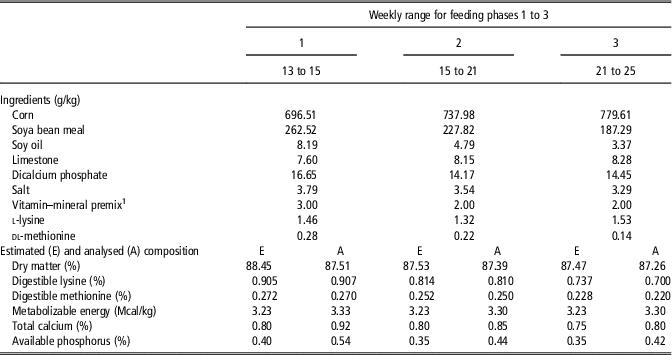
The gilts were fed three different corn-soya bean meal-based diets throughout the fattening period, from 13 to 15, 15 to 21 and 21 to 25 weeks of life. The first diet the animals received consisted of 3.23 Mcal/kg and 0.905% standardized digestible lysine, the second with 3.23 Mcal/kg and 0.814% standardized digestible lysine and the third diet with 3.23 Mcal/kg and 0.737% standardized digestible lysine (Table 1).
Ingredients, estimated and analysed composition of experimental pig diets (as-fed basis)

1 Vitamin and mineral premix composition, supplied per kilogram of diet: vitamin A (min.), 750 000 IU; vitamin B1 (min.), 75 mg; vitamin B12 (min.), 1500 mcg; vitamin B2 (min.), 360 mg; vitamin B6 (min.), 120 mg; vitamin D3 (min.), 90 000 IU; vitamin E (min.), 1200 IU; vitamin K3 (min.), 150 mg; biotin (min.), 1.5 mg; choline (min.), 9.75 g; niacin (min.), 2250 mg; pantothenic acid (min.), 1080 mg; cobalt (min.), 30 mg; copper (min.), 6.75 g; iron (min.), 12 g; iodine (min.), 30 mg; manganese (min.), 6.3 g; selenium (min.), 22.5 mg; zinc (min.), 12 g; lysine (min.), 33.93 g; Bacillus subtilis, 75 × 10e9 CFU.
Immunization
The experiment lasted 10 weeks. At 15 and 19 weeks of age, half of the gilts were vaccinated against GnRH with Vivax® (Zoetis, São Paulo, SP, Brazil) according to the manufacturer’s recommendations. Each millilitre of vaccine has 0.2 mg of GnRH analog-diphtheria toxoid conjugate as antigen and 150 mg of diethylaminoethyl-dextran hydrochloride as adjuvant (Zoetis). Vaccinations were given subcutaneously (2 ml) behind the ear. The intact group received an injection of saline following the same protocol. Considering that we exposed all the animals to mature boars (see the ‘Reproductive activity’ section), which hypothetically could have been more stressful for the control group, we decided to equalize both experimental groups regarding the immunization protocol.
Performance measurements
Gilts were weighed at the beginning of the study (first application), at the second application of the immunization treatment (first and second doses: 15 and 19 weeks of age, respectively), at 21 weeks of age (beginning of daily boar exposure (DBE) and at the end of the study (slaughter: 25 weeks of age). Feed remaining in the feeders was collected daily and weighed weekly. This amount was recorded on the days that the gilts were weighed, 15, 19, 21 and 25 weeks of age.
Reproductive activity
From 21 to 25 weeks of age, gilts were exposed daily to six mature teaser boars. For this procedure, gilts were divided in groups of four animals within each immunization category (Intact × Immunized). Each group was taken to the boars and interactions were allowed for 20 min. To exclude the effect of different boars, each group of four gilts was randomly exposed the same number of times to each boar. An observer strategically positioned in the aisle in front of the pens prevented any aggressive and/or sexual behaviour. Oestrus was determined by the observation of vulva morphology and the backpressure test in all of the gilts (Eliasson, Reference Eliasson1991). At the end of the trial, 18 ovaries and 18 uteri within each treatment group were collected, dissected and weighed. Gilts were selected for reproductive tract collection using the final live weights, which were closest to the average weight within each treatment.
Carcass traits evaluation
At 25 weeks of age, gilts were slaughtered following routine procedures in a commercial packing plant and carcass measurements, including cutting yield evaluation, were performed. All 72 carcasses were eviscerated and weighed head-off on an overhead rail scale. Backfat thickness (BfT, mm) and muscle depth (MD, mm) were measured using the Hennessy Grading Probe (HGP-7, Auckland, New Zealand) on the left side of each carcass, between the last two thoracic vertebrae, as described by Gomide (Reference Gomide2006). The equation (multiple linear regression) used by Saudali® Foods generated the lean meat percentage (LMP, %) and consequently lean meat weight (kg) on each hot carcass. Twenty-four carcasses within each treatment were selected for cutting yield evaluation. Carcasses were selected using the hot carcasses weights, which were closest to the average weight within each treatment. The left cold shoulder, collar, rib, loin and belly were weighed. Cold hams were weighed, and further dissected into meat, bone and skin plus fat.
Statistical analysis
Growth performance, carcass characteristics and reproductive organs data were analysed using ANOVA with the R statistical software (R Core Team, 2017). All data were analysed as a completely randomized design with the fixed effect of treatment and the random effects of pens. The number of gilts showing oestrus was registered, converted into percentages and analysed using the χ 2 test of R software (version 2017 for Windows; R Core Team, Vienna, Austria). Statistical differences were considered significant at P < 0.05. The gilts were considered the experimental unit for all the analyses, except for growth performance and carcass characteristics data, which used the pen as the experimental unit. Some R code for the statistical model used is provided in the Supplementary Material S1.
Results
Growth performance
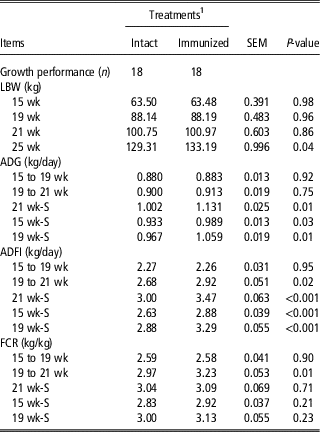
Table 2 shows growth performance for intact and immunized gilts during the different experimental periods. Live BW was positively affected by IM at 25 weeks of age (+3.90 kg, P < 0.05). IM increased average daily gain (ADG, +56 g, P < 0.05) and average daily feed intake (ADFI, +25 g, P < 0.001) for the whole experiment (from 15 to 25 weeks of age). There was no difference in ADG, ADFI or feed conversion ratio (FCR) from V1 to V2 (P > 0.05). The daily amount of feed consumed by immunized gilts increased 240 g from 19 to 21 weeks (V2 to DBE, P < 0.05), 470 g from 21 to 25 weeks (DBE to slaughter (S), P < 0.001) and 410 g from 19 to 25 weeks (V2 to S, P < 0.001). There was an improvement of 129 g (P < 0.01) and 92 g (P < 0.05) on ADG of immunized gilts from DBE to S and from V2 to S, respectively. Feed conversion ratio was 0.26 greater for immunized gilts (P < 0.05) from V2 to DBE and similar during the other experimental periods.
Effect of immunization against gonadotropin-releasing hormone on growth performance of gilts from 15 to 25 and from 19 to 25 weeks (wk) of age

LBW = live BW; ADG = average daily gain; ADFI = average daily feed intake; FCR = feed conversion ratio.
1 Intact and Immunized groups were subjected to 2-ml applications of saline and Vivax, respectively, at 15 and 19 wk of age. Gilts were daily exposed to mature boars from 21 to 25 wk of age and were slaughtered (S) at 25 wk of age.
Reproductive activity
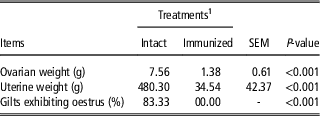
Table 3 shows the reproductive effects of IM on heavy weight finishing gilts. There was approximately a 5.5-fold reduction of average ovarian weight, along with an approximate 14-fold decrease of average uterine weight for immunized compared to intact gilts (P < 0.001). Thirty out of 36 gilts showed signs of oestrus in the intact group, whereas no immunized gilts showed observable signs of oestrus (P < 0.001).
Consequences of immunizing gilts against gonadotropin-releasing hormone on reproductive activity

1 Intact and Immunized groups were subjected to 2-ml applications of saline and Vivax, respectively, at 15 and 19 weeks of age. Gilts were daily exposed to mature boars from 21 to 25 weeks of age and were slaughtered at 25 weeks of age.
Carcass characteristics and cutting yields
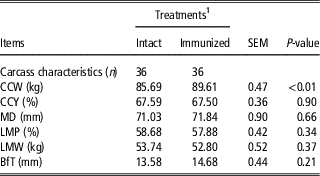
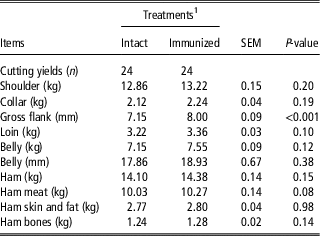
Tables 4 and 5 present the effects of IM on carcass traits and cutting yields of fattening gilts, respectively. Immunocastration did not affect cold carcass yield, MD, LMP and weight and BfT (P > 0.05). Immunized gilts had a greater cold carcass weight (+3.92 kg, P < 0.01) and gross flank (+ 850 g, P < 0.001). IM had no effect on shoulder, collar, belly, ham, ham meat, ham skin and fat, and ham bone weights (P > 0.05). Belly fat thickness was also not influenced by immunocastration (P > 0.05).
Influence of immunological suppression of gonadotropin-releasing hormone on carcass characteristics and cutting yields of gilts at 25 weeks of age

CCW = cold carcass weight; CCY = cold carcass yield; MD = muscle depth; LMP = lean meat percentage; LMW = lean meat weight; BfT = backfat thickness.
1 Intact and Immunized groups were subjected to 2-ml applications of saline and Vivax, respectively, at 15 and 19 weeks of age. Gilts were daily exposed to mature boars from 21 to 25 weeks of age and were slaughtered at 25 weeks of age.
Cutting yields of gilts injected with saline or immunized against gonadotropin-releasing hormone

1 Intact and Immunized groups were subjected to 2-ml applications of saline and Vivax, respectively, at 15 and 19 weeks of age. Gilts were daily exposed to mature boars from 21 to 25 weeks of age and were slaughtered at 25 weeks of age.
Discussion
The main challenge of rearing heavy weight market gilts (over 120 kg BW) is their decreased growth and feed intake during the periods of oestrus manifestation (Hinson et al., Reference Hinson, Galloway, Boler, Ritter, McKeith and Carr2012), which may lead to economic loss. In the present study, immunization against GnRH was used to overcome this issue.
The primary action of the immunological product used herein is the synthesis of antibodies against the endogenous GnRH, which results in gonadal regression, reduction of reproduction-related hormones and non-expression of reproductive behaviour in boars and gilts (Albrecht et al., Reference Albrecht, Grosse Beilage, Kanitz, Puppe, Traulsen and Krieter2012; Bilskis et al., Reference Bilskis, Sutkeviciene, Riskeviciene, Januskauskas and Zilinskas2012; Bohrer et al., Reference Bohrer, Flowers, Kyle, Johnson, King, Spruill, Thompson, Schroeder and Boler2014).
We hypothesized that a direct exposure of gilts to boars would be a practical way to verify the efficacy of Vivax® in suppressing oestrus in finishing gilts, due to the evidence of accelerated reproductive activity of gilts directly exposed to mature boars (Patterson et al., Reference Patterson, Willis, Kirkwood and Foxcroft2002). Our hypothesis was confirmed as immunized gilts showed a significant reduction in reproductive organs weights. Furthermore, almost all gilts from the intact group (30 out of 36) showed oestrus while no immunized gilt presented this behaviour. Recent studies reported similar results using the head-to-head method of exposing female pigs to sexually mature boars (Bohrer et al., Reference Bohrer, Flowers, Kyle, Johnson, King, Spruill, Thompson, Schroeder and Boler2014; Dalmau et al., Reference Dalmau, Velarde, Rodríguez, Pedernera, Llonch, Fàbrega, Casal, Mainau, Gispert and King2015).
It is well established in male pigs that IM causes a reduction in aggressive and sexual behaviour after the second dose (Baumgartner et al., Reference Baumgartner, Laister, Koller, Pfützner, Grodzycki, Andrews and Schmoll2010) which can increase feeder visits and consequently feed intake (Dunshea et al., Reference Dunshea, McCauley and Corbett2001; Elsbernd et al., Reference Elsbernd, de Lange, Stalder, Karriker and Patience2017). In the present experiment, feed intake was considerably increased in immunized gilts after the second dose with no effects of treatment on FCR from 15 to 25 weeks of age and BfT. This is a valuable finding to the pork industry considering that gilts usually show a reduced feed intake pattern when compared to barrows (Puls et al., Reference Puls, Rojo, Ellis, Boler, McKeith, Killefer, Gaines, Matzat and Schroeder2014b). It is worth highlighting that intact gilts were injected with saline in the present study (which would not be seen in commercial herds) to mimic the same effect of the immunization protocol. It is possible that this intervention could have slightly decreased the feed intake of intact gilts 3 to 4 days after vaccination, non-significantly as observed in boars (Elsbernd et al., Reference Elsbernd, de Lange, Stalder, Karriker and Patience2017) without consequences for overall results.
In addition to the beneficial effects on feed intake, our results clearly highlighted the growth performance improvement triggered by IM. Immunized gilts were heavier and grew faster than the intact females from the second immunization to slaughter and from the beginning of DBE to slaughter. This is another important finding in favour of IM adoption by the pork industry, as gilts typically show reduced growth rate when compared to boars and barrows (Comstock et al., Reference Comstock, Winters and Cummings1944; Friesen et al., Reference Friesen, Nelssen, Unruh, Goodband and Tokach1994; Puls et al., Reference Puls, Ellis, McKeith, Gaines and Schroeder2014a).
The present study, which reared gilts until 130 kg, showed that IM can improve carcass weight while not affecting cutting yields. Previous research involving evaluation of carcass characteristics and cutting yields in immunized pigs has focussed on finishing males (Boler et al., Reference Boler, Kutzler, Meeuwse, King, Campion, McKeith and Killefer2011 and Reference Boler, Killefer, Meeuwse, King, McKeith and Dilger2012; Harris et al., Reference Harris, Mellencamp, Johnston, Cox and Shurson2017), and has shown that IM applied during the finishing phase has the potential to increase pork cutting yields (Boler et al., Reference Boler, Puls, Clark, Ellis, Schroeder, Matzat, Killefer, McKeith and Dilger2014; Lowe et al., Reference Lowe, Gerlemann, Carr, Rincker, Schroeder, Petry, McKeith, Allee and Dilger2014).
However, there is a lack of information on the consequences of IM on cutting measurements in gilts. Bohrer et al. (Reference Bohrer, Flowers, Kyle, Johnson, King, Spruill, Thompson, Schroeder and Boler2014) reported increased final live weight for immunized gilts, in agreement with our study, increased backfat depth and decreased LMP, endorsing the benefits of IM for carcass quality in gilts. Daza et al. (Reference Daza, Latorre, Olivares and López-Bote2014) showed that immunized heavy weight Duroc × (Landrace × Large White) gilts had improved carcass weight and higher fat thickness at both the 10th rib and gluteus medius muscle. The previous results and the present study highlighted the need to increase the feeding potential of gilts without compromising their carcass quality.
Collectively, our results suggest that IM can promote oestrus suppression and, consequently, increase feed intake, live and carcass weights. IM did not show any major effect on cutting yields and further studies are needed to elucidate this effect. Therefore, immunization against GnRH is a promising tool for stimulating growth performance with no detrimental effects on carcass quality of fattening gilts, by means of oestrus suppression.
Acknowledgements
Many thanks to the staff of the Fazenda Experimental Professor Hélio Barbosa (FEPHB) for providing facilities and technical support and to Martolino Barbosa, Leonardo Rocha, Clarice Silva and Ana Paula Brustolini for assisting with data collection.
Declaration of interest
This study was funded by Zoetis Brazil and Fundação de Amparo à Pesquisa de Minas Gerais (FAPEMIG). J. L. is the Senior Director of Veterinary Professional Services of Zoetis and J. V. P. is a private consultant specialized in meat science, under contract with Zoetis. All other authors have no financial or personal relationship with Zoetis or other individuals or organisations that could inappropriately influence or bias the content of the paper.
Ethics statement
The procedures involving animals for this trial were assessed and approved by the Federal University of Minas Gerais Ethical Committee on Animal Experiments (Belo Horizonte, Minas Gerais, Brazil) under Protocol 243/2015.
Software and data repository resources
The data or models of the present study are not deposited in any official repository.
Supplementary material
To view supplementary material for this article, please visit https://doi.org/10.1017/S1751731118003099