Introduction
Children born very preterm (VPT, <32 weeks gestational age, GA) are at increased risk for difficulties in the higher-order aspects of cognition, such as executive function (EF), compared to their full-term (FT) born peers (van Houdt et al., Reference van Houdt, Oosterlaan, van Wassenaer-Leemhuis, van Kaam and Aarnoudse-Moens2019). EF is a global construct defined as the top-down coordination of separate but interdependent processes including working memory, cognitive inhibition, and mental flexibility for purposeful, goal-directed behavior (Diamond, Reference Diamond2013; Miyake et al., Reference Miyake, Friedman, Emerson, Witzki, Howerter and Wager2000). Importantly, EF undergoes rapid development in the preschool and school age years with developmental gains in inhibiting goal-irrelevant stimuli, managing conflicts of attention, flexibly shifting between response modalities, and holding and manipulating information in working memory (Diamond, Reference Diamond2013). Numerous follow-up studies have consistently shown that children born VPT demonstrate poorer EF skills compared to children born FT, with problems in cognitive and behavioral inhibition, working memory, and cognitive flexibility (Aarnoudse-Moens, Duivenvoorden, Weisglas-Kuperus, Van Goudoever, & Oosterlaan, Reference Aarnoudse-Moens, Duivenvoorden, Weisglas-Kuperus, Van Goudoever and Oosterlaan2012; Anderson & Doyle, Reference Anderson and Doyle2004; Coelho, Ribeiro, & Lopes, Reference Coelho, Ribeiro and Lopes2019; O’Meagher, Kemp, Norris, Anderson, & Skilbeck, Reference O’Meagher, Kemp, Norris, Anderson and Skilbeck2017). Among children born VPT, younger gestational age, neonatal medical complications, and cerebral white matter abnormalities (WMA) are associated with poorer EF in childhood (Taylor & Clark, Reference Taylor and Clark2016). Importantly, executive dysfunction has been linked to a range of adverse developmental and life-course outcomes including socio-emotional impairments, academic underachievement, and unemployment status (Kroll et al., Reference Kroll, Karolis, Brittain, Tseng, Froudist-Walsh, Murray and Nosarti2017; Ribner, Willoughby, Blair, & The Family Life Project Key Investigators, Reference Ribner, Willoughby and Blair2017; White et al., Reference White, Moore, Calkins, Wolf, Satterthwaite, Leibenluft, Pine, Gur and Gur2017).
Prematurity, poverty, and EF
Current bioecological theories posit that child development is shaped by interactions between the biopsychological characteristics of the individual and the socioecological processes that operate at distal (broad) and proximal (immediate) levels. Distal risk factors such as childhood exposure to poverty may indirectly influence child cognitive development through continued exposure to proximal risk factors that directly shape the milieu of the home environment (Bronfenbrenner & Evans, Reference Bronfenbrenner and Evans2000; Molfese, Modglin, & Molfese, Reference Molfese, Modglin and Molfese2003). In addition to the biological risks posed by VPT birth, children born VPT may also evidence poorer EF skills due to the fact that children born VPT are twice as likely as children born FT to be raised in poverty (Brumberg & Shah, Reference Brumberg and Shah2015). Thus, children born VPT are often considered to be a dual risk population (Chomyn, Reichert, Carroll, Qureshi, & Toye, Reference Chomyn, Reichert, Carroll, Qureshi and Toye2015; Potijk, Kerstjens, Bos, Reijneveld, & Winter, Reference Potijk, Kerstjens, Bos, Reijneveld and de Winter2013). Indeed, both preterm birth and exposure to poverty place children at increased likelihood of EF impairments throughout childhood (Last, Lawson, Breiner, Steinberg, & Farah, Reference Last, Lawson, Breiner, Steinberg and Farah2018; van Houdt et al., Reference van Houdt, Oosterlaan, van Wassenaer-Leemhuis, van Kaam and Aarnoudse-Moens2019). Multiple forms of socioeconomic adversity, such as reduced family income and neighborhood deprivation, have been linked to childhood disparities in EF (Lawson, Hook, & Farah, Reference Lawson, Hook and Farah2018). There is also some evidence of differential associations between individual, family, and neighborhood levels of socioeconomic adversity on child neurocognitive development (Geyer, Hemström, Peter, & Vågerö, Reference Geyer, Hemström, Peter and Vågerö2006; Hackman et al., Reference Hackman, Betancourt, Gallop, Romer, Brodsky, Hurt and Farah2014; Whittle et al., Reference Whittle, Simmons, Dennison, Vijayakumar, Schwartz, Yap, Sheeber and Allen2014). Therefore, different aspects of the child’s immediate and broader socioeconomic context, while related, may not be equally predictive of child outcomes.
Regarding the role of socioeconomic adversity on EF among children born VPT, a recent study by O’Meagher et al. (Reference O’Meagher, Kemp, Norris, Anderson and Skilbeck2017) found that children born VPT were less accurate, had slower response times, and made more perseverative errors on EF tasks than children born FT. Furthermore, O’Meagher et al. (Reference O’Meagher, Kemp, Norris, Anderson and Skilbeck2017) also reported that family and household demographic factors, particularly the level of parental education, was related to variability in child EF ability. Socioeconomic hardships and certain life experiences, including living below the poverty threshold and reduced access to educational and occupational opportunities, often co-occur and have the potential to increase parental stress (Lefmann, Combs-Orme, & Orme, Reference Lefmann, Combs-Orme and Orme2017; Ta, Gesselman, Perry, Fisher, & Garcia, Reference Ta, Gesselman, Perry, Fisher and Garcia2017). Racial and ethnic minority populations are disproportionately impacted by socioeconomic hardships and stressful life experiences due to structural and individual experiences of racism (Nuru-Jeter et al., Reference Nuru-Jeter, Michaels, Thomas, Reeves, Thorpe and LaVeist2018). It is not surprising, therefore, that exposure to multiple forms of socioeconomic adversity has been shown to have a cumulative effect on cognitive development in children born VPT (Evans, Li, & Whipple, Reference Evans, Li and Whipple2013; Manley et al., Reference Manley, Roberts, Doyle, Schmidt, Anderson, Barrington, Bohm, Golan, van Wassenaer-Leemhuis and Davis2015; Nadeau, Tessier, Boivin, Lefebvre, & Robaey, Reference Nadeau, Tessier, Boivin, Lefebvre and Robaey2003). In addition, EF development in children born VPT may be more susceptible to exposure to cumulative socioeconomic adversity due to the high rates of aberrant neonatal brain development and neurobehavioral dysregulation in infancy (Poehlmann et al., Reference Poehlmann, Schwichtenberg, Shlafer, Hahn, Bianchi and Warner2011).
Parenting and child EF
Previous studies in typically-developing children suggest that poverty alters the development of EF through its association with intervening socio-environmental factors including harsh and intrusive parenting behavior (Hackman, Gallop, Evans, & Farah, Reference Hackman, Gallop, Evans and Farah2015; Holochwost et al., Reference Holochwost, Gariépy, Propper, Gardner-Neblett, Volpe, Neblett and Mills-Koonce2016; Sarsour et al., Reference Sarsour, Sheridan, Jutte, Nuru-Jeter, Hinshaw and Boyce2011). Parents of infants born VPT, particularly those from socially disadvantaged backgrounds, experience significant disruptions to the parental role in the Neonatal Intensive Care Unit (NICU) including prolonged parent-infant separation and loss of the primary caregiving role (Bergman, Reference Bergman2019; Woodward et al., Reference Woodward, Bora, Clark, Montgomery-Hönger, Pritchard, Spencer and Austin2014). In light of these early parenting challenges, there is some longer-term evidence suggesting that mothers of children born VPT demonstrate less sensitive and more intrusive parenting behavior during parent-child interactions than mothers of children born FT (Clark, Woodward, Horwood, & Moor, Reference Clark, Woodward, Horwood and Moor2008; Jaekel, Wolke, & Chernova, Reference Jaekel, Wolke and Chernova2012; Stack, Matte-Gagné, & Dickson, Reference Stack, Matte-Gagné and Dickson2019). However, a recent meta-analysis of 34 follow-up studies found that there were no consistent differences in sensitivity, responsivity, or facilitation between parents of children born VPT and parents of children born FT, potentially due to the high degree of heterogeneity in effect sizes reported across studies (Bilgin & Wolke, Reference Bilgin and Wolke2015).
Exposure to more sensitive and supportive parenting during the transition to school provides the foundation for EF trajectories into later childhood (Helm et al., Reference Helm, McCormick, Deater-Deckard, Smith, Calkins and Bell2020). Assessing the role of parenting in a sensitive period of EF development during the transition to school may elucidate the ways in which proximal socio-environmental factors shape early and foundational EF skills important for ongoing EF development and later academic achievement (Helm et al., Reference Helm, McCormick, Deater-Deckard, Smith, Calkins and Bell2020; Ribner et al., Reference Ribner, Willoughby and Blair2017). However, to date, only a handful of studies have examined the extent that parenting behavior relates to EF in children born VPT. Two studies have shown that sensitive, non-intrusive parenting is associated with better EF in children born VPT at preschool-age (Camerota, Willoughby, Cox, Greenberg, & The Family Life Project Key Investigators, Reference Camerota, Willoughby, Cox and Greenberg2015; Zvara, Keim, Boone, & Anderson, Reference Zvara, Keim, Boone and Anderson2019). For example, Zvara et al. (Reference Zvara, Keim, Boone and Anderson2019) found that higher levels of parental responsivity and greater mutual synchrony within the dyad, coupled with lower levels of harsh-intrusive parenting, was associated with better EF in children born VPT assessed at age four years. Similar associations have also been reported for school-age children born VPT (Clark & Woodward, Reference Clark and Woodward2015; Treyvaud et al., Reference Treyvaud, Doyle, Lee, Ure, Inder, Hunt and Anderson2016).
Treyvaud et al. (Reference Treyvaud, Doyle, Lee, Ure, Inder, Hunt and Anderson2016) found evidence of robust links between negative dimensions of parenting behavior and subsequent EF problems in children born VPT. More specifically, exposure to increased parental intrusiveness and negative affect at age two years predicted poorer EF at age seven years, with findings persisting after covariate adjustment for earlier infant cognitive ability. In terms of the longitudinal development of EF, Camerota et al. (Reference Camerota, Willoughby, Cox and Greenberg2015) found that early exposure to lower levels of parenting sensitivity was associated with lasting problems in EF from age three to five years among children born low birthweight (LBW). This same study also found that for some children born LBW, early exposure to higher levels of sensitivity was associated with EF catch-up such that these children demonstrated similar EF skills as healthy control children by age five years. In contrast, van de Weijer-Bergsma et al. (Reference van de Weijer-Bergsma, Wijnroks, van Haastert, Boom and Jongmans2016) found that greater maternal intrusiveness supported the development of EF in infants born VPT, suggesting that infants born VPT may in fact benefit from increased directiveness as parents adapt their parenting behaviors to meet the cognitive needs of the child (Jaekel et al., Reference Jaekel, Wolke and Chernova2012). Parental support for autonomy and the tendency to use mental terms when speaking to the infant have also been related to EF development in children born FT (Bernier, Carlson, & Whipple, Reference Bernier, Carlson and Whipple2010). These collective findings suggest that reciprocal, child-focused interactions with high levels of parental warmth and support may promote EF development in childhood. However, as most prior studies have not included a FT control group (Treyvaud et al., Reference Treyvaud, Doyle, Lee, Ure, Inder, Hunt and Anderson2016; van de Weijer-Bergsma et al., Reference van de Weijer-Bergsma, Wijnroks, van Haastert, Boom and Jongmans2016; Zvara et al., Reference Zvara, Keim, Boone and Anderson2019), the degree to which parenting behavior is differentially associated with EF in children born VPT compared to children born FT remains unclear.
Links between poverty and parenting on EF in children born VPT
While exposure to poverty and harsh-intrusive parenting have been identified as key distal and proximal mechanisms of EF impairments in children born FT (Holochwost et al., Reference Holochwost, Gariépy, Propper, Gardner-Neblett, Volpe, Neblett and Mills-Koonce2016), these associations are less well understood among children born VPT. Disentangling links between poverty and parenting behavior is vital to delineate whether multiple socio-environmental risk exposures independently or jointly shape poorer EF in children born VPT to identify children at greatest risk of impairment (Bronfenbrenner & Evans, Reference Bronfenbrenner and Evans2000; Evans et al., Reference Evans, Li and Whipple2013). Prior work from our group has shown that links between socioeconomic disadvantage and poorer language development from ages two to five years was explained by lower levels of maternal self-reported affective involvement (Lean, Paul, Smyser, Smyser, & Rogers, Reference Lean, Paul, Smyser, Smyser and Rogers2018). However, this previous study did not include observational ratings of parenting behavior. Indeed, poverty is a well-established risk factor for less sensitive and unsupportive parenting behavior in the general population (Vernon-Feagans, Cox, Willoughby, et al., Reference Vernon-Feagans, Cox, Willoughby, Burchinal, Garrett-Peters, Mills-Koonce and Bauer2013). To the knowledge of the authors, only one study has examined household income, parental occupation, and maternal education as markers of socioeconomic status (SES) along with observations of parenting behavior to predict subsequent EF ability in children born VPT (Clark & Woodward, Reference Clark and Woodward2015). Clark and Woodward (Reference Clark and Woodward2015) found that exposure to maternal intrusiveness from ages two to four years partially mediated links between VPT birth and poorer EF ability at age six years, but that SES was not related to either EF ability or maternal intrusiveness. However, as the sample included in Clark and Woodward (Reference Clark and Woodward2015) was comprised of fewer single parent, racial and ethnic minority populations, and low SES families than urban American cohorts (Hack et al., Reference Hack, Taylor, Klein, Eiben, Schatschneider and Mercuri-Minich1994; Lean et al., Reference Lean, Paul, Smyser, Smyser and Rogers2018), previous findings may not generalize to more socially disadvantaged samples of children born VPT. In a large multi-site study of American children born FT, more cognitively stimulating and sensitive parenting in the home environment mediated the association between family Income-to-Needs Ratio and EF ability at age four years (Hackman et al., Reference Hackman, Gallop, Evans and Farah2015). This suggests that parental involvement in children’s early learning experiences in the home may be as important for the development of EF as the interactive and dynamic aspects of observed parenting behavior.
The potential role of parental psychosocial adversity
Previously reported associations between childhood impairments in EF and exposure to poverty and harsh or intrusive parenting may also reflect, at least in part, the role of parental psychopathology. More specifically, parental psychopathology may have an independent, direct effect on child EF due to shared, heritable liabilities in self-regulation and cognitive control (Kiss, Fechete, Pop, & Susa, Reference Kiss, Fechete, Pop and Susa2014; Leve et al., Reference Leve, DeGarmo, Bridgett, Neiderhiser, Shaw, Harold, Natsuaki and Reiss2013). Parental psychopathology could also indirectly influence child EF through its association with poorer quality parenting behavior during parent-child interactions (Crandall, Deater-Deckard, & Riley, Reference Crandall, Deater-Deckard and Riley2015; Deater-Deckard, Reference Deater-Deckard2014). For example, parental psychiatric disorders are more prevalent in the setting of poverty and have been linked to less sensitive parenting (Bernard, Nissim, Vaccaro, Harris, & Lindhiem, Reference Bernard, Nissim, Vaccaro, Harris and Lindhiem2018; McLaughlin et al., Reference McLaughlin, Breslau, Green, Lakoma, Sampson, Zaslavsky and Kessler2011). Prior work in our group has shown that in a longitudinal study of socially disadvantaged mothers of infants born VPT, maternal depression and stress in the NICU predicted less sensitive and more intrusive parenting five years post-NICU discharge (Gerstein, Njoroge, Paul, Smyser, & Rogers, Reference Gerstein, Njoroge, Paul, Smyser and Rogers2019). Maternal depression has also been found to explain a unique proportion of variance in children’s EF independent of the quality of parent-child interactions (Gueron-Sela et al., Reference Gueron-Sela, Camerota, Willoughby, Vernon-Feagans and Cox2018; Hughes, Roman, Hart, & Ensor, Reference Hughes, Roman, Hart and Ensor2013; Kiernan & Huerta, Reference Kiernan and Huerta2008).
In contrast to maternal depression and stress, much less is known regarding the roles of parental attention deficit/hyperactivity disorder (ADHD) symptoms and autism spectrum disorder (ASD) traits on parenting quality in parents of children born VPT. Mothers with ADHD or ASD are at increased risk of poor obstetric outcomes (Nörby, Winbladh, & Källén, Reference Nörby, Winbladh and Källén2017; Sundelin, Stephansson, Hultman, & Ludvigsson, Reference Sundelin, Stephansson, Hultman and Ludvigsson2018) with longer-term studies also reporting more harsh and controlling parenting styles in mothers with increased ADHD symptoms or ASD traits (Johnson & Chronis-Tuscano, Reference Johnson, Chronis-Tuscano and Barkley2018; Rea, Factor, Swain, & Scarpa, Reference Rea, Factor, Swain and Scarpa2019). Although we have previously found that maternal ADHD symptoms was related to latent profiles of internalizing and externalizing problems in children born VPT assessed at age five years (Lean et al., Reference Lean, Lessov-Shlaggar, Gerstein, Smyser, Paul, Smyser and Rogers2020), we did not examine maternal ADHD symptoms in relation to observational ratings of parenting behavior or children’s EF ability. Indeed, the role of parental ADHD symptoms and ASD traits on EF in children born VPT remains largely unexplored despite the fact that maternal ADHD has been linked with EF deficits in children born FT (Thissen, Rommelse, Altink, Oosterlaan, & Buitelaar, Reference Thissen, Rommelse, Altink, Oosterlaan and Buitelaar2014). When taken together, the independent and/or interactive effects of parental psychopathology and quality of parenting on child EF may elucidate heritable liabilities in self-regulation and cognitive control that are, at least in part, also transmitted through parent-child interactions.
The current study
Despite the importance of delineating the independent and/or interactive effects of poverty and related socio-environmental adversities on executive dysfunction in childhood, no existing study has examined poverty, parenting quality, and parental psychopathology together in relation to EF in children born VPT using both bioecological and cumulative risk frameworks. The identification of the modifiable, socio-environmental factors that alter the development of EF is vital to inform the design and evaluation of targeted, family-based interventions that improve EF abilities in children born VPT. The aims and hypotheses of this study were:
-
To examine the extent that socioeconomic and parental psychosocial adversity independently or jointly explain variability in parenting quality in parents of children born VPT and children born FT. We hypothesized that (a) parents of children born VPT will demonstrate less sensitive, less stimulating and more intrusive parenting behavior than parents of FT children, and (b) higher levels of socioeconomic and parental psychosocial adversity would be associated with less sensitive, less stimulating and more intrusive parenting behavior particularly among parents of VPT children (Jaekel et al., Reference Jaekel, Wolke and Chernova2012; Treyvaud, Reference Treyvaud2014).
-
To examine the independent and joint effects of prematurity, socioeconomic adversity, parenting quality, and parental psychosocial adversity on child EF ability at age five years. We hypothesized that (a) children born VPT would show poorer EF ability than children born FT, (b) infant clinical factors associated with prematurity (gestational age, birthweight, infant medical risk, and neonatal cerebral WMA) would correlate with EF disparities in children born VPT, (c) parenting quality would explain variability in EF ability and that these associations would be stronger in children born VPT than in children born FT (see Rochette & Bernier, Reference Rochette and Bernier2016), and (d) that parenting quality would work interactively with parental psychosocial adversity to explain a greater proportion of variance in EF ability than socioeconomic adversity (Clark & Woodward, Reference Clark and Woodward2015; Poehlmann et al., Reference Poehlmann, Schwichtenberg, Shlafer, Hahn, Bianchi and Warner2011; Taylor & Clark, Reference Taylor and Clark2016; van Houdt et al., Reference van Houdt, Oosterlaan, van Wassenaer-Leemhuis, van Kaam and Aarnoudse-Moens2019; Zvara et al., Reference Zvara, Keim, Boone and Anderson2019).
Methods
Sample
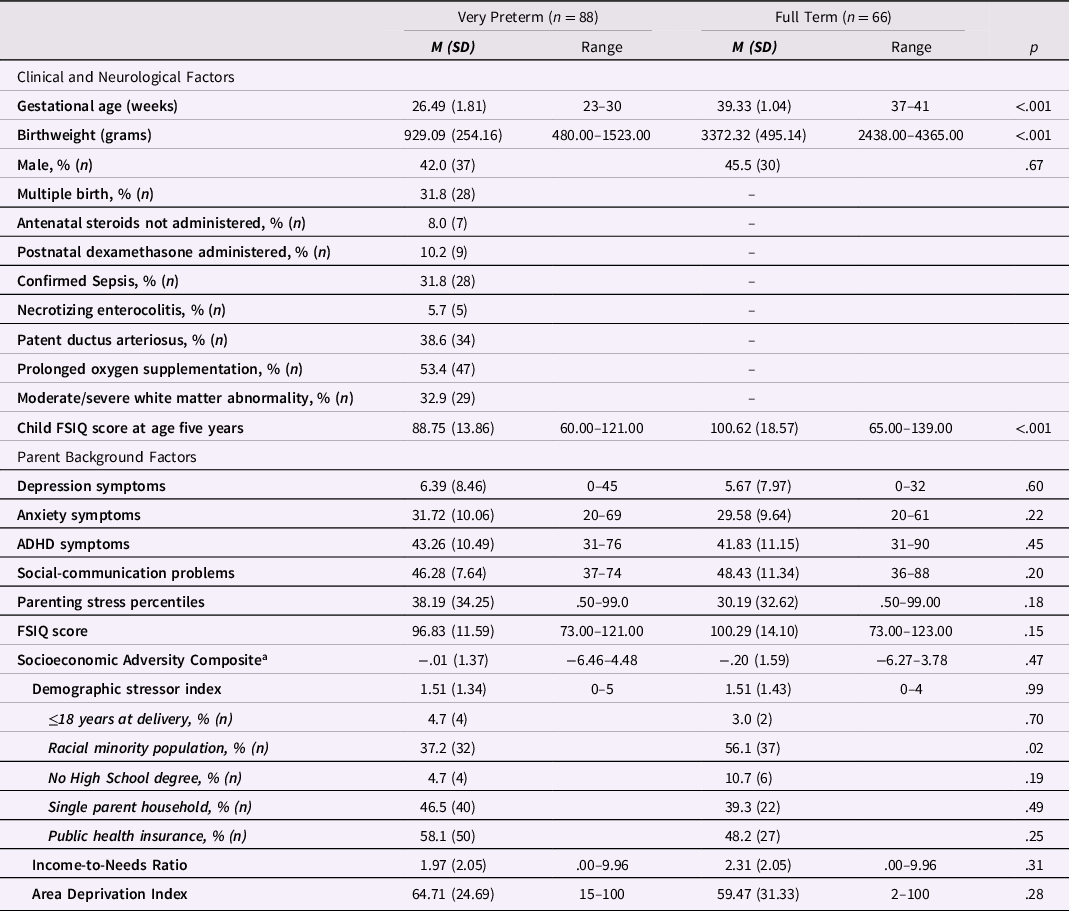
This study consisted of 106 infants born VPT (≤30 weeks GA), born during 2007–2010, who were recruited from St. Louis Children's Hospital Level-IV NICU. At age five years, 88 children born VPT returned for a developmental assessment (retention rate: 83%). As described in Lean, Paul, Smyser, Smyser, and Rogers (Reference Lean, Paul, Smyser, Smyser and Rogers2018), children born VPT who were lost to follow up were more likely to be born to young mothers (p = .02) and with public health insurance (p = .002) but there were no differences in infant clinical characteristics (p > .05). A comparison group of children born FT (n = 66; 37–41 weeks GA) was recruited through two methods. Thirty children born FT were recruited from the local communities of children born VPT at age five years. Using zip-codes provided by families of children born VPT, study recruitment flyers with study contact information provided were placed in local schools and pediatric offices. Parents of children born FT who contacted the study coordinator were screened for study eligibility, and subsequently selected for study enrolment based upon the child’s age, sex, and race for comparability with children born VPT. Thirty-six additional children born FT were identified as infants from an existing contemporaneous study conducted at an adjoining hospital’s obstetric service and assessed at age five years. As shown in Table 1, both groups of children had similar socioeconomic and family backgrounds. Exclusion criteria for both groups of children included parent unable to give informed consent, infant chromosomal/congenital abnormality, or suspected/proven congenital infection. Children born FT with neonatal acidosis and maternal positive urine drug screen were also excluded.
Infant clinical and social background characteristics

Note. Means (M) and Standard Deviations (SD) reported unless otherwise indicated. FSIQ, Full Scale Intellectual Quotient. ADHD, Attention Deficit Hyperactivity Disorder.
a Socioeconomic Adversity Composite is based upon sum of maternal demographic stressor index, Income-to-Needs Ratio (reversed scored), and Area Deprivation Index percentile z-scores.
Procedure
At the five-year follow-up assessment, children and their primary caregivers (95% mothers, 5% fathers; see Supplementary Material Tables S1 and S2) participated in a 15-minute semi-structured parent-child interaction. Dyads completed a puzzle, letter-matching task, tower building task, and copied a pattern of beads on a string (Clark et al., Reference Clark, Woodward, Horwood and Moor2008). Children also completed a range of cognitive tasks to assess EF. There was no difference in age at testing between children born VPT and children born FT (VPT m = 5.6 years (SD = .4), FT m = 5.7 years (SD = .5), p = .16). Children born FT (86%) were more likely to be in a primary school setting than children born VPT (59%, p = .001). Socioeconomic and family background information was obtained at the five-year follow-up using parent questionnaires and an in-person interview. Written informed consent was obtained from all caregivers. All study procedures were approved by the Institution Review Board.
Measures
Parent-child interactions
Parent-child interactions were video-taped and coded for parent Sensitivity, Intrusiveness, Stimulation of Cognition, Negative Regard, and Positive Regard using the Parent-Child Interaction Rating Scale (PCIRS) (Belsky, Crnic, & Gable, Reference Belsky, Crnic and Gable1995). The PCIRS is a validated observational scheme similar to scales from the Early Child Care Research Network (NICHD Early Child Care Research Network, 1999). The PCIRS has been used in typically-developing children and children born VPT (Ciciolla, Crnic, & West, Reference Ciciolla, Crnic and West2013; Gerstein et al., Reference Gerstein, Njoroge, Paul, Smyser and Rogers2019). Sensitivity captures behaviors that are child-centered, timely, and meet the needs of the child. Intrusiveness measures behaviors that are adult-centered, overstimulating, and controlling. Stimulation of Cognition assesses the extent that the parent facilitates learning and reinforces attempts at mastery. Positive Regard measures the expression of positive affect and praise, whereas Negative Regard assesses negative affect, hostility, or disapproval. All behaviors were rated on a Likert scale (1–5) with higher scores indicating greater intensity and frequency. Ratings were made by an expert rater (a PhD level member of the research team who was trained by a co-author of the PCIRS) and highly trained research assistants who were blind to study aims and child background. A quarter of video tapes were co-coded by all raters for reliability. This study used a global rating approach such that each rater observed the entire parent-child interaction and allocated a single PCIRS scale score for each parenting behavior. Final interclass correlation coefficients indicated high inter-rater reliability across the PCIRS scales (range .85–.93, see also Gerstein et al., Reference Gerstein, Njoroge, Paul, Smyser and Rogers2019). To identify a reduced set of broad dimensions that explained most of the variance in observed parenting behavior (Vernon-Feagans, Cox, & The Family Life Project Key Investigators, Reference Vernon-Feagans and Cox2013), PCIRS scales were analyzed with a principal components analysis (PCA). Similar data reduction techniques of parenting rating scales have been used by multiple previous studies (Gueron-Sela et al., Reference Gueron-Sela, Camerota, Willoughby, Vernon-Feagans and Cox2018; Treyvaud et al., Reference Treyvaud, Thompson, Kelly, Loh, Inder, Cheong, Doyle and Anderson2020; Woodworth, Belsky, & Crnic, Reference Woodworth, Belsky and Crnic1996). The results of the PCA were highly consistent with previous studies such that the PCIRS scales loaded onto two distinct components Positive Parenting (Sensitivity, Positive Regard, Stimulation of Cognition) and Negative Parenting (Intrusiveness and Negative Regard) that explained 79.02% of the variance (factor loadings > .70 and communalities > .76, see also Table S3, Supplementary Material).
Child executive function
Components of EF spanning working memory, inhibition, set-shifting, and executive control were assessed with a range of cognitive tasks. Working memory was evaluated using the Digits Forward subtest of the Differential Abilities Scale in which children recall increasingly longer series of digits (Elliott, Reference Elliott2007). Age-normed t-scores are reported. The Shape School task was used to assess cognitive inhibition, set-shifting, and executive control (Espy, Bull, Martin, & Stroup, Reference Espy, Bull, Martin and Stroup2006). In the inhibition condition, children name the color of figures with happy faces and suppress the response for figures with unhappy faces. In the set-shifting condition, children name the shape when the figure is wearing a hat and name the color when the figure is not wearing a hat. In the executive control condition, children must maintain and use inhibition and set-shifting rules concurrently. For each condition, an efficiency score ([items correct – errors]/time) is reported with higher scores indicating better performance. The Shape School has good psychometric properties (Espy et al., Reference Espy, Bull, Martin and Stroup2006) and has been used in children born VPT and children born FT (Pritchard & Woodward, Reference Pritchard and Woodward2011). Children who passed the initial baseline condition (naming colors) but who failed a subsequent condition (n = 19, 16.2%) were assigned the lowest score in the distribution of the failed condition to minimize data drop-out as the task progressed. Because EF has been shown to be a unitary construct in childhood (Brydges, Reid, Fox, & Anderson, Reference Brydges, Reid, Fox and Anderson2012; McKenna, Rushe, & Woodcock, Reference McKenna, Rushe and Woodcock2017), scores from each task were analyzed in a PCA to obtain a global EF component score. Consistent with Woodward et al. (Reference Woodward, Clark, Pritchard, Anderson and Inder2011), a single common EF component was extracted that explained 61.70% of the variance (factor loadings .58-.86 and communalities .34-.70).
Socioeconomic adversity
This study included three measures of socioeconomic adversity to capture immediate (i.e., parent and family unit) and broader (i.e., neighborhood) aspects of the dyad’s socioeconomic context. First, to describe the socioeconomic and life circumstances that have the potential to increase stress for the child’s primary caregiver, a cumulative maternal demographic stressor index was calculated using five demographic factors that were dichotomized (present = 1, absent = 0) and summed (0–5). Factors included young mother at delivery (age ≤18 years), racial minority population, no High School degree, public health insurance, and single-parent household (Hack et al., Reference Hack, Taylor, Klein, Eiben, Schatschneider and Mercuri-Minich1994; Mangin, Horwood, & Woodward, Reference Mangin, Horwood and Woodward2016; Manley et al., Reference Manley, Roberts, Doyle, Schmidt, Anderson, Barrington, Bohm, Golan, van Wassenaer-Leemhuis and Davis2015). Racial minority population (exclusively African American) was included in the demographic stressor index to account for social and health inequities that result from experiencing structural and individual racism in America, particularly in the region of recruitment which is heavily stratified by race (Subramanian, Acevedo-Garcia, & Osypuk, Reference Subramanian, Acevedo-Garcia and Osypuk2005; United States Census Bureau, 2010). Second, Income-to-Needs Ratio was used to describe the socioeconomic circumstances of the family household. Income-to-Needs Ratio is the total family income by the size of the household relative to national poverty thresholds (United States Census Bureau, 2015). Income-to-Needs Ratios <1.0 indicate that the family is living below the poverty threshold. Third, to assess the border context of the family neighborhood, Area Deprivation Index (ADI) percentiles were obtained using family zip-codes (Kind & Buckingham, Reference Kind and Buckingham2018). The ADI ranks neighborhood disadvantage using 2011–2015 Census block-level data to characterize neighborhood disparities in rates of poverty, housing quality, and access to basic necessities (see Table S4, Supplementary Material for the 17 factors included in the ADI). Higher ADI percentiles indicate greater neighborhood socioeconomic disadvantage.
Parental psychosocial adversity
This study included a range of validated measures that provide a dimensional assessment of parental psychiatric symptoms and social-communication problems at the five-year follow-up assessment. Parental depression symptoms were assessed using the Beck Depression Inventory-II (BDI-II) (Beck, Steer, & Brown, Reference Beck, Steer and Brown1996). The BDI-II demonstrates predictive validity for Major Depressive Disorder (Arnau, Meagher, Norris, & Bramson, Reference Arnau, Meagher, Norris and Bramson2001). Anxiety symptoms were assessed with the Trait subscale of the State-Trait Anxiety Inventory (STAI) (Spielberger, Gorsuch, Lushene, Vagg, & Jacobs, Reference Spielberger, Gorsuch, Lushene, Vagg and Jacobs1983). The STAI has acceptable internal consistency and test-retest reliability (Barnes, Harp, & Jung, Reference Barnes, Harp and Jung2002), with the Trait subscale of the STAI demonstrating better discriminant validity for current anxiety disorder than the State subscale (Kabacoff, Segal, Hersen, & Van Hasselt, Reference Kabacoff, Segal, Hersen and Van Hasselt1997). The Conner’s Adult ADHD Rating Scale-Self-Report (CAARS-SR) provided a dimensional measure of inattention/hyperactivity symptoms (Conners, Reference Conners2000). The CAARS-SR is based upon DSM-IV criteria and correlates with clinician ratings of ADHD (Adler et al., Reference Adler, Faraone, Spencer, Michelson, Reimherr, Glatt, Marchant and Biederman2008). Social-communication interaction problems were evaluated with the Social Responsiveness Scale-2-Adult Self Report (SRS-2-ASR) (Constantino & Gruber, Reference Constantino and Gruber2012). The SRS-2-ASR measures the presence and severity of quantitatively distributed ASD traits. It has a two-factor structure consistent with the DSM-5 nosology of ASD, spanning Social Communication Impairment (SCI) and Restricted and Repetitive Behavior. The SCI scale was selected for analysis because this scale focuses on problems in social awareness, social cognition, social motivation, and social communication; and problems in these aspects of social interaction have been shown to be highly relevant for parenting behavior (Hirokawa et al., Reference Hirokawa, Kimura, Ikehara, Honjo, Sato, Ueda and Iso2019; Parr, Gray, Wigham, McConachie, & Couteur, Reference Parr, Gray, Wigham, McConachie and Couteur2015). Additionally, no parent in this study had a total SRS-2-ASR score in the clinical range (t-score ≥76) and the SRS-2-ASR does not adequately discriminate adults with ASD from adults with anxiety disorders (South, Carr, Stephenson, Maisel, & Cox, Reference South, Carr, Stephenson, Maisel and Cox2017). Parenting stress was assessed with the long-form version of the Parent Stress Index (PSI) (Abidin, Reference Abidin1990). Total parenting stress percentiles are reported. The PSI has good internal consistency and has been validated in samples with low SES (Reitman, Currier, & Stickle, Reference Reitman, Currier and Stickle2002; Whiteside-Mansell et al., Reference Whiteside-Mansell, Ayoub, McKelvey, Faldowski, Hart and Shears2007). Across all measures, higher scores reflect greater parental psychosocial adversity. Correlations between psychosocial measures ranged from .49 to .65 (all p < .001, see Table S5, Supplementary Material.)
Additional measures
Infant clinical factors
Infant gestational age and birthweight was collected at the time of birth. To account for neonatal illness associated with prematurity, information regarding the NICU course was prospectively collected from medical records in the neonatal period. Key factors were dichotomized (present = 1, absent = 0) and summed (0–10): intrauterine growth restriction, prolonged oxygen supplementation, did not receive antenatal steroids, received dexamethasone, necrotizing enterocolitis, confirmed sepsis, patent ductus arteriosus, retinopathy of prematurity, ≥3 SD decrease in weight-for-height/length from birth to term-equivalent age, and >75th percentile for duration of parenteral nutrition (Lean, Paul, Smyser, Smyser, et al., Reference Lean, Paul, Smyser, Smyser and Rogers2018; Rogers et al., Reference Rogers, Smyser, Smyser, Shimony, Inder and Neil2015).
Neonatal white matter abnormalities
Moderate/severe neonatal cerebral WMA have been linked with executive dysfunction in children born VPT (Woodward et al., Reference Woodward, Clark, Pritchard, Anderson and Inder2011). Therefore, this study included a measure of neonatal WMA as a potential covariate of EF. At term-equivalent age, infants born VPT underwent an MRI scan using a Siemens 3T scanner with previously documented sequences (Rogers et al., Reference Rogers, Smyser, Smyser, Shimony, Inder and Neil2015). Anatomical images were qualitatively scored for cystic lesions, focal signal abnormalities, myelination delay, corpus callosum thinning, lateral ventricle dilatation, and cerebral volume reduction (Kidokoro, Neil, & Inder, Reference Kidokoro, Neil and Inder2013). Total scores were categorized into no (0–2), mild (3–4), or moderate/severe (≥5) WMA (Kidokoro et al., Reference Kidokoro, Neil and Inder2013).
Parental involvement in early learning
As EF is conferred by children’s early learning experiences in the home (Hackman et al., Reference Hackman, Gallop, Evans and Farah2015), the parent-report StimQ-Preschool (StimQ-P) questionnaire (Dreyer, Mendelsohn, & Tamis-LeMonda, Reference Dreyer, Mendelsohn and Tamis-LeMonda1996) was used to assess the quantity and quality of learning materials in the home, the extent that the parent and child read books together, whether the parent uses activities to teach concepts, and parental verbal responsivity across a variety of contexts. The StimQ-P has been validated in families with low SES (Green et al., Reference Green, Berkule, Dreyer, Fierman, Huberman, Klass, Tomopoulos, Yin, Morrow and Mendelsohn2009) and used in parents of VPT children (Lean, Paul, Smyser, & Rogers, Reference Lean, Paul, Smyser and Rogers2018).
Parental IQ
Parent intellectual ability was estimated using the Wechsler Test of Adult Reading (WTAR) (Wechsler, Reference Wechsler2001). Participants pronounce 50 words that have atypical grapheme-to-phoneme translations. WTAR standard scores are then converted to co-normed, demographically predicted Wechsler Adult Intelligence Scales-III (WAIS-III) full-scale intelligence quotient (FSIQ) scores to estimate intellectual ability (Wechsler, Reference Wechsler2001). The demographically predicted WAIS-III FSIQ scores are reported.
Child IQ
Child intellectual ability was assessed using the Wechsler Preschool Primary Scales of Intelligence-III (Wechsler, Reference Wechsler2004). FSIQ scores were based upon the Information, Vocabulary, Word Reasoning, Block Design, Matrix Reasoning, Picture Concepts, and Coding subtests. Severe cognitive delay was defined as FSIQ < 70.
Data analysis
All analyses were performed in SPSS (version 25; IBM New York) using linear mixed-effect models with restricted maximum likelihood estimates robust to missing data (2.6%–16.2% for parenting and parental psychosocial adversity variables) with estimation based on all available data points (Duricki, Soleman, & Moon, Reference Duricki, Soleman and Moon2016; Peugh & Enders, Reference Peugh and Enders2004). Statistical significance was set at p≤.05 and Cohen’s d was reported as a measure of between-groups effect size. As recommended by Orelien and Edwards (Reference Orelien and Edwards2008), marginal R 2 values are reported as an estimate of the proportion of variance explained by the fixed-effects specified in multivariate linear mixed-effect models. Family membership was included as a random effect with random intercept to account for preterm multiple births. The distributions of all key variables were inspected and extreme outlier values (>3SD) were reassigned the next poorest, non-outlier score in the distribution (Negative Parenting component = 3, BDI-II = 6, SRS-2-ASR = 2, CAARS-SR = 1, Income-to-Needs Ratio = 3). The residuals from all linear mixed-effect models were inspected and were normally distributed. We also inspected linear mixed-effect models for collinearity between independent variables. Measures of socioeconomic adversity (maternal demographic stressor index, family Income-to-Needs Ratio, neighborhood ADI percentiles) demonstrated moderate-to-strong inter-correlations (Spearman Rho range .65–.74, all p < .001). Therefore, we created an a Socioeconomic Adversity Composite score wherein each socioeconomic measure was z-scored and summed (Song, Lin, Ward, & Fine, Reference Song, Lin, Ward and Fine2013). Z-scores for Income-to-Needs Ratio were reverse coded prior to the calculation of the composite score to match the direction of maternal demographic stressor index and ADI percentile z-scores. Parental depression and anxiety symptoms were also found to be highly correlated (Spearman Rho = .63, p < .001).
To address the first aim of this study, Positive and Negative Parenting component scores and individual PCIRS scale ratings were compared between parents of children born VPT and children born FT. Socioeconomic and parental psychosocial adversity were then examined in relation to Positive and Negative Parenting composite scores in bivariate analysis. The bivariate analysis served to identify and select relevant variables for inclusion in subsequent multivariate linear mixed-effect models examining the factors that explained variance in parenting behavior. Models were then extended to include mean-centered interaction terms to examine the joint effects of significant independent variables.
To address the second aim of this study, EF component scores and working memory, set-shifting, cognitive inhibition, and executive control scores were compared between children born VPT and children born FT. EF results were re-examined adjusting for sex and maternal demographic stressor index, and excluding children with severe cognitive delay (VPT = 6, FT = 1). Additional analysis was undertaken among children born VPT to examine neonatal risk factors (gestational age, birthweight, infant medical risk index, and WMA) in relation to EF component scores. As the results of this analysis showed that neonatal risk factors were not related to EF component scores (all p > .05, see Supplemental Material Tables S6 and S7), these factors were excluded from further analysis. Bivariate analysis between parenting ratings, socio-environmental risk factors, and EF component scores was conducted to identify and select the significant variables for inclusion in multivariate liner mixed-effect models. Next, stepwise linear mixed-effect models with main effects and mean-centered interaction terms were used to examine the extent that socio-environmental factors of interest demonstrated independent or joint associations with child EF. Age at testing was considered as a covariate but it did not correlate with EF (r = .11, p = .25) and was similar between the birth groups (p = .16). Similarly, children’s educational setting was considered as a covariate but was also not found to be related to child EF (p = .41, see Supplementary Material Tables S8 and S9).
Results
Socioeconomic and psychosocial correlates of parenting behavior
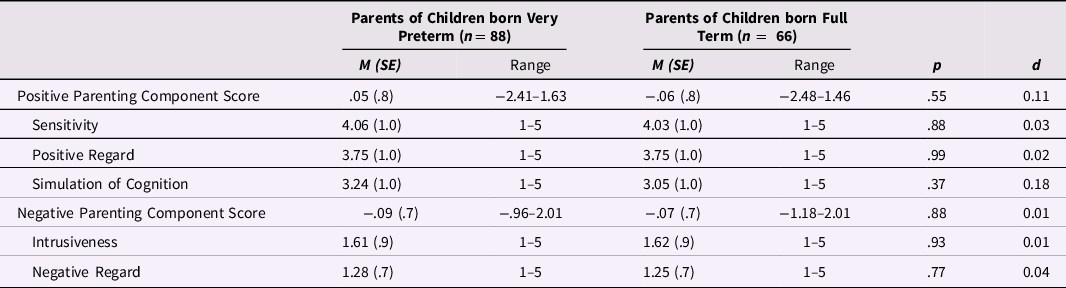
At the five-year follow-up assessment, parents of children born VPT obtained similar Positive Parenting and Negative Parenting component scores as parents of children born FT (all p > .05, Table 2). Both groups of parents also obtained similar ratings for PCIRS Sensitivity, Positive Regard, Stimulation of Cognition, Intrusiveness, and Negative Regard scales (all p > .05).
Comparison of parenting behaviors during parent-child interactions at the five year assessment

Note. Means (M) and Standard Errors (SE) from linear mixed-effect models reported.
Positive parenting
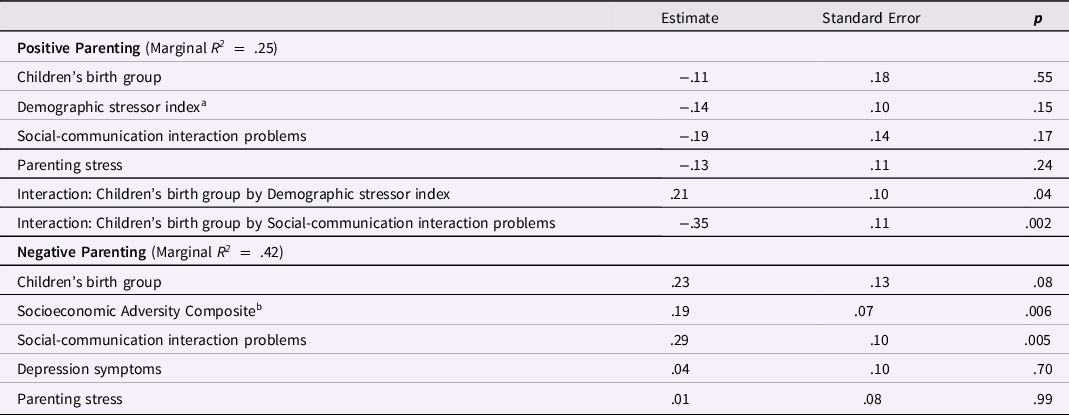
Table S10. (Supplementary Material) shows the bivariate associations between parental psychosocial adversity variables and Positive Parenting component scores from linear mixed-effect models adjusted for children’s birth group and preterm multiple births. Parental SCI problems (p = .01) and total parenting stress (p = .04) were negatively correlated with Positive Parenting component scores. In contrast, there was no bivariate association between Positive Parent component scores and either parental depression symptoms, anxiety symptoms, or ADHD symptoms (all p > .05). While no correlation was found for the overall Socioeconomic Adversity Composite (p = .08), the maternal demographic stressor index was the only factor within the composite that was negatively correlated with Positive Parenting component scores (p = .05). Therefore, the maternal demographic stressor index was included in subsequent multivariate models to account for this association (Table 3). Please see Table S11 for associations between individual demographic stressor factors and PCIRS scales.
The socioeconomic and parental psychosocial risk factors associated with positive and negative parenting component scores (n = 154)

Note. Standardized estimates from linear mixed-effect models reported. Birth Group coded FT = 0, VPT = 1. For linear mixed-effect models conducted in SPSS, the highest value of a categorical factor is used as the reference group. For Negative Parenting, there were no significant interactions between group, adversity composite scores or maternal social communication problems.
a Demographic stressor index is reported because it was the only measure of socioeconomic adversity that was related to Positive Parenting Component scores.
b Socioeconomic Adversity Composite is based upon sum of maternal demographic stressor index, Income-to-Needs Ratio (reversed scored), and Area Deprivation Index percentile z-scores.
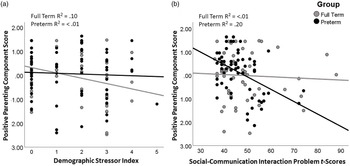
The results of the multivariate linear-effect mixed model (Table 3) showed that there was an interaction between children’s birth group and maternal demographic stressor index on Positive Parenting component scores (p = .04). The interaction term suggested that caregivers of children born FT from more advantaged backgrounds demonstrated more positive parenting behaviors than those from less advantaged backgrounds, but this association was weaker in the VPT group (Figure 1(a)). In addition, there was also an interaction term between children’s birth group and parental SCI problems on Positive Parenting component scores (p = .002). This interaction suggested that better parental social-communication skills were more strongly related to sensitive, warm, and stimulating parenting in parents of children born VPT than in parents of children born FT (Figure 1(b)). In contrast, there was no independent association of parenting stress (p = .24) after accounting for maternal demographic stressor index and parental SCI problems.
Associations between Positive Parenting component scores from parent-child interactions and (a) demographic stressor index (b) and social-communication interaction problems in parents of children born preterm and parents of children born full-term.

Negative parenting
Bivariate analysis showed that a wider range of parental psychosocial adversity variables were correlated with Negative Parenting component scores (Table S10, Supplementary Material). Correlated risk factors included higher levels of parent depression symptoms (p = .006), SCI problems (p < .001), and total parenting stress (p = .009). However, there was no bivariate association between Negative Parenting component scores and either parental anxiety symptoms or ADHD symptoms (all p > .05). In terms of socioeconomic adversity, the overall Socioeconomic Adversity Composite score (p < .001) and all components spanning the maternal demographic stressor index (p < .001), Income-to-Needs Ratio (p = .002), and ADI percentiles (p < .001) were correlated with Negative Parenting component scores.
Results of the multivariate linear mixed-effect model (Table 3) showed that higher Socioeconomic Adversity Composite scores (p = .006) and parent SCI problems (p = .005) were independently associated with Negative Parenting component scores. There were no interactions between children’s birth group, Socioeconomic Adversity Composite scores, or SCI problems on Negative Parenting (data not shown). Depression symptoms (p = .70) and total parenting stress (p = .99) did not explain unique variance in Negative Parenting component scores over and above the Socioeconomic Adversity composite and SCI problems.
Socioeconomic and parenting correlates of executive function at the five-year follow-up
At age five years, children born VPT had lower EF component scores than children born FT (p < .001; Table 4). Children born VPT performed less well on working memory (p = .001), set-shifting (p = .006), cognitive inhibition (p < .001), and executive control (p = .001) tasks. Between-groups differences on EF tasks persisted after covariate adjustment for demographic stressor index and sex (p≤.008), as well as after covariate adjustment and excluding children with severe cognitive delay (p≤.009).
Comparison of executive function ability between children born very preterm and children born full term at age five years (n = 154)

Note. Means (M) and Standard Errors (SE) from linear mixed-effect models reported.
a Adjusted for maternal demographic stressor index and sex.
b Adjusted for maternal demographic stressor index and sex, and excluding children with FSIQ < 70 (VPT = 6, FT = 1).
Bivariate analysis showed there was no correlation between the Positive Parenting component and EF component scores (p = .90; Table S12, Supplementary Material). Supplementary analysis regarding domain-specific associations between the PCRIS scales and child EF tasks are shown in Table S13 (Supplementary Material). In contrast, higher Negative Parenting component scores were correlated with poorer EF component scores (p = .005) (Table S12, Supplementary Material). Reduced parental involvement in children’s learning in the home was also correlated with poorer EF (p = .01). Other key psychosocial correlates of children’s EF included parent depression symptoms (p = .001), anxiety symptoms (p = .009), and the Socioeconomic Adversity Composite (p < .001). As parent depression and anxiety symptoms were highly correlated (Spearman Rho = .63, p < .001) and demonstrated collinearity in multivariate analyses, these factors were fitted to EF component scores using separate linear mixed-effect models.
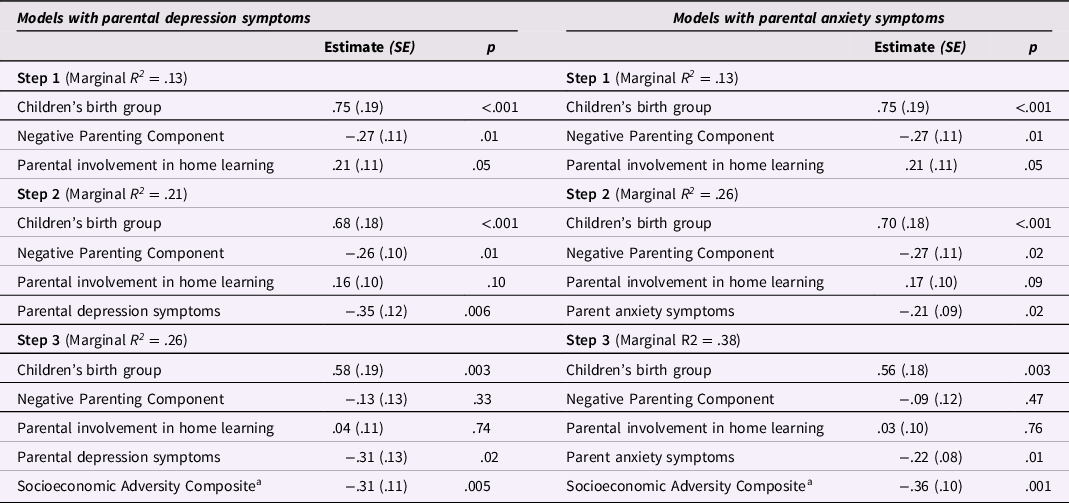
The results of the multivariate linear-mixed models (Table 5) suggested that in addition to children’s birth group (p < .001), higher Negative Parenting component scores (p = .01) and reduced parental involvement in early learning in the home (p = .05) were independently associated with poorer EF. There was no significant interaction between children’s birth group and exposure to negative parenting, or between children’s birth group and parental involvement in early learning on EF (all p > .05). After accounting for parental depression symptoms which were significantly related to child EF (p = .006), Negative Parenting remained associated with EF (p = .01) whereas parental involvement in the home was attenuated (p = .10). There was no interaction between parental depression symptoms and Negative Parenting (p > .05). In the final step of the regression, Socioeconomic Adversity Composite scores (p = .005) accounted for the role of Negative Parenting which was reduced to non-significance (p = .33). The addition of Socioeconomic Adversity Composite scores did not alter links between parent depression symptoms and EF (p = .02). There was no significant interaction between children’s birth group and parental depression symptoms, or between children’s birth group and Socioeconomic Adversity Composite scores on EF (all p > .05). The multivariate linear mixed-effect models including parental anxiety symptoms on child EF yielded a nearly identical pattern of results as the model regressing parental depression symptoms on child EF (Table 5). As shown in table S14 (Supplementary Material) the independent effects of parent depression symptoms (p = .03) and the Socioeconomic Adversity Composite (p = .03) on child EF remained significant after accounting for parent IQ (p = .73) and child IQ (p < .001). A similar pattern of results was observed for parent anxiety symptoms on child EF (p = .003) after accounting for parent (p = .59) and child IQ (p < .001) (Table S14).
Parenting behavior, parental psychosocial factors, and socioeconomic adversity on executive function ability at age five years (n = 154)

Note. Standardized estimates from linear mixed-effect models shown. There were no significant interaction terms between group, negative parenting, adversity or depression symptoms on children’s executive function ability. Birth Group coded FT = 0, VPT = 1. For linear mixed-effect models conducted in SPSS, the highest value of a categorical factor is used as the reference group.
a Socioeconomic Adversity Composite is based upon sum of maternal demographic stressor index, Income-to-Needs Ratio (reversed scored), and Area Deprivation Index percentile z-scores.
Discussion
This is the first study to examine associations between socioeconomic and parental psychosocial adversity on parenting behaviors during parent-child interactions, as well as the extent to which these factors are independently or jointly associated with EF ability in children born VPT. At the five-year follow-up, parents (predominantly mothers) of children born VPT demonstrated similar positive and negative parenting behaviors as parents of children born FT during parent-child interactions. Previous studies have reported less sensitive and more intrusive parenting behavior in mothers of children born VPT (Clark et al., Reference Clark, Woodward, Horwood and Moor2008; Jaekel et al., Reference Jaekel, Wolke and Chernova2012; Stack et al., Reference Stack, Matte-Gagné and Dickson2019). However, our findings are in line with a meta-analysis that found that parents of children born VPT did not consistently show higher rates of harsh-intrusive parenting than parents of children born FT (Bilgin & Wolke, Reference Bilgin and Wolke2015). Current study findings could be attributed to the fact that the two groups of parents included in this study had similar levels of socioeconomic adversity, psychiatric symptoms, and parenting stress; and thus equivalent risks for harsh-intrusive parenting (Lovejoy et al., Reference Lovejoy, Graczyk, O’Hare and Neuman2000; Park et al., Reference Park, Hudec and Johnston2017). Parents of infants born VPT may also show less sensitive and unsupportive parenting in the earlier child-rearing years which reduces over time (Treyvaud, Reference Treyvaud2014).
Although parents of children born VPT and children born FT showed similar parenting behaviors at follow-up, demographic stressors and parental psychosocial adversity were differentially related to parenting behaviors in each group. Higher levels of cumulative maternal demographic stressor factors were more strongly related to reductions in sensitive, warm, and stimulating parenting in parents of FT children than for parents of VPT children. This finding may reflect the fact that there was slightly more variability in demographic stressor index scores among the FT group, and thus improved statistical sensitivity to detect linear associations between demographic stressor index and positive parenting component scores (Lawson et al., Reference Lawson, Hook and Farah2018). Although supplementary analyses showed that there were no significant differences in parenting behavior between Caucasian parents and African American parents (as a proxy for structural and individual experiences of racism), there was a higher proportion of African American parents in the FT cohort and other studies have shown that observational rating systems may be biased against normative cultural differences in parenting (Bornstein, Reference Bornstein2012; Tamis-LeMonda, Briggs, McClowry, & Snow, Reference Tamis-LeMonda, Briggs, McClowry and Snow2008). Alternatively, the interaction term could also reflect parenting resilience/adaptation among parents of children born VPT in the setting of poverty (Ellis, Bianchi, Griskevicius, & Frankenhuis, Reference Ellis, Bianchi, Griskevicius and Frankenhuis2017). In contrast, broader socioeconomic adversity encompassing maternal demographic stressors, family Income-to-Needs Ratio, and neighborhood deprivation was linked to more intrusive and harsh parenting across both groups of parents. This suggests that pervasive socioeconomic disadvantage in both family and neighborhood contexts has a greater influence on the negative dimensions of parenting behavior (Lovejoy et al., Reference Lovejoy, Graczyk, O’Hare and Neuman2000). This finding could reflect the adverse effects of experiencing stressors associated with severe economic hardship on a daily basis (Neuhauser, Reference Neuhauser2016) and/or the intergenerational transmission of negative parenting styles in the setting of poverty (Kovan, Chung, & Sroufe, Reference Kovan, Chung and Sroufe2009).
Parents who reported increased SCI problems (i.e., difficulties with expressive communication, reduced social motivation, and problems in the perception and interpretation of social cues) showed lower levels of sensitive, warm, and stimulating parenting behavior during parent-child interactions; and this association was stronger in parents of VPT children than in parents of FT children. As there were no significant between-groups differences in mean parental SCI problems, the differential association with parenting behavior may reflect the unique challenges associated with parenting a child born VPT that parents with higher levels of SCI problems may find more difficult to overcome (Treyvaud, Reference Treyvaud2014). For example, early language and social-communication development is delayed in infants born VPT (Wong, Huertas-Ceballos, Cowan, & Modi, Reference Wong, Huertas-Ceballos, Cowan and Modi2014), which in turn, has been shown to influence maternal communication styles in parent-child relationships (Suttora & Salerni, Reference Suttora and Salerni2011). Furthermore, parents with increased SCI problems may find attuning and adapting to changes in child cues and affect more difficult, particularly with a highly dysregulated child (Hirokawa et al., Reference Hirokawa, Kimura, Ikehara, Honjo, Sato, Ueda and Iso2019; Parr et al., Reference Parr, Gray, Wigham, McConachie and Couteur2015; Siller, Hutman, & Sigman, Reference Siller, Hutman and Sigman2013). Although this is the first study to link self-reported SCI problems with direct observations of parenting behavior in parents of children born VPT, current findings are consistent with altered maternal communication patterns and poorer quality parent-child interactions in mothers with depression (Hwa-Froelich, Loveland Cook, & Flick, Reference Hwa-Froelich, Loveland Cook and Flick2008). When taken together, current study findings have important implications for future research focused on designing and evaluating the efficacy of parent-child interaction interventions that include a social-communication interaction and mental health components, particularly for parents of infants born VPT.
At age five years, children born VPT performed less well on EF tasks compared to children born FT (van Houdt et al., Reference van Houdt, Oosterlaan, van Wassenaer-Leemhuis, van Kaam and Aarnoudse-Moens2019). Among children born VPT, infant clinical factors were not associated with later EF ability. This association is consistent with prior work in this cohort showing that infant clinical risk is not associated with later with cognitive and language development (Lean, Paul, Smyser, Smyser, et al., Reference Lean, Paul, Smyser, Smyser and Rogers2018) and profiles of internalizing and externalizing problems at age 5 years (Lean et al., Reference Lean, Lessov-Shlaggar, Gerstein, Smyser, Paul, Smyser and Rogers2020). Existing studies using resting state functional-MRI in neonates born VPT have shown that the intrinsic functional connectivity of the neural networks that serve executive control and attention mature later in infancy, and may, therefore, be less vulnerable to the adverse effects of neonatal medical complications and stress experienced during the NICU stay (Smyser et al., Reference Smyser, Inder, Shimony, Hill, Degnan, Snyder and Neil2010, Reference Smyser, Snyder, Shimony, Mitra, Inder and Neil2016).
In contrast to hypothesis 2c, Positive Parenting component scores were not associated with global EF ability at age five years. Supplementary analysis showed that there was, however, evidence for more specific associations such that parenting sensitivity and stimulation of cognition correlated with children’s working memory. While the current study used the PCIRS to assess key parenting behaviors that are commonly examined in large-scale parenting studies (Brito, Ryan, & Barr, Reference Brito, Ryan, Barr and Saracho2015; NICHD Early Child Care Research Network, 1999), the PCRIS does not measure parental scaffolding or autonomy support which may more directly teach EF skills (Distefano, Galinsky, McClelland, Zelazo, & Carlson, Reference Distefano, Galinsky, McClelland, Zelazo and Carlson2018; Lowe et al., Reference Lowe, Erickson, MacLean, Duvall, Ohls and Duncan2014).
Current study findings showed that higher Negative Parenting component scores, comprised of intrusiveness and negative regard, were related to poorer EF in children born VPT and children born FT. Clark and Woodward (Reference Clark and Woodward2015) also found that maternal intrusiveness, but not sensitivity, predicted EF ability in children born VPT assessed at age six years. Thus, parental intrusiveness coupled with punitive responses may be detrimental for children’s opportunities to use self-control and engage in problem-solving important for the development of EF. Similar to prior reports (Treyvaud et al., Reference Treyvaud, Thompson, Kelly, Loh, Inder, Cheong, Doyle and Anderson2020), we found that instances of intrusiveness during parent-child interactions were more often observed than instances of negative regard for the child. Parents who demonstrate intrusive parenting behavior may have difficulties in self-regulation, representing a heritable liability for poorer child EF (Deater-Deckard, Reference Deater-Deckard2014). However, our study is unable to address directionality between parent and child behaviors. It is possible that the association between increased parental intrusiveness and poorer child EF could reflect parents adapting their behavior by increasing involvement/direction to support the goal-directed behavior of children born VPT with poorer EF. Jaekel et al. (Reference Jaekel, Wolke and Chernova2012) found that mothers of children born VPT showed higher levels of intrusiveness in parent-child interactions, but that these mothers provided greater parental involvement to better support the cognitive needs of their child. Although the development of self-regulation in infants born VPT has been found to be susceptible to exposure to negative parenting (Poehlmann et al., Reference Poehlmann, Schwichtenberg, Shlafer, Hahn, Bianchi and Warner2011), we did not find evidence of an interaction between children’s birth-group and exposure to harsh-intrusive parenting on EF ability (see also Clark & Woodward, Reference Clark and Woodward2015).
A major aim of this study was to use a cumulative risk framework to delineate the independent and joint effects of poverty, parental psychosocial adversity, and parenting quality on EF ability in children born VPT. Consistent with Hughes et al. (Reference Hughes, Roman, Hart and Ensor2013), our results suggested that independent of exposure to harsh and intrusive parenting, parental mood/affective problems explained a unique proportion of variance in children’s EF ability. Caregivers with higher levels of depression and/or anxiety symptoms may be less attuned to their child’s behavioral cues or experience emotional blunting during parent-child interactions (Lenze, Rodgers, & Luby, Reference Lenze, Rodgers and Luby2015), and may therefore, miss opportunities to engage with their child in ways that support the development of EF. Associations between parental mood/affective symptoms and children’s EF may also reflect heritable deficits in self-regulation common to both executive dysfunction and psychopathology (Crandall et al., Reference Crandall, Deater-Deckard and Riley2015; Harold et al., Reference Harold, Rice, Hay, Boivin, van den Bree and Thapar2011). In contrast to the research hypothesis (1b and 2d), parental ADHD symptoms were not related to either parenting quality or children’s EF. Although this finding was unexpected, previous studies linking parental ADHD to critical and inconsistent parenting behavior have either been conducted in clinical populations of parents and/or children with an ADHD diagnosis, used parent self-report questionnaires of parenting behavior, or observed different parenting constructs assessed with other behavioral coding schemes (Chronis-Tuscano et al., Reference Chronis-Tuscano, O’Brien, Johnston, Jones, Clarke, Raggi and Seymour2011, Reference Chronis-Tuscano, Raggi, Clarke, Rooney, Diaz and Pian2008; Mazursky-Horowitz et al., Reference Mazursky-Horowitz, Felton, MacPherson, Ehrlich, Cassidy, Lejuez and Chronis-Tuscano2015; Woods, Mazursky-Horowitz, Thomas, Dougherty, & Chronis-Tuscano, Reference Woods, Mazursky-Horowitz, Thomas, Dougherty and Chronis-Tuscano2019). This study examined a dimensional assessment of parental ADHD symptoms in relation to observations of parenting behavior coded with the PCIRS. In addition, Thissen et al. (Reference Thissen, Rommelse, Hoekstra, Hartman, Heslenfeld, Luman, van Lieshout, Franke, Oosterlaan and Buitelaar2014) found that parental ADHD diagnosis did not predict impaired EF in offspring, and instead found that parental EF ability is more directly related to child EF ability.
Current study findings also showed that the association between parental mood/affective symptoms and child EF persisted after accounting for family and neighborhood socioeconomic disadvantage, which was also related to child EF. There was no interaction between parental mood/affective symptoms and socioeconomic disadvantage, indicating that these risks factors may work independently to alter EF in childhood. Importantly, we also found that family and neighborhood socioeconomic disadvantage attenuated the association between negative parenting and poorer child EF. This finding is consistent with bioecological frameworks suggesting that the influence of parent-child relationships on child cognitive development is affected by the broader social context of the dyad (Bronfenbrenner & Evans, Reference Bronfenbrenner and Evans2000). Although current findings highlight the role of pervasive socioeconomic disadvantage on children’s EF over and above the role of parenting behavior (Last et al., Reference Last, Lawson, Breiner, Steinberg and Farah2018), other researchers have found that harsh-intrusive parenting mediates the impact of poverty on impaired EF (Hackman et al., Reference Hackman, Gallop, Evans and Farah2015). Differences in study findings may be attributed to previous studies relying upon narrow markers of SES such as maternal education or income (Bernier et al., Reference Bernier, Carlson and Whipple2010; Lowe et al., Reference Lowe, Erickson, MacLean, Duvall, Ohls and Duncan2014; Sosic-Vasic et al., Reference Sosic-Vasic, Kröner, Schneider, Vasic, Spitzer and Streb2017). We assessed maternal social-demographic stressors, family poverty, and neighborhood disadvantage. A multidimensional assessment of socioeconomic disadvantage may be more likely to capture the cumulative, systemic effect of poverty on childhood disparities in EF (Manley et al., Reference Manley, Roberts, Doyle, Schmidt, Anderson, Barrington, Bohm, Golan, van Wassenaer-Leemhuis and Davis2015; Sarsour et al., Reference Sarsour, Sheridan, Jutte, Nuru-Jeter, Hinshaw and Boyce2011). Additionally, the ability of supportive parenting to intervene on children’s EF development may also be limited in the setting of severe socioeconomic hardship due to the disproportionate, adverse effect of poverty on neuroendocrine responses and prefrontal brain function (Haft & Hoeft, Reference Haft and Hoeft2017; Lawson, Hook, Hackman, & Farah, Reference Lawson, Hook, Hackman, Farah, Griffin, Freund and McCardle2016). Poverty has also been more strongly linked to EF in school-age children who spend less time in the family household (Last et al., Reference Last, Lawson, Breiner, Steinberg and Farah2018), whereas parenting may play a greater role for earlier EF development in infants and preschool-age children who spend more time with their parents in the home (Bernier et al., Reference Bernier, Carlson and Whipple2010; Matte-Gagné, Bernier, & Lalonde, Reference Matte-Gagné, Bernier and Lalonde2015).
Strengths of this study span the inclusion of two demographically similar groups of children born VPT and children born FT, the high sample retention rate for children born VPT, a task-based assessment of EF, and the comprehensive assessment of socioeconomic disadvantage. This study also used semi-structured parent-child interaction tasks to capture systematic differences in parenting behavior across dyads as observed by blinded raters with high inter-rater reliability. However, study limitations include the possibility that parenting behavior observed in research settings may not generalize to the home environment. As this cohort is comprised of families with higher rates of single parenthood and socio-economic disadvantage than other samples of children born VPT (Mangin et al., Reference Mangin, Horwood and Woodward2016; Manley et al., Reference Manley, Roberts, Doyle, Schmidt, Anderson, Barrington, Bohm, Golan, van Wassenaer-Leemhuis and Davis2015), current study findings may not generalize beyond socially disadvantaged samples of children born VPT and demographically similar control groups. Although findings are consistent with existing longitudinal studies (Hughes et al., Reference Hughes, Roman, Hart and Ensor2013), this study cannot infer causality from cross-sectional PCI and EF data. Our findings relating exposure to poverty and parental mood/affective symptoms to child EF remained unchanged after accounting for parental IQ, but we acknowledge that parental IQ was estimated using co-normed, demographically predicted FSIQ scores based on WTAR performance rather than a direct assessment using the full WAIS-III battery. Lastly, while the sample size is comparable to other samples of children born VPT (Pérez-Pereira & Cruz, Reference Pérez-Pereira and Cruz2017; Yaari et al., Reference Yaari, Mankuta, Harel-Gadassi, Friedlander, Bar-Oz, Eventov-Friedman and Yirmiya2017), this study may have lacked statistical power to detect smaller moderation effects between independent variables. Future directions include the longitudinal assessment of parenting behavior observed in the home, structured clinical assessment of parent psychopathology, and assessing parent EF to determine the heritability of EF. Future studies should also undertake longitudinal mediation and/or moderated mediation analysis to elucidate the underlying causal mechanisms of EF impairments in children born VPT.
Conclusions
This study examined socioeconomic and parental psychosocial adversity in relation to longer-term parenting outcomes among parents of children born VPT, as well as the extent to which socioeconomic and parental factors explained variability in child EF ability at age five years. First, parent SCI problems and demographic stressors were differentially related to lower levels of positive parenting in parents of children born VPT and children born FT, respectively. Links between SCI problems and parenting quality in parents of children born VPT could reflect the extent that parents with high SCI problems find interpreting the cues of children born VPT more difficult to overcome. Second, negative parenting (intrusiveness and negative regard) was related to poorer child EF at age five years, whereas positive parenting (sensitivity, positive regard, stimulation of cognition) was not. This suggests that in addition to VPT birth, exposure to negative parenting behaviors may be detrimental for the development of EF. Alternatively, parents may be adapting their parenting behavior to support children’s EF difficulties. Nevertheless, the association between parenting quality and child EF was subsequently accounted for by the independent effects of parental mood/affective symptoms and family/neighborhood socioeconomic adversity. The findings of this study have important implications for future research focusing on the design and efficacy of parenting interventions that address parental SCI problems and mood/affective symptoms as part of early parent-child interventions that may improve dyadic interactions, and in turn, the development of EF in socially disadvantaged children born VPT.
Supplementary material
For supplementary material accompanying this paper visit https://doi.org/10.1017/S0954579421000961
Funding and Acknowledgements
This work was supported by the National Institutes of Health (R01-HD057098, R01-MH113570, R01-MH113883, K02-NS089852, UL1-TR000448, K23-MH105179, K01-MH122735), Intellectual and Developmental Disabilities Research Center at Washington University (U54-HD087011), Cerebral Palsy International Research Foundation, The Dana Foundation, March of Dimes, The Child Neurology Foundation, The Doris Duke Charitable Foundation, and a NARSAD Young Investigator Grant (#28521) from the Brain & Behavior Research Foundation. We thank current and past members of the Washington University Neonatal Developmental Research Group for study coordination and data collection, the Intellectual and Developmental Disabilities Research Center at Washington University for assistance with data collection, and the families involved with the study.
Conflicts of interest
None.