

1. Introduction
Environmental protection has long been a controversial issue in trade negotiations. In the early 1990s, a dispute between Mexico and the United States over dolphins put the then obscure General Agreement on Tariffs and Trade (GATT) in the spotlight. Mexico filed a complaint against the United States for its import restrictions on tuna from the countries that did not meet specific dolphin protection standards. Although the panel's report was never formally adopted, the dispute crystalized public opposition to further trade liberalization in the name of environmental protection.Footnote 1
A quarter of a century later, another controversial environment-related dispute brought trade negotiations into the public eye. In 2012, the Swedish energy company Vattenfall filed a request for arbitration against Germany over its decision to close down its nuclear plants. Although the dispute has not yet been settled, Vattenfall's claim for compensation is already presented in public debates as a challenge to a sovereign state's capacity to enact environmental regulations. Similar to the “Tuna-Dolphin” case, the Vattenfall-Germany dispute is presented by various groups as evidence that the expansion of trade law must be stopped in the name of environmental protection.
Over the years, American and European trade negotiators have gradually become more proactive on environmental issues. They increasingly include detailed environmental provisions in their respective PTAs. Rather than treating environmental protection as merely an exception to trade commitments, as it used to be, the United States and European Union now use PTAs as a vehicle for diffusing their environmental standards in other countries.Footnote 2
A transatlantic agreement might provide the greatest opportunity that the United States and the European Union have ever had for promoting their environmental standards globally. As acknowledged in a report published by the U.S. government, the Transatlantic Trade and Investment Partnership (TTIP) could “address environmental concerns in the dozens of developing countries whose largest trade and investment relationships are with the U.S. and the E.U.”Footnote 3 Given their systemic economic weight, any environmental standard endorsed by both the European Union and the United States would become de facto a global standard.Footnote 4
However, several analysts regard environmental protection as a major stumbling block in transatlantic negotiations.Footnote 5 They argue that E.U. and U.S. environmental standards are so different and rooted in such fundamentally incompatible principles that bridging the gap would be virtually impossible. While the European Union is a global leader on climate change mitigation and has the world's most stringent regulations on chemicals and genetically modified organisms, the United States is better known for its protection of endangered species and automobile emission standards. For obvious political reasons, the United States will not adopt European standards on greenhouse gas emissions. Similarly, European negotiators cannot afford to be perceived as yielding to the United States on genetically modified organisms.
Yet, despite these points of contention, this article argues that the forces bringing the United States and the European Union together, in terms of the trade and environment nexus, outweigh those that set them apart. While the United States and the European Union initially pursued different objectives by introducing environmental provisions in their respective PTAs, both drew similar lessons, learned from each other, and gradually converged on a shared set of environmental norms. Recently negotiated American agreements, such as the Trans-Pacific Partnership (TPP), have become more European-like. Simultaneously, European agreements, such as those with Vietnam, Canada, and Singapore, are becoming more Americanized. Despite their traditionally different approaches, there is a convergence between the United States and the European Union in the way that they address environmental issues in trade negotiations.
Specifically, this article does not consider the criticisms expressed by environmental groups with regard to TTIP, nor does it claim that U.S. and E.U. domestic regulations are converging. It does not predict that TTIP will be easy to conclude or ratify either. Instead, it argues that U.S. and E.U. PTAs are more similar in terms of how they address environmental issues than what is commonly assumed. This transatlantic convergence manifests when recent American and European agreements are compared with third countries’ agreements. While it is important not to overlook the residual differences between the U.S. and E.U. models, a myopic view focusing exclusively on American and European agreements could exaggerate their differences.
To identify the specificities and assess the convergence of environmental clauses found in PTAs, we manually coded 275 different categories of environmental provisions found in 688 trade agreements signed between 1947 and 2016.Footnote 6 Some clauses are very common, such as the exception to trade commitments for the conservation of natural resources, which is found in more than 300 agreements. Other coded provisions are rare, like the use of geographical indication to protect biodiversity or the requirement to ratify the Rotterdam Convention on hazardous chemicals. Two encoders independently analyzed each of the 688 trade agreements and discrepancies were arbitrated by a third person.Footnote 7
Building on this dataset, this article is structured in two parts. The first section discusses the different origins of U.S. and E.U. approaches to addressing environmental protection in PTAs. The second argues that the differences, while still recognizable, have been diluted over time. The conclusion discusses the implication of this transatlantic convergence.
2. Different laboratory, different experiments
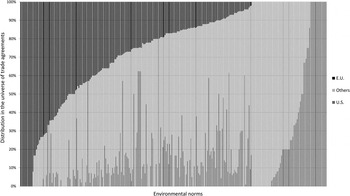
The United States and the European Union have distinct models for incorporating environmental provisions in PTAs.Footnote 8 Figure 1 shows that several environmental clauses are predominantly or exclusively found in either American or European PTAs. For example, American agreements are the only ones to include a clause relating to the suspension of benefits in the event of failure to compensate for the non-enforcement of an environmental provision. In contrast, European agreements are the only ones to formally acknowledge the principle of common but differentiated responsibilities in global environmental degradation.
The distribution of 275 environmental clauses in trade agreements.

This section argues that variations between American and European agreements reflect the different objectives pursued by their respective trade negotiators. Historically, the United States sought to establish a level playing field with its trade partners and to protect its regulatory sovereignty from trade-based challenges. By comparison, the European Union was motivated by a more cooperative approach, with the aim of achieving greater coherence between its trade, environmental, and developmental objectives. These different goals have led to the development of quite different models for environmental provisions.
2.1 The competitive American approach
The U.S. government's principal objective for including environmental provisions in PTAs has always been to create a level playing field. Until the early 1990s, the United States was a regulatory precursor in the field of environmental protection. With regard to certain issues, its domestic regulations were more stringent, risk adverse, and comprehensive than any other country.Footnote 9 In this context, the United States became increasingly concerned that its environmental standards would affect its competitiveness if foreign competitors were not subject to equally stringent regulations. Thus, enhancing environmental standards in foreign markets become one of American trade policy's key objectives. It remains so to this day.
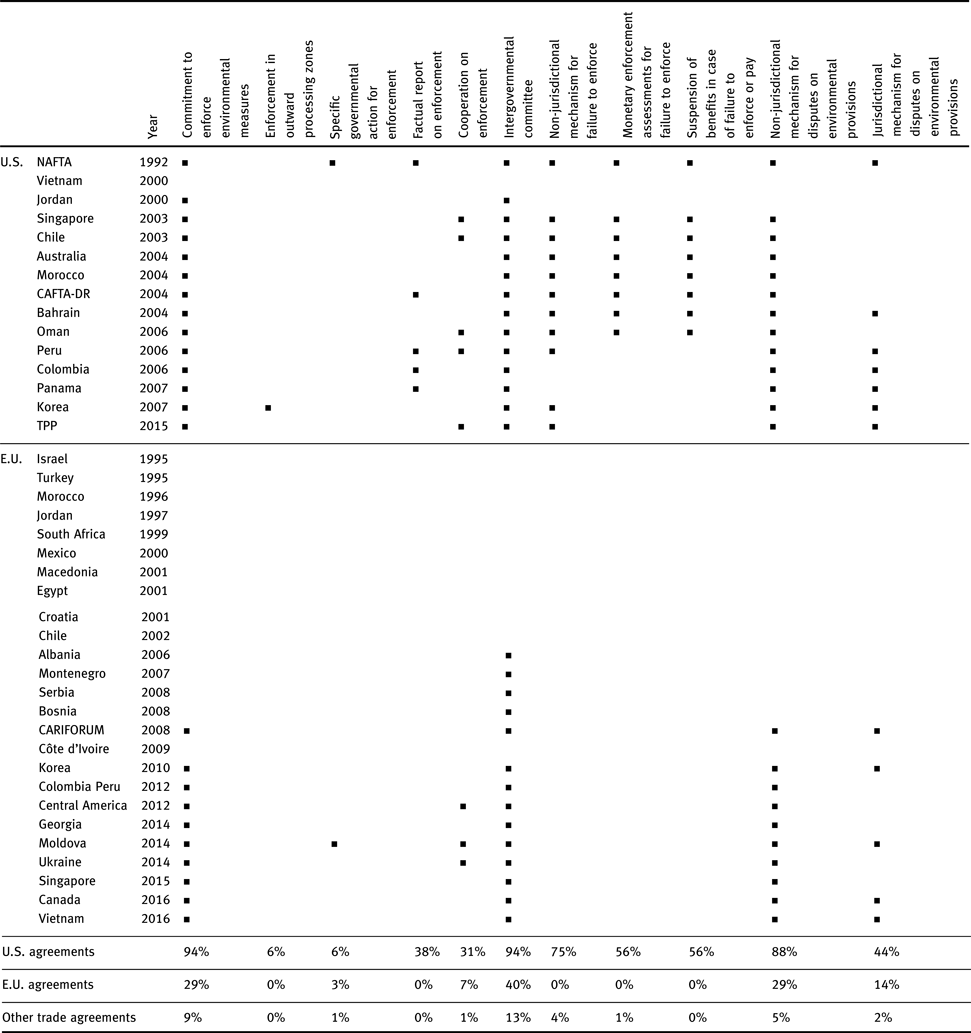
In 1992, this objective became clear with the adoption of the North American Free Trade Agreement (NAFTA) and its side-treaty, the North American Agreement on Environmental Cooperation (NAAEC).Footnote 10 With both agreements, the U.S. government sought to level the playing field in two different ways. First, it adopted a strict legal approach, compelling parties to enforce their own laws and regulations.Footnote 11 At the time, environmental and labor groups were concerned that Mexico would not enforce its regulations properly as a deliberate strategy to reduce production costs and attract foreign investment. In order to minimize the risk of “environmental dumping,” NAFTA states that a “party should not waive or otherwise derogate from” their environmental measures. The NAAEC echoes this commitment by stating that “each Party shall effectively enforce its environmental laws and regulations.”Footnote 12 It also specifies the methods that parties should use to ensure that their domestic environmental regulations are enforced. For example, appointing and training inspectors, investigating suspected violations and promoting environmental audits, are proposed actions that are suitable for ensuring that environmental standards are enforced.Footnote 13 If a party systematically fails to enforce its environmental laws and regulations, the NAAEC provides multiple procedures to rectify the situation. In the event of persistent failure to enforce domestic environmental measures, an arbitral panel may be established. This panel can impose a monetary fineFootnote 14 and, in the case of non-payment, a party has the right to trade retaliation.Footnote 15
As table 1 shows, subsequent American PTAs use similar language and incorporate multiple provisions relating to the enforcement of environmental regulations. All the norms pertaining to this broad category first appeared in a U.S. agreement, illustrating the fact that they are a central component of U.S. trade policy. Table 1 also indicates that these clauses are rarely found outside U.S. agreements.
The distribution of selected clauses relating to the enforcement of environmental regulations

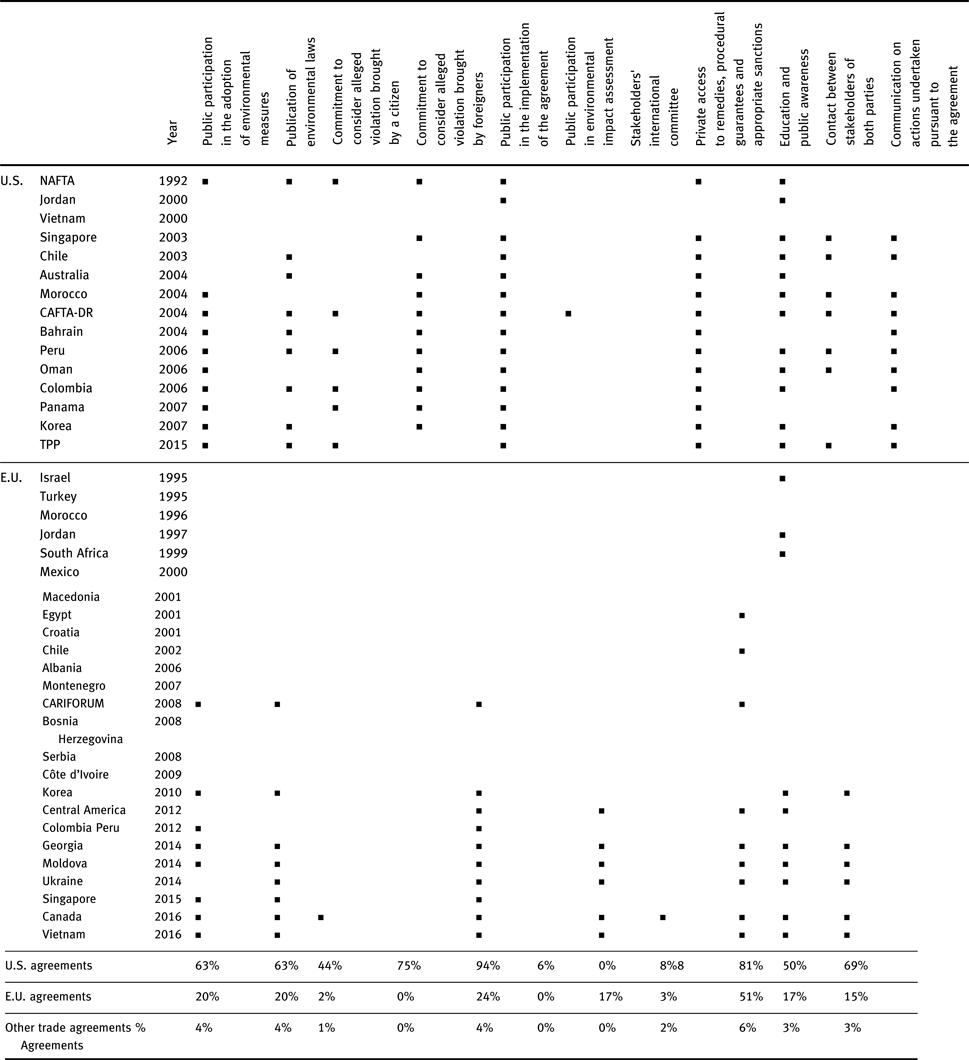
The second approach typically used in American agreements to prevent environmental dumping is to empower local activists and environmental groups. For example, the NAAEC states that governments should give stakeholders the opportunity to comment on domestic environmental measures before they are adopted.Footnote 16 This clause, along with other provisions promoting transparency and public participation, are designed to empower civil society groups and create endogenous pressure for enhanced environmental protection.Footnote 17 Table 2 shows that this strategy was later used in several other American agreements.
The distribution of selected clauses relating to public participation

In addition to preventing environmental dumping, the United States also aims to protect its regulatory sovereignty on environmental matters. This policy objective emerged in response to the challenges generated by U.S. environmental measures under the GATT. No less than six GATT/WTO disputes were directly related to an U.S. environmental measure, which is far more than for any other WTO member. Moreover, during the NAFTA negotiations, other U.S. environmental measures were heavily criticized by U.S. trade partners and were likely to be challenged under the GATT.Footnote 18 In this context, it was paramount for the U.S. government to protect itself against future legal disputes.
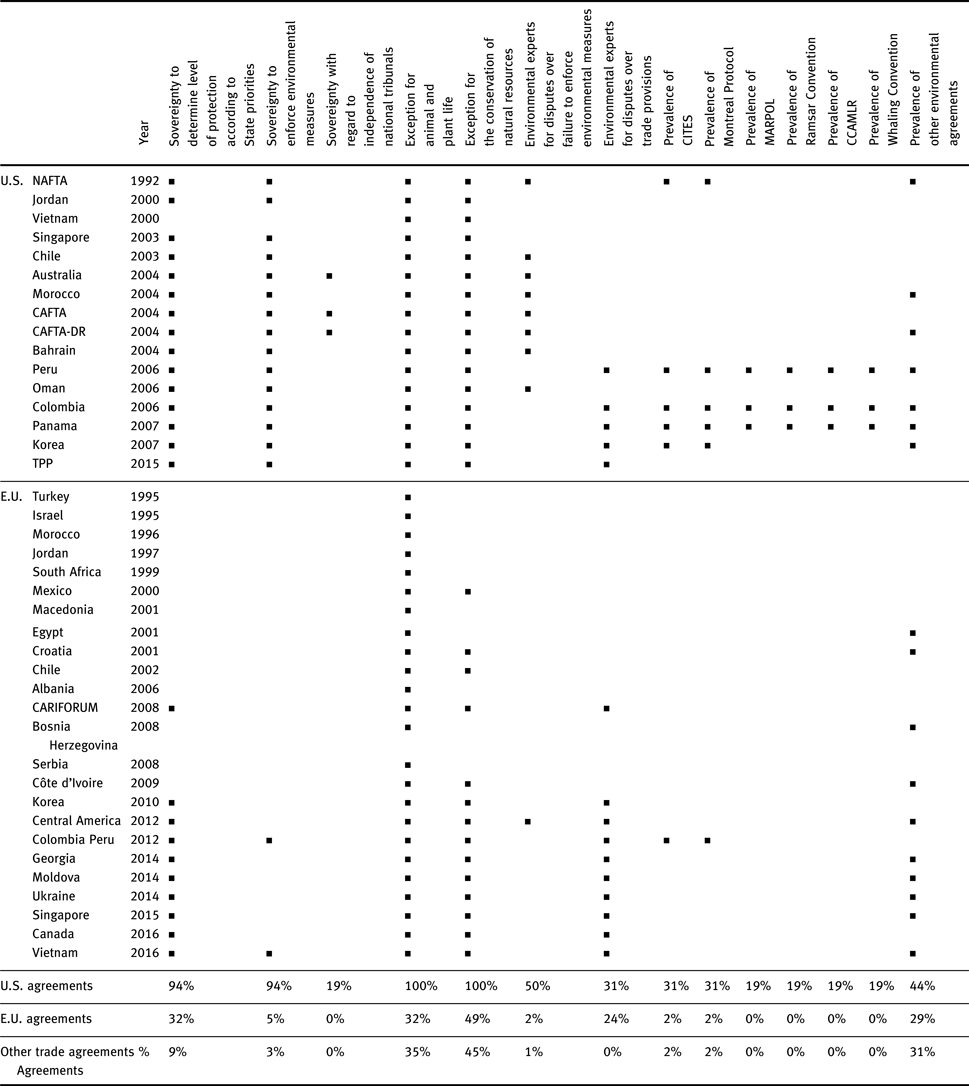
Thus, at the request of U.S. negotiators, NAFTA includes numerous provisions protecting regulatory sovereignty. The agreement specifically states that each party may “establish the level of protection it considers appropriate.”Footnote 19 Likewise, article 104 states that import restrictions may be applied to enforce a list of specific multilateral environmental agreements. Consequently, obligations from agreements, such as the Convention on International Trade in Endangered Species of Wild Fauna and Flora (CITES), the Montreal Protocol on Substances that Deplete the Ozone Layer and the Basel Convention on the Control of Transboundary Movements of Hazardous Wastes and their Disposal prevail in case of inconsistency with NAFTA clauses. Recent agreements go even further. In the event of an environmental dispute, parties are obliged to select panelists with relevant environmental experience.Footnote 20
Most of these provisions are normative innovations, which were not found in WTO agreements or any previous PTAs. After NAFTA, these provisions were systematically reproduced in most American trade agreements. Therefore, they represent a certain American model (see table 3). To this day, the key U.S. objective in negotiations is to establish a level playing field with trade partners, while preserving its regulatory sovereignty.
The distribution of selected clauses relating to regulatory sovereignty

2.2 The cooperative European approach
In the early 1990s, the global regulatory leadership on environmental matters shifted on the other side of the Atlantic.Footnote 21 As U.S. policymakers increasingly sought to avoid unnecessary regulation, their European counterparts became more inclined to regulate on the grounds of the precautionary principle, even when environmental risks were not scientifically established. As a result, the European Union began to introduce more environmental clauses in its PTAs.
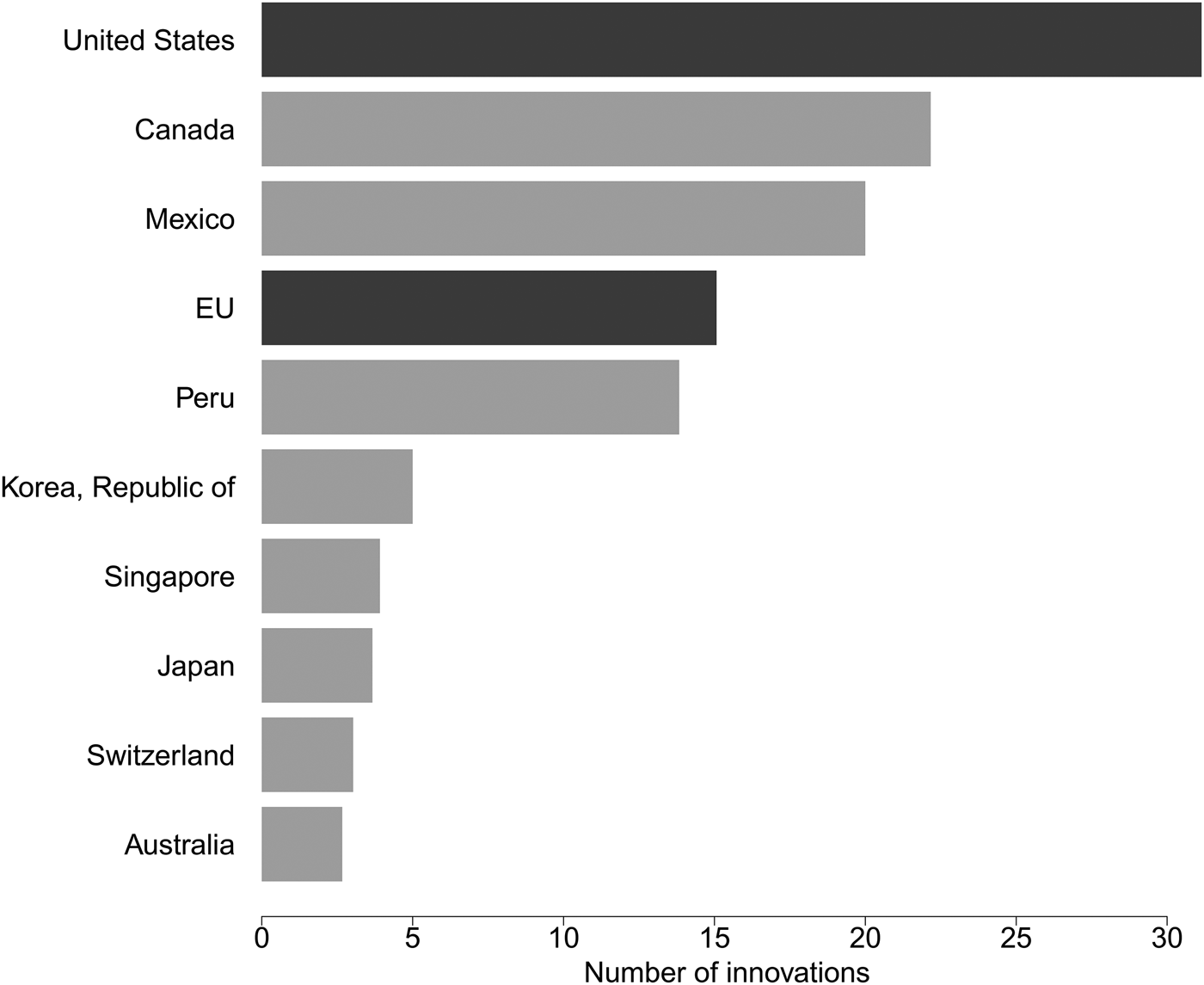
In this context, it is not surprising to find that several environmental clauses first appeared in European PTAs. Figure 2 shows that the United States has elaborated far more “innovative” environmental provisions than any other country.Footnote 22 To this day, NAFTA and its side-treaty have generated more environmental “legal innovations” as a result of trade negotiations than any other agreement in the world. NAFTA's legacy explains why Canada and Mexico also figure among the top ten innovators.Footnote 23 Yet, figure 2 also shows that the E.U. trade negotiators have designed a significant number of innovative provisions relating to environmental protection.
Number of unprecedented environment clauses for the top ten regulatory innovators.

The United States uses a one-size-fits-all approach, where legal innovations are duplicated for subsequent PTAs.Footnote 24 On the contrary, European PTAs do not have a standardized uniform approach to environmental protection. The European Union seems to adjust the environmental provisions in its PTAs to the political, economic, and ecological context of its trade partners. According to our research, the average distance of American PTAs displays a Jaccard value of 0.54. This distance is extended to 0.82 for European PTAs.Footnote 25
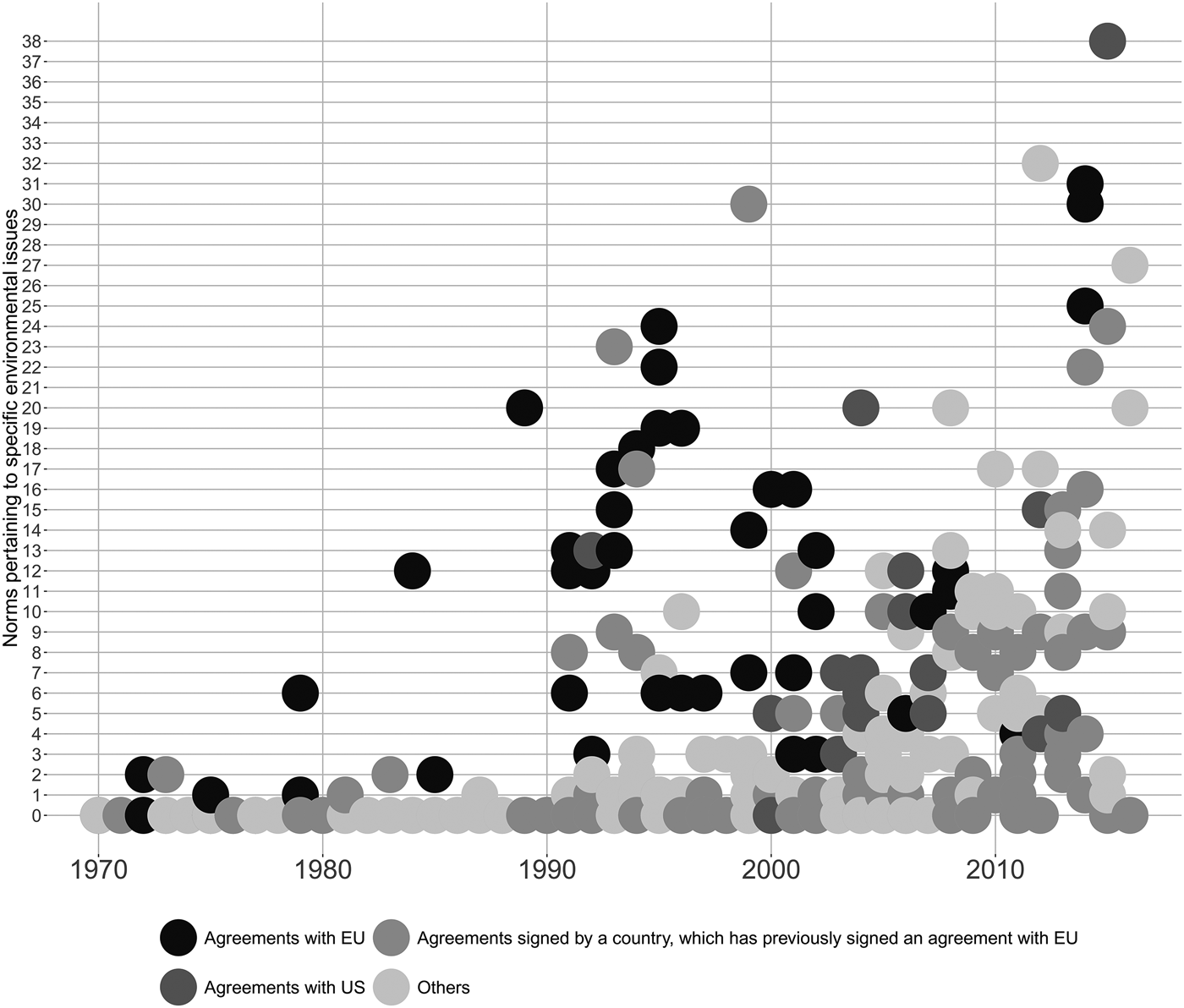
In particular, the European environmental clauses included in the PTAs are scattered across diverse issue areas, as shown in figure 3. While the United States relies on generic environmental provisions that are applicable to any environmental issues, European agreements tend to address specific issue areas. In this respect, the European Union engages in “legal inflation” as the number of environmental issue areas addressed in its PTAs increases over time.Footnote 26 Recent European PTAs cover issue areas as diverse as sustainable fisheries, deforestation, renewable energy, climate change adaptation, toxic wastes, greenhouse gas emissions, the ozone layer, migratory species, endocrine disrupting chemicals, soil erosion, wetlands, invasive species, scenery preservation, mercury, heavy metals, and genetically modified organisms.
Number of specific environmental issue areas addressed in PTAs.

On average, the E.U. PTAs incorporate more specific environmental commitments with neighboring countries.Footnote 27 These countries have a more direct impact on the ecosystems of E.U. member states. As a consequence, European PTAs with neighboring countries often include detailed provisions on transboundary air pollution and transboundary river basins.
Moreover, European PTAs involving neighboring countries often set the stage for greater cooperation. The association agreement with Bosnia Herzegovina, for example, states that the aim of cooperation between the parties is to strengthen “administrative structures and procedures to ensure strategic planning of environmental issues and coordination between relevant actors.”Footnote 28 Some PTAs involving candidates for E.U. accession include a clause specifying that the “approximation of laws shall extend to the protection of the environment.”Footnote 29 In fact, at least thirteen European PTAs include a provision relating to the harmonization of environmental measures.Footnote 30
European agreements involving more geographically distant partners are typically shallower but are equally focused on political cooperation. They integrate broad norms designed to promote dialogue and facilitate the exchange of information. European PTAs were notably the first trade agreements to include an explicit reference to the common but differentiated principles of responsibility. This cooperative approach contrasts with the confrontational judicial approach adopted in the United States. Unlike the United States, few European PTAs establish mechanisms for monitoring compliance with environmental standards or adjudicating environmental disputes.
The distinction between the American and European approach can be attributed to the fact that the European Union maintains a different relationship with its trading partners. The European Union does not seem to perceive its trading partners as competitors with whom a level playing should be established. Rather, it seems to perceive several of its trade partners as developing countries and, in many cases, former colonies, which require assistance in order to achieve an effective level of environmental protection.Footnote 31
At least thirteen European PTAs include detailed provisions on technical assistance or financial assistance in the field of environmental protection. For example, the 1999 trade agreement between the European Union and South Africa states that the former should assist the latter to improve “energy operators’ performance standards in technical, economic and financial terms especially in the electricity and liquid fuels sectors.”Footnote 32 Likewise, a 2001 agreement with Macedonia provides that the European Union should assist the Macedonian government to reach the European level of nuclear protection.Footnote 33 In contrast, several U.S. agreements solely include a vague clause on “human resources training and development in the environment.”Footnote 34
The incorporation of environmental provisions in European trade agreements seems motivated by a desire to achieve a higher degree of coherence between its trade, development, and environmental policies. Given the E.U. construction, with its complexity and multilayers, policy coherence has always been a major concern.Footnote 35 Since the 1997 Amsterdam Treaty, achieving sustainable development has been formally recognized as a fundamental E.U. objective. Hence, environmental protection must be integrated into all E.U. policies and activities.
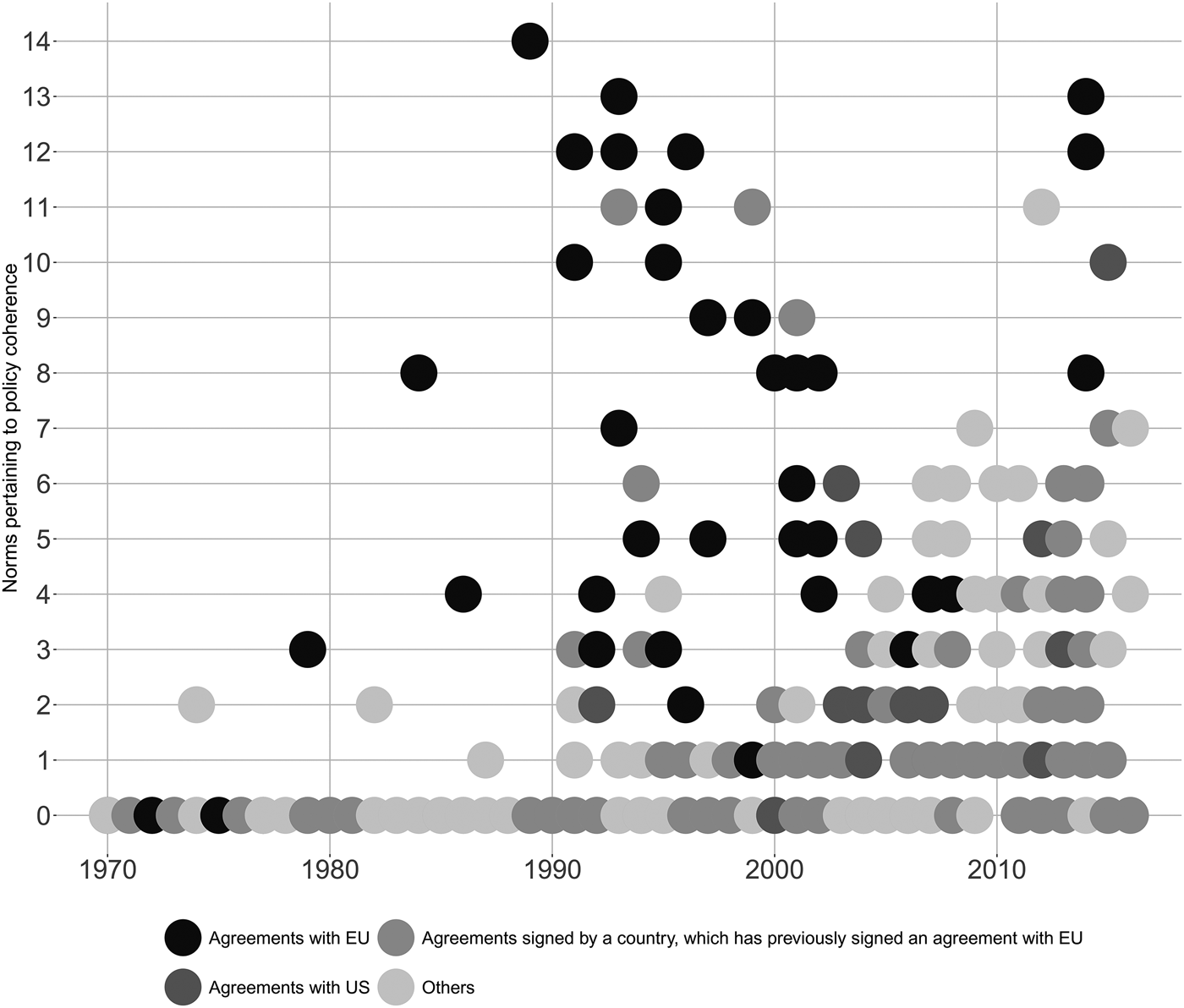
Figure 4 clearly illustrates the E.U. concern for policy coherence. Several European PTAs explicitly seek to achieve greater coherence between environmental protection and various specific economic sectors, such as agriculture, transport, urban development, mining, and tourism. This search for coherence between environmental and other specific policy fields is characteristic of European PTAs.
Number of clauses pertaining to policy coherence in PTAs.

The 2006 Renewed E.U. Sustainable Development Strategy explicitly states that the “E.U. should be working together with its trading partners to improve environmental and social standards and should use the full potential of trade or cooperation agreements at regional or bilateral level to this end.”Footnote 36 Although this policy document was only adopted in 2006, the idea of using PTAs as tools to promote sustainable development had already guided previous E.U. trade negotiations. As discussed in the next section, this European approach has also been integrated in the most recent American agreements.
3. A case of transatlantic policy convergence
American and European PTAs have developed very different approaches to environmental protection. While the United States has traditionally focused on the enforcement of domestic regulations and the participation of non-state actors, the European Union has relied instead on cooperation with its trade partners and coherence across policy fields.Footnote 37 However, American and European models are not static. They evolve incrementally and, over the time, American and European agreements have become increasingly similar. While important divergences remain, the European Union emulates U.S. provisions. In turn, the United States has adopted some of the features typical of E.U. agreements.
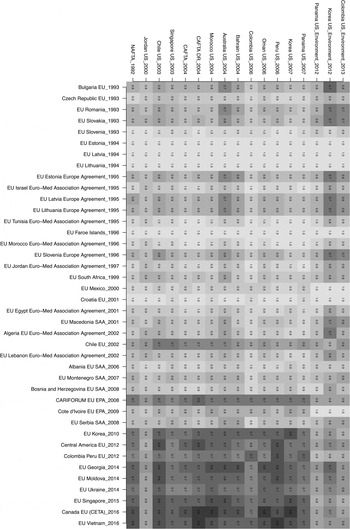
This convergence is shown in figure 5. European agreements are located on the x-axis and American agreements on the y-axis in chronological order. According to the Jaccard distance measures, the older European agreements display considerable disparity with American agreements, as illustrated by the light gray hue. On the contrary, environmental provisions found in European agreements since 2008 are similar to American agreements signed since 2003. This is shown by the lower distance measures in the darker gray color, which suggests a certain convergence between U.S. and E.U. agreements.
Convergence of U.S. and E.U. agreements.

3.1 The Europeanization of American agreements
Until 2006, the majority of American trade agreements only included a few detailed environmental clauses on specific issue areas. This changed in 2007 when the Democrats gained control of both the House and the Senate. The Republican administration then agreed to revise its trade policy and to strengthen the environmental clauses included in PTAs. As a result, the pending agreements, which had not yet been ratified by Congress, were slightly revised. The first revision occurred with the U.S.-Peru agreement. It included new environmental provisions, which the U.S. government qualified as “groundbreaking.”Footnote 38 It also made U.S. agreements more like European agreements.
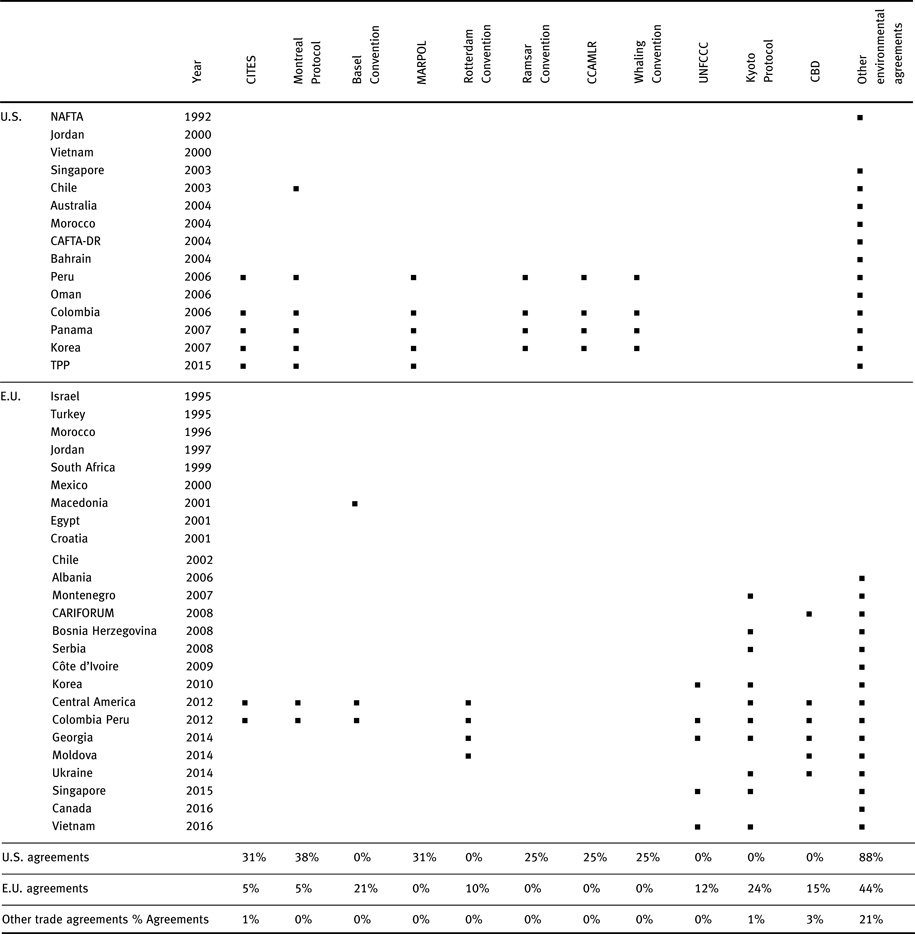
Notably, the U.S.-Peru agreement and subsequent agreements that were ratified under the new policy called for the implementation of a set of multilateral environmental agreements (see table 4). This requirement is subject to the same dispute settlement procedures as the main commercial provisions in the PTAs. In this way, the United States extended the tough legal stance, characteristic of trade law, to environmental agreements, which are known for their soft approach to managing non-conformity. The aim of including a selection of environmental agreements under the umbrella of a trade deal is primarily to diffuse U.S. environmental norms, rather than to create a level playing field. Historically, the United States has been an active proponent of many of these environmental agreements, although few of them actually raise any competitive trade issues.Footnote 39 The inclusion of the moratorium on whaling, for example, is not so much designed to level the playing field in the whaling industry, but to promote a social norm globally in order to encourage marine mammal protection, which has been a major public concern in the United States since the 1970s. As Jinnah and Lindsay observed, the U.S. government uses the links between PTAs and multilateral environmental agreements “as mechanisms to diffuse environmental norms abroad.”Footnote 40 This suggests that the United States uses its trade agreements to promote American environmental norms, a practice that was already common in E.U. agreements.
The distribution of selected clauses relating to the implementation of environmental agreements

The agreement between the United States and Peru is also the first U.S. agreement to include an eight-page long annex on forest governance that aims to fight illegal logging and the illegal trade in wildlife. The annex includes specific and prescriptive provisions, as well as clauses regarding criminal penalties, inventories, export quotas, producers’ audit, and chain of custody.Footnote 41 Similar provisions on forest governance can be found in some earlier European agreements.Footnote 42
The U.S-Peru agreement also includes an article devoted to biological diversity, which took many analysts by surprise. By signing the agreement, the parties “recognize the importance of respecting and preserving traditional knowledge and practices of indigenous and other communities that contribute to the conservation and sustainable use of biological diversity.”Footnote 43 In a side agreement, the parties also recognize the importance of obtaining informed consent before gaining access to genetic resources and of sharing the benefits derived from the use of traditional knowledge and genetic resources. It also implicitly recognizes the risk of the misappropriation of genetic resources by underlining the importance of the quality of patent application to ensure that the conditions of patentability are satisfied. After the notorious U.S. refusal to ratify the Convention on Biological Diversity, the inclusion of such norms and principles in the context of a trade agreement is significant. In comparison, the European Union has promoted the principle of benefit sharing with the genetic resource providers and traditional knowledge holders in numerous trade agreements.Footnote 44 This is a further example of a certain convergence between European and American agreements.
In its most recent agreements, the United States also included numerous provisions relating to capacity building, which appeared either in the chapter devoted to the environment or in a side agreement, a cooperation agreement or an annex. Although some previous American PTAs already included a clause on capacity building, they had less scope and fewer details on technical assistance, technology transfer, and funding assistance than the recent agreements. According to the U.S. government, the implementation of capacity-building commitments in the framework of the agreements with Oman, Morocco, Chili, and Peru led to the training of more than 8,200 people in natural resource management or biodiversity conservation. In addition, it led to the adoption of over 700 environmental policies, laws, or regulations; public awareness campaigns that reached more than 11,000,000 people; and to an improvement in natural resource management affecting a total area exceeding 30 million hectares.Footnote 45
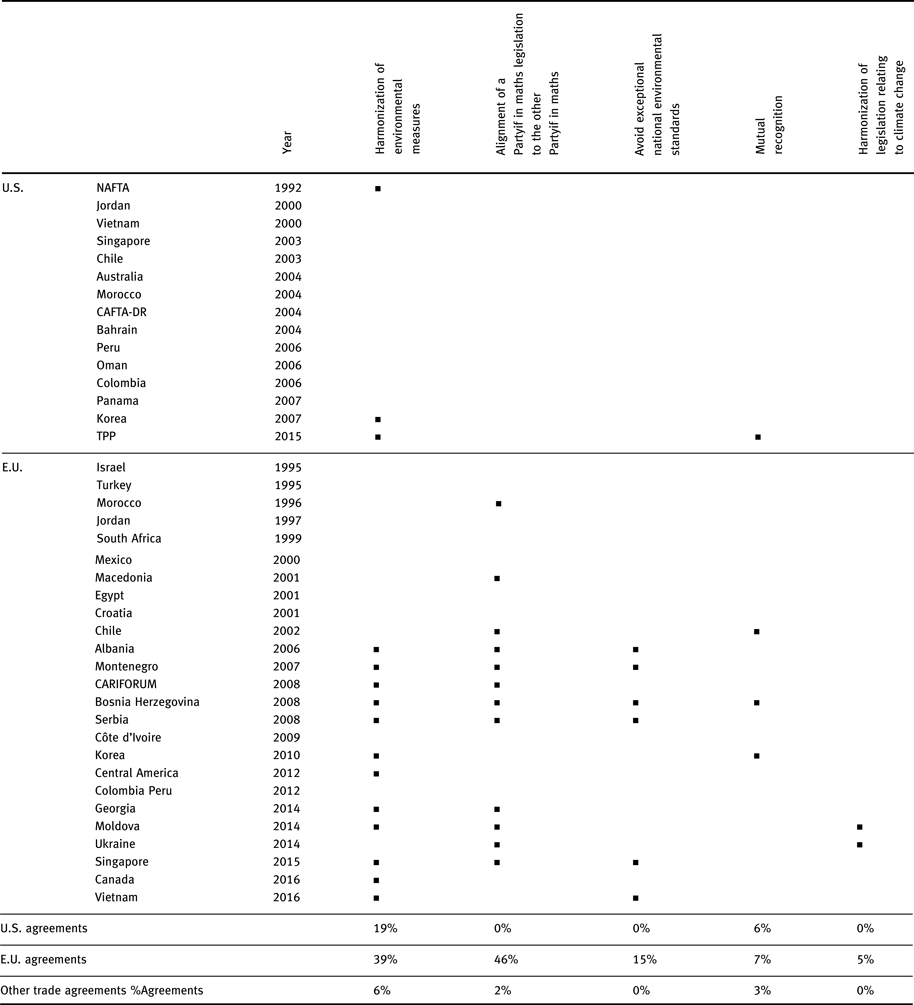
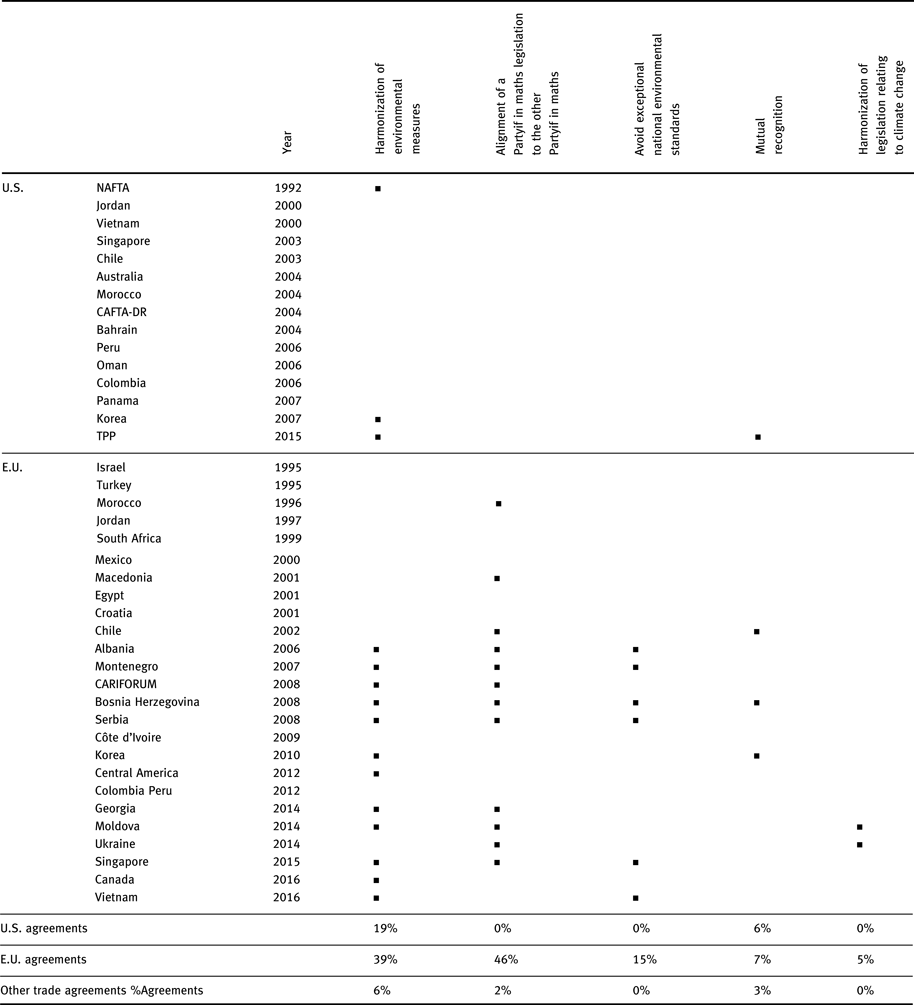
Since Korea is no longer considered as a developing country, the U.S.-Korea agreement does not provide for any commitment on capacity building and technology transfer. Nonetheless, the U.S.-Korea agreement is one of the first American PTAs to include a provision on regulatory harmonization in the environmental field. In the agreement, both parties seek to harmonize their standards for the safety and environmental performance of motor vehicles.Footnote 46 A similar provision can also be found in the TPP.Footnote 47 Until then, measures of this type relating to the harmonization of national standards were typically found in European agreements, as shown in table 5.
The distribution of selected clauses relating to environmental regulatory harmonization
The type of environmental provisions integrated in U.S. trade agreements since 2006 shows that the U.S. goals go beyond leveling the playing field and protecting American regulatory sovereignty. While these policy objectives remain, the United States is now also seeking to address specific environmental issues and achieve greater coherence, as has traditionally been the case for the European Union. Figure 3 shows that the United States is following the European model by increasingly addressing specific environmental issue areas in its recent PTAs. The TPP, for example, includes precise provisions on sustainable fisheries, the ozone layer, and the conservation of marine mammals.Footnote 48 Recent U.S. agreements also integrate several provisions relating to policy coherence, as shown in figure 4. The TPP, for example, indicates that it is essential to establish coherence between environmental policies and other policy areas, such as mining, urban development, and industrial activities.Footnote 49
These new concerns about specific environmental issues and policy coherence are clearly presented in the report Standing Up for the Environment: Trade for a Greener World published by the U.S. government in 2015. In this report, the U.S. government states that “environmental stewardship is a core American value […], and the Administration is committed to using trade policy as a tool to ensure economic growth and environmental protection go hand in hand.”Footnote 50 It adds that one of the objectives of the U.S. government in TPP negotiations is to “capitalize on the potential of trade agreements to increase levels of environmental protection, strengthen cooperative efforts to conserve living resources, and build capacity to address environmental challenges.”Footnote 51 While the United States has been a pioneer in the introduction of environmental clauses in trade agreements, this type of language was more typical of the European approach until recently.
3.2 The Americanization of European agreements
As the scope of U.S. agreements is extending to cover a larger array of provisions than before, E.U. agreements are gaining in depth, with more stringent enforcement provisions. Indeed, with the adoption of the Global Europe Strategy in 2006,Footnote 52 the European Union has developed a more American approach to trade negotiations. Until then, the majority of European PTAs was negotiated in the context of the E.U. neighborhood policy or with development objectives. Since 2006, however, the obvious stagnation of multilateral negotiations at the WTO spurred the E.U. to consider bilateral negotiations as an offensive tool that would primarily serve its own trade interests. Thus, the European Union sought to initiate bilateral talks with heavyweight economic partners and to conclude more ambitious agreements as a way of generating significant trade benefits. The stated goal was to build a more “comprehensive, integrated and forward-looking external trade policy that makes a stronger contribution to Europe's competitiveness.”Footnote 53 This competitiveness-driven approach resulted in the inclusion of environmental provisions designed to prevent environmental dumping, which has been one of the main U.S. objectives for more than twenty-five years.
In many ways, the agreement signed between the E.U. and Caribbean countries in 2008 represents a turning point. Since then, E.U. trade agreements have systematically included a chapter or a section devoted to the environment.Footnote 54 In this sense, the European Union has distanced itself from its traditional eclectic and inconsistent approach, which was adapted to the respective needs and interests of its individual trade partners. Instead, it now favors a more systematic approach with a standardized chapter, which evolves incrementally from one negotiation to the next.Footnote 55 While this is what the United States has been doing since NAFTA, the standardization of trade negotiations is relatively new for the European Union.
To design its template chapter on sustainable development, the European Union drew extensively on other countries’ experiences.Footnote 56 The 2007 OECD study Environment and Regional Trade Agreements Footnote 57 provided an important so urce of information. The study looks in detail at the negotiation and implementation of environmental provisions as set out in various trade agreements. Additionally, the European Union commissioned Jacques Bourgeois, Kamala Dawar, and Simon Evenett to conduct a study entitled A Comparative Analysis of Selected Provisions in Free Trade Agreements.Footnote 58 The study compares the environmental provisions of twenty-seven trade agreements. In these reports and in academic literature more broadly, the NAAEC is often presented as a normative breakthrough, which introduced some of the most innovative and stringent environmental norms with regard to the international trade regime of any trade agreements.Footnote 59 Therefore, these studies contributed to making U.S. agreements one of the sources of inspiration for the new generation of E.U. agreements.
In particular, the European Union was inspired by the U.S. agreements for the environmental aspects of investment protection. Until 2007 and the Treaty of Lisbon, foreign investment was not part of E.U. competences, and European trade agreements did not include a chapter on investment.Footnote 60 Even though European member states had been negotiating bilateral investment treaties for decades, the majority of the treaties did not include any environmental measures. The French, German, and British models of the bilateral investment treaty did not include environmental exceptions. This could be explained by the fact that, until recently, European countries had not faced controversial environmental disputes with foreign investors.Footnote 61 In contrast, NAFTA'S chapter 11 triggered several investor-state disputes relating to environmental measures, such as the Glamis Gold, Metalclad, Ethyl, Myers, Sun Belt, Methanex, Crompton, Clayton, St. Mary's VCNA, Windsteam, and Lone Pine cases.Footnote 62
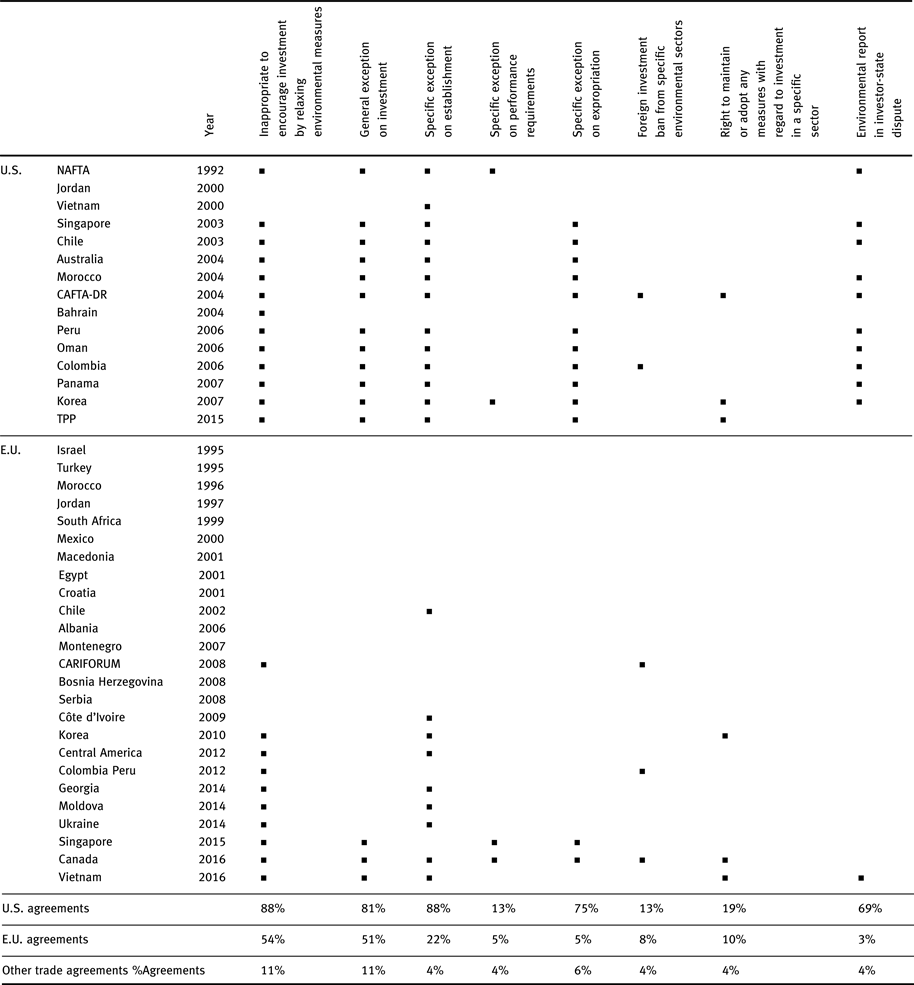
NAFTA already included an environmental exception in its investment chapter. The clause states that nothing “shall be construed to prevent a Party from adopting maintaining or enforcing any measure otherwise consistent with this Chapter that it considers appropriate to ensure that investment activity in its territory is undertaken in a manner sensitive to environmental concerns.”Footnote 63 It further states that the parties should not waive environmental measures to attract foreign investment.Footnote 64 In addition to these two clauses, other provisions relating to the environment were added following U.S. trade agreements, including a reference to multilateral environmental agreements, recognition of the parties’ right to exercise discretion with respect to environmental matters, and a definition of environmental law. There were a few controversial NAFTA cases where investors considered that they were entitled to compensation, claiming that environmental regulations had an impact equivalent to the expropriation of their businesses. Since 2003, U.S. negotiators have responded by systematically inserting an annex in their agreements to clarify that “except in rare circumstances […] non-discriminatory regulatory actions designed and applied to protect legitimate public welfare objectives, such as health, safety and the environment, do not constitute indirect expropriation.”Footnote 65
The European Union integrated some of these provisions in its recent agreements. European agreements signed after 2008 reproduce the commitment to uphold the level of environmental protection and the prohibition of waiving environmental laws to attract foreign investments. More recently, in its agreements with Canada and Singapore, the European Union also included a statement to clarify that measures designed for public welfare objectives do not constitute indirect expropriation. Thus, the lessons learnt from NAFTA and the safeguards designed by the United States to limit the risk of legal challenges generated by environmental regulations have influenced the European trade agreement template, as table 6 shows.
The distribution of selected environmental clauses relating to investment liberalization

The European Union borrowed an additional element from the United States, namely, the mechanism to ensure that the parties enforce their environmental laws. As illustrated in table 1, recent E.U. agreements incorporate this type of provision. In a manner similar to the NAAEC, European agreements signed after 2008 state that the parties should enforce their own environmental laws. State-state consultation could be initiated if a party considers that the other is failing to enforce its environmental laws effectively. The recent Canada-E.U. (CETA) agreement also reproduces a detailed provision from NAAEC regarding procedural guarantees to permit effective legal action against infringements of environmental law.Footnote 66
In recent agreements, the European Union has also duplicated some clauses relating to civil society participation, traditionally found in U.S. agreements (see table 2) in order to strengthen its trading partners’ level of environmental protection. Since the agreement with Caribbean countries in 2008, E.U. agreements provide that parties should consult stakeholders when introducing environmental measures. They also state that parties to recent E.U. agreements should set up a mechanism allowing stakeholders to submit views, request consultations or make recommendations on the implementation of the agreement's environmental obligations. The E.U.-Moldova agreement, for example, provide that “[e]ach Party shall convene new, or consult existing, domestic advisory groups on sustainable development with the task of advising on issues relating to this Chapter. Such groups may submit views or recommendations on the implementation of this Chapter.”Footnote 67 CETA also includes a provision, similar to a NAFTA provision adopted in 1992, stating that each party shall “ensure that its authorities competent to enforce environmental law give due consideration to alleged violations of environmental law brought to its attention by any interested persons […].”Footnote 68
As in the case of the United States at the time of NAFTA, the European Union does not merely strive actively to create a level playing field. It also has a defensive objective, namely, to protect its regulatory sovereignty against legal challenges. While environmental disputes are less frequent at the WTO, the European Union faced a number of complaints concerning sanitary and public health measures. The cases of beef hormones, GMO, and asbestos were a major challenge to the European precautionary approach. Moreover, several E.U. environmental regulations could be contested at the WTO in the near future. These include the European Union's electronic recycling requirements, its approval scheme for chemicals, its restrictions on foreign airlines’ greenhouse gas emissions, and its restriction of endocrine disrupting chemicals. By including additional safeguards in its bilateral trade agreements, the European Union can limit the potential for third parties to contest its regulations.Footnote 69 It also sends European citizens the reassuring signal that E.U. regulatory sovereignty is not on the negotiating table.
Accordingly, in its most recent agreements, the European Union has included a provision on the “right to regulate,” which is very similar to the one traditionally found in U.S. agreements. It recognizes that parties have the right to establish their own level of environmental protection and devise their own environmental priority. Moreover, in some of its agreements, the European Union has included a provision stating that “experts proposed as panelists shall comprise individuals with specialized knowledge or expertise in environmental law […],” a provision that is also found in some U.S. trade agreements post 2003.
In November 2015, the European Commission publicly presented a textual proposal for the TTIP's sustainable development chapter. Judging from the proposal, the European Commission seems keen to reproduce provisions on enforcement, transparency, civil society participation, and protection of regulatory sovereignty in the TTIP. The European Union has autonomously drawn lessons from the U.S. experience in the last decade and has not waited for the TTIP to incorporate these lessons in its trade agreements.
4. Conclusion
Although the United States and the European Union have traditionally promoted different environmental clauses in their respective PTAs, this article argues that by borrowing from each other, they are converging on a common model. U.S. agreements have integrated some features of earlier European agreements, such as provisions on technology transfer and detailed commitments on specific environmental issues. In parallel, recent European agreements have become more Americanized, with stricter enforcement rules, more provisions for public participation in decision-making, environmental safeguards on investment matters, and enhanced protection on regulatory sovereignty. Today, both the European Union and the United States use environmental provisions in PTAs for various purposes, such as to level the playing field with developing countries, shield their own environmental regulations from legal challenges, increase their policy coherence, and influence the environmental policies on the global agenda.
Mixing the traditional U.S. legalistic adversarial style with the cooperative sectorial approach, more commonly found in European agreements, may constitute a promising formula.Footnote 70 Far from being incompatible, these two approaches are complementary. When combined, they result in a set of environmental commitments that offer a broad scope and significant depth in terms of enforceability. Countries that sign these PTAs are encouraged to increase their level of environmental protection in a variety of domains and also to seriously enforce their environmental standards.
Of course, differences remain between the U.S. and E.U. approaches. First and foremost is the U.S. insistence on covering environmental provisions in the framework of the trade agreement's main dispute settlement mechanism. The Trade Promotion Authority, adopted in June 2015, sets out that environmental obligations should “be subject to the same dispute settlement and remedies as other enforceable obligations under the agreement.”Footnote 71 This contrasts sharply with European agreements. Even in the most recent European PTAs, disputes on environmental provisions are only subject to government consultations. However, a resolution adopted by the European Parliament recommends strengthening environmental measures by providing “recourse to a dispute settlement mechanism on an equal footing with the other parts of the agreement, with provision for fines to improve the situation in the sectors concerned, or at least a temporary suspension of certain trade benefits […].”Footnote 72
Given this convergence, U.S. and E.U. negotiators do not face insurmountable difficulties when it comes to reaching an agreement on a set of environmental provisions to be included in the TTIP. The U.S. and E.U. negotiators are cognizant of the environmental provisions that would be unacceptable for the other party. In fact, to avoid potential stumbling blocks, the most controversial environmental issues in the transatlantic relationship were carefully left out of the negotiation agenda. These include the trade in GMOs, chemical approval and climate change mitigation.
At the time of writing, TTIP negotiations are on ice due to the Trump administration's uncertain trade policy and transatlantic political frictions resulting from this uncertainty. Yet, assuming that U.S. and E.U. negotiators receive the mandate to reactivate negotiations and conclude TTIP, the most significant challenge they will face will not be finding a common technical ground but addressing the concerns of civil society groups. This is the irony of TTIP negotiations: while trade negotiators on both sides of the Atlantic have never been so in tune with each other on technical aspects, they have never been so politically out of sync with their own constituents. Numerous environmental groups have expressed their deep concerns on issues relating to the TTIP, including the risk of regulatory chill created by an investor-state dispute settlement mechanism and the additional CO2 emissions that could result from U.S. exports of crude oil and natural gas to the European Union. TTIP might be the greenest PTA ever concluded, with more specific detailed environmental provisions than any previous U.S. trade agreement. It might also be more enforceable in legal terms than any other European trade agreement. However, that may not suffice to reassure environmental groups.
This skepticism towards TTIP is shared among environmental groups on both sides of the Atlantic. A survey of position papers concerning the TTIP circulated by American and European groups suggests that there is “little discernible difference” between them.Footnote 73 They focus on the same environmental issues and put forward similar policy proposals. They also actively collaborate in transatlantic advocacy coalitions. This congruence contrasts with earlier U.S. and E.U. experiences, when developing countries’ civil society groups were opposed to environmental norms promoted by their American and European counterparts.Footnote 74
These trends—convergence among U.S. and E.U. negotiators and intense collaboration among stakeholders—point to the distinctive transnational dimension of TTIP negotiations.Footnote 75 The greatest divide in the TTIP negotiations is not the Atlantic divide but the one between the transnational network of negotiators, who are converging on a set of norms, and the transnational network of non-state actors, who increasingly distrust their own negotiators. This new divide might well constitute more of a challenge than traditional divisions. There is no doubt that current negotiating practices need to be adapted accordingly.