INTRODUCTION
A diagnosis of cancer and its subsequent treatment often create a crisis for patients (Caplan, Reference Caplan1974; Courtens et al., Reference Courtens, Stevens and Crebolder1996), as they are confronted with loss of bodily functions, emotional anguish, deteriorating physical conditions, and the threat of death (McCorkle & Quint-Benoliel, Reference McCorkle and Quint-Benoliel1983; de Haes & van Knippenberg, Reference de Haes and van Knippenberg1985). Weisman and Worden (Reference Weisman and Worden1976) described the heightened concerns about life and death experienced after a cancer diagnosis as existential plight. The sudden threat of not having a future may render patients vulnerable to a reduced quality of life (QoL) (Weisman & Worden, Reference Weisman and Worden1976; McCorkle & Quint-Benoliel, Reference McCorkle and Quint-Benoliel1983). When placed within a temporal frame, existential plight covers around 100 days (Weisman & Worden, Reference Weisman and Worden1976) and may last as long as 4 months after diagnosis depending on a host of individual and contextual factors (Weisman, Reference Weisman1979; Reference Weisman and Moos1984). Evidence from early and recent longitudinal studies raises questions about whether the impact of advanced cancer may require a longer period of adjustment due to the level of distress triggered and corresponding extended recovery time (McCorkle et al., Reference McCorkle, Benoliel and Donaldson1989; Rose et al., Reference Rose, Kypriotakis and Bowman2009).
Theoretical and empirical work supports the capacity of individuals to maintain their QoL after a diagnosis with life-threatening illness, as well as the notion that symptom distress, functional status, or general health perception are not always the best determinants of patient QoL (Wilson & Cleary, Reference Wilson and Cleary1995; Courtens et al., Reference Courtens, Stevens and Crebolder1996). More importantly, a growing body of literature points to a stable, moderate-to-strong relationship between spiritual well-being (SpWB) and QoL (Cohen et al., Reference Cohen, Mount and Strobel1995; Brady et al., Reference Brady, Peterman and Fitchett1999; Sawatzky et al., Reference Sawatzky, Ratner and Chiu2005; Visser et al., Reference Visser, Garssen and Vingerhoets2010), primarily contributed by the dimensions of Meaning and Peace (Brady et al., Reference Brady, Peterman and Fitchett1999; Salsman et al., Reference Salsman, Yost and West2011; Whitford & Olver, Reference Whitford and Olver2011; Lazenby et al., Reference Lazenby, Khatib and Al-Khair2013; Bai & Dixon, Reference Bai and Dixon2014).
There is not much literature that focuses on SpWB and QoL among patients newly diagnosed with advanced cancer, on whether patients' SpWB and QoL outcomes continue to improve 100 days after diagnosis, and on whether the pattern of associations remains the same as patients move further from the point of diagnosis. The aims of our study, which was conducted among a sample of patients newly diagnosed with advanced cancer who demonstrated existential plight at baseline, were threefold: (1) to assess whether patients' SpWB and QoL changed from one to three months post-baseline; (2) to describe the relationship between SpWB (as well as factors) and QoL (as well as domains) between one and three months post-baseline; and (3) to examine whether the relationship between SpWB (as well as factors) and QoL (as well as domains) changed between one and three months.
METHODS
Design and Sample
Our study was designed as a secondary data analysis of a cluster randomized controlled trial to evaluate the effects of a nursing intervention provided by clinic-based advanced practice nurses for adults newly diagnosed with advanced cancer undergoing treatment. Some 153 patients with head and neck, gastrointestinal, lung, or gynecological cancers were recruited from among four clinics at the Smilow Cancer Hospital at Yale–New Haven Hospital between 2010 and 2013. The data were collected primarily in face-to-face interviews held in the clinics at baseline (time 0) and at one (time 1) and three months post-baseline (time 2). A full description of the parent study is published elsewhere (Ercolano et al., Reference Ercolano, Bai and Lazenby2013). We limited our secondary analysis to the untreated (control) group to avoid a possible effect of the intervention on SpWB or QoL, or their interrelationship. Two timepoints (times 1 and 2) were available for analysis of SpWB and QoL.
Measures
At the baseline interview, emotional distress was measured using the Emotional Distress Thermometer (Jacobsen et al., Reference Jacobsen, Donovan and Trask2005). The number of medical diagnoses other than cancer was obtained from an adapted comorbidity checklist (Yancik et al., Reference Yancik, Havlik and Wesley1996). The demographic and clinical characteristics were collected using an investigator-developed form. Measures at one and three months post-baseline are described below.
The 12-item Functional Assessment of Chronic Illness Therapy–Spiritual Well-Being Scale (FACIT–Sp–12) (v. 4) assesses Meaning, Peace, and Faith independent of any religion or specific belief on a 5-point Likert-type scale (0 = “not at all”; 4 = “very much”) (Fitchett et al., Reference Fitchett, Peterman and Cella1996; Peterman et al., Reference Peterman, Fitchett and Brady2002). Total scores range from 0 to 48, with higher scores reflecting higher levels of SpWB. The factor pattern of the FACIT–Sp–12 was based on common factor analyses of the parent study data, which revealed three factors: Peace, Meaning, and Faith (Bai & Dixon, Reference Bai and Dixon2014). The Cronbach's alphas for the total scale and the three subscales were: 0.92 (total FACIT–Sp–12), 0.83 (Peace), 0.80 (Meaning), and 0.93 (Faith).
The Functional Assessment of Cancer Therapy–General (FACT–G) (v. 4) (Cella et al., Reference Cella, Tulsky and Gray1993) contains 27 items that are scored on a 5-point Likert-type scale and evaluate quality of life during the previous week. The total FACT–G score is calculated by summing all the items in the four subscales (physical, emotional, social/family, and functional well-being), with scores ranging from 0 to 108 and higher scores reflecting better overall QoL. The Cronbach's alphas for the total score and the four subscales were: 0.92 (total FACT–G), 0.85 (physical well-being), 0.84 (social/family well-being), 0.86 (emotional well-being), and 0.88 (functional well-being). The single-item Gf7 in the functional well-being subscale (“I am content with the quality of my life right now”) measures global QoL (Brady et al., Reference Brady, Peterman and Fitchett1999; Whitford & Olver, Reference Whitford and Olver2011; Lazenby et al., Reference Lazenby, Khatib and Al-Khair2013).
Statistical Analysis
Measures of central tendency and dispersion were employed to describe the data. The change in SpWB and QoL between one and three months post-baseline was analyzed using mixed-effect models controlling for length of time since the diagnosis at baseline. Spearman's rho was calculated to examine the bivariate relationship between QoL and SpWB at one and three months, respectively. Multiple linear regression models were created to determine the “uniqueness” (Nunnally & Bernstein, Reference Nunnally and Bernstein1994, p. 182) or unique contribution of SpWB, and Peace, Meaning and Faith in predicting QoL. Collinearity diagnostics were performed by means of variance inflation factors (VIFs) for each independent variable entered in the regression equations. Sample characteristics of participants who completed the study were compared with those who did not using chi-square tests. In all analyses, a p value of 0.05 or less was considered significant. Statistical analyses were performed using SAS software (v. 9.3).
RESULTS
Sample Characteristics
Of the 67 subjects assigned to the control condition, 15 were lost to follow-up due to: (1) death (n = 3), (2) rapidly worsened health that precluded continued participation (n = 4), and (3) unknown reasons (n = 8). Analyses revealed that these 15 participants did not differ significantly from the final sample in terms of any of the demographic or clinical variables at study entry (data not shown). This report was limited to the 52 patients assigned to the attention control group in the parent study with complete data at one and three months post-baseline.
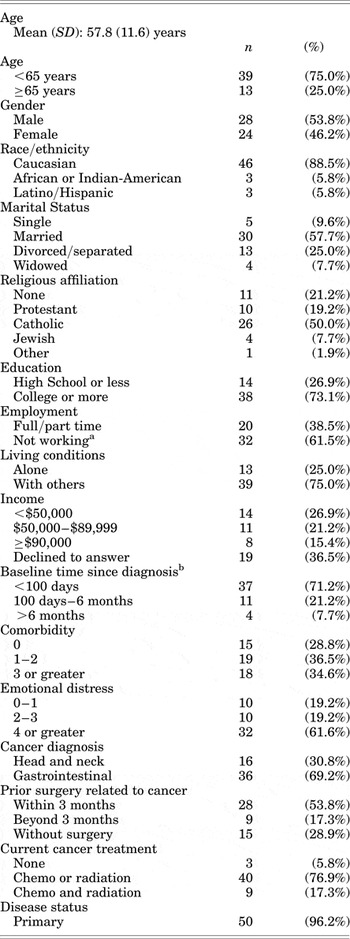
The mean age was 57.8 (SD = 11.6) years, with a range of 28–87 years. The majority were white, well-educated, and lived with others. Slightly more than a third of participants were working in full- or part-time jobs. Most patients (78.8%) indicated a religious affiliation. Some 96% of participants had a primary diagnosis of stage 3 or 4 head and neck or gastrointestinal cancer. The median time since diagnosis at each measurement timepoint was: 63 days at baseline (time 0), 112 days at one month (time 1), and 183 days at three months post-baseline (time 2) (Table 1). According to Weisman and Worden (Reference Weisman and Worden1976), the duration of existential plight is about 100 days after cancer diagnosis, so the data collected at times 1 and 2 were thus considered appropriate for this secondary analysis.
Demographic and clinical characteristics (N = 52)

aNot working includes retired (n=12), sick leave (n = 5), disabled (n = 6), unemployed (n = 6), homemaker (n = 2), and not indicated (n = 1).
bBaseline time since diagnosis: Mean (Median) = 84 (63) days. Emotional distress mean (SD): 4.23 (2.83).
One month post-baseline time since diagnosis: Mean (Median) = 129 (112) days. Three months post-baseline time since diagnosis: Mean (Median) = 213 (183) days.
Description of Outcomes and Tests of Changes
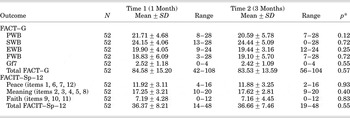
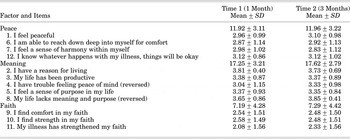
Outcome measures and tests of the changes between the two interviews at one and three months post-baseline are provided in Table 2. The score change of one item in the emotional well-being subscale of the FACT–G—“I worry that my condition will get worse”—was inversely related to the length of time since diagnosis at baseline (p = 0.003). After controlling for baseline time since diagnosis, no significant differences were found for the score change of SpWB or QoL outcomes from the one- to three-month assessments at scale, factor, or item levels. Table 3 shows individual items of the FACIT–Sp–12 by factors.
Description of outcomes at one and three months post-baseline

*The p value was obtained from mixed-effect models controlling for days since diagnosis at baseline. EWB = emotional well-being; FACIT–Sp–12 = 12-item Functional Assessment of Chronic Illness Therapy–Spiritual Well-Being Scale; FACT–G = Functional Assessment of Cancer Therapy–General (v. 4); FWB = functional well-being; Gf7 = “I am content with the quality of my life right now,” indicating global QoL; PWB = physical well-being; QoL = quality of life; SWB = social/family well-being. No significant difference was found for QoL or SpWB at scale or item levels from one to three months post-baseline controlling for length of time since diagnosis at baseline. The score change for one item (Ge6) in the emotional well-being subscale of the FACT–G, “I worry that my condition will get worse,” was inversely related to the length of time since diagnosis at baseline (p = 0.003).
Description of FACIT–Sp–12 items at one and three months post-baseline (N = 52)

FACIT–Sp–12 = 12-item Functional Assessment of Chronic Illness Therapy–Spiritual Well-Being Scale.
Please note that the factor pattern of the FACIT–Sp–12 is based on principal factor analysis, iterative principal factor analysis, and analysis via the method of maximum likelihood on data from the parent study (Bai & Dixon, Reference Bai and Dixon2014).
Associations Among Outcomes at 1 and 3 Months
Positive moderate-to-strong correlations were found between measures of QoL and SpWB, as well as among QoL and the Peace and Meaning factors at one and three months post-baseline. Faith positively correlated with QoL at one month (time 1); however, this relationship diminished and became insignificant at three months (time 2). In addition, an inverse relationship was observed between Faith and physical well-being at three months. (Table 4)
Bivariate correlations among outcome measures at one and three months post-baseline (Spearman) (N = 52)

*p<0.05, **p < 0.01, ***p < 0.001.
EWB = emotional well-being; FACIT–Sp–12 = 12-item Functional Assessment of Chronic Illness Therapy–Spiritual Well-Being Scale; FACT–G = Functional Assessment of Cancer Therapy–General (v. 4); FWB = functional well-being; Gf7 = “I am content with the quality of my life right now,” indicating global QoL; PWB = physical well-being; QoL = quality of life; SWB = social/family well-being.
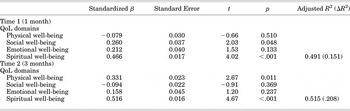
To determine the unique contributions of SpWB to QoL, a series of multiple regression procedures were utilized. As shown in Table 5, after controlling for physical, social/family, and emotional well-being, SpWB accounted for 15.1 and 20.8% of the unique variance of the one-item global QoL (Gf7) at one and three months, respectively. Similar procedures via hierarchical entry examined the effect of different factors of SpWB on QoL as measured by total FACT–G. Peace accounted for a greater proportion of variance of QoL at one month (ΔR 2 for Peace = 12.1%, p = 0.001, ΔR 2 for Meaning = 6.5%, p = 0.01). At three months, the proportion of variance of QoL accounted for by Meaning doubled, whereas the effect of Peace stayed about the same (ΔR2 for Peace = 11.8%, p = 0.001, ΔR2 for Meaning = 13.2%, p < 0.001). Faith did not show unique associations with QoL at either assessment timepoint.
General linear model on Gf7: “I am content with the quality of my life right now” (N = 52)

DISCUSSION
This study examined SpWB and QoL, as well as their interrelationship at the scale and factor levels in a sample of 52 patients newly diagnosed with advanced cancer undergoing treatment. We measured SpWB and QoL at 1 and 3 months post-baseline. No statistically significant difference was identified in SpWB or QoL between the 1- and 3-month post-baseline assessments after controlling for length of time since diagnosis at baseline. SpWB contributed high variance to QoL—more than physical or emotional well-being. Peace and Meaning demonstrated positive and unique associations with QoL at both timepoints, with the relative importance shifting over time. Faith was positively related to QoL at the one-month assessment; however, this effect was not retained at three months.
SpWB and QoL
SpWB scores measured by the FACIT–Sp–12 for general cancer patients reported in the literature show considerable fluctuations: from 28.34 (SD = 9.24) (Cotton et al., Reference Cotton, Levine and Fitzpatrick1999) to 38.5 (SD = 8.1) (Peterman et al., Reference Peterman, Fitchett and Brady2002). The range of QoL FACT–G scores reported in the literature ranges from 62.2 (SD = 16.8) (Wang et al., Reference Wang, Shen and Xu2011) to 89.41 (SD = 16.55) (Schultz & Winstead-Fry, Reference Schultz and Winstead-Fry2001). Compared with these ranges, participants in our sample reported a high degree of SpWB (time 1 mean = 36.37, SD = 8.21; time 2 mean = 36.66, SD = 7.46) and overall QoL (time 1 mean = 84.58, SD = 15.20; time 2 mean = 83.53, SD = 13.59) at both one and three months. Considering the high baseline emotional distress (time 0 mean = 4.23, SD = 2.83) for this sample, it is possible that the initial SpWB and QoL scores were low and that the outcomes demonstrated an improvement at one and three months post-baseline, which were 112 and 183 days since cancer diagnosis (median value), respectively. This result is in line with the approximately 100-day duration Weisman and Worden (Reference Weisman and Worden1976) postulated for existential plight.
Change of SpWB and QoL over Time
Among investigations that examined patients' psychosocial outcomes during the initial stage of the cancer trajectory, McCorkle and Quint-Benoliel (Reference McCorkle and Quint-Benoliel1983) were the first to provide empirical evidence supporting the significance of existential plight. They followed 56 lung cancer patients at diagnosis and three months later. Although symptom distress remained about the same over time, significantly fewer concerns and better mood were reported at the second interview. McCorkle and Quint-Benoliel concluded that patients were able to psychologically assimilate the threat of cancer; and even though symptoms remained constant, their emotional distress decreased as time elapsed from the day of diagnosis from the first interview to the second interview. Our study lends support to these findings.
One recent study (Rose et al., Reference Rose, Kypriotakis and Bowman2009) following 142 patients newly diagnosed with advanced cancer every three months from diagnosis to one year post-diagnosis revealed that mood status did not return to normal until six months post-diagnosis. Researchers reported continued improvement of depression and anxiety from baseline to six months afterwards, although SpWB remained stable throughout the 12-month observation.
In our sample, given the high level of anxiety as reported on the Emotional Distress Thermometer and problem list at baseline, patients seemed to have improved from baseline to one month post-baseline; however, SpWB and QoL outcomes remained stable from one to three months post-baseline. It is unclear whether these results were influenced by the additional resources available to patients in the control condition, including interdisciplinary team clinical care and the use of a symptom management toolkit provided for all participants.
Associations Between Overall SpWB and QoL
Another primary purpose of our study was to examine the interrelationship between SpWB and QoL, at the scale and factor levels, and whether these associations changed over time. The importance of SpWB and the Peace and Meaning factors of the FACIT–Sp–12 was supported at both one and three months post-baseline. Of note, SpWB was the best predictor of the one-item measure of QoL—more than physical well-being, emotional well-being, and social well-being at both timepoints. In the cancer literature, physical well-being and emotional well-being have been given more weight than SpWB when it comes to quality of life (Cella & Tulsky, Reference Cella and Tulsky1993; Cella et al., Reference Cella, Tulsky and Gray1993). Although previous studies have demonstrated Meaning/Peace (one factor) accounting for more variance than the other QoL domains (Brady et al., Reference Brady, Peterman and Fitchett1999), there is a lack of evidence to support overall SpWB as a dimension equally important as physical or emotional well-being (Brady et al., Reference Brady, Peterman and Fitchett1999; Whitford & Olver, Reference Whitford, Olver and Peterson2008).
Whitford and colleagues (Reference Whitford and Olver2011), in a sample of 999 newly diagnosed cancer patients of primarily Australian origin, found that SpWB accounted for a unique 6.9% of the variance on the one-item QoL measure. Similarly, in a study with 205 predominantly Muslim cancer patients in Jordan, Lazenby and colleagues (Reference Lazenby, Khatib and Al-Khair2013) reported a 7.1% unique contribution of SpWB to global QoL. Our study revealed a stronger effect of SpWB at both one and three months post-baseline (15.1 and 20.8%, respectively) after controlling for the same QoL domains. These findings may be partly related to the homogeneous advanced cancer stage of our sample, the closeness in time to the cancer diagnosis, or a combination of the two.
Associations Between Factors of SpWB and QoL
Associations Between the Peace and Meaning Factors and QoL
Peace accounted for more variance of QoL at an earlier stage after a cancer diagnosis; however, Meaning accounted for more variance of QoL as patients moved further from time of diagnosis, with the effect doubling at three months post-baseline. This finding suggests that being able to accept situations that cannot be changed (Roberts & Fitzgerald, Reference Roberts and Fitzgerald1991) may be of primary importance for maintaining a person's QoL during the initial phase of existential plight and that it may take time to construe positive Meaning from their cancer experience. This process may be difficult, particularly for those patients whose cancer progresses.
Association Between Faith and QoL
Much contention surrounds Faith and its relationship with QoL. Mixed evidence exists for positive (Brady et al., Reference Brady, Peterman and Fitchett1999; Lazenby et al., Reference Lazenby, Khatib and Al-Khair2013), negative (Canada et al., Reference Canada, Murphy and Fitchett2008; Edmondson et al., Reference Edmondson, Park and Blank2008), no effect (Edmondson et al., Reference Edmondson, Park and Blank2008; Salsman et al., Reference Salsman, Yost and West2011; Bai & Dixon, Reference Bai and Dixon2014), or an interaction between Faith and Meaning/Peace on QoL (Yanez et al., Reference Yanez, Edomondson and Stanton2009; Zavala et al., Reference Zavala, Maliski and Kwan2009). Faith in our study showed significant positive associations with QoL at one month post-baseline; however, this pattern of relationship did not repeat at three months, when Faith was found to be only inversely correlated with physical well-being.
This inverse correlation between Faith and physical well-being has not been observed previously, although overall spiritual well-being (Lazenby & Khatib, Reference Lazenby and Khatib2012) or Peace (Lazenby et al., Reference Lazenby, Khatib and Al-Khair2013) has been found to be inversely related to physical well-being in two previous studies with predominantly Muslim cancer patients. Multiple pathways might explain the unexpected relationship between Faith and physical well-being. Perhaps people with a high physical pain burden and discomfort may find great comfort in their faith in the face of seemingly uncontrollable stress. Alternatively, people who rely on religious coping alone to overcome obstacles and difficulties may focus more on the physical pain. Due to the descriptive nature of our study, we are not able to determine the direction of these associations.
CLINICAL AND RESEARCH IMPLICATIONS
This study enhances our understanding of spiritual well-being as a multidimensional construct. The relationship between SpWB or its factors and QoL does not establish the direction of causality; however, it does pave the way to integrating the Peace and Meaning dimensions into separate assessments of QoL, and poses new challenges for clinicians to identify approaches that can lead to outcomes indicated by Peace and Meaning. Breitbart and colleagues have demonstrated individual meaning-centered psychotherapy as a promising approach to enhancing QoL and SpWB for patients with advanced cancer through assisting patients in sustaining or enhancing a sense of meaning and purpose in their lives (Breitbart et al., Reference Breitbart, Poppito and Rosenfeld2012). Previous theoretical work has also suggested that a sense of peace may offer a perspective that enables individuals to reinterpret their perception of the environment and be content with their circumstances (Roberts & Fitzgerald, Reference Roberts and Fitzgerald1991; Roberts & Messenger, Reference Roberts and Messenger1993); however, Peace is largely dismissed in clinical healthcare and study outcomes. Clinicians whose interventions are intended to improve QoL for people newly diagnosed with advanced cancer might consider including Peace as a primary clinical endpoint to be assessed individually or collectively with other QoL outcomes. In contrast, the positive effect of Faith on QoL does not hold in the multivariate context, which implies that Faith may not be appropriate to be addressed in isolation from a patient's sense of Meaning and Peace.
LIMITATIONS
Our study has several limitations. First, the data available for the purpose of this secondary analysis were limited to timepoints one and three months post-baseline. It would have helped to clarify the expected changes during existential plight if baseline SpWB and QoL data had been collected. Second, the small sample size limited the statistical power of our analyses as well as the generalizability of our findings, so that any conclusions should be regarded as tentative. Also, the additional resources provided to the attention control group in our sample may have masked a possible extended period of existential plight for people with advanced cancer. Finally, our report reflects the psychosocial status of a largely homogenous sample of newly diagnosed advanced cancer patients, and it is unclear to what extent our results are generalizable to other subgroups of the cancer population.
CONCLUSIONS
This study underscores the significance of SpWB for people newly diagnosed with advanced cancer and highlights the relative importance of Peace and Meaning, which may shift over time. Our results confirm that patients newly diagnosed with advanced cancer experienced an existential crisis, improved, and then stabilized over time. Our findings also support the notion that SpWB cannot be reduced to emotional well-being (Koenig, Reference Koenig2008). To our knowledge, this is the first study that longitudinally examined associations among SpWB and its Peace, Meaning, and Faith factors and QoL for people newly diagnosed with advanced cancer. Future studies are needed that would follow a larger sample of patients over a longer period of time to determine the association between SpWB and QoL, as well as the patterns of change within this population.
ACKNOWLEDGMENTS
This study was funded by the National Institutes of Health (NIH) and the National Institutes of Nursing Research (NINR) (1R01NR011872, R. McCorkle, PI).