Healthcare workers (HCW) are exposed to several infectious diseases transmitted from humans to humans, in particular to airborne diseases.Reference Sehulster and Chinn 1 Administrative, engineering, and personal protective measures have all been shown to reduce the risk of transmission of these diseases to HCW and both the World Health Organization and the Centers for Diseases Control and Prevention have published clear guidelines to protect HCW from tuberculosis and flu, for example.Reference Sehulster and Chinn 1 , Reference Jensen, Lambert, Iademarco and Ridzon 2 However, exposure to Mycobacterium leprae is not considered an occupational hazard. Despite its airborne transmission, there are no studies (to our knowledge) comparing the prevalence of M. leprae infection or leprosy in HCW and the general population that could indicate this risk.
In the present study, we aimed to evaluate the prevalence of M. leprae infection among HCW in 4 hospitals in Manaus, capital of the Amazon state, and its associated factors.
METHODS
A serologic survey was conducted from October 1, 2012, through June 30, 2013, in 4 teaching/research hospitals in Manaus city, which had a leprosy prevalence rate in 2012 of 2.12 cases/10,000 inhabitants.Reference Matta 3 The inclusion criterion was working for at least 2 years at the institution. The sample size (278) was calculated to show an 18.5% difference (2.5 odds ratio) between prevalence in HCW exposed or not exposed to leprosy patients (1:4 exposure rate), with an 80% power and a 95% CI, assuming a 20% prevalence of anti-PGL-I seropositivity in the nonexposed HCW. With the expectation of a 30%–40% refusal rate, 390 HCW (nurses, physicians, nurse technicians, and nurse aids, stratified by hospital and professional category) were randomly selected.
After signing an informed consent, participants answered an interviewer-applied questionnaire to provide information on sociodemographic characteristics, eating habits (bovine meat and dairy), occupation, exposure to leprosy patients in and outside the workplace, and having an autoimmune disease.
M. leprae infection or exposure was evaluated using an enzyme-linked immunosorbent assay (ELISA) and a rapid immunochromatography test, to detect IgM antibodies to PGL-I antigen, NT-P-HSA, and NT-P-BSA. Five microliters of whole blood were collected by a pinprick digital puncture and immediately processed for a rapid result using the ML Flow test.Reference Bührer-Sékula, Smits and Gussenhoven 4
An additional 30 μL of blood was collected in filter paper for an ELISA in-house test, using HSA as antigen-carrier, because studies have reported the presence of anti-BSA antibodies in the serum of healthy individuals and in patients with liver disease, autoimmune diseases, diabetes mellitus, or milk allergy.Reference Sjöwall, Kastbom, Almroth, Wetterö and Skogh 5 Both tests have been validated in previous studies.Reference Bührer-Sékula, Smits and Gussenhoven 4 , Reference Moura, Penna and Fujiwara 6
Proportions and their 95% CIs were compared using the Pearson χ2 test. The association between independent variables and the outcome (M. leprae infection or exposure) was measured using the odds ratio, and significance levels were established at.05.
The study was approved by the ethical review board of Fundação de Medicina Tropical Heitor Vieira Dourado (process 2091/2012). All participants signed an informed consent form.
RESULTS
Of the 390 randomized HCW, 73 (18.7%) refused to participate and 37 (9.5%) were not working at the institution (reasons to refuse participation were maternity leave or transfer to other healthcare facility). The remaining 280 (71.8%) were included. The 2 groups were comparable regarding sex, occupation, and institution, but those who refused were significantly older (P<.001).
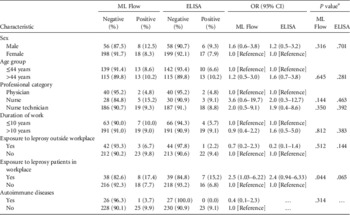
The ML Flow rapid test was positive in 9.3% (95% CI, 5.9%–12.7%) of participants and ELISA was positive in 8.2% (5.0%–11.5%). Factors associated with a positive result for each test are displayed in Table 1. None of the professional categories (physician, nurse, or nurse technician) was associated with a positive serologic test for leprosy. Moreover, combining groups that may have similar exposure levels to M. leprae (nurse and nurse technician) did not increase the statistical power (data not shown).
Factors Associated With Positive Anti-PGL-I IgM Serology by ML Flow Rapid Test and ELISA for Anti-PGL-I Mycobacterium leprae Antigen Among 280 Healthcare Workers From Manaus, Amazonas, October 1, 2012–June 30, 2013

NOTE. ELISA, enzyme-linked immunosorbent assay; IgM, immunoglobulin M; ML, M. leprae.
a By Pearson χ2 test.
Exposure to leprosy patients in the workplace but not outside the workplace was significantly associated with a 2.5 increase (95% CI, 1.03–6.22) in the odds ratio of M. leprae infection or exposure using the ML Flow test (P=.044). A similar OR (2.4 [95% CI, 0.94–6.33]) was observed using the ELISA; however, this association was not significant (P=.065). No statistical significant difference was seen regarding the participating institutions, the consumption of bovine meat, or dairy ingestion.
DISCUSSION
To assess the occupational risk for HCW across job categories we used ELISA and a rapid test as a marker of infection or exposure to M. leprae. When we compared the results of seropositivity among HCW who reported previous work with leprosy patients with the results of the group who did not, a significant statistical difference was found for the ML Flow test, suggesting that there is an occupational risk. Our results are different from the findings by Calado et al,Reference Calado, Magnanini, de Moura, Gallo, Bührer-Sékula and de Oliveira 7 who did not observe a difference related to exposure in the workplace. No significant differences were found relating to the length of time employed (>10 years vs ≤10 years) or exposure to leprosy outside the workplace.
Among the 280 HCW evaluated, 26 (9.3%) were positive in the ML Flow test and 23 (8.2%) were positive for the ELISA assay. Using the ML Flow test, a study with HCW from 3 Brazilian states (Rio de Janeiro/RJ, Mato Grosso do Sul/MS, and Rio Grande do Sul/RS), reported a seropositivity of 10.8%, 16.0%, and 21.8%, respectively. Methodologic differences in our recruitment strategy may have influenced the results. Our study randomly selected HCW and Calado et alReference Calado, Magnanini, de Moura, Gallo, Bührer-Sékula and de Oliveira 7 used the snowball sampling technique, which may have introduced a bias in the study. Another possible explanation could be the dietary habits, such as the consumption of bovine meat, leading to unspecific bindings in serologic tests due to the presence of anti-BSA antibodies. In Amazonas state, the regional habit of fish rather than meat consumption could have influenced the lower seropositivity found, compared with the results found in the Rio Grande do Sul state, where the consumption of bovine meat is higher.Reference Souza A de, Pereira, Yokoo, Levy and Sichieri 8
Although there was a lower seropositivity with ELISA using HSA as the carrier, compared with ML Flow using BSA, there was not statistical difference. These results are in agreement with another recent study comparing HSA and BSA as the antigen carriers.Reference Moura, Penna and Fujiwara 6
A better understanding of the transmission, the epidemiology, and the features that lead to the development of leprosy is important to disease control. M. leprae infection is more prevalent than the disease, but subclinical infection and its role in transmission and disease development are not completely understood. We cannot exclude the possibility that the socioeconomic status may also be a determinant of professional risk, although casual high exposure in the general population outside the workplace may also play a role, especially in hyperendemic regions such as the study area. The social contacts within the neighborhood, village, or urban ward also appear to be important transmission sources.Reference Feenstra, Nahar, Pahan, Oskam and Richardus 9 Additionally, the force of infection in highly endemic areas shows no difference in the detection rate between household and neighbors' contacts.Reference Moura, Dupnik and Sampaio 10 Furthermore, the stigma associated with leprosy makes the relationship between new cases and the index case often difficult to acknowledge.
To our knowledge, this is the first study that associates leprosy with an occupational hazard by higher seropositivity observed among HCW with previous contact with leprosy patients. However, to scientifically supply evidence of the actual risk of leprosy development among HCW, it will be necessary to develop a longitudinal study to evaluate whether the infection or exposure by M. leprae eventually results in overt disease.
ACKNOWLEDGMENTS
We thank Tsuyoshi Fujiwara, MD, for providing the antigen.
Financial support. Foundation for Research Support of the State of Amazonas and the National Council for Scientific and Technological Development.
Potential conflicts of interest. All authors report no conflicts of interest relevant to this article.