


INTRODUCTION
Formulaic language, long regarded as a peripheral phenomenon, is now considered an essential aspect of second/foreign (L2) vocabulary acquisition (Schmitt, Reference Schmitt2010). SLA research has seen a large increase in studies examining the acquisition of formulaic sequences (FS) and collocations in particular (see Boers & Lindstromberg, Reference Boers and Lindstromberg2012 for an overview). Studies have demonstrated that FS can be learned through explicit learning activities (e.g., Boers, Demecheleer, Coxhead, & Webb, Reference Boers, Demecheleer, Coxhead and Webb2014; Peters, Reference Peters2014, Reference Peters2016; Webb & Kagimoto, Reference Webb and Kagimoto2011). However, given that time spent on teaching vocabulary in the classroom is limited, the question arises whether FS can be learned incidentally from meaningful L2 input (reading, listening, TV viewing).
Most studies that have examined the incidental learning of FS have focused on reading (Pellicer-Sánchez, Reference Pellicer-Sánchez2017; Szudarski, Reference Szudarski2012; Szudarski & Carter, Reference Szudarski and Carter2016) or reading-while-listening (Webb, Newton, & Chang, Reference Webb, Newton and Chang2013). However, one type of input that has recently received increased attention in studies on incidental vocabulary acquisition is television. There is empirical evidence that TV viewing is an effective way of learning L2 vocabulary (e.g., Peters & Webb, Reference Peters and Webb2018). Yet, research into the potential of TV viewing for FS is limited (Puimège & Peters, Reference Puimège and Peters2019a), even though television has been shown to be a rich source of formulaic language (Lin, Reference Lin2014). At present, it remains unclear whether learners can pick up FS while watching a TV program. The present study aims to investigate incidental learning of FS through TV viewing, and which item-related and learner-related variables might mediate the learning of FS.
BACKGROUND
INCIDENTAL VOCABULARY ACQUISITION THROUGH TV VIEWING
There is growing evidence that exposure to authentic input plays an important role in L2 learning (e.g., Lindgren & Muñoz, Reference Lindgren and Muñoz2013; Peters, 2018). Exposure to the L2 through reading, listening to music, video games, and TV viewing has been shown to benefit learners’ L2 proficiency and vocabulary knowledge (e.g., Lindgren & Muñoz, Reference Lindgren and Muñoz2013; Peters, 2018; Peters et al., 2019; Puimège & Peters, Reference Puimège and Peters2019b). One of the most common and influential types of L2 input is television. Lindgren and Muñoz (Reference Lindgren and Muñoz2013) found that TV viewing had a greater influence on reading and listening proficiency in young learners than other types of out-of-class exposure. Similarly, Peters (2018) found that watching television without subtitles was one of the most important predictors of vocabulary knowledge in secondary-school and university level learners.
Activities such as reading and TV viewing, in which the main focus is not on vocabulary acquisition, can be considered incidental learning activities (Schmitt, Reference Schmitt2010). Following previous research (e.g., Hulstijn, 2003; Nation & Webb, Reference Nation and Webb2011), the present study operationalizes incidental learning in terms of test announcement. A learning task is considered incidental when learners are not instructed to pay attention to vocabulary items or forewarned of a vocabulary test (for a thorough discussion, see Hulstijn, 2003). Research has demonstrated that single words can be acquired incidentally through TV viewing (Feng & Webb, 2019; Peters & Webb, Reference Peters and Webb2018; Rodgers & Webb, Reference Rodgers and Webb2019). Peters and Webb (Reference Peters and Webb2018) investigated incidental vocabulary learning from a single episode of a TV program. They performed two experiments in which participants watched a one-hour documentary. Learning gains were measured using a form recognition and meaning recall test in the first experiment, and a meaning recognition test in the second experiment. In both experiments, approximately four words were learned between the pre- and posttests.
In Rodgers and Webb’s (2019) study, Japanese EFL learners watched 10 episodes of an English-language TV program, with a total viewing time of 7 hours. Fifty-six target words were tested before and after the experiment. The learning gains of the experimental group were significantly higher than those of the control group, who only completed the tests. Moreover, a medium-sized correlation was found between frequency of occurrences of the target items and learning gains, showing the importance of frequency in incidental vocabulary learning.
Taken together, these studies show that TV viewing may result in incidental acquisition of single words. Further, it was found that factors that affect learning include exposure frequency, cognateness, and learners’ prior vocabulary knowledge (Feng & Webb, 2019; Peters & Webb, Reference Peters and Webb2018; Rodgers & Webb, Reference Rodgers and Webb2019). However, not much is known about the potential of TV viewing for acquiring formulaic language.
LEARNING FORMULAIC SEQUENCES FROM INPUT
There are two approaches to the study of formulaic language: the phraseological approach (Granger & Paquot, Reference Granger, Paquot, Granger and Meunier2008; Nesselhauf, Reference Nesselhauf2005) and the distributional or frequency-based approach (e.g., Biber, 2009). For the purposes of this study, we adopt a definition of FS that combines both approaches. FS are defined as conventionalized and recurring word combinations (e.g., Van Lancker Sidtis, Reference Van Lancker Sidtis2012), varying in length, frequency, semantic transparency, contiguity, and flexibility (Siyanova-Chanturia & Pellicer-Sánchez, Reference Siyanova-Chanturia and Pellicer-Sánchez2019).
FS are widespread in language (e.g., Erman & Warren, Reference Erman and Warren2000) and fulfill many communicative functions (Schmitt, Reference Schmitt2010). Knowledge of FS has been shown to benefit language processing in both native speakers and L2 learners (e.g., Reference Siyanova-Chanturia and MartinezSiyanova-Chanturia & Martinez, 2015; Underwood, Schmitt, & Galpin, Reference Underwood, Schmitt, Galpin and Schmitt2004). The use of FS has also been found to be a key predictor of L2 writing and speaking proficiency (Boers et al., Reference Boers, Demecheleer, Coxhead and Webb2014; Crossley, Salsbury, & McNamara, Reference Crossley, Salsbury and McNamara2015; Paquot, Reference Paquot2017). As such, knowledge of FS is considered to play a crucial role in attaining nativelike L2 proficiency. However, mastery of formulaic language has been shown to be a major challenge to L2 learners, particularly in terms of productive use. Compared to native speakers, learners make use of a smaller range of FS (e.g., Laufer & Waldman, Reference Laufer and Waldman2011). They also tend to make many mistakes, often L1 induced, leading to their speech and writing being perceived as unnatural and nonnativelike (e.g., Laufer & Waldman, Reference Laufer and Waldman2011; Nesselhauf, Reference Nesselhauf2005).
A reason why formulaic language tends to be problematic for L2 learners is the low frequency of individual FS in language. Compared to their single-word components, many FS have a very low occurrence rate and are therefore less likely to be encountered in L2 input than single words (Bahns & Eldaw, Reference Bahns and Eldaw1993). The amount of exposure needed for incidental learning of FS is thus much higher than for the single words they are made up of (Webb et al., Reference Webb, Newton and Chang2013). Because learners do not have access to the same amount of L2 input as native speakers, and the opportunities for encountering FS during reading and listening are limited (Cobb, Reference Cobb2007), some researchers have suggested that FS need to be taught explicitly (Boers & Lindstromberg, Reference Boers and Lindstromberg2012). However, as Webb et al., (Reference Webb, Newton and Chang2013) argue, there is simply not enough time to teach all FS in the classroom. It thus seems warranted to also investigate the potential of exposure to L2 input and the learning gains that can be made in an incidental context.
Evidence for the potential of reading for learning FS incidentally is inconclusive. Szudarski (Reference Szudarski2012) investigated the acquisition of verb-noun collocations from reading. Two experimental groups read a text containing target collocations. The first group only read the text, while the second group also completed form-focused activities. On average between 7% and 14% of collocations were learned in the reading-only group. No significant difference in learning gains was found between the reading-only group and a control group (which only completed the vocabulary tests), indicating that reading only did not lead to considerable improvement in collocational knowledge. However, the items targeted included verb-noun collocations containing delexicalized verbs such as take office and do damage, which have been shown to be particularly difficult for L2 learners (e.g., Peters, Reference Peters2016).
In a highly controlled study, Pellicer-Sánchez (Reference Pellicer-Sánchez2017) focused on the learning of adjective - pseudo-noun collocations for five word knowledge aspects when EFL learners read a story. Learning gains were found for all aspects of knowledge, but were higher for receptive knowledge (3.20 out of 6 words on average) than for productive knowledge (.90 out of 6 words) of collocations. In three case studies, Macis (Reference Macis2018) investigated the learning of “duplex collocations,” or collocations that have both a figurative and a literal meaning such as drop the ball and hit the roof, through reading a modified novel. In individual interviews, three participants were asked to recall the meaning(s) of the target collocations before and after they read the novel. Between 20 and 44 percent of target collocations (n = 76) were learned between the pretest and the delayed posttest administered 3 weeks after the participants had read the novel.
One study has investigated the learning of FS through reading-while-listening. In Webb, Newton, and Chang’s study (2013), EFL learners read and listened to four modified versions of a graded reader, each including a different number of occurrences of 18 verb-noun collocations. The results showed that learners were able to pick up receptive and productive knowledge of the form and meaning of the collocations. The lowest posttest scores were found in a productive form test for items encountered once (M = .60 out of 18 items), and the highest scores were found in a receptive form test for items encountered 15 times (M = 15.58 out of 18 items).
There is reason to believe that collocations and other types of FS can also be acquired from watching L2 television. Corpus research has shown that formulaic language is ubiquitous in spoken language (e.g., Erman & Warren, Reference Erman and Warren2000), and that the distribution of formulaic language in television is similar to that in everyday speech (Lin, Reference Lin2014). Television might therefore be expected to give adequate exposure to L2 FS for incidental learning. Only one study (as far as we know) has addressed the incidental learning of FS from watching nonsubtitled television. In an exploratory study, Puimège and Peters (Reference Puimège and Peters2019a) investigated the potential of TV viewing for learning single words and FS. Twenty intermediate to high-proficiency EFL learners watched a 20-minute episode of an English-language TV program. Learning gains were found for both single words and FS. In the form recall test, 2 out of 15 single words and 3.95 out of 20 FS were learned on average. These gains were slightly higher than in the meaning recall test (M = 1.05 for single words, M = 2.4 for FS), but the latter was not further analyzed because of a potential test effect. Given the limited sample size and the limited number of FS (n = 20) tested, more research into the effect of TV viewing on learning FS is warranted.
FACTORS AFFECTING THE LEARNING BURDEN OF FORMULAIC SEQUENCES
Frequency and Association Strength
An important consideration in incidental vocabulary acquisition is the frequency of lexical items. It is widely acknowledged that high-frequency words tend to be learned before lower-frequency words (e.g., Ellis, Reference Ellis2002; Nation, Reference Nation2001). Learners’ sensitivity to frequency patterns in language arises through statistical learning mechanisms in which knowledge is built through repeated encounters in varied contexts (Ellis, 2006). However, the relationship between knowledge and frequency is not as straightforward for FS (Durrant, Reference Durrant2014). Apart from the frequency of a FS as a whole, the frequency of its single-word components is likely to determine its learnability. Further, contingency and association strength, i.e., the frequency of co-occurrence of the single-word components in relation to their frequency of occurrence in other word combinations, might also affect learners’ knowledge of FS. One consistent finding in previous research is that FS that are frequent in use and contain high-frequency components tend to be known better than low-frequency FS containing low-frequency components (e.g., Durrant & Schmitt, Reference Durrant and Schmitt2010; González Fernández & Schmitt, Reference González Fernández and Schmitt2015; Nguyen & Webb, Reference Nguyen and Webb2016). For example, González Fernández and Schmitt (Reference González Fernández and Schmitt2015) tested advanced learners’ knowledge of collocations, and examined the relationship between knowledge and the association strength of the collocations, based on corpus-derived measures. It was found that collocations with high t-scores (e.g., good example), which tend to be high-frequency collocations, were more likely to be known than collocations with high MI scores (e.g., densely populated), which tend to have lower frequency (Evert, Reference Evert, Lüdeling and Kytö2008).Footnote 1 A similar finding was attested by Durrant and Schmitt (Reference Durrant and Schmitt2010), who focused on learners’ productive knowledge of collocations. They found that learners make extensive use of high t-score collocations, but produce fewer high MI collocations than native speakers.
Puimège and Peters (Reference Puimège and Peters2019a) looked into the effect of association strength on the incidental learning of FS through TV viewing and found that there was a negative relationship between the MI scores of the target items and learning. This finding tentatively suggests that items with lower MI scores might be more easily learned incidentally probably due to the low frequency of their components. However, more research into the effect of frequency and association strength is needed.
Learners’ frequency of encounters with FS has also been investigated more directly in intervention studies on incidental learning of FS. Three studies found a significant effect for frequency of occurrence of target collocations in the input (Macis, Reference Macis2018; Szudarski & Carter, Reference Szudarski and Carter2016; Webb et al., Reference Webb, Newton and Chang2013), but Pellicer-Sánchez (Reference Pellicer-Sánchez2017) did not. The reason for this may be that frequency was operationalized differently in these studies, and that different types of FS (e.g., adjective-noun collocations in Pellicer-Sánchez [Reference Pellicer-Sánchez2017] and verb-noun in Webb et al. [Reference Webb, Newton and Chang2013]) were tested.
Collocate-Node Relationship
Another variable found to affect the learning burden of FS is their collocate-node relationship, or the combination of word classes or parts of speech of the constituent parts (Peters, Reference Peters2016; Puimège & Peters, Reference Puimège and Peters2019a). In a study on deliberate learning of collocations (Peters, Reference Peters2016), verb-particle combinations (e.g., head back) were by far the most difficult to acquire incidentally through TV viewing, followed by verb-noun combinations. In spite of the scarcity of studies into the factors that might affect the learning of FS, it seems that word combinations containing a verb might be more difficult to acquire, possibly because many verb-noun or noun-verb collocations contain delexicalized verbs, such as make, do, and take, which tend to have low salience, as they often do not carry the meaning of a FS (e.g., take a chance, go crazy, make acquaintance) (Boers et al., Reference Boers, Demecheleer, Coxhead and Webb2014). This could explain why they might not be noticed when learners encounter them during reading (Boers et al., Reference Boers, Demecheleer, Coxhead and Webb2014). Second, FS containing verbs have greater morphological variation than, for example, adjective-noun combinations (Peters, Reference Peters2016). Finally, it should be noted that phrasal verbs (e.g., give up, take off) may be even more difficult because they can be highly polysemous, idiomatic, and semantically opaque (Garnier & Schmitt, Reference Garnier and Schmitt2016).
Semantic Transparency
FS also vary in their level of fixedness and semantic transparency or compositionality, i.e., the extent to which the meaning of a FS as a whole can be derived from the meaning of its constituents (Lewis, Reference Lewis1993). While some types of FS, namely collocations and lexical bundles tend to be transparent in meaning (e.g., shift the blame, what do you think), idioms and proverbs can be semantically opaque (e.g., beat around the bush) or ambiguous (e.g., kick the bucket).
Research examining the effect of semantic transparency on L2 learners’ knowledge of FS has yielded conflicting findings. Macis and Schmitt (Reference Macis and Schmitt2017) investigated learners’ knowledge of polysemous collocations that have both a figurative and a literal meaning. They found that intermediate EFL learners lacked knowledge of the figurative meanings of the target collocations, with only 33% of figurative meanings being known on average. However, semantic transparency, operationalized through ratings, was not a significant predictor of knowledge. Garnier and Schmitt (Reference Garnier and Schmitt2016) measured learners’ knowledge of different meaning senses of frequent English phrasal verbs. No relationship was found between semantic transparency and knowledge of phrasal verbs. The effect of transparency has not been examined in studies on incidental learning of FS.
Congruency
Another variable that might affect the learning burden of FS is L1 congruency. Congruency is “the presence or absence of a literal L1 translation equivalent” (Peters, Reference Peters2016, p. 114). For example, for Dutch-speaking learners, the English collocation go for a walk is incongruent, as the Dutch equivalent is translated as make a walk. An example of a congruent collocation for Dutch-speaking learners of English is close a deal. These are clear examples, but it should be noted that congruency is not always that straightforward, for example, when one of the components in the FS is not used in its prototypical sense (e.g., “pull” in pull a muscle) (Nesselhauf, Reference Nesselhauf2005; Peters, Reference Peters2016). Nevertheless, congruency has been shown to affect the deliberate learning of L2 collocations. Peters (Reference Peters2016) found that congruent collocations were recalled more easily than incongruent ones, and some of the mistakes in recalling target collocations were L1 induced, showing the importance of L1 interference in L2 production. Further, learners have also been shown to make more errors for incongruent than for congruent collocations in acceptability judgment tasks (Yamashita & Jiang, Reference Yamashita and Jiang2010), as well as in production of FS in writing (e.g., Laufer & Waldman, Reference Laufer and Waldman2011; Nesselhauf, Reference Nesselhauf2005). Finally, research has also shown that congruent FS have a processing advantage over incongruent ones (Wolter & Gyllstad, Reference Wolter and Gyllstad2013; Wolter & Yamashita, Reference Wolter and Yamashita2018). It seems reasonable to assume that congruent FS will be easier to learn incidentally, given their resemblance to L1 word combinations. Yet, there is no empirical evidence for this hypothesis.
THE PRESENT STUDY
Compared to the number of studies on single words, research into the incidental acquisition of FS is still scarce. Further, even though studies on the potential of TV viewing for language learning are gaining traction, little is known about the learning of FS from audio-visual input (Puimège & Peters, Reference Puimège and Peters2019a). Given that TV is an important source of input for language learning, more studies are needed that explore the potential of TV for different aspects of vocabulary learning. To the best of our knowledge, no study has explored the learning of FS from one full-length TV episode. The present study aims to investigate the incidental acquisition of FS through watching one full-length nonsubtitled TV episode by testing a large number of FS varying in corpus frequency, degree of semantic transparency, congruency, and collocate-node relationship. Research into the incidental learning of FS from audio-visual input is important if we want to understand the item-related and learner-related mechanisms underlying this learning process. The following research questions were addressed:
1. What is the effect of watching a one-hour TV program on the learning of FS?
2. What is the relationship between learner- and item-related factors and vocabulary learning gains?
A pretest-posttest within-participants design was adopted to answer our research questions, as within-participants designs have been argued to have more power than between-participants designs. Further, fewer participants are needed in within-participants studies and no random assignment of participants to conditions is needed (Charness, Gneezy, & Kuhn, Reference Charness, Gneezy and Kuhn2012). Because we did not include a control group (no exposure to audio-visual input), we used distractor items not occurring in the input in our tests to control for a test effect. Participants watched a one-hour documentary during an English class and were tested on their knowledge of the form and meaning of 56 FS appearing in the input and of 9 distractor items not occurring in the input.
METHODOLOGY
PARTICIPANTS
Seventy-seven Flemish EFL learners (L1 = Dutch) in their first year at university participated in the present study. Data from 35 participants were removed because they did not attend all four sessions of the experiment or because they did not have Dutch as their L1, bringing the total number of participants to 42 (32 female; 10 male; Mage = 18.72 (range = 11)). The participants could be considered upper-intermediate learners of English (B1-B2 according to the European Framework of Reference). Their results on the Vocabulary Levels Test (VLT; Schmitt et al., Reference Schmitt, Schmitt and Clapham2001)Footnote 2 showed that they were familiar with the 5,000 most frequent word families in English (see “Results” section for more details). Given the present study’s focus on incidental vocabulary learning from audio-visual input, it should be noted that EFL learners in Flanders, the Dutch-speaking part of Belgium, are used to watching English-language TV programs and movies with and without subtitles (Peters, 2018; Peters et al., Reference Peters, Noreillie, Heylen, Bulté and Desmet2019). As was shown in a questionnaire about the participants’ viewing habits, the learners in the present study regularly watched English-language television with and without subtitles (see also “Results”).
INPUT
An authentic full-length documentary that was relevant to the language students was selected as the audio-visual input, namely the episode “Uses and Abuses” of Stephen Fry’s Planet Word. The documentary focuses on the role of swearing and euphemisms in language. Like Peters and Webb (Reference Peters and Webb2018), we used a full-length, one-hour TV program because such viewing conditions better reflect authentic viewing behavior. Additionally, the use of a one-hour TV program allowed us to select a sufficiently large set of target FS to explore the role of a range of item-related variables, which would not have been possible with a short video clip. The input contained 8,124 tokens and 1,085 types, of which 91% belonged to the 2,000 most frequent word families in the British National Corpus (BNC) and Corpus for Contemporary American English (COCA), and 93.76% belonged to the 3,000 most frequent word families (determined by Compleat Lexical Tutor; Cobb, n.d.). These percentages were considered acceptable for comprehension, given the learners’ vocabulary knowledge as measured by the VLT.
TARGET ITEMS
Fifty-six FS occurring in the documentary were selected as target items. These are listed in Appendix 1 in the Supporting Information. The first selection of target items was done quasirandomly. We made a rough selection of word combinations that we considered to be formulaic. Following previous studies (e.g., Macis & Schmitt, Reference Macis and Schmitt2017), we then checked whether their MI score in the OpenSubtitles corpus (Tiedemann, Reference Tiedemann2012) was higher than 3 by using SketchEngine (Kilgarriff et al., 2014). All FS contained lexical words, so that knowledge of the form-meaning link could easily be tested. This meant that lexical bundles, proverbs, complex prepositions, and other types of structural or communicative FS (Granger & Paquot, Reference Granger, Paquot, Granger and Meunier2008) were not included.
Unlike previous studies (e.g., Pellicer-Sánchez, Reference Pellicer-Sánchez2017; Webb et al., Reference Webb, Newton and Chang2013), which typically focused on a small selection of FS, a large number of target items were selected to capture as much incidental learning as possible. By including both low-frequency (e.g., jazz up, grist to the mill) and high-frequency items (e.g., cell phone, depend on), we could detect learning of FS that may have been partially known. The final selection of target items included 12 compounds (e.g., ice cube, cell phone), 6 phrasal verbs (e.g., tell off, jazz up), 7 idioms (e.g., grist to the mill, spend a penny), 23 lexical collocations (e.g., common denominator, keep a diary), 6 grammatical collocations (e.g., drive off, chip in), 1 simile (laugh like hell), and 1 binomial (fight or flight response) (Granger & Paquot, Reference Granger, Paquot, Granger and Meunier2008). Except for eight items, all FS occurred only once in the documentary.
In addition to the 56 target FS, nine distractor items were added to control for a test effect. Distractor items were FS taken from the OpenSubtitles2011 corpus based on the same criteria as the target items. They are shown in Table 2, Appendix 1 in the Supporting Information. We piloted 70 FS (60 target items and 10 distractors) with a group of second-year students at the same university as the participants to test the difficulty of the target items and to avoid a ceiling effect. Items that were considered too easy (= known by all participants in the pilot) were not included in the final study, resulting in 56 target items and 9 distractors.
Because different types of FS were examined, we analyzed the effects of a number of item-related factors that have been shown to affect learning: collocate-node relationship, congruency, transparency, corpus frequency, and MI. Table 1 in Appendix 1 (Supporting Information) lists the values for all target items.
Procedure

Collocate-Node Relationship
Collocate-node relationship was determined in terms of the parts-of-speech of the single-word components. Six types of collocate-node relationship were identified: noun-noun (e.g., pain reliever), verb-noun (e.g., cause offence), adjective-noun (e.g., collateral damage), verb-particle (e.g., spark off), verb-preposition (e.g., tap into), and “other” (beyond the pale, in the end, well versed in). For target items consisting of three or more single-word components, two main components were identified. For example, the main components of the simile laugh like hell were laugh (verb) and hell (noun).
Congruency
To analyze the influence of the participants’ L1, target FS were labeled as congruent or noncongruent by four raters, resulting in a dichotomous variable for congruency/L1 influence. Raters were native speakers of Dutch with a master’s degree in English. Items for which there was disagreement received the label chosen by three of the raters. Interrater reliability, calculated using both Krippendorff’s alpha and Fleiss’s kappa, was rather low: .62 and .65, respectively.
Transparency
Following Gyllstad and Wolter (Reference Gyllstad and Wolter2016), semantic transparency of the target items was determined through Howarth’s Phraseological Continuum Model (1998). We categorized the 56 FS according to their level of transparency by means of the Continuum Model: free combinations (e.g., sexual depravity), restricted collocations (e.g., mince words), figurative idioms (e.g., white lie), and pure idioms (e.g., beyond the pale).
Statistical Measures
Two statistical measures of FS were considered: corpus frequency and MI. For all target items, raw frequency values and MI scores were obtained from the OpenSubtitles2011 corpus using SketchEngine. The frequencies were logarithmically transformed. The least frequent item (well versed in) occurred 54 times in the OpenSubtitles corpus, the most frequent item (find out) occurred 833,102 times.
Prior Knowledge of Target Items at the Level of Meaning Recall
Learners’ prior knowledge of the meaning of the target item was included as an item-related variable in the analysis of the form recall test results. Incidental vocabulary learning is an incremental process in which partial knowledge is gained through single exposures, each encounter potentially strengthening knowledge gained from previous exposures (e.g., Hulstijn, Reference Hulstijn and Chapelle2013). Given that form recall and meaning recall represent two levels of strength of form-meaning knowledge (see “Vocabulary Tests” section), the learning threshold for form recall should be lower if there is already knowledge of meaning recall. In other words, if participants demonstrated partial knowledge of a target item in the meaning recall test before the experiment, this could affect their learning gains in the form recall test. To account for a potential effect of partial knowledge on learning, we included as a variable whether the meaning of a target item was known in the pretest. This variable was dichotomous, reflecting the binary scoring on the meaning recall test, that is, the item was either known or unknown at the level of meaning recall before the experiment.
VOCABULARY TESTS
Two vocabulary tests were designed to measure knowledge of the form-meaning link at the meaning recall and form recall levels of strength. Form recall represents a more difficult level of form-meaning knowledge than meaning recall as it measures learners’ production of the L2 form, whereas meaning recall requires receptive knowledge of form and meaning (e.g., Laufer & Goldstein, 2004). These levels of strength have been said to be implicational: knowledge at the level of form recall implies or presupposes knowledge at the meaning recall level. The test formats, both paper-and-pencil, were adapted from Puimège and Peters’s (2019a) exploratory study. In the form recall test, participants were asked to provide the written form of the target items based on a Dutch equivalent or meaning description. The first letter and number of letters of each component was given because for some FS there were correct synonyms (e.g., cell phone/mobile phone, pain relievers/pain killers), and the purpose of the test was to elicit the FS appearing in the input. An example item from the test follows. Reliability of the test was measured using Cronbach’s alpha. Both for the pretest (α = .85) and posttest (α = .87), reliability was high.
• de boodschap of het nieuws verspreiden = s_ _ _ _ _ t _ _ w _ _ _ _
In the meaning recall test, participants were asked to provide the meaning of the target items. Because the input was aural, only the spoken form of the items was given. The target items were presented twice by a native speaker of English, and 4 seconds were left between the first and second presentation of each item. The duration of the aural presentation of the items was 20 minutes and 43 seconds. To allow participants sufficient time to formulate their answers, and to go back to a previous item on the test if necessary, they were allowed to write down the FS. Reliability was high for both the pretest (α = .85) and posttest (α = .87).
QUESTIONNAIRES
We gave the participants two short questionnaires: one about learners’ TV viewing habits and the content of the documentary, and one about the experimental treatment. The first questionnaire had two purposes. First, we wanted to briefly test learners’ minimal comprehension of the input. Participants were asked what they had learned from the documentary in terms of content and grammar/vocabulary. They were also asked to rate if the input was interesting on a five-point Likert scale, relevant to the course, easy to understand, and of appropriate length. The second questionnaire, administered after the posttests, was designed to explore how participants had experienced the experimental treatment and the pre- and posttests. The questionnaire was used to check whether learners had been aware of the purpose of the study during the treatment, whether they recognized some of the target items while watching the documentary, and if there may have been a test effect. Both questionnaires were in English and can be found in Appendix 2 in the Supporting Information.
PROCEDURE
The procedure consisted of four sessions (see Table 1). Three weeks before the learning session, participants completed the VLT (Schmitt et al., Reference Schmitt, Schmitt and Clapham2001). The pretests were administered in a second session, 1 week after the VLT and 2 weeks before the learning session. Both the form recall test and the meaning recall test were administered in group. The form recall test was completed first. To avoid a test effect from the form recall test to the meaning recall test, participants had to do grammar exercises for 1 hour, after the form recall test and before taking the meaning recall test. The order of the items was different in the two tests, also to control for a test effect. The total duration of the pretest session was approximately 2 hours, grammar exercises included.
Two weeks after the pretests, participants watched the documentary in group, without captions or subtitles. Immediately after watching the documentary, participants completed the first questionnaire about their TV viewing habits and the content of the documentary. Because a test effect from immediate to delayed posttest has been reported in vocabulary studies (Peters & Webb, Reference Peters and Webb2018; Webb et al., Reference Webb, Newton and Chang2013), we decided to administer the posttests in only one session, 5 days after the learning session. As in the pretest session, grammar exercises were provided between the form recall test and the meaning recall test to avoid a test effect. After completing the posttests, the second short questionnaire was administered.
SCORING AND ANALYSES
All data were scored dichotomously by two raters. Because only the aural forms of the FS were presented during the learning session, spelling mistakes were tolerated. Responses that were judged to be phonetically correct (e.g., ginea pig, ginney pig, pain releavers, free speach, faul language) received a score of 1, incorrect responses received a score of 0. Interrater reliability was 1.00 for the form recall pretest, 0.99 for the form recall posttest, 0.97 for the meaning recall pretest, and 0.99 for the meaning recall posttest.
To answer the first research question, a repeated measures multivariate analysis of variance (MANOVA) was conducted with three within-subject variables: Time (pre- or posttest), Test (form or meaning test), and Item (target or distractor). Skewness and kurtosis values showed that all but one of the data subsets were normally distributed (form recall pretest [distractors]: W = .93, p = .01, skewness = .771 (SE = .365), kurtosis = .718 (SE = .717)). Because of the light skewness of the data, a parametric test was still considered reliable for analyzing our results. Although we did not assess multivariate normality directly, the fact that nearly all data were normally distributed suggest that this assumption was probably met (Grice & Iwasaki, Reference Grice and Iwasaki2007).
Repeated measures logistic regressions (Generalized Estimating Equation or GEE in SPSS, version 25) were conducted to analyze the relationship between the dependent variable, FS learned, and the predictors, learners’ prior vocabulary knowledge and the five item-related factors. The advantage of GEE is that models can include variables at both the learner level and the item level. One GEE model was run per test. The following parameters were entered in each model: prior vocabulary knowledge, collocate-node relationship, congruency, transparency, corpus frequency, and MI score. Prior knowledge of target items in the meaning recall test was also included as a parameter for the analysis of the form recall test. The categorical variable collocate-node relationship was dummy coded using “other” as reference level (Field, 2009, pp. 253‒260). A stepwise procedure was followed to remove nonsignificant parameters from the model. The model was rerun until only significant predictors were left.
Although nine target items occurred more than once in the input, frequency of occurrence was not entered as a variable in the analyses because we did not have enough FS per frequency level (four items occurred twice, four items three times, one four times), so that including a parameter for occurrence frequency might give unreliable results in the GEE analyses.
RESULTS
VOCABULARY LEVELS TEST
The descriptive statistics of the VLT are shown in Table 2. The high average scores on the 2K, 3K, and 5K levels suggest that the participants were familiar with these frequency bands. A level was considered mastered when a score of 26 out of 30 was reached (Schmitt et al., Reference Schmitt, Schmitt and Clapham2001).
Mean scores and standard deviations (in brackets) for all participants

PARTICIPANTS’ VIEWING HABITS
The first questionnaire tapped into learners’ TV viewing habits and comprehension of the documentary. The results show that participants were used to watching English-language television on a regular basis, although there was some variation between participants. Table 3 shows how many hours per week the participants reported to watch TV. With regard to comprehension of the input, learners’ responses show that they had at least basic comprehension of the content. Specifically, the questionnaire items “what have you learned in terms of content?” and “what have you learned in terms of language?” elicited references to central topics in the documentary, for example, “I have learned that taboo words are very powerful and that slang evolves quickly,” “Pain-relieving effects of swearing (experiment with the ice cubes),” and “How our brain functions when producing bad language.” Participants also named expressions and words they had learned from the documentary, for example, “spend a penny,” “to the end of the rainbow,” “I’m sorry for offending you,” versus “I’m sorry if any offense was caused.”
Number of hours spent per week watching English-language television

RQ1. WHAT IS THE EFFECT OF WATCHING A ONE-HOUR TV PROGRAM ON THE LEARNING OF FS?
Form Recall
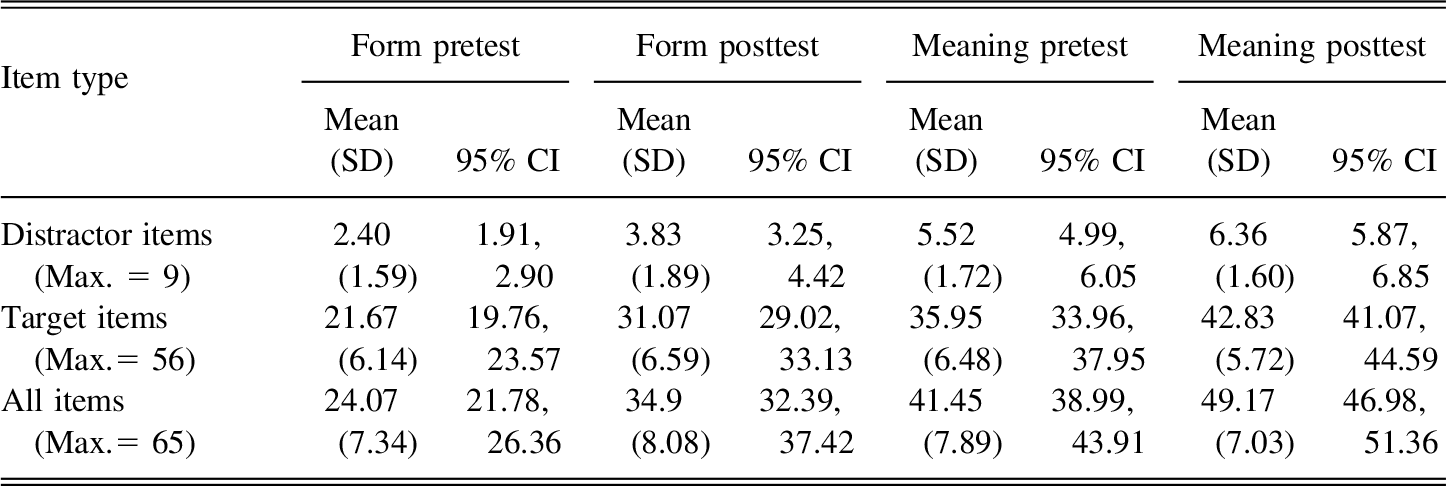
As can be seen in Table 4 and Figure 1, learning gains were made between the pre- and posttest. The mean total score for the target items increased by 9.4 points between the pre- and posttests, indicating that on average 9.4 FS were learned at the level of form recall. The minimum number of items learned was 3, and the maximum number was 16. The mean score for the distractor items also increased, but not to the same extent.
Descriptive statistics for the form recall and meaning recall tests
Learning gains from form recall pretest to form recall posttest.

Meaning Recall
At the level of meaning recall, learning gains were made between the pre- and posttests (see Table 4 and Figure 2). On average, 6.88 FS were learned, with a minimum learning gain of zero and a maximum of 18 items. As in the form recall test, there was some learning of distractor items, but again to a lesser extent (see Figure 2).
Learning gains from meaning recall pretest to meaning recall posttest.

The MANOVA with repeated measures (see Table 5) revealed significant main effects for Time (F(1,41) = 433.54, p < .0001, η p2 = .914), Test (F(1,41) = 638.2, p < .0001, ηp2 = .94), and Item (F(1,41) = 1598.61, p < .0001, η p2 = .975). A significant interaction was found between Time and Item (F(1,41) = 326.5, p < .0001, η p2 = .901), with higher learning gains for target items than for distractor items. This shows that learning was primarily due to the treatment, rather than to the tests. There was also a significant interaction between Time and Test (F(1,41) = 17.19, p < .0001, η p2 = .295), indicating that learning gains were significantly higher in the form recall test than in the meaning recall test. Significant interactions were also found for Test and Item (F(1,41) = 371.76, p < .0001, η p2 = .888), and Time, Test, and Item (F(1,41) =, p = .003, η p2 = .195). The three-way interaction indicates that the difference in learning gains between target items and distractors was larger in the form recall test than in the meaning recall test.
Results of the repeated measures MANOVA

RQ2. WHAT IS THE RELATIONSHIP BETWEEN LEARNER- AND ITEM-RELATED FACTORS AND VOCABULARY LEARNING GAINS?
Form Recall
To answer the second research question, a GEE with repeated measures was conducted with the data of the pre- and posttests. The results are summarized in Table 6. The analysis was done for 1,442 cases. Only cases for which there was no knowledge of the target item in the pretest were analyzed. The following parameters contributed significantly to the model: prior vocabulary knowledge, corpus frequency, knowledge of meaning in the pretest, and collocate-node relationship. Congruency, transparency, and MI score did not significantly contribute to the model.
GEE: Form recall

Note: B = coefficient, Exp(B) = odds ratio, 95% CI = 95% confidence interval for Exp(B).
Prior knowledge of the meaning of the FS was the most important predictor of learning the form of FS. The odds of a correct response in the form recall test were almost four times higher when the item was known in the meaning pretest. Second, the odds of a correct response increased by nearly 54% when the logarithmically transformed corpus frequency increased by one unit (Exp(B) = 1.537). For prior vocabulary knowledge, when score on the VLT increased by 1, the odds of a correct response increased by 2%. Thus, if the score increased by 10, the odds would increase by 21% (exp10*B = 1.21).
For collocate-node relationship, when “other” was taken as the reference category to which other categories of collocate-node relationship were compared, a positive relationship was found between learning and collocate-node = “adjective-noun,” collocate-node = “noun-noun,” collocate-node = “verb-noun,” and collocate-node = “verb-particle.” A negative relationship was found between learning and collocate-node “verb-preposition.” The odds ratios indicate that, compared to “other,” adjective-noun combinations were learned the best, followed by noun-noun, verb-noun, verb-particle, and verb-prepositions combinations. Additional analyses in which the other types were taken as reference categories confirm this result. The results of the additional models can be found in Appendix 3 (Supporting Information).
Meaning Recall
A GEE analysis was conducted for 843 observations (= unknown items in the pretest). The results are shown in Table 7. There were fewer observations than in the form recall test because more items were already known in the meaning recall pretest. Positive correlations with learning were found for frequency, transparency, MI score, and prior vocabulary knowledge. Congruency did not significantly affect learning.
GEE: Meaning recall

Note: B = coefficient, Exp(B) = odds ratio, 95% CI = 95% confidence interval for Exp(B).
As was the case in the form test, corpus frequency positively affected learning, but its effect was slightly larger. The odds ratio was 1.68, indicating that the odds of a correct response increased by 68% when frequency increased by one unit. Similarly, there was a positive relationship between prior vocabulary knowledge and learning at the level of meaning recall. The effect of prior vocabulary knowledge was also larger than in the form recall test. The odds of a correct response were 3% higher when one extra word was known in the VLT (or 31% when 10 more words were known).
For collocate-node relationship, when “other” was taken as reference category, there were positive coefficients for the categories “adjective-noun” and “noun-noun.” For the other types, negative coefficients were found, indicating that these were not learned well. Noun-noun combinations were learned best, followed by adjective-noun, other, verb-noun, verb-preposition, and verb-particle combinations. Additional analyses in which other collocate-node relationships were taken as the reference category confirmed this result (see Appendix 3, Supporting Information).
Unlike in the form test, MI was a significant predictor of learning the meaning of the FS. An odds ratio of 1.04 for MI score indicates that the odds of learning an item in the meaning recall test increased by 4% when the MI score of the item increased by one unit. For transparency, when “pure idiom” was the reference category, there were positive coefficients for “free combination” and “restricted collocation,” and a negative coefficient for “figurative idiom.” Additional GEE models (see Appendix 3, Supporting Information) confirmed that free combinations were learned best, followed by restricted collocations, pure idioms, and figurative idioms.
DISCUSSION
The aim of the present study was to investigate whether FS could be learned from watching a full-length TV program and whether learner-related and item-related factors would contribute to the learning. The study expands on previous research by using a full-length TV episode and by measuring a large number of FS. Given the small learning gains typically found in incidental learning, this allowed us to more accurately research incidental learning gains (Peters & Webb, Reference Peters and Webb2018). Moreover, by including a large variety of FS we could examine the effects of item-related factors on incidental learning.
THE EFFECT OF WATCHING A ONE-HOUR TV PROGRAM ON THE LEARNING OF FS
In answer to the first research question, the results of the pre- and posttests show that knowledge of both the form and meaning of FS can be gained from watching L2 television. In line with the findings of Puimège and Peters’s study (2019a), significant learning gains were found for two knowledge aspects, form recall and meaning recall, showing that even knowledge at the level of form recall can be acquired from TV viewing. Approximately 10 items on average were learned at the level of form recall, and nearly 7 items were learned at the level of meaning recall.
Previous studies have shown that television is a rich source of vocabulary for L2 learners (e.g., Lin, Reference Lin2014; Webb & Rodgers, Reference Webb and Rodgers2009), and that TV viewing can result in considerable learning of single-word knowledge (e.g., Peters & Webb, Reference Peters and Webb2018). The present study shows that watching L2 television also has great potential for the incidental learning of formulaic language. Considering the amount of knowledge that can be gained from a one-hour documentary, watching L2 television extensively might be an effective way for learners to enhance their knowledge of FS in the long term, especially for learners who otherwise have little exposure to aural L2 input, as argued by Webb and Chang (Reference Webb and Chang2015).
The learning gains found in this study are larger than those found in most previous studies on incidental learning of collocations (e.g., Szudarski, Reference Szudarski2012). Moreover, it is likely that even more learning occurred than accounted for in the vocabulary tests. In the first questionnaire, participants were asked what they had learned from the input in terms of grammar or vocabulary. Apart from items occurring in the vocabulary tests, participants also listed words and expressions that were not tested (e.g., to go to our Rose Cottage or our rainbow’s end).
One reason why such high learning gains were found compared to previous research might be that the participants in the present study were upper-intermediate learners studying English at university. As the questionnaires showed, they were motivated participants for whom the content of the video as well as the linguistic elements appearing in it were relevant. The participants may therefore have been more oriented toward learning new words and expressions from the input than learners in previous studies. Furthermore, the participants indicated that they found the content of the documentary interesting. They may thus have been more engaged with the learning materials than learners in previous studies. It should also be noted that the FS tested in this and the exploratory study varied in semantic transparency and collocate-node relationship, whereas previous studies (e.g., Pellicer-Sánchez, Reference Pellicer-Sánchez2017; Webb et al., Reference Webb, Newton and Chang2013) only tested lexical collocations. Moreover, in contrast to previous studies, we included a large number of target items, allowing us to measure a large proportion of formulaic language that could be potentially learned from the input. Finally, the type of input used might also partly explain differences in learning gains between this and previous studies. Television is not only a highly engaging form of L2 input (e.g., Rodgers & Webb, Reference Rodgers and Webb2019), it also offers contextual clues to the meaning of unknown words through imagery (Reference PetersPeters, 2019; Rodgers, Reference Rodgers2018). Further, there is more correspondence between text and imagery in documentaries than in other genres, as was shown by Rodgers (Reference Rodgers2018). This might also have contributed to the learning gains found in the present study.
As in Pellicer-Sánchez’s study (2017), we used delayed posttests instead of immediate posttests to measure learning gains. Our results show that items learned were retained for at least 5 days after watching the documentary. This is an encouraging finding, especially considering that individual FS tend to occur infrequently in language input and are unlikely to be encountered multiple times in a short time span. As Webb et al. (2013, p. 113) pointed out, encounter rates with FS tend to be infrequent, and “it may be that any knowledge gained through one encounter is forgotten before the next encounter.” The learning gains found in the present study indicate that learners do retain knowledge of FS for some amount of time. Moreover, our findings suggest that learners already partially knew some of the FS before the experiment and increased their knowledge of these items (see the next section).
Rather unexpectedly, we found higher learning gains in the form recall test than in the meaning recall test. Although this finding seems counterintuitive at first given that form recall represents a higher level of knowledge, it can be explained by learners’ knowledge of some of the items’ meaning in the meaning recall pretest. Items that were already known at the level of meaning recall would be easier to learn at the level of form recall. Another possible explanation is that in spite of our efforts to flush learners’ memory after the form test there might have been a test effect between the form recall test and the meaning recall test in the pretest session, as some participants duplicated some of the definitions appearing in the form recall test in the meaning recall test, which suggests that they tried to link definitions from the first test to items of the second test. This was also confirmed in the questionnaire data because some participants indicated that the form recall test had helped them when taking the meaning recall test. However, it is not clear if completing the form recall test resulted in learning, or if the test merely primed “the knowledge area” of the items, making these items easier in the form recall test (Nation & Webb, 2011, p. 284). If knowledge of meaning was indeed gained during the pretest session, this could explain why learning gains between the pre- and posttest were smaller for meaning recall than for form recall.
THE RELATIONSHIP BETWEEN LEARNER- AND ITEM-RELATED FACTORS AND VOCABULARY LEARNING GAINS
The results of the GEE analyses show that the learner-related variable, learners’ prior vocabulary knowledge (VLT score), and a number of item-related factors had an effect on the learning of FS from TV viewing.
The most important finding is probably that this study shows the incremental nature of vocabulary learning as a result of repeated encounters with lexical items in meaningful input. In the form test, the largest effect was found for learners’ knowledge of the meaning of the FS prior to the treatment. Items for which the meaning was already known in the pretest were 3.5 times more likely to be learned in the form recall test. This seems to indicate that the incidental acquisition of FS is an incremental process, in which learners gain partial knowledge of FS through repeated encounters in meaningful input. Our findings suggest that, despite the fact that individual FS are not frequently encountered in L2 input, learners can build up knowledge of FS over time, given that they have access to the meaning of the FS and notice them.
Factors that were found to affect learning both at the form and meaning recall level were corpus frequency, collocate-node relationship, and learners’ VLT score. Corpus frequency of the target FS influenced learning, with more frequent FS being learned more easily. This finding is in line with Peters (2019) and Puimège and Peters (Reference Puimège and Peters2019a), who suggested that corpus frequency could be considered a proxy of learners’ previous encounters with target items. They argued that learners might have partial knowledge of vocabulary items that they have encountered previously. It is likely that items with higher corpus frequency will have been encountered more frequently and will therefore be more familiar to learners. The relationship between corpus frequency and learning gains could also be due to the fact that items with the lowest frequency of occurrence in the OpenSubtitles corpus tended to have low-frequency single-word components (e.g., sexual depravity, grist to the mill). These were also the items for which the smallest learning gains were found. Words like depravity and grist are so infrequent that they were likely to be unknown by most of the participants. The presence of unknown components could have reduced the semantic transparency of FS, regardless of their level of idiomaticity or figurativeness. Furthermore, when a FS contained an unknown component, learners may have focused solely on deriving the meaning of the unknown word, instead of paying attention to the FS as a whole (Webb et al., Reference Webb, Newton and Chang2013).
A relationship was also found between learning and collocate-node relationship in the form recall test and in the meaning recall test. At both levels of knowledge, noun-noun and adjective-noun combinations were learned better than other types. In line with previous findings, combinations containing verbs were the most difficult to acquire (e.g., Peters, Reference Peters2016; Puimège & Peters, Reference Puimège and Peters2019a). Particularly verb-preposition combinations were not learned well. This may be because they contain grammatical words, which tend to be less salient than lexical words (Cintrón-Valentín & Ellis, Reference Cintrón-Valentín and Ellis2016). Furthermore, combinations that contain verbs have higher morphological variation than other types of FS (Peters, Reference Peters2016), which might add to their learning difficulty.
Learners’ VLT score also predicted learning in both tests. Our study provides further evidence for “the rich get richer hypothesis” (Horst & Meara, Reference Horst and Meara1999), in which learners who have a larger vocabulary size tend to have greater vocabulary gains from exposure to L2 audio-visual input (Montero Perez, Peters, Clarebout, & Desmet, Reference Montero Perez, Peters, Clarebout and Desmet2014; Peters, Heynen, & Puimège, Reference Peters, Heynen and Puimège2016; Peters & Webb, Reference Peters and Webb2018). Similar to the findings of Puimège and Peters’s (2019a) study, FS were more likely to be learned when participants had greater higher scores on the VLT.
Unlike in the form test, MI and transparency predicted learning in the meaning test. Items with higher MI scores were learned better than items with low MI scores. This finding contradicts earlier research showing that FS with high MI scores tend to be infrequent and therefore less likely to be known by L2 learners (e.g., González Fernández & Schmitt, Reference González Fernández and Schmitt2015). A closer examination of the target items showed that in our study items with low MI scores were mostly verb-particle (e.g., tell off) and verb-preposition (draw from) combinations. This makes sense given the low-frequency bias of MI (Evert, Reference Evert, Lüdeling and Kytö2008), and the fact that particles and prepositions tend to have high corpus frequency. The perceived effect of MI score might thus be due to the collocate-node relationship of items with low MI-scores, rather than the association strength or overall frequency of the items.
Transparency was also found to affect learning in the meaning recall test. Fully or highly transparent items had the highest learning gains, followed by semitransparent restricted collocations. Pure and figurative idioms were more difficult. It is possible that learners could not derive the meaning of the most idiomatic FS, except for those that were explicitly explained in the input (e.g., pushing up daisies, spend a penny).Footnote 3 This seems to lend evidence to Grant and Bauer’s (Reference Grant and Bauer2004) claim that opaque FS are the most difficult to acquire because their meaning cannot be derived from their components. Even if opaque FS are more salient, they still need to be understood to be learned. It is likely that the learning burden of FS in incidental contexts is determined by a compromise between salience and transparency of meaning.
No significant effect was found for congruency, which seems surprising given that incongruent FS have been found to cause problems in L2 learners’ writing (e.g., Nesselhauf, Reference Nesselhauf2005). However, the previous studies focused on processing or deliberate learning of FS and did not consider other factors that might affect learning. Our findings suggest that other factors might be more important in the incidental learning of FS. Furthermore, even though congruency of the target items was determined by multiple raters, interrater reliability was low, indicating that congruency was a matter of subjective judgment, as was suggested by Peters (Reference Peters2016). In addition, as was the case with semantic transparency, the presence of unknown single-word components might have rendered some of the FS more opaque and more difficult to learn, even if they had a literal L1 translation.
Finally, it is worth mentioning that although there was some variation in participants’ English TV viewing habits with regard to the presence of subtitles or captions, our questionnaire data (see Table 3) indicate that all participants were used to hearing English on TV, and regularly watched English-language television with or without subtitles. We therefore did not consider this variable in our GEE models.
LIMITATIONS AND SUGGESTIONS FOR FUTURE RESEARCH
We adopted a within-participants design because such a design needs fewer participants and has greater power than between-participants designs (Charness et al., Reference Charness, Gneezy and Kuhn2012). Nevertheless, the number of distractors was limited, which could be considered a limitation of the present study. Moreover, the participants in this study were all upper-intermediate learners of English who were used to watching English-language television. More research is needed to generalize the findings to other learning contexts and other TV genres.
Another limitation might be the use of authentic input. Because we did not want to compromise the ecological validity by manipulating the audio track of the documentary, we did not control for the number of occurrences of target items in the input. It might be interesting to investigate the effect of frequency of encounters on the learning of FS through TV viewing. Other factors that were not controlled for were length of the FS, morphological and syntactic flexibility, and adjacency. However, we decided to examine only those factors that have been found to relate to the learning burden of FS, and that have been considered important in previous studies on the incidental acquisition of FS.
Finally, a noteworthy methodological issue in the present study pertains to the use of multiple vocabulary tests to measure learning gains. Testing two levels of word knowledge allowed us to tap into partial knowledge and the incremental nature of vocabulary from meaning knowledge to form knowledge. However, when multiple tests are administered, a test effect cannot be completely avoided. Even with an hour in between the two tests, it seems that learners were still alerted to certain items in the meaning recall test, as they managed to link some words to the definitions provided in the form recall test. Because some learning may have occurred during test completion, the results of the present study might overestimate the learning gains made through the treatment. The test effect found in our study shows that a great deal of care should be taken when testing the same target items for multiple aspects or levels of knowledge, as the risk of priming exists “even when a difficult test … comes before an easier test” (Nation & Webb, Reference Nation and Webb2011, p. 284). A possible way to avoid test effects in the future is by including a larger proportion of distractors in the pre- and posttests.
CONCLUSION
The aim of the present study was to examine the effect of TV viewing on the incidental acquisition of L2 FS. The results indicate that a considerable number of FS can be learned incidentally from watching a one-hour documentary, at the levels of form recall and meaning recall. This study adds to the growing body of evidence that TV viewing can be a highly effective method for acquiring L2 vocabulary. It shows that TV viewing can aid learners’ acquisition of L2 vocabulary beyond the single word, particularly for items that are already partially known, and for highly frequent FS, which are likely to have been encountered before. It was also found that semantically transparent items, which are more accessible in terms of form-meaning mapping, were learned better. Finally, in line with previous findings, learners with larger vocabularies were more likely to acquire knowledge of FS from the input.
SUPPLEMENTARY MATERIAL
To view supplementary material for this article, please visit https://doi.org/10.1017/S027226311900055X






