Introduction
Although investigations into the Ross Sea benthos have intensified in recent decades, we still know relatively little about the structural patterns of macrozoobenthic communities as a whole. The way in which benthic communities interact and the influence of past and present biotic and abiotic factors on the structure of these communities are still far from being understood (Clarke & Crame Reference Clarke and Crame1992, Gutt Reference Gutt2000, Thatje et al. Reference Thatje, Hillenbrand and Larter2005). Recent studies have emphasized the importance of ice disturbance and primary production as main factors fostering the benthic communities of the western Ross Sea similar to other high-Antarctic regions. Other factors such as chlorophyll a and phaeophytin content of the sediment, substrate and habitat structure, depth and food supply are suggested to be less important but play a variable role for benthic community structure (Cummings et al. Reference Cummings, Thrush, Norkko, Andrew, Hewitt, Funnell and Schwarz2006, 2010, Thrush et al. Reference Thrush, Dayton, Cattaneo-Vietti, Chiantore, Cummings, Andrew, Hawes, Kim, Kvitek and Schwarz2006, Kröger & Rowden Reference Kröger and Rowden2008).
The study by Bullivant in Reference Bullivant1967 was the first to provide information about the distribution of macrobenthic communities in the Ross Sea based on different types of gear and video samples. Most of the following benthic studies were focused on shallow waters in McMurdo Sound and Terra Nova Bay (e.g. Dayton et al. Reference Dayton, Robilliard and Paine1970, Dayton Reference Dayton, Robilliard, Paine and Dayton1974, Dayton & Oliver Reference Dayton and Oliver1977, Barry & Dayton Reference Barry and Dayton1988, Gambi et al. Reference Gambi, Castelli and Guizzardi1997, Cantone et al. Reference Cantone, Castelli and Gambi2000, Cattaneo-Vietti et al. Reference Cattaneo-Vietti, Bavestrello, Cerrano, Giano, Mazella, Pansini and Sará2000, Schiaparelli et al. Reference Schiaparelli, Albertelli and Cattaneo-Vietti2003, Chiantore et al. Reference Chiantore, Guidetti, Cavallero, De Domenico, Albertelli and Cattaneo-Vietti2006). Little work has been conducted on habitats of the deeper shelf (Gambi & Bussotti Reference Gambi and Bussotti1999, Barry et al. Reference Barry, Grebemeier, Smith and Dunbar2003). Of note is that systematic analyses off the north-western Victoria Land coast are less intensive, although the BioRoss Survey, the Latitudinal Gradient Project (LGP), and related work have greatly improved our knowledge about benthic communities in this area (Cummings et al. Reference Cummings, Thrush, Norkko, Andrew, Hewitt, Funnell and Schwarz2006, De Domenico et al. Reference De Domenico, Chiantore, Buongiovanni, Ferranti, Ghione, Thrush, Cummings, Hewitt, Kröger and Cattaneo-Vietti2006, Schiaparelli et al. Reference Schiaparelli, Lörz and Cattaneo-Vietti2006, Thrush et al. Reference Thrush, Dayton, Cattaneo-Vietti, Chiantore, Cummings, Andrew, Hawes, Kim, Kvitek and Schwarz2006, Choudhury & Brandt Reference Choudhury and Brandt2007, Rehm et al. Reference Rehm, Thatje, Mühlenhardt-Siegel and Brandt2007, Kröger & Rowden Reference Kröger and Rowden2008). Data on macrozoobenthic biomass distribution showed that benthic communities along the Victoria Land coast followed a latitudinal gradient of abiotic factors (Povero et al. Reference Povero, Castellano, Ruggieri, Monticell, Saggiomo, Chiantore, Guidetti and Cattaneo-Vietti2006). A study on the distribution of complete benthic communities based on abundance of higher taxa of smaller macrobenthic organisms revealed a similar distribution of communities along the latitudinal gradient. Still, no gradual shift of faunal composition was recorded (Rehm et al. Reference Rehm, Thatje, Arntz, Brandt and Heilmayer2006). Both studies emphasized the potential importance of additional regional factors in structuring the Ross Sea benthos.
The present study aimed 1) to investigate the change in larger macrozoobenthos assemblage composition based on higher taxonomic level with changing latitude, 2) to verify the results of quantitative data obtained by the analysis of community patterns of macrobenthic invertebrates obtained with a Rauschert sled (Rehm et al. Reference Rehm, Thatje, Arntz, Brandt and Heilmayer2006), which were sampled on the same cruise, and 3) to compare the Ross Sea assemblages to other Antarctic shelf regions. A semi-quantitative Agassiz trawl was employed, which allows the data to be compared to semi-quantitative studies from other Antarctic shelf areas using trawled gear (Voß 1988, Galéron et al. Reference Galéron, Herman, Arnaud, Arntz, Hain and Klages1992, Arnaud et al. Reference Arnaud, López, Olaso, Ramil, Ramos-Esplá and Ramos1998, Arntz et al. Reference Arntz, Thatje, Linse, Avila, Ballesteros, Barnes, Cope, Cristobo, De Broyer, Gutt, Isla, López-González, Montiel, Munilla, Ramos-Espla, Raupach, Rauschert, Rodríguez and Teixidó2006).
Methods
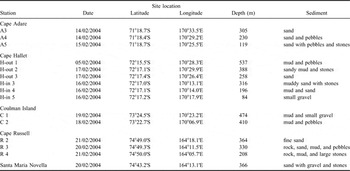
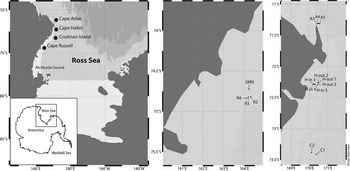
During the 19th cruise of the RV Italica to the Ross Sea, Antarctica, in summer 2004 a multi-geared operation was undertaken along a latitudinal gradient transect. Sampling was performed in four areas: Cape Adare, Cape Hallett, Coulman Island, and Cape Russell, with a depth gradient being sampled at each location (Table I, Fig. 1).
Sampling locations in the Ross Sea, Antarctica.

Left: sampling areas (black dots) off the Victoria Land coast (Ross Sea, Antarctica). Middle and right: stations (black dots) within the sampling areas.

An Agassiz trawl (AGT) was used with a standard 120 cm x 55 cm opening and a 20 mm mesh size. This type of equipment is used to capture large macrozoobenthic organisms, and complemented samples collected using a small mesh Rauschert dredge during the same cruise (Rehm et al. Reference Rehm, Thatje, Arntz, Brandt and Heilmayer2006). The dredge was hauled with a mean velocity of 1 knot over distances ranging from 60–380 m and a depth range from 84–388 m.
On deck, subsamples were taken from the AGT catches and transferred into 4% buffered formalin. To keep sampling effort unbiased, random subsamples with constant volume (6 l barrels) were taken from whole and unsorted hauls using a shovel. Once back on shore, samples were transferred to 70% ethanol and sorted into major taxonomic groups using a stereomicroscope where necessary (compare Table II and supplemental Table SI). Abundances were documented for each group; colonial groups such as sponges, cnidarians, and bryozoans, were recorded according to six frequency categories with regard to the distribution of the taxa within the whole catch (0–5; absent to very abundant if the group was dominating the sample). Absolute abundances of countable organisms have been analysed simultaneously with uncountable (colonial) organisms in different ways. A simple and less accurate method is to integrate colonial organisms with presence/absence values into the similarity matrix (e.g. Salzwedel et al. Reference Salzwedel, Rachor and Gerdes1985, Thatje et al. Reference Thatje, Gerdes and Rachor1999, Starmans et al. Reference Starmans, Gutt and Arntz1999). A further method used is to calculate the relative coverage of colonial taxa and multiply the result with a factor to adjust relative values to the level of the compared absolute data (e.g. Gutt & Starmans Reference Gutt and Starmans1998, Barry et al. Reference Barry, Grebemeier, Smith and Dunbar2003). We used a different way to adjust both types of data. To reduce the weight of highly abundant taxa absolute abundances were transformed with the square root prior to the cluster analyses. As a result, 96% of the values of the species station matrix ranged from 0–5, which is the same interval as for the categories of the colonial taxa. Thus, for the creation of the similarity matrix we used a combined datasheet with square-root transformed absolute data and the six frequency categories for colonial taxa. The software package Primer (Clarke & Gorley Reference Clarke and Gorley2000) was used to complete a group-averaged cluster analysis of abundances on the basis of Bray-Curtis Index (Bray & Curtis Reference Bray and Curtis1957). Cluster analysis was combined with a SIMPROF test completed to 95% confidence limits, which determines the statistical significance of the clusters.
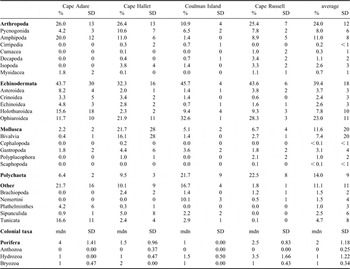
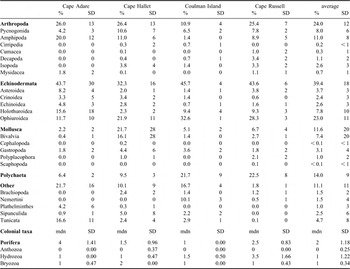
Average relative abundances in percentage of dominant macrozoobenthic taxa found in the sampling areas of the coastal north-western Ross Sea shelf. For colonial taxa the median of the frequency categories is given instead of the average relative value. SD = standard deviation, mdn = median.
Results
A total of 27 different taxonomic groups were identified within the samples (Table II). Number of groups per station ranged from 9 (Cape Adare) to 22 (Cape Hallett). Amphipoda and Polychaeta were the only groups found at all stations. Abundances recorded ranged from one to 1346 specimens within a single group. The highest number of any one group found at a station was the bivalve Adacnarca nitens Pelseneer, 1903 found at Cape Hallett (H-in 5), which were all found attached to a hydrozoan species. This population sample of Adacnarca nitens included the full range of known size classes, from juvenile to adult stages. Considering the north-western coastal Ross Sea shelf as a whole, the Echinodermata clearly dominate (41% of total abundance) followed by Crustacea (22%). Polychaeta, Others, and Mollusca are similar in abundance (15%, 13%, and 9%, respectively).
A latitudinal transect (71° to 74°S) was sampled from north to south, along the Victoria Land coastline. The only north–south gradient identified is an increase in the relative abundance of Polychaeta (6% at Cape Adare, 23% at Cape Russell) within the assemblage. Polychaeta vary as to their position in the assemblage, contributing the least at Cape Hallett but being the second dominant group at Coulman Island (Table II). Less speciose taxa like the Sipunculida and Nemertini were grouped to ‘Other’ organisms, which also have a varied position within the assemblages. Cape Adare sees the highest percentage of others (22%), resulting primarily from a high tunicate count at A4 (21%). The lowest abundance of ‘Other’ organisms is seen at Cape Russell (2%), with Cape Hallett and Coulman Island exhibiting intermediate numbers of ‘Other’ organisms (10% and 17%, respectively). Molluscs contribute between 2 and 22% to total abundance with the minimum at Cape Adare and the maximum at Cape Hallett. The high contribution results from a mass occurrence of the bivalve Adacnarca nitens at station H-in 5 (82% of total abundance). Relative mollusc abundance of Cape Hallett omitting this station is 2.5% which is similar to relative mollusc abundance at Cape Russell 2.7% (Cape Adare < 1%, Coulman Island 1.4%). In this case molluscs display the same gradient as Polychaeta with the highest contribution to the southern benthic community. Relative abundance of crustaceans (22%) and echinoderms (41%) show less variation between sample areas with minima off Coulman Island (Crustacea 11%) and Cape Hallett (Echinodermata 32%).
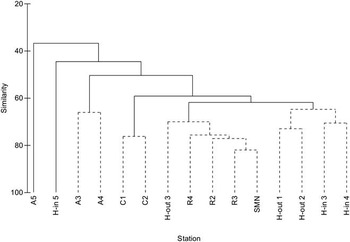
Cluster analysis carried out on major macrobenthic taxa shows a clear difference in assemblage according to the geographical position of the sample areas along the latitudinal gradient. According to the SIMPROF analysis stations for clusters (Fig. 2) are not significantly different. These clusters represent the four sampling areas Cape Adare, Coulman Island, Cape Hallett and Cape Russell (Bray Curtis similarities: 66%, 76%, 70%, 63%). However, there are three exceptions: Station A5 and H-in 5 grouped with no other station at a similarity level of 37% and 46%, respectively. Station H-out 3 was placed within the Cape Russell cluster.
Dendrogram showing clusters of macrozoobenthos stations off Victoria Land in the Ross Sea, Antarctica. Square root transformation applied to data. SIMPROF analysis completed to 95% confidence limits (indicated by dotted lines).

Discussion
Composition of benthic community
The dominance of Echinodermata along the northern Victoria Land coast is comparable to the distribution patterns of other Antarctic regions (e.g. Galéron et al. Reference Galéron, Herman, Arnaud, Arntz, Hain and Klages1992, Gerdes et al. Reference Gerdes, Klages, Arntz, Herman, Galéron and Hain1992, Arnaud et al. Reference Arnaud, López, Olaso, Ramil, Ramos-Esplá and Ramos1998, Gutt & Starmans Reference Gutt and Starmans1998, Gutt et al. Reference Gutt, Fricke, Teixidó, Potthoff and Arntz2005). Ophiurids contribute most to echinoderm abundance, which is also evident from benthic communities of the shelf of other Antarctic regions sampled with hauled gear (e.g. Voß Reference Voß1988, Galéron et al. Reference Galéron, Herman, Arnaud, Arntz, Hain and Klages1992, Arnaud et al. Reference Arnaud, López, Olaso, Ramil, Ramos-Esplá and Ramos1998). Polychaeta and Mollusca were abundant groups (14% and 12%, respectively of total abundance), which is comparable to Agassiz trawl samples (10 mm mesh size) from the eastern Weddell Sea (Voß Reference Voß1988, Galéron et al. Reference Galéron, Herman, Arnaud, Arntz, Hain and Klages1992). However, mollusc abundances are low at regions with less extended shelf areas (Arnaud et al. Reference Arnaud, López, Olaso, Ramil, Ramos-Esplá and Ramos1998, Arntz et al. Reference Arntz, Thatje, Linse, Avila, Ballesteros, Barnes, Cope, Cristobo, De Broyer, Gutt, Isla, López-González, Montiel, Munilla, Ramos-Espla, Raupach, Rauschert, Rodríguez and Teixidó2006). Arthropods, and Amphipods in particular, displayed a comparatively increased proportion of abundance (22% and 11%, respectively of total abundance) towards other surveys based on similar gear, though still in the range of taxon distribution of the eastern Weddell Sea (Voß Reference Voß1988, Arnaud et al. Reference Arnaud, López, Olaso, Ramil, Ramos-Esplá and Ramos1998, Arntz et al. Reference Arntz, Thatje, Linse, Avila, Ballesteros, Barnes, Cope, Cristobo, De Broyer, Gutt, Isla, López-González, Montiel, Munilla, Ramos-Espla, Raupach, Rauschert, Rodríguez and Teixidó2006). Thus, the eastern Weddell and the western Ross Seas are more similar with regard to the portion of bivalve and arthropod abundances than to other Antarctic shelf communities. Both regions are subject to intense impact of iceberg scours (Gerdes et al. Reference Gerdes, Klages, Arntz, Herman, Galéron and Hain1992, Reference Gerdes, Hilbig and Montiel2003, Thrush et al. Reference Thrush, Dayton, Cattaneo-Vietti, Chiantore, Cummings, Andrew, Hawes, Kim, Kvitek and Schwarz2006), which is suggested to be one of the main factors influencing diversity off Victoria Land (Thrush et al. Reference Thrush, Dayton, Cattaneo-Vietti, Chiantore, Cummings, Andrew, Hawes, Kim, Kvitek and Schwarz2006, Kröger & Rowden Reference Kröger and Rowden2008) and which entail a largely increased ratio of crustaceans and an increased ratio of molluscs compared to undisturbed areas (Gerdes et al. Reference Gerdes, Isla, Knust, Mintenbeck and Rossi2008).
Benthic community structure along the Victoria Land coast
Our data show a clear difference in assemblage according to the geographical location along the latitudinal gradient. However, only polychaetes are gradually distributed along the Victoria Land coast displaying the maximum portion of abundance at Cape Russell. Although variation is seen between sites, this pattern cannot be attributed simply to latitude as there are evidently more complex interactions taking place. Thrush et al. (Reference Thrush, Dayton, Cattaneo-Vietti, Chiantore, Cummings, Andrew, Hawes, Kim, Kvitek and Schwarz2006) point out that benthic communities along the western coast of the Ross Sea are mainly shaped by ice disturbance, solar radiation, polynyas, and advection of planktonic production, providing a complex regime, which they suppose to result in a non-linear change of biodiversity. Patterns of polychaete assemblages of the north-western Ross Sea confirm a non-linear correlation with latitude (Kröger & Rowden Reference Kröger and Rowden2008). Similar findings were shown by the distribution of cumacean assemblages, though abundance increased and community changed with latitude, no linear shift was recorded (Rehm et al. Reference Rehm, Thatje, Mühlenhardt-Siegel and Brandt2007). Also, no correlation between latitude and macrobenthic communities was recorded by Cummings et al. (Reference Cummings, Thrush, Chiantore, Hewitt and Cattaneo-Vietti2010), who identified sediment grain size, the ratio of sediment chlorophyll a to phaeophytin content, and depth as explanatory factors influencing macrobenthic communities. Main driving factors for polychaete assemblage structure as identified by Kröger & Rowden (Reference Kröger and Rowden2008) are sponge spicule content, sediment chlorophyll a content, sediment sorting coefficient, and distance to nearest iceberg scour. Macrozoobenthic community patterns described on the basis of biomass also showed a latitudinal gradient partially depending on an environmental and trophic gradient, but on a smaller scale communities are influenced by a complex of factors independent of the latitudinal gradient (Povero et al. Reference Povero, Castellano, Ruggieri, Monticell, Saggiomo, Chiantore, Guidetti and Cattaneo-Vietti2006).
The northernmost community at Cape Adare is characterized by an increased portion of Amphipoda, though the general contribution of crustaceans is the same as in most other communities along the Victoria Land coast. Fresh iceberg scours were found at Cape Adare during the Victoria Land Transect project (Thrush et al. Reference Thrush, Dayton, Cattaneo-Vietti, Chiantore, Cummings, Andrew, Hawes, Kim, Kvitek and Schwarz2006), which are characterized by motile groups such as amphipods and crinoids that act as first colonizers of disturbed areas, whereas their contribution to abundance decreases in older scars (e.g. Peck et al. Reference Peck, Brockington, Vanhove and Beghyn1999, Gutt Reference Gutt2000, Teixidó et al. Reference Teixidó, Garrabou, Gutt and Arntz2007, Gerdes et al. Reference Gerdes, Isla, Knust, Mintenbeck and Rossi2008). The impoverished cumacean community of Cape Adare, recorded during the same cruise, points also in this direction (Rehm et al. Reference Rehm, Thatje, Mühlenhardt-Siegel and Brandt2007), as smaller less motile organisms follow by passive advection during succession (Gerdes et al. Reference Gerdes, Isla, Knust, Mintenbeck and Rossi2008). On the other hand, the Cape Adare community has the highest proportion of ascidians (Tunicata), which are also part of the more advanced community succession stages following iceberg scours (Gerdes et al. Reference Gerdes, Isla, Knust, Mintenbeck and Rossi2008). This is due to the fact that there are differences in faunal composition between stations. Station A3 shows patterns of communities of older ice scours, such as high abundance of Porifera, although Echinoderm abundance is exceptional high (42% Holothuroidea, 25% Ophiuroidea) which is characteristic for young ice scours. In contrast, at station A5 typical elements of young iceberg scours are seen (Gerdes et al. Reference Gerdes, Isla, Knust, Mintenbeck and Rossi2008); namely, amphipods (33%), ascidians (27%) and crinoids (10%) show the highest proportions. Station A4 displays intermediate patterns between young and older scours; a possible explanation could be the sample touching new and older scours at the same time. This is not unlikely, as the area is exposed to frequent ice impact (Keys Reference Keys1983).
Although the clusters of the communities of Cape Hallet and Cape Russell were the most similar, the SIMPROF analysis marked both clusters as being significantly different. The benthic community of Cape Russell, in contrast to Cape Hallett, is influenced by the Terra Nova Bay polynya, which is an area of high productivity (Saggiomo et al. Reference Saggiomo, Catalano, Mangoni, Budillon and Carrada2002) dominated by diatoms during the summer months (Arrigo et al. Reference Arrigo, Robinson, Worthen, Dunbar, DiTullio, van Woert and Lizotte1999). The supply of diatoms may explain the increased numbers of Cumaceans in the Cape Russell area, as these are a typical food source for cumaceans (Blazewicz-Paszkowycz & Ligowski Reference Blazewicz-Paszkowycz and Ligowski2002). In general cumacean abundance is higher in this area than in more northern areas along the Victoria Land coast and the species Vaunthompsonia inermis (Zimmer, 1909), which feeds on diatoms as recorded from Admiralty Bay, King George Island (Blazewicz-Paszkowycz & Ligowski Reference Blazewicz-Paszkowycz and Ligowski2002), is more abundant in the Cape Russell area than off Cape Hallett (Rehm et al. Reference Rehm, Thatje, Mühlenhardt-Siegel and Brandt2007). Further groups, which were more abundant to the south, are ophiurids and polychaetes. This is in accordance with the observations of macrozoobenthic biomass distribution, which showed increased ophiurid and polychaete abundances in correlation to sediment grain size (Povero et al. Reference Povero, Castellano, Ruggieri, Monticell, Saggiomo, Chiantore, Guidetti and Cattaneo-Vietti2006). The finest sediments of our study occurred off Coulman Island corresponding with a clear dominance of Ophiuroidea and Polychaeta. Cape Hallett displays the highest bivalve contribution to the benthic community; though this is due to the mass occurrence of Adacnarca nitens at station H-in 5 (see also Higgs et al. Reference Higgs, Reed, Hooke, Honey, Heilmayer and Thatje2009). Comparing the distribution of bivalves within the Cape Hallet area (ignoring station H-in 5) shows that relative bivalve abundance of Cape Hallet is similar to the relative bivalve abundance of Cape Russell.
Results of the present study and from the analyses of smaller macrozoobenthic organisms sampled during the same survey with a small mesh Rauschert Sled (Stransky Reference Stransky2008) are consistent with regard to community distribution off the Victoria Land coast (Rehm et al. Reference Rehm, Thatje, Arntz, Brandt and Heilmayer2006). Both analyses recover a nearly identical resolution of clusters emphasising the suitability of both gear for preliminary assessment of macrozoobenthic community structure.
Conclusion
Macrozoobenthic assemblages in the western Ross Sea show overall similarity to other high-Antarctic shelf communities, especially of the eastern Weddell Sea. Furthermore, this study confirmed the view of a non-linear change of diversity and community structure along the Victoria Land coast. As discussed, for isopods, cumaceans, and polychaetes (Choudhury & Brand 2007, Rehm et al. Reference Rehm, Thatje, Mühlenhardt-Siegel and Brandt2007, Kröger & Rowden Reference Kröger and Rowden2008) valuable information beyond a first assessment of benthic communities may by obtained with a higher taxonomic resolution.
Acknowledgements
We are indebted to Ricardo Cattaneo-Vietti for providing the opportunity to participate at the 19th expedition of the Programma Nazionale di Ricerche in Antartide (S.C.r.l.). We would also like to thank Susanne Gatti, Olaf Heilmayer, and, especially, Mariachiara Chiantore for organising and their help during the cruise. Furthermore, we are grateful to the crew of RV Italica for assistance and comfortable time at sea. Travelling funds were provided by the German Science Foundation (DFG) to the principal author (Br 1121/23-1). We thank the reviewers for their helpful comments.
Supplemental material
A supplemental table will be found on http://www.journals.cambridge.org/jid_ANS.