Introduction
The parasitoid host selection process involves two steps, host location and recognition, both of which involve physical and chemical stimuli. Both herbivory-induced plant volatiles (HIPVs) and oviposition-induced plant volatiles (OIPVs) are used by parasitoids to locate their hosts (Vinson, Reference Vinson1998; Wegener et al., Reference Wegener, Schulz, Meiners, Hadwich and Hilker2001; Büchel et al., Reference Büchel, Malskies, Mayer, Fenning, Gershenzon, Hilker and Meiners2011). Parasitoids use distance-related cues when searching for hosts. At first they use HIPVs and OIPVs as long-range cues, and then they depend on short-range cues such as chemicals from the host, vibration, and visual signals, when they are closer to a potential host (Borges et al., Reference Borges, Schmidt, Sujii, Medeiros, Mori, Zarbin and Ferreira1998; Laumann et al., Reference Laumann, Aquino, Moraes, Pareja and Borges2009, Reference Laumann, Cokl, Lopes, Ferreira, Moraes and Borges2011; Aquino et al., Reference Aquino, Dias, Morges, Blassioli-Moraes and Laumann2012). HIPVs and OIPVS are released by plants as ‘calls for help’−host defences−that attract natural enemies of the herbivore. Plants respond to herbivore injury when the damage occurs and to oviposition prior to damage produced by immature insects. The ability to respond to the presence of eggs is an important plant defence (Hilker et al., Reference Hilker, Stein, Schröder, Varama and Mumm2005; Hilker & Meiners, Reference Hilker and Meiners2006; Bruce et al., Reference Bruce, Midega, Birkett, Pickett and Khan2010). To accomplish this, plants need to recognize cues from the eggs and from the egg–plant interaction, which can be physical, such as weight or a shadow on the leaf surface; or chemical, such as kairomones released by eggs or synomones released by plants with deposited eggs (Hilker & Meiners, Reference Hilker and Meiners2010, Reference Hilker and Meiners2011).
Parasitoids can also react to cues from host eggs. Edovum puttleri (Hymenoptera: Eulophidae) is attracted to kairomones from eggs of Leptinotarsa decemlineata (Coleoptera: Chrysomelidae) (Leonard et al., Reference Leonard, Wu and Ferro1987; Hu et al., Reference Hu, Gelman and Bell1999). Female Anaphesiole (Hymenoptera: Mymaridae) recognize chemicals derived from eggs or adults of Lygus hesperus (Heteroptera: Miridae) during host recognition (Takasu & Nordlund, Reference Takasu and Nordlund2001); and females of the egg parasitoid Telenomus euproctidis (Hymenoptera: Platygastridae) are attracted to volatiles from egg masses of Orgyia postica (Lepidoptera: Lymantriidae) (Arakaki et al., Reference Arakaki, Yamazawa and Wakamura2011).
Telenomus podisi (Hymenoptera: Platygastridae) is found in croplands of the Americas and is the most common natural enemy of the stink bug Euschistus sp. (Heteroptera: Pentatomidae) (Medeiros et al., Reference Medeiros, Schimidt, Loiácono, Carvalho and Borges1997, Reference Medeiros, Loiácono, Borges and Schimidt1998; Pacheco & Corrêa-Ferreira, Reference Pacheco and Corrêa-Ferreira2000; Michereff et al., Reference Michereff, Michereff Filho, Blassioli-Moraes, Laumann, Diniz and Borges2015). It is attracted to its primary host, E. heros, by chemical cues including sex pheromones, defensive compounds from the methatoracic gland, and cuticular compounds (Borges & Aldrich, Reference Borges and Aldrich1994; Borges et al., Reference Borges, Schmidt, Sujii, Medeiros, Mori, Zarbin and Ferreira1998, Reference Borges, Costa, Sujii, Cavalcanti, Redígolo, Resck and Vilela1999, Reference Borges, Colazza, Ramirez-Lucas, Chauhan, Moraes and Aldrich2003; Laumann et al., Reference Laumann, Aquino, Moraes, Pareja and Borges2009), HIPVs and OIPVs (Moraes et al., Reference Moraes, Laumann, Pires, Sujii and Borges2005, Reference Moraes, Pareja, Laumann, Hoffmann-Campo and Borges2008; Michereff et al., Reference Michereff, Laumann, Borges, Michereff Filho, Diniz, Farias Neto and Moraes2011, Reference Michereff, Borges, Laumann, Diniz and Moraes2013), vibratory signals (Laumann et al., Reference Laumann, Moraes, Cokl and Borges2007, Reference Laumann, Cokl, Lopes, Ferreira, Moraes and Borges2011), and visual cues (Aquino et al., Reference Aquino, Dias, Morges, Blassioli-Moraes and Laumann2012). T. podisi is an egg parasitoid, but it is not attracted to volatiles released by soybean plants with E. heros eggs (Moraes et al., Reference Moraes, Pareja, Laumann, Hoffmann-Campo and Borges2008; Michereff et al., Reference Michereff, Laumann, Borges, Michereff Filho, Diniz, Farias Neto and Moraes2011). Similarly, oviposition by the stink bug Nezara viridula (Heteroptera: Pentatomidae) does not induce changes in plant odours that attract the egg parasitoid Trissolcus basalis (Hymenoptera: Platygastridae) (Colazza et al., Reference Colazza, Mcelfresh and Millar2004a ). Under natural conditions, stink bugs feed on plants while ovipositing, and egg parasitoids are attracted by the HIPVs that result. The absence of OIPVs might explain the lack of response to volatiles released by plants that are treated only by oviposition by stink bugs. Other studies have shown that stink bug eggs have chemicals that Platygastridae parasitoids use to locate their hosts (Bin et al., Reference Bin, Vinson, Strand, Colazza and Jones1993), and there is evidence that the eggs themselves have volatiles that attract natural enemies (Sales, Reference Sales1979; Tognon et al., Reference Tognon, Sant'Ana and Jahnke2014). Therefore, the aim of this study was to determine whether chemicals from stink bug eggs change the foraging behaviour of T. podisi and to investigate what happens to this chemical information when the eggs are laid on leaves, as T. podisi do not respond to plants with naturally deposited eggs (Colazza et al., Reference Colazza, Mcelfresh and Millar2004a , Reference Colazza, Fucarino, Peri, Salerno, Conti and Bin b ; Moraes et al., Reference Moraes, Pareja, Laumann, Hoffmann-Campo and Borges2008, Michereff et al., Reference Michereff, Laumann, Borges, Michereff Filho, Diniz, Farias Neto and Moraes2011).
Material and methods
Insect rearing
E. heros individuals were obtained from a laboratory colony started from adults collected in soybean fields near Embrapa Genetic Resources and Biotechnology, Brasília, Brazil (15°47′S, 47°55′W). Bugs were reared in 8-litre plastic containers on a diet of soybeans, sunflower (Helianthus annus) seeds, raw peanuts (Arachis hypogaea), fresh green beans (Phaseolus vulgaris), and water. The food supply was replenished twice weekly. Females and males were separated after mating and maintained in different cages under the same conditions as described above. Racks covered with tulle fabric and placed inside the cages provided an oviposition substrate, and they were changed every day to avoid egg contamination.
The egg parasitoid T. podisi was obtained from a laboratory colony raised on E. heros eggs. The wasps were maintained in acrylic cages (25 cm2 angled neck tissue culture flasks; ICN Biomedicals, Irvine, CA, USA) and fed twice weekly with a drop of honey. Following hatching, the parasitoids were kept in acrylic cages for 24 h without host eggs before mating. Two-day-old naive females were used in the experiments. E. heros and T. podisi were maintained in separate environmental rooms at 27 ± 1°C, 65 ± 10% relative humidity, and a 14-h photoperiod.
Plants
Soybean seeds (Dowling cultivar) were germinated on damp paper for 3 days and then transplanted to pots containing a mixture of soil and organic substrate (1:1 w/w). Plants were kept in a greenhouse and used when in the V3 phenological, i.e., stem elongation, stage. The experimental procedures included (1) plants treated with hexane or acetone egg extracts, (2) plants with eggs laid naturally by stink bugs, (3) plants with eggs laid artificially, and (4) untreated control plants.
Preparation of E. heros egg extracts
Extracts for bioassays were prepared from single clusters of approximately 20 eggs. The eggs were submerged in 40 µl of acetone or n-hexane solvent in a 2-ml glass vial, and placed in an ultrasonic bath (Unique, USC – 2800A) for 15 min. The solvent was then collected in a Pasteur pipette, passed through a 4 mm diameter 0.45 µm micropore filter (PFTE-4-4 Iso-Disc™, Supelco, USA) and concentrated under gentle nitrogen flow until total solvent evaporation. After drying, 100 µl of Tween-20 (0.1% v/v) was added, and the solution was vortexed for 30 s. For chemical analysis, extracts of 100 E. heros egg clusters (~2000 eggs = 1 g) were prepared using a similar procedure. Eggs were placed in a 4 ml glass vial and immersed in 4 mL of solvent. The procedure required 100 egg clusters because the compounds in one egg cluster are present in very small amounts that are not quantifiable using gas chromatography-flame ionization detection (GC-FID) or GC-mass spectrometry (MS). The extracts were prepared in triplicate for each solvent.
Natural and artificial oviposition on soybean plants
Soybean plants used for natural oviposition bioassays had two egg clusters of 10–12 eggs each. The eggs were deposited by six mated females between 12 and 15 days of age, and their proboscises were removed before they were placed on the soybean plants to avoid herbivory injury. Stink bugs were removed from the plants a few minutes before the bioassays began. For artificial oviposition, single egg clusters with 10–12 eggs were placed on the surfaces of the first and second pairs of leaves of the plant by simple touching and without artificial glue. The natural glue on the base of the egg simulated natural oviposition and avoided stimulating plant defences. Untreated soybean plants were used as controls.
Plant treatment with egg extracts
Plants were treated with three sequential applications of 5 µl hexane or acetone egg extract. Control plants were treated with 15 µl of solvent in Tween-20 (0.1% v/v).
Bioassays
Y-tube olfactometer bioassays were conducted to determine whether volatiles emitted from eggs, plants treated with eggs, or egg extracts affected parasitoid searching behaviour. The olfactometers consisted of square acrylic blocks (19 × 19 cm2) with a 1 cm Y-shaped cavity sandwiched between two glass plates (Moraes et al., Reference Moraes, Laumann, Pires, Sujii and Borges2005). The leg of the cavity was 8 cm long, and each arm was 7 cm long. Activated-charcoal filtered, humidified air was pushed through the system at 0.6 litre min−1 and pulled out at 0.2 litre min−1 by a push–pull system. Behaviour of the insects was monitored by a CCD camera (Sony SPT M324CE; Sony, Minato-Ku, Tokyo, Japan) with a 12.5–75.0 mm/F1.8 zoom lens and analysed using software architecture comparison analysis method software (Jorge et al., Reference Jorge, Laumann, Borges, Moraes, Cruz, Milare and Palhares2005). A single T. podisi female was introduced at the base of the Y-tube and observed for 600 s. The first choice arm, which was the first one that the wasp entered and remained in for at least 20 s, and residence time in each arm were recorded by the software. Residence time was the time that the parasitoid remained in an arm. After every five repetitions, the plants were replaced and the positions of the arms of the olfactometer were changed to avoid bias in the parasitoid responses. Each female was used only one time and forty repetitions were made for each combination tested.
Plants were used in the bioassays at 24, 48, and 72 h after treatment. Treated and control plants were kept in different rooms under the same temperature, humidity, and lighting conditions until used in the experiments to avoid chemical signalling between them. Damaged or undamaged plants were placed in glass chambers and connected to the olfactometer via silicone tubing.
Ten-microliter aliquots of test solution were applied to 1 cm2 strips of filter paper (80 g m−2, 205 µm thick, 14 µm average pore size; Qualy J Prolab, Paraná, Brazil), which remained at room temperature for 1 min before being inserted into a syringe connected to the arm of the olfactometer. The solvent was allowed to evaporate. The same procedure was performed for the control filter paper strips containing only the n-hexane or acetone solvent. The filter paper and the olfactometer system were exchanged after every five assays.
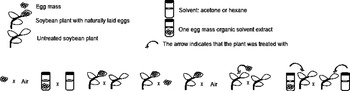
The bioassay combinations that were used to test whether E. heros eggs emit volatile compounds that attract T. podisi are shown in figure 1. The attraction of volatiles from one egg cluster was evaluated against both air and the volatiles emitted from the extracts of one egg cluster to determine whether attractant volatiles were present in either the acetone or hexane. To evaluate whether chemicals from the secretions released by E. heros females during egg oviposition or by the plants might be involved in the attraction of T. podisi, bioassays were conducted using plants with eggs laid naturally and artificially and with plants treated with egg extracts.
Experimental scheme of plant treatment. Ten-microliter aliquots of egg extract were applied to filter paper. For plants treated with egg extract or solvent, 15 µl aliquots were applied to filter paper.

Scanning electronic microscopy (SEM)
To evaluate whether E. heros oviposition physically damages soybean leaves, they were examined by SEM after oviposition. Approximately 1 cm2 pieces cut from abaxial and adaxial sites on fresh leaves with E. heros eggs were fixed with glutaraldehyde 2.5% (v/v) in 0.1 M sodium cacodylate buffer (pH 6.8) for 24 h under low pressure. The leaves were then transferred to fresh solution under low pressure for an additional 30 min. The buffer solution was replaced again and kept at 4°C for 90 min. After fixation, the samples were washed five times for 10 min with 0.1 M sodium cacodylate buffer. The cacodylate buffer was replaced by a 2% osmium tetroxide solution for 60 min at room temperature followed by three sequential washes with sodium cacodylate buffer. The leaf samples were dehydrated in an aqueous series of 30, 50, 70, 90, and 100% methanol (v/v); the samples were kept in each concentration for 20 min. After dehydration, the samples were critical-point dried in liquid CO2 (Baltec CPD 030, Baltec, Schalksmühle, Germany) between 0 and 5°C at atmospheric pressure. The samples were then sputter coated (Emitech K550) with a 20-nm-thick gold film. The images were obtained using either a Zeiss DMS 962 at 10KV with distance of 13–18 mm or a JSM 840 A at 10 KV with distance of 10–15 mm.
Chemical analysis
Egg extracts were analyzed by GC (Agilent 7890A, DB-5MS) with a 30 m × 0.25 mm ID column and 0.25 µm film thickness, (J&W Scientific, Folsom, CA, USA), using a temperature program of 50°C (2 min), 5°C min−1 to 180°C (0.1 min), and 10°C min−1 to 250°C (20 min). The column effluent was analyzed with a FID at 270°C. For GC, 50 µl of each extract was separated, and 1 µl of octadecane was added as an internal standard (IS) with a final concentration of 9.8 µg ml−1. One microliter of each sample was injected using the splitless mode with helium as the carrier gas. The amounts of volatile chemicals released by the plant every 24 h were calculated in relation to the area of the IS. Data were collected with EzChrom Elite software (2008) (Agilent, California, USA) and were recorded Excell software (Microsoft, 2007, EUA).
For qualitative analysis, selected extracts were analyzed using an Agilent 5975MSD instrument equipped with a quadrupole analyzer, a nonpolar DB-5MS column (30 m × 0.25 mm ID and 0.25 µm film thickness; J&W Scientific, Folsom, CA, USA), and a splitless injector with helium as the carrier gas. Ionization was by electron impact (70 eV and source temperature 200°C). Data were collected and analyzed with GC-MS ChemStation 2.1 Software (2008) (Agilent, California, USA). Substances in the extracts were identified by comparing spectra with library databases (Software NIST-Wiley database, version 2.0, 2008, USA) or published spectra and confirmed using authentic standards when available.
n-Hexane (95%, suitable for pesticide residue analysis) and acetone (ACS reagent >99.5%) were purchased from Sigma-Aldrich (Steinheim, Germany). Hexanoic acid, octanoic acid, decanoic acid, hexadecanoic acid, hexadecanoic acid methyl ester, hexadecanoic acid ethyl ester, (Z)-9-octadecenoic acid, octadecanoic acid, and ethyl stearate were purchased from Sigma-Aldrich (St. Louis, MO or Milwakee, WI, USA). The ocimene mixture of isomers (90%), (-)-linalool 98%, n-tetradecane (>99%), n-hexadecane (>99%), and n-octadecane (>99%) were purchased from Sigma-Aldrich (Steinhem, Germany). Limonene was purchased from TCI America (Tokyo, Japan).
Statistical analysis
For each treatment, the parasitoid first choice data were analyzed using logistic regression to estimate the probability of each choice. The model fitted the side (left or right) on which the test odour was presented as the independent variable. The hypothesis of no preference (i.e., the proportion choosing each odour = 0.5) was tested by the chi-square Wald test. The data for the residence time of the parasitoid in each olfactometer arm, treatment, and control were analyzed by the paired t-test. If insects had not moved after 3 min, they were considered nonresponders and were not included in the statistical analysis. The analyses were performed using the R-2.8.0 statistical program (R statistical Development Core Team, 2009) and results considered significant if P < 0.05.
Results
Bioassays with volatiles from E. heros eggs
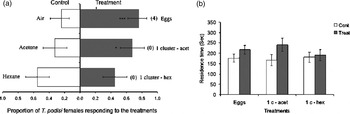
T. podisi showed a preference for volatiles emitted from one cluster of E. heros eggs when compared with air as the first choice (χ2 = 12.120, DF = 49, P < 0.001) (fig. 2a), but there was no significant difference in residence time (t = –1.880, DF = 49, P = 0.06, fig. 2b).
(a) Response of T. podisi females to plant treatments. One egg cluster vs. air; one cluster E. heros egg extract vs. acetone or hexane. Asterisks indicate significant differences between treatments using the Wald test with distribution χ2, 0.05% probability. Numbers in parentheses indicate the insects that did not respond to any treatment. (b) Residence time (seconds) of T. podisi females in the Y-tube olfactometer. One egg cluster vs. air; one cluster extract vs. acetone or hexane. The absence of an asterisk indicates that there is no significant difference between the treatments.

Bioassay of volatiles from E. heros egg extracts
When the egg extracts were tested against the solvents, the parasitoid was selectively attracted to the volatiles emitted from one-cluster acetone extracts compared with acetone as first choice (χ2 = 4.687, DF = 39, P = 0.031) (fig. 2a); the other treatments did not attract parasitoid females (fig. 2a). The residence time did not differ for any of the treatments when compared with their respective controls (one-cluster acetone extract; t = –1.494, DF = 39, P = 0.143 and one-cluster hexane extract; t = −0.231, DF = 39, P = 0.818, fig. 2b).
Bioassay of volatiles from plants with natural and artificial oviposition
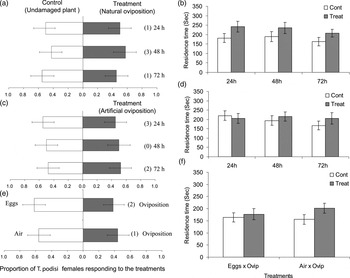
T. podisi did not distinguish between the volatiles emitted from undamaged soybean plants and those from plants with natural oviposition as first choice at 24 h (χ2 = 0, DF = 39, P = 1); 48 h (χ2 = 0.893, DF = 39, P = 0.344); and 72 h (χ2 = 0.398, DF = 39, P = 0.527; fig. 3a). There were also no differences in residence time at 24 h (t = −2.00, DF = 39, P = 0.058); 48 h (t = −0.954, DF = 39, P = 0.345); or 72 h (t = −1.20, DF = 39; P = 0.235; fig. 3b). The same pattern was observed following artificial oviposition for first choice at 24 h (χ2 = 0.398, DF = 39, P = 0.527); 48 h (χ2 = 0, DF = 39, P = 1); and 72 h (χ2 = 0.999, DF = 39, P = 0.751, fig. 3c); and for residence time at 24 h (t = 0.346, DF = 39, P = 0.730); 48 h (t = −0.533, DF = 39, P = 0.597; and 72 h (t = −1.712, DF = 39, P = 0.094); fig. 3d).
Responses of T. podisi females to odours of plants (a) treated with mated E. heros females to evaluate oviposition injury, (c) treated with two E. heros egg clusters laid on two different leaves, and (e) with natural oviposition vs. eggs or vs. air. The bioassays were performed 24, 48, and 72 h after treatment. Numbers in parentheses indicate the insects that did not respond to any treatment. Residence time (seconds) of T. podisi females in Y-tube olfactometers in response to odours of plants with (b) natural oviposition, (d) artificial oviposition and (f) plants with natural oviposition vs. eggs or vs. air. The absence of an asterisk indicates that there is no significant difference between the treatments.

T. podisi did not show a preference between the volatiles emitted from the plants with natural oviposition at 24 h compared with either the volatiles from one egg cluster as first choice (χ2 = 2.821, DF = 39, P = 0.092) or residence time (t = −0372, DF = 39, P = 0.711, fig. 3e, f). The same pattern was observed for the volatiles emitted from the plants with natural oviposition at 24 h compared with either air as first choice (χ2 = 0.716, DF = 39, P = 0.397) or for residence time (t = −1265, DF = 39, P = 0.211, fig. 3e, f).
Bioassay of volatiles from plants treated with egg extracts
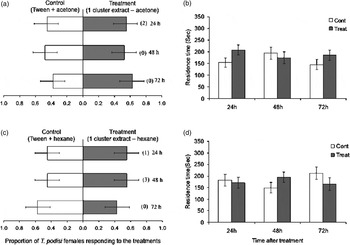
The volatiles released from plants treated with one-cluster acetone extracts were not more attractive to T. podisi than the volatiles released from control plants treated with acetone as assessed by first choice at 24 h (χ2 = 0.398, DF = 39, P = 0.527); 48 h (χ2 = 0.099, DF = 39, P = 0.751; and 72 h (χ2 = 2.446, DF = 39, P = 0.117, fig. 4a). There were also no differences in residence time at 24 h (t = −1.825, DF = 39, P = 0.075); 48 h (t = 0.434, DF = 39, P = 0.666); and 72 h (t = −1.080, DF = 39, P = 0.286, fig. 4b).
Responses of T. podisi females to odours of plants (a) treated with an acetone extract of E. heros egg clusters (treatment) or (c) with a hexane extract of E. heros egg clusters (treatment). The bioassays were performed 24, 48, and 72 h after treatment. Numbers in parentheses represent the insects that did not respond to any treatment. Residence time (in seconds) of T. podisi females in Y-tube olfactometers in response to odours of plants (b) treated with an acetone extract of an E. heros egg cluster or (d) treated with a hexane extract of an E. heros egg cluster (treatment). The absence of an asterisk indicates that there is no significant difference between the treatments.

T. podisi did not show a preference for volatiles from plants treated with one-cluster hexane extracts over hexane controls in either first choice at 24 h (χ2 = 0.398, DF = 39, P = 0.527); 48 h (χ2 = 0.398, DF = 39, P = 0.527; or 72 h (χ2 = 0.893, DF = 39, P = 0.344) or residence time at 24 h (t = 0.276, DF = 39, P = 0.783); 48 h (t = −1.198, DF = 39, P = 0.237); or 72 h (t = 0.982, DF = 39, P = 0.331, fig. 4c, d).
SEM of surface structure of plants with E. heros eggs
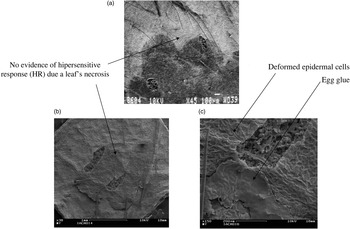
E. heros females laid eggs on soybean plants without significant damage to the leaf tissue (fig. 5a, b). When stink bugs lay their eggs, they secrete an adhesive that fixes their eggs onto the leaf surface (fig. 5c). When the eggs are removed, some of the secretion is removed with them, resulting in damage to leaf tissue (fig. 5c). The SEM images showed that egg deposition did not result in necrosis of leaf tissue and that oviposition did not provoke a hypersensitive response in the plants.
Scanning electronic microscopy images of oviposition damage caused by E. heros in soybean leaves. (a) and (b) show oviposition sites in cultivar Dowling with no evidence of a hypersensitive response due to leaf necrosis and (c) shows the glue used to fix the eggs to the sheet. (a) was obtained with a JSM 840A and (b) and (c) were obtained with a Zeiss DMS 962.

Chemical analysis of egg extracts
Chemical analysis of 1 h acetone extracts revealed 30 peaks that were consistently present in the chromatograms (Supplementary Material Table 1 and fig. 6). The egg parasitoids responded only to volatiles from acetone extracts; therefore, only compounds extracted by acetone were quantified. The major compounds identified were C16 and C18 saturated and unsaturated fatty acids, including: hexadecanoic acid; linoleic acid; (Z)-9-octadecenoic acid methyl ester, (Z,Z)-9,12-octadecadienoic acid methyl ester; methyl stearate; and (Z)-9-octadecenoic acid ethyl ester. Several minor compounds were identified, including short-chain fatty acids from C6 to C14 and monoterpenes, specifically limonene, (E)-β-ocimene, and linalool (Supplementary Material Table 1).
Discussion
The egg parasitoid T. podisi was attracted to volatile chemicals from E. heros eggs and had a positive taxis. This parasitoid may use volatiles from stink bug eggs for short-range host searching. Several volatile compounds that might be attractants were extracted from E. heros eggs. However, when eggs were laid on soybean plants, these compounds did not appear to be noticed, as the parasitoid was not attracted.
T. podisi was not attracted to volatiles emitted by soybean plants when treated naturally or artificially with one cluster of E. heros eggs, as has been previously reported (Moraes et al., Reference Moraes, Pareja, Laumann, Hoffmann-Campo and Borges2008, Michereff et al., Reference Michereff, Laumann, Borges, Michereff Filho, Diniz, Farias Neto and Moraes2011). Different hypotheses have been proposed to explain this. The SEM images showed that when stink bugs laid eggs on the leaves, there was no visible physical damage to the leaf surface that could lead to localized necrosis and hypersensitive responses (Walling, Reference Walling2000; Kaloshian & Walling, Reference Kaloshian and Walling2005). Only touching the leaf surface did not elicit an indirect plant defence that might attract a natural enemy (Hilker & Meiners, Reference Hilker and Meiners2006, Reference Hilker and Meiners2010). Although some studies have shown that the emission of OIPVs was independent of visible foliar damage or hypersensitive responses (Fatouros et al., Reference Fatouros, Lucas-Barbosa, Weldegergis, Pashalidou, Van Loon, Dicke, Harvey, Gols and Huigens2012; Tamiru et al., Reference Tamiru, Bruce, Midega, Woodcock, Birkett, Pickett and Khan2012), the absence of response of T. podisi to odours released from plants with eggs suggests that there no OIPVs were emitted in this system, which included soybean plants, E. heros’ eggs and T. podisi.
Another explanation is that chemicals in the eggs or ovipositor secretions suppressed the indirect defence of soybean plants, as suggested by Moraes et al. (Reference Moraes, Pareja, Laumann, Hoffmann-Campo and Borges2008). In Arabidopsis thaliana, elicitor-treatment suppressed plant defence responses, and the accumulation of salicylic acid at the oviposition site was thought to be involved with the suppression (Bruessow et al., Reference Bruessow, Gouhier-Darimont, Buchala, Metraux and Reymond2010). A similar response was observed following E. heros oviposition on soybean plants, which enhanced systemic methyl salicylate production compared with other treatments 96 h after egg laying, but T. podisi was not attracted to the volatiles emitted following oviposition damage (Moraes et al., Reference Moraes, Pareja, Laumann, Hoffmann-Campo and Borges2008; Michereff et al., Reference Michereff, Laumann, Borges, Michereff Filho, Diniz, Farias Neto and Moraes2011). The chemical profile of the plants changed after the E. heros eggs were laid, but the change did not result in attracting the egg parasitoid T. podisi.
Although OIPVs were not induced in this system, it was expected that the parasitoid would respond to volatiles emitted by the eggs that were present on the plants. The absence of response might be explained by the small quantities of compounds emitted by the eggs that were in contact with the plant foliage. Chemical analysis showed that an average of 5.8 ng of volatile compounds was extracted from each E. heros egg. This has been less reported than for other species (Tooker & De Moraes, Reference Tooker and De Moraes2007; Liu et al., Reference Liu, Yu and Li2008). In this study, the amount of hexadecanoic acid was 0.16 ng egg−1, but 222 ng egg−1 has been reported in Helicoverpa armigera (Lepidoptera: Noctuidae). The egg volatiles might also have been masked by constitutive volatiles of the soybean plants, which are present in much higher amounts (Michereff et al., Reference Michereff, Laumann, Borges, Michereff Filho, Diniz, Farias Neto and Moraes2011). It should be noted that in the olfactometer bioassay there were no visual or other cues to orient the egg parasitoid in addition to the constitutive volatiles from the plants. Normally, egg parasitoid responses to infochemicals include a sequence of steps that involve several cues, such as the distance from the odour source, wind, visual information of plants and eggs, and other environmental stimuli (Fatouros et al., Reference Fatouros, Dicke, Mumm, Meiners and Hilker2008; Hilker & Meiners, Reference Hilker and Meiners2011).
The saturated and unsaturated fatty acids, including hexadecanoic acid, linoleic acid, and (Z)-9-octadecenoic acid, that were found in acetone egg extracts might be T. podisi attractants. Chemical analysis of Ostrinia nubilalis (Lepidoptera: Crambidae) and Mamestra brassicae (Lepidoptera: Noctuidae) egg extracts revealed the presence of fatty acids, their ethyl esters, and various hydrocarbons, which were found to be kairomones that influenced the search behaviour of the egg parasitoid Trichogramma brassicae (Hymenoptera: Trichogramatidae) (Renou et al., Reference Renou, Nagnan, Berthier and Durier1992). Females of another egg parasitoid, Telenomus euproctidis (Hymenoptera: Platygastridae), were shown to be attracted to Orgyia postica (Lepidoptera: Lymantriidae) egg masses, but chemical analysis to identify potential semiochemicals was not done (Arakaki et al., Reference Arakaki, Yamazawa and Wakamura2011).
Presumably, egg volatiles function at short range when parasitoids are near plants, and compounds with medium and low volatility, such as long-chain fatty acids and fatty acid methyl esters, are the likely signalling molecules. The absence of OIPVs and highly volatile egg compounds that might attract Platygastridae egg parasitoids can account for the detection of HIPVs, which are reliable indicators of the presence of stink bugs and their eggs (Moraes et al., Reference Moraes, Laumann, Pires, Sujii and Borges2005, Reference Moraes, Pareja, Laumann, Hoffmann-Campo and Borges2008; Michereff et al., Reference Michereff, Laumann, Borges, Michereff Filho, Diniz, Farias Neto and Moraes2011, Reference Michereff, Borges, Laumann, Diniz and Moraes2013; Melo Machado et al., Reference Melo Machado, Sant'Ana, Blassioli-Moraes, Laumann and Borges2014).
HIPVs are important cues for parasitoid host foraging behaviour because stink bugs feed on plants while ovipositing. HIPVs are reliably associated with the presence of eggs on the plant, but the chemical profiles of both HIPVs and OIPVs can be modified by simultaneous infestation of multiple herbivores and/or pathogens that occurs under natural conditions. That can interfere with attraction of natural enemies and has been shown to affect the behaviour of various parasitoids including Cotesia marginiventris, T. basalis, T. brassicae and Trichogramma evanescens (Rasmann & Turlings, Reference Rasmann and Turlings2007; Moujahed et al., Reference Moujahed, Frati, Cusumano, Salerno, Conti, Peri and Colazza2014; Cusumano et al., Reference Cusumano, Weldegergis, Colazza, Dicke and Fatouros2015). Because of this, multitrophic interactions among herbivores that are natural enemies of the soybean should be considered in future studies evaluating parasitoid responses in this model system. It is most likely that egg parasitoids use HIPVs as reliable signals to detect the presence of their host species.
In summary, our study showed that the interaction between soybean plants, E. heros eggs and T. podisi is different from several other systems involving plant-herbivore oviposition (with or without physical damage on the leaf surface) and their natural enemies (Hilker & Meiners, Reference Hilker and Meiners2006; Fatouros et al., Reference Fatouros, Dicke, Mumm, Meiners and Hilker2008, Reference Fatouros, Lucas-Barbosa, Weldegergis, Pashalidou, Van Loon, Dicke, Harvey, Gols and Huigens2012; Tamiru et al., Reference Tamiru, Bruce, Woodcock, Caufiled, Midega, Ogol, Mayon, Birkett, Pickett and Khan2011, Reference Tamiru, Bruce, Midega, Woodcock, Birkett, Pickett and Khan2012). We also showed that E. heros eggs have compounds that affect T. podisi foraging behaviour and that E. heros oviposition alone does not induce chemicals that attract T. podisi to soybean plants. Additional studies should be conducted to evaluate the effect of the chemical compounds found in E. heros eggs on foraging behaviour in Platygastridae parasitoids. It would be interesting to determine whether increased amounts of these compounds attract natural enemies or change plant responses and whether different soybean cultivars or plant species have similar defences to mask egg volatiles.
SUPPLEMENTARY MATERIAL
The supplementary material for this article can be found at http://dx.doi.org/10.1017/S0007485316000419.
Acknowledgements
We thank Daniela Conceição for helping with laboratory rearing of the insects, Guy de Capdeville for helping in image acquisition, and Diego M. Magalhães for comments that greatly improved the manuscript. This work received financial support from the Brazilian Council for Scientific and Technological Development (CNPq) through a grant to M. F. F. Michereff, the Federal District Research Foundation (FAP-DF), and the Brazilian Corporation of Agricultural Research (EMBRAPA).