Mupirocin is commonly used for nasal decolonization of Staphylococcus aureus, but the emergence of resistance is a growing concern.Reference McDanel, Murphy and Diekema1–Reference Huang, Singh and McKinnell3 Alcohol-based nasal antiseptics are a potential alternative to mupirocin. Steed et alReference Steed, Costello, Lohia, Jones, Spannhake and Nguyen4 reported that an alcohol-based nasal antiseptic reduced the burden of S. aureus in the nares of healthcare personnel. Moreover, in a quasi-experimental study, perioperative use of an alcohol-based nasal antiseptic by orthopedic patients and personnel was associated with reduced infection rates.Reference Mullen, Wieland, Wieser, Spannhake and Marinos5 These findings are promising, but more information is needed regarding the efficacy of alcohol-based sanitizers in reducing nasal S. aureus in colonized patients.
We conducted 2 nonblinded randomized trials to determine the effectiveness of a single application of 2 different doses of a commercial alcohol-based (ie, 62% ethanol) nasal sanitizer (Nozin Nasal Sanitizer antiseptic, Global Life Technologies, Chevy Chase, MD) to reduce methicillin-resistant S. aureus (MRSA) in colonized patients. Patients receiving systemic antibiotics or nasal antiseptics were excluded. In the first trial (N = 30 participants), a single saturated swab was used to apply the product or phosphate-buffered saline to both nasal vestibules. In the second trial (N = 40), 3 separate saturated swabs were used to apply consecutive treatments over 3 minutes. The manufacturer recommends the triple-dose application for preoperative treatment, and twice-daily application of a single saturated swab is recommended postoperatively and for intensive care unit decolonization. One individual (A.K.) performed the nasal applications according to the manufacturer’s instructions.
For all participants, rayon swabs (BBL Culture Swabs, Becton Dickinson, Franklin Lakes, NJ) were used to collect cultures from the anterior nares and vestibule prior to and 10 minutes, 2 hours, and 6 hours after application. Swabs were also used to collect cultures for MRSA from the clothing and skin (hands, groin, and chest/axilla) for the initial 23 participants. The swabs were cultured for MRSA as previously described.Reference Sunkesula, Kundrapu, Macinga and Donskey6 Lab personnel were blinded to the study groups.
We also applied 3 single-dose applications of the sanitizer to the nares of 9 MRSA-colonized patients over 8 hours (applications at 0, 4, and 8 hours) using the protocol of Steed et al.Reference Steed, Costello, Lohia, Jones, Spannhake and Nguyen4 Nares cultures were collected at baseline and 2 hours after the third dose.
Repeated measures analysis of variance was used to compare treatment and control groups. For the repeated dosing group, MRSA concentrations during treatment were compared to pretreatment concentrations. Analyses were performed using R version 3.5.1 statistical software (R Foundation for Statistical Computing, Vienna, Austria). The study protocol was approved by the facility’s institutional review board.
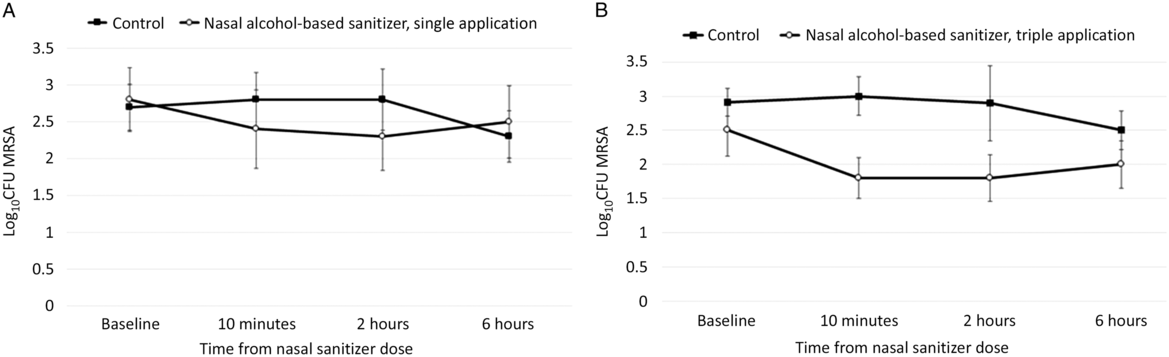
For the single-application trials, 68 of 70 (97%) participants were male, and the mean age was 65. The single-dose application was associated with a nonsignificant trend toward reduced mean MRSA concentrations in the treatment group versus the control group at 10 minutes and at 2 hours after dosing (Fig. 1A). The triple-dose application significantly reduced mean MRSA concentrations in comparison to controls at 10 minutes and at 2 hours after dosing, but not at 6 hours after dosing (Fig. 1B). MRSA was frequently recovered from the clothing (19 of 23, 83%) and skin (17 of 23, 74%) of participants.
Effect of a single application of an alcohol-based nasal sanitizer versus phosphate-buffered saline on the burden of methicillin-resistant Staphylococcus aureus (MRSA) in the nares of colonized patients. (A) Single application (N = 30 participants). (B) Triple application with 3 consecutive treatments over 3 minutes (N = 40 participants). *P < .05. Note. CFU, colony-forming units.

For the assessment of repeated dosing of the alcohol-based nasal sanitizer over 8 hours, all 9 participants were male. There was no reduction in MRSA 2 hours after the final dose in comparison to baseline (mean ±SE, 2.3 ±0.43 vs 2.3 ±0.78 log10 colony-forming units per swab; P > .05).
In summary, single-dose applications of an alcohol-based sanitizer did not significantly reduce nasal MRSA, and a triple-dose application only transiently reduced the burden of MRSA with no significant reduction by 6 hours after dosing. Several factors might contribute to the relatively limited efficacy of the alcohol-based nasal sanitizer in MRSA-colonized patients. First, adequate application of alcohol in the anterior nares is relatively challenging. Second, organic material reduces the efficacy of alcohol and may be present in relatively large amounts in the nares.Reference Boyce and Pittet7,Reference Loveday, Wilson and Pratt8 Third, S. aureus in the nares may not be accessible to alcohol treatment (ie, embedded within mucus and at the base of hair follicles).Reference Ten Broeke-Smits, Kummer, Bleys, Fluit and Boel9 At such sites, S. aureus in the nares may be analogous to resident skin flora on hands that is minimally suppressed by alcohol.Reference Boyce and Pittet7 Finally, alcohol has only a transient antibacterial effect, and more persistent activity may be required to reduce the burden of nasal MRSA.Reference Boyce and Pittet7
Our results differ from a recent report of significant reductions in the burden of nasal S. aureus in healthcare personnel with the alcohol-based nasal antiseptic applied 3 times during an 8-hour period.Reference Steed, Costello, Lohia, Jones, Spannhake and Nguyen4 The differing results may be related in part to differences between colonized patients and personnel. Most of the patients we studied were persistent carriers, whereas some healthcare personnel in the study of Steed et alReference Steed, Costello, Lohia, Jones, Spannhake and Nguyen4 may have been transient carriers. Many of the colonized patients also had a high burden of contamination on their clothing and skin, providing a potential reservoir for recurrent inoculation of the nares.Reference Kanwar, Cadnum, Thakur, Jencson and Donskey10
Our study has some limitations. The study was nonblinded regarding the application of the control or alcohol solution, and it was conducted in a single center with primarily male participants. For the assessment of repeated applications, no control group was included, and the number of participants was low. Because the triple-dose alcohol application significantly reduced MRSA for at least 2 hours, it is possible that frequent, relatively high doses of alcohol might maintain S. aureus suppression. If contamination on clothing and skin contributes substantially to recolonization of the nares, it is possible that alcohol-based nasal sanitizers might be more effective in combination with chlorhexidine bathing.
Acknowledgments
None.
Financial support
This work was supported by the Department of Veterans Affairs. Global Life Technologies provided the Nozin Nasal Sanitizer used for the study but did not provide funding or input on study design and did not review the manuscript.
Conflicts of interest
C.J.D. has received research funding from Clorox, EcoLab, GOJO, Pfizer, Avery Dennison, and Boehringer Laboratories. All other authors report no potential conflicts.