1. Introduction
1.1. Semantically extended derived nouns
In German, deverbal action-denoting nouns routinely also denote concrete referents connected with or resulting from the action, as is shown in (1) (nr in the gloss means ‘nominalizer’):
- (1)
(a) Absperrung seal.off.nr
‘act of sealing off’+‘barrier, i.e. an object that seals off or blocks’
(b) Siedlung settle.nr
‘act of settling’+‘settlement, i.e. a place where people settle’
(c) Tätowierung tattoo.nr
‘act of tattooing’+‘tattoo, i.e. the result of the action of tattooing’
(d) Bewachung guard.nr
‘act of guarding’+‘people who guard’
The nature of the additional, concrete sense is not uniform among these nouns. In some cases the result of the action of the base verb is denoted; in others the concrete sense is simply connected to the action of the base verb in some way. In (1a) the additional sense denotes the instrument with which the action of the base is achieved, and in (1b) the location of the action of the base is indicated; both are specialized interpretations of the result of the action of the base verb (i.e. a ‘barrier’ is the result of ‘sealing off’; a ‘settlement’ is the result of ‘settling’). The additional interpretations are thus result nouns, that is to say, they denote ‘the outcome of an action’ (Bisetto & Melloni Reference Bisetto, Melloni, Booij, Ducceschi, Fradin, Guevara, Ralli and Scalise2007: 394). Likewise, in (1c) the result of the verb – although this time with no further specialization – is denoted. In (1d), in contrast, the additional sense denotes not the result of the action of the base verb, but rather the agents who perform the action. The presence of a suffix associated with the formation of action-denoting nouns ensures that the action sense is constant and always predictable (Matthews Reference Matthews1991: 68; Zucchi Reference Zucchi1993: 9–10). The action sense is the word's unmarked, default sense (regardless of whether it is the word's conventional sense). Throughout this investigation the action sense of an -ung derivative is referred to as the primary sense; the concrete sense is thus the secondary sense.
The acquisition of an additional result interpretation by the nouns in (1a–c) is predictable as they are derived from verbs whose event structure implies a result (Bisetto & Melloni Reference Bisetto, Melloni, Booij, Ducceschi, Fradin, Guevara, Ralli and Scalise2007: 396–401). The collective agent interpretation in (1d) is not predictable – bewachen ‘to guard’ is not a resultative verb – and, although the acquisition of a collective agent interpretation by action nouns will be shown in this study to be regular and fairly widespread, such interpretations are based on extralinguistic knowledge (Bisetto & Melloni Reference Bisetto, Melloni, Booij, Ducceschi, Fradin, Guevara, Ralli and Scalise2007: 402).
Although existing research has tended to focus only on the result interpretations of action nouns, in this paper all additional interpretations of action nouns are studied in order to provide as comprehensive an analysis as possible of the semantic extension of action nouns and to account for the reasons why the nouns acquire the extra senses. The aim of the paper is to capture accurately the fine detail of the semantic extension that takes place in these nouns, to investigate whether the nouns' multiple senses are best accounted for by a polysemic or a monosemic analysis, and to investigate what the nouns reveal about the nature and direction of semantic change.Footnote 2
1.2. Action nouns in German
This investigation is based almost exclusively on nouns derived with the German suffix -ung, which is highly productive in the formation of action nouns primarily from complex native (and nativized Latinate) verb stem bases (Fleischer & Barz Reference Fleischer and Barz1995: 172):Footnote 3
(2) bewach-en ‘to guard’+-ung>Bewach-ung ‘guarding’
evaluier-en ‘to evaluate’+-ung>Evaluier-ung ‘evaluation’
Where no idiomatization has taken place, the resulting derivatives denote the action of the verb and nothing more (e.g. there are no implications about the speaker's attitude to the action or whether the action is ongoing, once-only or repeated). Where an -ung derivative has come also to denote the result of an action or a concrete object referent related to the action, its primary (transparent and compositional) action sense is almost always retained (this is discussed in Section 3).
Corpus data show the German suffix -ung to be productive only for the formation of deverbal action-denoting nouns: any additional senses must be extensions of the original action-denoting sense.Footnote 4 If the corpus is accepted as an accurate sample of the language, it must be the case that, diachronically, the action sense of these nouns precedes their concrete sense (contra, for example, Fleischer & Barz Reference Fleischer and Barz1995: 176). The action-denoting nouns have been extended by metonymy to acquire a concrete sense (Wellmann Reference Wellmann and Duden1998: 516), namely from the action to a concrete entity (including people) associated with that action. The direction of semantic change in these words clearly goes from abstract to concrete, contradicting the widely held assumption that the direction of semantic shift is concrete to abstract (Sweetser Reference Sweetser1990: 27; Heine, Claudi & Hünnemeyer Reference Heine, Claudi and Hünnemeyer1991: 48). Therefore, the data under investigation here pose a problem for existing theories of semantic change.
The focus here is on nouns formed with -ung, exemplified in (1), because it is the only productive means of forming deverbal action nouns whose derivatives regularly receive a secondary (result or other concrete) interpretation. The products of infinitival conversion – exemplified in (3), parallel to the examples in (1) – only exceptionally acquire a result interpretation such as that in (3e); indeed, they relatively rarely become established at all (Fleischer & Barz 1995: 211). One reason for this may be that, unlike the -ung derivatives, infinitival conversions cannot be pluralized, which is a disadvantage when denoting concrete objects.
- (3)
(a) Absperren seal.off.nr ‘sealing off’
(b) Siedeln settle.nr ‘settling’
(c) Tätowieren tattoo.nr ‘tattooing’
(d) Bewachen guard.nr ‘guarding’
(e) Essen eat.nr ‘eating’+‘food’
The action nouns productively formed with the suffix -erei are not studied further here due to their semantic and pragmatic specialization: they often have pejorative connotations (Fleischer & Barz Reference Fleischer and Barz1995: 149) and, when they acquire a secondary sense at all, it generally denotes the location at which the action is carried out. Again, the examples given are parallel to those in (1):
- (4)
(a) Absperrerei seal.off.nr
‘continued (unpleasant) sealing off’
(b) Siedlerei/Siedelei settle.nr
‘continued (unpleasant) settling’
(c) Tätowiererei tattoo.nr
‘continued (unpleasant) tattooing’+?‘tattoo parlour (viewed pejoratively)'
(d) Bewacherei guard.nr
‘continued (unpleasant) guarding’+?‘guards' office (viewed pejoratively)’
Sense extension of action nouns may also be observed among the products of now-unproductive deverbal suffixes such as -e and -nis. These derivatives are not investigated in depth here because no further sense extensions seem likely (in view of the ability of -ung derivatives to be extended) and because many of these derivatives have undergone idiosyncratic and unpredictable semantic changes. Nonetheless, some examples – parallel to those involving -ung – are included for comparison in Section 3.
This paper is structured thus: In Section 2 the theoretical background to the investigation – including a discussion of previous treatments of nouns such as those in (1) – is laid out. The data are categorized in Section 3 and tested against three hypotheses in Section 4. Section 5 tackles the question of whether the phenomenon is better described as monosemy or polysemy. In Section 6 the implications of the findings of the investigation are considered and a further application of the findings is proposed.
2. Theoretical background
2.1. Problems posed by these words
The structural transparency of the derivatives in (1) ensures that they are always motivated by their base verb regardless of their referent: the sense of the base verb is a constant in both interpretations of each noun. This suggests that the various interpretations of these derivatives is a matter of pragmatics, i.e. they receive their precise sense – action or concrete – only in context, as described by Bauer (Reference Bauer1983: 188–189) with reference to English nominalizations. This corresponds to Ruhl's (Reference Ruhl1989: ix) statement that ‘meaning almost universally ceded to be semantic should be considered pragmatic’. That claim was made in support of monosemy, which rests on the principles that ‘[a] word has a single meaning’ and that, ‘[i]f a word has more than one meaning, its meanings are related by general rules’ (Ruhl Reference Ruhl1989: 4). However, while the manner in which primarily action-denoting derived nouns acquire concrete senses clearly follows certain patterns, it is unclear whether ‘general rules’ alone offer a satisfactory explanation of the situation. Indeed, inasmuch as these derivatives have more than one sense, they conform at first glance to a traditional definition of polysemy as ‘the synchronic linking of multiple related senses to a single form’ (Sweetser Reference Sweetser1990: 1). Certainly, the secondary sense is not an ad hoc extension of the primary sense; rather, the secondary interpretations are often established and frequently idiosyncratic. A polysemy-based account can cover the fact that the secondary sense of these lexemes rarely denotes simply any concrete or result referent related to the action-denoting sense. It is unclear whether a monosemy-based account can do so.
The concrete senses of these derived nouns often correspond to semantic roles for which a productive deverbal derivational affix already exists in German, e.g. agents, instruments, etc., while for others no such affix exists, e.g. result nouns. The question of why action-denoting nouns are extended to fulfil particular roles, some of which are already occupied and others not, is also addressed here based on actual usage.
2.2. Previous approaches
Much research deals with the differences between action nouns and result nouns (for example, Chomsky Reference Chomsky and Chomsky1970 and Fu, Roeper & Borer Reference Fu, Roeper and Borer2001). The semantic extension of action nouns is mentioned in several German works (e.g. Glušak & Balakirev Reference Glušak and Balakirev1994: 29; Fleischer & Barz Reference Fleischer and Barz1995: 176; Wellmann Reference Wellmann and Duden1998: 427; Erben Reference Erben2000: 101); Motsch (Reference Motsch1999: 435) states that if a suffix is associated with the formation of action nouns, then it is usually also associated with agent, instrumental, result and locative nouns. Away from German, Bisetto & Melloni (Reference Bisetto, Melloni, Booij, Ducceschi, Fradin, Guevara, Ralli and Scalise2007) investigate the relationship between the action and result interpretations of Italian deverbal nouns and the role played by the derivatives' bases in the possible interpretations of these derivatives. Booij & Lieber (Reference Booij and Lieber2004) examine the reasons why words and affixes acquire extra senses and functions, concluding that the pragmatic pressure to fill a gap in the derivational system of a language leads suffixes to gain additional functions. Their work serves as a starting point for the analysis developed here.
3. The characteristics of derived nouns with multiple senses
The examples in (1) suggest that the additional sense acquired by an action-denoting noun is relatively idiomatic, despite its structural and semantic transparent relation to the action sense and to the base verb, and despite the predictable acquisition of a result sense of an action noun derived from a result verb. This property has serious implications for a hypothesis proposing that the nouns are only listed once in the lexicon and given a precise sense in context according to pragmatic factors. An entirely regular concrete sense could be activated as required, but as soon as the secondary sense becomes even slightly semantically specialized, it has to be listed in the lexicon. To assess the relationship between the primary and secondary senses, and the extent of the specialization of the secondary sense, it is necessary to look at the way in which the words are used. This section examines the semantically extended -ung derivatives found in the corpus.
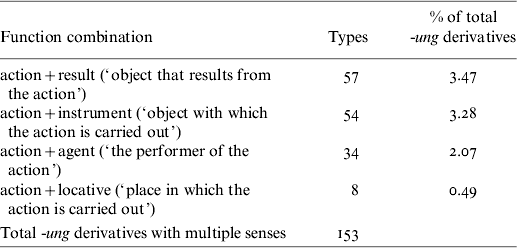
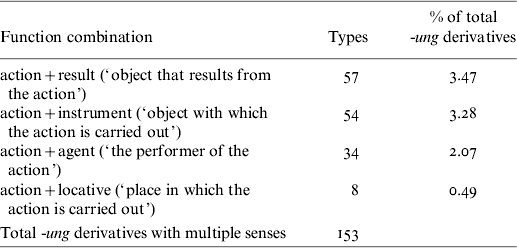
The corpus contains 1644 individual deverbal -ung derivatives (types). Of these, 1486 types (90.39%) exclusively denote an action, while 16 types (0.97%) have only a concrete or result sense (i.e. their primary action sense has fallen out of use). 153 types (9.31%) denote both an action and a concrete or result referent: these are the derivatives investigated here. The rarity with which the action sense is lost indicates the strong coherence of -ung as an action-denoter. Despite the low numbers of derivatives involved, the secondary senses acquired by the derivatives pattern into a grouping more complex than that sometimes assumed in the existing research: the grouping is shown in Table 1, which also indicates the extent to which the various combinations, which are forms of polysemy networks (Taylor Reference Taylor2003: 644), occur in the corpus (see Wellmann Reference Wellmann and Duden1998: 427; a similar list is given in Glušak & Balakirev Reference Glušak and Balakirev1994: 29). There is some overlap between the sub-categories: instrumentals and locatives may also be specializations of the result of an action; the nouns analysed here as ‘results’ are those whose result sense has not become specialized.
The multiple functions performed by the -ung nouns in the corpus
In the sub-sections that follow, each of the above combinations is examined in turn. The nature of the secondary concrete function and its relation to the primary action sense are considered.
3.1. Action+result
This type of sense extension, which is predictable in action nouns derived from resultative verbs (as noted, with reference to Bisetto & Melloni Reference Bisetto, Melloni, Booij, Ducceschi, Fradin, Guevara, Ralli and Scalise2007, in Section 1.1 above) is the most frequently occurring secondary function of -ung nouns: it denotes – with no semantic specialization – ‘the result of the action’ in a broad sense:
- (5)
(a) Bestellung order.nr
‘ordering’+‘order, i.e. item that has been ordered’
(b) Erzählung tell.nr
‘telling’+‘account, story, i.e. thing that is told’
(c) Tätowierung tattoo.nr
‘tattooing’+‘tattoo, i.e. result of the action of tattooing’
(d) Veröffentlichung publish.nr
‘publishing’+‘publication, i.e. thing that is published’
The additional sense here denotes simply the end result of the action denoted primarily by the noun (Wellmann Reference Wellmann and Duden1998: 516); while many of the result interpretations denote a concrete referent (Bestellung, Tätowierung), others have no concrete referent (Erzählung ‘telling, story’ <erzählen ‘to tell’). Any further information is added in context. The predictability of this extension accounts for its relatively high frequency, as does the fact that there is no derivational means of directly forming result nouns in German; this role has, historically, frequently been assumed by deverbal action nouns, such as the now unproductive suffix -nis and the very weakly productive suffix -e, illustrated in (6):
- (6)
(a) Ersparnis save.nr
‘saving’+‘saving, i.e. money that is saved’
(b) Ausgabe give out.nr
‘giving out, distribution’+‘edition, i.e. item that is “given out”’
(c) Einnahme take (in).nr
‘taking in, income’
3.2. Action+instrument
The semantic limitations of the primary productive deverbal instrument suffix (-er) force the semantic extension of action nouns. Prototypically, -er instrumentals denote instruments in a narrow sense, namely implements with which an action is carried out (Fleischer & Barz Reference Fleischer and Barz1995: 153). Action nouns with -ung are extended to denote instruments that are not implements as such, but are generally instruments on a large scale or are collective or conceptual, as shown in (7), in which possible -er instrumentals (glossed inst) are also listed. This tallies with the greater semantic generality of the -ung agents compared to the -er agents (see Section 3.3). The -ung action nouns are extended here to fill gaps in the lexicon. While Absperrung and Verglasung are specific uses of result senses, such an interpretation is not possible for Lenkung.
- (7)
(a) Absperrung seal off.nr
‘sealing off’+‘barrier, i.e. object with which something is sealed off’
vs.
?Absperrer seal off.inst
‘machine for sealing something off’
(b) Lenkung steer.nr
‘controlling, steering’+‘steering system (in a car), i.e. the totality of the instruments required with which to steer a car’
vs.
?Lenker steer.inst
‘controller, steerer’
(c) Verglasung glaze.nr
‘action of glazing’+‘glazing, i.e. that with which a window is glazed’
vs.
?Verglaser glaze.inst
‘machine for glazing’
3.3. Action+agent
The agent interpretations of -ung derivatives have no semantic connection with a result interpretation (see also Melloni Reference Melloni2006: 292, who does not include such nouns); they are more idiosyncratic and unpredictable. The agents denoted by -ung nouns are usually collective, i.e. they are singular nouns that denote a group of people who perform the action of the base verb, as shown in (8), in which the corresponding -er agents (glossed ag) are also noted.
- (8)
(a) Besetzung fill.nr
‘occupying, filling’+‘people filling a role’
vs.
Besetzer fill.ag
‘occupier’
(b) Regierung govern.nr
‘governing’+‘government, i.e. people who govern’
vs.
Regierer govern.ag
‘ruler’
(c) Verwaltung administer.nr
‘administrating’+‘administration, i.e. people who administer’
vs.
Verwalter administer.ag
‘administrator’
An -ung noun is used to denote an individual agent only twice in the corpus (confirming the rarity of this use noted by Fleischer & Barz Reference Fleischer and Barz1995: 176):
- (9)
(a) Begleitung accompany.nr
‘accompanying’+‘person who accompanies’Footnote 5
(b) Vertretung deputize.nr
‘deputizing’+‘person who deputizes’
This scarcity of singular agents is a result of the high productivity of the primary deverbal agent suffix -er, which renders superfluous the sense extension of -ung derivatives in this function and usually blocks potential formations; indeed, the two agent interpretations in (9) compete with synonyms in -er, namely Begleiter and Vertreter. The sense extension of action nouns, a semantic process (albeit one that makes reference to morphology), is thus weaker than the morphological process of derivation from scratch; that is to say, the preferred option is the formation of an agent noun with -er.
The collective agent sense is not covered by the -er agents (other than by making an -er derivative plural, which would not completely satisfy the required meaning). In fact, there is no derivational affix in German whose primary role is to form deverbal collective agent nouns. The next-best possibility available to speakers is the extension of the action nominalization of the relevant verb to denote the required referent who performs the action of that verb and, therefore, the action of the action nominalization (see Wellmann Reference Wellmann and Duden1998: 513). This process is similar to the phenomenon described by Booij & Lieber (Reference Booij and Lieber2004: 352) as the ‘pragmatic pressure’ that results when there is ‘a real world need for a specific kind of word, but no available productive affix in a language with which to create such a word’. While Booij & Lieber (Reference Booij and Lieber2004: 352) state that in such a situation ‘the semantically closest productive affix is put to use’, which suggests that a new derivative is formed with a secondary affix (in this case, the action-denoting -ung), in the data the semantically closest word is utilized, namely to denote a sense that cannot be denoted using productive derivational means. In this investigation it is assumed that the sense extension due to pragmatic pressure involves whole derivatives – and not just their affix – because of the various types of extension which relate to the sense of the whole word (and its base verb), and because of the apparent tight controlling of the semantic extension by blocking which can only work by making reference to the whole word. This is why Booij & Lieber's terminology is extended here. Nonetheless, the suffix -ung clearly serves as a marker to speakers that the nouns denote actions and is therefore the key to the filling of a gap in the lexicon or the affix inventory. Semantic extension of derived words due to the pragmatic pressure stemming from a gap accounts for the relatively high frequency of collective agents compared to singular agents among the -ung nouns.
Semantic extension of action nouns to ensure economy in the lexicon is a tendency rather than an absolute rule, and counter-examples may be found. In Italian, for example, despite the existence of edificio ‘building (i.e. a house, etc.)’, the action noun costruzione ‘building’ also denotes a concrete ‘building’ (as a synonym of edificio). If edificio predates the concrete sense of costruzione, it would be expected that the extension of the action noun costruzione would have been blocked by the existence of edificio (as is predicted by a standard theory of blocking); if the concrete sense of costruzione predates the morphologically unrelated edificio, the preservation of economy in the lexicon has clearly broken down.Footnote 6 In German, the action noun Bau ‘building’ (<bauen ‘to build’) also has a concrete sense denoting a ‘building’, a sense with which the morphologically related Gebäude and Bauwerk (both concrete ‘building’) are also established. Such examples relate to relations between words in the lexicon and serve to emphasize the tendential nature of the preservation of lexical economy. This existence of synonyms does not, however, have further implications for the thesis presented here, namely that the lack of an affix with a particular function can activate a semantic extension of an action noun with an appropriate meaning.
A further type of agent found in this combination is the group of impersonal agent nouns. The prototypical referents of deverbal -er nouns are not impersonal (although such an interpretation is possible). The non-prototypicality of impersonal -er agents may well have led to the extension of -ung action nouns as in (10). The possible -er derivative would be semantically more specific.
- (10)
(a) Beschränkung restrict.nr
‘restricting’+‘restriction, i.e. thing that restricts’
vs.
?Beschränker restrict.ag
‘restrictor’
(b) Leitung lead, conduct.nr
‘leading, conducting’+‘cable, (telephone) line, i.e. thing that conducts’Footnote 7
vs.
Leiter lead, conduct.ag
‘conductor’Footnote 8
3.4. Action+locative
Infrequently, -ung action nouns are extended to denote the place at which the action is carried out:
- (11)
(a) Ausstellung exhibit.nr
‘exhibiting’+‘exhibition, i.e. place where items are exhibited’
(b) Kreuzung cross.nr
‘action of crossing’+‘crossing, i.e. place where a road or railway line is crossed’
(c) Siedlung settle.nr
‘settling’+‘settlement, i.e. place where people settle’
All of the examples encountered in the corpus, such as those in (11), are result nouns (i.e. an Austellung is the product of ‘exhibiting’, a Kreuzung is the product of one object ‘crossing’ another, a Siedlung is the product of ‘settling’). Despite the rarity of the extension of -ung in this way, the action-to-place-of-action extension pattern is salient and found both elsewhere in German and in a number of other languages, particularly with the suffixes that developed from the French -erie:
- (12)
(a) German: Brauerei brew.nr
‘brewing’+‘brewery’
Spinnerei spin.nr
‘spinning’+‘spinning mill’
(b) Danish: bogbinderi book bind.nr
‘book binding’+‘place at which book binding takes place’
(c) Dutch: melkerij milk.nr
‘milking’+‘dairy, place at which milking takes place’
In the languages exemplified in (12), the cognate suffixes -(er)ei, -eri and -erij attach to deverbal and denominal bases (e.g. Brauerei and Spinnerei in (12a) are also motivated by, respectively, Brauer ‘brewer’ and Spinner ‘spinner’). In the German corpus used in this investigation, -(er)ei forms only deverbal and denominal action nouns productively, but not locatives.Footnote 9 The -(er)ei locatives generally denote specifically a place of work, thus the type of locative covered by -ung nouns in (11) still fill a gap in the affix inventory.
The barely productive deverbal action suffix -e (which has been superseded by -ung) exhibits the same pattern of sense extension in all functions as -ung and is primarily (albeit weakly) productive for the formation of deverbal locatives, in (13) below (glossed loc); that is to say, it derives nouns directly with a locative sense (with no evidence of an action noun having been semantically extended). It thus conforms completely to Booij & Lieber's definition of pragmatic pressure (rather than the extension to words proposed in this paper) according to which it is the semantically closest affix that is used. Diachronically, this can be seen as a result of analogy with -e derivatives that received a locative interpretation through sense extension of their action sense. Synchronically, the fact that -e is now barely productive for action nouns suggests that a prerequisite of primary productive use in an additional function is a loss of productivity in the (diachronically earliest) primary function. Accordingly, the highly productive -ung is unlikely to see productive primary use in the formation of concrete nouns.
- (13)
(a) Tanke fill up.loc
‘petrol station’, but *‘action of filling a car with petrol’
(b) Umkleide change clothes.loc
‘changing room’, but *‘action of changing one's clothes’
3.5. Conclusions on the characteristics of the semantically extended -ung nouns
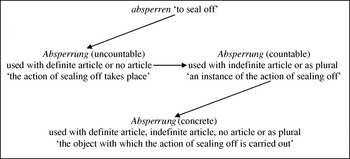
The diachronic order of the acquisition of the two senses of the semantically extended -ung nouns sheds some light on the likely stages undergone by the nouns when acquiring a secondary sense. At its most basic, an -ung action noun used with either a definite article or no article is uncountable; once extended, it is both countable and may denote a concrete referent. An intermediate stage is assumed here in which the noun denotes only an action but is countable. The route of the extension posited is shown in Figure 1.
The process by which an action noun acquires a concrete sense.

This sequence is disputed by Fleischer & Barz (Reference Fleischer and Barz1995: 176), who consider the denoting of concrete objects to be a primary function of -ung and not simply occasional sense extension. However, their examples, Kupplung ‘coupling, clutch (of motor vehicle)’ and Täfelung ‘panelling’, an action interpretation of which is said by Fleischer & Barz to be doubtful, are both in fact established with an action sense (see, for instance, the words' entries in Duden Reference Duden2001).
Important for the proposal in Figure 1 is the absence of evidence in the corpus that -ung derivatives are formed directly with a concrete sense: with two exceptions (which are explained below), the only non-established -ung derivatives denote actions. In the corpus there are 59 non-established -ung derivatives (3.59% of all the -ung types in the corpus), of which 57 denote an action. The remaining two ‘new’ derivatives have a concrete sense in context but could also denote an action and probably received their concrete interpretation by analogy with the semantic extensions of the nominalization of the head of their compound verb bases, as shown in (14). The sense found in the corpus is shown in bold type.Footnote 10
- (14)
(a) Vorabmeldung advance report.nr
‘advance reporting’+‘advance report’
(cf. Meldung ‘reporting’+‘report’)
(b) Vorabveröffentlichung advance publish.nr
‘advance publication/publishing (action)’+‘advance publication’
(cf. Veröffentlichung ‘publication/publishing’+‘publication (object)’)
A further point considered was the level of use of each sense of the -ung derivatives, with the aim of finding whether, in general, the action sense or the concrete sense could be considered the conventional sense. If, for example, it was found that the concrete sense was always more widely used, this would suggest that the concrete sense was the conventional one. In fact, no trends were found in the data. For example, while the action sense of Bestellung ‘order (action+concrete)’ (26 tokens) outnumbered its concrete sense (4 tokens), the opposite was the case for Stiftung ‘action+collective agent’, which had 99 tokens with concrete referents and 6 tokens denoting actions. The prevalence of one sense over another is dependent on the use of the individual derivatives and not on any wider patterns within the derivational system.
4. Hypotheses to explain derived nouns with multiple senses
An analysis of these nouns must account for the following characteristics:
• diachronically, the action-denoting sense precedes the concrete sense
• both senses are established
• the action-denoting sense is wholly transparent while the concrete sense is often idiosyncratic
• in use, the two senses are independent of one another: no knowledge of the action sense is required to understand the concrete sense
In this section, three possible explanations of the data are proposed and measured against these criteria.
4.1. Hypothesis 1: The lexemes are polysemous
As nouns with two interpretations clearly related to one another, the -ung derivatives are obvious candidates for description as examples of polysemy, i.e. ‘the synchronic linking of multiple related senses to a single form’ (Sweetser Reference Sweetser1990: 1). The principal motivating factors for a polysemic explanation of the phenomenon are the fact that a word's acquisition of an extra sense is part of a diachronic transition, and the fact that the referent of the secondary sense is often idiosyncratic or specialized, and therefore independent of the primary sense. The additional sense of a polysemous word is obtained by extending its original sense, often metaphorically, as in (15). Similarly, the additional sense of an -ung derivative can be viewed as a (metonymic) extension of the original sense, as in (16).
(15) Birne ‘pear’>‘light bulb (similar in form to pear), head (similar in form to pear)’
(16) Absperrung ‘sealing off’>‘barrier (i.e. instrument with which something is sealed off)’
In (15), the original sense of the lexeme and the additional sense have distinct, established senses: both must be listed in the lexicon. In (16), only the secondary sense has to be listed; the primary one could be listed but can always be retrieved from the components of the word (Taylor Reference Taylor2003: 642). Despite this similarity, however, the two cases are not directly comparable. In (15), in which the noun is simplex, the additional sense refers only to the referent of the original sense. In (16), the noun is a transparent deverbal derivative and the additional sense makes reference to the base verb as well as to the noun's original action sense. Thus, the semantically extended -ung derivatives – if this hypothesis is to be followed – represent an atypical kind of polysemy.
On this account, the semantically extended -ung nouns are polysemous, having an abstract sense and a concrete sense (agent, instrument, locative or result), both of which are lexically listed. The required sense is selected in context. The action-denoting sense is wholly predictable and transparent (and therefore unmarked); the concrete sense is specialized, unpredictable and therefore relatively marked in comparison. This polysemy is the synchronic manifestation of the diachronic phenomenon of semantic change (see Fritz Reference Fritz1998: 57; Blank Reference Blank and Nerlich2003: 268), of which the action sense is the starting point, and represents an intermediate stage in the continuum of change: ‘no historical shift of meaning can take place without an intervening stage of polysemy’ (Sweetser Reference Sweetser1990: 9, also Traugott & Dasher Reference Traugott and Dasher2002: 280). This process is illustrated in (17), where M stands for the meaning of a particular word, M1 is the action sense and M2 the additional sense:
(17) M1>M1~M2 (>M2) (Traugott & Dasher Reference Traugott and Dasher2002: 280)
The stage ‘M1~M2’ is polysemy. The final stage in which M1 is lost and M2 prevails is not always reached (and therefore appears in parentheses in (17)): ‘only occasionally do old meanings disappear altogether’ (Traugott & Dasher Reference Traugott and Dasher2002: 280). The result of stalled semantic change is a state of polysemy that may last indefinitely (Traugott & Dasher Reference Traugott and Dasher2002: 12). In Section 4 it was noted that the M2 -ung derivatives – i.e. those which denote only concrete objects, having lost their action sense – are relatively rare and that the polysemous ones (the M1~M2 derivatives) are relatively frequent. This suggests that semantic change is highly susceptible to stalling and that the transitional state manifested as polysemy is actually the regular state of affairs. The strong coherence of -ung as a marker of an action noun prevents the loss of the original M1 sense.
Polysemy, as the consequence of semantic shift, is an inherent indicator of the direction of this shift (see Cruse Reference Cruse2004: 212). All the nouns investigated here carry a marker – their derivational affix – indicating that they were formed as action-denoting nouns. Accordingly, the direction of semantic change in these cases must go from an abstract sense to a concrete sense. This conflicts with the traditionally assumed ‘concrete-to-abstract’ direction of semantic change (e.g. Sweetser Reference Sweetser1990: 27), as exemplified in (18). Most of the -ung derivatives clearly travel backwards along this continuum, beginning at ‘activity’ and moving towards ‘object’ or ‘person’. Only the action+locative derivatives move in the ‘correct’ direction.
(18) person>object>activity>space>time>quality (Heine et al. Reference Heine, Claudi and Hünnemeyer1991: 48)
The traditional assumption of concrete-to-abstract semantic change implies that, at least synchronically, the concrete sense of a polysemous derivative is to be regarded as the main sense, with the action sense secondary and not always present or established; that is, the concrete sense would be the default reading of the word, the sense that ‘first comes to mind when the word is encountered out of context, or the reading which one would assume to be operative in the absence of contextual indications to the contrary’ (Cruse Reference Cruse2004: 196). The transparent and unmarked action sense can be reconstructed by speakers at will. The corpus data show, however, that some of the derivatives discussed here have a prevailing action sense and others a prevailing concrete sense, and that an action sense is always present. It therefore cannot be assumed that either sense is the default for all polysemous derivatives; the only certainty is that the abstract sense is always wholly predictable.
4.2. Hypothesis 2: The derivational suffixes are polysemous
An alternative view is that multiple senses of a derived word arise not because the word is polysemous, but because the derivational affix is polysemous. A polysemic analysis of derivational affixes that perform several functions is made by Lehrer (Reference Lehrer and Nerlich2003: 217), Lieber (Reference Lieber2004: 17–18) and Booij (Reference Booij2005: 220). A derivative formed with a polysemous affix can potentially perform any of the semantic functions which the affix can denote. This hypothesis, however, does not fully explain the data. The potential is seldom exploited: once a derivative is established with a particular additional (i.e. non-action) sense, it only rarely receives further additional interpretations: these are blocked by the established interpretation. This blocking must make reference to the entire derivative and not only to the affix. Therefore, even if the view is taken that the affixes are polysemous, provision must be made for lexical storage of all the senses of each derivative (i.e. the derivatives would also be polysemous), otherwise the blocking could not take place. Without this blocking an -ung derivative could have four concrete interpretations in addition to its action-denoting sense. The data offer no evidence of this beyond a handful of derivatives which have two concrete senses. Furthermore, a polysemous affix could be used to primarily form a derivative with any of that affix's senses: this does not occur in the data (other than the two weak exceptions noted in (14) above). Because of its focus on the affix and not the whole word, this hypothesis does not explain the apparently ‘wrong’ path of semantic change taken by the derivatives, i.e. the fact that the abstract sense always precedes the concrete sense.
4.3. Hypothesis 3: The lexemes are monosemous
In contrast to the preceding hypotheses, both of which ultimately entail that the individual senses of the semantically extended -ung derivatives are listed separately in the lexicon, the hypothesis put forward here strives for lexical economy. Monosemy is the principle according to which ‘as few senses as possible should be given separate recognition in the (ideal) lexicon of a language, and as many as possible derived from these’ (Cruse Reference Cruse2004: 94; see also Lyons Reference Lyons1963: 90). The constant of an affix with a certain sense in a large group of words, all of which have this sense alongside a further sense (drawn from a restricted repertoire) makes a monosemic analysis of the data seem expedient. The data could fit the ‘monosemic bias’ proposed by Ruhl (Reference Ruhl1989: 4), noted in Section 2.1 and reproduced in (19):
(19) First Hypothesis: A word has a single meaning.
Second Hypothesis: If a word has more than one meaning, its meanings are related by general rules.
The relationship between the base verb and the senses of the semantically extended derived words seems to allow a description of the words in terms of monosemy. The constant transparency of the base verb provides the ‘single meaning’ of each interpretation of a semantically extended -ung noun. The constancy of the sense of the base verb allows a word's meanings to be ‘related by general rules’. These ‘general rules’ state that an -ung noun denoting nothing more than the action of the base verb may also denote concrete referents in the semantic roles of result, agent, instrument and locative. This situation matches that described by Copestake & Briscoe (Reference Copestake, Briscoe, Pustejovsky and Bogureav1996: 48): ‘basic conventional senses are assumed by default, and … the extended senses have to be forced by context’. The action sense, which is constant in all the examples, is the ‘unitary meaning for a lexical item’ (Ruhl Reference Ruhl1989: 4; see also Traugott & Dasher 2002: 15) that is the basis of the assumption of monosemy. A word's action sense alongside its concrete sense is that word's ‘variant range’ (Ruhl Reference Ruhl1989: 4). Regarding the choice between a polysemic and a monosemic analysis, Fretheim (Reference Fretheim, Németh and Bibok2001: 113; see also Lyons Reference Lyons1963: 90 and Fretheim Reference Fretheim, Németh and Bibok2001: 80)Footnote 11 concludes that
[o]ne should opt for a monosemous rather than a polysemous account of lexical meaning when (i) syntax, prosody, or their combination is what causes the hearer to exclude one meaning variant and adopt the other one, or (ii) when there exist contexts which neutralize the difference between the meaning variants.
Accordingly, the multiple-sense -ung derivatives are monosemous under Fretheim's criteria (i) and (ii): the syntactic behaviour of the action and concrete readings is divergent, and each reading is clear in context. This approach is, however, only partly successful.
It is true that a word such as Überraschung ‘surprise’ (derived from the result verb überraschen ‘to surprise’) can be ‘modified in context by a process of inferential enrichment of the encoded lexical meaning’ (Fretheim Reference Fretheim, Németh and Bibok2001: 80), namely the meaning of the base verb, so that not only that action of the base verb may be denoted, as in (20a), but also a concrete referent related to the verb, as in (20b).
(20)
(a) die Überraschung des Mannesthe.fem.nom surprising the.masc.gen man.masc.gen‘the surprising of the man’
(b) Es stand eine schöne Überraschung auf dem Tisch.it stood a.fem.nom lovely.fem.nom surprise on the.masc.dat table‘There stood a lovely surprise on the table.’
There is, however, no established or listed concrete referent for Überraschung; only the fact that it may denote a concrete result is listed in the lexicon. The monosemic approach is convincing in a case such as this. If, on the other hand, the concrete sense is established, unpredictable, has a specific referent, and is therefore necessarily lexically listed, the monosemic approach is less convincing: it is unclear what kind of ‘general rules’ (Ruhl Reference Ruhl1989: 4) could link such an idiomatic sense with the lexeme's transparent, predictable action sense. For instance, the concrete sense of Absperrung (from the result verb absperren ‘to block’) is not simply ‘any concrete manifestation of the action of absperren’ (i.e. as is the case with Überraschung and its base überraschen), but rather is also the specific and unpredictable ‘barrier’ (although a barrier itself may have many different physical manifestations). In cases where the additional meaning is as specific as this (which is generally the case in the data), a separate rule stating the precise referent/semantic content would be necessary. The specific semantic content of the additional senses must be listed (if speakers are to use and understand the words successfully) in the manner of a polysemic analysis.
Accordingly, it would have to be concluded that, if no concrete sense is listed in the lexicon (type: Überraschung), then monosemy is a convincing explanation; if, however, the concrete sense is listed (type: Absperrung), then a polysemic description is more able to account for the situation. Thus, the monosemic approach accounts only for part of the data; the polysemic approach, despite its relative lack of economy and its clash with traditional views of semantic change, accounts for all the data.
5. Polysemy vs. monosemy
Each of the three possible analyses proposed in Section 4 has strengths and weaknesses. The principal strength of a monosemic analysis is its economy, but it is not able to account for cases in which the secondary sense is established and idiosyncratic. The ability to account for that characteristic is the strength of the polysemic analysis, whose drawback is, in addition to its lack of economy, its conflict with the accepted direction of semantic change. Nonetheless, the conclusion reached in Section 4.3 was that only a polysemic description is able to account for all cases of semantically extended -ung derivatives. In this section, this position is refined and its implications are considered.
The data indicate that the semantic extension, despite its relative rarity, is more systematic and regular than the literature admits. Löbner (Reference Löbner2002: 40) states that polysemy ‘results from a natural economic tendency of language’. Whether a polysemic or monosemic analysis is to be pursued, this is also the case for the semantically extended -ung derivatives. As shown in Section 3, the semantic extension of -ung derivatives, resulting from the pragmatic pressure to fill lexical gaps and gaps in the inventory of productive primary affixes, is an important part of the derivational system (see Wellmann Reference Wellmann and Duden1998: 513; Booij & Lieber Reference Booij and Lieber2004: 352). It restricts the number of productive affixes available in the language, thus easing the burden on the lexicon: it is a means of ensuring economy in the morphological system. For example, the semantic extension of the -ung derivatives means that suffixes for the formation of collective agents, (conceptual) instruments, deverbal locatives and general result nouns are unnecessary. The semantically unspecific (and therefore flexible) action nouns, which are simply a nominal manifestation of their base verb, are identified as semantically closest to the referent, which itself is either the result of the action of that verb, or is closely related to the action of the verb in some other way.
The action-denoting -ung derivatives can acquire one of four secondary concrete senses (and occasionally more than one). The data suggest that this inventory of concrete interpretations is restricted (for instance, by the same restrictions as morphological productivity, such as blocking) and apparently closed (no new types of interpretation appear to have been added). Thus, while the concrete interpretation cannot be described as predictable as such, although the potential for a general result interpretation of a noun derived from a resultative verb is predictable, the patterning of the concrete interpretations itself is predictable. This corresponds to Löbner's (Reference Löbner2002: 45) statement that, in cases such as this, ‘[t]he kinds of relations are, to a certain extent, predictable. But whether or not a certain lexeme in a certain language at a certain time will have a certain range of meanings is not predictable’. The transparency of the derivatives and the high coherence of the suffix -ung in its action interpretation mean that the primary, action sense of the derivatives is always predictable. Dressler (Reference Dressler, Štekauer and Lieber2005: 271) states that ‘[w]ord formation rules can only predict word formation meaning [e.g. the action sense of -ung nouns] but not the opacifying differences between word meaning and word formation meaning’; for example, Absperrung could equally have acquired an agent sense (‘the group of people active in sealing off an area’) or a locative sense (‘the place that is sealed off’). This suggests that the repertoire of senses of the suffix -ung is paradigmatically arranged, with one of the possible interpretations of a lexeme becoming actualized. Thus, an -ung action nominalization may acquire an agent, instrument, locative or result sense as required. The addition of a further concrete sense is usually blocked.
The difference in nature between the Überraschung ‘surprise’ and Absperrung ‘barrier’ types (see Section 4.3 above) means that they could be analysed differently. A monosemic description is sufficient to account for the Überraschung-type cases, in which only the word's ability to denote an unspecified referent with a concrete sense (the result of the action of the verb) must be covered. If, however, as in the Absperrung-type cases, the concrete sense is established and possibly idiosyncratic or specialized (although still morphologically transparent), denoting a fixed referent, only a description positing lexical listing of both senses of the word (i.e. the primary action sense and the secondary concrete sense) is sufficient: a polysemic description does this. In any case, the difference between the concrete senses of Überraschung and Absperrung is one of usage rather than of the lexemes' semantic content: the former could potentially receive (or have received) a specific sense, while the latter could (until it became established with a specific sense) have been used generally to denote any concrete manifestation of the result of the action of the base verb. Other than the matter of whether the referent of the word's concrete sense is fixed or not, there is no compelling reason to separate the two types of semantically extended -ung derivative. Every other aspect of the two types' behaviour is identical. The aim of the remainder of this section is to provide a unified analysis of these words.
The data presented in this investigation suggest that the phenomenon is highly organized and restricted. The -ung derivatives, all of which were formed initially as action nouns, are semantically extended to denote a concrete referent with one of the four possible senses (collective or impersonal) agent, instrument, locative or result. This semantic extension is a matter of routine. Once established, the secondary concrete sense of each lexeme – but no further semantic information – is listed in the lexicon; therefore, Absperrung is listed as having an action and an instrumental sense, Überraschung as action and agent. The difference between the concrete extensions of Absperrung and Überraschung is a result of usage and not of processes in the lexicon itself: the former is routinely applied directly to its concrete referent (which remains the same or similar all the time) while the latter denotes the result of the action and has no fixed, regularly occurring referent beyond this. This proposed lexical listing of senses is supported by the fact that the usual concrete senses usually block a further concrete interpretation of the derivative; thus, for example, Absperrung is never encountered with the collective agent sense ‘group of people who carry out the action of absperren (?‘the blockers-off’), although this would be possible, based on the behaviour observed among the data as a whole. This resembles prototypical morphological blocking which is overcome only relatively rarely (see e.g. Aronoff & Anshen Reference Aronoff, Anshen, Spencer and Zwicky1998: 240).
The aim of this section was to determine whether the semantically extended -ung derivatives should be accounted for as monosemy or polysemy. It has been shown that the phenomenon cannot be considered a canonical example of either type of analysis. The most serious weakness of the monosemic analysis is its inability to account for the Absperrung-type cases, i.e. those in which the secondary concrete sense is established and idiosyncratic. If all the data are to be described by a single analysis, a polysemic analysis must be preferred. Such an analysis allows for lexical listing of the secondary senses and therefore describes both the Überraschung and Absperrung types. In canonical polysemy, the relation between the primary and secondary senses is one of semantic extension alone; in the cases considered here, the primary and secondary senses are related not only through semantic extension, but also through their morphological structure: their transparency means that the sense of the base verb motivates both senses. In sum, the semantic extension by which -ung action nouns come also to denote concrete referents is a form of polysemy, albeit a non-prototypical one. The derived words themselves are polysemous and the fact that the suffixes perform several functions is a consequence of the polysemy of the words on which they occur: only this explanation can account for the controlled nature of the semantic extension observed.
6. Further implications and applications of the findings
If the semantic extension of -ung derivatives is accepted as an instance of polysemy, this implies that the derivatives are a rare counter-example to the accepted direction of semantic change. The implications of the findings for this aspect of historical linguistics do not seem to be grave, however. The multiple senses of the -ung derivatives are a consequence of these derivatives' ability to denote more than one semantic function. Potentially at least, it seems that the suffix could be used to primarily form derivatives with any of the four concrete functions should a context require such a word. That this does not happen in practice is simply a matter of routine – and blocking – and does not necessarily prohibit the potential primary formation of derivatives with concrete senses. Only if this were wholly prohibited, and if a primary abstract sense were a necessary first step (which is nonetheless the situation in the usage data studied), would the data seriously contradict the direction of semantic change.
A further implication of a polysemic analysis is its acceptance that the nouns involved must be lexically listed. It has been claimed in generative linguistics that productively formed derivatives – such as the German -ung nouns – are not lexically listed (Aronoff Reference Aronoff1976: 45; Zucchi Reference Zucchi1993: 3).Footnote 12 The principle is that the productively formed derivatives ‘only come into existence when created by rule and must be created again when needed again’ (Anshen & Aronoff Reference Anshen and Aronoff1988: 646). Since a word must be lexically listed before it can assume additional senses, such a view implies that derivatives formed by productive means cannot become polysemous. In German, however, the attachment of -ung to a verb stem to form an action noun is highly productive. Overall, rather than occurring where suffixes have lost their coherence or productivity, as argued by Aronoff (Reference Aronoff1976: 45), the polysemy observed here seems to occur when an affix is so productive and coherent that it can be comfortably used to denote more than one function or sense without confusion (despite the potential ambiguity out of context). The claim that productively formed derivatives are not listed in the lexicon thus does not tally with the data studied here. Indeed, Haspelmath (Reference Haspelmath2002: 44) states that frequently used transparent derivatives can be lexically listed: the phenomenon described here offers further evidence in support of this.
Finally, the findings of this paper can be applied to another, similar phenomenon in which a derived noun with a non-concrete sense comes to acquire concrete senses. In German, the deadjectival nouns formed with the suffix -heit (and its allomorphs -keit and -igkeit) primarily denote a quality. When a secondary sense with a personal referent is acquired, as in Persönlichkeit ‘personality [quality]’+‘personality [person]’, the word has moved backwards along the entire length of the semantic change continuum shown in (18) above. Similarly, Süßigkeit denotes in its primary (and earliest) sense the quality ‘sweetness’ and has acquired the concrete sense ‘sweet (i.e. confectionery)’. In both these cases, the secondary sense is established and idiosyncratic (beyond denoting a concrete referent with the characteristics of the base adjective). Again, therefore, a polysemic analysis is preferable.