Introduction
Glottal incompetence caused by unilateral vocal fold paralysis is characterised by hoarseness, although patients may develop severe complications such as dysphonia, poor coughing effort, aspiration and pneumonia. Dysphonia impairs oral communication and quality of life, while aspiration pneumonia may be life-threatening.
Unilateral vocal fold paralysis can result from idiopathic neuropathy, surgical trauma, or tumours of the neck, thorax and skull base. Extralaryngeal malignancy and its treatment are also common causes of unilateral vocal fold paralysis. Most patients with cancer-related unilateral vocal fold paralysis already have compromised pulmonary and nutritional status, due to the underlying disease process and aggressive oncological surgery, chemotherapy and/or radiation treatment. In this population, hoarseness, dysphagia, aspiration and impaired respiratory function secondary to glottal incompetence are common and can be devastating.Reference Abraham, Gonen and Kraus1 Glottal incompetence can usually be remedied by vocal fold medialisation, which not only prevents life-threatening complications, such as aspiration pneumonia, but can also dramatically improve patients' quality of life.Reference Abraham, Gonen and Kraus1
Over the past few decades, several techniques have evolved to effect medialisation of the paralysed vocal fold, including injection laryngoplasty, medialisation thyroplasty and arytenoid adduction.
The paralysed vocal fold's position and vertical level difference compared with the opposite vocal fold are the major factors that affect voice quality in patients with unilateral paralytic dysphonia.Reference Hong and Jung2 The paralysed vocal fold is not only significantly lateralised but also has a considerable vertical gap between itself and the opposite vocal fold.
A traditional Isshiki type I thyroplasty can medialise the membranous portion of the paralysed vocal fold, but it cannot effectively eliminate a wide posterior glottal chink or correct a difference in the level of the two vocal folds.Reference Su, Tsai, Chuang and Chiu3
In contrast, arytenoid adduction has been proven to better correct a large posterior glottal gap and vertical difference between the two vocal folds.Reference Hong and Jung2, Reference Isshiki, Tanabe and Sawada4 Recently, some investigators have addressed the importance of suture placement, forces and direction angles for arytenoid adduction. Due to the complexity of three-dimensional arytenoid movement during phonation, the outcome of a traditional Isshiki arytenoid adduction procedure may not precisely simulate the physiological and biomechanical function of the vocal adductors (i.e. the thyroarytenoid and lateral cricoarytenoid muscles), leading to unsatisfactory voice quality outcomes in some patients. Thus, Su et al. developed a modified arytenoid adduction procedure using a second suture lying along the longitudinal axis of the lateral cricoarytenoid muscle; subsequent clinic outcome assessment showed a significant improvement in voice quality due to better correction of the height differences between the two vocal folds.Reference Su, Tsai, Chuang and Chiu3
However, many otolaryngologists avoid performing arytenoid adduction. The main reasons may be difficulty in performing Isshiki's arytenoid adduction, and patient discomfort when rotating the thyroid cartilage under local anaesthesia in order to reach the muscular process.Reference Hoffman and McCulloch5, Reference Sonoda, Kataoka and Inoue6
Traditionally, speech and language pathologists and otolaryngologists have used several different modalities in attempts to quantify the impact of unilateral vocal fold paralysis on their patients. Acoustic and aerodynamic tests of voice samples are used to assess how glottal insufficiency changes objective voice parameters. Perceptual ratings of speech, performed by trained listeners, help to evaluate subjective voice quality. In addition, health-related quality of life surveys can provide an opportunity for clinicians to explore disease severity and response to therapeutic intervention from the patient's viewpoint.Reference Spector, Netterville, Billante, Clary, Reinisch and Smith7
In the present study, we modified the arytenoid adduction procedure by adjusting the placement of a second suture fixed in the cornu posterior cricoid ligament, in order to stabilise the arytenoid in a position close to normal physiological alignment during phonation. We then used the multiple assessment modalities cited above in order to evaluate the efficacy of this modified arytenoid adduction in the management of patients with symptomatic cancer-related unilateral vocal fold paralysis, and to determine the impact of symptomatic cancer-related unilateral vocal fold paralysis on patients' quality of life.
Patients and methods
Patients
The Shanghai Changhai Hospital institutional review board approved the study protocol. Informed consent was obtained from each patient before surgery.
Between February 2001 and December 2008, 42 patients with cancer-related unilateral vocal fold paralysis (23 males and 19 females; mean age ± standard deviation (SD) 44.5 ± 16.8 years; age range 15–78 years) underwent modified arytenoid adduction for correction of glottal insufficiency, at the otorhinolaryngology and head and neck surgery department of Changhai Hospital, Second Military Medical University, Shanghai. No patients had significant atrophy or bowing of the paralysed vocal fold pre-operatively. Of these cases of cancer-related unilateral vocal fold paralysis, 24 were caused by advanced malignancy with invasion of the recurrent laryngeal or vagus nerve (due to thyroid cancer (12 cases), oesophageal cancer (eight), lung cancer (two) and metastatic squamous cell carcinoma of unknown primary site (two)), with symptoms of hoarseness and/or aspiration unimproved after primary cancer treatment. Another 18 cases arose secondary to cancer treatment, such as surgery and radiotherapy (14 cases resulted from recurrent laryngeal nerve sacrifice during surgery, while four resulted from nasopharyngeal cancer radiotherapy).
Patients with moderate or severe aspiration received modified arytenoid adduction as soon as possible, while those with unilateral vocal fold paralysis related to surgery underwent the procedure at least six months after the primary procedure, in order to permit spontaneous recovery or compensation by the contralateral vocal fold.
One patient died of primary disease two months post-operatively, and four patients were lost to follow up. Therefore, 37 patients were enrolled in this retrospective study (20 males and 17 females; mean age ± SD 42.8 ± 17.4 years; age range 15–78 years).
Subjective and objective parameters were assessed pre-operatively and three months post-operatively. Subjective assessment was based on aspiration ratings and perceptual assessment of voice quality. Objective assessment included acoustic and aerodynamic evaluation. Quality of life survey data were also collected, and peri-operative complications were recorded.
Surgical procedure
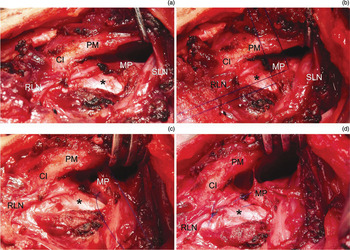
Arytenoid adduction was performed essentially as described by Isshiki et al., with minor modifications.Reference Isshiki, Tanabe and Sawada4 The inferior pharyngeal constrictor muscle was incised from its origin at the oblique line of the thyroid cartilage, to expose the posterior margin of the thyroid cartilage. The mucosa of the piriform sinus was gently teased off the medial surface of the thyroid cartilage, using a combination of sharp and blunt dissection. Disarticulation of the cricothyroid joint was not necessary. The dissection proceeded to the point at which the muscular process of the arytenoid could be palpated, and two 4-0 prolene sutures were placed through the muscular process, leaving four long tails for performing the arytenoid adduction. The ends of the first prolene suture were passed through two holes drilled by a 16-gauge stitch in the antero-inferior aspect of the ipsilateral thyroid cartilage. Gentle traction was placed on the sutures, and they were tied using a two-hole microsurgical plate as a bolster. This rotated the vocal process of the arytenoid medially, thus adducting the true vocal fold.Reference Woodson, Picerno, Yeung and Hengesteg8 The stitch tension was adjusted based on the quality of the patient's voice. The second prolene suture was attached to the cornu posterior cricoid ligament, which realigned the arytenoid more closely to the physiological adduction position. During the operation, an intralaryngeal segment of the recurrent laryngeal nerve was teased gently from the arytenoid cartilage, using blunt dissection, and was preserved (see Figure 1).
Modified arytenoid adduction technique for a representative case with left unilateral vocal fold paralysis. Black asterisk indicates the inferior cornu of the thyroid cartilage. (a) After incising the inferior pharyngeal constrictor and dragging anteriorly the posterior margin of the thyroid cartilage, the inferior cornu of the thyroid cartilage and the muscular process of the arytenoid are exposed. (b) Two prolene sutures are placed through the muscular process of the arytenoid, leaving four long tails for adduction. (c) Traction placed on the arytenoid-thyroid cartilage suture rotates the vocal process medially, but leads to detachment of the articular facet between the arytenoid and cricoid. (d) The second suture is attached to the cornu posterior cricoid ligament; traction on this suture relocates the arytenoid to approximate the physiological adduction position. CI = inferior cornu of thyroid cartilage; PM = posterior margin of thyroid cartilage; MP = muscular process of arytenoid; RLN = recurrent laryngeal nerve; SLN = superior laryngeal nerve

Laryngostroboscopic examination
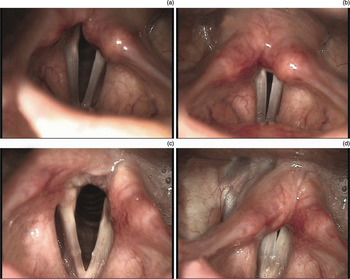
All 37 patients underwent laryngostroboscopic examination (Endostrob-DX; Xion, Berlin, Germany), pre-operatively and at least three months post-operatively. The movement and orientation of the vocal folds during inspiration and phonation was dynamically recorded and photographed. The position of the paralysed vocal fold and the vertical difference between the two vocal folds were evaluated by three laryngologists pre- and post-operatively (see Figure 2).
Laryngostroboscopic findings for a representative case of cancer-related unilateral vocal fold paralysis, before and three months after modified arytenoid adduction: (a) pre-operative, inhalation; (b) pre-operative, phonation; (c) post-operative, inhalation; (d) post-operative, phonation. A significant post-operative improvement in posterior glottal closure is seen, with no obvious gap between the two vocal folds during phonation.

Subjective aspiration rating
Aspiration was rated subjectively both pre- and post-operatively, using a four-point scale as described by Cummings.Reference Cummings, Purcell and Flint9 Aspiration severity was rated as follows: no aspiration = 0; mild = 1; moderate = 2; and severe = 3. Aspiration was considered mild when there was occasional choking but no need for dietary modification. Moderate aspiration equated to symptoms necessitating dietary modification. Aspiration was considered severe when patients required feeding tube placement for alimentation.Reference Su, Tsai, Chuang and Chiu3
Vocal function evaluation
Vocal function was evaluated in all patients pre- and post-operatively, using the same test procedure.
Firstly, perceptual voice assessment was performed by three experienced laryngologists blinded to the patient's clinical status. Voice quality was rated according to the grade-roughness-breathiness-asthenia-strain scale.Reference Hirano10 These parameters were rated on a four-point scale as follows: 0 = normal; 1 = mild dysphonia; 2 = moderate dysphonia; and 3 = severe dysphonia.
Secondly, acoustic analysis was conducted, assessing fundamental frequency, jitter, shimmer and normalised noise energy, as described previously.Reference Zheng, Li, Zhou, Cuan and Wen11 Dr Speech software was used (Tiger Electronics, North Reading, Massachusetts, USA).
Thirdly, aerodynamic assessment of mean airflow rate and maximal phonation time were performed using a pneumotachograph (Vitalograph Compact II; Maids Moreton, Buckinghamshire, UK).
Quality of life surveys
Patients' quality of life was assessed in order to evaluate their perceptions of living with the tremendous stress of cancer, and also to evaluate the impact of their voice disorder.Reference Billante, Spector, Hudson, Burkard and Netterville12
We used the MOS (Medical Outcomes Study) 36-item Short-form Health Survey, a widely used and validated, generic quality of life measure assessing eight domains of general health: physical functioning, physical role limitations, bodily pain, general health, vitality, social functioning, emotional role functioning and mental health. Scores were tabulated as per published algorithms, from 0 (worst) to 100 (best).Reference Ware and Sherbourne13, Reference McHorney, Ware and Racezk14
We also used the Voice Handicap Index and the Voice Outcome Survey. The Voice Handicap Index has three separate subscales designed to assess the impact of a voice disorder on functional daily activities, emotional well-being and physical comfort. Each subscale involves 10 questions.Reference Jacobson, Johnson, Grywalsky, Silbergleit, Jacobson and Benninger15 Similarly, the Voice Outcome Survey is a five-question research tool which enables voice disorder patients to rate the impact of their vocal problems on their daily living and work environment.Reference Gliklich, Glovsky and Montgomery16
Statistical analysis
The acoustic and aerodynamic evaluation data are presented as mean ± SD. Analysis of variance and Student's t-test were performed on selected data sets to determine the statistical significance of differences in pre- versus post-operative voice quality. Wilcoxon's signed-rank test was used for ranked data on aspiration and perceptual voice assessment, as these data were non-parametric. Statistical analysis was performed using the SPSS for Windows version 10.0 software program (SPSS Inc, Chicago, Illinois, USA). We considered p < 0.05 to indicate a moderate statistical difference, and p < 0.01 a significant statistical difference.
Results
A total of 42 patients underwent modified arytenoid adduction. The incidence of peri-operative complications was 11.9 per cent (five of 42), comprising mainly vocal fold oedema, haematoma, infection and airway obstruction. Four patients developed mild complications post-operatively, which were resolved by symptomatic treatment within a few days. One patient developed severe stridor and shortness of breath due to haematoma formation, which necessitated a tracheotomy; the patient was successfully extubated two weeks later. No other fundamental problems were encountered.
Pre-operative laryngostroboscopic findings indicated that all cases had a large posterior glottal chink during phonation. The left vocal fold was paralysed in 33 cases, and the right vocal fold in nine cases. The position of the paralysed vocal fold was paramedial in 37 cases and lateral in five cases. Pre-operatively, all 42 cases exhibited a significant vertical difference of the two paralysed vocal folds. No bowing or vocal fold atrophy was noted.
Laryngostroboscopic examination conducted immediately after surgery demonstrated significant improvement in posterior glottal closure and vertical vocal fold difference in all 42 cases, compared with individual pre-operative findings. Thirty-seven patients underwent laryngostroboscopic examination three months post-operatively; in these patients, stable and persistent medialisation of the paralysed vocal fold was successfully achieved.
Subjective aspiration evaluation
Of the 42 unilateral vocal fold paralysis patients who self-evaluated pre-operatively, 26 had moderate aspiration, 10 mild aspiration and six no aspiration. During their hospital stay, all these patients had improved aspiration symptoms post-operatively, although two patients still experienced mild post-operative aspiration. Of the 37 patients with three-month post-operative follow-up data, all but two showed no deterioration in aspiration outcomes. The overall success rate for swallowing rehabilitation in these patients was thus 94.6 per cent (35/37). There was a statistically significant decrease in subjective aspiration rating in these patients, comparing pre- and post-operative data (p < 0.01).
Perceptual voice assessment
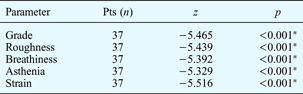
Based on ratings data by three experienced laryngologists blinded to patients' clinical status, patients' pre-operative vocal quality was impaired as regards each parameter of the grade-roughness-breathiness-asthenia-strain scale. Post-operatively, all patients showed a statistically significant decrease in scale scores, compared with pre-operative scores (p < 0.01; Table I).
Nonparametric analysis of grbas scale assessment: pre- vs post-operative
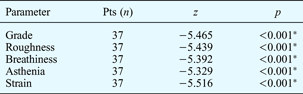
*Significant at p < 0.01 (Wilcoxon's signed-rank test). GRBAS = grade, roughness, breathiness, asthenia, strain; pts = patients
Acoustic and aerodynamic analyses
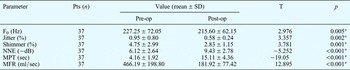
The results of acoustic and aerodynamic analyses are summarised in Table II. Patients' values for all acoustic parameters (i.e. fundamental frequency, jitter, shimmer and normalised noise energy) decreased significantly post-operatively, compared with pre-operative values (p < 0.01). Patients' post-operative maximal phonation times were significantly longer, compared with pre-operative values (p < 0.01). Furthermore, the mean value for patients' mean airflow rate fell into the normal range (140–220 ml/second) post-operatively, a significant difference compared with pre-operative values (p < 0.01).
Acoustic and aerodynamic analyses

*Significant at p < 0.01. Pts = patients; SD = standard deviation; pre-op = pre-operative; post-op = post-operative; F0 = fundamental frequency; NNE = normalised noise energy; MPT = maximum phonation time; MFR = mean airflow rate
Quality of life measurements
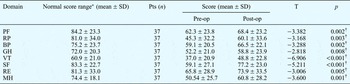
Before arytenoid adduction, all patients exhibited a significant decrease in all domains of the MOS 36-item Short-form Health Survey, compared with published normative values.Reference Gliklich, Glovsky and Montgomery16 Post-operatively, all patients displayed significant improvement in all eight domains of this survey, compared with pre-operative scores (p < 0.01; Table III). Furthermore, absolute scores for social functioning and emotional role functioning rose above published reference values.Reference Ware, Snow, Kosinski and Gandek17
SF-36 scores

*For general US population (n = 2472).Reference Ware, Snow, Kosinski and Gandek17†Significant at p < 0.01. SF-36 = MOS (Medical Outcomes Study) 36-item Short-form Health Survey; SD = standard deviation; pts = patients; pre-op = pre-operative; post-op = post-operative; PF = physical functioning; RP = role limitations, physical; BP = bodily pain; GH = general health; VT = vitality; SF = social functioning; RE = role functioning, emotional; MH = mental health
Significant improvement was seen in patients' Voice Handicap Index results, for both total and subscale scores, comparing pre- and post-operative values. Patients' Voice Outcome Survey scores also improved significantly, comparing pre- and post-operative values (p < 0.01; Table IV).
VHI and VOS scores

*Significant at p < 0.01 (paired t-test). VHI = Voice Handicap Inventory; VOS = Voice Outcome Survey; pts = patients; SD = standard deviation; pre-op = pre-operative; post-op = post-operative; F = functional daily activities; P = physical comfort; E = emotional well-being
Discussion
Otolaryngologists are often confronted with unilateral vocal fold paralysis due to extralaryngeal malignancy, generally due to thyroid, oesophageal or lung cancer, or metastasis from an unknown primary. Recent evidence suggests that the paralysed vocal fold undergoes complex alterations, including significant lateralisation and the development of a considerable vertical gap between the two vocal folds.Reference Su, Tsai, Chuang and Chiu3, Reference Chhetri, Gerratt, Kreiman and Berke18 These alterations lead to glottal incompetence. Patients with cancer-related unilateral vocal fold paralysis may have significant dysfunction of speech, swallowing, ventilation and the cough reflex. These problems impair patients' quality of life. Furthermore, aspiration may be a life-threatening event for patients who already have compromised pulmonary function. Laryngeal reinnervation has been shown to be an effective intervention which restores physiological laryngeal phonatory and protective sphincteric function, by re-establishing the tension and mass of the paralysed vocal fold.Reference Zheng, Li, Zhou, Cuan and Wen11, Reference Zheng, Li, Zhou, Cuan, Wen and Lan19, Reference Zheng, Zhou, Chen, Li and Cuan20 However, this method is not a good choice for patients with cancer-related unilateral vocal fold paralysis because of their short life expectancy, given the relatively lengthy reinnervation process. Vocal fold medialisation represents an alternative, palliative procedure which can improve voice quality and resolve aspiration while involving minimal intrusion into the patient's life, and it is accepted currently for the treatment of cancer-related unilateral vocal fold paralysis.Reference Abraham, Gonen and Kraus1
At present, several surgical approaches are popular for the treatment of unilateral vocal fold paralysis, including vocal fold injection, type I thyroplasty and arytenoid adduction. Thyroplasty can medialise the membranous portion of the vocal fold, but complete closure of the posterior commissure cannot be achieved. Injection techniques cannot resolve this kind of problem either. In contrast, arytenoid adduction procedures mimic the action of the lateral cricoarytenoid muscle, rotating the vocal process medially and inferiorly to a more physiological position, and providing better closure of the posterior commissure.Reference Woodson, Picerno, Yeung and Hengesteg8 However, classical arytenoid adduction may have the adverse effect of rocking the arytenoid forwards abnormally. Hence, a second suture is employed to attach the muscular process to the inferior cornu of the thyroid cartilage, to prevent such rocking. The present study adopted a further modification. The second prolene suture was attached to the cornu posterior cricoid ligament, rather than to the inferior cornu of the thyroid cartilage, in order to better mimic the action of the partial posterior cricoarytenoid muscle. This maintains the arytenoid in the physiological adduction position during the phonation phase, and prevents the arytenoid rocking abnormally. Better voice quality was expected to be achieved with this modified technique.
At present, arytenoid adduction is used less widely in the clinic, probably because it involves more difficult manipulation and a higher complication rate, compared with other medialisation techniques.Reference Hoffman and McCulloch5, Reference Su, Lui, Lin, Chiu and Cheng21, Reference Tucker, Wanamaker, Trott and Hicks22 Some investigators have reported the incidence of severe complications (e.g. haematoma requiring tracheostomy) to range from 0 to 10 per cent.Reference Hoffman and McCulloch5, Reference Su, Lui, Lin, Chiu and Cheng21, Reference Tucker, Wanamaker, Trott and Hicks22 In the present study, the incidence of serious complications did not exceed this range. Four patients developed mild post-operative complications, while one developed stridor and shortness of breath necessitating a tracheotomy. The risk of serious post-operative complications such as bleeding and airway compromise can be minimised by appropriate closed negative-pressure suction drainage and the administration of peri-operative antibiotics and steroids. Thus, with appropriate technique and peri-operative care, the possibility of improved outcomes outweighs the relatively low risk of significant complications following arytenoid adduction. Additionally, the arytenoid adduction procedure is not difficult to learn for a laryngologist with good surgical skills and anatomical knowledge.
• Glottal incompetence due to cancer-related unilateral vocal fold paralysis results in impaired voice quality, and may cause severe, life-threatening aspiration and pneumonia
• In this series, a modified arytenoid adduction procedure successfully eliminated glottal incompetence, resulting in improved voice quality, decreased aspiration and significantly improved quality of life, with very few severe complications
• Modified arytenoid adduction is a favourable palliative treatment choice for patients with cancer-related unilateral vocal fold paralysis without significant atrophy or bowing of the vocal fold
In the present study, a higher rate of aspiration was observed pre-operatively in patients with cancer-related unilateral vocal fold paralysis. However, satisfactory resolution of aspiration was achieved post-operatively, in accord with other published studies. Furthermore, the patients' post-operative voice quality improved greatly, confirmed by objective acoustic evaluation. Related aerodynamic parameters also improved, directly reflecting the effectiveness of arytenoid adduction in these patients.
The palliative effectiveness of arytenoid adduction, as regards quality of life improvement, should be recognised in these patients. This effect is apparently little known. In order to evaluate this link, the present study used three surveys: the MOS 36-item Short-form Health Survey, the Voice Handicap Inventory and the Voice Outcome Survey. Pre-operative survey data indicated that patients suffered significant general health and voice-related limitations due to unilateral vocal fold paralysis, and suggested that this condition had a far-reaching impact on quality of life. The quality of life findings of the present study give credence to the idea that improved glottal closure, with resultant voice improvement, has a significant positive impact on the patient's overall general health and social interaction. Post-operatively, it was noted that patients could better perform routine and vigorous physical tasks, were more productive at work and during daily activities, and had improved vitality and energy.
One limitation of the present study was lack of analysis of the correlation between the arytenoid adduction procedure and patients' life expectancy, because of the study's relatively short three-month follow-up time. However, there are reports that medialisation interventions are beneficial to patients with poor prognoses.Reference Abraham, Gonen and Kraus1
Conclusion
In the present study, a modified arytenoid adduction procedure was generally successful in recovering glottal competence by eliminating the posterior commissure gap and the vertical difference between the two vocal folds. The procedure also improved patients' quality of life and voice, and resolved aspiration. There was no increase in the rate of post-operative complications, compared with previous reports.
We believe that performing a modified arytenoid adduction procedure as palliative surgery represents a favourable choice for patients with cancer-related unilateral vocal fold paralysis without significant atrophy or bowing of the vocal folds.
Acknowledgement
This work was supported by grants number 30772415 and 30672295 awarded for scientific research by the National Natural Science Foundation of China. The authors also appreciated the technical assistance provided by Jianjun Jing, Gang Chen and Mingxing Zhang MD.