Fifty years have passed since the first report of Kawasaki disease at 1967, and the number of patients with coronary artery lesions exceeding 40 years old has currently increased. The prevalence of acute coronary syndrome caused by Kawasaki disease in young adult patients is speculated to be about 5%.Reference Daniels, Tjajadi and Walford1 Most are asymptomatic many years after the onset of Kawasaki disease when they were children, until the onset of acute coronary syndrome.Reference Tsuda, Abe and Tamaki2,Reference Gordon, Daniels and Kahn3 Most patients often drop out from follow-up after Kawasaki disease. Patients with acute coronary syndrome are transferred to emergency hospitals, and most of them are often treated as acute coronary syndrome in young adults due to atherosclerosis, without being considered to have coronary artery lesions due to Kawasaki disease. Primary percutaneous transluminal coronary intervention is an indispensable method for ischaemic coronary artery disease, and coronary stent implantations are currently the acceptable method in adults. However, the pathogenesis of the coronary artery disease differs between atherosclerosis and Kawasaki disease. Most of initial results after stent implantation might be successful. However, how are their long-term results after stent implantation? Are stent implantations in coronary artery lesions caused by Kawasaki disease acceptable or not? As a clue to answer this question, I reviewed the references of coronary stent implantation in this population.
Kawasaki disease patients who underwent coronary stent implantations from the previous literatures until 2019 were reviewed. As the cause of acute coronary syndrome in adults, coronary artery ectasia due to atherosclerosis can be found. Therefore, the differential diagnosis between atherosclerosis and Kawasaki disease in such coronary artery ectasia in adults is needed. Some presumed Kawasaki disease patients with stent implantations were excluded from this review because they were not diagnosed as acute Kawasaki disease in children. In the 30 literatures and an experience in our hospital from 1997 to 2019, 34 coronary arteries in the 33 patients with a history of Kawasaki disease underwent coronary stent implantation were reviewed. I investigated their outcome of the 34 stent implantations from those reports. The number of emergency coronary stenting and elective coronary stenting was 9 and 25, respectively.
Primary stenting in acute coronary syndrome
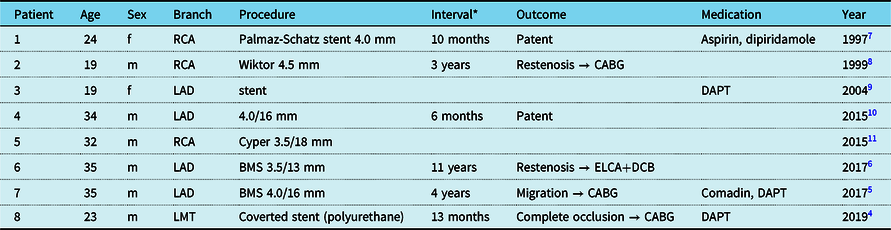
Primary stenting in patients with acute coronary syndrome after Kawasaki disease was performed in eight patients between 1997 and 2019 (Table 1).Reference Barca, Menendes and Palacios4–Reference Kawai, Takakuwa and Naruse10 There were six males and two females. The age at the time of the stenting ranged from 19 to 35 years, with a median of 24 years. The stenting lesions were as follows: left anterior descending artery 4, right coronary artery 3, and left main trunk 1. The kinds of stenting were as follows: Bare metal stents 2, Cypher 1, Palmaz-Schatz 1, Wiktor 1, covered stent with polyurethane 1, and unknown 2. All initial results were successful. Follow-up coronary angiograms were performed in six patients, and the interval from the stenting ranged from 6 months to 11 years. All four patients who underwent coronary angiograms after 1 year had coronary revascularization. Three patients underwent coronary artery bypass grafting, and one who had undergone a bare metal stent implantation underwent excimer laser coronary angioplasty with a drug-coating balloon. The cause of the coronary revascularization was restenosis in 2, migration of the stent in 1, and a complete occlusion with migration of the stent in 1. The stented coronary artery was patent in two patients, whose follow-up period was 6 months and 10 months, respectively.
Primary stenting for acute coronary syndrome

BMS=bare metal stent; CABG=coronary artery bypass grafting; DAPT=dual anti-platelet therapy; DCB=drug-coating balloon; ELCA=excimer laser coronary angiography; LAD=left anterior descending artery; LMT=left main trunk; RCA=right coronary artery
* Interval from the stent implantation to coronary angiogram
A 22-year-old man suffered from acute myocardial infarction due to a severe calcified aneurysm at the bifurcation of the left coronary artery and underwent an emergency stent implantation with a polyurethane-covered stent (PK papyrus Biotronik) for the left main lesion.Reference Barca, Menendes and Palacios4 He had experienced cardiogenic shock 13 months after stent implantation because of a complete occlusion with a malposition, although dual anti-platelet therapy was performed after the procedure. He had an emergency coronary artery bypass grafting 24 hours after the re-percutaneous transluminal coronary intervention for the left main complete occlusion. However, a high degree of competitive flow occurred, and the left main trunk was ligated. He has been asymptomatic for 16 months after the coronary artery bypass grafting.
A 35-year-old man had a new aneurysm formation 2 years after the bare metal stent implantation for the left anterior descending artery with giant coronary aneurysms; however, he was asymptomatic.Reference Kaneko, Kashima and Hashimoto5 He underwent an aneurysrectomy and coronary artery bypass grafting 4 years after stenting, due to migration of the stent with a new aneurysm formation. Another 35-year-old man was asymptomatic for 11 years after bare metal stents stenting.Reference Kawamura, Komiyama and Fukamizu6 A coronary angiogram at 11 years after the stenting revealed severe stenosis due to neoatherosclerosis. He underwent drug-coating balloon angioplasty after an excimer laser coronary angioplasty. In 1-year follow-up, the culprit vessel was patent.
Elective coronary stent implantation
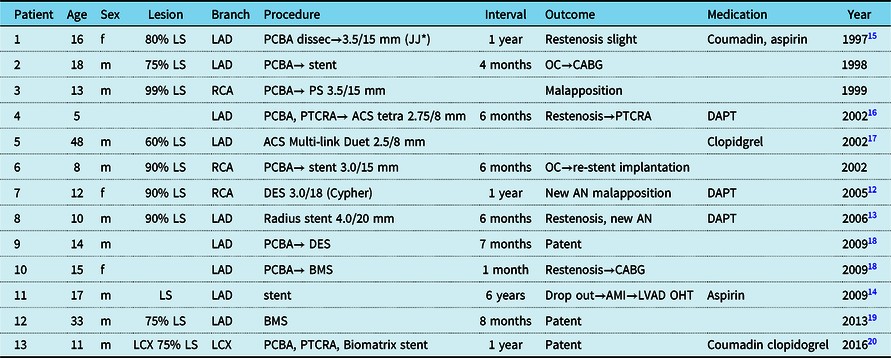
Thirteen patients with elective stent implantations were reported between 1997 and 2016 (Table 2).Reference Matsushita, Tamura and Nishiga11–Reference Iliadis and Duvernoy17 There were nine males and three females, and the sex was not written in one patient. The age at the time of the stenting ranged from 5 to 48 years, with a median of 13 years. The target vessels were as follows: left anterior descending artery 9, right coronary artery 3, and left circumflex 1. All the initial results were successful; however, a slight malapposition immediately after implantation was found in one patient. Follow-up coronary angiograms were performed in 11 among the 13 patients. The interval from the procedure to the follow-up coronary angiograms ranged from 4 months to 6 years. Seven (64%) among 11 patients had adverse effects. Complete occlusions and restenosis occurred in three and two patients, respectively. A malapposition with a new aneurysm formation was found in one patient with a Cypher stent,Reference Matsushita, Tamura and Nishiga11 and restenosis with a new aneurysm formation in one with a radius stent.Reference Li, Cheng and Lee12 A re-percutaneous coronary intervention was performed in two patients, perctaneous transluminal coronary rotational atherectomy in one and a re-stent implantation in one. Two patients underwent a coronary artery bypass grafting, and one had an left ventricular assist device implantation. A 23-year-old man who dropped out from follow-up had an acute myocardial infarction 6 years after the stenting, and he underwent heart transplantation after an left ventricular assist device.Reference Yoon, Lee and Kim13 He did not take any mediciation after dropping out.
Elective coronary stent implantations

AMI=acute myocardial infarction; AN=aneurysm; BMS=bare metal stent; CABG=coronary artery bypass grafting; DAPT=dual anti-platelet therapy; DES=drug-eluting stent; JJ*=Johnson and Johnson; LAD=left anterior descending artery; LS=localised stenosis; LVAD=left ventricular assist device; OC=completer occlusion; PCBA=percutaneous transluminal coronary balloon angioplasty; PS=Palmaz-Schatz stent; PTCRA=percutaneous transluminal coronary rotational atherectomy; RCA=right coronary artery
Stent implantation for chronic total occlusion
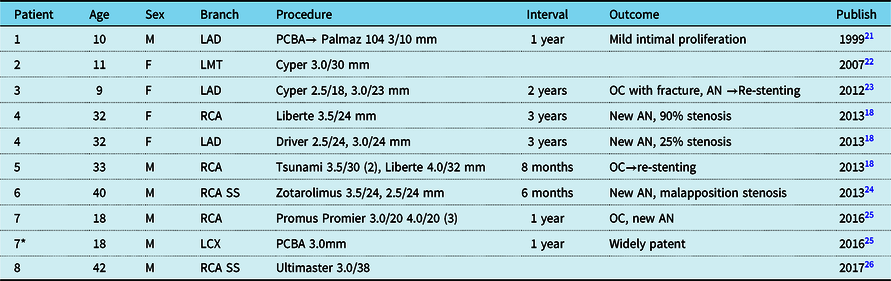
Nine branches with stent implantations for chronic total occlusions or segmental stesosis were reported between 1999 and 2017 (Table 3).Reference Mueller, Knirsch and Kniirsh18,Reference Hashimi, Lazzam and McCrindle21–Reference Nakano, Kataoka and Yasuda26 There were five males and three females. The age at the time of procedure ranged from 9 to 42 years, with a median of 18 years. Six patients underwent stenting for chronic total occlusions, and two stenting for segmental stesosis. The target vessels were as follows: right coronary artery 5, left anterior descending artery 3, and left main trunk 1. All initial results were successful. Follow-up coronary angiograms were performed in seven branches in six patients. The interval from the procedure to the follow-up coronary angiogram ranged from 6 months to 3 years. Adverse effects after the stenting occurred in six out of five patients who had follow-up coronary angiograms. Drug eluting stents were used in all six branches. The adverse effects were as follows: restenosis with a new aneurysm formation in 2, a complete occlusion with a new aneurysm formation in 2, a malapposition with a new aneurysm formation in 1, and a complete occlusion in 1. New aneurysm was found in five branches. One patient underwent a re-stent implantation for a stent occlusion.
Stent implantations for chronic total occlusions

AN=aneurysm; LAD=left anterior descending artery; LCX=left circum flex; LMT=left main trunk; OC=occlusion; PCBA=percutaneous transluminal coronary balloon angioplasty; RCA=right coronary artery; SS=segmental stenosis
* The PCBA alone was performed in the LCX
A 9-year-old girl underwent a Cypher implantation with two stents for the mid-left anterior descending artery.Reference Kim, Hyo-Soo and Yun23 The 2-year follow-up coronary angiograms revealed chronic total occlusion of the left anterior descending artery; however, dual anti-platelet therapy was administered. The complete occlusion was from the proximal left anterior ascending artery to the second broken piece of the previously implanted distal Cypher stent, and collateral communication from the first diagonal branch to the distal left anterior descending artery occurred. Multiple fractures of the previous stent were found. After massive thrombosuction of the proximal left anterior ascending artery, a TAXUS-Liberte was overlapped with the previous fractured stents. Another TAXUS-Liberte stent was inserted into the left anterior descending artery. Seven months after the restenting, a good patency of the left anterior descending artery was observed.
A 40-year-old man was implanted with a Zotarolimus-eluting stent implantation for a chronic total occlusion of the right coronary artery.Reference Sawai, Tanigawa and Masuda24 That chronic total occlusion seemed to be segmental stenosis, which indicated revascularization by several very small new vessels after a thrombotic occlusion in a giant aneurysm. Two overlapped Zotarolimus-eluting stents were implanted from the ostium to the mid-portion of the right coronary artery. The 6-month follow-up coronary angiograms revealed restenosis in the Zotarolimus-eluting stent implanted in the right coronary artery and a new aneurysm formation around the distal Zotarolimus-eluting stent. Intravascular ultrasound also revealed a coronary aneurysm and a late acquired stent malapposition. Although he underwent a bare metal stent implantation in the mid-left anterior descending artery, there was no re-stenosis in that portion.
An 18-year-old man underwent percutaneous coronary intervention for chronic total occlusions of two major epicardial arteries. A drug-eluting stent implantation was performed in the right coronary artery, and balloon angioplasty was performed in the left circumflex. A follow-up coronary angiogram revealed a complete occlusion with new anerysms in the right coronary artery and a widely patent left circumflex, although he was asymptomatic.Reference Steinberg, Jones and Lombardi25
Covered stenting
Five patients underwent covered stent implantations between 2007 and 2019 (Table 4).Reference Mario, Kilic and Yeh27–Reference Waki, Arakaki and Mitsudo29 Elective stenting and emergency stenting were performed in three and two patients, respectively. One patient in the above primary stenting in acute coronary syndrome was included.Reference Barca, Menendes and Palacios4 The age at the procedure ranged from 6 to 25 years. Three covered stents were occluded. A 10-year-old boy who had undergone an arterial switch operation for a transposition of the great arteries during the neonatal period had a percutaneous transluminal coronary rotational atherectomy for localised stenosis of segment 2 caused by Kawasaki disease in our hospital. During that procedure, a dissection was occurred, and a covered stent implantation was performed at segment 1. He had syncope due to complete atrioventricular block 6 months after the stent implantation. Coronary angiogram revealed the complete occlusion of at the portion of covered stent, but the target vessel was patent. He underwent a coronary artery bypass grafting, and the complete atrioventricular block improved. The other occluded patient was asymptomastic. The two covered stents were patent, and the interval from the stenting to the follow-up coronary angiogram was 6 months and 5 years, respectively.Reference Muto and Ishikawa19,Reference Kim, Song and Yoo28
Covered stents

DAPT=dual anti-platelet therapy; LAD=left anterior descending artery; LMT=left main trunk; LS=localised stenosis; OC=occlusion; PTFE=polytetrafluoroethylene; RCA=right coronary artery
* This patient had covered stenting for acute coronary syndrome
Percutaneous coronary intervention without a stent implantation
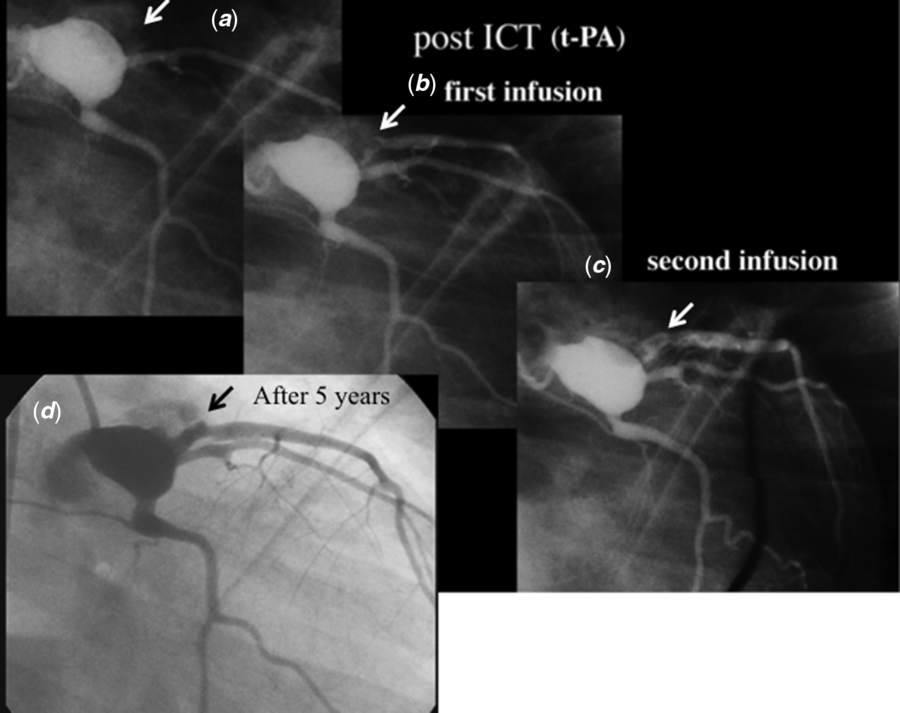
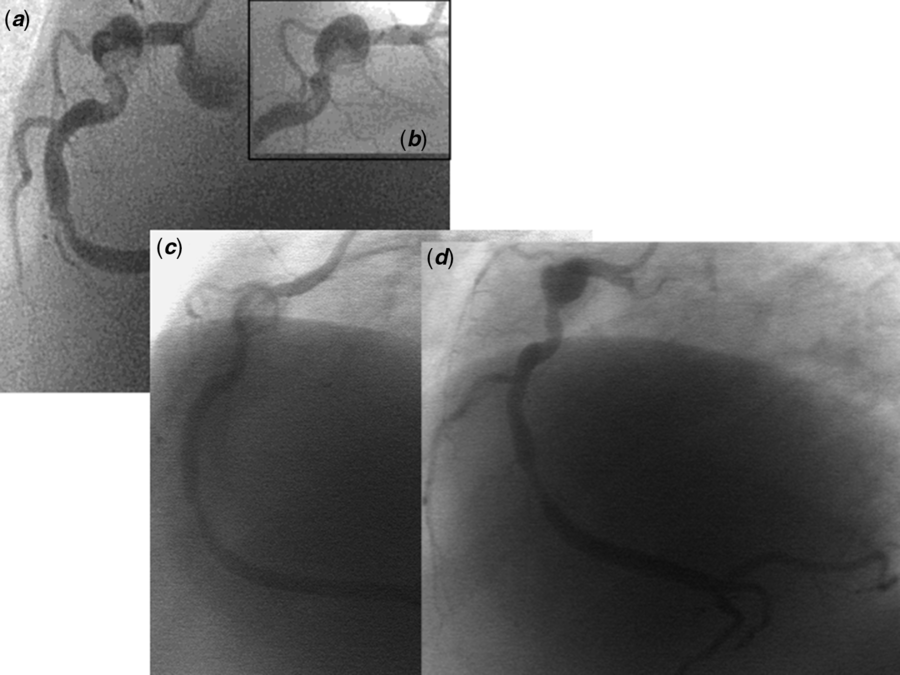
I presented our percutaneous coronary intervention cases without a stent implantation. An 8-year-old boy, who presented with bilateral giant aneurysms, visited the emergency clinic because of chest pain. His electrocardiogram exhibited ischaemia and hyper acute T waves in leads V2–V4. An emergency coronary angiogram revealed the complete occlusion of the left anterior coronary artery (Fig 1). Intracoronary thrombolysis with a tissue plasminogen activator was performed for the left coronary artery. Reflow in the left anterior descending artery was detected and the chest pain was alleviated. Coronary angiograms 5 years post-intracoronary thrombolysis confirmed patency of the left anterior descending artery. He has had no symptoms for 11 years after intracoronary thrombolysis. He underwent bilateral coronary artery bypass graftings at 19 years old because of localised stenosis in the right coronary artery and left anterior descending artery.
Coronary angiograms before and after the intracoronary thrombolysis therapy for acute myocardial infarction. (a) Before the intracoronary thrombolysis therapy. (b and c) After the intracoronary thrombolysis therapy. (d) 5 years after the intracoronary thrombolysis therapy.

A 33-year-old female with a giant right coronary artery aneurysm visited the emergency clinic because of chest and back pain. She has been followed while on treatment with aspirin for 25 years. She had the coronary risk factors including obesity and smoking in adults. An emergency coronary angiogram showed a 90% stenosis due to a massive thrombus in an aneurysm (Fig 2). Intraaortic balloon pumping was instituted. Her chest pain improved. After 3 days, the thrombus size had decreased and the stenosis decreased to 75%. Coumadin and aspirin were begun and she was discharged. However, she had further chest pain 30 days after the initial attack. An emergency coronary angiogram showed a complete occlusion of the right coronary artery due to a massive thrombus. The distal right coronary artery was perfused via the left coronary artery. Repetitive aspiration of the thrombus and percutaneous balloon angioplasty were successful. A simple aspiration or thrombolytic therapy is not always successful because of the large volume of thrombus in the giant aneurysm. In such cases, percutaneous balloon angioplasty is often added. After this procedure, she has had no cardiac events for the last 16 years while on treatment with coumadin and aspirin.
Coronary angiograms before and after the percutaneous coronary intervention for ACS. (a) Coronary angiogram at the time of the initial visit at 33 years old. (b) Coronary angiogram 3 days after intraaortic balloon pumping was initiated. (c) Coronary angiogram after the aspiration therapy during the second visit. (d) Coronary angiogram after percutaneous balloon angioplasty.

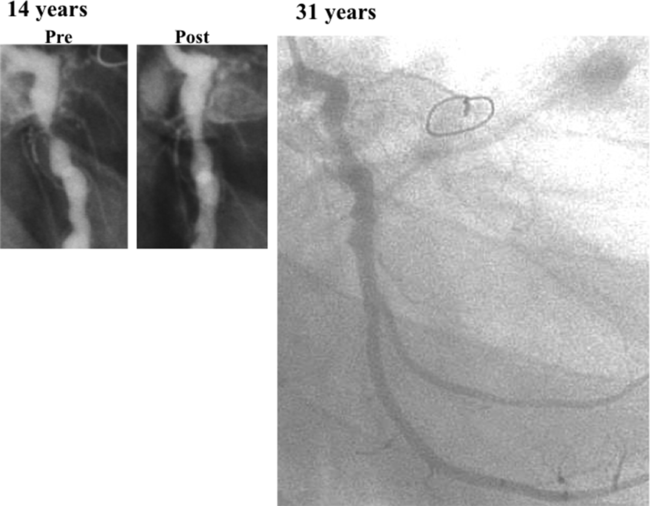
A 14-year-old male had a perctaneous transluminal coronary rotational atherectomy for localised stenosis of the left circumflex (Fig 3). Although this patient had had a re-perctaneous transluminal coronary rotational atherectomy for re-stenosis 1 year after the perctaneous transluminal coronary rotational atherectomy, good patency has persisted for the last 15 years after the re-perctaneous transluminal coronary rotational atherectomy. However, he had the coronary risk factors including obesity and hypercholesterolemia after that and had restenosis of the target lesion at the age of 34 years old.
Follow-up coronary angiograms after the percutaneous transluminal coronary rotational atherectomy for localised stenosis in the left circumflex. (Left) Coronary angiograms before and after the transluminal coronary rotational atherectomy. (Right) Sixteen years after the transluminal coronary rotational atherectomy.

Insights
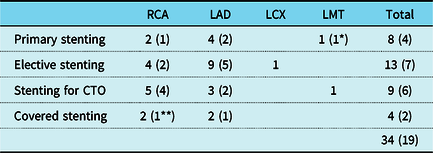
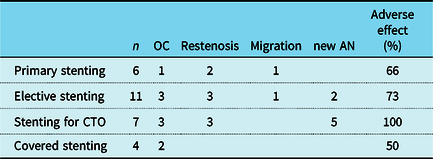
As a summary of the literature review, 33 patients with the history of Kawasaki disease underwent a stent implantation for 34 coronary arteries (Table 5). Follow-up coronary angiograms were done in 28 vessels. Adverse effects in the late period were found in 19 coronary arteries (68%) (Table 6). There were nine complete occlusion, eight restenoses, and two migration. A new aneurysm formation was found in 7 (37%) of the 19 vessels, 6 (86%) of the 7 vessels were drug-eluting stent and 5 were found after the procedure for chronic total occlusion. The confirmation of the patency in 7 vessels was within 1 year, and a 5-year patency was observed in two vessels. The adverse effects free-rate after stenting at 1 year and 3 years were 57 and 25%, respectively (n = 28). These results indicated that the stent implantations in this population were not always acceptable as a safety method to maintain the patency of the culprit vessel for several years.
Stent implantations and adverse effects

( ) number of adverse effects
CTO=chronic total occlusion; LAD=left anterior descending artery; LCX=left circum flex; LMT=left main trunk; RCA=right coronary artery
* This patient had covered stenting for acute coronary syndrome
** The patient had an emergency covered stenting, because he had coronary artery perforation with percutaneous transluminal coronary rotational atherectomy
Adverse effects after stent implantations in follow-up angiograms

AN=aneurysm; CTO=chronic total occlusion; OC=complete occlusion
Giant aneurysms caused by Kawasaki disease of more than 8 mm often caused by thrombotic occlusions.Reference Tsuda, Tsujii and Hayama30,Reference Tsuda, Hamaoka and Suzuki31 Most causes of acute myocardial infarction, which requires a percutaneous coronary intervention, have been massive thrombi in giant aneurysms without significant coronary stenosis. Either aspiration of thrombus or intracoronary thrombolysis has been recommended. In the ineffective cases with those procedures, percutaneous balloon angioplasty is useful to add on. Furthermore, anti-thrombotic therapy is indispensable in such patients after the procedure.Reference Motozawa, Uozumi and Maemura32 If the cause of the occlusion was a massive thrombus without any significant coronary artery stenosis, a stent implantation would not always be needed.Reference Motozawa, Uozumi and Maemura32,Reference Morita, Kinoshita and Fukita33 Furthermore, stent implantation in culprit lesions is not necessarily easy in patients with dilated lesions because a malapposition is likely to occur. If coronary artery stenosis exists, functional myocardial ischaemia should be evaluated later. After that, it may be better to decide an option of coronary revascularization. If the optimal anti-coagulant therapy was done, most of patients without significant coronary stenosis would have been asymptomatic many years after the primary percutaneous coronary intervention, such as our experience. Furthermore, the EROSION study in adults showed that the majority of the patients with acute coronary syndrome caused by plaque erosion managed with aspirin and ticagrelor without stenting remained free of any major adverse cardiovascular events for <1 year.Reference Xing, Yamamto and Sugiyama34 It is considered that a primary stent-less percutaneous coronary intervention is better from the view of long-term management because most causes of acute coronary syndrome are thrombotic occlusions.
In the elective percutaneous coronary intervention, a progressive localised stenosis with ageing complicates severe coronary artery calcification. A perctaneous transluminal coronary rotational atherectomy is suitable for severe localised stenosis with calcification.Reference Akagi35 In a target vessel in which a larger burr than a 2.15 mm diameter can be used, good patency of the vessel can be maintained by close follow-up and re-rotational atherectomy.Reference Tsuda, Miyazaki and Yamada36 Restenosis within the first year after the percutaneous transluminal coronary rotational atherectomy often develop because of reactive intimal thickening after the procedure. New aneurysms may develop after high-pressure balloon angioplasty in addition to the perctaneous transluminal coronary rotational atherectomy. Even if a stent was not implanted, it can maintain a patency of more than 10 years in young adults. Restenosis can occur owing to its disease progression and coronary risk factors with ageing. Stent implantations cannot always prevent restenosis, and the adverse effects are often reported in the references. In the long-term period of more than 20 years, the selection of a re-percutaneous coronary intervention may be more common and easier than a re-percutaneous coronary intervention in cases with stent implantations. Because the pathogenesis of intimal thickening remains unknown, it is unknown whether eluting drugs are possible to prevent intimal thickening. Contrarily, eluting drugs are possible to treat some adverse effects such as new aneurysm formations. Especially, new aneurysms were often found after the procedure for total chronic occlusion. Usually, some segments of chronic total occlusion were the sites which aneurysms exist in the acute phase of Kawasaki disease, and most of them were caused by thrombotic occlusion. Therefore, new aneurysms might be likely to appear again with revascularization due to stent implantation.
There are two major characteristics of percutaneous coronary intervention for coronary artery lesions caused by Kawasaki disease. One is the coronary aneurysm changing morphologically over time after acute Kawasaki disease, and the another is the progressive of severe coronary arterial wall calcification with ageing. Furthermore, giant aneurysms often regress in the late period, and most of those patients have not been recognised as having coronary artery lesions caused by Kawasaki disease.Reference Daniels, Tjajadi and Walford1,Reference Tsuda, Hanatani and Kurosaki37 Coronary artery lesions caused by Kawasaki disease persist long into adulthood. There are undoubtedly many asymptomatic adult patients with coronary artery lesions caused by Kawasaki disease who remain undiagnosed.Reference Tsuda, Abe and Tamaki2,Reference Tsuda, Matsuo and Naito38 Coronary artery lesions caused by Kawasaki disease are not always familiar to internists and the affected population is a small group among the adult ischaemic heart disease patients. Coronary stent implantations are currently performed in such patients as accepted procedures. However, there have been some reports about thrombotic occlusions, stent fractures, new aneurysm formation, and malapposition after stenting in patients with presumed coronary artery lesions caused by Kawasaki disease.Reference Tsuda, Abe and Tamaki2,Reference Kuramitsu, Hiromasa and Jinnouchi39,Reference Yokouchi, Oharaseki and Ihara40 Generally, the results of the coronary stent implantations in severe coronary calcification patients are poor, and the long-term outcome of stent implantations remains unknown.Reference Tsuda, Miyazaki and Yamada36 The nature of coronary artery lesion in Kawasaki disease patients differs from atherosclerotic lesion. Cardiologists should be aware of this special subset of patients.Reference Daniels, Tjajadi and Walford1
This review has some limitations. The number of patient enrolled in this review is very small because experience with percutaneous coronary intervention used in the late period after Kawasaki disease is limited. Furthermore, most of patients did not always undergo follow-up coronary angiograms in the late period. Some patients who underwent stent implantation may be missed from this review. The methods and devices of percutaneous coronary intervention have remarkably changed with the development since the 2000s. There were many different types of stents. It is difficult to evaluate an effectiveness of each stent.
However, at present, the stent implantations in this population were not always effective, and the adverse effects often occurred. It remains unknown that if stent implantations can prevent a progression of coronary arterial intimal thickening after Kawasaki disease in the late period and how long the patency of culprit vessels maintains with stenting. Are they different depending on type of stent and characteristics of culprit lesions? Further studies about the log-term outcome after stent implantations should be performed, and the usefulness of the procedure as a coronary revascularization should be indicated in the future. The indications for stent implantation in each patient must be also considered depending on its benefits and demerits in its long-life, although management for emergency cardiac events is dispensable. When the patient is young, it may be better to avoid a stent implantation as long as possible.Reference Tsuda41,42 Knowing the long-term efficacy and complications of percutaneous coronary intervention is important in deciding the procedure. With the improvement in the percutaneous coronary intervention and resolution of coronary artery lesions in the future, an effective stent-free coronary percutaneous revascularization is expected. Most of patients with coronary artery lesions caused by Kawasaki disease are asymptomatic except for occurrence of acute coronary syndrome. When it is considered to improve both prognosis and the quality of life, the effectiveness, risk of complication, quality and degree of the procedure must be discussed. We must select the best procedure for each patient on this basis, derived the accumulation of evidence.
Conclusions
It is desirable to avoid stent implantations in patients with coronary artery lesions caused by Kawasaki disease because some adverse effects after the procedure are likely to occur. Knowing the long-term efficacy and complications of percutaneous coronary intervention is important in deciding the procedure.
Acknowledgements
The author thanks the coronary interventionists at the National Cerebral and Cardiovascular Center for their support and cooperation. The author also thank Mr. John Martin for his kind English language consultation.
Financial support
This research received no specific grant from any funding agency, commercial or not-for-profit sectors.
Conflicts of interest
None.