The notion of progress is as slippery in historiography as it is in human history. And yet in the field of American slavery, a brief look at work of the Dunning school will confirm that the quality of historical analysis has shown progress. As early as mid-century we find a classic with staying power: Kenneth Stampp's Peculiar Institution (1956), perhaps the earliest scholarly book on the topic that can still be read with pleasure and learning and without embarrassment. Its appearance only just predated the introduction of quantitative methods. With Alfred Conrad and John Meyer's 1958 Journal of Political Economy article, economic historians began to pursue the history of slavery with methods more systematic than any previously employed. Not, of course, that all agreed on the conclusions: far from it. The frank scholarly disputes that greeted Robert Fogel and Stanley Engerman's Time on the Cross (1974) persuaded many traditional historians that nothing conclusive could result from quantification. More discerning readers of this Journal, though, would recognize the slow struggle for scholarly progress: bold, imaginative research, followed by careful, energetic criticism. Right up to the present, quantitative methods remain a touchstone of the economic-historical study of American slavery.
Non-quantitatively oriented historians have continued to write on American slavery of course. But grand synthetic works such as Ira Berlin's Many Thousands Gone (1998) did not specifically concentrate on the economics of slavery. Lately narrative historians have re-directed readers back towards the economic history of slavery. Superficially that sounds familiar, but both methods and goals differ from those typically found in this Journal. In terms of method, the newer “history of capitalism” school substitutes more and better anecdotes for tables of regression results. More controversial is the explicit use of what the writer of the book under review calls “evocative history,” in which imagination substitutes for primary sources. A broader goal of these scholars, as we are informed by the New York Times (6 April 2013), is to relate American slavery to American capitalism, a concept only slightly less slippery than that of progress.
To allow our readers to consider these developments in detail, four reviews follow of a prominent recent addition to this literature, Edward Baptist's The Half Has Never Been Told: Slavery and the Making of American Capitalism. Each of the four economic historians is a longstanding contributor to this Journal on topics discussed in Baptist's book. Their analyses consider both the qualities of the book under review, and how the trend in historical writing of which it is representative relates to the quantitative economic-historical literature on American slavery.
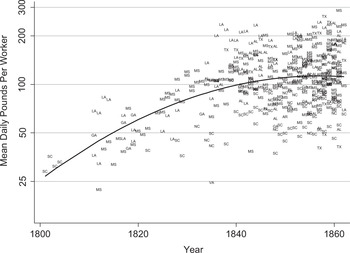
Edward Baptist's study of capitalism and slavery is flawed beyond repair. One of the cornerstones of his work is the observation that the quantity of cotton picked per day per slave increased three to four times between 1800 and 1860. This finding primarily relies on my research with Paul W. Rhode (“Biological Innovation and Productivity Growth in the Antebellum Cotton Economy,” this Journal 68, no. 4 [2008]: 1123–71). The increase in the cotton picking rate per slave (along with increase in the quality of American cottons) was fundamentally important in explaining many aspects of southern development, including the increase in cotton output, the South's ability to capture a dominant share of the Atlantic cotton trade, the pattern of western migration (which created so much misery for slaves), the increasing concentration of slaves on cotton plantations, and the long run increase in slave prices. Here was a major reason for the prosperity of southern elites. We argued that the increase in picking productivity was primarily due to the spread of improved cotton varieties. The succession of improved cotton varieties yielded considerably larger bolls, in some instances taller plants, along with many other characteristics that made the cotton much easier to pick. The development of improved varieties was not a one-time occurrence despite Baptist's unsupported contention (p. 127) to the contrary (Olmstead and Rhode, Creating Abundance: Biological Innovation and American Agricultural Development. New York: Cambridge University Press, 2008: 98–133).
Baptist downplays the effect of cotton varieties and instead argues that output per slave rose because of continuously increasing and more sophisticated doses of torture—he dubs the alleged innovations in violence as the southern “whipping machine.” If a slave failed to reach the assigned quota, that individual was summarily and brutally whipped day after day—skin was flayed and blood flowed. (One might ask how a mangled human, tormented and weakened by daily beatings could recover in short order to perform any work, let alone achieve a previously unattainable standard.) To avoid torture, slaves learned to pick faster and faster, day after day, year after year over a sixty-year span. Baptist wants us to believe that they did this by some secret process that only slaves understood. These secret slave picking innovations were the primary source of the increase in picking rates of Upland cotton over a half century—slavery allowed owners to capture the benefits of the slaves' secrets (pp. 131, 271). The mystery is even more bizarre because Baptist also seems to suggest that slaves developed a secret way of cradling small grains (p. 113).
Instead of sounding alarms, many reviewers have embraced Baptist's account even though it is inconsistent with a large body of data and defies common sense. Rhode and I accumulated from plantation records more than 600,000 entries showing the amount of cotton picked per day by individual slaves between 1800 and 1861. There was a clear pattern during a given picking season: picking rates were typically low at the beginning, rose as the crop matured, and then fell later in the season. (Picking rates also formed an inverted “U” over a given slave's lifetime.) Within this general configuration, there were sharp ups and downs due to the weather and other factors. An individual's performance could vary by 30 percent or more from day to day. Planters would have had to regularly lower quotas as well as raise them. Baptist only has quotas going up. It is impossible to reconcile his story with the data.
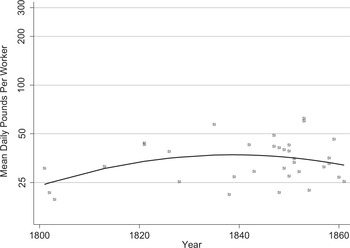
We considered the possibility that something besides better varieties might have accounted for the productivity gains we found in picking Upland cotton. Maybe it was due to “better” systems of torture, better management systems, or some combination of these and other factors? If so, then one would expect to see similar increases in the productivity of slaves toiling in other crops such as Sea Island cotton (which had a different production function than Upland varieties), rice, and tobacco. Figures 1 and 2 show the picking data for Upland cotton and Sea Island cotton plantations: there was very little increase in picking rates on Sea Island plantations. Although this evidence was in the figure that Baptist reproduced from our work, he left off the bottom half showing Sea Island plantations. The enigma grows because the output per slave in tobacco and rice production also failed to increase much. The Sea Island cotton, rice, and tobacco barons surely knew what their Upland cotton-producing kin were doing, and whips were available to all plantation owners. If Baptist's “whipping machine” drove the huge increase in Upland cotton picking output, he needs to explain why the nabobs producing other crops did not apply more (or new forms of) torture to increase their output.
MEAN DAILY PICKING RATES BY PLANTATIONS, 1801–1862UPLAND COTTON (N=468)

MEAN DAILY PICKING RATES BY PLANTATIONS, 1801–1862 SEA ISLAND COTTON (N=34)

The problems for the torture hypothesis of slave production dynamics are even more daunting. Baptist describes nightmarish plantation conditions circa 1800–1810—oppressively long work days stretching into the night, slaves regularly pushed beyond their physical limits, daily whippings, poor food, short (even starvation) rations, and the constant threat of family breakups (pp. 114–20). Is it really possible that these vile early nineteenth century slave owners and their hired thugs were so much nicer, gentler, and more conscientious (or so much more ignorant) custodians of their chattel that they voluntarily extracted only one–fourth as much output in a day as the more callous and cunning plantation owners of a few decades later? Slavery was a disgustingly vicious institution in 1860, but it was also a disgustingly vicious institution in 1800.
To be sure, some ex-slaves talked about cotton-picking quotas increasing and about slaves being beaten for not reaching their quotas. However, from the few testimonials that Baptist cites, or even from the broader collection of more than one thousand ex-slave accounts available on the web, one cannot reasonably conclude that innovations in torture led to the observed growth in Upland cotton picking output per slave. So just to be clear, I am not so much questioning the ex-slaves' testimony, as I am chastising Baptist's selective misuse of it. Further, Baptist has repeatedly tarred other reviewers who have even mildly questioned slave testimony as making blatantly racist remarks. Contrary to Baptist's attacks, to question an ex-slave's account does not imply giving white sources a free pass, and it is not necessarily part of a larger racist pattern of dismissing all black testimony. Good historians question sources. Samples of his ad hominem responses to legitimate questions are easily found (Baptist, “The Economist's review of my book reveals how white people still refuse to believe black people about being black,” http://www.theguardian.com/commentisfree/2014/sep/07/economist-review-my-book-slavery; Baptist on YouTube at http://www.youtube.com/watch?v=Cw6lFyy8jIk; and Baptist, “The Response.” Slavery & Abolition 36, no. 1 (2015): 186–97 [see p. 195]).
Baptist has a habit of making things up. As one example, he claims that the method for organizing slave labor was called the “pushing system.” Until now we had the “task system” and the “gang system.” Baptist's pushing system was the gang system on steroids. The term is compatible with his overall argument because it meshes well with his torture hypothesis, but where is a single contemporary mention of it dealing with U.S. slavery? Google Ngram Viewer shows no mention of a “pushing system” during the entire antebellum era outside of three references to a single discourse on philosophy and a reference to slavery in Jamaica. The term only rarely appears in works on slavery published in the twentieth century. Baptist's first reference to the pushing system (p. 116) notes (without references) that this was a term that slaves used, but reviewer Eric Foner (“A Brutal Process: The Half Has Never Been Told,” New York Times, 3 October 2014) notes that it was a term used by planters—myths become even bigger myths. Factual errors are too common to enumerate, but anyone who knows anything about U.S. cotton production will delight in learning that around 1947 “Arizona would be the nation's biggest cotton producer” (p. 331). In fact, Arizona was a bit player far behind Texas, California, Mississippi, and many other states.
Baptist's carelessness with numbers when coupled with his fundamental misunderstanding of economic logic leads to a vast overstatement of cotton's and slavery's “role” on the wider economy and on capitalist development. He asserts that cotton production circa 1836 was valued at about $77 million and made up about “5 percent of the entire gross domestic product.” Then, by double counting and with a wave of his wand, he succeeds in boosting cotton's role to more than $600 million, “almost half of the economic activity of the United States in 1836.” Here is the method: he adds the value of land and slave sales—but asset sales are not counted as a part of GDP. He adds the value of inputs used to produce cotton—a clear example of double counting because these costs are subsumed in the price of the cotton. Further, he adds the “money spent by millworkers and Illinois hog farmers,” and so on. If one extended of this faulty methodology by summing the “roles” of cotton with a few other primary products, the amount would easily exceed 100 percent of GDP—not possible (pp. 321–22; cf Bradley Hansen's analysis at http://bradleyahansen.blogspot.com/2014/10/the-back-of-ed-baptists-envelope.html). This is the stuff of his supposed new history of capitalism. Economic historians have long pondered the role of slavery in the nation's economic development. Douglass C. North stimulated a flurry of research with the publication of The Economic Growth of the United States: 1790–1860 (New York: Prentice-Hall, 1961). The ensuing stream of research included the creation of the Parker-Gallman sample, which has become a mainstay for scholarly work on slavery and the South. These and subsequent economic historians have debated the impact of slavery, but the consensus is that it was detrimental to economic development. (They of course are constrained by the need to use conventional accounting methods.) What is still more paradoxical for the notion that slavery was indispensable for capitalist development is that capitalism survived the Civil War and emancipation in excellent health and that cotton output soared in the second half of the nineteenth century.
All and all, Baptist's arguments on the sources of slave productivity growth and on the essentiality of slavery for the rise of capitalism have little historical foundation, raise bewildering and unanswered contradictions, selectively ignore conflicting evidence, and are error-ridden.
In the introduction to his book on the relationship between American capitalism and American slavery, Edward Baptist makes a bold claim. When speaking about the difficulty of teaching slavery he notes that “everyone who teaches about slavery knows a little dirty secret that reveals historians' collective failure: many African-American students struggle with a sense of shame that most of their ancestors could not escape the suffering they experienced” (pp. xix–xx). Baptist believes his work is part of a larger agenda that will lift this burden—freeing African-American students of American history from the shame that is (inherent?) in being the descendants of enslaved people. That is a powerful motivation to write a book, to see it as a device that can bring about a bold reclamation of a sense of self.
This would make me the ideal audience for Baptist's book. I am an African-American. I am the descendent of enslaved African Americans, and from the Cotton South that is the focus of Baptist's history. I was once a student of American economic history, and now I am a researcher and teacher of that same history. That economic history could play a central role in such a personal process only heightened my interest in seeing how it would be accomplished. Being that I am African-American, have I struggled less with my sense of shame now that I have read Baptist's book? Since this work has been reviewed elsewhere and by several other scholars in this volume, my review will concentrate on this specific task that Baptist sets before himself. To my knowledge, no other review has touched this issue or addressed whether the stated goal was accomplished (which itself says something about race, history, and race among American historians, but I digress…).
To begin, there is an odd familiarity in Baptist's claim to remove shame from the record of slavery through an analysis of its capitalistic underpinnings. That is exactly what Fogel and Engerman sought to do in Time on the Cross, where they explicitly noted that there was “black achievement under adversity” and that enslaved labor was far more productive than its Northern counterpart. Part of the impetus for this was to show that enslaved people were not the shiftless, lazy, and unruly characters painted by an earlier generation of racist historians and a subsequent generation of revisionists, and explanations of low productivity went from ineptitude to daily resistance. In the more rigorous (although now dated) framework of production functions, Fogel and Engerman showed that the productivity advantage of Southern agriculture was due to the labor input. In particular, they alluded to a “gang labor” style of agricultural production, especially in large scale cotton farming, where enslaved people worked in sync at a high rate to produce the phenomenal output per person seen in the antebellum era. This included the work of pregnant slave women, whose productivity was remarkably high. To square this circle, Fogel and Engerman argued that the material living conditions of slaves were better than previously thought, that family breakups were rare, and that slave breeding was even rarer. Overall, the revision to American history offered by an earlier generation of economic historians included a robust slave economy with incredibly productive slaves.
Baptist oddly claims that economic historians never discussed cotton picking “in any substantive way” in this literature (Baptist, “The Response.” Slavery & Abolition 36, no. 1 [2015]: 186–197, quote on p. 189) and his book reflects this mistaken fact. It would be impossible to read the heated debates of that time and think of anything but cotton productivity—and this productivity must, inherently, be about cotton picking. Similarly, Baptist's rather hostile attitude towards economics and economists (see the review above) is reflected in his book by the fact that he fails to acknowledge that without economic historians the very backbone of this argument about the relationship between slavery and American economic development would be a non-starter. The very fact that slavery was so profitable was not widely accepted among American historians until economists (using antecedents of the efficient markets hypothesis that Baptist dismisses) showed that slaves were a profitable investment. The ensuing debates about slavery and the enslaved in the making of America are predicted on the work of economic historians. How can we have an institution form the heart of a new style of capitalism if the cold-blooded search for (economic) profit is not its core?
This is not to say that the economic revisionism was correct on all parts. There were problems with that story which began to be clear in subsequent analysis. Richard Steckel, for example, showed that the material living conditions of slave children were quite poor—the material condition of enslaved children only improved when they reached an age where they could be productive in the field. The selling of slaves further into the Deep South was common, and the fertility of slave women was quite high. By the late 1990s, it was generally accepted that slavery was a profitable enterprise with productive slaves whose material living conditions were quite poor. And this is not controversial. The human capital of enslaved people is totally owned by others, and underinvestment was common due to high mortality (a dead slave is not productive) and also for behavioral reasons (hungry slaves are weaker and pose less of a threat to slaveholders' control). My use of the term “cold-blooded” was not accidental. But make no mistake, there is not a single economic historian I know who would ever argue neither that slavery was divorced from the development of American capitalism. American slavery has retained its place in economic history due to its inherent market orientation and its fundamental role in American economic development, full stop.
With this historiography in mind, it is somewhat puzzling to see that Baptist attempts to make something entirely new of these facts in his book. To be clear, his aim is to show that American capitalism was built on enslaved work, and in the United States the peculiar slaveholding institutions combined with traditional capitalist sources (merchants, etc.) to produce a new form of American capitalism. That American capitalism went on to define capitalism in the world. The high daily quotas and meager rations kept productivity up, profits high, and an international network of mills filled with precious, enslaved-picked cotton. On the ground, there was a pushing system where quotas increased again and again and plantations operated as a site of terror in the interest of more and more cotton. This system was a forerunner to later industrial success for the United States, where factory discipline would adopt quotas and strict rules to enforce labor behavior, whether or not that behavior was related to the output. Even more, enslaved labor kept the price of cotton low, fueled the Industrial Revolution, and was the key determinant in American economic ascendency.
There are some pieces that would help make this argument concrete. Baptist argues that there is little exceptional about Southern economic development and strives to integrate it into the American whole, but he concentrates on the cotton south (the New South) and gives much less attention to the Old South. A full integration would require a more expansive focus. The counterfactual of the prices that would have been observed in the absence of enslaved labor is key. The different forms of agricultural organization needed must be theorized. While Baptist paints a striking picture of the enslaved world in the United States, the alternative world is needed to make the ultimate point about what the world gained from enslavement in the United States. Baptist never gives a ballpark calculation of what the consumer and producer surpluses due to enslavement were, and if we had such a measure we could say how much of American (and world) GDP growth was due to American enslaved labor. Even without this calculation, Baptist claims that this fact should free African American students from the shame they feel when studying American slavery. The remarkable fact is that this argument has been made before, where hardworking/overworked/overwrought slaves drove American wealth to unprecedented levels and the spoils of political power in the world. But that argument did not work to remove shame then and it does not work now.
Baptist frames his analysis of slavery by dissecting its parts. He likens American slavery to a body, and therefore names the chapters after various body parts. Hands, for example, are literally the key component. One hand was the hand that picked cotton, under ever increasing quotas and threats of violence that were fueling American political and economic power. The other hand was the one that turned buying and selling people into its own occupation. The feet were of the enslaved, who were sold ever deeper south to more fertile land which could grow the precious crop. And the seed was not cotton seed, but the northern financiers and other conspirators who fueled land speculation, broke the rules, and would make a Wall Street giant of the 1980s blush with their cavalier attitude towards the rules of finance (particularly if an investment did not pan out). Like a body, the pieces connect together to form a whole of an American slave system which used brutal methods to exact high productivity from enslaved people, was terroristic in its methods, and was nothing less than a collective effort to break the spirit of enslaved people.
Very little of this is new, certainly not to an economic historian of slavery. What struck me most while reading this book is how dated the central economic argument is. Perhaps most shocking are the economic arguments that Baptist dismisses. He claims, for example, that economists emphasized a rhythm system that was less than fully articulated. Baptist replaces the gang labor system of Fogel and Engerman with the whipping machine and other forms of punishment without considering that the two are not mutually exclusive. Organization and brutal punishment are not substitutes. He also dismisses innovations in cotton agriculture while not considering that even if more resistant and easier to grow, it still had to be picked at breakneck speed. To be clear, there were innovations in cotton and planters were keen on this development of new breeds which would be resistant to rot and infestation. More cotton meant more profit. Baptist never makes a firm argument about the elasticity of demand for the crop, which he needs to make an argument about ever increasing production being met with ever higher prices. Even with more cotton being picked per enslaved person, there was strong demand for the hands that could pick it—innovation led to more land suitable to cotton cultivation, further driving demand for slaves whose productivity was steadily increasing. Once again, an elasticity would help here, especially as Baptist makes much of the money earned from the trade of enslaved individuals.
To bring the enslaved themselves into the story Baptist relies very heavily on slave narratives. This has become a key controversial part of the book as Baptist takes them, more or less, at face value. The use of narrative evidence adds a unique piece to this book and this piece is worthy of note for two reasons. First, histories of slavery have repeatedly ignored the testimony of former slaves as being products of politics in the late antebellum and post-bellum eras. That may be true, but the meta-analysis of narratives is a worthy attempt to bring the enslaved and their experiences into focus. Consistent descriptions could be the product of design, but not when supplemented by additional evidence. Baptist is correct to note that narratives should be used just as other sources from the period—all of them are products of circumstances that historians should assess and judge. To neglect them is to favor one constructed history over another. Quantitative history has made some inroads that would have allowed Baptist to say more about living conditions, culture, and family structure among the enslaved (Stephen Crawford, “The Slave Family: A View from the Slave Narratives.” In Claudia Goldin and Hugh Rockoff, editors, Strategic Factors in Nineteenth Century American Economic History [Chicago: University of Chicago Press, 1992]: 331–50).
Second, Baptist takes some liberties with the narratives. When this has been pointed out, Baptist tends to dismiss this critique either as (1) standard historical practice or (2) a racist attack that dismisses the use of the testimony of the enslaved. My concern is different. Baptist takes liberties (and whether these fall within accepted practice is another matter) with the intention of focusing attention on the horrors of slavery. This supposes, at its heart, that the enslaved could not effectively do so. If they had, this half would have been told and heard. The enslaved needing a conduit for the truth of their experience is rather troubling. Doesn't this tell us in the century and a half since the end of chattel bondage we could not find one descendent of the enslaved to do this?
It could be that the story must be told by certain people. That is equally troubling and no less likely a possibility. I say this because the horrors described in the book are not new to historians of slavery, and especially of those active in the debates over the economics of slavery. Recall that the model of incentives and punishment offered by Fogel and Engerman was fully rebutted in painstaking detail. This meant a direct confrontation with the brutality of slavery and its impact on health, children, and basic family function and formation. And yet we are being told that this part was not told. Was it not told or was it not heard? There is a difference.
The most disappointing part of the book is that, like so many other works, it says it is about slavery when in fact it is about slaveholders, Northern interests, and regional politics. The largest breakthroughs in the modern historiography of American slavery have concerned the enslaved, as in Blassingame's analysis of psychological development, Gutman's work on family structure, or Genovese's analysis of the cultural foundations of Southern society. The more recent anthropometric work on the health of slaves and rates of family breakup has done the same. Baptist uses the slave narratives to anchor his chapters, sometimes drawing more from the record than is there, but ultimately this is a book about the people who bought and sold other individuals for profit, the way that they organized the people they bought and sold, and how they fostered relationships with those that did not own people to further their cause. The narratives are used as devices which begin and end the anatomical device of the book, but the meat of the argument lies in the heart of the chapters where the narratives are largely absent.
I was not freed from shame from having read Baptist's book. Perhaps this is because the facts he presents were not new to me. It could also be that American slavery will never be a source of pride for anyone. It is time to accept that fact. Evidently, Baptist believes that showing the powerlessness of enslaved people against their captors, and the key piece their labor provided to an industrializing world, lessens the shame they may feel. Knowing that one's ancestors were subjected to terror and horror does not remove shame any more than claims that the enslaved were embodied with a Protestant work ethic, and it is curious as to how it could. Needing a champion for the voice of the enslaved does not help, either.
What few histories explore, but keen observers know well, is that the culture developed and ritualized in slave quarters remains America's largest cultural export to this day. Walk anywhere in the world and you will see that exported American culture bears a remarkably strong dose of melanin, of a culture created and developed among the enslaved. Baptist alludes to this in fleeting pieces, particularly in the chapters on tongues and breath, where he makes strides to describe some aspects of the foundations of (African) American culture. This never develops the point as fully as it should be—that an economic system that redefined capitalism also birthed a culture that continues to define and refine the American experience. That is the half that has never been told, and certainly not by Baptist. Baptist, like many others, continues to see the enslaved as a vehicle for his own need to tell us something new, even when it is not. That, I believe, is the true shame about the historiography of slavery. The subject is rarely the object of analysis. When the enslaved are brought more fully into view it is still in the service of some other goal where these limited sources are put in place to bring voice for what would have to be idiosyncratic experiences. Unfortunately, Baptist does little to alter that trajectory. Shame, indeed.
Edward Baptist's book, The Half Has Never Been Told, is a political and economic history of the Old Southwest. Beginning with the Louisiana Purchase in 1803, the United States was actively engaged in the acquisition of new lands. Northern attempts at expansion were thwarted by Canadian (and British) resistance whereas southerners had greater success, displacing Native Americans and Mexicans through a combination of land purchase and conquest. The lands in the Southwest were particularly well suited for the production of cotton and the profits from this crop helped to spur on the geographic expansion of slavery (p. 115). When foreign lands were no longer available for expansion, the South turned its attention towards the territories, resulting in conflict and eventually war with the North. For Baptist, “slavery's expansion was the driving force of US history between the framing of the Constitution and the beginning of the Civil War” (p. 413).
Baptist wants to tell his story from the viewpoints of the slaves and to do so, he relies on the narratives, biographies, and interviews of former slaves. “No one autobiography or interview is pure and objective as an account of all that the history books left untold. But read them all, and each one adds to a more detailed, clearer picture of the whole. One story fills in gaps left by another, allowing one to read between the lines” (p. xxv). We cannot be expected to read all interviews conducted by the WPA. Indeed, not all interviews are presented in the book. Instead, we rely on Baptist to select them for us. Are the selected interviews representative of all interviews in the sample? Was Baptist able to effectively “read between the lines”? Unfortunately, we cannot answer these questions using the information presented in this book.
Much of this book concerns the slaves sold in New Orleans, the site of the largest slave market in the Southwest. To tell his story, Baptist uses two databases: The Hall database (that includes the records of slaves sold prior to 1820) and the so-called “Baptist database” for slaves sold from 1829–1831. Sales data for 1830 were originally collected by Herman Freudenberger and myself and shared with Baptist. Baptist extended the sample and relabeled it the “Baptist database.” (Herman Freudenberger and Jonathan B. Pritchett. “The Domestic United States Slave Trade: New Evidence.” Journal of Interdisciplinary History 21 [Winter 1991]: 447–77.) Although these data add important details to his story, Baptist should be more cautious in their use. For example, in a single year, he finds that “the number of people sold in New Orleans increased almost five times over” (p. 53). A five-fold increase in sales is implausibly large and is likely the result of sampling error. In addition, Baptist compares the sales advertisements of slaves with their corresponding sales invoices. He finds that the occupations of imported slaves were often omitted from the invoices and concludes that the skilled slaves sold in New Orleans were purchased as potential cotton pickers rather than as artisans. According to Baptist, cotton planters worked men, women, and older children at identical jobs and had no need for skilled slaves. Buyers “wanted to buy people who had no claim to a specialized status…. Everyone had a uniform status – that of cotton ‘hand’” (p. 119). Traders selling artisans as common labor seems highly unlikely. Why would traders pay premium prices for skilled slaves in the exporting areas, transport them to New Orleans, advertise them as skilled, and then sell them at lower prices as unskilled field hands? If New Orleans buyers wanted field hands, then traders would have purchased lower-priced field hands in the exporting areas. A more plausible explanation for Baptist's finding is that New Orleans notary publics underreported the occupations of slaves.
Chapter Four concerns cotton production in the Southwest and the topics discussed by Baptist should be familiar to most economic historians. Baptist finds that slavery was profitable; slave agriculture was economically efficient; the cotton market was competitive; productivity gains in slave agriculture were passed onto customers in the form of lower prices; the efficiency gains were confined to farms that employed gang labor (or the so-called “pushing system of labor”); prior to the Civil War, slaveholders were optimistic about the economic future of slavery; and that slaves worked harder (at a greater level of intensity) than free labor. Indeed, his findings are similar to those presented by Robert Fogel and Stanley Engerman in Time on the Cross (Boston: Little, Brown & Co., 1974). There are, however, major differences between Fogel and Engerman and Baptist. Baptist believes that slaves worked more hours, took fewer breaks, and were frequently whipped by their owners. Is this an accurate description? Although many ex-slave interviews describe whippings, other interviews do not. With the exception of Bennett Barrow, planters did not record the frequency and severity of their whippings. Fogel and Engerman use Barrow's records to show that slaves were rarely whipped whereas Baptist uses these records to show the opposite. How should we interpret statistics such as 0.7 whippings per hand per year (Fogel and Engerman 1974, p. 145)? Was Barrow a typical planter, especially with regard to the frequency of whippings? With so little information, support for almost any view is possible.
Chapter Seven concerns the potentially dangerous mix of sex and credit in the Southwest. For Baptist, the sexual exploitation of enslaved women encouraged slaveholders to engage in excessive risk taking. Slaveholders, “primed by the sexual arousal built into the human commodity market, … chase[d] short-term gains with little thought for the future” (p. 243). Using their slaves as collateral, slaveholders took on “immense debt” by purchasing additional slaves on credit (pp. 243–44, 257). Not only did they risk their wealth, they gambled with their slaves' lives.
For Baptist, the 1830s was a decade of financial instability. The demise of the Second Bank was following by rising asset prices, the banking panic of 1837, and economic recession. Missing from this story is evidence of excessive risk taking by slaveholders. New Orleans sales records indicate that most slaves were sold for cash. Buyers rarely over-extended themselves by purchasing slaves on credit. Some slaveholders pledged their slaves as collateral on equity loans. The amount that was borrowed was small, however, relative to assessed value of the slaves. Finally, some slaveholders defaulted on their loans. How many slaves were auctioned due to the forfeiture of collateral? Baptist does not address this question in his book.
The central theme of this book is the expansion of slavery. To expand, southerners needed land and labor—the slave trade provided much of the labor and military and political actions provided much of the land. Economic historians continue to debate the economic significance of the geographic expansion of slavery. In The Half Has Never Been Told, Baptist makes a strong case for why southerners thought that slavery needed to expand in order to survive.
This book will take many readers out of their comfort zones. It offers gripping accounts of former U.S. slaves and the conditions to which they were subjected. It also offers a non-traditional view of what economists call “technical progress” in standard models, de-emphasizing quantitative work by economic historians about hybrid seeds and other agricultural improvements in favor of increasingly severe punishment across individuals and over time to raise the rates at which cotton could be harvested. It delves into social psychology to describe how slaves learned to alter consciousness while picking fibers with increasing dexterity from boll to boll. It recounts the tragedies of forced migrations, physical abuse, broken families, and the commoditization and securitization of human beings. To Edward Baptist, it was not all about money, though money and profit are clearly central to his book, but also about power, domination, and politicians that did little or nothing to break the destructive pattern.
The sources are sound and the cited accounts authentic. Yet the line between documented accounts and what sound like 21st century augmentations can be blurry, and this will likely pose challenges to those charged with evaluating Baptist's book from a purely economic perspective. As a financial economist and not a student of slavery in the United States, I will instead focus on some of the connections between the cotton economy and the author's interpretations of early U.S. banking history, the Second Bank of the United States, Jacksonian democracy, and the Panic of 1837, all of which play important roles as the accounts unfold.
To begin, Baptist seems unsure about how to judge the Second Bank in the context of economic growth and development. He states (correctly) that the Bank saved the economy from the Panic of 1819, but does not address the extent to which contemporaries charged the Bank with saving its shareholders at the expense of the public. He praises the Bank's role in controlling note issues by state-chartered banks, but does not consider how this constriction of the banking system and credit continued a system designed by and for a wealthy elite—an elite for which the Bank regularly distributed annual dividends of 7 percent at the time of Andrew Jackson's election to the Presidency in 1828. At the same time Baptist vilifies the Bank for allocating its resources to areas based on expected financial returns, including its branches in the South, suggesting that the private sector, and Nicholas Biddle in particular, should have taken greater social responsibility when influencing the markets that drove the allocation of capital.
Yet the early development of a market economy has also been increasingly recognized as a key ingredient in the remarkable success of the United States—a story of success not driven solely by cotton exports. For example, at the peak of the pre-1837 cotton boom, the total value of cotton produced in the United States was about $71 million, or somewhere between 5 and 6 percent of GDP. Some of this cotton was not exported but rather contributed to additional value as an input to a growing domestic textile industry. Much of the economy remained focused on family farms, and transportation improvements were enormous undertakings and contributors to overall economic activity. The bottom line is that, while cotton was of course the key component of U.S. exports, there were a great deal of other pursuits going on at the time, and the driving influence of cotton simply does not square with economists' quantitative understandings.
Baptist is more certain about Andrew Jackson and his role in fueling the cotton economy. Jackson is maligned for promoting a populist movement in which no white man was “left behind” while other groups were ignored, yet we should recognize that the movement did succeed in stripping some of the nation's financial power from the elite and transferring it back to the populace. Surely Jackson's version of equality did not include women and slaves as Baptist correctly points out, and he did hold slaves like other Presidents before him and clearly viewed them as personal property. Yet Jackson's form of populism did widen the circle of economic opportunities for many, including a multitude not involved in slavery, and it might be interesting to consider how the movement provided a spark that empowered citizens and politicians after Jackson to build on its momentum in rethinking institutions and making the sorely needed changes that enabled slavery's eventual abolition.
Baptist's views about the Panic of 1837 are traditional and somewhat dated. A decline in the price of cotton, documented by Lewis C. Gray (History of Agriculture in the Southern United States to 1860. Washington: Carnegie Institution, 1933: 1026–27) to have been relatively small, was not the primary cause. Neither was speculation in cotton lands, for the land boom that Jackson's policies first encouraged and then brought to an abrupt end was occurring more in non-slave states of the now-Midwest than in Louisiana and Mississippi. The transfer of government balances that had accumulated in eastern cities benefited the southeastern states the most, not those on the cotton frontier. Indeed, it took a well-organized campaign to break up the financial elite in the Northeast, and while Jackson's policies no doubt had the unintended consequence of weakening the U.S. financial system by dislocating the monetary base, they also allowed banking services to diffuse more evenly, and especially in the Midwest.
None of the above is meant to take away significantly from Baptist's work, but only to place it in an appropriate context. From a traditional economics perspective, it presents an incompletely-tested hypothesis about technological progress, but also provides enough compelling textual evidence to make further evaluation of the hypothesis worthwhile. While at times the book seems to take too broad an approach to the links between finance, financial crises, capitalism, and slavery in the antebellum United States, this reader was able to look past these deficiencies to gain a clearer ground-level view of the slave economy—indeed a half that has never been told—or at least never so vividly.