The growing need for financial education
During the 1980s and 1990s the financial landscape in the UK, as in many Western states, became increasingly complex, with the growth of the credit industry, the mortgage market and electronic forms of money serving as just a few examples (Pahl, Reference Pahl1999). At the same time, there was a shift in responsibility and risk for welfare from the state to the individual (Klein and Millar, Reference Klein and Millar1995; Giddens, Reference Giddens1998; Gunter and Furnham, Reference Gunter and Furnham1998; Marginson, Reference Marginson1999). This has all placed much greater onus on individuals to develop financial capability in order to manage money better and make informed choices (DfEE, 2000; FSA, 2008; HM Treasury and FSA, Reference Treasury and FSA2008; PISA, 2012). In 2000, the Department for Education and Employment (DfEE) argued that:
the flexible labour market, lifelong learning, short-term contracts, and greater longevity all have serious consequences for how we undertake financial planning. Financial choices and decisions will have significant consequences for future financial well-being. Financial capability is an important life skill for everyone: the ability to make financial decisions is the key to identifying and making best use of the opportunities in today's changing world. (DfEE, 2000: 4)
The credit crunch and subsequent Global Financial Crisis provide further reasons for considering financial education a priority for policy makers, particularly as a way of developing financial inclusion (Cnaan et al., Reference Cnaan, Moodithaya and Handy2012; PISA, 2012). Difficulties in making ends meet are likely to increase as unemployment rises, pay stagnates and prices rise. Evidence suggests that people on low incomes are better at keeping track of their finances than other groups (Atkinson et al., Reference Atkinson, McKay, Kempson and Collard2006), but financial education may nevertheless be helpful at the margins in helping people manage increasingly tight resources. Finally, the Browne review of higher education has placed greater financial responsibility onto prospective university students to balance the risk and reward of paying increased annual tuition fees (up to £9,000 per annum) on graduation, once a certain salary level is reached (Butler and Malik, Reference Butler and Malik2010).
The focus on individual responsibility may be problematic, but given these changes in the economic and policy environment it seems clear that there is an increasing need for financial education. A recent study of assets and debts among couples from across the socio-economic spectrum found support for financial education in schools as well as support and advice for adults (Rowlingson and Joseph, Reference Rowlingson and Joseph2010). So when should financial education start? Who should deliver it? In what way? How can it be delivered most effectively? There is actually very little evidence that financial capability programmes more generally have improved levels of financial capability (Atkinson, Reference Atkinson2008), but this is largely because of the lack of any rigorous research in this field rather than evidence that such programmes are ineffective. In their review of financial education initiatives, the The Financial Services Authority (FSA) (FSA, 2008: 32) concludes that the effectiveness of such programmes ‘are difficult to measure and . . . the benefits of such education may not manifest themselves for many years’. The previous Labour government had begun a major longitudinal evaluation of various education initiatives, which would have been extremely useful here, but the research fell victim to the spending cuts of the coalition government in 2010.
On the broader subject of children and money, there is some literature in economic sociology, economic psychology and social policy (Gunter and Furnham, Reference Gunter and Furnham1998; Webley and Nyhus, Reference Webley and Nyhus2006; Ridge, Reference Ridge2002, Reference Ridge2007), but this is still rather limited and generally based on small samples. One exception to this is a survey of around 10,000 people aged twelve to seventeen which has been carried out every year between 2007 and 2011 (Royal Bank of Scotland, 2011). The survey found that young people had incomes on average of £90 per month, with the majority coming from parents (£36) and paid work (£27). Young people may therefore benefit from financial education not just to prepare them for the adult world of finance but also to assist with their particular needs while still young. The emphasis on preparing young people for the adult world sees children largely as human ‘becomings’ rather than human ‘beings’.
Given the relative lack of research on this topic, this article seeks to contribute to academic and policy debates by exploring the current provision of financial education in the UK. It also draws on some empirical research undertaken in two Birmingham schools to explore some key issues in this field with children themselves.
Financial education in UK schools
The Labour government of 1997–2010 certainly encouraged financial education at primary and secondary school levels, hoping that pupils would be taught how to develop: ‘financial knowledge and understanding’, ‘financial skills and competence’ and ‘financial responsibility’ (DfEE, 2000: 6). As part of this drive, the Personal Finance Education Group (PfEG) was established in 2000 as an independent charity, funded largely by the financial services industry, to support the teaching of financial capability in schools. PfEG's mission is:
to ensure that all young people leaving school have the confidence, skills and knowledge in financial matters to participate fully in society. (PfEG, 2010).
By providing a diverse range of resources for schools, from one-to-one consultancy to case studies and online learning facilities, PfEG have played an influential role in establishing a financial education programme. The aim of their approach is to try to ensure that financial education is tailored to individual needs in line with the personalised learning agenda (Hartley, Reference Hartley2009).
New Labour encouraged all schools to undertake some form of financial education from 2000 (DfEE, 2000), but despite this, and the work of PfEG, Ofsted (2008) have suggested that the quality of provision is uneven, varying according to schools commitment, time, expertise and engagement in financial education. The FSA (FSA, 2006: 3) discovered that 88 per cent of primary and 71 per cent of secondary schools did not explicitly teach personal finance education. In the minority of schools that incorporated some financial education into the curriculum, most did so because they felt that it was an important part of the education process (FSA, 2006). These schools included personal finance education by applying it on an ad-hoc (and rather minimal) basis, that is once or twice a term in maths or PSHE (Personal, Social and Health Education), and saw it as increasingly important to include it as students got older (FSA, 2006). Possible reasons for the lack of financial education formally integrated into the curriculum may have been due to the lack of confidence among teachers in teaching finance, lack of leadership within schools and schools concentrating on key performance targets such as SATs results (FSA, 2008).
By 2006 it was clear that despite government encouragement relatively little was happening in schools. Since then there has been a flurry of financial education initiatives stemming, at least partly, from increasing awareness and concern around financial exclusion and financial disadvantage. Various optional initiatives have been promoted, including the £10 million My Money programme from 2008 to 2011 (HM Treasury and FSA, Reference Treasury and FSA2008) which aimed to:
provide an integrated approach to personal finance education from when a child first starts school through to the end of secondary school. (DfES, 2010:1)
The programme was designed for children and young people to understand key economic concepts that will prepare them for their life ahead. At secondary school level, a non-statutory programme was introduced in September 2008 which combined ‘careers education, work-related learning, enterprise and financial capability’ and was linked to the Every Child Matters agenda (QCA, 2007: 227). The FSA also supported a £16 million Learning Money Matters education programme for secondary school-children delivered via PfEG in England (HM Treasury and FSA, 2008), with similar initiatives in Scotland, Wales and Northern Ireland.
Despite all these initiatives, there was still little evidence of much activity in schools by 2010, and so the government decided that financial education would only be given prominence when made compulsory in both primary and secondary schools. At the time the Secretary of State for Children, Schools and Families, Ed Balls, stated:
It's really important that we teach our children about money matters like pensions, responsible saving and effective money management. That's why I've announced Personal, Social, Health and Economic education, which includes economic wellbeing and financial capability, will be compulsory for all children . . . We need to make sure all young people have the information they need to prepare them for the complexities of today's modern world so that they can give security to their families and prepare for the future. (DfES, 2010:1)
However these plans were sidelined in order to concentrate on the upcoming general election in May 2010. Most recently, an All Party Parliamentary Group has been launched by MP Justin Tomlinson on financial education for young people. Over 140 MPs have joined the group and it is supported by PfEG, Which?, Citizens Advice, the Money Advice Service, Barclays, Capital One, HSBC and Nationwide Building Society, among others (PfEG, 2011). It launched its inquiry into financial education in schools in December 2011 and its first recommendation was for personal finance education to be a compulsory part of every school's curriculum (All Party Parliamentary Group, 2011).
As we shall see, however, putting this subject into the National Curriculum would be only a small step towards providing effective financial education. The content and delivery of such education is also crucial.
Research in Birmingham schools
As discussed above, there has been very little research in this field, particularly research involving the direct participation of children. In the absence of such research, we carried out a small-scale project to explore children's understandings of key financial issues and their views about the personal finance education they had received through the My Money Week (www.pfeg.org/resources/my-money-week). This was not designed as an evaluation study but as an exploratory piece of work to highlight key issues.
Working in partnership with Birmingham City Council and the PfEG, two schools in Birmingham were identified, one primary and one secondary, that delivered financial education and that were participating in My Money Week, which was held between 28 June and 4 July 2010. We particularly wanted to select examples of schools that were most enthusiastic and active about financial education. However, the PfEG consultant we worked with could not identify any secondary schools in the West Midlands that they thought would provide particularly good examples of delivering financial education. This, in itself, is an important finding.
PfEG had much better links with primary schools and so two of these were selected for the study. One of these was located in one of the most deprived inner-city areas of the UK and the other was in a much more affluent suburban setting. These different socio-economic/geographical profiles provided an additional dimension to the research. To thank the participating schools and pupils a small cash gift was donated to the school and some pens/novelty erasers were given out to the pupils.
Overall, eight small group discussions with eight pupils each lasting between thirty to forty minutes were carried out. Four were carried out with Key Stage 1 (age seven) and four with Key Stage 2 (age eleven). The research took place in the week before and after the PfEG My Money Week initiative. It was intended that by exploring financial issues with the students prior to this initiative we would be able to explore some ‘baseline’ knowledge and views. By returning after the initiative we might pick up any changes and also ask their opinions about the initiative. The small group discussions were transcribed in full and pictures that children drew and annotated were used to inform the analysis.
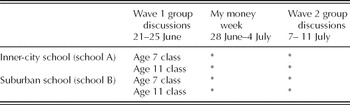
There were therefore a number of dimensions to analyse: before/after My Money Week, Key Stage 1/Key Stage 2 and Inner-City/Suburban School (see table 1).
Fieldwork sessions (*) in 2010

Children's understanding of money
Understanding money provides the foundations for understanding abstract concepts such as credit and debt (Gunter and Furnham, Reference Gunter and Furnham1998). In addition, parents’ behaviour is thought to influence the economic behaviour of their children (Gunter and Furnham, Reference Gunter and Furnham1998; Webley and Nyhus, Reference Webley and Nyhus2006). For example, children that have a bank or savings account are likely to save regularly, which is important, particularly in later life. Rather than asking children the personal and potentially sensitive questions of where they got money from and what they did with it, we depersonalised the questions and asked the children ‘where do children/adults get money from?’. This desensitised the question and also enabled the pupils to draw on a range of influences such as their own experience, media, family and friends, which are often cited as key influences (FSA, 2008). This also recognised that poorer children are less likely to receive pocket money, particularly on a regular basis, and some young adults may earn their own money through informal paid employment which provides a degree of independence and autonomy (Ridge, Reference Ridge2002).
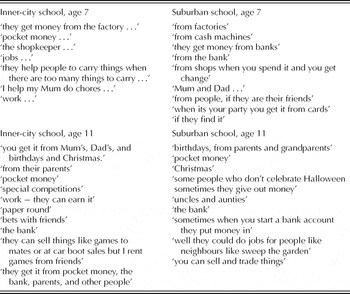
The top half of table 2 shows the responses from children at age seven in both schools. Children across both schools said that money came from factories (by which they meant the ‘factory’ that produces money, the Royal Mint). This may reflect the more immediate relationship of children and money as they talk about money being physical and real to them rather than virtual (for example, through the use of credit and debit cards), and corresponds with findings from Bonn and Webley's (2000) similar study of children's understanding of the origin of money in South Africa.
Where do children get money?

Source: Authors fieldwork.
Children in the inner-city school were more likely to mention work/chores as a way for children to get money than those in the suburban school, where the emphasis was more on obtaining money through gifts from friends and family.
At age eleven, some pupils still mentioned the physical source of money. For example:
Technically when people say money doesn't grow on trees, they are wrong because paper comes from trees and money is made of paper. (Inner-city school, age 11)
The children in the eleven-year-old age groups also gave more examples around similar themes as the seven-year olds, featuring gifts and money for work/chores (see bottom half of table 2). The bank was mentioned by children in both schools, as was buying and selling to raise money. This reflected a strong entrepreneurial take on money at both schools.
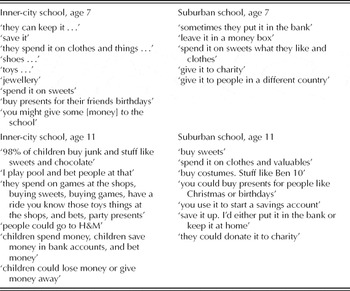
When asked what children do with money, children from both schools at age seven mentioned saving, although it was only in the suburban school that anyone mentioned saving in a bank (see table 3). Spending featured heavily, but so too did giving money away, for example, to charity.
What do children do with money?

Source: Authors fieldwork.
At age eleven, spending money was most commonly mentioned, although children at both schools talked about saving and giving money away (see table 3). So while children often said that they purchased products that ‘satisfy immediate needs’, such as sweets, they were able to understand the consequences of making more long-term decisions and investments for the future (Gunter and Furnham, Reference Gunter and Furnham1998: 35). This supports earlier research that suggests that children are socialised as consumers from a young age as:
childhood, like adulthood, is deeply steeped in the consumer culture of our time. A higher standard of living leads to increasing demands and escalating pressures on families struggling to achieve adequate social integration and social standing. (Ridge, Reference Ridge2002: 37)
Moreover, these findings reflect the different forms of money that children may be exposed to and the need for financial education to be mindful of the diverse range of individual needs.
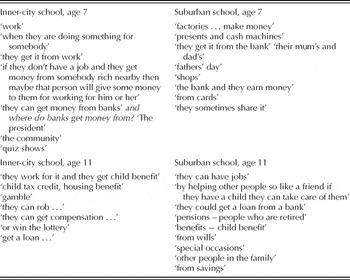
Turning to where adults get money from, we found that parents’ economic behaviour and understanding can play a significant role in influencing children's economic behaviour (Gunter and Furnham, Reference Gunter and Furnham1998; Webley and Nyhus, Reference Webley and Nyhus2006). Children aged seven still mentioned factories, banks and cash machines, but those from the inner-city school, in particular, mentioned work (this was also mentioned by one of the children at the suburban school). Children from the suburban school were, again, more likely to mention gifts of money (for example, for fathers’ day and from cards).
Children aged eleven had a more sophisticated understanding of where adults get money from. Social security benefits featured quite strongly as a source of income, and children, particularly at the inner-city school, could name individual benefits, such as child benefit, child tax credit and housing benefit. Children at both schools mentioned work as a source of income, but some clear differences began to emerge between the schools in terms of the other sources of income mentioned. Children at the inner-city school mentioned more precarious sources of income, such as loans, stealing, compensation and lottery wins, whereas children from the suburban school mentioned sources of income generally associated with more affluent groups, for example inheritance, gifts from friends and savings. The children's understandings of income and benefits at the inner-city school may demonstrate particular localised knowledge shared within lower socio-economic families as a coping mechanism to deal with (potential) economic, social and emotional ‘instability and hardship’ (Furnham, Reference Furnham2005; Pimlott-Wilson, Reference Pimlott-Wilson2012).
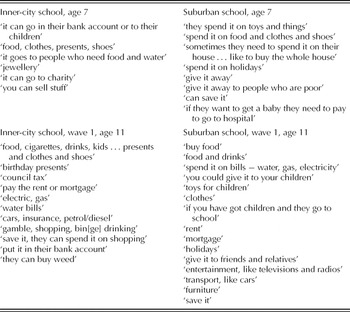
When asked what adults do with money, children aged seven gave a variety of answers including spending on necessities (such as food, clothes, etc.), luxuries (such as jewellery), charity and saving. Children in the suburban school also mentioned spending on holidays and buying a house.
At age eleven, children mentioned many more things that adults can do with money (see table 5). Utility bills are particularly prominent here (for example, rent, water, gas, electricity). These did not really feature in the answers of seven-year-old children who seemed generally unaware of such bills. Spending on children also featured fairly prominently. Children from both schools also mentioned saving. It is thought that increased levels of financial capability encourages thrift and saving, however research has shown that while education was important in shaping values, in reality people do not necessarily save more with increased education (Anderson and Nevitte, Reference Anderson and Nevitte2006).
Where do grown-ups get money?

Source: Authors fieldwork.
What do grown-ups do with money?

Source: Authors fieldwork.
These findings reflect the different experiences of money that children may be exposed to and the need for financial education to be mindful of the diverse range of individual issues. We saw this particularly clearly when the eleven-year-olds were asked about whether or not it was a good idea to borrow money, which provoked a lively response from the children in the inner-city school as follows:
‘Yes but if you don't pay it back the bailiffs come get yer.’
‘I think it's a good idea to borrow money because say you need the money at that time and you really need it, you can get it and at that time when you don't need it you can give it back.’
‘But it's not that easy because sometimes you might need money and you have spent all that money, what money are you gonna have left? ‘ . . .
. . . ‘Then you need savings’. . .
. . . ‘But if you have got savings money, why would you borrow, what's the point [of borrowing]?’
. . . ’Not from loan sharks . . . because if you borrow £20 then you have to pay back £200 or £300 back.’
‘That's how they operate, say you need money fast they say I'm gonna add 10% interest each month until you pay it back and then if you don't, they will threaten you with violence.’
This discussion highlights that the children were aware of the pitfalls of borrowing (in terms of repossession by bailiffs if people default on loans). They were also aware of the high cost of credit from some sources, such as moneylenders.
The eleven-year-old children from the suburban school mentioned borrowing from other sources, such as informal borrowing from friends and family and formal sources such as credit cards. Like the children from the inner-city school, these children were also wary of borrowing money because of cost (through paying interest) but there was no mention of bailiffs or loan-sharks. Overall, as expected, the older children had a more sophisticated understanding of money, which is supported by earlier research (Bonn and Webley, Reference Bonn and Webley2000). However, the different environments did not necessarily impact upon understanding of economic concepts but rather highlighted the different socio-economic environmental contexts in which the children were growing up in, as evidenced in other studies (Bonn and Webley, Reference Bonn and Webley2000; Furnham, Reference Furnham2005).
Our research shows that, in the main, children do understand the nature of money and key economic concepts. The different socio-economic geographies of the schools highlights the differential experiences and understandings of money particularly in relation to the household income and the strategies by which households can negotiate different financial strategies. Moreover, this research shows that children are engaged and able economic actors (Chin, Reference Chin1999; Martens, Reference Martens2005).
Learning about money in school
When we returned for the second wave of fieldwork and asked the children what they remembered from My Money Week, the main thing they talked about was our visit the week before My Money Week. They remembered the issues we had discussed and we had to probe very clearly to ask them about the activities that they had engaged in within the school rather than with us. The main activity which they recalled (at both schools) was designing a coin. This was a practical/creative task and was associated with a competition (for the best design). The children had very little recall of any other discussions about money during My Money Week, although there were some vague mentions of ‘scenarios on cards’, a shop-keeping game and the issue of wants versus needs was raised.
Our visit had been memorable to the children because they had volunteered to take part and had been selected from among their class-mates to participate in discussions with outsiders and so the session would have been very unusual for them. They said that they enjoyed our session and also the discussions they had during My Money Week. There was also enthusiasm for more discussions about money in the future.
Discussion
Financial education in schools is increasingly viewed as important by policy makers and the public for two key reasons: firstly, financial education is seen as important for children and young people ‘as consumers, workers, business people or investors’ (Gunter and Furnham, Reference Gunter and Furnham1998: 95), and, secondly, it is seen as helping children to have greater understanding of effective economic decision making now and in the future. The increasingly complex financial world we live in, at a time of global financial crisis and retrenchment of state welfare, make such education increasingly important. However, financial education cannot be viewed as a panacea for creating financial citizenship or combating financial exclusion. Government, regulators and financial institutions all play a part in creating a responsible and transparent financial system for individuals to access appropriate and affordable financial products and services.
However, despite a flurry of initiatives during the 2000s, there is little evidence that financial education in schools is having a major impact. In the absence of such evidence, it is difficult to judge the effectiveness of particular programmes, but, overall, it seems that schools engage relatively little with financial education. This lack of engagement with financial education may be for a number of reasons: it is not part of the National Curriculum; schools are judged narrowly on exam scores and so have little time to spend on subjects which are not going to be formally examined and then contribute to league tables; teachers lack training in this field; there is a lack of leadership and commitment within schools on this subject (FSA, 2008; Ofsted, 2008). Financial education therefore needs to become embedded within the classroom, otherwise it will continue to be relatively ignored. Of course, the school curriculum is under pressure from many initiatives, and teachers do not always have time or expertise capacity to include financial education in their lessons on a regular basis, even if it is made a compulsory part of the curriculum in the future.
Putting financial education into the National Curriculum is only a small, first step, however. Just as important is consideration of the content, style and delivery of financial education. Our small-scale research seeks to highlight a number of key issues here. The first is the need to recognise diversity between and within classrooms in relation to children's experiences with money. As we have seen, this is important in relation to poorer children whose experiences of money are very different from children from more affluent backgrounds (see also Ridge, Reference Ridge2002). Discussions of money in the classroom could (further) stigmatise poorer children and teachers would need to handle the curriculum sensitively. In order to engage children in financial education, it needs to be tailored to their diverse needs and mindful that not all children have the same experience or attitudes to money or such issues as pocket money, working part-time or paying for university (Ofsted, 2008; Ridge, Reference Ridge2002). While we might think that teachers are aware of, and deal appropriately with, such sensitivities in the classroom, Reay (Reference Reay2006: 301) has argued that teachers fail to consider and respond to ‘classed, racialised and gendered processes’, and so fail to support children from disadvantaged backgrounds. It is essential for financial education to be mindful of the diversity and inequalities of children's lives. Possible ways of doing this could be to impersonalise the curriculum and use stories and case studies rather than using the children's experiences to draw upon, which might lead to sensitive issues.
Another point here is that financial education is highly likely to be a sensitive subject. It is certainly one which implicitly, if not explicitly, involves values (Anderson and Nevitte, Reference Anderson and Nevitte2006). For example, thrift and saving have strong cultural/moral overtones compared with spending and consuming. So how should financial education approach these? And why might we wish to change values? If it is in order to influence behaviour then we may be disappointed. For example, increased levels of financial capability appear to encourage support for the idea of thrift and saving, but research has also shown that it does not necessarily lead to increased levels of actual saving (Anderson and Nevitte, Reference Anderson and Nevitte2006; Otto, et al., Reference Otto, Paul, Schots, Joris, Westerman and Webley2006). This is because saving behaviour is related to level of income rather than people's values:
education is a strong predictor of how much priority people place on the value of teaching thrift, whereas income is a strong predictor of one's ability to save. (Anderson and Nevitte, Reference Anderson and Nevitte2006: 258)
This therefore raises the question of the extent to which financial education is merely about equipping young people with key skills or with changing their values and attitudes as well as their behaviour. But which values, attitudes and behaviour should be promoted and who should decide this?
One of the challenges in teaching financial education is in ensuring that the learning process for children and young people should be ‘vivid’ and ‘real’ (DfES, 2007: 2). Learning about pensions and mortgages at age eleven to fourteen, as is currently suggested, is perhaps slightly unrealistic as it is largely irrelevant to their immediate needs. The content and style of teaching therefore needs to be carefully considered. One way forward would be to involve children in curriculum design. Another way is to combine financial education initiatives with financial services initiatives. For example, in the US, Sherraden et al. (Reference Sherraden, Johnson, Guo and Elliott III2011) have argued that young children increase financial capability when they have access to financial education and it is accompanied by participation in meaningful financial services. They found that, using a quasi-experimental design, elementary school children who participated in the I Can Save initiative (a school savings scheme to help children save for higher education) scored significantly higher on a financial literacy test taken in fourth grade than comparison group students in the same school, regardless of parent education and income (see also Johnson and Sherraden, Reference Johnson and Sherraden2007).
Alongside issues of content and style there is also the issue of delivery. The children we spoke to found our sessions particularly memorable because we were outsiders. The use of specialists within schools (whether provided through various financial services sector initiatives or through PfEG consultants) should therefore be considered alongside training teachers to take on this area of education. We found individual teachers in the schools we visited very committed to financial education, but they were heavily committed to the more general running of their classes and the school. Peer-to-peer support and mentoring may also be worth exploring further, particularly with older age groups.
It will be interesting to see if the government accepts the recommendations of the recent All Party Parliamentary Group on Financial Education for Young People (2011). If it does, it will be even more important to continue the debate, and the research, on the kind of financial education that young people receive in schools. Involving children and young people in this discussion will be vital in designing the kind of education which is likely to be relevant and sensitive to their needs both while they are young and for their future lives.