

Women’s identities and women’s health have succeeded in being defined beyond reproduction, Reference Baird1 but motherhood remains central to women’s status, both culturally and as the object of policy. Reproductive policy can facilitate or hamper women’s capacity either to choose motherhood or to avoid it. Making choices regarding one’s reproductive capacity is fundamental to widely accepted definitions of human dignity 2 and has implications for women’s ability to exert influence in the public sphere, where they are still underrepresented at the highest levels of power. 3 Since the 1960s and 1970s, the reproductive rights movement has focused on access to contraception and abortion. 4 In addition to the ongoing fight to expand and protect legal access to those means of controlling fertility, the reproductive rights movement has expanded to include efforts to establish public policies that support women’s access to procedures that enhance the capacity for fertility, such as in vitro fertilization (IVF) and gestational surrogacy.
As Schneider and colleagues have argued, theories of policy change can help us investigate the “Lasswellian question of who benefits and loses from policy change” and “whether change impacts the conditions of democracy.” Reference Schneider, Ingram, deLeon, Sabatier and Weible5 This article will use the social construction framework to assess reproductive policies for the purpose of considering these very questions. The framework seems appropriate here because it considers the role that powerful stereotypes and value-laden images play in influencing policy outcomes. Such stereotypes and images seem to be at play in the context of reproductive policy. The fabled, favored status of motherhood (think “motherhood and apple pie” and “women and children first”) — and competing, fraught views of women’s sexuality — may result in some women being cast as deserving and other women being disparaged, depending upon their maternal status.
The forces of reproductive technology and changing social mores have converged to create numerous heretofore-impossible paths, both toward and away from motherhood, and public policies have played a role in making those paths either more or less accessible to women. Women who once had no chance of becoming mothers — the infertile and postmenopausal — now may have the possibility of bearing a child or arranging for a surrogate mother to bear a child for them through the IVF process. Through egg donation, women may become mothers without actually bearing the child or the egg donor identifying as a mother at all. (Notably, women who donate eggs do not tend to see themselves as mothers, whereas men donating sperm are more likely to conceptualize themselves as fathers. Reference Almeling6 ) Women might even, some fear, become mothers without any input from men; although a human being has yet to be cloned, cloning has been accomplished in other animal species using somatic cell nuclear transfer (i.e., without using sperm). And, of course, women may avoid motherhood altogether by means of an ever-expanding array of birth control methods, or abortion.
A brief history of social construction theory in the study of public policy
The idea of social construction had been around in varying forms for decades in several fields, including sociology and psychology. For example, Berger and Luckmann argue in their 1966 treatise, Reference Berger and Luckmann7 which is concerned primarily with the sociology of knowledge, that the “social order is not part of ’the nature of things.”’ Rather, it “exists only as a product of human activity.” Similarly, psychologist Vivien Burr posits that social construction theory requires that we take a “critical stance towards taken for granted knowledge” and consider the cultural and historical context of the categories and concepts that shape our understanding of the world. Reference Burr8
Ingram and Schneider were among the first to bring social construction theory squarely into the study of public policy. Their seminal work on the social construction of target populations of policy establishes that public policy makers distribute benefits and burdens to these groups according to social constructions that the policy makers themselves have contributed to creating and perpetuating through public policy. Reference Schneider and Ingram9,Reference Schneider and Ingram10,Reference Ingram and Schneider11,Reference Ingram, Schneider, deLeon and Sabatier12,Reference Schneider, Ingram, deLeon, Sabatier and Weible13 The Ingram-Schneider social construction framework is delineated by two dimensions, one characterizing the political power of the target population on a continuum from high to low, and the other distinguishing the target population’s deservedness as positive or negative. The resulting four quadrants of identity are as follows:
-
∙ “The Advantaged,” who are positively portrayed and powerful
-
∙ “Contenders,” who are negatively portrayed but powerful
-
∙ “Dependents,” who are positively portrayed but powerless
-
∙ “Deviants,” who are negatively portrayed and powerless
This framework has been quite influential. Since 1993, over 120 peer-reviewed publications have applied or developed it in at least 10 policy domains. 14 Its importance to policy research is further evidenced by its inclusion in Sabatier’s and Weible’s definitive text, Theories of the Policy Process (2014), Reference Sabatier and Weible15 which presents the major theoretical approaches informing the field.
However, social construction theories, and the Ingram-Schneider framework in particular, have their critics. For example, while philosopher Ian Hacking acknowledges that, by the end of the 20th century, “talk of social construction” had “become common coin, valuable for political activists and familiar to anyone who comes across current debates about race, gender, culture or science,” he concludes that the pervasiveness of the term social construction led to its becoming tired and overused, blunting its effectiveness in offering fresh analytical insights. Reference Hacking16 In addition to this sort of general criticism, a few have argued that Schneider’s and Ingram’s original article, “Social Construction of Target Populations” (1993), insufficiently takes institutions or history into account. Reference Lieberman17 Nonetheless, the extent to which the framework has been employed by policy researchers is testimony to its perceived utility as a tool in addressing questions unanswerable by other predominant policy theories of the day, such as how and why policy benefits and burdens are distributed among advantaged and deviant groups. 18
Mothers as “Dependents”
The social constructions of mothers in particular, and women in general, have undergone significant changes since social construction was first posited as a policy framework, and these constructions continue to evolve. In a 2014 explanation of the social construction framework, Schneider, Ingram, and deLeon offer women in the role of mothers as an illustration of Dependents, along with “children, and most students, as well as the hungry, the homeless, the mentally handicapped, victims of disasters, families in poverty, and other categories of unfortunates.” Such groups are generally viewed sympathetically and deemed worthy of receiving public support, but they are seen as lacking in political power because they “do not have a strong role in the creation of national wealth.” 19
However, not all women are socially constructed as Dependents. As Schneider and Ingram observed in an earlier article (1993), as women “have become more organized and more active in the economic sector,” they have moved toward a position of power and perhaps in some cases been less positively viewed. 20 Notably, in a 2007 depiction of social construction, Ingram, Schneider, and deLeon locate women who are part of the feminist movement or who are lesbians as rising toward the quadrant of Contenders, 21 and feminist women and lesbians are absent altogether from the most recent iteration of the Ingram-Schneider framework (2014). 22
This article takes into account various public policies with mothers and would-be mothers as their target populations and considers the symbiotic relationship of social constructions of women and associated public policies. It focuses on policies regarding reproductive technologies that allow women to either embrace or eschew their capacity for motherhood, and it considers how the resultant roles align women in the Ingram-Schneider quadrants of identity — Advantaged, Contender, Dependent, or Deviant — with their attendant benefits and burdens. I argue that when women embrace motherhood, they are more likely to be viewed positively and to reap benefits, whether or not they are weak or powerful, whereas women who eschew motherhood are more likely to be viewed negatively, and experience burdens. As Waggoner has asserted, the tendency of the policy system to “value pregnancy and potential motherhood,” favoring women as mothers, is evident in the promotion of “preconception healthcare” which “positions all women of childbearing age as ’prepregnant’ and exhorts them to minimize health risks to …future pregnancies.” Reference Waggoner23 So too, policies that promote being in the state of motherhood, such as mandatory insurance coverage for infertility treatment, proffer benefits that reflect positive social constructions of motherhood as natural and desirable (even if the means to achieving it are not entirely natural). Conversely, policies that enable women to avoid taking on a motherly role, such as unrestricted access to abortion or contraceptive services, are often beset by controversy and policy constraints that burden women and reflect negative social constructions of women who choose not to embrace traditional feminine roles, or who engage in sexual activity without the intent or desire to reproduce. Each of these means of achieving or avoiding motherhood conjures a different social construction and attendant policy mechanism.
To make this argument, I begin with a background section on the characterization of mothers as Dependents, and the context of women’s evolving economic and political status. The Special Supplemental Nutrition Program for Women, Infants, and Children, otherwise known as WIC, is briefly discussed in this background section as an example of a policy that depicts women as Dependents. Although WIC is not a reproductive policy, it is relevant here because the program expressly targets women in maternal roles through the provision of a benefit based on that maternal status. After establishing this background, I then turn to review selected reproductive policies that reflect and shape the social construction of motherhood.
Background
Economic and political status of women
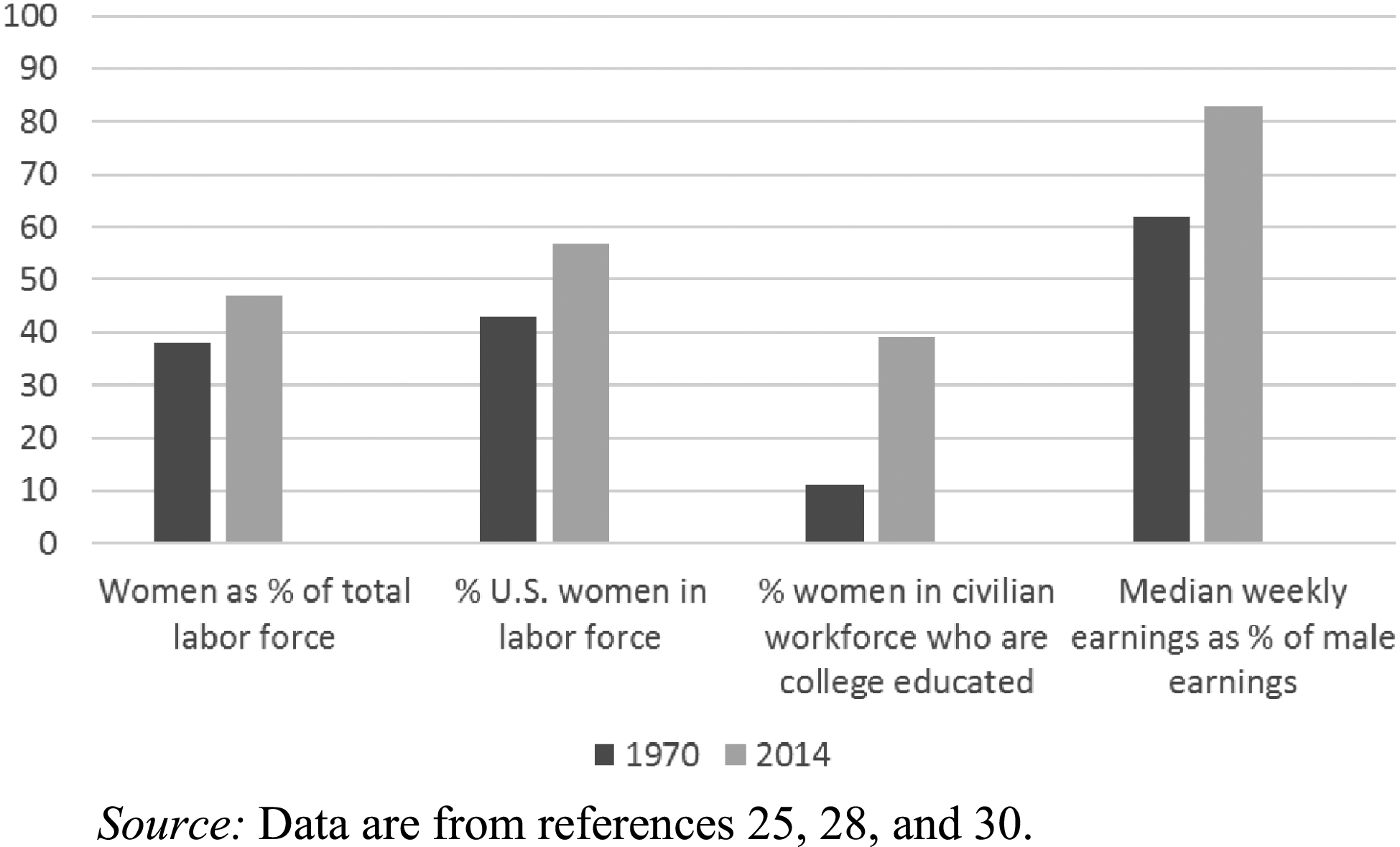
The characterization of mothers as Dependents in the social construction framework harks back to an era when women more broadly and clearly met the defining characteristic of this category, in that they “did not have a strong role in the creation of national wealth.” 24 Since that time, the economic status of women has changed so that they represent a larger percentage of the total labor force, and their earning potential and educational status have also increased significantly. Whereas women comprised 38% of the total labor force in 1970, Reference Hayghe and Johnson25 they made up 47% of that total in 2014. 26 In 2009, during the height of a recession, University of Chicago law professor Casey B. Mulligan even anticipated that women would soon become a workforce majority. Reference Mulligan27 According to the Bureau of Labor Statistics, 43% of women in the United States participated in the labor force in 1970, compared with 80% of men; by 2014, the labor-force participation rate would rise to 57% for women and decline to 69% for men. Reference Hayghe and Johnson25,26 Between 1970 and 2014, the percentage of women in the civilian workforce who were college educated more than tripled, from 11% to 39%. 28 In 2014, the median weekly earnings of full-time wage and salary workers was $871 for men and $719 for women, making women’s earnings about 83% of those of their male counterparts. 29 Although the relative earnings of women and men were far from parity, 83% represents a significant improvement since the first time that earning data were compared in 1979, when women earned about 62% of what men were paid. 30 (See Figure 1. Reference Hayghe and Johnson25,28,30 )
Economic status of women in the United States, 1970 versus 2014.

Ingram, Schneider, and deLeon have proposed that “the allocation of benefits and burdens to target groups in public policy depends upon their extent of political power and their positive or negative social construction on the deserving or undeserving axis” (emphasis added). 31 The political and economic power of women has clearly increased since 1978, the year when the first baby conceived through IVF was born. In addition to the economic gains noted above, the representation of women in state legislatures expanded markedly between 1977, when 9% of state legislators were women, and 2015, when that number had risen to 25%. 32 Still, although women doubled their ranks in state legislatures during this time period, they fell short of proportional representation by more than half, as the U.S. population was 51% female in 2014. 33 Similarly, women remain underrepresented in the U.S. House of Representatives and Senate, where they fill just 19% and 20% of seats, respectively.
The WIC program
The Special Supplemental Nutrition Program for Women, Infants, and Children (WIC) can be thought of as the quintessential program based on the characterization of women — and mothers, in particular — as Dependents. WIC’s mission of safeguarding “the health of low-income women, infants, and children up to age 5 who are at nutrition risk” 34 was established in 1972, when wage and workforce participation gaps between the sexes were more profound. By 1978, the number of WIC program participants had reached over 1 million. 35 By 2013, that number had grown steadily to 8.6 million people (2 million women, 2 million infants, and 4.6 million children). 36 Hungry children and hapless women have long been “positively constructed as deserving, at least in terms of sympathy and pity” according to the social construction framework’s depiction of Dependents. 24 That positive social construction of WIC participants arguably may have contributed to the long-term survival and expansion of the program, since policy makers supporting it might hope to appear magnanimous and empathetic to those less fortunate who are perceived as deserving. Where welfare programs are concerned, the aphorism “women and children first” may well hold true — as long as they are perceived as not being responsible for their misfortune.
However, when women are perceived as undeserving of assistance and somehow responsible for their own plight, they are no longer seen in the sympathetic light of Dependents. Those seen as blameworthy edge their way toward the negative Deviant category. Like Dependents, social groups in the Deviant quadrant are characterized by their lack of political power. Mothers enrolled in welfare programs are among those so situated in the social construction framework, 24 in keeping with the specter of the “welfare queen,” which was first raised by Ronald Reagan on the presidential campaign trail in 1976, and which has persistently appeared in political campaigns and public policy debates thereafter. Reference Blake37 Welfare mothers are not depicted as being quite as far along the Deviant spectrum as “criminals” and “terrorists,” but they still keep company with those groups in the same ignominious quadrant of the framework. 21
Interestingly, in the updated social construction and power typology, “welfare mothers” have been replaced by “welfare cheats,” 22 a less-gendered characterization. This linguistic shift might be attributable to the rising economic and political power of women overall, as groups wielding such power seem less likely to be subjected to either burdensome policies or stigmatizing slights; however, any such interpretation could only be speculative.
Reproductive policies
The Association of Reproductive Health Professionals (ARHP) defines reproductive health as “a broad topic intimately tied to every person’s quality of life” that includes “helping people navigate hormonal changes in their bodies …choosing whether and when to be pregnant, and …understanding ourselves as sexual beings.” 38 Policy organizations at the national and international levels that concern themselves with reproductive health, such as the Guttmacher Institute and the World Health Organization, usually include “providing high-quality services for family planning, including infertility services” and “eliminating unsafe abortion” prominently within their portfolios. 39 In this article, I examine policies in the United States that help people in choosing “whether and when to be pregnant,” including infertility insurance mandates, contraceptive coverage, and abortion rights and restrictions. These are identified as the main policy areas covering women’s capacity to exercise autonomy in taking on, or avoiding, the role of motherhood.
Author Rebecca Traister, among others, has noted that the “shape, pattern and definition of female life” in the United States has changed markedly since the late 19th century, when the median age of women getting married for the first time was between 20 and 22 years. As of 2016, the median age at first marriage has risen to 27, and women no longer find themselves headed “down a single highway toward early heterosexual marriage and motherhood.” 40 The notion that women can postpone or avoid marriage and still choose to seek financial independence, be sexually active, and have the option of becoming mothers — all without the necessity of a male partner — is a recent historical phenomenon in the United States, and one with trailing social acceptance. The reproductive policy reflected in infertility insurance mandates, contraception, and abortion supports the contention that women are more likely to be viewed negatively, and encounter resistance in the form of burdensome (or at least less-than-generous) policies, when they choose nontraditional paths. However, the social construction of motherhood and related policies also demonstrate some areas of dynamism.
Infertility insurance mandates
Since the 1980s, 15 states have adopted laws that require insurance providers to cover either infertility diagnosis or treatment. 41 Insurance coverage constitutes a considerable benefit for those who are eligible. About 12% of women, or 1 in 8 couples, in the United States have sought treatment for infertility, and the costs can be substantial, particularly for IVF, the most expensive type of infertility treatment (less-costly options include hormone therapy and insemination). One cycle of IVF can be expected to cost about $8,000, plus another $3,000 to $5,000 for related medications, 42 and several IVF cycles are typically required to bring about a live birth.
The conferral of infertility treatment benefits suggests that recipients might hold the privileged status of an Advantaged group, or at least be positively constructed as Deserving, although their level of political power may vary. However, the extent and specifications of the mandated benefits offer a more nuanced view of how those benefits both reflect and contribute to prevailing social constructions. As noted, infertility insurance mandates have been instituted in just under one-third of the states. The fact that most states do not have such mandates belies the Advantaged status of women nationwide.
Furthermore, the rules contain a number of significant restrictions and exceptions. Three states exclude IVF; six have exemptions from providing coverage for religious employers; and four require that those who receive benefits be married. Hawaii’s code stipulates that “the patient’s oocytes” must be “fertilized with the patient’s spouse’s sperm”; 43 Arkansas and Texas have similar provisions. Rhode Island defines infertility as “the condition of an otherwise presumably healthy married individual who is unable to conceive or sustain a pregnancy during a period of one year” (emphasis added). 44
The marriage-related regulations seem to support the assumption that women are more positively socially constructed and likely to receive benefits when they are in a traditional gender role, such as that of a heterosexual married woman seeking to have a family within an idealized family structure. According to Ingram, Schneider, and deLeon, the ideal family is stereotypically portrayed as being “composed of a married man and woman and a couple of children,” and this family unit is emblematic of the Advantaged, who “have high levels of political power resources and enjoy positive social construction as deserving people important in the political and social hierarchy in general and, more specifically, in social welfare as broadly construed.” 45 Notably, some critics of reproductive technologies used in infertility treatments, such as IVF, charge that they contribute to the deterioration of the already beleaguered American family by enabling surrogacy and other nontraditional ways of creating children. Reference Markens46
Although the 2015 Supreme Court decision in Obergefell v. Hodges made same-sex marriage a constitutionally protected right, 47 some state laws mandating infertility insurance coverage currently foreclose the possibility of lesbians accessing such coverage by explicitly stating that the “the patient’s eggs must be fertilized with her spouse’s sperm.” 48 Unmarried women, whether heterosexual or homosexual, are also burdened by restrictions requiring spousal sperm (in Arkansas, Hawaii, and Texas) and by definitions of infertility that limit it to a condition of the married (as in Rhode Island). Even the most basic definition of infertility on the books in some states excludes homosexual couples de facto; for example, in New Jersey, “the wording in its law asks couples to demonstrate they have tried to conceive naturally by having unprotected sex for a year or two.” Reference Leonard49
Recent public policy actions related to infertility treatments may be evolving toward inclusiveness. In 2015, Maryland ended its same-sex exclusion for IVF, Reference Adashi50 and, in 2016, two same-sex couples sought access to infertility treatments by suing New Jersey’s insurance commissioner. Reference Leonard49 However, until policies that prohibit unmarried or homosexual women from having access to the benefit of infertility insurance coverage are overturned, those women who wish to be mothers outside of the traditional heterosexual family structure are still prone to being treated as Contenders, or even Deviants.
Confirming the Contender status for women with regard to infertility insurance mandates is difficult given the paucity of coverage of the issue in the press. A LexisNexis search for news articles on the states’ infertility laws yields little, if any, specific coverage, of each law’s passage. Schneider and Ingram have hypothesized that public officials prefer that policy benefits for Contenders be noticed “only by members of the target groups and largely hidden from everyone else.” 51 While there is no evidence or credible reason to think that lawmakers or anyone else sought to conceal the policy process in the case of the infertility insurance mandates, the fact that the issue garnered scant attention suggests that these mandates provided no major public payoff for policy makers championing the issue. Such sub rosa benefits are typically doled out to Contenders, who have sufficient political clout to garner benefits but might be at least somewhat negatively constructed as a group.
The social construction of women aspiring to the role of motherhood is generally positive, but research indicates that infertility has historically carried some stigma. Reference Greil, McQuillan, Scheffler, Johnson and Slausen-Blevins52,Reference Loftus and Namaste53 Blame for the condition is sometimes unjustly placed on career women or women who choose to postpone childbearing. Reference Watkins and Baldo54 The Centers for Disease Control and Prevention (CDC) report that “about 20% of women in the United States now have their first child after age 35” and that “one-third of couples in which the woman is older than 35 years have fertility problems.” 55 Advanced maternal age is but one factor among many that can contribute to infertility, but the belief that women may be responsible for their own infertility could cast them as Contenders — they have the political power befitting their advanced economic status, but they bear the negative social construction typical for women outside of traditional feminine roles.
Contraceptive coverage
Insurance coverage for contraception is much more widely available than insurance coverage for infertility treatment. Currently, 28 states require that insurance plans with prescription drug coverage also cover contraceptive drugs and devices approved by the Food and Drug Administration. Furthermore, the federal Patient Protection and Affordable Care Act of 2010 (ACA) requires that all health plans written after August 2012 provide contraceptive coverage without cost to patients. Existing plans are exempt from this ACA requirement, but the U.S. Department of Health and Human Services predicts that the exemptions will end within a few years, 56 implying that contraceptive coverage will eventually be more universal.
In the United States, some 11 million women between the ages of 15 and 44 (17%) use oral contraceptives; 57 38% of women in this age group are not “contraceptors” (to use the CDC’s term); 17% have been sterilized; 10% rely in condoms; and the final 18% use a variety of other birth control methods. Reference Mosher and Jones58 Oral contraceptives typically cost $15 to $45 per month. Reference Sonfield and Gold59 Although the monthly cost of oral contraception is not high relative to the substantial one-cycle cost of IVF treatment, the cumulative expense of oral contraception over the course of a woman’s reproductive life can be substantial — adding up to as much as $14,000 over 25 years for the pills alone (women may also have to pay for annual physical exams, which most physicians require before they will prescribe oral contraception). When contraception is affordable and broadly covered by insurance, women can exercise more choice and tend to use contraceptives more consistently and effectively, Reference Sonfield and Gold59 which conveys greater benefits in the form of autonomy and avoidance of unwanted pregnancies.
The social construction of target populations can help explain why public policy sometimes produces or supports “unequal citizenship.” 60 While policy designs tend to reflect prevailing power relationships, they can also contribute to introducing change. The disparity between the broad coverage of prescription drugs and the far less frequent coverage of contraception was dramatically brought to light by the brouhaha following the introduction of Viagra, the erectile dysfunction drug for men, in 1998. When it became widely known that drug companies routinely covered Viagra, at a cost of $10 per pill, but did not reliably cover contraception, the appearance of the new drug served as a focusing event for those leading the decades-old crusade for contraceptive equity in state legislatures. Within a year of Viagra’s appearance on the market, 30 states had introduced contraceptive mandate measures. Reference Goldberg61 By 2002, insurance coverage for contraception had tripled from 1993 levels. Reference Henig62
The elevated economic and political status of women by the start of the 21st century might reasonably be presumed to have contributed to altering state, and later federal, policies to reflect the evolving and more powerful position of women in society. Resulting policies might be expected in turn to help further secure that more powerful position. Research has shown that “groups receiving positive messages and resources from public policy” are more likely to be politically active after seeing improvements in their material circumstances and attendant reinforcement of a positive social construction of the group. 63 Inequitable prescription policies of the past may have reflected, in part, a negative social construction of autonomous, sexually active women at a time when women were more generally regarded as Dependents. More equitable access both reflects, and serves to secure, the attainment of more equal citizenship for women.
A vestige a negative social construction of women in reproductive policy was dramatically raised in 2012 during debate over the ACA requirement for church-affiliated organizations to offer birth control as part of their health care plans. When Georgetown University law student Sandra Fluke testified on behalf of the requirement, flamboyant radio host Rush Limbaugh famously equated insurance coverage of contraception to being paid to have sex. Regarding Fluke’s support for the measure, Limbaugh said, “It makes her a slut, right? It makes her a prostitute. She wants to be paid to have sex. She’s having so much sex she can’t afford the contraception. She wants you and me and the taxpayers to pay her to have sex.” 64 Although Limbaugh’s remarks were widely denounced and may represent a minority view, they are indicative of the disapprobation some direct at “contraceptors” and at the provision of contraception to women, which might be particularly strong when coverage for contraception is mandated through policy.
Neither public policy nor any other factor acts as a singular force for changes in social constructions. 65 Other influences likely include social movements, like the women’s movement; technological change, such as the development of birth control and infertility treatments; and judicial decision, including the 1972 Supreme Court ruling in Eisenstadt v. Baird, 66 which invoked the right to privacy while preventing the states from banning the use of contraceptives by anyone, whether married or single. In tracing the changing and disparate social constructions of women in the various roles relating to their reproductive capacity, it is interesting to note that the year of this landmark decision on the road to seeing women characterized as Contenders was also the founding year of the WIC program, whose recipients have been defined as Dependents according to the current framework.
Benefits, burdens, and abortions
Eisenstadt v. Baird asserted that the right to privacy means each individual has a right “to be free from unwarranted governmental intrusion into matters so fundamentally affecting a person as the decision of whether to bear or beget a child,” as articulated by Justice Brennan writing for the majority. 66 The following year, 1973, the Supreme Court ruled in Roe v. Wade that the right to privacy encompassed a woman’s right to terminate an unwanted pregnancy. From the perspective of women’s autonomy, this right constitutes a benefit to women. However, it is a benefit beset by many burdens imposed by policy. Following the 1992 Supreme Court ruling in Planned Parenthood v. Casey, states were free to impose restrictions on access to abortion by stipulating when, where, by whom, and under what circumstances abortions might be performed, so long as these restrictions did not constitute an “undue burden” to women seeking abortions. 67
According to the Ingram-Schneider framework, public officials are under considerable pressure “to provide beneficial policy to powerful, positively constructed target populations and devise punitive, punishment-oriented policy for negatively constructed groups.” 68 Further, “Advantaged groups are likely to be able to resist the imposition of any burden that is not obviously justifiable to accomplish some agreed-upon policy purpose.” 69 Given the number and nature of the dozens of state restrictions on women’s access to abortion, women who seek abortions do not appear to hold an Advantaged position with regard to this issue. Only Oregon has no restrictions on abortions; in other states, such as Oklahoma, abortion laws have as many as 22 separate restrictive provisions. According to Alberti, drawing on research from the Guttmacher Institute, half of U.S. women live in a state that is “openly hostile” to abortion. 70 That research indicates that the 92 new state abortion restrictions enacted in 2011 constituted the highest annual number of restrictions ever, and these were enacted “against the backdrop of a contentious presidential campaign in which abortion and even contraception were front-burner issues.” 71 Following the peak number of restrictions in 2011, 2013 garnered second place, with 70 new restrictions, and 2015 came in third, with 57; in sum, 288 new state restrictions were implemented after the 2010 midterm elections. 72
Schneider and Ingram define burdens as “rules that confer disadvantages, tools that constrict control or liberty, or other actions that confer negative values on a group.” Reference Schneider and Ingram73 Identified categories of abortion restrictions that meet at least one of these criteria include waiting periods and mandatory counseling, ultrasound requirements, and limitations on insurance coverage and public funding, among others. Although all target populations are subject to burdens, Advantaged groups are the least likely to experience burdens and Deviant groups are at the highest risk, since “punishment” of those in this latter group “yields substantial political payoffs.” 74 The high number of abortion restrictions achieved and the seemingly significant amount of political capital reaped by those advocating such restrictions suggest that women seeking abortions are being treated as Deviants — those who have low or weak political power and are characterized negatively as undeserving. In choosing to terminate an unwanted pregnancy, a woman may be seen as deviating from her expected traditional role as mother.
State policies regarding abortion can be seen as variously responding to and characterizing women in social constructions as Dependents, Deviants, and Contenders. As noted previously, Dependents are defined as being positively socially constructed or deserving but having low or weak political power. Arguably, in the United States, a woman seeking an abortion must be considered blameless for her condition to be seen somewhat positively. Many state abortion restrictions contain the caveat that the restriction does not apply in cases of rape or incest, because those who become pregnant in those circumstances are mostly regarded as innocent victims. In Utah, for instance, women are required to wait 72 hours after receiving mandatory counseling before they can have an abortion, but this restriction is waived if the pregnancy is the result of rape or incest. In Arkansas, the prohibition against abortions after 20 weeks’ gestation is similarly waived for rape victims. Also, 32 states and the District of Columbia have bans against using state funds to pay for abortions but will make exceptions when the pregnancy is the result of rape or incest. 75 (Other exceptions are made when federal funds are available or the woman’s life is endangered.)
Presumably, the primary reason that states and the federal government impose funding restrictions on abortion procedures is to achieve the policy goal of limiting the number of abortions. However, the denial of funding to individuals who are considered undeserving, such as poor women seeking abortions, could also have political payoffs for policy makers, and such political capital has been identified by Schneider and Ingram as one of the two primary motivators for those producing public policy, in addition to effectively addressing public problems. 76 Federal funding restrictions on abortion have their origins in the Hyde Amendment of 1976, which bans the use of federal funds for abortions except in cases of rape or incest or to save the life of the mother. This federal ban effectively makes abortion inaccessible for low-income women, because it applies to Medicaid recipients. (In addition, the funding ban affects federal employees, including members of the armed services and Peace Corps, and federal prisoners.) Although access to abortion has been defined as a constitutionally protected right, the 12% of U.S. women of reproductive age who are Medicaid recipients are unlikely to be able to afford the $370 average cost of abortion at 10 weeks’ gestation, which translates to more than a third of their monthly income. Reference Boonstra77 Seventeen states use their own funds to pay for abortions for Medicaid enrollees, but the other thirty-three states offer no such option to low-income women. Reference Boonstra77 In fact, most women who get abortions in the United States are poor or low-income and must pay for the services themselves. Reference Jones, Upadhyay and Weitz78
Poor women who become pregnant may be characterized as careless or blameworthy. Lacking both “political power and positive social constructions,” they are held responsible for “ills of society that might more accurately be attributed to the broader social and economic system” — a defining characteristic of Deviants in the social construction framework. 24 Representative Henry Hyde (R-IL) himself acknowledged that the Medicaid bill was the only vehicle available to him in his quest to restrict abortion for all women, Reference Boonstra77 applying, as it did, to a group lacking in both political and economic power.
Implications and limitations of social construction
Limits of the analytic framework
While the social construction framework provides a useful means for examining the conferral of benefits and burdens through policy to groups based on their political power and perceived deservedness, some social constructions and policies defy neat categorization (see Figure 2). For instance, poor mothers can be characterized as Dependents and receive benefits such as WIC, but they can also be cast as Deviant “welfare queens” or find themselves burdened by lack of access to either abortion or infertility treatment (since infertility treatment mandates require only that insurers provide treatment to those who already have access to other health benefits). Similarly, all women seeking abortions might be alternately cast as Dependents, Deviants, or Contenders, depending on their perceived power to assert access to this constitutionally guaranteed right, or their perceived “deservedness,” which depends on whether they are believed to be blameless for their unwanted pregnancy.
Social constructions and political power: Types of target populations by reproductive status and policy treatment.

Other dimensions of identity
Race is a facet of identity that is not explicitly dealt with in this analysis of motherhood in policy, nor is race addressed in the framework on which it is based. Future research should examine the policy implications of motherhood as they affect individuals at the nexus of a wider diversity of identities, including race in addition to gender and economic status. An intersectionality-based policy analysis (IBPA), for instance, recognizes that “human lives cannot be reduced to single characteristics,” and its proponents rightly urge policy analysts to consider “the complex relationship between mutually constituting factors of social location and structural disadvantage.” Reference Hankivsky79
Other reproductive policies
Some policies, such as those dealing with gestational surrogacy, are so disparate throughout the states that the social constructions they suggest are hard to pin down. Policy responses to surrogacy vary from a ban in Michigan that would imprison a surrogate mother for entering into such a contract to an Arkansas law that states that the child born of a surrogacy agreement shall belong to the biological father and the woman intended to be the mother, if the two are married to each other. Reference Luckey80 Although the nature of some of these restrictions suggests a favored status for traditional family structures, the panoply of policy limits the applicability of the framework here and the generalizability of any possible social constructions of maternal roles related to surrogacy.
Still, the social construction framework enables a fuller consideration of who benefits from or is burdened by policy based on political power and conceptions of deservedness; its utility may therefore be expanded in the reproductive policy realm as other issues, such as guidelines for egg donation, personhood amendments, and transvaginal ultrasound requirements, continue to be contemplated in the public sphere.
Conclusion
Advances in reproductive technologies have allowed women greater options in either choosing or avoiding pregnancy and motherhood. Public policy has played a part in making such technologies more or less accessible to women, and the social construction framework helps to explain the public policy process in this realm. As its central architects have convincingly asserted, “social constructions are an inherent and essential feature of politics and policymaking,” and, furthermore, policies themselves “and the social constructions embedded in them are on the advancing edge of institutional and social change.” 81 The evolving roles of women in society with regard to their economic status and political power are importantly related to their reproductive capacity. Policies put in place to contend with reproductive advancements are both reflective of, and capable of shaping, existing social constructions. This examination of the social construction of motherhood and reproductive policy suggests that public policy can indeed be a source of change in prevailing constructions over time, and that this change has likely contributed to the diminishment of social inequality and the encouragement of more active citizenship among women. Further, this analysis has demonstrated that women’s identities as mothers are more multifaceted and complex than the single depiction of mothers as Dependents put forth in the original social construction framework and carried through its subsequent iterations.