Implications
This study contributes to knowledge about which factors motivate or limit the implementation of digital dermatitis (DD) treatments under field conditions. The results highlight some practical limitations and possible alternatives to the use of walk-through footbaths, and suggest the need for clear and detailed recommendations on effective DD treatment practices. These findings may help researchers, when assessing the effectiveness of DD treatments in clinical trials, to design treatment protocols. They may also help health advisers to prescribe treatment practices which are acceptable under field conditions, thereby increasing their effectiveness, promoting the rational use of antimicrobials and finally improving cow welfare and productivity.
Introduction
Digital dermatitis (DD) is a contagious disease that causes lameness in dairy herds (Offer et al., Reference Offer, Logue and McNulty2000, Green et al., Reference Green, Borkert, Monti and Tadich2010). It has been reported to affect 70% to 96% of dairy herds in Western Europe and North America, with on average 5% to 30% of lactating cows affected within each herd (Somers et al., Reference Somers, Frankena, Noordhuizen-Stassen and Metz2005; Cramer et al., Reference Cramer, Lissemore, Guard, Leslie and Kelton2008). It manifests as circumscribed erosive to ulcerative lesions around the coronary band, mostly observed between the heels on the hind feet. These lesions can be very painful and affect the welfare of affected animals (Read and Walker, Reference Read and Walker1998). In addition, DD has a detrimental effect on herd productivity because of the cost of treatment and the decreased performance of affected cows (Bruijnis et al., Reference Bruijnis, Hogeveen and Stassen2010; Cha et al., Reference Cha, Hertl, Bar and Grohn2010; Relun et al., Reference Relun, Lehebel, Chesnin, Guatteo and Bareille2013b).
The two measures usually recommended to control DD are the improvement of environmental hygiene and the treatment of affected animals and/or the whole herd (Laven and Logue, Reference Laven and Logue2006; Nuss, Reference Nuss2006). As improving environmental hygiene can be a complicated task involving significant investment, treatment remains the DD control measure most widely used in the field (Laven and Logue, Reference Laven and Logue2006).
Two treatment approaches mainly have been recommended: 1. individual treatments, usually using antibiotics applied topically, to heal affected animals, and 2. ‘collective treatments’, usually using disinfectants applied topically through footbaths, mainly to limit the spread of the disease in the herd (Laven and Logue, Reference Laven and Logue2006). Over the past 10 years, a growing number of DD control products have become available (Thomsen et al., Reference Thomsen, Sørensen and Ersbøll2008) to replace formalin, which has carcinogenic properties (IARC, 2004), and copper sulphate (CuSO4), which may reach a toxic threshold when waste footbath solutions disposed into slurry are spread repeatedly over the soil (IARC, 2004; Stehouwer and Roth, Reference Stehouwer and Roth2004). Unfortunately, there is a lack of data regarding which treatment strategies are most effective in controlling DD (Laven and Logue, Reference Laven and Logue2006). Further research thus is required to determine the best combination of products, regimens and approaches to control DD.
To encourage farmers to adopt new treatment strategies, the factors that currently motivate and limit their implementation in the field must be well identified (Garforth et al., Reference Garforth, McKemey, Rehman, Tranter, Cooke, Park, Dorward and Yates2006). These factors can vary between farms depending on the way work is organized, the locations available for the application of treatments, and how the farmers perceive effectiveness and acceptable constraints (Leach et al., Reference Leach, Whay, Maggs, Barker, Paul, Bell and Main2010).
The objectives of this study thus were: 1. to establish an inventory of treatment practices implemented by dairy farmers in France to control DD; and 2. to identify the factors motivating or limiting the application of these treatments in the field.
Material and methods
Study population
The survey was carried out in the spring of 2009 in France. The farms involved were recruited through 15 professional hoof trimmers and 8 veterinarians from the five principal dairy producing regions in France, that is, West, East, Normandy, North and Southeast (FranceAgriMer, 2011). The hoof-trimmers were contacted using a list of the members of the French hoof-trimmers association and of the animal health services of these regions (Anonymous, 2009). The veterinarians were contacted using a list of the members of the French association of bovine practitioners. The hoof-trimmers and veterinarians were asked to indicate dairy farmers whose herds had experienced DD for over 2 years, and who may be willing to participate in a survey on DD management. It was assumed that such farmers would have had the opportunity to test different practices and would have sufficient perspective on the treatments implemented. The median number of farmers indicated by each veterinarian or hoof-trimmer was 4 (Q1 to Q3: 2 to 6; range from 1 to 13). Of the 75 farmers contacted and invited to participate in the survey, 72 agreed and were visited.
Data collection
Each farm was visited once by the same person, a student in the final year of veterinary school. During the visit, a face-to-face interview was conducted with one of the farmers from the farm, with the farmer answering a semi-structured questionnaire. This questionnaire had been pre-tested by the student on two farms before being used. Before beginning the interview, the farmers were shown pictures of DD lesions and other foot diseases to clarify what should be considered to be DD. Farmers’ answers were recorded on a printed paper copy of the questionnaire (available upon request). The first part of the questionnaire collected data on the general characteristics of the herd (number and breed of milking cows, type of housing and milking parlour), livestock management (floor cleaning practices, grazing management, hoof care, purchase of dairy cows), and DD outbreaks in the dairy herd (DD detection methods, categories of cows affected, frequency and seasonality of DD outbreaks). The farmers then were questioned about the DD treatment protocols that had been tried since the diagnosis of the disease on the farm. A protocol was defined as one product used, with one concentration, one route of application (topical with or without a bandage, parenteral administration, surgical intervention, footbath, hoof mat, collective spraying or foam), one regimen (duration and frequency of application), and one level of implementation (individual or collective). When topical treatments were involved, farmers were asked whether they cleaned the cows’ feet before applying the treatment. Once the treatment protocols that had been tried since the diagnosis of DD on their farm were catalogued, farmers were asked to specify what had motivated them to use each one. For individual treatments, these circumstances could be the detection of a lesion without lameness, with lameness or with severe lameness. For collective treatments, farmers were asked if they applied the treatment following an outbreak, on a regular basis during winter or all year round. For collective treatments, farmers also had to indicate the number of cows that they sent through the footbath before renewing the footbath solution. Farmers then were asked which of the treatment protocols they were continuing to apply at the time of the interview, and to indicate which of the following four factors had motivated the continuation or discontinuation of the protocols: perceived effectiveness (improvement of lameness, healing of DD lesions, absence of recurrence, limitation of DD spread), time and labour needed for the application and cost (for the purchase and maintenance of material and products). They also were asked if any other factors had motivated the continuation or discontinuation of the treatment.
Data analysis
Data were entered by the student in an Excel spreadsheet (Microsoft Corp., Redmont, WA, USA). They were managed and analysed using SAS® software version 9.1.3 (SAS Institute Inc., Cary, NC, USA). A treatment protocol was deemed to have been adopted when a farmer, having tested one or more protocols on his herd, chose to continue using the protocol in question. Otherwise, it was deemed to have been abandoned. The answers to semi-open questions dealing with the motives for continuation (adoption) or discontinuation (abandonment) of a treatment protocol were coded by the first author, and closely related answers were grouped into the following six categories for statistical analysis: ‘effectiveness’, ‘time’, ‘labour’, ‘cost’, ‘toxicity’ and ‘other’.
Treatment protocols implemented by the farmers since the diagnosis of DD in their farm were first described, specifying which products, routes of application, regimens and pre-treatment cleaning measures had been most often used. Protocols were described separately for individual and collective treatments. χ2-tests were used in addition to investigate whether farmers were more likely to use a specific route of application for a specific circumstance of treatment (i.e. for individual treatments, one route of application could be used for severely lame cows, another for lame cows and another for DD lesions detected without lameness).
χ2-tests were then used to investigate whether some treatment practices influenced the adoption or the abandonment of a treatment protocol. The analyses assessed the influence of three factors: 1. level of treatment implementation, that is, individual or collective application; 2. route of application, separately for individual and collective treatments; and, for the main routes of application, 3. product used. Lastly, descriptive methods were used to summarize the main motivators reported by the farmers for adopting and abandoning a treatment protocol.
Results
Sample description
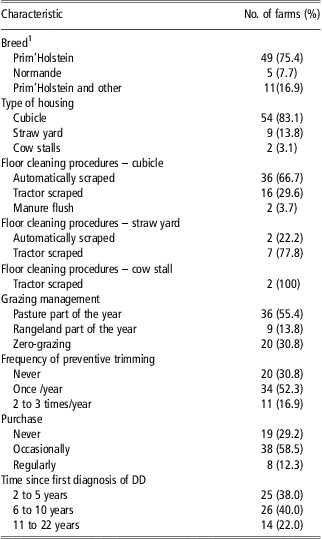
Of the 72 farmers who were visited, one had only beef cattle at the time of the interview and six had been treating DD for < 2 years. Finally, data from 65 farms were included in the analysis. Twenty-nine farms were in the West, 22 in the East, 7 in Normandy, 4 in the North, and 3 in the Southeast. Farmers milked a mean number of 76 cows (range from 35 to 150). The main characteristics of the farms are presented in Table 1.
Characteristics of 65 French dairy farms involved in a survey on digital dermatitis treatment practices

1Predominant breed (⩾ 90%); other breeds: Montbeliardes, Brown Swiss, Red'Holstein, Normande, crossbreed.
The farmers reported detecting DD in two ways: either they detected the disease once the lesions were established and caused lameness, or they actively looked for the presence of DD lesions. All of the farmers declared that the appearance of lameness enabled them to detect a cow infected with DD and for seven farmers (7/65 [11%]), this detection also could occur following the perception of a nauseating odour. Seven farmers (7/65 [11%]) detected DD lesions by visual inspection of the hind legs of animals in the milking parlour after the legs were washed with water, an inspection conducted mainly on a regular, monthly basis. In most but not all cases, the detection of a lesion led to the individual treatment of this animal. Preventive foot-trimming sessions also were recognized as an opportunity to detect and treat infected animals.
Farmers noted that DD mainly appeared when environmental conditions were humid (24/65 [37%]) or in winter (24/65 [37%]). Farmers asked a median number of two other people (Q1 to Q3: 1 to 3; range from 1 to 5) for advice regarding DD treatment. The first person asked was another farmer (36/65 [55%]), followed by hoof-trimmers (17/65 [26%]) and veterinarians (7/65 [11%]). The other advisers were product salesmen, milk technicians, nutritionists, inseminators and researchers.
Treatment practices used to control DD
Of the 65 farmers interviewed, seven had only used individual treatments and two had only used collective treatments. The 56 other farmers had tried at least one collective treatment and one individual treatment since the diagnosis of DD in their herds.
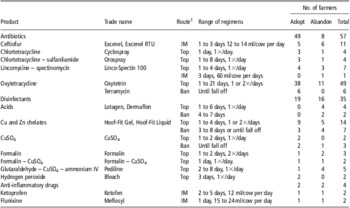
In total, 30 different products were used for individual treatments (14 antibiotics, 14 disinfectants and 2 anti-inflammatory drugs), with a median number of two products used per farmer since the diagnosis of the disease in his or her herd (Table 2). The products most often used were oxytetracycline, a disinfectant containing copper and zinc chelates, and ceftiofur (Table 3). Individual treatments most often were applied topically without a bandage, once or twice a day for 1 to 3 days, and the feet were usually cleaned before being treated (Table 2). Three farmers (3/63 [5%]) also used surgery, through cryotherapy, ablation or cauterization of DD lesions. The route of application chosen differed according to the circumstances that motivated the implementation of an individual DD treatment (P = 0.008). When cows were observed as severely lame, farmers were more likely to use parenteral treatments (8/19 farmers who applied individual treatments on severely lame cows [42%]), followed by topical treatments without a bandage (7/19 [37%]), and finally topical treatments with a bandage (4/19 [21%]). In contrast, farmers were more likely to use topical treatments without a bandage when the cow was observed with a DD lesion without lameness (7/10 [70%]).
Summary statistics for individual treatment protocols against digital dermatitis per route of administration used by 63 French dairy farmers since the diagnosis of the disease in their herd

1No. of farmers who always, never or sometimes cleaned feet, with a water hose or a brush, before a topical treatment. Farmers who cleaned feet on an irregular basis were not counted.
2Data of four farmers. Eleven farmers left the bandage on the foot until it fell off.
Main type of treatments used by 63 French dairy farmers for individual treatment of digital dermatitis

1Route of application: Ban = topical application with a bandage; IM = intra-muscular injection; Top = topical application without a bandage.
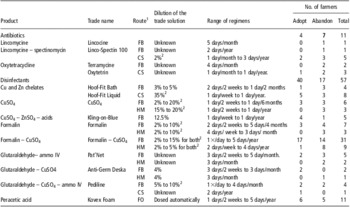
In total, 31 different products were used for collective treatments (3 antibiotics and 28 disinfectants), with a median number of 2 products used per farmer since the diagnosis of the disease in his or her herd (Table 4). The three products most often used were a solution of formalin and CuSO4, a solution containing copper and zinc chelates, and formalin alone, the product being most often applied through a footbath on a monthly basis, for 1 to 10 consecutive days (Tables 4 and 5). Many farmers did not know the dilution used (23/58 [40%]). The feet were rarely cleaned before treatment, unless the treatment was applied through collective spraying (Table 4). The median number of passages through the footbath before treatment solutions were renewed was 120 (Q1 to Q3: 85 to 200; range from 30 to 800). Although the route of application did not differ according to the circumstance of treatment (P = 0.46), farmers were more likely to apply foam on a regular basis all year round (7/11 farmers who used a foam [64%]), collective spraying after an outbreak (9/15 farmers who used collective spraying [60%]), and footbaths or hoot mats either after an outbreak (20/46 farmers who used a footbath [43%], and 7/17 farmers who used a hoof mat [41%]) or on a regular basis all year round (19/46 [41%] and 6/17 [35%]), respectively).
Summary statistics for collective treatment protocols against digital dermatitis per route of administration used by 58 French dairy farmers since the diagnosis of the disease in their herd

1No. of farmers who always, never or sometimes cleaned feet, with a water hose or a brush, before a topical treatment. Farmers who cleaned feet on an irregular basis were not counted.
2Data of 44 farmers. Two farmers used a footbath on an irregular basis.
3Data of six farmers. Five farmers used collective spraying on an irregular basis.
Main type of treatments used by 58 French dairy farmers for collective treatment of digital dermatitis

1Route of application: FB = footbath; CS = collective spraying; HM = hoof mat; FO = foam.
2Unknown for at least 30% of the farmers.
Influence of treatment practices on the adoption of treatments
Twenty-five farmers adopted only individual treatments, 4 farmers adopted only collective treatments and 36 farmers adopted both individual and collective treatments, often used concomitantly.
Farmers adopted significantly more individual treatments than collective treatments (61/63 [97%] and 40/58 [70%], respectively; P ⩽ 10−4).
Among individual treatments, farmers were more likely to adopt treatments applied topically and more likely to abandon surgery (P ⩽ 10−4). For treatments applied topically without a bandage, farmers were more likely to adopt tetracyclines and more likely to abandon acids, formalin and a solution of glutaraldehyde, CuSO4 and benzalkonium (P ⩽ 10−4; Table 3).
Among collective treatments, farmers were more likely to adopt footbaths or collective sprayings and to abandon hoof mats (P = 0.0003). For footbaths, they tended to adopt solutions of copper sulfate or zinc sulfate and to abandon antibiotics (P = 0.66; Table 5).
Principal reasons for adopting or abandoning treatments reported by farmers
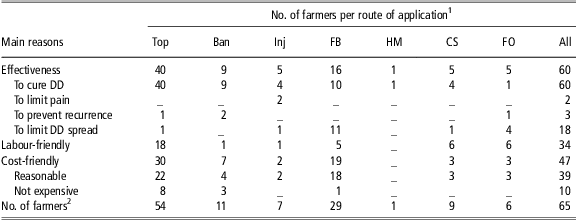
The most reported reason for the adoption of a protocol was its perceived effectiveness, followed by treatments that were ‘reasonable’ or ‘not expensive’ and labour-friendly (Table 6). For individual treatments, farmers mainly mentioned their ability to cure DD, particularly for treatments applied topically. For collective treatments, farmers cited instead their capacity to limit DD spread, particularly for treatments applied through foam (Table 6).
Main reasons reported by 65 French dairy farmers for the adoption of a treatment protocol against digital dermatitis (DD) according to the route of application (most farmers adopted more than one treatment protocol and reported more than one reason for the adoption of a treatment protocol)
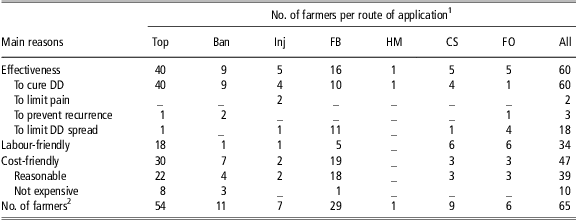
1Top = topical, without a bandage; Ban = topical with a bandage; Inj = injection; FB = footbath; HM = hoof mat; CS = collective spraying; FO = foam; no farmer adopted a surgical intervention to treat DD.
2Number of farmers currently using a given route of application.
The most reported reason for the abandonment of a treatment was the labour consumed, followed by a lack of effectiveness and the cost of the treatment (Table 7). Footbaths and hoof mats often were abandoned because of the reluctance of animals to walk over them. Hoof mats also were abandoned because of the difficulty of manipulating and cleaning the mats correctly (Table 7). Three products were abandoned because they caused discomfort for either the farmer or the animals: acids (4/4 [100%] farmers who used acids), a solution of glutaraldehyde, CuSO4 and benzalkonium alkyl (4/5 [80%] farmers who used this product) and formalin, used with or without CuSO4 (9/39 [23%] farmers who used formalin).
Main reasons reported by 65 French dairy farmers for the abandonment of a treatment protocol against digital dermatitis (DD) according to the route of application (most farmers abandoned more than one treatment protocol and reported more than one reason for the abandonment of a treatment protocol)
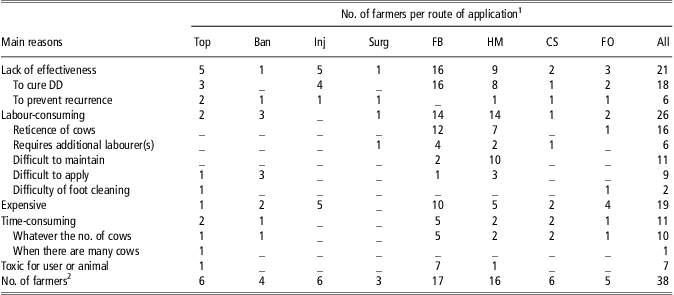
1Top = topical, without a bandage; Ban = topical with a bandage; Inj = injection; Surg = surgical intervention; FB = footbath; HM = hoof mat; CS = collective spraying; FO = foam.
2Number of farmers abandoning a given route of application.
Discussion
This study was conducted to provide information about how French dairy farmers treat DD and to highlight several reasons why some treatment protocols are adopted or abandoned by dairy farmers. Results should be regarded as exploratory results, and thus multiple test adjustment was not strictly required (Bender and Lange, Reference Bender and Lange2001). However, results would have remained unchanged if the data had been analysed using the Bonferroni correction to adjust for multiple tests (data not shown).
The number of farmers participating per region follows the density of dairy farms in France (FranceAgriMer, 2011). Results of this study might thus reflect DD treatment practices used by dairy farmers in France. Herd sizes are relatively small in France, with each herd producing on average 300 000 l of milk per year. When farmers are managing herds of over 500 cows, which is common in North America, their constraints and priorities may be different from those of French farmers (LeBlanc et al., Reference LeBlanc, Lissemore, Kelton, Duffield and Leslie2006). It thus would be interesting to conduct similar studies in different countries to adapt advice on treatment strategies to the specific features of each situation. Collecting information on farmer demographics (farmer's age, level of education) could also further our understanding of farmers’ choices.
As French farmers do not systematically record foot lesions, the recruitment of the participants had to rely on suggestions provided by hoof-trimmers and veterinarians. These health advisers may have influenced the farmers’ choices of treatment practices and reduced the number of different practices used by farmers. However, most farmers reported that they consulted other farmers before consulting their hoof-trimmer or veterinarian about treatment practices. The number of different practices used might thus be only a slight underestimation of treatment practices used by French dairy farmers.
Farmers were questioned about the DD treatment protocols that had been tried since the diagnosis of the disease on the farm, which occurred from 2 to 22 years ago. A recall bias may thus have affected their answers. Answers regarding adoption of a treatment protocol may be more accurate than those mentioned for the abandon of a treatment protocol.
Results of this survey confirmed that widely diverse DD treatment practices are used in the field. Laven and Logue (Reference Laven and Logue2006) suggested that the lack of scientific data on effective treatment protocols could result in a diversity of practices implemented in the field. In the present survey, the variability of protocols for individual treatments may have been limited because most protocols used antibiotics. Antibiotics are registered as medicines and consequently detailed guidelines on their use are available. In contrast, collective treatments usually use disinfectants. Unfortunately, several disinfectant products do not have clear application guidelines. There is a need to conduct clinical trials, even for disinfectants, to improve recommendations regarding effective protocols.
Even if a ‘social desirability’ bias may have reduced the number of inappropriate treatment practices reported, results revealed that several antibiotics were used outside their marketing authorization for individual and collective treatments. Most of these antibiotic treatments were reported as abandoned, but these practices, particularly the use of antibiotics in footbaths, may increase the risk of the development of antibiotic resistances (Shearer and Hernandez, Reference Shearer and Hernandez2000; Nishikawa and Taguchi, Reference Nishikawa and Taguchi2008). Such practices thus should be discouraged by health advisors.
Individual topical treatments were adopted most frequently by farmers because they were judged to be effective without being overly difficult to apply or too expensive. The curative effectiveness of individual treatments perceived by farmers, notably when tetracyclines were used, agrees with the results of numerous clinical trials (van Amstel et al., Reference van Amstel, van Vuuren and Tutt1995; Kofler et al., Reference Kofler, Pospichal and Hofmann-Parisot2004; Laven and Logue, Reference Laven and Logue2006). However, farmers often apply such treatments for periods that are shorter than those assessed in trials (van Amstel et al., Reference van Amstel, van Vuuren and Tutt1995; Kofler et al., Reference Kofler, Pospichal and Hofmann-Parisot2004; Laven and Logue, Reference Laven and Logue2006). Individual topical treatments using disinfectants were adopted less often than those using antibiotics, mainly because they were considered to be less effective in healing lesions. These observations also agree fairly well with numerous studies (Hernandez et al., Reference Hernandez, Shearer and Elliott1999; Manske et al., Reference Manske, Hultgren and Bergsten2002). A recent study reported good effectiveness for Hoof-Fit Gel®, one of the products tried by the farmers (Holzhauer et al., Reference Holzhauer, Bartels, van Barneveld, Vulders and Lam2011). In this trial, the product was applied topically with a bandage and the application was repeated three times, whereas in the present survey, the product was applied mostly without a bandage over 1 to 4 days. The difference in effectiveness estimated in the clinical trial and that perceived by farmers may be because of differences in the application protocols. These findings reinforce the need for clear recommendations on practices derived from clinical trials.
Some disadvantages noted by farmers for individual treatments were that they often observed recurrence and, when numerous animals had to be treated considerable labour and time were required. Recurrence has been reported in previous studies (Berry et al., Reference Berry, Graham, Mongini and Arana1999; Nuccitelli and Berry, Reference Nuccitelli and Berry2007). Given the labour and time required to apply individual treatments, collective treatments are justified when a large number of animals must be treated (Laven and Logue, Reference Laven and Logue2006).
Among individual treatments, parenteral treatments often were abandoned because they were judged to be ineffective and expensive. However, these treatments most often were used when cows were observed with severe lameness, potentially reflecting infection with severe DD lesions, and that lesions at this advanced stage could respond less well to antibiotics (Nishikawa and Taguchi, Reference Nishikawa and Taguchi2008). It also is possible that DD was not the cause of the severe lameness observed, which could lead to the erroneous conclusion that the treatment was ineffective. Although the effectiveness of parenteral treatments against DD is still under debate, some authors argue that this route of administration could deposit sufficient concentrations of antibiotics deep enough under the skin to achieve both a clinical and a bacteriological cure of DD lesions (Laven, Reference Laven2006; Döpfer et al., Reference Döpfer, Lopez-Benavides, Buchalova, Mateus, Cook, Dusick, Hemling, Socha, Read and Gomez2011). As these treatments remain costly, it is not certain that farmers would be ready to use parenteral antibiotics, particularly on animals deemed to be less severely infected. This may not even be desirable if the antibiotics used are the latest generation of antibiotics like ceftiofur, as was the case of farmers in the present study. Further studies should be conducted to asses the benefits of parenteral treatments compared with topical treatments, taking into account the severity and the bacteriological cure of the lesions. This would provide insights to their usefulness in DD treatment strategies.
Collective treatments were judged by farmers to be less satisfactory than individual treatments. The primary reason cited by most farmers who abandoned collective treatments involving disinfectants was that these treatments were ineffective in healing lesions. This observation reveals that the role collective treatments should play in the control of DD, namely healing DD lesions and/or limiting the spread of the disease, remains unclear for many farmers. Previous studies found that collective treatments using antibiotics or disinfectants could be effective in curing DD lesions (Laven and Hunt, 2002; Laven and Logue, Reference Laven and Logue2006). Recent studies report however low healing rates, whether with formalin or copper sulphate, even when the treatments were applied at least once every 15 days (Speijers et al., Reference Speijers, Baird, Finney, McBride, Kilpatrick, Logue and O'Connell2010; Teixeira et al., Reference Teixeira, Machado, Caixeta, Pereira and Bicalho2010). Disinfectants applied through footbath have been found to cure small DD lesions better than large ones, suggesting that collective disinfection of the feet should be used to limit DD spread and not to heal affected cows (Relun et al., Reference Relun, Lehebel, Bareille and Guatteo2012). If this information is shared with farmers, they may be less likely to abandon collective treatments.
In the present survey, the reasons for the ineffectiveness of collective treatments perceived by farmers may lie in the way they are implemented. Firstly, most farmers applied footbaths for a few days every month or less frequently. Although no optimal regimen has been described to date, these application frequencies were well under those assessed in clinical trials (Laven and Logue, Reference Laven and Logue2006). They could be insufficient to heal lesions or even to prevent DD spread. Secondly, very few farmers cleaned the feet of their animals before applying collective treatments. Cows’ feet often are dirty when stabled and faecal contamination of footbath solutions inactivates most of the active ingredients (Laven and Logue, Reference Laven and Logue2006; Nielsen et al., Reference Nielsen, Thomsen and Sørensen2011). Lastly, most farmers did not even have an approximate sense of what concentrations they used. Yet the concentration of the active ingredients in footbaths might influence their effectiveness (Speijers et al., Reference Speijers, Baird, Finney, McBride, Kilpatrick, Logue and O'Connell2010). One thus sees the necessity of informing farmers about the correct practices to follow when applying collective treatments with disinfectants in order to observe effectiveness.
Among the disadvantages cited for footbaths and hoof mats, several farmers mentioned the reluctance of animals to pass through the footbaths and over the hoof mats, the difficulty of manipulating this material, and, in the case of hoof mats, of cleaning them. It therefore would be useful to either improve the design of this material to facilitate its manipulation and the passage of animals, or to find alternative footbath treatment application systems.
The application system using foam in the holding area could circumvent some of the practical constraints of footbath use. Most of the farmers who adopted this system reported that it was easy to apply and effective in limiting DD spread. Nevertheless, its maintenance costs and perceived lack of effectiveness in healing DD led several farmers to abandon foam.
An alternative system could be the collective spraying of animals’ hind feet with a disinfectant solution. The disadvantages associated with collective treatments – ineffective in curing DD, labour consuming and expensive – were cited less frequently by farmers in relation to this route of application compared with other collective treatment routes. A recent clinical trial showed that this route of application was as effective as footbaths for curing and limiting the spread of DD (Relun et al., Reference Relun, Lehebel, Bareille and Guatteo2012; Relun et al., Reference Relun, Lehebel, Bruggink, Bareille and Guatteo2013a).
Conclusion
The three main factors that motivated French dairy farmers to adopt a DD treatment protocol were perceived effectiveness in curing DD, ease of application and reasonable cost. Individual treatments that were applied topically without a bandage over 1 to 3 days and used tetracycline were adopted by many farmers; however, they were judged to be time and labour consuming when a lot of cows had to be treated and insufficient to prevent recurrence. Further research should focus on collective treatments, as many factors may discourage farmers from using them. Firstly, there is a need to clarify what type of effectiveness is expected from the use of such treatments: curing DD or limiting its spread. Secondly, clinical trials should be conducted to determine which combinations of products, concentrations and frequencies could lead to this effectiveness, using disinfectant products that are less toxic than formalin or copper sulphate. Finally, efforts should be made to design application routes that allow cows to circulate easily and which are easy to apply. The biggest challenge will be to develop effective protocols that do not require too much time, labour or investment, particularly as limitations on all three of these inputs are likely to increase over time.
Acknowledgements
We wish to thank the farmers, veterinarians and cattle hoof-trimmers for their contribution to this study. We also thank Jean Prodhomme (CFPPA du Rheu, Rennes, France) for his sound advice and two anonymous reviewers for their valuable comments.