Political participation lies at the heart of democratic politics, and participation in local public affairs has been accorded an especially important status by democratic theorists such as Robert Dahl and Richard Dagger.Footnote 1 It is through participation in city politics, they suggest, that we learn to exercise the skills of democratic citizenship. Yet, levels of local participation – even the most basic act of voting – have declined in many advanced industrial democracies. Given the importance of political participation to democratic political theory and observed declines in participation, it is not surprising that scholars have devoted so much time to studying its antecedents using a variety of theoretical approaches. This range of theoretical tools is perhaps best expressed in the several analytic foci of Verba, Schlozman and Brady’s synthesis and extension of several decades of work on political participation: the civic volunteerism model.Footnote 2 This model highlights the distinct roles of resources that enable individuals to act politically, their interest in political issues and their mobilization by political elites that renders that potential into political behaviour. The empirical foundations for these three pillars of the civic volunteerism model were quite deep before Verba and his colleagues began their work. But they have been strengthened significantly by their union in a more comprehensive model of participation.
Still, as suggested by Oliver, our understanding of participation remains incomplete, especially with respect to how institutional contexts bear on its expression.Footnote 3 This is especially evident in regards to local political participation, a venue that Dahl argued plays a crucial role in engendering democratic citizenship.Footnote 4 Are participation rates higher in large cities or small? Are citizens more politically active in governmentally fragmented metropolitan settings or in those with more consolidated local institutions? Are metropolitan areas in which most citizens are concentrated in one or a handful of relatively large jurisdictions more conducive to political participation than those in which they disperse more evenly across local governments? On each of these very basic questions, notes Oliver: ‘Previous research … has arrived at strikingly contradictory answers.’Footnote 5 Our lack of firm answers concerning the role of local institutional context in engendering or impeding individual political engagement is troubling given these very institutions provide our best opportunity for enhancing participation. Even if institutional contexts influence rates of political participation far less than their demographic and psychological antecedents, the former are much more subject to conscious and direct policy manipulation. Indeed, most proposals to improve local participation start by altering the configuration of metropolitan institutions, albeit in sharply different ways.Footnote 6
We argue that this confusion of empirical findings arises from the sheer diversity of competing hypotheses, from a failure to conceptualize the causal processes underlying these hypotheses thoroughly, and from the use of inadequate specifications to control for rival hypotheses. We review these problems and provide a more comprehensive – although still not complete – assessment of the relationship between metropolitan jurisdictional contexts and two modes of participation: registering to vote and joining civic organizations. The first section of this article critiques prior analyses of metropolitan jurisdictional contexts. Secondly, we develop a theoretical framework organizing the many extant hypotheses on the context of political participation, which we then test, using a hierarchical modelling approach, with survey data collected by the Knight Foundation from 2002 on twenty-five urban counties. Finally, we discuss how our findings bear on the long debate over the structure of metropolitan institutions. We should note that we focus for the most part on the experience of the United States, given our empirical cases and the fact that much of the modern theory driving this debate originated in America. But these controversies have a long history, reaching back, for example, to arguments made by H. G. Wells about urban consolidation in Britain at the turn of the last century,Footnote 7 and today the empirical and theoretical controversies we discuss are found in nearly identical form in the European context.Footnote 8 In both settings, we find essentially similar concerns about declining participation and largely similar controversies over the relative merits of metropolitan fragmentation and consolidation and city size in promoting or impeding citizen participation. Indeed, while exceptionally sharp controversies remain in this literature (or rather literatures), this is an area of scholarship in which truly successful comparative work has developed.Footnote 9
Sources of theoretical and empirical confusion
Much of the confusion about metropolitan contexts arises from failing to specify precisely which aspects of ‘context’ matter and how. In practice, the literatures on urban politics address three conceptually distinct traits.Footnote 10 The first is jurisdiction size, typically measured by municipal population. While we will see that there are a number of competing interpretations of its direction of influence, for now it is sufficient to note that scholars have argued that size influences opportunities to participate, the kinds of issues on political agendas, the diversity of interests found in a community, and the kinds of elites that might work to mobilize citizens. The second trait is jurisdiction fragmentation, usually measured by the number of independent municipalities within an urban county or metropolitan area. Proponents and opponents of fragmentation have argued that opportunities to vote with one’s feet directly and indirectly influence levels and modes of participation. The third metropolitan trait thought to influence participation is jurisdiction concentration, or how dispersed the metropolitan population is across its municipalities, which is commonly measured by a Herfindahl index of concentration. Thus, a population may be highly concentrated in a large central city with relatively tiny suburbs or evenly distributed across a number of similarly sized cites. Again, there are a number of competing perspectives about how concentration might influence political participation.
We examine these competing perspectives below. It is important to note now, however, that these traits are conceptually distinct. Except at the extreme of the population of an urban county being fully concentrated in one city and, therefore, having very low fragmentation, all combinations of these traits are viable in theory. That said, the traits could, depending on level of analysis, be related both empirically and theoretically. County-level measures of average city size, fragmentation and concentration are often highly correlated.Footnote 11 Theoretically, those who tend to support jurisdictional fragmentation also tend to prefer municipalities with smaller and more evenly dispersed populations.Footnote 12 Those who favour consolidated urban-county governments tend to prefer cities with larger, more concentrated populations. Kelleher and Lowery have labelled the former set of preferences the ‘small-is-beautiful’ school and the latter as the ‘large-is-lively’ perspective.Footnote 13 Given these consistencies, scholars often interchange the measures, assuming that metropolitan institutions have a one-dimensional structure.Footnote 14 If within-urban county correlations between size, fragmentation and concentration were constant across urban counties, this ready substitution would not be troubling. We could readily extrapolate from findings about the effects of municipal size to conclusions about population concentration or jurisdictional fragmentation and visa versa. Unfortunately, the strong correlations at the county level break down when examined at the level of the individual city. This means that the municipalities in two counties with similar values of fragmentation and concentration may vary considerably in average size, and two counties with similarly sized cities may vary markedly in fragmentation and concentration.Footnote 15
These weak correlations have several implications. First, we cannot draw conclusions on hypotheses highlighting any one of the three jurisdictional traits from empirical results employing measures of the others. Secondly, these weak relationships suggest that we cannot be theoretically imprecise in specifying the causal processes underlying hypotheses. While the small-is-beautiful and large-is-lively perspectives may represent consistent sets of preferences within debates about metropolitan governance, the component preferences represent distinct causal processes that need to be evaluated separately. And thirdly, studying only one of those causal processes will not adequately control for the influence of the others. Well-specified models must account for the hypothesized influence of all three jurisdictional characteristics simultaneously. Given the various measures and incomplete specifications of much of the literature, it is not surprising, therefore, that it evidences a complex mix of contradictory and conflicting findings.
Theoretical expectations about context
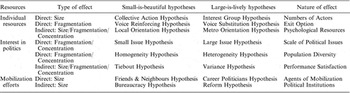
To lay a foundation for a better specified model of the context of urban political participation, Table 1 organizes much of the prior work on the role of context into a series of often mutually supporting hypotheses. These are organized first by how they bear on elements of Verba, Schlozman and Brady’s civic volunteerism model: the resources that enable individuals to act politically, their interest in political issues and the mobilization efforts of political elites that render that potential into political behaviour.Footnote 16 Within each of these supports for participation, we distinguish between hypotheses associated with each of the three institutional traits identified earlier. Table 1 then identifies the locus of the issue and the associated hypothesis from, respectively, the small-is-beautiful and large-is-lively perspective.
Competing Hypotheses About Direct and Indirect Effects of Metropolitan Context on Political Participation

Numbers of Actors
The first set of hypotheses addresses how city size might influence the ways in which an individual’s resources promoting political activity are developed and then translated into political behaviour. A number of theoretical arguments – from the communitarians’ call for face-to-face strong talk to Riesman’s attention to the anomie arising from mass society – have been used to suggest that the utility of the resources we bring to participation is diminished in larger communities.Footnote 17 But the most common source of this expectation is founded on analyses of the collective action problem generally and the paradox of voting specifically.Footnote 18 Any act of participation by a citizen is less likely to influence outcomes on local public goods as the number of citizens within a city grows. Thus, incentives to free ride should increase with city size, generating lower rates of participation for a given level of individual resources. There are several problems with this argument. First, most cities are far larger in size than a situation in which the Olsonian factors of monitoring and sanctioning might come into play so as to encourage participation. An even more difficult problem, of course, is that citizens do vote, and often at quite high rates. In accounting for this unexpectedly high level of participation in the face of incentives to free ride, our understanding of the severity of the collective action problem has evolved in a number of ways. Many scholars now believe that while quite real, the collective action problem is not as severe as initially thought and that political and organizational elites have become quite creative in circumventing its consequences.Footnote 19
Still, most of the arguments challenging the small-is-beautiful collective action hypothesis do not lead to a purely rival expectation that large cities promote participation via facilitating political activity. One exception, however, focuses on the role of civic organizations and interest groups in promoting participation. This argument has two parts. The first arises from Verba, Scholzman and Brady’s observation that such organizations play a key role in preparing individuals for political participation.Footnote 20 It is through organizations that individuals first become engaged with issues, linking them to their personal lives. Moreover, organizations provide individuals with the critical skills they need to participate effectively in politics, such as organizing ideas and speaking in public. The second part of the argument rests on Gray and Lowery’s observation that the density of such organizations increases with community size as the potential constituents of new groups pass the threshold size at which their founding and survival becomes viable.Footnote 21 Taken together, these arguments suggest that the latent individual resources that might promote political participation should be more efficiently translated into actual political behaviour in larger communities.
Exit Option
A second effect bearing on the translation of individual resources into political participation is a function of opportunities for exit – leaving one jurisdiction for another – associated with fragmentation. Interestingly, the competing hypotheses of each of these perspectives is rooted in the public choice understanding of voting with one’s feet. A few public choice scholars suggest that voice in the form of traditional political behaviour like voting and contacting officials should be higher within fragmented systems as the exit potential reinforces the utility of voice. If voice requires exit to be effective,Footnote 22 then the returns expected from voice should be lower in consolidated metropolitan governments. In one of the very few direct tests of this proposition, Blomquist and Parks examined local turnout in the Indianapolis metropolitan area before and after governmental consolidation in 1969.Footnote 23 Although this case was unique in a number of respects, consistent with the voice reinforcing hypothesis, turnout in municipal elections declined sharply after the initial election cycles following urban-county consolidation.
In some respects, however, this hypothesis does not reflect the view of fragmentation evident in the work of Tiebout and of Ostrom, Tiebout and Warren.Footnote 24 In that more traditional interpretation, officials’ attentiveness to citizens’ preferences does not arise from contacting, petitioning and/or voting. Indeed, the traditional understanding of public choice theory has at best a limited appreciation of the value of participation as usually understood within political science. Ostrom, Bish and Ostrom, for example, briefly acknowledge a modest role for voting in signalling preferences to elected officials.Footnote 25 But they then suggest that citizens’ latent threat to vote with their feet serves as a better guarantor that their preferences will prevail.Footnote 26 Thus, exit substitutes for voice as the primary form of local political activity. Of course, a robust exit threat depends on the availability of a large number of local jurisdictions within a metropolitan area to which voters might migrate should they become dissatisfied.Footnote 27 In studies employing larger numbers of cases, however, support for the voice substitution hypothesis has been at best mixed.Footnote 28
Psychological Resources
Metropolitan institutions may also influence individuals through the psychological resources of efficacy and community attachment. Both camps suggest that those who are more attached and efficacious participate at higher rates, but they have different views about how context influences attachment and efficacy. The small-is-beautiful school suggests that citizens are locally orientated and that efficacy and attachment decline with city size. Getting things done in large cities can be difficult, therefore decreasing efficacy.Footnote 29 Oliver notes: ‘Larger cities require a more complex bureaucracy, have greater spatial distance between city offices and citizens, and have elected officials who represent more people, all of which may increase the difficulty of participation and the importance of individual resources.’Footnote 30 Instead, suggest Ross and Levine, citizens in smaller cities:
… value the relatively small-scale, participatory nature of their government. They believe that government closest to the people governs the best. In small communities, city council members are seen as friends and neighbors, people who reflect community values. Smaller governments also allow greater responsiveness; a citizen with a problem does not need to run the gamut of impersonal bureaucratic functionaries.Footnote 31
In sum, citizens’ feelings of efficacy should decline with city size.
Yet, arguing that citizens are more oriented to the metropolitan area, the large-is-lively camp asks ‘efficacious for what?’ Shifting attention from city size, a number of other scholars argued that fragmentation effectively partitions metropolitan settings.Footnote 32 Citizens simply have no forum in which to discuss, much less act upon, many vital issues, including urban sprawl, racial segregation, growth management, unemployment and economic development. As Burns expressed it: ‘The way in which Americans have constructed local autonomy means that we have created a space in American politics where race and class are embedded in boundaries.’Footnote 33 Fragmented metropolitan settings ensure that these vital concerns are transformed into non-issues.Footnote 34 In such settings, say metropolitanists, citizens are unlikely to be efficacious.
With rare exceptions, both schools recognize that community attachment facilitates participation.Footnote 35 It is often assumed that citizens are more deeply attached to smaller cities. Sometimes, this assessment is founded on nothing more than reference to the New England town government or the suburban myth of the 1950s. More recently, however, Oliver’s analysis of survey data from 2,550 respondents from 800 places strongly supported the notion that smaller cities facilitate participation, a result that Oliver interprets as a function of the civically richer environments of such settings and the resulting greater attachment to the locality.Footnote 36
Still, a number of scholars have argued that tiny cities provide too narrow a base for firm attachments. In a world where people live, work and play in different cities during the course of a single day and shift those locations to still other venues on the next, citizens may identify more with metropolitan areas.Footnote 37 The evidence is mixed. In contrast to Oliver’s results, other scholars find no relationship between city size and attachment.Footnote 38 Lowery and Lyons found that respondents in a fragmented urban county were more likely to identify with their county than their cities.Footnote 39 And Lowery, Lyons and DeHoog’s analysis of matched neighbourhoods in consolidated and fragmented settings – where the latter were incorporated as independent cities – found both that psychological attachment to the community was much stronger in the former and that rates of political participation were strongly and positively associated with psychological attachment.Footnote 40
Scale of Political Issues
The second set of hypotheses concerns citizens’ interest in politics. Three mutually supporting effects of metropolitan institutions might influence citizens’ interest in politics, and the small-is-beautiful and large-is-lively schools offer competing expectations of each. The first concerns the kinds of issues raised in local politics. Dahl argued that larger communities are more likely to address the kinds of larger issues that are compelling to voters.Footnote 41 Today, these might include issues of race, economic development and urban sprawl.Footnote 42 Others have argued that citizens are more attentive to narrower, smaller issues – snow removal, waste collection and so on.Footnote 43 Such issues, of course, can have considerable import politically, as former Mayor Jane Byrne of Chicago discovered when the snow ploughs were tardy one year. These kinds of readily understood issues of direct and immediate concern in people’s lives can quite effectively promote political participation. And such attention to very local issues need not arise from psychological myopia or a lack of concern about broad social and economic issues. Rather, Fischel has rooted citizens’ attention to very local concerns in the large investment homeowners have in their houses and property.Footnote 44 Given this investment, they must be especially attentive to issues like waste and snow removal, local zoning and neighbourhood schools since these bear directly on housing values.
We think that both arguments are misplaced. Even small cities, if isolated, must exercise full competence for larger issues like race, economic development and urban sprawl. Indeed, research on rural development suggests that these concerns are no less pressing for smaller communities.Footnote 45 And even large cities may have little competence over more expansive issues if embedded in a fragmented institutional setting. Their ability to influence encompassing issues may depend more on the actions of other cities within the metropolitan area than on their own efforts. So, instead of size, whether larger or smaller issues dominate policy agendas depends more on fragmentation. The impact of fragmentation, however, might be diminished somewhat for cities with higher levels of concentration. Their populations’ approach being coterminous with that of their county, they are more likely to be politically competent to deal with broader issues. If local citizens’ interest in politics is stimulated by larger social and economic issues, then fragmented and weakly concentrated local governments should evidence lower levels of participation, given their relative inability to address these kinds of concerns. But if citizens’ interest is stimulated by attention to smaller concerns (perhaps driven by investment in housing), then that interest should be diminished in consolidated and concentrated municipalities, because these narrow concerns must share space on policy agendas with broader issues. Indeed, Kelleher and Lowery found that consolidation and fragmentation powerfully interact so that the negative impact of fragmentation is reduced in highly concentrated settings.Footnote 46
Population Diversity
Population diversity is also widely expected to influence levels of participation, as illustrated by a variety of relevant literatures. Analyses of community level data by economists suggest that participation is higher in demographically homogeneous settings. In explaining this finding, Costa and Kahn refer to citizens’ preferences ‘to interact with others like them because of shared interests, socialization to the same cultural norms, and greater empathy toward individuals who remind them of themselves.’Footnote 47 Thus, this effect may reflect the psychological variables discussed earlier rather than interest in politics per se. Still, we include this expectation under this component of the civic volunteerism model given Oliver’s linking of the same traits to interest in politics: ‘when people feel they have more in common with neighbors or have a greater sense of efficacy, interest in local affairs is greater.’Footnote 48 However, this research employs metropolitan area as a unit of analysis.Footnote 49 It does not examine the within-metropolitan area variables of city size, population concentration and jurisdictional fragmentation that are presumably the vehicles through which the ‘positive’ effects of greater homogeneity are secured.
The opposite argument – that social heterogeneity promotes participation – is common, too, and is often alternatively discussed in terms of the relationship between social capital and diversity.Footnote 50 Deutsch and also Verba, Schlozman and Brady suggest that if contention between competing interests raises the stakes of citizens in policy outcomes, then interest in politics should be highest in more diverse communities.Footnote 51 Rubenson focused on racial diversity as an especially important conduit for stimulating participation.Footnote 52 Indeed, despite Oliver’s earlier assertion that participation should be higher when ‘people feel they have more in common with neighbors’, he has also argued that participation should be highest when there is policy competition.Footnote 53 Writing in an earlier paper, he noted:
Local politics should be more contentious (and participation highest) in economically diverse cities as these places have more groups pursuing contradictory goals. Conversely, a greater consensus over local policy in economically homogeneous cities should limit competition, citizen interest, and participation.Footnote 54
We think that Oliver’s initial argument was more nearly correct.
More to the point, how are size, fragmentation and concentration related to heterogeneity? City size might be associated with greater diversity. But Oliver suggests, instead, that it is really fragmentation that reinforces homogeneity by facilitating more efficient demographic and economic sorting, an argument echoing previous scholarship.Footnote 55 The concentrated poverty created via efficient sorting is especially detrimental for participation.Footnote 56 Participation, however, may also be reduced in more affluent settings as political conflict is limited. This does not mean that fragmented areas have fewer conflicts. Rather, as Oliver noted, ‘the exclusionary practices that help create and sustain a suburb’s affluence effectively limit the range of social problems and political conflicts within their borders … With a similar uniformity of political interests and a lack of political resources, residents of poor cities also find fewer incentives to involve themselves in local affairs.’Footnote 57 Indeed, demographic sorting in fragmented areas seems to have become much more refined over recent decades.Footnote 58 But we also expect that the deleterious impact of fragmentation on participation might be offset in part when metropolitan areas are more concentrated. That is, demographic sorting should be somewhat less efficient for a city that retains a larger proportion of the urban county’s population.
Performance Satisfaction
Our third set of expectations about the impact on institutional context and interest in politics rests on two somewhat divergent views about the purpose of political participation.Footnote 59 Often, we view participation as civic acts affirming one’s place in the community. Consistent with this republican view of citizenship, prior satisfaction with government services has been positively associated with a variety of traditional forms of political participation.Footnote 60 However, we also view participation in more instrumental terms – political behaviour as a response to dissatisfaction and an effort to improve the situation. This second view of participation has received some empirical support.Footnote 61 So, at the individual level, we might well ask whether satisfaction with local public services promotes political participation or reduces citizens’ need for recourse to it.
While we will address this issue, our real concern is about how institutional context influences participation. Two hypotheses highlight an indirect effect working through satisfaction. The Tiebout model assumes that citizens have divergent preferences for local public goods.Footnote 62 Fragmented systems address this diversity by offering a variety of market baskets of local public goods. As a result, divergent preferences are balanced by divergent provisions of goods, thereby promoting higher and more uniform levels of satisfaction. Indeed, this is the key insight of the Tiebout model.Footnote 63 If higher satisfaction promotes participation, fragmentation should promote participation. But if participation is better viewed as a response to dissatisfaction, then the higher levels of satisfaction expected of fragmented systems should reduce participation.
Critics focus on the model’s assumption that citizens have divergent preferences about local public goods. Kelleher and Lowery have called this the variance hypothesis.Footnote 64 Its core is Stein’s finding that preferences for local public goods do not, in fact, vary a great deal.Footnote 65 Instead, citizen satisfaction is both highest and most uniform when many high quality services are provided.Footnote 66 But the disjunction of service needs and tax bases found in fragmented settings ensures that services will not be provided uniformly in such systems.Footnote 67 As a result, the diverse market baskets of public goods provided in fragmented settings ensure that initially uniform sets of preferences are translated into considerable variation in levels of service satisfaction. Given that central cities are almost always losers in the balancing of service need and fiscal capacity, this means that their satisfaction levels should be low. If lower satisfaction promotes political activity as a response to dissatisfaction, then fragmentation will generate higher participation. But if satisfaction is better understood as a civic duty with little specific information on policy per se, then the lower levels of satisfaction expected in fragmented systems should reduce political activity.
Agents of Mobilization
The seventh and eighth sets of hypotheses shift our attention to the third element of Verba, Scholzman and Brady’s typology of the roots of political participation: mobilization. Both the small-is-beautiful and large-is-lively schools suggest that individual resources and an interest in politics are not sufficient. Instead, we commonly wait for someone to ask us to act politically. And as demonstrated by Niven, face-to-face mobilization can increase turnout.Footnote 68 Work by McClurg points to the importance of discussion within social networks in getting citizens involved in politics.Footnote 69 However, who asks (or, in other words, who mobilizes) may depend on city size. The political elites of smaller cities are more likely to be amateur or part-time officials who are also friends and neighbours. To the small-is-beautiful school, they play an especially important role in mobilization. Oliver, citing Fischer, Lofland, Huckfeldt and Sprague, argued that ‘people in larger places are less likely to know their neighbors, have mutual friends, and see acquaintances in public settings, which in turn may inhibit political mobilization.’Footnote 70 Oliver found that citizens of smaller cities were more frequently asked to participate by friends and neighbours than those in larger cities.Footnote 71
The elites of larger cities are more likely to be unknown to voters personally and career politicians. But while lacking close personal ties, career politicians are far more likely than amateurs to have a strong personal incentive in encouraging others to participate in local politics on their behalf as well as established routines for doing so. Thus, in explaining mobilization, Rosenstone and Hansen accord a prominent role not to amateur friends and neighbours, but to career politicians.Footnote 72 Larger cities are more likely to support a pool of career politicians. To the large-is-lively school, then, mobilization should be more effective in larger cities.
Municipal Institutions
The relative importance in mobilization assigned to friends and neighbours and to career politicians by the two schools varies. However, these relationships may also be influenced by the kinds of institutions large and small cities tend to support. But the small-is-beautiful and large-is-lively camps have somewhat divergent concerns about which types of institutions might best promote participation. Administrative institutions are especially important to the former. Smaller cities are more likely to rely on a co-production of services by citizens and local officials rather than bureaucratic production of local public goods.Footnote 73 Thus, citizens of smaller towns are not just more likely to be asked to participate by friends and neighbours than are those living in big cities. They are also likely to be asked to do more things.
In contrast, the large-is-lively school is more attentive to political rather than administrative institutions. That is, smaller cities are more likely to adopt reform institutions, including council-manager systems, non-partisan ballots and at-large districts. It is traditionally argued that participation is enhanced in non-reformed governments in comparison to cities with manager-council systems and at-large elections because direct elections of mayors and ward and partisan elections are expected to be associated with greater mobilization efforts on the part of local officials.Footnote 74 But more recent studies have found less consistent effects.Footnote 75 Still, larger cities are expected, via their greater reliance on non-reformed political institutions, to be less effective at mobilizing citizens.Footnote 76
Testing the participation hypotheses
Data and Variables
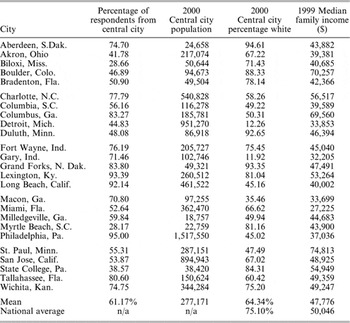
We have now outlined several explanations and expectations about the effects of metropolitan context on political participation. Testing all of these hypotheses and all of the causal linkages underlying them is beyond the scope of this or perhaps any other single study. Still, we test a number of them simultaneously using a combination of individual-level survey data from the Knight Foundation with city-level institutional measures. The city-level variables included in our models are from the US Census Bureau, while the individual-level data were drawn from the Knight Community Indicators Project, a research-based initiative conducted in 2002 by the John S. and James L. Knight Foundation. This project focused on twenty-six communities (see Table 2) in which Knight Ridder newspapers are located.Footnote 77
The Knight Community Survey Cities

Part of the project entailed random telephone surveys in 2002 of samples of 500 to 800 adults over the age of eighteen who were residents of the city and/or the county in which the respective Knight Ridder papers were published. Careful attention was given to ensuring the samples were geographically and demographically representative.Footnote 78 In all but one of the twenty-six cases (Boca Raton, Florida), only city residents were sampled or respondents were identified as residing in the city or the county (via a specific survey question). Unfortunately, however, the home jurisdictions of respondents not living in the city in which the papers were published were not identified. We could not, therefore, match the individual survey responses on service satisfaction, ideology, political participation and so on to the municipal and metropolitan institutional characteristics that define the context of their political activities. Thus, our analysis is restricted to the survey responses of individuals residing in the home communities (cities) of twenty-five Knight Ridder newspapers. The first column of Table 2 lists this information – the percentage of each of the samples in the central city.Footnote 79
While this sample was neither designed for our purpose nor perfectly matches national distributions on a number of variables, Table 2 indicates that it includes a range of very different kinds of places. However, while some may contend that the sample of cities is a serious weakness, we contend that it also must be considered one of this study’s greatest strengths. Due to the variation across the cities that it does include on a number of different dimensions, we are confident in its utility to investigate the issues posed here. It is particularly valuable as it deviates from much of the urban politics literature that examines, almost exclusively, big cities, or from much work on the consolidation front as well, where case studies are the dominant analytic strategy.Footnote 80 A weakness, of course, is that it is a non-random-sample of only twenty-six cities. However, despite the selection, they are a reasonably representative sample in terms of geography, demographics, economics and politics.Footnote 81
With a 2000 population of 1,517,550, Philadelphia (Pennsylvania) is the largest city in the sample. In contrast, the population of the smallest, Milledgeville (Georgia), was only 18,757. The proportion of white residents ranged from 94.61 per cent in Aberdeen (South Dakota) to only 11.92 per cent in Gary (Indiana). And average income ranged from only $27,225 in Miami (Florida) to $74,813 in St. Paul (Minnesota). There is also significant institutional variation between the cities. Of the twenty-six Knight cities, fourteen (54 per cent) have mayor–council structures, eleven (42 per cent) have council–managers, and one (4 per cent) has a commission.Footnote 82 Nine of the twenty-six Knight cities (35 per cent) have pure ward elections, seven (27 per cent) have at-large elections, and the remainder have some combination of the two.Footnote 83 And 31 per cent of the Knight communities have partisan elections.Footnote 84 Finally, four cities have consolidated city–county governments – Columbus (Georgia, Muscogee County), Lexington (Kentucky, Fayette County), Miami (Florida, Miami-Dade County), and Philadelphia (Pennsylvania, Philadelphia County). Overall, the sample is somewhat poorer and more non-white than the national average. It also includes somewhat fewer reform cities and somewhat more consolidated governments than nationally. Yet, in sum, while not a random sample of all cities in the United States, our sample varies considerably on the key variables identified by the hypotheses presented earlier. Additionally, similar or identical samples have been used by Rahn et al. and by Rahn and Rudolph.Footnote 85
Dependent Variables
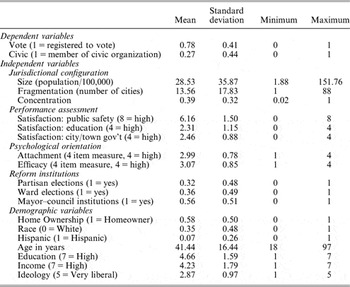
Oliver’s recent tests of models of participation using a number of different indicators of political activity indicated that his broad range of measures responded to causal forces in a very consistent manner.Footnote 86 We take advantage of this by focusing on two quite different modes of political activity as our dependent variables. The first is registering to vote, as indicated by responses to the following question: ‘Are you registered to vote in your precinct or election district, or haven’t you had a chance to register?’ This is the most minimal form of political activity that a citizen can undertake. As noted earlier, voting and vote registration are often conceptualized as a form of voice. That is, people register to vote because they want to vote or have some reason to do so. So, registration is itself a political act that should be affected by context. An alternative view, of course, is that registering to vote is a ritualistic act of good citizenship or even something of an automatic act. While both are certainly true to some extent, the former interpretation is likely to be especially relevant for the US case given that voting rolls are routinely purged when voters do not vote in subsequent elections. That is, registration is far from automatic in American cities. We will see that our empirical results seem to confirm this interpretation given that we find similar causal forces at work on both registration and on volunteering, our second dependent variable, something that should not be true if these represented fundamentally different kinds of activity. As seen in Table 3, 78 per cent of respondents were registered, a value that is consistent with national rates. Across the cities, however, this varied from only 61 per cent in Biloxi (Mississippi) to 86 per cent in Detroit (Michigan). Our second measure of participation taps membership in civic organizations by responses to the following question: ‘In the past 12 months have you volunteered your time to … a neighbourhood or civic group such as a block organization or a neighborhood watch?’ As would be expected given the greater cost of this mode of participation, only 27 per cent offered positive responses. Again, however, there is considerable variation across the Knight communities. Only 10 per cent of respondents in Aberdeen (South Dakota) answered ‘Yes’, in contrast to 42 per cent in Detroit (Michigan).
Descriptive Statistics for All VariablesFootnote *

* Based on the model for Voter Registration, the total Level 1 observations are 7,418 and for Level 2 are 25. For volunteering with a civic organization, there are 7,438 individual observations. The statistics presented here are nearly identical to those sets of observations.
Independent Variables
We are interested in three institutional traits of the cities and the urban counties in which they sit. The first is Size as measured by population in 2000. Jurisdictional Fragmentation is measured by the number of general purpose local governments within the urban county. This ranged from a low of only one in Columbus (Georgia), Milledgeville (Georgia), Lexington (Kentucky), Philadelphia (Pennsylvania), and Tallahassee (Florida) to a high of 88 for Long Beach (California). As seen in Table 3, mean fragmentation is 13.56.Footnote 87 Jurisdictional Concentration is measured by a Herfindahl index of concentration. In our case, the index is the sum of the squared proportions of the populations of the general purpose local governments in the urban county where values near 1.0 indicate that nearly the entire population of the county is concentrated in one city and values near 0 indicate that county population is more evenly dispersed. As seen in Table 3, mean concentration was 0.39, but ranged from 1.0 for our consolidated urban-county governments to a low of 0.021 for Myrtle Beach (South Carolina). The three traits are quite distinct at the urban county level. For our twenty-five Knight cities, the simple correlation of size and concentration is 0.40 while the correlation of fragmentation and concentration is −0.36. Somewhat surprising, the correlation of size and fragmentation is actually positive, although quite modest (r = 0.16).
For the most part, these three institutional variables are expected to have a direct impact on the two measures of political participation, which allows us simply to examine the estimates for the three institutional variables. However, we also suggested that they might have more indirect influence on political activity through citizens’ satisfaction with public services, their attachment to the community and their efficacy, and the kinds of electoral institutions cities adopt. Following Oliver, several of our models include measures of these intervening variables.Footnote 88 We employ three measures of Performance assessment – for public safety (by adding separate indicators for police and fire departments), local public education and the town or city overall. In each case, the respondents were asked to indicate whether the local institution was doing an excellent, good, fair or a poor job serving their community. Responses were scored from 4 to 1, generating aggregate city means of 6.11, 2.29 and 2.43 for the three services, respectively. Our indicator of Attachment is perhaps the weakest measure in the analysis since it is more of an assessment of the quality of life and, thus, might also be tapping some aspects of performance satisfaction. Still, respondents were asked to indicate whether the city was a poor, fair, good or excellent place to live, with the responses coded from 1 to 4, respectively. To measure Efficacy, respondents were asked the following question: ‘Overall, how much impact do you think people like you can have in making your community a better place to live?’ The responses included no impact and a small, moderate or big impact, which were coded from 1 to 4, respectively. Mean attachment was 2.99 while mean efficacy was 3.07. The last set of intervening variables includes indicators of reliance on the non-reformed institutions of the mayor–council system and ward and partisan elections. Each is measured by a dummy variable with a value of 1 if a city employs the institution.Footnote 89
Our models also include both individual-level and jurisdiction-level controls. The former include Home ownership, Income, Education, Race, Hispanic ethnicity, Age and Ideology.Footnote 90 The maximum and minimum values, means and standard deviations of these controls are reported in Table 3.
Methods
While we have argued that much of the confusion of findings on the metropolitan context of political participation arises from incomplete specification of the models employed to test these hypotheses, to some extent, this surely arises from the disciplinary background from which we approach the topic. Scholars studying urban politics from a political psychology perspective are often inattentive to the full range of institutional forces that bear on the political behaviour of individuals.Footnote 91 Those approaching urban politics from an institutional perspective are too often inattentive to individual-level determinants of behaviour that, as we have seen, may plausibly interact with contextual forces.Footnote 92
The research designs used by scholars studying the metropolitan context of participation reflect this distinction, ranging from citizen surveys in one or more cities, through analyses of aggregate data on cities in one metropolitan area, to studies employing urban counties as the unit of analysis. Each of these designs is more useful for answering some questions than others. But if we are simultaneously to tap the individual and institutional sources of variation in political participation, we need data from multiple levels. Thus, in this article, we employ a multi-level (or hierarchical) modelling strategy, with individuals nested in cities, to test adequately and completely the previously presented array of hypotheses.
A multi-level design offers a multitude of methodological advantages. First, because it recognizes and controls for the clustering of individuals within larger units, it does not violate the assumption of statistical independence. Additionally, it accounts for the possibility of non-constant variance across different cities.Footnote 93 Finally, it is particularly useful in estimating cross-level interaction effects.Footnote 94 Failure to use a multi-level strategy for nested data can result in biased standard errors as well as incorrect Type I error rates.Footnote 95
A multi-level model essentially involves the simultaneous estimation of both a level-1 (individual) and a level-2 (city) model.Footnote 96 All variables included in the model, with the exception of dummy variables, are grand mean centred. Because our dependent variable is dichotomous, we use logit to estimate the models. In subsequent sections, we also present and discuss odds ratios for selected significant coefficients.
Findings
The Fully Unconditional Model: Establishing City-Level Variation
In order to estimate the variation in each dependent variable attributable to city-level differences, an initial step common to multi-level analyses is beginning with an ‘unconditional’ or null model.Footnote 97 Such a model includes no predictors at either the individual or city level.Footnote 98 For example, for Vote, the level-1 model is as follows:

The level-2 model then seeks to explain β 0j via the following equation,

By substituting the level-2 equation into level-1 the full hierarchical model to be estimated is

where γ 00, the constant, represents the average log-odds of being registered to vote, u 0j (the city-level random effect) is the variance component of the level-2 units and rij (the individual-level random effect) is the variance component of the level-1 units.
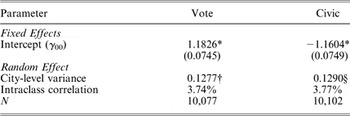
Essentially, at this stage in the analysis, we are primarily interested in u 0j, which tells us whether significant city-level variation (or clustering) is present. In other words, this effect captures whether registering to vote or volunteering in a civic organization actually varies across the cities in the sample. Table 4 reports the results of these models for both dependent variables – Vote and Civic. Because both coefficients for the random effects are significant, we conclude that there is important variation in voter registration and volunteering in a civic organization at the city level that must be acknowledged.Footnote 99
Null Models of Voter Registration and Civic Organization Membership

Note: All models were estimated using logit with restricted PQL estimation using HLM 6.0.
Robust standard errors are in parentheses.
*p < 0.05, one-tailed tests.
†χ 2, 24df = 257.27, p < 0.01.
§χ 2, 24df = 264.133, p < 0.01.
Next, to investigate how the overall variance in Vote and Civic is divided between the individual and city level, we calculate the intraclass correlation coefficient (ICC).Footnote 100 The proportions are small, although not completely unsubstantial; 3.74 per cent of the variance in voter registration is attributable to city-level differences, while 3.77 per cent of the variance in volunteering in a civic organization can be linked to city factors. These percentages are consistent with similar work. For example, in a paper by Rahn and Rudolph, only 4.3 per cent of the variation in trust in government is found to be at the city level.Footnote 101 Rubenson finds approximately 9 per cent to 12 per cent of the variation in multiple measures of participation attributable to city-level factors.Footnote 102 Additionally, Steenbergen and Jones note that due to the individual-level measurement of the dependent variable, we should expect to see the majority of variance at that level and, thus, these seemingly smaller percentages are not alarming.Footnote 103 With evidence of meaningful differences at the city level established, we now move to multivariate analyses in which we seek to explain this variation more completely.
Multivariate Specifications of Registration and Volunteering
A hierarchical model consists of two components – Level 1 and Level 2 structural models. The Level 1 model for Vote is below, with each of the βkj terms representing the effect of a particular variable on the likelihood of voter registration. The variables included in the models for Civic (explaining the likelihood of volunteering in a civic organization) are identical to those listed here:

The Level 2 model seeks to explain the intercept from the above equation using city-level variables:

Additionally, in hierarchical modelling, a researcher is faced with many choices about random and fixed Level 1 variables. Essentially, if the effect of the individual-level variable is expected to be constant across units, one would set the error term to 0. Thus, this coefficient is ‘fixed’. If the variable is expected to have a different effect in different units, it should be allowed to vary. While theoretical considerations should be the primary manner of deciding, multiple empirical strategies also might be utilized to decide which specification is most appropriate.Footnote 104 We model a subset of the Level 1 coefficients for both Vote and Civic as randomly varying.Footnote 105 The inclusion of these parameters allows us to account for nonconstant effects of select variables in different cities.Footnote 106 The equation for a fixed coefficient (for example, Efficacy) is as follows:

A randomly varying coefficient is estimated using the following equation:

Because many of the individual-level hypotheses presented earlier are context dependent, we also include and test multiple cross-level interactions. These terms allow for the simultaneous modelling of individual and city-level factors. Essentially, we explain the slope of an individual-level variable with city-level predictors. For example, we test whether the effect of Efficacy is dependent on Size, Fragmentation and Concentration via the following equation:

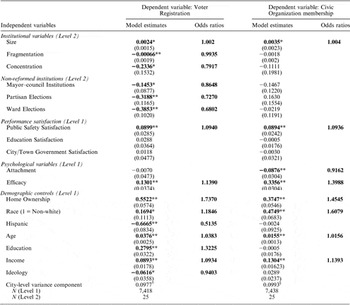
We similarly test whether attachment and measures of citizen satisfaction are dependent on various metro factors using these cross-level interaction terms. In Table 5, we present the base models for Vote and Civic, with no interactions. In Tables 6 and 7, we report cross-level interaction terms. Select odds ratios for significant variables are also reported.
Base Models of Voter Registration and Civic Organization Membership

Notes: All models were estimated using logit with restricted PQL estimation using HLM 6.0. Robust standard errors are in parentheses. Randomly varying Level 1 variables (for Voter Registration): Education Satisfaction, City/Town Government Satisfaction, Race and Education. Randomly varying Level 1 variables (for Civic Organization membership): Education and Public Safety Satisfaction. Dependent variables are measured using the following questions: (A) ‘Are you registered to vote in your precinct or election district (1), or haven’t you had a chance to register (0)?’ (B) ‘In the past 12 months have you volunteered your time to … a neighborhood or civic block organization or a neighborhood watch (1)?’
**p < 0.05, *p < 0.10; one-tailed tests. †χ 2, 18df = 66.6436, p < 0.01; §χ 2, 18df = 109.2139, p < 0.01.
Multivariate Models of Voter Registration and Civic Organization Membership, with Cross-Level Interactions (Attachment and Efficacy)

Notes: All models were estimated using logit with restricted PQL estimation using HLM 6.0. Robust standard errors are in parentheses. Randomly varying Level 1 variables (for Voter Registration): Education Satisfaction, City/Town Government Satisfaction, Race and Education. Randomly varying Level 1 variables (for Civic Organization membership): Education and Public Safety Satisfaction.
Dependent variables are measured using the following questions: (A) ‘Are you registered to vote in your precinct or election district (1), or haven’t you had a chance to register (0)?’ (B) ‘In the past 12 months have you volunteered your time to … a neighborhood or civic block organization or a neighborhood watch (1)?’
**p < 0.05, *p < 0.10; one-tailed tests.
†χ 2, 18df = 67.307, p < 0.01; §χ 2, 18df = 66.8680, p < 0.01; ‡χ 2, 18df = 109.3277, p < 0.01; ¶χ 2, 18df = 109.398, p < 0.01.
Multivariate Models of Voter Registration and Civic Organization Membership, with Cross-Level Interactions (Satisfaction)

Notes: All models were estimated using logit with restricted PQL estimation using HLM 6.0. Robust standard errors are in parentheses. Randomly varying Level 1 variables (for Voter Registration): Education Satisfaction, City/Town Government Satisfaction, Race and Education. Randomly varying Level 1 variables (for Civic Organization membership): Education and Public Safety Satisfaction.
Dependent variables are measured using the following questions: (A) ‘Are you registered to vote in your precinct or election district (1), or haven’t you had a chance to register (0)?’ (B) ‘In the past 12 months have you volunteered your time to … a neighborhood or civic block organization or a neighborhood watch (1)?’
**p < 0.05, *p < 0.10; one-tailed tests.
†χ 2, 18df = 66.8238, p < 0.01; ‡χ 2, 18df = 62.7283, p < 0.01; §χ 2, 18df = 67.9141, p < 0.01; ¶χ 2, 18df = 110.305, p < 0.01; ∥χ 2, 18df = 105.0149, p < 0.01; ††χ 2, 18df = 108.785, p < 0.01.
Base models: explaining registration and volunteering
The base models for the hierarchical logit results for voting registration and volunteering within civic organizations are presented in Table 5. Overall, the results are consistent across both measures of political participation. This is especially true for the individual-level demographic controls, which we will comment on only briefly. The pattern of significant estimates indicates that voter registration is more likely among homeowners and older, better educated and wealthier residents. With the exception of education (not significant), the same pattern is true for volunteering with civic organizations. Perhaps more surprisingly, the estimates for black citizens were also positive and significant across the models and dependent variables, indicating greater participation among minority residents than non-minorities.Footnote 107 The estimates indicate that Hispanic respondents were no more or less likely to work with civic groups, but were discernibly less likely to register to vote. Finally, the ideology coefficients indicate that conservatives are slightly more inclined to register to vote, yet are no more or less likely to help a civic organization.
With respect to size, fragmentation and concentration, we observe interesting results. For voter registration, all three of the jurisdiction variables are highly significant predictors. The estimates for size and fragmentation provide strong support for the large-is-lively school, with the odds of voting increasing as cities become larger and counties less fragmented. The corresponding odds ratios are interpreted as follows. A one-unit increase in jurisdiction size indicates that individuals are 2 per cent more likely to register to vote, and as the degree of fragmentation surrounding a city increases by one unit, individuals are less likely to vote (0.6 per cent). However, as a city becomes more concentrated or retains a greater proportion of urban county residents, the odds of registration decrease by 21 per cent. A similar pattern exists for the relationship between size and volunteering in a civic organization. As the size of a jurisdiction increases, the odds of voting similarly are improved. Additionally, although not statistically significant by conventional standards, both fragmentation and concentration are also negatively signed.
In Table 5, however, we find mixed evidence for the previously presented hypotheses tapping the indirect effect hypotheses. First, for voter registration, contrary to our expectations, the estimates for all three of the reform variables are incorrectly signed negative and statistically significant, indicating that the presence of these institutions decreases the likelihood of voter registration. However, two other intervening variables are correctly signed (positive) and statistically significant predictors of voter registration – satisfaction with public safety and efficacy. Both coefficients and odds ratios indicate that greater satisfaction with public safety leads to a greater chance of being registered to vote, as do more efficacious feelings towards one’s jurisdiction. Additionally important to note is that the other satisfaction variables, while not statistically significant, are of the expected positive sign.
A very similar pattern of findings is evident for volunteering with civic groups. This similarity allows us to describe these results more briefly. Of the intervening variables, again only satisfaction with public safety and efficacy generated both the expected sign and were discernibly different from 0. In perhaps the biggest difference with the vote registration results, reliance on a mayor–council system produced the expected positive sign, although the estimates were not significant at conventional levels.
In sum, then, fragmentation and concentration seem to have a significant and negative impact on vote registration, while size has a significant and positive influence. With respect to volunteering in civic organizations, only size has both a significant and positive influence. Our findings differ markedly from some prior work, especially that of Oliver.Footnote 108 We consider why more fully in the conclusion.Footnote 109
Cross-Level Interactions
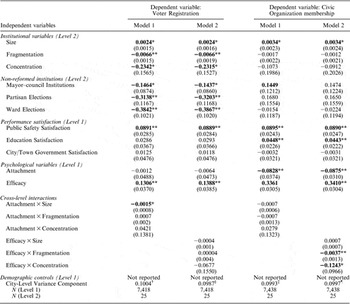
Because many of our hypotheses suggest that the effects of individual characteristics depend on jurisdiction-level traits, we estimated models including cross-level interaction terms. We estimate and present the results from a number of different specifications in Tables 6 and 7 because the simultaneous introduction of so many variables leads to estimation problems and issues with multicollinearity. We begin with the effects of size, fragmentation and concentration on Attachment and Efficacy, the results of which are presented in Table 6. The previous literature hints at different mechanisms by which context might influence these psychological resources, with the small-is-beautiful and large-is-lively perspectives offering opposing expectations. Our results are mixed. With respect to attachment, the only significant jurisdiction-level trait is Size, and it is negatively signed in the models for both dependent variables. In other words, as size increases, attachment’s effect on the odds of voter registration and volunteering in a civic organization decreases. This finding offers greater support for the small-is-beautiful perspective. However, contrary to both perspectives, fragmentation and concentration do not appear to influence how attachment drives participatory activities. Additionally important to note, however, is that the inclusion of these interaction terms does not remove the significant direct effects of the jurisdiction-level traits.
With respect to efficacy, however, the results are slightly different. First, in the model for voter registration, there is no effect for size, fragmentation or concentration on efficacy, and thus, no support is found for either side of the small versus large arguments. However, with respect to volunteering in a civic organization, both concentration and fragmentation have significant, negative effects via efficacy. As the level of fragmentation increases, the effect of efficacy on the likelihood of helping in a civic organization decreases. Thus, this offers greater support for the large-is-lively perspective, arguing that citizens are more orientated to the concerns of a metropolitan area versus the small, non-issues of a highly fragmented region. Interestingly, the effect of concentration on efficacy is also negative, indicating that as a region becomes more concentrated (with a greater proportion of citizens living in the central city), the effect of efficacy on volunteering in a civic organization decreases.
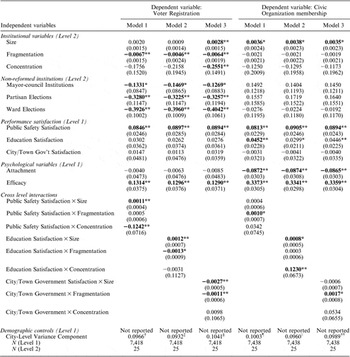
In Table 7, we investigate cross-level interactions between the various dimensions of satisfaction and the jurisdiction-level traits. The effect of satisfaction with both public safety and education on the likelihood of being registered to vote increases with city size (indicated by the positive, significant estimate for the Public Safety Satisfaction × Size). However, the sign for the interaction term between concentration and satisfaction with public safety is negative, indicating that the effect of satisfaction on voter registration is weakened in more concentrated areas. For the first dependent variable (Voter registration), we also observe negative signs for the interactions between fragmentation and education satisfaction and fragmentation and satisfaction with city/town government. Thus, the effect that satisfaction on these dimensions has on voter registration is weakened when counties are fragmented. This finding is in sharp contrast to the arguments of the small-is-beautiful perspective, which contends that if higher satisfaction promotes participation, fragmentation should generate more participation. However, it appears that more locational choices decrease the effect of satisfaction on voter registration.
Slightly different results emerged for the second dependent variable tapping volunteering in civic organizations. The only significant mediating effect for the jurisdiction-level variables via satisfaction with public safety is through fragmentation, and it is positively signed. Thus, in more highly fragmented areas, satisfaction with public safety is more influential in predicting volunteering in civic organizations. With respect to education satisfaction and size, the interaction is positive. In other words, as size of city increases, the effect of satisfaction with schools on the likelihood of membership in a civic organization increases as well. In the final model of Table 7, the interaction term between city/town government satisfaction and fragmentation is positive. Thus, as regions become more fragmented, government satisfaction has a greater effect on predicting the odds of volunteering with a civic organization.
Conclusion
Our results indicate that city size positively influences political participation while fragmentation and concentration diminish it. We can consider more fully how these findings fit into the confused mix of prior empirical assessments of the contextual determinants of urban political participation by examining how they compare to those reported by Oliver.Footnote 110 Our results differ least with Oliver’s earlier finding on the effects of fragmentation.Footnote 111 He did not examine fragmentation per se, but rather the diversity of the communities that presumably results from variations in opportunities for demographic sorting. Still, there is very strong evidence that these two variables are closely and causally related.Footnote 112 Indeed, Oliver’s more direct examination of diversity suggests that the strong fragmentation effect we observe is consistent with the large-is-lively school’s heterogeneity or social diversity hypothesis.
Our results differ markedly, however, from Oliver’s finding of a strong negative association between size and participation.Footnote 113 This difference might be explained in three ways. The first concerns our measures of participation. Oliver examined self-reports of actual voting, of contacting officials and of attending community and organizational meetings, while we examined self-reports of registering to vote and membership in civic groups.Footnote 114 How might this have mattered? Clearly the differences in findings do not arise from use of self-reports. But our measures tap what are arguably less and more difficult participatory behaviours, respectively. Registering to vote is easier than voting, and attending a meeting is easier than volunteering with a civic organization. Still, our results were very consistent across these two very different types of behaviour. To ascribe the difference to our examination of easier and more difficult behaviours would require a theory that could explain why causal relations operative for moderately difficult behaviours are somehow reversed for very easy and very difficult modes of participation. We do not find such an account to be plausible. Therefore, we cannot easily attribute the difference in our findings from Oliver’s analysis to the use of different dependent variables.
A perhaps more plausible account would point to differences in sample. Oliver used national survey data while we employed surveys from small to large cities within metropolitan settings.Footnote 115 Might the negative association Oliver found between size and participation be a function of his attention to a wider distribution of places, ranging from extremely rural setting, through suburban places, to the megalopolis of Los Angeles? In contrast, might our positive assessment of size be valid only across the mid-sized cities we examine? The answer seems to be ‘No’. Oliver’s analysis included a full set of controls for type of location.116Footnote 116 These did little to diminish his basic finding that size is negatively related to participation. Moreover, such a claim would require a plausible theory to explain why a relationship operative for a broad sample of cases reverses so powerfully in a subsample of settings.
Another explanation for these divergent results is inherent in our broader specification of jurisdictional characteristics. Most importantly, our models include measures of three traits of the cities we examine and the urban counties they sit in: size, fragmentation and concentration. We have seen that these three characteristics are empirically and theoretically distinct aspects of institutional context within which urban political participation takes place.
That said, our results do not answer all of the questions we might ask about the context of urban political participation. This can be understood best by re-examining Table 1. Our results speak more clearly to some parts of the table than to others. Clearly, they provide little or mixed support for the small-is-beautiful hypotheses in the second column from the left. But we also found little or mixed support for the indirect versions of the large-is-lively hypotheses – the metro orientation, variance and reform hypotheses.117Footnote 117 Our empirical results, however, are consistent with all five of the remaining large-is-lively hypotheses highlighting, respectively, the interest group and career politician mobilization consequences of jurisdiction size and the voice substitution, large issue and heterogeneity implications of fragmentation. To sort out these causal connections better would be a useful next step in this analysis. This should begin by examining more directly the linkages between the three contextual variables and the three elements of the civic volunteerism mode – the individual resources, interest in politics and mobilization efforts that promote political participation. We can then examine more precisely how each of these relationships influences propensities to act politically. In this regard, we are especially interested in examining how mobilization efforts on the part of political elites subsidize individual resources and interest in politics so as to promote participation. This, of course, is the core of real local politics.