1. Introduction
The Terreneuvian, the earliest and longest Cambrian epoch, lasted over 20 Ma (e.g. Landing et al. Reference Landing, Bowring, Davidek, Westrop, Geyer and Heldmaier1998, Reference Landing, Peng, Babcock, Geyer and Moczydłowska-Vidal2007) and spanned the three stages of the Cambrian Evolutionary Radiation (CER) (Landing et al. Reference Landing, Myrow, Benus and Narbonne1989, Reference Landing, Geyer, Brasier and Bowring2013; Landing Reference Landing1992; Zhu et al. Reference Zhu, Yang, Li, Yuan and Voronin2008). CER stage 1 (terminal Ediacaran ‒ earliest Cambrian) featured increasingly diverse biomineralized metazoans and soft-bodied animals that produced deep, behaviourally complex burrows (e.g. Geyer & Uchman, Reference Geyer and Uchman1995; Zhuravlev et al. Reference Zhuravlev, Liñan, Gámez Vintaned, Debrenne and Fedorov2012). The Ediacaran‒Cambrian boundary global stratotype section and point (GSSP) lies in CER stage 1 at the Trichophycus pedum Assemblage Zone base (ichnofossils) in eastern Newfoundland (Narbonne et al. Reference Narbonne, Myrow, Landing and Anderson1987; Landing, Reference Landing1992, Reference Landing1994; Brasier, Cowie & Taylor, Reference Brasier, Cowie and Taylor1994; see T. pedum Assemblage Zone of Landing et al. Reference Landing, Geyer, Brasier and Bowring2013; Fig. 1).
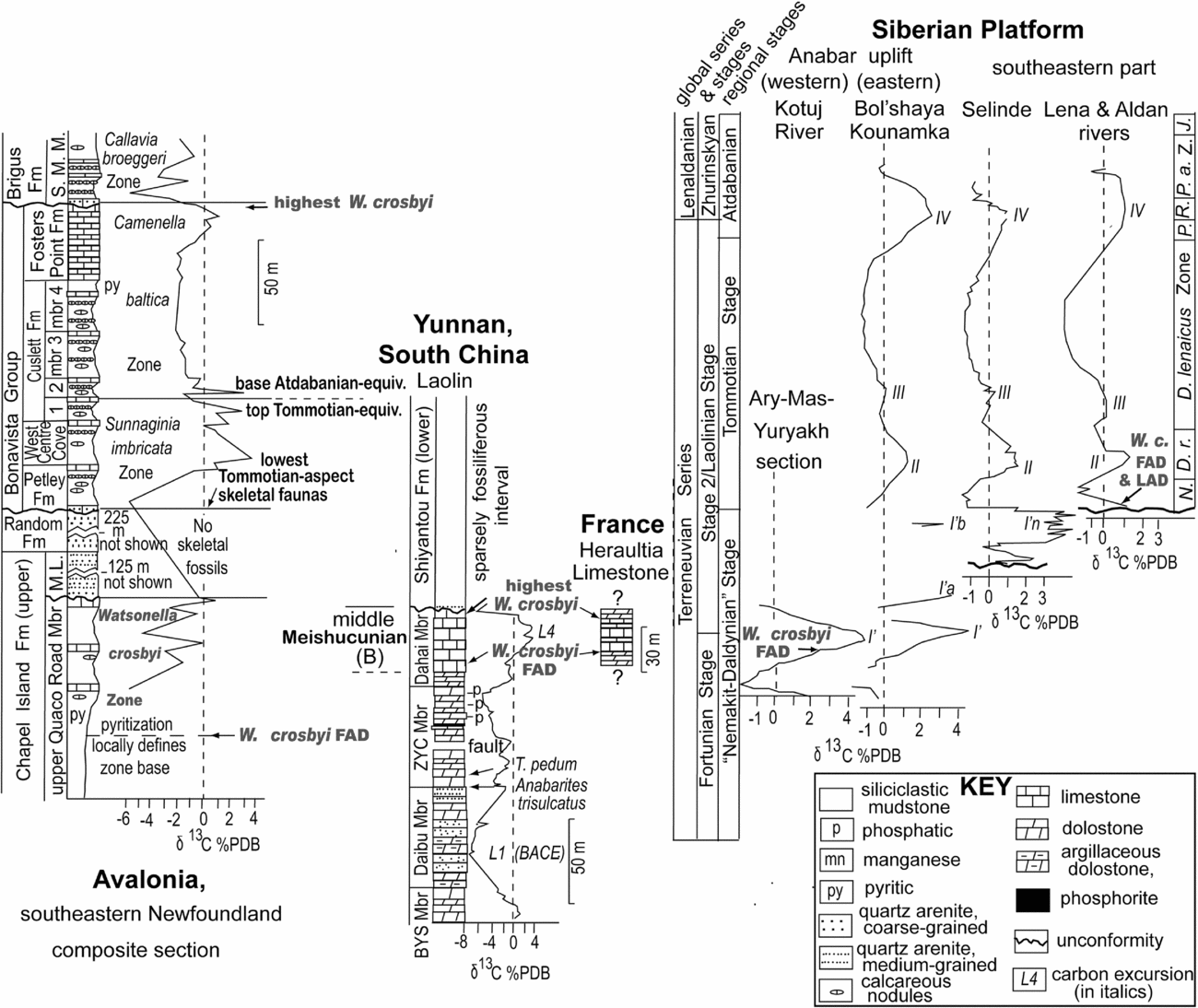
Lower Cambrian correlation. Avalonian carbon isotope stratigraphy (Brasier, Anderson & Corfield, Reference Brasier, Anderson and Corfield1992) and bio- and lithostratigraphy (Landing et al. Reference Landing, Geyer, Brasier and Bowring2013); Fosters Point Formation thickness increased four-fold for figure; carbon isotope stratigraphy of Lena–Aldan river region (Kirschvink et al. Reference Kirschvink, Magaritz, Ripperdan, Zhuravlev and Rozanov1991; Brasier et al. Reference Brasier, Corfield, Derry, Rozavov and Zhuravlev1994a , b), Bol'shaya Kuonamka (Kouchinsky et al. Reference Kouchinsky, Bengtson, Misssarzhevsky, Pelechaty, Torssander and Val'kov2001) and Selinde (Kouchinsky et al. Reference Kouchinsky, Bengtson, Pavlov, Pavlov, Runnegar, Val'kov and Young2005); coeval Siberian and Avalonian stratigraphic units and isotope excursions aligned; South China Platform succession (Li et al. Reference Li, Ling, Jiang, Pan, Chen, Cai and Feng2009). Fm – Formation; Mbr – Member; M.L. – Mystery Lake Member; T. – Trichophycus; W. – Watsonella. Siberian zones: N. – Nochoroicyathus sunnaginicus; D. r. – Dokidocyathus regularis; D. lenaicus – Dokidocyathus lenaicus; P. – Profallotaspis jakutensis; R. – Repinaella; D. a. – Delgadella anabara; J. – Judomia. Modified from Landing et al. (Reference Landing, Geyer, Brasier and Bowring2013, fig. 5); addition of Heraultia and Ary-Mas-Yuryuakh sections and deletion of several Siberian and Chinese sections. Laolinian Stage, Lenaldanian Series and Zhurinskyan Stage proposals (Landing et al. Reference Landing, Geyer, Brasier and Bowring2013), submitted to Cambrian Subcommission in 2013, follow Remane et al. (Reference Remane, Bassett, Cowie, Gohrbandt Land, Michelsen and Naiwen1996) guidelines.

This report focuses on CER stage 2 with the radiation and likely intertidal origin of many biomineralized metazoans, such as molluscs, hyoliths and tommotiids (Landing & Westrop, Reference Landing, Westrop, Lipps and Wagoner2004). CER stage 3 featured the offshore diversification of mineralized trilobites and was a ‘non-event’ in peritidal communities, where trilobite remains are sparse and the mollusc-hyolith-linguloid assemblages from CER stage 2 persisted (Landing et al. Reference Landing, Myrow, Benus and Narbonne1989, Reference Landing, Geyer, Brasier and Bowring2013; Landing & Westrop, Reference Landing, Westrop, Lipps and Wagoner2004).
The Terreneuvian includes the Fortunian Stage and a later Stage 2 (the Laolinian Stage of Landing et al. Reference Landing, Geyer, Brasier and Bowring2013; Fig. 1). The Siberian Tommotian Stage with diverse SSFs (small shelly fossils) is latest Terreneuvian in age (Ogg, Ogg & Gradstein, Reference Ogg, Ogg and Gradstein2008) but, as concluded here, the earliest appearances of key ‘Tommotian-aspect’ SSF taxa are older (by c. 5 Ma) and referable to the latest Fortunian ‒ early Age 2.
2. Early correlations of Terreneuvian micromollusc-rich assemblages
CER stage 2 featured the FAD (first (actually ‘lowest’) appearance datum) of the micromolluscs Watsonella crosbyi (e.g. discussed in Landing et al. Reference Landing, Myrow, Benus and Narbonne1989, Reference Landing, Geyer, Brasier and Bowring2013; often reported as Heraultipegma sibirica in Siberia and H. varensalensis in South China) and Aldanella attleborensis (i.e. A. yangjiaheensis in South China). The FADs of these two forms have been regarded as Tommotian and global correlation aids (e.g. Steiner et al. Reference Steiner, Li, Qian, Zhu and Erdtmann2007; Li et al. Reference Li, Zhao, Gubanov, Zhu and Na2011; Demidenko & Parkhaev, Reference Demidenko, Parkhaev, Zhan and Huang2014). The W. crosbyi and A. attleborensis FADs have been used to correlate the Tommotian and middle Meishucunian Stage of South China (e.g. Brasier, Reference Brasier, Cowie and Brasier1989; Khomentovsky & Karlova, Reference Khomentovsky and Karlova1993; Steiner et al. Reference Steiner, Li, Qian, Zhu and Erdtmann2007, Reference Steiner, Li and Ergaliev2011; Devaere et al. Reference Devaere, Clausen, Steiner, Álvaro and Vachard2013; taxonomy of both forms in Landing, Reference Landing1988; Landing et al. Reference Landing, Myrow, Benus and Narbonne1989, Reference Landing, Geyer, Brasier and Bowring2013; Parkhaev & Karlova, Reference Parkhaev and Karlova2011; Parkhaev, Karlova & Rozanov, Reference Parkhaev, Karlova and Rozanov2011).
This correlation seemed justifiable as the very lowest Cambrian has low diversity biotas with the triradiate tubes of Anabarites trisulcatus and pseudoconodont elements of Protohertzina anabarica in the lower ‘Nemakit-Daldynian’ Stage and lower Meishucunian. Overlying strata have early molluscs as Purella, other monoplacophoran-like forms, and coelosclerotophorans in the upper ‘Nemakit-Daldynian’ and lower middle Meishucunian (Fig. 1). ‘Nemakit-Daldynian’ and ‘Manykayan’ are essentially synonymous, Siberian lowest Cambrian stage names (e.g. Missarzhevsky, Reference Missarzhevsky1989; Brasier et al. Reference Brasier, Cowie and Taylor1994 b; Zhuravlev & Riding, Reference Zhuravlev and Riding2001, tab. 1.1). Most Russian reports regard ‘Nemakit-Daldynian’ as terminal Proterozoic (e.g. Rozanov, Khomentovsky & Shabanov, Reference Rozanov, Khomentovsky and Shabanov2008). ‘Nemakit-Daldynian’ and ‘Manykayan’ are imprecisely defined units without type sections or formally defined bases. ‘Nemakit-Daldyn’ and ‘Manykay’, first used for lithostratigraphic units, cannot designate chronostratigraphic units (e.g. Salvador, Reference Salvador1994). Without an appropriate stage-level name, a so-called ‘Nemakit-Daldynian’ Stage is used herein for the Siberian lowest Cambrian (Fig. 1).
Emphasis on Watsonella crosbyi and Aldanella attleborensis in correlation led to proposal of an A. attleborensis FAD as a guide for global Tommotian correlation or a Cambrian Stage 2 base (Rozanov, Khomentovsky & Shabanov, Reference Rozanov, Khomentovsky and Shabanov2008; Parkhaev, Karlova & Rozanov, Reference Parkhaev, Karlova and Rozanov2011; Devaere et al. Reference Devaere, Clausen, Steiner, Álvaro and Vachard2013; Demidenko & Parkhaev, Reference Demidenko, Parkhaev, Zhan and Huang2014). A W. crosbyi FAD was also argued as a potential (e.g. Li et al. Reference Li, Zhao, Gubanov, Zhu and Na2011; Steiner et al. Reference Steiner, Li and Ergaliev2011) or ‘preferred’ Stage 2 base (Peng & Babcock, Reference Peng and Babcock2011).
3. Tommotian concepts
The Tommotian Stage stratotype base is the base of the Nochoroicyathus sunnaginicus Zone (archaeocyathans) at ‘Dvortsy’ on the Aldan River, SE Siberia (Rozanov & Missarzhevsky, Reference Rozanov and Missarzhevsky1966; Fig. 1). Another ‘Tommotian concept’ regarded all diverse lowest Cambrian SSF assemblages with or without archaeocyathans, and which are possibly older than the Tommotian stratotype, as Tommotian (e.g. Rozanov et al. Reference Rozanov, Missarzhevsky, Volkova, Voronova, Krylov, Keller, Korolyuk, Lendzion, Michniak, Pykhova and Sidorov1969). The ‘Tommotian Stage’ was equated to an ‘evolutionary event’ (Rozanov & Zhuravlev, Reference Rozanov, Zhuravlev, Lipps and Signor1992).
The ‘Nemakit-Daldynian’–Tommotian contact in SE Siberia is a change from lower sparsely fossiliferous Yudoma Formation dolostone with karstic or extensional fissures and channels. Glauconitic remanié sedimentary deposits with the lowest Tommotian fossils fill these depressions and are overlain by reddish and green, siliciclastic and calcareous mudstones (e.g. Khomentovsky, Val'kov & Karlova, Reference Khomentovsky, Val'kov, Karlova, Khomentovsky and Gibsher1990; Fig. 1). A sub-Tommotian hiatus in SE Siberia (Landing in Narbonne et al. Reference Narbonne, Myrow, Landing and Anderson1987; Moczydłowska & Vidal, Reference Moczydłowska and Vidal1988) has been considered to be short (Khomentovsky & Karlova, Reference Khomentovsky and Karlova1993), but the abrupt appearance of over 174 named taxa, as well as high-level groups such as archaeocyathans and brachiopods, without a record of their earlier diversification suggests a long hiatus (Landing, Reference Landing1994).
4. The Tommotian and carbon isotope stratigraphy
Development of a Siberian terminal Precambrian ‒ lower Cambrian carbon isotope stratigraphy (Magaritz, Holser & Kirschvink, Reference Magaritz, Holser and Kirschvink1986; Magaritz et al. Reference Magaritz, Latham, Kirschvink, Zhuravlev and Rozanov1991; Kirschvink et al. Reference Kirschvink, Magaritz, Ripperdan, Zhuravlev and Rozanov1991; Brasier et al. Reference Brasier, Corfield, Derry, Rozavov and Zhuravlev1994a , b) allowed evaluation of the duration of the pre-Tommotian hiatus in SE Siberia, and its relationship to an ‘evolutionary event.’ An important extension of this work was Knoll et al.’s (Reference Knoll, Grotzinger, Kaufnan and Kolosov1995 b) synthesis of lowest Cambrian biostratigraphy and carbon isotope stratigraphy on the NW Anabar Uplift.
Knoll et al. (Reference Knoll, Kaufman, Semikhatov, Grotzinger and Adams1995b ) recognized a sub-Tommotian interval in the Medvezhya Formation at the Kotuikan (Kotujkan, herein) River section (Fig. 1) that had earlier been considered sub-Tommotian biostratigraphically by A.K. Val'kov and V.V. Missarzhevsky (e.g. Khomentovsky & Karlova, Reference Khomentovsky and Karlova2002). This interval has a strong δ13C positive excursion (I’) distinct from the negative excursion of the lowest Tommotian. Positive excursions in the underlying Manykay Formation were compared to the I and Z excursions in the sub-Tommotian Yudoma Formation in SE Siberia (Knoll et al. Reference Knoll, Kaufman, Semikhatov, Grotzinger and Adams1995b ; Fig. 1). The diverse, ‘Tommotian’ SSFs in the Medvezhya Formation at Kotujkan River of Rozanov et al. (Reference Rozanov, Missarzhevsky, Volkova, Voronova, Krylov, Keller, Korolyuk, Lendzion, Michniak, Pykhova and Sidorov1969, exposures M 418‒419, units 13‒16) were therefore shown to be pre-Tommotian (Knoll et al. Reference Knoll, Kaufman, Semikhatov, Grotzinger and Adams1995b ; also Parkhaev & Karlova, Reference Parkhaev and Karlova2011; Fig. 1), and must be referred to the upper ‘Nemakit-Daldynian’. Knoll et al. (Reference Knoll, Kaufman, Semikhatov, Grotzinger and Adams1995b , fig. 2) concluded this ‘previously unknown’ interval showed an earlier, more staggered appearance of ‘Tommotian’ SSFs, and that the local FADs of supposed Tommotian ‘index’ SSFs did not offer unambiguous Tommotian correlations.
Ary-Mas-Yuryakh section (70°08.5ʹN, 114°00ʹE, left bank of Kotuj River upstream from mouth of Ary-Mas-Yuryakh Creek), northern Siberia. Upper Manykay Formation (Koril Member, thrombolithic boundstones) overlain at sequence boundary by Medvezhya Formation limestone. Lower horizon with Aldanella crassa (90 conchs), middle with A. attleborensis (80 conchs), and upper with Watsonella crosbyi (7 specimens) and A. attleborensis (10 conchs).

Knoll et al.’s (Reference Knoll, Grotzinger, Kaufnan and Kolosov1995 b) report did not seem to alter Cambrian biostratigraphic practices. Aldanella attleborensis, with a sub-Tommotian FAD at Kotujkan River (Knoll et al. Reference Knoll, Kaufman, Semikhatov, Grotzinger and Adams1995b ), was later proposed as a guide to the Tommotian base, to Tommotian equivalents globally and a Stage 2 base (Rozanov, Khomentovsky & Shabanov, Reference Rozanov, Khomentovsky and Shabanov2008; Parkhaev & Karlova, Reference Parkhaev and Karlova2011; Parkhaev et al. Reference Parkhaev, Karlova and Rozanov2011; Rozanov et al. 2011; Demidenko & Parkhaev, Reference Demidenko, Parkhaev, Zhan and Huang2014). The A. attleborensis FAD lies below the I’ carbon excursion peak and just above the sequence boundary under the Medvezhya Formation on Kotujkan River (Knoll et al. Reference Knoll, Kaufman, Semikhatov, Grotzinger and Adams1995b ). These data mean that the known lowest Siberian range of the species is likely truncated, sub-Tommotian and inappropriate for defining a Stage 2 base.
Knoll et al. (Reference Knoll, Kaufman, Semikhatov, Grotzinger and Adams1995b ) noted that the presence of archaeocyathans indicates a Tommotian or younger age. Landing et al. (1987, Reference Landing, Geyer, Brasier and Bowring2013) complemented this by concluding that (a)rchaeocyathans, lingulate (b)rachiopods and (h)yolithid hyoliths (‘abh taxa’) do not occur below the Tommotian or globally below Tommotian-equivalent successions. Bimembrate tommotiids (e.g. Camenella kozlowskii) appear just above the I’ excursion peak (Knoll et al. Reference Knoll, Kaufman, Semikhatov, Grotzinger and Adams1995b ) and their lowest occurrence may be a correlation aid to the upper ‘Nemakit-Daldynian’, although the Russian literature generally assigns their oldest occurrences to the Tommotian (e.g. Missarzhevsky, Reference Missarzhevsky1989; Khomentovsky & Karlova, Reference Khomentovsky and Karlova1993). Archaeocyathans show habitat limitations in the Tommotian to tropical shelves, but genera and species of bimembrate tommotiids, lingulates, hyoliths and micromolluscs allow intercontinental correlation with their tropical Siberia cool-water Avalonia range and are not limited to archaeocyathan-bearing facies (e.g. Landing, Reference Landing1988; Landing et al. Reference Landing, Myrow, Benus and Narbonne1989; Landing & Westrop, Reference Landing, Westrop, Lipps and Wagoner2004).
5. Revised correlation of Terreneuvian micromollusc-rich assemblages
An alternative interpretation emphasizes a pre-Tommotian appearance of early assemblages with Watsonella crosbyi with or without Aldanella attleborensis (e.g. Landing, Reference Landing1988; Landing et al. Reference Landing, Myrow, Benus and Narbonne1989, Reference Landing, Geyer, Brasier and Bowring2013). Indeed, correlations of lower Tommotian and middle Meishucunian faunas with the two species are problematical as this means that very dissimilar assemblages are regarded as coeval. Middle Meishucunian faunas with W. crosbyi and A. attleborensis lack any ‘abh taxa’ species, although ‘abh taxa’ appear in similar carbonate platform facies in the higher lower Cambrian strata of South China (e.g. Zhang, Reference Zhang, Zhang, Chen and Palmer2003). Another problem with many correlations based on W. crosbyi and A. attleborensis FADs is that these taxa have diachronous ranges that are often bracketed by stratigraphic breaks of unknown duration (e.g. SE Siberia) or are lithofacies-associated, with the two species appearing with marine shoaling in Avalonia (Landing et al. Reference Landing, Myrow, Benus and Narbonne1989, Reference Landing, Geyer, Brasier and Bowring2013; Landing, Reference Landing2004).
In South China, diverse micromolluscs with Watsonella crosbyi and rare Aldanella specimens appear above local unconformities in the middle Meishucunian strata and with a change from a phosphatic or dolomitic into an overlying more calcareous unit (e.g. Zhongyicun and Dahai members; e.g. Landing, Reference Landing1994; Yang et al. Reference Yang, Steiner, Li and Keupp2014; Fig. 1). This middle Meishucunian fauna disappears upwards at an unconformity or a change to poorly fossiliferous sedimentary deposits (e.g. Steiner et al. Reference Steiner, Li, Qian, Zhu and Erdtmann2007; Yang et al. Reference Yang, Steiner, Li and Keupp2014; Fig. 1), which means the upper W. crosbyi and Aldanella ranges are truncated and do not show the long Avalonian biostratigraphic ranges where both taxa extend into Atdabanian-equivalent rock (Landing et al. Reference Landing, Myrow, Benus and Narbonne1989, Reference Landing, Geyer, Brasier and Bowring2013; Fig. 1).
Other successions with Watsonella crosby have been correlated with the Tommotian. Esakova & Zhegallo (Reference Esakova and Zhegallo1996) reported five Tommotian faunal zones, with a W. crosbyi Zone at their top, from the Bayan Gol Formation of Mongolia. However, most of Esakova & Zhegallo's (Reference Brasier, Shields, Kuleshov and Zhegallo1996, fig. 3 range chart) ‘Tommotian’ taxa from the upper Bayan Gol Formation (their W. crosbyi Zone; 31 named species with 14 described only from the Bayan Gol) have ranges limited to the lower–middle Meishucunian and upper ‘Manykayan-Nemakit-Daldynian’ strata, and no ‘abh’ taxa occur. The exception was W. crosbyi, reported as W. sibirica from one section, with a supposed Tommotian FAD as then known. Demidenko & Parkhaev (Reference Demidenko, Parkhaev, Zhan and Huang2014) referred the upper Bayan Gol Formation to the Tommotian based on the occurrence of W. crosbyi with the monoplacophoran Bemella jakutica, although Knoll et al. (Reference Knoll, Kaufman, Semikhatov, Grotzinger and Adams1995b ) reported B. jakutica below the I’ excursion. Lapworthella tortuosa was cited as a Tommotian index for the upper Bayan Gol. However, Esakova & Zhegallo's (Reference Esakova and Zhegallo1996) specimens lack the granulose transverse growth ridges of L. tortuosa, while elongate, non-granulose sclerites (i.e. L. ludvigseni) that resemble L. tortuosa’s have sub-Tommotian FADs in Avalonia and possibly in the middle Meishucunian. (Landing (Reference Landing1984, p. 1394; Maloof et al. Reference Maloof, Porter, More, Dudás, Bowring, Higgins, Fike and Eddy2010, fig. A3) noted Jaing's (Reference Jaing, Luo, Jiang and Wu1982, pl. 18) illustrations of L. tortuosa-like specimens from Dahai Member localities, while Qian & Bengtson (Reference Qian and Bengtson1989, p. 145) and Li et al. (Reference Li, Steiner, Zhu, Yang, Wang and Erdtmann2007) questioned these middle Meishucunian reports.)
The Watsonella crosbyi-bearing faunas of the Heraultia Limestone in France were regarded as Tommotian (Devaere et al. Reference Devaere, Clausen, Steiner, Álvaro and Vachard2013; Fig. 1). The Heraultia Limestone shows lithofacies control of its 25 known taxa, with W. crosbyi present in limestone, not dolostone. Heraultia faunas include taxa mostly limited to the lower‒middle Meishucunian strata (Devaere et al. Reference Devaere, Clausen, Steiner, Álvaro and Vachard2013), and no ‘abh taxa’ are present. The presence of W. crosbyi provided the basis for a Tommotian-equivalency, and a sub-Tommotian recovery of W. crosbyi (this report) would remove any certainty for a Tommotian correlation of the Heraultia and Bayan Gol faunas.
6. Ary-Mas-Yuryakh
Rozanov et al. (Reference Rozanov, Missarzhevsky, Volkova, Voronova, Krylov, Keller, Korolyuk, Lendzion, Michniak, Pykhova and Sidorov1969, section M 410) described the lithology and biota of the Ary-Mas-Yuryakh section (Fig. 2), which is located 14 km SSW of Knoll et al.’s (Reference Knoll, Grotzinger, Kaufnan and Kolosov1995 b) Kotujkan River section, northern Siberia. Kotujkan River and Ary-Mas-Yuryakh have similar, supposedly ‘Tommotian’ SSFs in the lower Medvezhya Formation, and lack ‘abh taxa’ (faunas in Rozanov et al. Reference Rozanov, Missarzhevsky, Volkova, Voronova, Krylov, Keller, Korolyuk, Lendzion, Michniak, Pykhova and Sidorov1969; Knoll et al. Reference Knoll, Kaufman, Semikhatov, Grotzinger and Adams1995b , fig. 2). The sections are almost identical, with the Medvezhya's base a sequence boundary on Kotujkan River (Knoll et al. Reference Knoll, Kaufman, Semikhatov, Grotzinger and Adams1995b , fig. 1) and Ary-Mas-Yuryakh (Landing, Reference Landing1994). Our new data show the strong I’ excursion at both Kotujkan River and Ary-Mas-Yuryuakh (Knoll et al. Reference Knoll, Kaufman, Semikhatov, Grotzinger and Adams1995b ; this report) and sub-Tommotian Watsonella crosbyi and Aldanella attleborensis FADs at Ary-Mas-Yuryakh (Figs 1, 2).
7. Conclusions
The I’ excusion in the ‘Nemakit-Daldynian’ above the Watsonella crosbyi and Aldanella attleborensis FADs (Knoll et al. Reference Knoll, Kaufman, Semikhatov, Grotzinger and Adams1995b ; this report) is critical in lowest Cambrian correlation. Carbon isotope stratigraphy has long supported correlation of the upper ‘Nemakit-Daldynian’ I’ excursion and middle Meishucunian L4 excursion (also P3 excursion, although the Zhujiang carbon isotope excursion (ZHUCE) may include several excursions) (Knoll et al. Reference Knoll, Kaufman, Semikhatov, Grotzinger and Adams1995b ; Kaufman et al. Reference Kaufman, Knoll, Semikhatov, Grotzinger, Jacobsen and Adams1996; Zhu, Li & Zhang, Reference Zhu, Li and Zhang2001; Li et al. Reference Li, Ling, Jiang, Pan, Chen, Cai and Feng2009). Samples through the W. crosbyi Zone in SE Newfoundland show increasingly positive δ13C values (Brasier, Anderson & Corfield, Reference Brasier, Anderson and Corfield1992) that suggest the I’ excursion (Landing et al. Reference Landing, Geyer, Brasier and Bowring2013; Fig. 1). Finally, the Bayan Gol Formation and Heraultia Limestone faunas with W. crosbyi are best regarded as pre-Tommotian. The Bayan Gol's δ13C succession suggests correlation of its F excursion or, pending further study, its D and E excursions, with L4 and I’ (Brasier, Dorjnamjaa & Lindsay, Reference Brasier, Dorjnamjaa and Lindsay1996; Brasier et al. Reference Brasier, Dorjnamjaa and Lindsay1996; Landing et al. Reference Landing, Geyer, Brasier and Bowring2013).
The earliest SSF assemblages with Watsonella crosbyi with or without Aldanella attleborensis are demonstrably pre-Tommotian as earlier proposed (Landing, Reference Landing1988, Reference Landing1992, Reference Landing1994, Reference Landing, Nance and Thompson1996; Landing et al. Reference Landing, Myrow, Benus and Narbonne1989, Reference Landing, Geyer, Brasier and Bowring2013) and occur worldwide (eastern Newfoundland, southern New Brunswick, South China, NW Siberia, Mongolia and France.) Assemblages with diverse micromolluscs, orthothecid hyoliths, W. crosbyi and Aldanella spp. appear to bracket a time of relative evolutionary stasis for many metazoans. Landing & Westrop (Reference Landing, Westrop, Lipps and Wagoner2004; also Landing et al. Reference Landing, Myrow, Benus and Narbonne1989) showed that once benthic genera and species appeared, they persisted through much of the Avalonian lower Cambrian strata (i.e. W. crosbyi‒top Camenella baltica zones; Fig. 1). Geochronologic data suggest these early occurrences of W. crosbyi and A. attleborensis at c. 530 Ma (Landing et al. Reference Landing, Geyer, Brasier and Bowring2013), and their persistence into Atdabanian-equivalent strata younger than c. 520 Ma in Avalonia (e.g. Landing et al. Reference Landing, Bowring, Davidek, Westrop, Geyer and Heldmaier1998). A duration of SSF elements of c. 10 Ma of these assemblages emphasizes the suggestion of Knoll et al. (Reference Knoll, Kaufman, Semikhatov, Grotzinger and Adams1995b , p. 1142) that SSFs are not ‘robust markers’ for recognition and correlation of the Tommotian.
A 530–529 Ma volcanic ash date on the upper Kessyusa Formation in northern Siberia was assigned to the lower Tommotian Nochoroicyathus sunnaginicus Zone (Kaufman et al. Reference Kaufman, Peek, Martin, Cui, Grazhdankin, Rogov, Xiao, Buchwaldt and Bowring2012). Earlier, Missarzhevsky (Reference Missarzhevsky1989) referred the upper Kessyusa Formation to the N. sunniginicus Zone. However, archaeocyathans and Tommotian ‘abh taxa’ do not appear in the upper Kessyusa, and its fauna (Missarzhevsky, Reference Missarzhevsky1989; Knoll et al. Reference Knoll, Grotzinger, Kaufnan and Kolosov1995a , table 2; Rogov et al. Reference Rogov, Karlova, Marusin, Kochnev, Nagovitsin and Grazhdankin2015, fig. 2j) includes Watsonella crosbyi and other taxa that are not necessarily Tommotian as they appear below the I’ carbon excursion peak at Kotujkan River and Ary-Mas-Yuryakh. Only Camenella kozlowskii (discussed above) from the upper Kessuysa (Missarzhevsky, Reference Missarzhevsky1989) suggests correlation as high as the upper I’ excursion.
The strong positive δ13C values of the upper Kessyusa Formation (Knoll et al. Reference Knoll, Grotzinger, Kaufnan and Kolosov1995a ; Kaufman et al. Reference Kaufman, Peek, Martin, Cui, Grazhdankin, Rogov, Xiao, Buchwaldt and Bowring2012; A. Kouchinsky, unpubl. data from Khorbusuonka) do not occur in the lower Tommotian stratotype and argue against a Tommotian correlation. The positive carbon isotope excursions in the upper Kessyusa of Knoll et al. (Reference Knoll, Grotzinger, Kaufnan and Kolosov1995a ) correlate best into the Medvezhya (Figs 1, 2; also Knoll et al. Reference Knoll, Kaufman, Semikhatov, Grotzinger and Adams1995b ; Kaufman et al. Reference Kaufman, Knoll, Semikhatov, Grotzinger, Jacobsen and Adams1996) and lower Emyaksin (Fig. 1; Kouchinsky et al. Reference Kouchinsky, Bengtson, Misssarzhevsky, Pelechaty, Torssander and Val'kov2001) formations of the Anabar uplift, and are older than the lowest Tommotian's negative shift (Kirschvink et al. Reference Kirschvink, Magaritz, Ripperdan, Zhuravlev and Rozanov1991; Knoll et al. Reference Knoll, Kaufman, Semikhatov, Grotzinger and Adams1995b ; Kouchinsky et al. Reference Kouchinsky, Bengtson, Misssarzhevsky, Pelechaty, Torssander and Val'kov2001, Reference Kouchinsky, Bengtson, Pavlov, Runnegar, Torssander, Young and Ziegler2007). A a 530‒529 Ma date on Watsonella crosbyi-bearing assemblages of the upper Kessuya Formation is therefore biostratigraphically and geochemically pre-Tommotian, and older than an estimated Tommotian base of c. 525.5 Ma (Maloof et al. Reference Maloof, Porter, More, Dudás, Bowring, Higgins, Fike and Eddy2010).
The earliest biotas with Watsonella crosbyi may pre-date 530 Ma. Moczydłowska (Reference Moczydłowska1991, p. 35) reported Aldanella attleborensis, A. crassa and Anabarella sp., which occur elsewhere with W. crosbyi, from the Asteridium tornatum-Comasphaeridium velvetum Zone (acritarchs) in Poland (SSF taxonomy in Landing, Reference Landing1988; Parkhaev & Karlova, Reference Parkhaev and Karlova2011). This very early Cambrian occurrence emphasizes that SSF FADs without non-biostratigraphic brackets should not define Cambrian stage bases. Landing et al. (Reference Landing, Geyer, Brasier and Bowring2013) proposed that the globally correlatable L4-I’ carbon isotope excursion, with a lower bracket provided by the W. crosbyi and/or A. attleborensis FADs, best defines a Stage 2 GSSP base. However, the A. attleborensis FAD is only a few metres above the sequence boundary at Kotujkan River and, at a change into more calcareous lower Medvezhya Formation facies (A. Kouchinsky, unpub. data), is in the lowest Cambrian Polish acritarch succession. These biostratigraphically problematical A. attleborensis FADs suggest that a sub-Tommotian-equivalent horizon based on a W. crosbyi FAD below the L4-I’ excursion or, perhaps preferably, on the L4-I’ excursion peak above a W. crosbyiFAD, may provide more robust definitions of a Stage 2/Laolinian Stage basal GSSP horizon.
Acknowledgements
K. Ziegler (University of California, Los Angeles) provided carbon isotope analyses.