Widely acknowledged as Debussy’s most important composition and one of the most significant of all twentieth-century operas, Pelléas et Mélisande still remains something of an enigma. Maeterlinck’s story, which was first published in Brussels by Paul Lacomblez on 4 May 1892, is extremely difficult to classify. Part fairy tale, part Gothic horror story, part psychological drama and part social critique, it simultaneously harkens the past and foreshadows the future. Debussy’s music is no easier to fathom. Through its use of leitmotivs and quotations, the score draws on late-nineteenth century operatic traditions, especially those cultivated by Richard Wagner. But Pelléas et Mélisande seldom sounds very Wagnerian. On the contrary, the score often seems more cinematic than operatic, a point that Debussy addressed towards the end of his life.Footnote 1
The enigmatic aspects of Debussy’s opera are clearly on display in Pelléas et Mélisande cent and après: études et documents, edited by Jean-Christophe Branger, Sylvie Douche and Denis Herlin. The book, which grew out of a conference at the Sorbonne on 6–7 May 2002, is extremely broad in scope and contains 15 essays by some of the world’s leading authorities on Debussy along with an extensive array of supporting materials. It opens with a fascinating conversation between the volume’s editors and Pierre Boulez. Given Boulez’s lifelong passion for Debussy’s music, this interview is entirely justified: in just 14 pages, it touches on numerous issues, ranging from connections to other operas and other works by Debussy to the problems of staging and interpretation. The conversation also gives Boulez an opportunity to discuss some of his personal encounters with the opera, such as studying the work with Messiaen and conducting the opera with the Royal Opera House, Covent Garden and the Welsh National Opera, Cardiff.
The editors arrange the 15 papers into four groups. The first deals with the genesis and première of Pelléas et Mélisande.Footnote 2 Langham Smith sets the ball rolling by discussing Debussy’s unfinished opera Rodrigue et Chimènes (1890–92).Footnote 3 Besides spotting some surface resemblances, he describes some similarities and differences in the ways Debussy treats leitmotivs and keys in both pieces. Denis Herlin then considers Debussy’s first exposure to Maeterlinck’s play. Although he was originally attracted to Maeterlinck’s play La Princesse Maleine (1889), Debussy switched his attention to Pelléas et Mélisande early in 1893 and attended the latter’s première at the Théâtre des Bouffes-Parisiens on 17 May. The event was staged by the Théâtre de l’Œuvres, an avant-garde Symbolist troupe, founded by Camille Mauclair and Aurélien-François Lugné-Poe.Footnote 4 Although Herlin doesn’t explain why Debussy picked Pelléas et Mélisande over La Princesse Maleine, it was probably because the latter was thought to have been plagiarized from Shakespeare.Footnote 5 It was apparently for this reason that La Princesse Maleine was never performed on the Parisian stage.Footnote 6 Vincent Giroud then examines the complete piano/vocal draft of Pelléas et Mélisande, formerly belonging to the New England Conservatory of Music and now part of the Frederick R. Koch Collection at Yale University.Footnote 7 Whereas Giroud describes a single text, David Grayson addresses the hazards of creating a modern critical edition of Pelléas et Mélisande.Footnote 8 His account of the difficulties of doing so for the Œuvres Complètes de Claude Debussy is exemplary and deserves to be read by anyone interested with problems in contemporary text criticism. Finally, Roger Nichols examines the production manuals compiled by Albert Carré for the opera’s première at the Théâtre Nationale de L’Opéra-Comique on 30 April 1902. Placed alongside Grayson’s paper, Nichols’ fascinating essay underscores the striking disjunction between the musicologist’s desire for historically informed performances and the stage director’s desire to avoid them at all costs.
The second set of essays consider the reception of Pelléas et Mélisande, both inside and outside France.Footnote 9 Barbara Kelly’s chapter offers a fine summary of the former, starting with Laloy, the Debussystes, and Le Cas Debussy, and ending with the period after World War I. This essay is particularly a propos given the extensive compilation of Pelléas reviews at the end of the book. Next, Renata Suchowiejko gives an intriguing account of the impact that Pelléas et Mélisande had on Polish composers in the 1920s, especially Szymanowski and his disciples. She ends by describing the performances of Maria Modrakowska, the ‘Polish Mélisande’. Lastly, Sylvie Douche looks at Maurice Emanuel’s famous analysis of Pelléas et Mélisande (1926), connecting it to Debussy’s studies at the Paris Conservatoire, Lavignac, and Guiraud. The latter are especially important because Guiraud was an experienced opera composer – he completed 11 of his own and added traditional orchestral recitatives for Bizet’s Carmen and Offenbach’s Les contes d’Hoffman – and because Debussy discussed with him his own goals as an opera composer. Though rich in detail, Douche’s essay might also have mentioned Guiraud’s influence on Debussy’s orchestration and John Clevenger’s extensive discussion of Debussy’s education.Footnote 10
The third group of essays addresses aesthetic and analytical issues.Footnote 11 Joseph-Marc Bailbé discusses the significance of hair as symbol in Maeterlinck’s Pelléas et Mélisande, and in various works by the latter’s compatriot Georges Rodenbach. Although hair has been a potent symbol since ancient times, Bailbé is right to trace its use by Maeterlinck and Rodenbach to texts such as Poe’s Ligeia (1838), Villiers de L’Isle Adam’s Véra (1883), Huysmans’ À Rebours (1884), and Maupassant’s La Chevelure (1884).Footnote 12 But there is more to the story.Footnote 13 Mention should surely be made to Ophelia, who captivated French authors from the sixteenth (e.g., Belleforest) to the nineteenth centuries (e.g., Gautier, Baudelaire, Mallarmé and Louÿs).Footnote 14 She was equally popular with Millais and other pre-Raphaelites, who also emphasized her connections to water, another prominent symbol in Maeterlinck and Rodenbach.Footnote 15 Next, Jean-Christophe Branger compares Pelléas et Mélisande with Alfred Bruneau’s opera Le rêve (1891). Although Branger shows some interesting connections between the two works, he could have reinforced his observations by considering Étienne Destranges’s monograph Le rêve d’Alfred Bruneau. Étude thèmatique et analytique de la partition avec un portait (Paris: Librairie Fischbacher, 1896). The following analytical essays by Christian Goubault and Annie Labussière are, however, somewhat less satisfying. To be fair, the task of analyzing an entire opera in a couple of short essays is daunting to say the least, especially when there is no generally agreed method for doing so. But, despite this caveat, these essays fall short on several counts. Although Goubault covers a wide range of topics (declamation, leitmotivs, chords, scales, modes, texture, timbre and dynamics), his remarks are too general to have much impact. And when he does look in detail at Acte 4, Scène 4, he fails to cite several important analyses of the very same passage.Footnote 16 Meanwhile, Labussière’s discussion of the work’s melodic profile loses sight of the forest for the trees: her analyses consist of microscopic readings of several short extracts without ever placing them within any broad harmonic context.
The final group of essays, concerning the legacy of Pelléas et Mélisande, is again a mixed bag.Footnote 17 Aude Caillet targets Charles Koechlin. A student of Massenet, Geldage and Fauré, Koechlin fundamentally changed his attitude towards Debussy and his music following the première of Pelléas et Mélisande, becoming one of his most ‘militant’ admirers. He not only helped Debussy orchestrate Khamma in 1911–12, but he also wrote countless pages defending him and his music, including an unpublished study of Pelléas et Mélisande.Footnote 18 Beate A. Föllmi then considers the connections between Debussy and Schoenberg. Although the latter completed his symphonic poem Pelléas et Mélisande in 1903 quite unaware of Debussy’s opera, Schoenberg became sympathetic to his music. In Structural Functions of Harmony, for example, Schoenberg not only analyzed the opening of ‘Nuages’, but he claimed that Debussy’s ‘new and more violent dissonances and modulations could still be catalogued and explained with the theoretical tools of the preceding period’.Footnote 19 Lastly, Anne-Sylvie Barthel-Calvet considers Marius Constant’s symphonic arrangement of Pelléas et Mélisande. This orchestral version, which is by no means the first of its kind, draws extensively on the interludes, and Barthel-Calvet gives a helpful guide to the original location of Constant’s material.Footnote 20 Whatever the merits of the arrangement, it is interesting to note that Debussy was reluctant to make such a score of his own because it isolates the music from the drama. As he explained in a letter to Ysaÿe (13 October 1896): ‘If this work has any merit, it lies above all in the connection between the movement on stage and the movement in the music. … In my opinion Pelléas and Mélisande must appear as they are’.Footnote 21
The second half of the volume contains a variety of reference materials. The four appendices are all extremely helpful, though in different ways and for different tasks.Footnote 22 Appendix 1 presents Maurice Emmanuel’s transcription of Debussy’s conversations with Guiraud (1889–1890). Appendix 2 gives a detailed chronology of the opera, from 17 May 1893, when Debussy attended the première of the play, until 30 April 1902, when the opera was first performed. Appendix 3 lists the work’s 107 performances at the Théâtre Nationale de L’Opéra-Comique between 1902 and 24 June 1914. Appendix 4 identifies more than 50 productions of the opera in Europe and the US from 9 January 1907 to 31 January 1918. The final section compiles 111 reviews and essays about Pelléas et Mélisande published in the French press in 1902–1903. The editors also include a detailed annotated list of the authors of those reviews/essays. The volume ends with an extensive bibliography and a pair of indices.
No book can cover everything, of course, and no book can cover all of its topics equally well. Although this volume presents lots of great information, it nonetheless has some interesting omissions. To begin with, it says little or nothing about the play and its background. The issue is a fascinating one: Langham Smith has already shown how Maeterlinck drew on a wide variety of sources ranging from Dante and Shakespeare to Poe, Wagner, Tennyson, Rossetti, Burne-Jones, Mallarmé and Villiers de L’Isle Adam.Footnote 23 A few new facts have, however, come to light.Footnote 24 Patrick Mahony reported some years ago that Maeterlinck actually adapted the plot from a novella written by the Italian Renaissance author Matteo Bandello (ca. 1480–1561), the most likely one being from ‘A Ladie Falslie Accused’.Footnote 25 Having been translated into French by Boaistuau and Belleforest, the story circulated in English in William Painter’s anthology The Palace of Pleasure (1566/67). This collection is particularly significant because it a well-known source of plots for many Elizabethan playwrights including Shakespeare. Since Maeterlinck was an avid Shakespearian, he probably found Bandello’s story in Joseph Jacobs’ 1890 edition of The Palace of Pleasure, a work that was dedicated to Burne-Jones. Burne-Jones was not only one of Maeterlinck’s favourite painters, but he was also awarded a gold medal at the Exposition Universelle in Paris in 1889 and became a corresponding member of the Académie des Beaux-Arts.
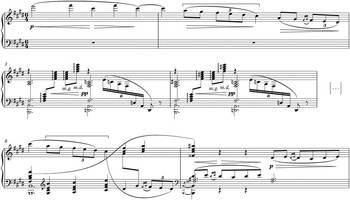
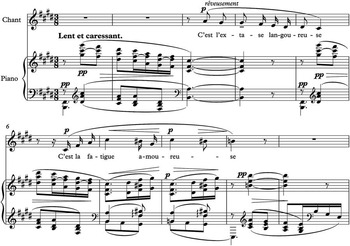
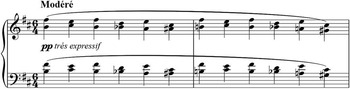
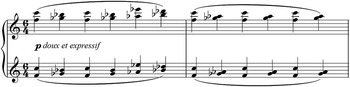
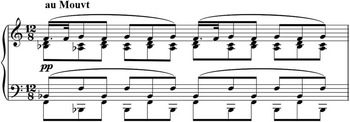
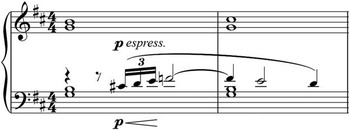
The matter of borrowing raises another issue largely ignored by this volume: the genesis of Debussy’s score. Except for Langham Smith, who finds connections between Pelléas et Mélisande and Rodrigue et Chimène, the essays say very little about how Debussy set about writing his opera. One reason why this topic is so interesting is that Debussy was an inveterate recycler. It is well known, for example, that he liked to rework material from other composers, such as Wagner and Mussorgsky.Footnote 26 But Debussy also liked to rework material from his own compositions. Take, for example, the opening of Acte 2, Scène 1, when Mélisande meets Pelléas and drops her wedding ring down Blindman’s Well. The scene confirms Langham Smith’s observation that Debussy often associated the dominant-ninth chords, especially in E major, to convey Golaud’s desire for the young Mélisande, the growing love between Pelléas and Mélisande, and the ‘particular understanding’ between Arkel and Mélisande.Footnote 27 Example 1 suggests that this material recalls Debussy’s early song ‘C’est l’extase’ (Ariettes Oubliées, c. 1887, text by Paul Verlaine).
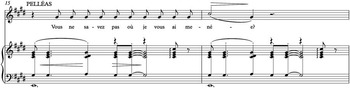
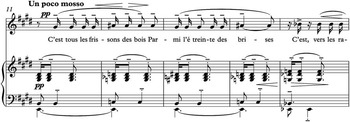
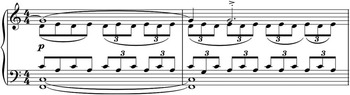
As Examples 1a and 1b illustrate, the prominent dominant ninths chord B–D♯–F♯–A–C♯ in bars 3, 4, 8 and 9 of the opera recall the opening sonority of ‘C’est l’extase’, while the descending gesture A–G♯–F♯–E–D♯–C♯ in bar 2 and bar 8 sounds a lot like the vocal gesture in bars 3–5 of the mélodie. And as Examples 1c and 1d show, the syncopated rhythms in bars 15–16 of the opera resemble those heard starting in bar 11 of ‘C’est l’extase’.
Claude Debussy, Pelléas et Mélisande, Acte 2, Scène 1, Une fontaine dans le parc, bars 1–4, 8–9

Debussy, Ariettes oubliées, ‘C’est l’extase’, bars 1–10

Debussy, Pelléas et Mélisande, Acte 2, Scène 1, Une fontaine dans le parc, bars 15–16

Debussy, Ariettes oubliées, ‘C’est l’extase’, bars 11–15

Sometimes, however, Debussy recycled material from Pelléas et Mélisande in his later compositions. In the opening section of the book, Pierre Boulez mentions that the Nocturnes ‘are very close to the style of Pelléas’, as are ‘some passages from La Mer’.Footnote 28
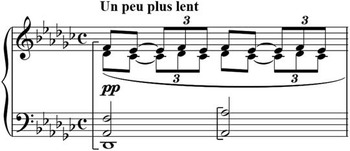
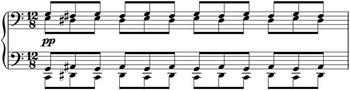
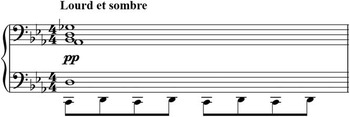
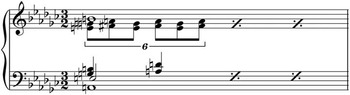
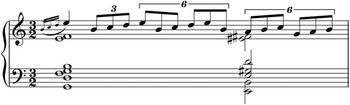
To cite some examples, the neighbour motive from ‘Sirènes’ and the opening of ‘Nuages’ allude to material from the grotto scene (Exx. 2a–d).Footnote 29
Debussy, Nocturnes, Sirènes, bar 56 (reduction)

Debussy, Pelléas et Mélisande, Acte 2, Scène 3, Devant un grotte, bar 410

Debussy, Nocturnes, Nuages, bars 1–2

Debussy, Pelléas et Mélisande, Acte 2, Scène 3, Devant une grotte, barS 453–454

The neighbour motive from ‘Sirènes’ also reappears in the other premonition scenes: it permeates the shipwreck scene (Ex. 2e), it is absorbed in the main motive of the vault scene (Ex. 2f), and again in Yniold’s scene with the sheep (Ex. 2g).
Debussy, Pelléas et Mélisande, Acte 1, Scène 3 Devant le château, bar 443

Debussy, Pelléas et Mélisande, Acte 3, Scène 2, Les souterrains du château, bar 292

Debussy, Pelléas et Mélisande, Acte 4, Scène 3, Une fontaine dans le parc, bar 435

Debussy’s sketches for Acte 3, Scène 3 even contain the neighbour motive from ‘Sirènes’ (see Ex. 2h), as well as a gesture that closely resembles the cor anglais motive and supporting harmonies from ‘Nuages’ (see ExX. 2i–j).Footnote 30
Debussy, sketches for Pelléas et Mélisande, Acte 3, Scène 3, Les souterrains du château, bar 11

Debussy, sketches for Pelléas et Mélisande, Acte 3, Scène 3, Les souterrains du château, bar 14

Debussy, Nocturnes, Nuages, bars 5–6

Taken together, such examples of intertexuality not only offer important insights about Debussy’s approach to musical composition, but they have interesting programmatic implications as well.
Finally, the volume presents a very narrow picture of how Pelléas et Mélisande has influenced later generations of composers. While it is useful to discuss Debussy’s influence on Szymanowski, Koechlin and Schoenberg, it is by no means clear that these three composers give an adequate picture of the extraordinary impact Debussy’s opera has had on later composers. That picture might also include other operatic and stage works such as Dukas’ Ariane et Barbe-bleue (1906), Bartok’s Bluebeard’s Castle (1911), Stravinsky’s Le Rossignol (1908–14) and even Bernstein’s West Side Story (1957), whose ending recalls Mélisande’s death in the final pages of Acte 5. More recently, Witold Lutosławski developed the opening motive of Debussy’s opera in his Grave for cello and piano (1981, 1982), a work that he dedicated to the distinguished Debussy aficionado Stefan Jarocinski. Pelléas et Mélisande has even inspired people working in the popular domain: in 1981 Gualtiero Bartalini created an amusing version of the story in rhyme, and in 1983 P. Craig Russell produced a wonderful comic book adaptation of the drama.Footnote 31 Allusions to Pelléas et Mélisande can even be found in the sound tracks to Hollywood movies, such as Portrait of Jennie (1948).Footnote 32
All in all, this volume is certainly an important addition to the bookshelf. Its strengths are clear. The essays provide the reader with a wide variety of different perspectives from which to view Pelléas et Mélisande: there’s something here for everyone. Meanwhile, the documentary materials are invaluable to anyone interested in the reception history of the opera. The text is, furthermore, beautifully edited and nicely produced. But the book does have quirks that some readers will find perplexing. These idiosyncrasies suggest that there is a good deal more to say about the aesthetic background, genesis, musical structure, and historical impact of Debussy’s Pelléas et Mélisande. If the volume prompts us to delve more deeply into these topics, then it has done its job admirably. With luck, this enigmatic opera will continue to challenge us for the next hundred years and more.