Introduction
One central question regarding the history of Anatolia from the Turkish conquest in 473/1071 to the aftermath of the Ilkhanid collapse in the fourteenth century concerns the degree of integration of these new Islamicate territories into the Iranian cultural sphere. As is well-known, Saljuq rulers and their epigones made Persian the language of administration, and in Konya, the capital of the Rum Saljuqs (r. 473–707/1081–1307), Persian was the lingua franca.Footnote 1 But what about the practices and norms? To what extent did they mirror those seen in Iran? The study of chancery documents may offer a reliable basis for such an investigation. Indeed, these documents are standardized or, to quote Wansbrough, they “encode predictable processes”.Footnote 2 For this reason, subtle differences in structure and formulation are meaningful and can reveal much about the state itself that produced these texts. More than a decade ago, through the contrastive analysis of two deeds of appointment of an official (called shiḥna) over Türkmen – one issued by the chancery of the Great Saljuqs and the other by the chancery of the Eldigüzid atabegs – I was able to show a rather different appreciation of the nomads.Footnote 3 In this article, we will investigate another type of state document in a comparative perspective: the sawgand-nāma.
Sawgand-nāma literally means “oath-letter”. They served to pacify relationships between rulers, or to strengthen loyalty between a subordinate and a ruler. Oath-based political relations between rulers and subjects are found throughout medieval Western Eurasia.Footnote 4 It was a special type of covenant (ʿahd).Footnote 5 Thus, in his chronicle of the early Ghaznavids, Bayhaqī (d. 470/1077) describes how a vassal ruler incited the prince Masʿūd (d. 432/1040), not yet the sultan, to write him “an ʿahd and a sawgand such as is the practice among kings (chinānki rasm-ast ki miyān mulūk bāshad)”. Bayhaqī, an eyewitness, reports that Masʿūd himself wrote “the text of the treaty (nuskhat-i ʿahd) and the document containing the oath (sawgand-nāma)”, a text which began: “By the Almighty God and that oath (sawgand) which is customary in a formal treaty document (ʿahd-nāma): until the time when the Amir Manūchihr will be with us…”. Bayhaqī commented: “The requirements and conventions of such documents were set down fully right to the end (sharāyiṭ-rā tā bi-pāyān bi-tamāmī āwarda) in such a manner that nothing could be more eloquently expressed nor could anything be finer”.Footnote 6
To understand what these “requirements and conventions” were, we must turn to other sources. Indeed, while references to the sawgand-nāmas are ubiquitous in the chronicles, none of their authors has actually copied the text of a sawgand-nāma. This is true of Bayhaqī as well as the chroniclers who lived in medieval Islamic Anatolia. There is no surviving original, but some texts have been kept in inshāʾ literature.Footnote 7 An inshāʾ work essentially comprises a collection of sample letters, official or otherwise. Since the authors of inshāʾ works could have used original documents (even by altering them), the importance of this type of source for historians of the pre-modern Islamic world is well-established, and they have long been used to offset the dearth of archival documents.
So far, the text of only one sawgand-nāma from pre-fourteenth-century Anatolia was known. In the last section of his “Conventions for Letters” (Rusūm al-Rasāʾil), Ḥusām al-Dīn Khūʾī’s (alive in 709/1309–10) inserted a text entitled ʿahd-nāma whose content is very similar to what is called sawgand-nāmas in Iran. Indeed, it contains the four prerequisites of such texts:
• the preamble with Quranic quotation(s);
• the oath declaration (with God as witness);
• the obligations incumbent upon the oath-taker;
• the catalogue of penalties (Ps. tāwān; cf. Latin: sanctio) for perjury.
However, the text given by Ḥusām al-Dīn Khūʾī is devoid of any element of identification, and we cannot be sure whether it was written specifically for the occasion, or if it is based on an actual document.
This is not the case of a newly found sawgand-nāma, copied in an inshāʾ work entitled Qiṣṣa-yi Salāṭīn. The Qiṣṣa-yi Salāṭīn is known through a unicum manuscript: Marʿashī 11136 (fols. 1v–92v) and its anonymous author evidently worked in the Saljuq chancery as he copied letters (mostly private) from the years 1240–1250s. The manuscript itself (most probably an autograph) was copied around 656/1258.Footnote 8 The Qiṣṣa-yi Salāṭīn contains a total of 166 discrete texts (mostly full letters) and ends with a small treatise. It contains a sawgand-nāma written explicitly to ensure a clear line of dynastic succession in favour of an heir apparent named ʿAlāʾ al-Dawla wa-l-Dīn Kay-Qubād. The ruler to whom the oath is addressed is mentioned only as khudāygān-i jahān (“lord of the world”), which is also the title given to the anonymous dedicatee of the Qiṣṣa-yi Salāṭīn,Footnote 9 and Malik al-Islām (in the subtitle).
This article will provide an edition, translation and commentary on the text. By comparing it with Iranian sawgand-nāmas, on the one hand, and another Anatolian specimen, on the other hand (I will introduce another entirely new text), I will show that while the secretaries in Konya followed the practices established in Iran, they also introduced some features that could be linked to the local religious context. As far as Rum Saljuqs’ politics is concerned, it is another text in the Qiṣṣa-yi Salāṭīn that supports the claim of ʿAlāʾ al-Dīn Kay-Qubād II (d. 655/1257), son of Sultan Ghiyāth al-Dīn Kay-Khusraw II (d. 644/1246) and his Georgian wife, to the throne. The commentary will be included as footnotes within the translation. However, before reaching this stage, we must outline the current state of the research on oath-letters to fully grasp the significance of the text under study.
State of the art on oath-taking and oath-letters
At the end of the nineteenth century, Vladimir Barthold (1898–1900) was the first historian to incorporate inshāʾ literature among his sources. He was also the first to give a partial edition of a sawgand-nāma: the oath sworn by Khwārazm-Shāh Atsız (d. 551/1156) to his overlord, the Great Saljuq sultan Sanjar (d. 552/1157), as copied in the St Peterburg’s inshāʾ manuscript known as Aḥkām-i dīwān-i salāṭīn-i māḍiyya. However, it took almost 120 years for historians of Islamicate societies to deal with this type of text again.
In the meantime, sawgand-nāma were examined by specialists from other disciplines. In 1921, Jivanji Jamshedji Modi, the renowned expert on Zoroastrianism in the subcontinent, edited, translated and commented on a text drawn from a seventeenth-century Indian manuscript, but apparently produced much earlier by Zoroastrians in Iran.Footnote 10 In the latter part of his article, Modi broadened the discussion to include references to oath-taking in the pre-Islamic period. This subject was tackled briefly two decades later, in Iran, by Malik al-Shuʿarā Bahār and in more detail by Ibrāhim Pūr-Dāwud;Footnote 11 more recently, Touraj Daryaee addressed the oaths to Mithra during the Sassanian period.Footnote 12 The attempts to link, far into the Islamic period, the emphasis on oath-breaking with “Mazdean sensibility” are tempting but appear difficult to establish.Footnote 13
Mentions of oath-taking in Persian poetry are countless. Ḥusayn Kiyānī has compiled them into a voluminous book, including 175 authors from the fourth/tenth-century Khurasani poets to the contemporary period.Footnote 14 Firdawsī alone receives over a hundred pages of discussion, which is easily explained as his Shāh-nāma is replete with sawgands sworn with witnesses such as Ādhar-Gushasp, Mithra, the sun, even the king’s life, etc.Footnote 15 But Kiyānī’s catalogue suffers from a total lack of analysis and, more importantly for us, it limits itself to text in verse. Thus, while he dedicates a section of his book to sawgand-nāma (not only sawgand), he quotes 48 authors; however, all the works but one are in verse.Footnote 16 It is therefore not surprising to see that in the Glossary and Index of Terms of the second edition of EI2, sawgand-nāma only refers to a special type of poem.Footnote 17 Gregor Schoeler (2014) introduced a sawgand-nāma poem composed in Arabic by the famous Abū Nuwās (d. c. 200/815), but strangely Schoeler did not establish a connection between the Iranian background of this poet (who boasted about being well-versed in Iranian customs) and the vast corpus of sawgand-nāma in Persian or from Iran.
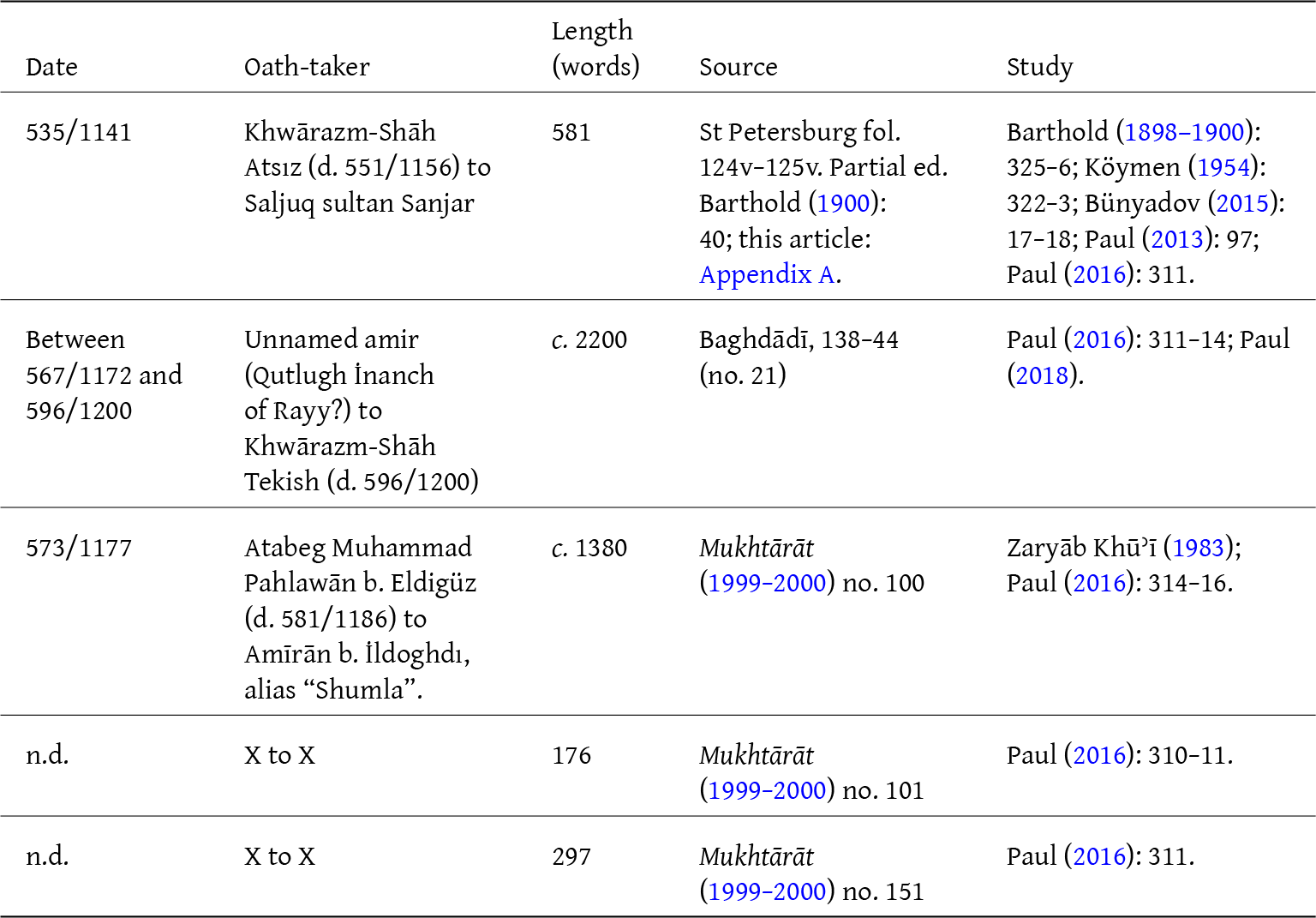
The seminal work on the importance of oath-taking in pre-modern Islamicate societies is the late Roy Mottahedeh’s Loyalty and Leadership. Mottahedeh dissected the types of relationships that structured society, the oath being key to what he called the “acquired loyalties” (in contrast to “loyalties of category”, like race, for example).Footnote 18 Mottahedeh, who made his case based on the example of Buyid Iran (fourth/tenth century), relied on chronicles and did not have the opportunity to study actual oath-letters.Footnote 19 Mottahedeh’s work was taken forward in two distinct ways. First, Christopher Melchert investigated the judicial oath (yamīn) in Islamic law.Footnote 20 Sketching the evolution from the theoretical underpinnings in the second/eighth century in Iraq to further developments in the seventh/thirteenth century, his authoritative article includes all the necessary references to sources and prior literature on the topic (especially Schacht, Brunschvig and Crone). Second, Jürgen Paul dealt extensively with oaths in his monograph on the Herrschaftspraxis in twelfth-century Eastern Iran, but in far greater detail than Mottahedeh, notably because he was able to use the sawgand-nāmas transmitted through Persian inshāʾ (see Table 1).Footnote 21 The same year, in 2016, ʿAlī Riḍāʾiyān and Qāsim Sālārī published a valuable article entitled “The importance of Persian treaties and oath-letters of the fifth/eleventh and sixth/twelfth c. in clarifying the relationships between the central government and provincial rulers”. The subject is very similar to Paul’s and they focus on the same set of texts, but Paul’s analysis is more detailed (each text is summarized) and more reliable.Footnote 22 It is also more interesting as he builds on Mottahedeh’s insights to stress the role of codified interpersonal relationships, showing that while khidma is the emblematic ceremony at the core of the system guaranteeing the survival of the state, sawgand (and thus sawgand-nāma) is another one.Footnote 23
The sawgand-nāmas from pre-Mongol Iran

For Anatolia, sawgand-nāmas have never been studied. This type of text does not appear among the “official documents” (resmi vesikalar) of the Saljuq period edited by Osman Turan in 1958. However, Turan included two taʿahhud-nāmas sent by the Christian ruler of Cyprus Hugues de Lusignan, to the Rum Saljuq sultan ʿIzz al-Dīn Kay-Qubād I (d. 616/1219). These are trade agreements, but the letter dated [612/]1216 is the closest equivalent to a sawgand-nāma, as Hugues “swears to abide by the intention of good friendship expressed by ʿIzz al-Dīn, the great sultan of the city of Konya, to the best of [his] power and means, for a period of three years”.Footnote 24
From the eighth/fourteenth century, we know of two ʿahd-nāmas that possess all the characteristics of an oath-letter (including the standard Muslim oath and the sanctio).Footnote 25 However, in 2021 Rustam Shukurov convincingly showed that they could not have been written by Muslim secretaries, but rather by the Byzantine chancery (possibly during the Byzantine reconquest of Anatolia in the tenth–eleventh centuries).
Although Ḥusām al-Dīn Khūʾī’s oath-letter (called ʿahd-nāma) has, as far as I know, never been commented on, Andrew Peacock has recently quoted several occurrences of sawgand-nāmas in the chronicles in an article dealing with the agency of the urban elites. The two most notable examples are the oaths sworn by the inhabitants of Konya to the sons of Sultan ʿIzz al-Dīn Qılıch Arslan II (d. 588/1192) and, nearly two centuries later, the oaths exchanged between the people of Sivas and the local governor.Footnote 26 The exchange of oaths, concludes Peacock (like Paul), is a reciprocal process, whereby the inhabitants pledge loyalty while the ruler is similarly bound to provide guarantees.
Edition and translation of the sawgand-nāma to the Rum Saljuq sultan in Qiṣṣa-yi Salāṭīn
In the edition, I follow the standard modern practices in Iran for transcribing Persian. Arabic sentences are vocalized.Footnote 27 In the following translation, I have inserted paragraph numbers to facilitate explanations in the commentary.
سوگندنامۀ ملک الاسلام.
قالَ اللهُ تَعالى و هُوَ أَصدَقُ القائِلينِ ﴿يَا أَيُّها الَّذينَ آمَنوا أَوفوا بِالعُقودِ﴾ و قَال عَزَّ و جَلَّ أَیضاً ﴿وأَوفوا بِعَهدِ اللَّهِ إِذا عاهَدتُّم﴾ و قال أَيضا عَزَّ و جَلَّ ﴿و أَوفوا بِالعَهدِ إِنَّ العَهدَ كانَ مَسئُولًا﴾. این عهدی است که می کنیم و سوگندی است که می خوریم و میثاقی است که می بندیم نیّت صافی و اعتماد خالص و تنی و عقلی کامل که:
با دوستان خدایگان جهان ـ خَلَّدَ اللهُ سُلطانَهُ ـ دوست باشیم و با دشمنانش دشمن، و هرچ تعلّق به مصلحت و مسفدت ]۷۲ر[ مُلک و مملکت سلطان عَالم باز گردد عرضه داریم، و بدانچ فرماید منقاد امر و نهیش باشیم، و در دفع دشمن وسع طاقت خود بذل کنیم، و بر آن باشیم که شرّ بدخواه از اطراف و اکناف ممالک محروس زایل گردد، و هنگام محاربه و مقاتله در معرکۀ دشمن مخذول روی نگردانیم، و در مصلحت ملک و دولت پادشاه عالم کوشیم، و هر قولی و فعلی که ضر]ر[ آن به دولت قاهره مملکت او رجوع کند محترز و مجتنب باشیم. واللهِ واللهِ بِاللهِ بِاللهِ الطالِبُ الغالِبُ الضارُّ النافِعُ المُدرِکُ المُهلِکُ ﴿الحَيُّ الذي لايَموتُ﴾ که حین و بعد متابعت و مطاوعت و عبودیّت و جان سپاری به مال و نفس قایم مقام و وليّ عهد، ملک معظّم، علاء الدولة والدین کیقباد را دانیم و شناسیم، و بندگی او را از جملۀ فرایض و لوازم شمریم، و از ربقۀ طاعت او تمرّد و سرکشی نکنیم، و باقی ملکان را تبع و خدمتکاران او دانیم، و اگر مَلکی دیگر به وجود آید آن را نیز تبع و خدمتکار او شناسیم. واللهِ باللهِ تاللهِ که چنین است.
و اگر خلاف این عهد و میثاق کنیم و یا تاویل ورخصت جوییم، و یا در قید بُطلان آن باشیم و یا رو]کذا[، و یا بر آن اندیشه خوض نماییم، و یا کسی را بر آن داریم یا تلقین کنیم اِمّا به رمز و اِمّا به اشارت، از خدا و از قران که کلام قدیم اوست و باقی کتابها که از آسمان مُنزَل شده است و از صد هزار و بیست و چهار هزار نقطۀ نبوّت بیزار باشیم، و بر ذات باری ناسزا گفته و روا دیده باشیم، و جملۀ انبیا را کاهن و ساحر و دروغ گو و قُران مجید شعر و افسانه و هذل و لغو خوانده باشیم، و به نبوّت پیغامبر ما محمّد مصطفی - صَلواتُ الرَحمَنُ عَلیهِ - و به روز قیامت و حشر و نشر منکر شده باشیم، و ملّت یهودی را بر دین اسلام ترجیح و تفضیل ]۷۲پ[ نهاده، و به خون معصومان اجازات و رخصت داده و جمیع ما حَرَّمَ اللهُ حلال داشته باشیم، و صد حجّ پیاده در ذمّت ما ثابت و لازم گشته باشد، و هر مالی که داریم از ناطق و صامت و نقد و جنس به راه خدا سَبیل باشد، و بر ما حرام، اگر ازین عهد و میثاق بر گردیم چندانک زنده باشیم واللهِ و باللهِ ]و[ تاللهِ که چنین است؛ و اللهُ عَلی ما نَقولُ وَکیلٌ.
Oath (sawgand-nāma) in the name of the King of Islam (malik al-Islām).
[§1] God the Almighty has said, and He is the most truthful of the speakers (aṣdaq al-qāʾilīn), “O believers, fulfil your bonds” (Quran 5:1Footnote 28 ); and He, may He be honoured and glorified, has also said “Fulfil God’s covenant, when you make covenant” (Quran 16:91); and He, may He be honoured and glorified, has further said “And fulfil the covenant, surely the covenant shall be questioned of” (Quran 17:34).
[§2] This is the covenant (ʿahd) that we make, the oath (sawgand) that we take, the pact (mīthāq) that we establish, [with] pure intentions (niyyat ṣāfī) and sincere trust, sound in mind and body (tanī wa ʿaqlī kāmil):
[§3] We will be friends with the friends of the lord of the world (khudāygān-i jahān) – may God make his rule eternal – and enemies with his enemies; and we will report (ʿarḍa dārīm) all matters concerning the welfare or detriment (maṣlaḥat wa mufsidat) of the kingdom of the sultan of the world; and we will comply with his commands and prohibitions; and we will do our utmost (wusʿ-i ṭāqat-i khūd) to repel the enemy, and strive to eliminate (bar ān bāshim ki) the evil of the ill-wishers (sharr-i bad-khwāh) from the domains of the protected kingdom; and during warfare, on the battlefield, we will not turn away (rūy nagardānīm) from the vile enemy; and we will strive for the welfare (maṣlaḥat) of the kingdom and the state of the lord of the world; and we will be vigilant (muḥtariz wa mujtanib) to avoid any word or action that could harm the victorious state.
[§4] And I swear by God (wa-llāhi wa-llāhi billāhi billāhi), the Caller (al-ṭālib), the Conqueror (al-ghālib), the Afflictor (al-ḍārr), the Benefactor (al-nāfiʿ), the One who comprehends (al-mudrik), the Killer (al-muhlik), the Ever-Living who does not die (al-ḥayy alladhī lā yamūtu),Footnote 29 that:
[§5] now and henceforth (ḥīn wa baʿd), we will be obedient, devoted and ready to sacrifice our lives and properties (mutābiʿat wa muṭāwiʿat wa ʿubūdiyyat wa jān-sipārī bi-māl wa nafs)Footnote 30 for the heir apparent (qāyim-maqām wa walī-ʿahd), the powerful prince (malik-i muʿaẓẓam),Footnote 31 ʿAlāʾ al-Dawla wa-l-Dīn Kay-Qubād; and we regard serving him as a duty and a religious obligation (az farāyiḍ wa lawāzim); and we will not rebel against the yokeFootnote 32 of his obedience (ribqa-yi ṭāʿat); and we will regard all other princes as his subordinates (tabʿ wa khidmatkār); and should another prince be born (bi-wujūd āyad), we will also regard him as his subordinate. And by God (wa-llāhi bi-llāhi ta-llāhi) I swear that this will be so (ki chinīn ast).
[§6] And if we break this covenant and this pact (ʿahd wa mīthāq), if we look for subtleties and pretexts (taʾwīl wa rukhṣat), or if we find ourselves compelled to nullify it (dar qayd-i buṭlān-i ān), or if we are proceeding in this direction (rawānīm), or if we seriously contemplate doing so (bar ān andīsha khawḍ namāyīm), or if we incite someone to do so (kasī-rā bar ān dārīm yā talqīn kunīm), either implicitly or explicitly (ammā bi-ramz wa ammā bi-ishārat), then we abhor God, the Noble Quran which contains His ancient words (kalām-i qadīm),Footnote 33 as well as all the other scriptures that have been revealed and the 124,000 prophets (nuqṭa-yi nubuwwat);Footnote 34 we shall insult God and let Him be insulted (rawā dīda bāshim); we shall proclaim that all the prophets are soothsayers (kāhin), magicians (sāḥir) and liars, and the Noble Quran to be mere poetry, tales and nonsense (shiʿr wa afsāna wa hadhl);Footnote 35 we shall deny (munkar) the prophecy of our Prophet – blessings of the Merciful upon him – as well as Judgement Day and what happens during it (rūz-i qiyāmat wa ḥashr wa nashr);Footnote 36 and we shall give preference to Judaism over Islam; and we shall authorize the blood of the innocents (maʿṣūmān) to be shed and all that God has forbidden (jamīʿ mā ḥarrama Allāhu) shall be permissible to us; and a hundred pilgrimage to Mecca on foot will be a fixed and necessary obligation upon us; and the totality of our possessions, speaking or silent (nāṭiq wa ṣāmit),Footnote 37 in currency or in kind (naqd wa jins), shall be devoted to the path of God (bi-sabīl-i khudā), and may they become forbidden (ḥarām) to us if we turn away from this covenant (ʿahd wa mīthāq), as long as we live (chandānk zinda bāshīm).
[§7] And I swear thrice that it will be so (wa-llāhi wa bi-llāhi [wa] ta-llāhi ki chinīn ast), and God is the guardian of what we say (wa-llāhu ʿalā mā naqūlu wakīl).
Analysis of the sawgand-nāma
Category of text
The Qiṣṣa-yi Salāṭīn includes two sawgand-nāmas (fols. 26v–28r). Only the first one pertains to the state of the Rum Saljuqs, while the second was purportedly sent by Queen Tamar of Georgia (r. 1184–1212) to Saladin (d. 589/1193). This last text, also in Persian, closely mirrors the structure of the Islamic documents, but substitutes Islamic references with Christian ones.Footnote 38 Notably, in the Qiṣṣa-yi Salāṭīn, the sawgand-nāmas appear among the eight types of letter templates. The first category consists of congratulation letters (tahniyat-nāma) featuring eight examples, followed by condolence letters (taʿziyat-nāma) with six examples, and so on.
This is important because the first part of the Qiṣṣa-yi Salāṭīn (at least up to fol. 28r) is clearly an attempt to emulate secretarial manuals, such as the one authored by the Khurasani kātib Muḥammad b. ʿAbd al-Khāliq Mayhanī in 585/1190.Footnote 39 The type of letters defined in this part of the Qiṣṣa-yi Salāṭīn aligns perfectly with those termed ikhwāniyyāt by Mayhanī, differentiating them from appointment letters termed sulṭāniyyāt. But the one notable exception is precisely the inclusion of oath-letters, which are not covered in either Mayhanī’s manual nor in Muḥammad Nakhjawānī’s Dastūr al-kātib (wr. 767/1365–6), the most complete work of this genre in Persian. Muḥammad Nakhjawānī does include a model for ʿahd-nāma, resembling our sawgand-nāmas with phrases like “your friends are my friends” and “I will provide you advice”, but notably omits any form of oath, and thus, the consequent penalties for its breach.Footnote 40
Conversely, in Ḥusām al-Dīn Khūʾī’s manual, the oath-letter (termed ʿahd-nāma) appears in the section taqrīrāt-i dīwānī, which could be translated as “state documents”, an equivalent for sulṭāniyyāt. Similarly, in Baghdādī’s Tawassul ilā l-tarassul, a sawgand-nāma concludes the first chapter entitled “Decrees, proclamation of victory and covenants” (manshūr-i dīwānī, fatḥ-nāma wa ʿuhūd). The varied categories accommodating sawgand-nāmas illustrate that applying a simple binary classification, such as official versus private letter, to these texts is overly simplistic.Footnote 41
Structure of the text
We recognize in the text translated above the four main parts of an oath-letter, except that some parts are repeated: the oath-formula appears three times, and the commitments are presented in two separate paragraphs. This sawgand-nāma is structured as follows:
1) Preamble with three Quranic quotes emphasizing the importance of fulfilling one’s covenant.
The first quote (Quran 5:1 yā ayyuhā l-ladhīna āmanū awfū bi-l-ʿuqūd) is a requisite in all sawgand-nāma.Footnote 42
2) Declaration of oath with conditions for its validity.
The terms ʿahd, mīthāq and sawgand are used interchangeably. The individual taking the oath swears fealty to the sultan (khudāygān-i jahān). The formula “this is an oath we take” (sawgandī ast ki mī-khūrīm) serves as a performative declaration, meaning that uttering these words is binding.Footnote 43 This presupposes that some validity conditions are respected. These conditions include mental and physical soundness as well as sincerity. While mental and physical soundness are common requirements across all types of contracts, sincerity is not (it is not mentioned, for example, in deeds of sale).Footnote 44
3) Commitments toward the sultan.
Chroniclers typically summarize oaths in a single sentence, for example, “Manūchihr will be with us” in the aforementioned anecdote told by Bayhaqī. Here, the sawgand-nāma explicitly outlines five commitments: strategic alignment (pledging to share friends and enemies); military support against aggression (notably emphasizing the avoidance of desertion mid-conflict, a common occurrence);Footnote 45 obedience to the sultan’s orders; communication of matters beneficial or harmful to the sultan; and cautious behaviour to protect the sultan’s interests.
4) Declaration of oath (bis).
The sentence of oath (“I swear by God”) is repeated four times, using two variants (wa-llāhi billāhi). God’s omnipotence is highlighted through seven active participles, depicting his abilities to understand (al-mudrik), but also to inflict harm (al-ḍārr), even death (al-muhlik), all the while remaining forever living (al-ḥayy).
5) Commitments toward the heir apparent.
The individual taking the oath swears fealty to the “heir apparent” (walī-ʿahd) ʿAlāʾ al-Dīn Kay-Qubād II. Several statements emphasize an unconditional commitment to serve and obey. The choice of words (“physical and material sacrifice”, “religious obligation”) makes these commitments stronger than the precedent. To clarify matters further, the text explicitly states that ʿAlāʾ al-Dīn has precedence over all his brothers (malikān), including those not yet born. The last clause guarantees the precedence of ʿAlāʾ al-Dīn regardless of change inside the family.
6) Punishments for violation or finding pretexts.
This is the most extensive section, detailing severe consequences for oath-breaking, affecting both the earthly and spiritual realms. The first penalty – hate for God, His prophets and their revealed books – amounts not only to being condemned to death but also to eternal damnation. This hatred (bizār shudan) is not a wilful act but rather a divine alteration of the violator’s heart.Footnote 46 Subsequent clauses – blaspheming God, denying the Quran’s truth, rejecting Muḥammad’s prophecy – are expansions of this “hatred”. The fifth clause – preference for Judaism over Islam – contradicts the rejection of all revelations, but it signifies the violator’s blood is ḥalāl (permissibility of bloodshed against him), similar to the condemnation for harming the righteous (sixth clause). The two final clauses, demanding impossible penance (undertaking 100 pilgrimages to Mecca on foot) and absolute poverty (relinquishing all possessions), underscore the grave nature of prior transgressions.Footnote 47
7) Declaration of oath (ter).
This repetition of the oath introduces a variant: ta-llāhi, after the standard wa-llāhi wa bi-llāhi. This variant is seen in other texts written in Iran (either in Persian or Arabic), but not in the Arab world.Footnote 48 In the last sentence, God is made the “guardian” (wakīl) of the sawgand-nāma, ensuring its sanctity and enforcement.
Comparison with other sawgand-nāmas
How does this text composed in Anatolia compare to the sawgand-nāmas written in Iran? Just 473 words long, it is shorter than the oath to Khwārazm-Shāh Tekish (c. 2,200 words), to Khūzistān ruler Shumla (1,380 words) and even to Sanjar (581 words).Footnote 49 It is only longer than the fully anonymized sawgand-nāmas in Mukhtārāt (1999–2000) (see Table 1). However, it stands out due to variations in the commitments to and the penalties for oath-breaking. Indeed, it is the only known oath specifically designed to ensure a clear line of dynastic succession.Footnote 50 This clause is notably absent from other sawgand-nāmas, which focus on enforcing loyalty or assistance towards an effective ruler.
Likewise, the detailing of punishments within sawgand-nāmas is highly revealing. Let us remember that the list of these punishments is inseparable from the oath. Thus, it also appears in sawgand-nāma poems, albeit in a literary fashion. For instance, Sayyid Ḥasan Ghaznawī (d. 556/1161), the author of the most famous sawgand-nāma poem, states that in the event of perjury, “the hair of [his] skin will turn into burning arrows” (mūy dar tan-i man gardad ātishīn paykān).Footnote 51 And for Zoroastrian sawgand-nāma, the punishment included enduring the fate of Ḍaḥḥāk (that is, being crucified on a mountain for a thousand years), in addition to losing the benefits of all good deeds previously accomplished (equating to damnation).Footnote 52
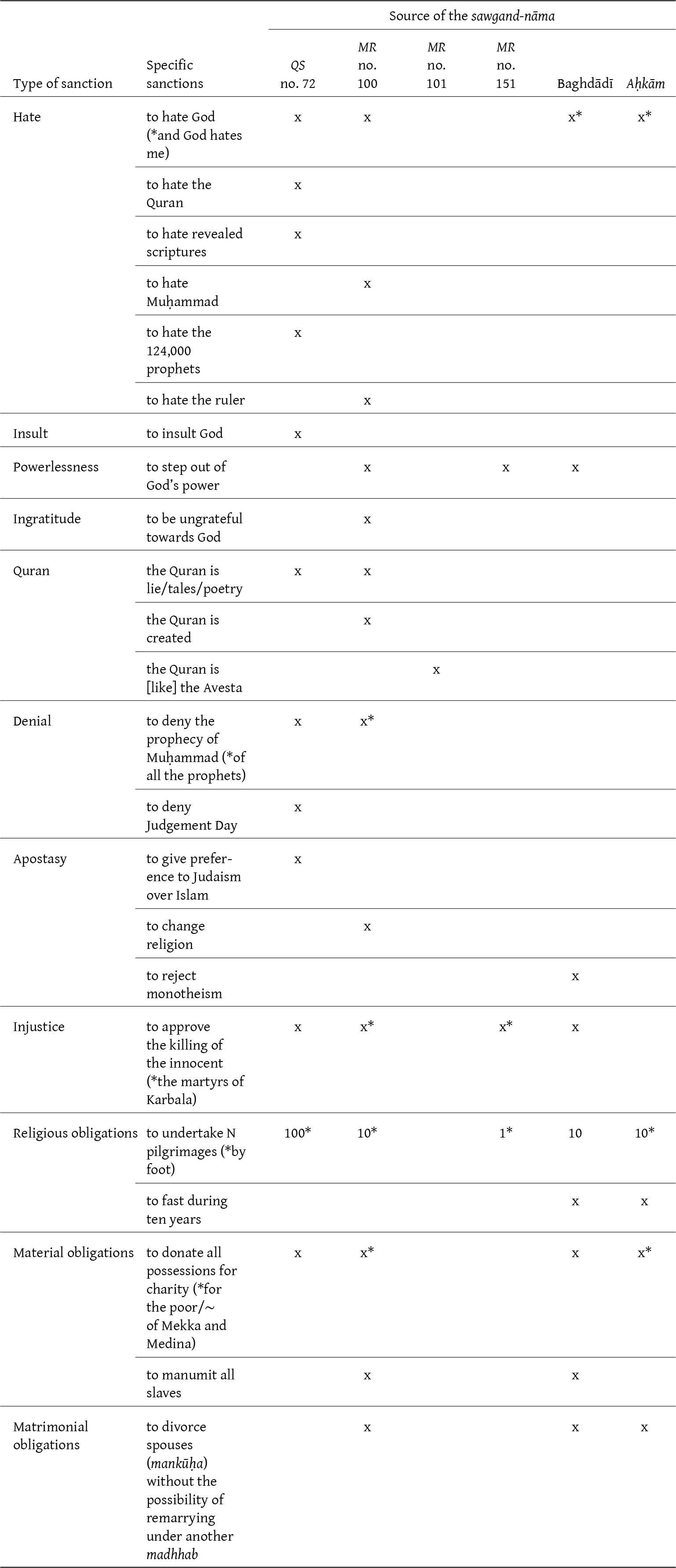
In an Islamic context, Melchert reminds us that “hadith threatens the perjurer with divine wrath at the Last Judgement”, but also that “Islamic law prescribes no punishment for perjury, leaving this up to the qadi’s discretion”.Footnote 53 The sawgand-nāmas are indeed very specific. Since the major sin in Islam is muḥāriba (i.e. waging war against God; see Quran 5:33), this is what is detailed extensively in these texts. Table 2 lists all punishments mentioned across the five known Iranian sawgand-nāmas as well as the text under study. Unsurprisingly, we recognize the categories known in Medieval Europe as poena spiritualis and poena saecularis.Footnote 54 Various aspects of the sawgand-nāma written in Konya align with those from Iran, including ideological (with oath-breakers hating God); political, through the endorsement of the killing of innocents (var.: the martyrs of Kerbala as in the Mukhtārāt [1999–2000]); and practical, in actions such as freeing all slaves and performing an exceedingly high number of pilgrimages. Let us add that apostasy from Islam automatically voids the marriage as well as the waqf institutions an individual may have established to protect his wealth.Footnote 55 It is also specified that seeking excuses or engaging in specious interpretations (taʾwīl) to avoid fulfilling oaths is tantamount to breaking the oath.Footnote 56
Typology of sanctions for the oath-breaker in Iran and Anatolia (QS: Qiṣṣa-yi Salāṭīn; MR: al-Mukhtārāt)

However, notable differences emerge: in the Rum Saljuq sawgand-nāma, the theme of “hatred” is much more developed. It extends beyond God to include the Quran and all the 124,000 prophets. It further specifies that the oath-breaker’s attitude will manifest openly, through insults towards God and a preference for Judaism. Insults are not mentioned in the Iranian sawgand-nāmas. The sawgand-nāma to Khūzistān ruler Shumla is the only Iranian model that mentions apostasy, yet it specifies Zoroastrianism and Ismailism as alternatives to Islam. Conversely, the sawgand-nāma under study does not include the requirement to irreversibly divorce all of one’s wives (irreversibility is enforced through triple repudiation, ṭalāq, with a special clause making taḥlīl impossible), a stipulation present in all the major Iranian sawgand-nāmas.
In summary, this sawgand-nāma closely mirrors that of Iran, yet it exhibits greater severity in ideological terms, while being less demanding in practical aspects. This conclusion might be correlated with the particular emphasis on the theme of disbelief in the texts in vogue in Rum at that time, as Peacock has shown through the analysis of local catechisms known as Sirāj al-qulūb, as well as popular literature in Turkish like the Hamzaname.Footnote 57
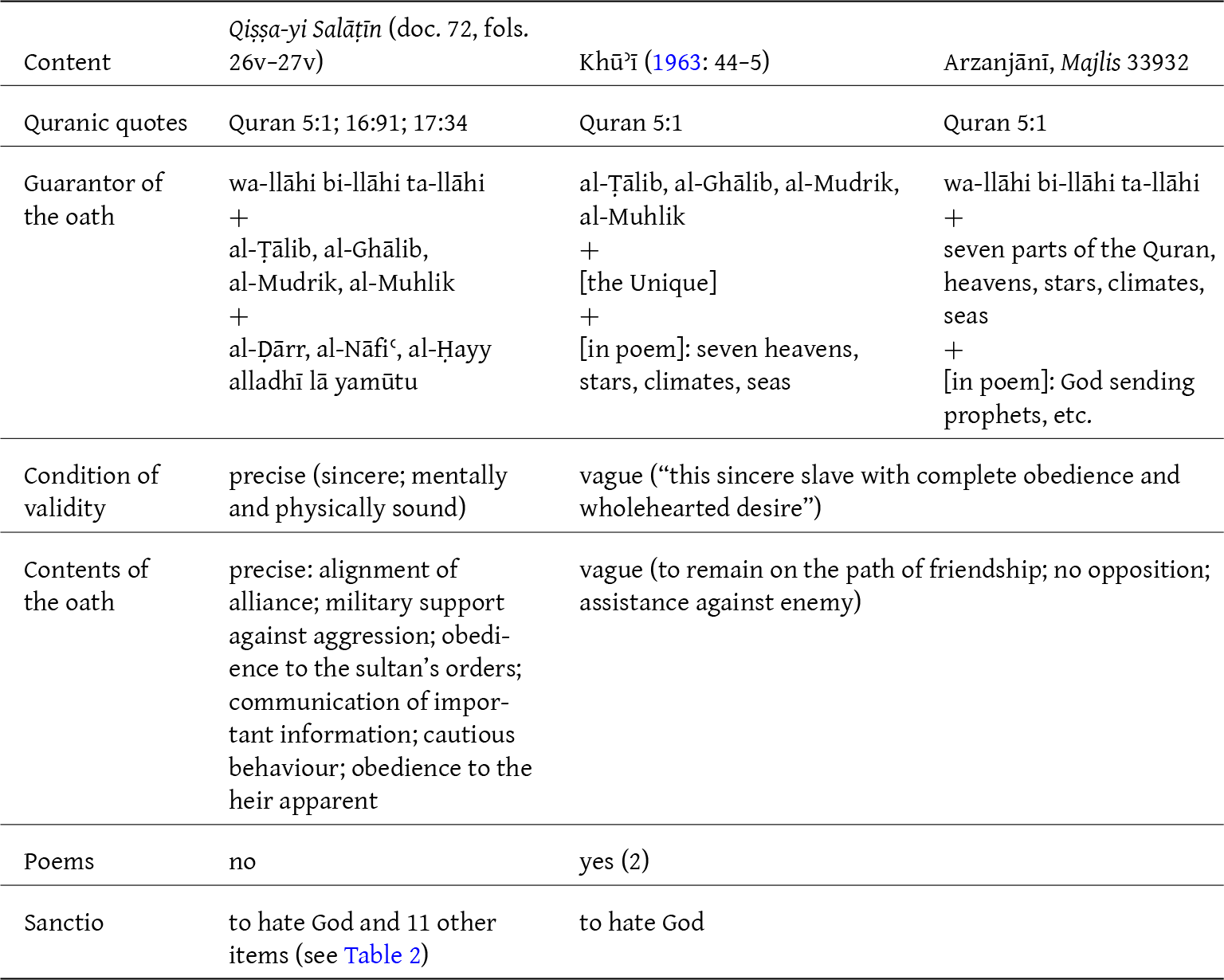
In this line of discussion, it is pertinent to compare the sawgand-nāma copied in Qiṣṣa-yi Salāṭīn with the two other known sawgand-nāmas from Anatolia before the Ottoman period: the one transmitted by Ḥusām al-Dīn Khūʾī in the early eighth/fourteenth century, and another one, copied in the autograph manuscript of Ṭayyib b. Sharaf al-Dīn b. Qiwām al-Dīn Mawlawī Arzanjānī (early ninth/fifteenth century) (see Appendix 2).Footnote 58 These two texts differ from our sawgand-nāma, but are remarkably similar to each other (see Table 3). Both anonymize (using fulān), are of the same length (around 250 words), contain verses (though different ones) and share features unseen in Iranian examples, such as the symbolic use of the number seven or the invocation of angels, prophets and saints as witness. Notably, the wording for the content of the oath and the sanctio is almost identical. The commitments are vague, and the sanctio amounts to a single clause: “I will take God in hate”.Footnote 59 Maybe we could interpret this simplification as a sign that accumulating clauses was no longer considered the most effective method of ensuring the oath’s integrity.
Content comparison between the three Persian sawgand-nāmas from Anatolia

Impact of the sawgand-nāma
This sawgand-nāma had two main purposes: like all oaths, it aimed to strengthen the contractual relationship between the oath-takers, but here the commitments also implied recognition of the heir apparent, ʿAlāʾ al-Dīn Kay-Qubād. Three Rum Saljuq princes bore this name, but there is no doubt about the identity of the person mentioned: it was ʿAlāʾ al-Dīn Kay-Qubād II, son of Ghiyāth al-Dīn Kay-Khusraw II. We can be sure of this because the third ʿAlāʾ al-Dīn Kay-Qubād, who lived at the beginning of the eighth/fourteenth century, was not yet born when the Qiṣṣa-yi Salāṭīn was written. The first ʿAlāʾ al-Dīn Kay-Qubād, who died in 634/1237 at nearly 50 years old would have been an option if all the texts copied in the Qiṣṣa-yi Salāṭīn could not be dated to the years 1240 to the 1250s.Footnote 60 This sawgand-nāma also aligns with other texts in the Qiṣṣa-yi Salāṭīn placing ʿAlāʾ al-Dīn Kay-Qubād II on the throne: a series of shorter documents detailing the sultan’s honorific titles (alqāb), with ʿAlāʾ al-Dīn Kay-Qubād b. Ghiyāth al-Dīn Kay-Khusraw consistently identified as the heir apparent (see fols. 28r–30r).Footnote 61 One document, the foundation inscription of a caravanserai established by Gurjī Khātūn, reveals that ʿAlāʾ al-Dīn’s claim to the throne was literally set in stone at the entrance of the winter capital, Antalya. But this is also evident in the voluminous correspondence among members of the Saljuq royal family – for example, the two letters sent shortly before 644/1246 by Sultan Ghiyāth al-Dīn Kay-Khusraw to his son ʿAlāʾ al-Dīn: the former was in Antalya, and the latter, explicitly named as walī-ʿahd (heir apparent), was in Konya (fols. 37v–38v). While the genesis of Qiṣṣa-yi Salāṭīn is not entirely clear, it is obvious that its author belonged to the entourage of ʿAlāʾ al-Dīn Kay-Qubād II.
Ghiyāth al-Dīn Kay-Khusraw II was married to Tamar at an early age to seal the alliance between the expanding Rum Saljuq sultanate and the powerful Georgian kingdom. Not long after their marriage, probably around 636/1238–39, Tamar gave birth to a son, immediately named after his glorious grandfather, ʿAlāʾ al-Dīn Kay-Qubād.Footnote 62 At that date, Ghiyāth al-Dīn Kay-Khusraw had other sons, but none of them from a mother of royal lineage. For strategic considerations on the one side (the Mongols were already present in Iran) or perhaps for more personal reason (Kay-Khusraw II was said to be enamoured with his Georgian wife), ʿAlāʾ al-Dīn was proclaimed heir apparent (walī-ʿahd).Footnote 63 The fact that following the death of his own father, Ghiyāth al-Dīn Kay-Khusraw II had seized the throne and promptly eliminated his half-brothers were other reasons to prepare the succession well in advance.
Despite the precautions taken by his parents, ʿAlāʾ al-Dīn Kay-Qubād II did not become sultan when his father died unexpectedly at a young age, in 643 or 644 (1245–46). This was particularly unfortunate as the situation of the Saljuq sultanate itself had radically changed with the Mongol victory at Köse-Dagh in 641/1243, reducing it from a major regional power to a vassal state. At the time of his father’s death, ʿAlāʾ al-Dīn was only seven years old and was unable to make any decisions. According to the court historian Ibn Bībī (wr. 680/1281–82), the vizier Shams al-Dīn Iṣfahānī (d. 1249) served as an unofficial regent. In agreement with the great amir Jalāl al-Dīn Qarāṭāy, he placed the deceased sultan’s elder son, ʿIzz al-Dīn Kāy-Kāwūs II (d. ca. 678/1279–80), on the throne and also married the widowed Queen Tamar, thereby becoming atabeg of ʿAlāʾ al-Dīn. However, according to another reliable chronicler, Qarāṭāy enthroned ʿAlāʾ al-Dīn and his two brothers of the same rank. Maybe it was after his other brother, Rukn al-Dīn Qılıch Arslan IV, had come back from the Mongol capital with a decree in his favour.Footnote 64 What is clear is that the dynastic succession, which should have been secured by oaths like the one analysed here, did not proceed as planned. Consequently, one must question the effectiveness of the harsh penalties for perjury. Evidently, numerous courtiers who swore an oath akin to that in the sawgand-nāma subsequently served the new sultan, and not ʿAlāʾ al-Dīn Kay-Qubād II.
The decision to uphold an oath is influenced by a blend of personal ethics (personal integrity), societal norms (the social cost of breaking an oath was significant, as Mottahedeh notes) and the depth of religious beliefs (naturally difficult for historians to assess). To make sense of this apparent contradiction, we propose two lines of reasoning. First, the list of punishments should not be taken literally: no prince or important person has ever performed the pilgrimage entirely on foot, much less donated all his possessions or openly declared war against God. The role of this accumulation of penalties is symbolic, illustrating the scale of what could be the breaking of a covenant with God as witness. Second, accommodations were always possible. Ibn Bībī’s chronicle of the Rum Saljuq state highlights how individuals or groups could negotiate their commitments to the sawgand. One particularly relevant example mirrors the situation addressed by our oath: in 588/1192, following the sultan’s death (ʿIzz al-Dīn Qılıch Arslan II), a dynastic feud erupted between two of his sons. The people of Konya, having sworn allegiance to malik Ghiyāth al-Dīn Kay-Khusraw I (d. 608/1211), initially wanted to resist his brother, Rukn al-Dīn Sulaymān II. However, they eventually agreed to support the more powerful pretender, Sulaymān, on the condition that he ensured his brother’s safety. A similar scenario unfolded a decade later after Sulaymān’s death. This time, despite having sworn binding oaths to his infant son, the inhabitants of Konya agreed to surrender the city in return for safe conduct for Rukn al-Dīn Sulayman’s son.Footnote 65 Is that not exactly what happened with ʿAlāʾ al-Dīn Kay-Qubād II? No blood was shed, and during his teens, he maintained good relations with his brothers, even being associated with the throne (the so-called “joint sultanate”).
Finally, we must note that in 652/1254, at the age of 16, ʿAlāʾ al-Dīn Kay-Qubād II embarked on a journey to Mongolia to attend the quriltai of the Qa’an, exactly like Rukn al-Dīn Qılıch Arslan IV had done in the previous decade. He did so on the behalf of his half-brother ʿIzz al-Dīn. We cannot know what his personal motives were, but it is not unreasonable to assume that he hoped to return from the Mongol capital with a decree in his favour, given that he was of age to rule, of Georgian descent (another vassal kingdom of the Mongols) and, the sawgand-nāma could prove it, the rightful heir to the Saljuq throne. Tragically and very unexpectedly, ʿAlāʾ al-Dīn died en route. If he had harboured personal ambitions, then his sudden death following a banquet during the journey may not been entirely natural. And this is exactly what Āqsarāʾī, writing two generations after Ibn Bībī, conveys when he laments the death of ʿAlāʾ al-Dīn, whom he respectfully calls “sultan and son of sultan”.Footnote 66
Conclusion
The correspondence between the structure and the wording of this text with the sixth/twelfth-century sawgand-nāmas from Iran illustrates the deep integration of Anatolia into the Persianate world. A visitor from Western Iran or Khurasan would probably feel at home in Konya, although, in considering this text, he might note minor variations in prescribed punishments. These variations were most likely influenced by the local context and a prevailing theme of disbelief (characteristic of seventh/thirteenth-century Anatolian texts).
To what extent the authors of inshāʾ works could modify the documents at their disposal is a question that needs to be asked for each work, and sometimes for each text. In the case of the sawgand-nāma examined here, and contrary to the two other specimens from Anatolia, there is no reason to doubt its authenticity because other sources do tell us that ʿAlāʾ al-Dīn Kay-Qubād II had been chosen as heir apparent. This text confirms that the author of the Qiṣṣa-yi Salāṭīn obviously belonged to the circles close to Queen Gurjī Khātūn’s sidelined son. This source offers a counterbalance to the dynastic narrative presented in later chronicles, which reinterpret the period of the 1230s to 1240s with the benefit of hindsight. The Qiṣṣa-yi Salāṭīn was as much a collection of letter templates as, potentially, a portable archive.Footnote 67
As Marina Rustow noted, regarding the Fatimid documents of the Cairo Geniza, “the accumulation of documents gives the system its meaning”. Our challenge in engaging with Marʿashī 11136 will be to decode this “system” and understand the transformations of the Rum Saljuq sultanate under Mongol domination.
Acknowledgements
An earlier version of this article was presented at the colloquium “State Documents from the Medieval Islamicate World”, organized by Arezou Azad and Marina Rustow in Oxford on 21–22 June 2023. I am grateful to Shervin Farridnejad, Mohammad Karimi Zanjani Asl, Jürgen Paul, Andrew Peacock and Emad al-Din Sheykh al-Hokamaee for answering my queries during the preparation of this text. All mistakes are mine.
Funding statement
This article was written within the framework of a project funded by the Deutsche Forschungsgemeinschaft (DFG, German Research Foundation) – project number 502121115.
Appendices
Appendix 1: Edition of the sawgand-nāma in St Petersburg C-816, fols. 124v–125v
سوگندنامه قالَ اللهُ تَعالى و هُوَ أَصدَقُ القائِلينِ ﴿و أَوفوا بِالعَهدِ إِنَّ العَهدَ كانَ مَسئُولًا﴾ ﴿وأَوفوا بِعَهدِ اللَّهِ إِذا عاهَدتُّم وَلَا تَنقُضُوا الأَيْمانَ بَعدَ تَوكيدِها وقَد جَعَلتُمُ اللَّهَ عَلَيكُم كَفيلًا﴾.
من که اتسز بن محمد خوارزم شاه ام، توفیق می خواهم از خدای - عَزَّ و جَلَّ - و به رحمت او پناه می طلبم، و در نگاه داشت وفای عهد که می بندم، در بندگی و طاعت خداوند عالم، سلطان اسلام که صلاح دین و دنیا]ی[ خویش ازین می دانم ومی شناسم، و اللهُ المُوَفِّق لِلسَدادِ و الهادي إلى الرَشاد.
عهد بستم من که اتسز بن محمّد خوارزم شاه ام، و نذر کردم با خدای - عَزَّ و جَلَّ - و رسول او محمّد -عليه السلام - که:
تا من باشم مطیع و فرمان بر و بندۀ خداوند عالم سنجر بن ملکشاه بن محمّد - که زندگانیش باد- باشم، و سراز طاعت و بندگی او نتابم، و باهیچ مخالف و بدخواه دولت وی از ترک و تازیک و خویش و بیگانه و زن و مرد و کافر و مسلمان باز]کذا. صحیح: یار؟[ نگردم، و به خود پناه ندهم، و به هیچ وجه از وجوهْ دولت او را خلاف نکنم، وبا دوست دولت که دانم دوست باشم، و با دشمن دولت که دانم دشمن باشم، و اگر کسی از مخالفان دولت وی به خلاف دولت وی خبری نویسند ]کذا[ یا پیغامی دهد یا تدبیری کند، پوشیده ندارم، و رای اعلی را معلوم گردانم، و در دفع و قهر و قمع مخالفان و قاصدان دولت وی بدان که ممکن گردد، و وُسع من آید به تن و مال در حال بکوشم.
و به همۀ وجود بندگی نمایم، و به هیچ عذر و بهانه تمسّک و تعلّل نکنم، و از بعد طاعت و پرستش ایزد تعالی که آفریدگار عالم و عالمیان است، طاعت و بندگی و فرمان برداری آن پادشاه مبارک بر خود فرض عین دانم، و هم برینجمله باشم، که درین عهدنامه مذکورست، و با خدای - عَزَّ و جَلَّ - ]۱۲۵ر[ و رسول او - علیه السلام - عهد بستم، و نذر کردم و سوگند خوردم: بالله الرَحمَن الرَحیم، باللهِ العَلي العَظیم، بالله المَلِک الّذي لا إلَهَ إِلّا هُو،َ بالله المُدرِکُ المُهلِکُ بالله الحَيُّ الذي لايَموتُ، که هم بر این عهد باشم که درین عهد مذکور است، به ایزد به ایزد به ایزد به زنهار ایزد، و به خدای هفت آسمان و زمین، بدان خدای که جز وی خدایی نیست، که ازین جمله چیز خلاف نکنم، واگر نه چنین کنم که درین ذکر است، خدای تعالی از من بیزار است، و من از خدایبیزارم، واگر به هیج وجه از وجوه خلاف کنم، خدای تعالی را بر من ده حجّ پیاده که به پای خود بیارم، و ده سالروزه که پیوسته بدارم، و هر چه مال دارمبر مساکین مکّه و مدینه صدقه کردم، و هر منکوحه که دارم و خواهم داشت همه طلاق داده باشم، و اگر از جمله اینعهد و نذر که کردم، ودر این سوگند که خوردم، هیچ استثنا و تاویل و حیله در آورده ام، و به هیچ نوع نذر دیگر داشتم، به جز بندگی و طاعت خداوند عالم سنجر - که زندگانیش باد - هر چه خدای - عَزَّ و جَلَّ - گفت، و رسول او محمّد - صَلواتُ اللهِ و سَلامُهُ عَلیه - گفت، و پیغامبران - علیهم السلام - به خلق آوردند، همه دروغ است، و از جملۀ آنان باشم، که خدای - عَزَّ و جَلَّ - در مُحكم تنزیل گفت ﴿أُولَٰئِكَ لَهُمُ اللَعنَةُ و لَهُم سُوءُ الدارِ﴾ و خدای - عَزَّ و جَلَّ - با رسول او را محمّد -علیه السلام - و جملۀ انبیا وفرشتگان -علیهم ]اصل: علیه[ السلام - و ثقات و معروفان و معتبران را که حاضر بودند، برین عهدFootnote 69 و وثیقه و سوگندان گواه گرفتم، به طوع و اختیار و رغبت ]برگ ۱۲۵پ[ في مُنتَصَفِ شَوّالِ سَنَة خَمسٍ وثَلاثينَ وخَمسِمِائَةِ.
Appendix 2: Edition and translation of the sawgand-nāma in Majlis 33932, fols. 77r–79r
سوگند نامه ]۷۷پ[ قال الله تعالى ﴿يَا أَيُّها الَّذينَ آمَنوا أَوفوا بِالعُقودِ﴾ بنابر آن که به قدر ایمان و حفظ پیمان در میان اقران و اخوان به سبب مزید اعتماد و واسطۀ تأکید اعتقاد است، چون از خدمت امیر فلان القاب إلی آخره اشارت صدور یافت که جهت تمهید مبانی مودّت در مابین از طرفین معاهدتی باشد، این محبّ خالص به رغبت تمام قلم صدق در بنان گرفته می نویسد و می گوید که والله و بالله و تالله به هفت سُبع و هفت ]۷۸ر[ آسمان و هفت اختر .و هفت اقلیم و به هفت دریا، به خدایی که وحدانیّت او از صفات منزّه است
آن خدایی که فرستاد انبیا نه به حاجت بل به فضل و کبریا
آن خداوندی که از خاک ذلیل آفرید او شهسواران جلیل
پاکشان کرد از مزاج خاکیان بگذرانید از تک افلاکیان
برگرفت از نار و نور صاف ساخت وانکه او بر جملۀ انوار تاخت
من که فلان بن فلانم سوگند می خورم که چندان که آن خداوند ]۷۸پ[ بر جادّۀ مودّت و سنّت محبّت باشد، و مراسم معاهدت را محافظت کند، در اخلاص و اتّحاد و موالات آن خداوند یک دل و یک زبان باشم، و به هیچ حال خلاف ارادت او نیندیشم، و به مال به وسع طاقت پیش آیم.
و اگر اعدا و حسّاد قصد او اندیشه کنند، و مرا معلوم شود، به دفع و منع آن بکوشم، و اگر درین ایمان غلاظ حیلتی کنم،و رخصتی جویم، از خدای تعالی بیزار باشم، درین قسمِ مُبرمِ یمینِ محکم ملایکه و ارواح ]برگ ۷۹ر[ انبیا و اولیا را اشهاد کردم ومی گویم که
خشنودی تو غایت خشنودی من است دارم نگاه سیر تو تا روح در تن است
God Almighty has said, “O believers, fulfil your bonds” (Quran 5:1). Given that the extent of treaties (īmān) and the preservation of covenants (paymān) among peers and brothers is due to the increased trust (iʿtimād) and a means of reinforcing belief (iʿtiqād), when Amir So-and-So with all his honorific titles indicated that it was for the purpose of laying the foundations of friendship (mawaddat) between the two parties through treaty (muʿāhidat), this sincere lover [i.e. I], with full desire, takes the pen of truth in my hand, and says: “By God, by God, and by God (wa-llāhi bi-llāhi ta-llāhi), by the seven parts of the Quran (haft-subʿ),Footnote 70the seven heavens, the seven stars and the seven climates, and by the seven seas, by God whose unity is one of his impeccable attributes”.
By the God who sent the prophets, not in His need of them but in grace and majesty;
By the Lord who from the lowly earth those glorious princely riders (shahsawār),
And purified them from the temperament of earthly beings, and caused them to outrun the celestials;
By him who took up from the fire and fashioned into pure Light – and then it outstripped all the other lights.Footnote 71
I, so-and-so son of so-and-so, swear that as long as this lord remains on the path of friendship and affection, and observes the dispositions of the treaty, I will be sincere, united, and loyal to this lord, with one heart and one tongue; I will not, in any case, act against his will; I will come forth with resources as far as I am able; and if enemies and the envious plot against him, and I become aware of it, I will strive to defend and prevent it.
If in this treaty (īmān) I practise deceit or seek permission, then I will take God Almighty in hate. In this solemn and firm oath (qasam-i mubram-i yamīn-i muḥkam), I take for witness the angels and the souls of prophets and saints, and I say that
Your satisfaction is the ultimate goal of my satisfaction, I keep looking at you as long as the soul is in the body.