1. INTRODUCTION
1.1 Grammatical movement
There is much evidence that phrases undergo grammatical movement: wh-elements move to the left periphery of the interrogative clause, as shown in (1a), one DP (determiner phrase) is moved to the position of grammatical subject, (1b), and in raising and exceptional case marking constructions, DPs move from their embedded complement clauses to the matrix clause, (1c).
- (1)
a. Who did Mary find (who)?
b. Mary was found (Mary).
c. Mary seems (Mary) to have been found (Mary).
The phenomenon of grammatical movement has been studied systematically at least for the past fifty years (e.g. Ross Reference Ross1967; Chomsky Reference Chomsky1981; Lasnik & Saito Reference Lasnik and Saito1992; Chomsky & Lasnik Reference Chomsky, Lasnik, Jacobs, von Stechow, Sternefeld and Venneman1993; Rizzi Reference Rizzi2006; Boeckx Reference Boeckx2008).Footnote 1 During the 1980s, a consensus view emerged in which movement was unified with the theory of Case (Chomsky Reference Chomsky1981). The initial insight came from Jean-Roger Vergnaud, who, in a personal letter to Noam Chomsky and Howard Lasnik in 1977 (Vergnaud Reference Vergnaud2008), argued that the distribution of phonologically overt and covert noun phrases follows from a principle requiring overt noun phrases to have abstract Case. The principle in question was subsequently termed ‘Case Filter’ (Chomsky Reference Chomsky1981). Grammatical movement arranged noun phrases into positions where they would receive Case. Movement was seen as a ‘last resort’ operation permuting elements so that a violation of some principle, such as the Case Filter, could be avoided.
This model was carried into the more recent minimalist enterprise, although it also changed its form in the process. In the early versions of the minimalist theory (Chomsky Reference Chomsky1995), elements moved into local grammatical configurations in order to delete their uninterpretable formal features, such as Case, before being sent off to the syntax–semantics interface. Then the theory evolved in a different direction. To understand these changes, notice that in addition to the Case Filter there has always been another type of motivation for movement, namely, the fact that in many languages the finite clause requires the presence of a phonologically overt subject. This property was called the Extended Projection Principle (EPP) by Chomsky (Reference Chomsky1982). The EPP explains why the subject position (Spec, TP) must be filled with some element, typically a DP that is moved to that position.Footnote 2 Chomsky (Reference Chomsky, Martin, Michaels and Uriagereka2000) then suggested that all types of movement are triggered by the same EPP feature: the original EPP by the EPP feature of T (tense), wh-movement by the EPP feature of an interrogative complementizer, object shift by the EPP feature of v (transitivizer) and topicalization by the EPP feature of C. At this point the idea that DPs move in order to check their Case is lost, and thus the unification of movement with Case is, likewise, gone (for minimalist proposals that attempt to unify the EPP with Case, see Martin Reference Martin, Epstein and Hornstein1999 and Bošković Reference Bošković2002).Footnote 3
We call the above view, in which elements move in order to check the EPP features of functional heads, the attracting head hypothesis. This hypothesis says that the explanation of movement has something to do with the attractive properties (EPP) of singular functional heads. The attracting head hypothesis is quite popular nowadays.Footnote 4
Chomsky (Reference Chomsky and Kenstowicz2001) departs slightly from the attracting head hypothesis. He suggests that T has complete ϕ-features and the EPP feature if and only if it is selected by a finite C, from which the T inherits these features through a ‘feature spread’. This architecture is assumed and discussed further in Chomsky (Reference Chomsky and Belletti2004, Reference Chomsky2008). Abstracting considerably from many of the details, the idea is that the C–T configuration triggers movement into (Spec, TP) and v*–V configuration triggers movement into (Spec, VP). While movement is still related to functional heads, it becomes a joint property of two heads. Let us call this the sandwich EPP hypothesis. The term ‘sandwich’ emphasizes the fact that heads C and T jointly attract a DP between them, so that DP is then characteristically ‘sandwiched’ between the two heads.
By using mostly Finnish data, Brattico & Huhmarniemi (Reference Brattico and Huhmarniemi2006) (B&H henceforth) presents a version of the sandwich EPP hypothesis. It starts with Chomsky's theory of valuation, in which functional heads (or ‘probes’) value Case features, and phrases value ϕ-features. The key hypothesis of B&H is that the unvalued features are always valued by the most local c-commanding probe/valuator no matter what element that probe/valuator happens to be. Because of this, it might happen that one functional head ends up valuing Case to another functional head. For instance, if C is merged to TP without an intervening DP, it will value nominative case to T. In Chomsky's (Reference Chomsky2008) terms, there is ‘feature spread’ from C to T. However, this feature spread produces a case-marked tense that does not receive an interpreation at Spell Out/PF in Finnish. The situation is avoided by probing a suitable phrase to (Spec, TP) that then becomes the closest probe/valuator for T. With the DP in place, the resulting feature spread produces a legitimate representation: case-marking for the DP and ϕ-features for the tensed verb, as shown in (2).
(2)


The impossibility of a case-marked tensed verb and the possibility of a ϕ-marked tensed verb is, according to B&H, a morphological property of Finnish; notice that in some languages also verbs may obtain case features while other languages lack overt case features completely (Blake Reference Blake2001). Finite verbs do not have unvalued Case feature in Finnish, only unvalued ϕ-features, and the reverse is true of DPs. Movement becomes a function of overt morphological properties of the language. The crucial difference to the more standard probe–goal system is that in the B&H model of valuation, probes do not really search: the feature spread goes to whatever is confronted next in the domain. Non-local agreement phenomena then become a problem.Footnote 5 Note further that this explanation covers A-movement; A-bar movement (and head movement) may scramble the word order further. In this article, we compare the attracting head hypothesis with the sandwich EPP hypothesis by using L1 acquisition data.Footnote 6
1.2 Aims of the present study
We selected the B&H version of the sandwich EPP hypothesis to test against L1 data. As pointed out in the previous section, according to this model the EPP feature of T depends on the presence of C. We make use of the fact that C does not appear overtly in the early speech in L1 acquisition (Lebeaux Reference Lebeaux1988; Radford Reference Radford1990, Reference Radford, Harris and Wexler1998; Meisel & Müller Reference Meisel, Müller and Meisel1992; Clahsen, Penke & Parodi Reference Clahsen, Penke and Parodi1993). Against this background, the sandwich EPP hypothesis predicts that the subject DP should raise to (Spec, TP) only after the complementizer system has matured. The attracting head hypothesis does not make such a prediction since, according to this hypothesis, T could have an EPP feature irrespective of the C.
Even if there were a connection between the emergence of the complementizer system and movement into (Spec, TP), one could reason that the preverbal subject emerges not because the subject raises to (Spec, TP), but because the verb remains lower in the structure (or perhaps the structure lacks T altogether). To show beyond doubt that the EPP is triggered by C, we examined negative utterances in Finnish. Negative utterances in adult Finnish are built around three functional heads C, Neg and T, in that order.
(3)
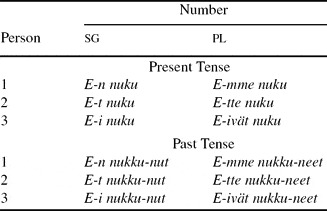
According to the received view of Finnish sentential negation (Holmberg & Nikanne Reference Holmberg, Nikanne, Holmberg and Nikanne1993, Reference Holmberg and Nikanne2002), the negative word e- heads its own NegP projection, which is merged above TP but below CP. The negative word agrees fully with the subject DP, and the verb raises to T (or there is an auxiliary) and obtains tense. The past verb also agrees with the subject in number, but this is an incomplete agreement.Footnote 7 The system is illustrated in Table 1. The negation shows full subject ϕ-features; tense plus number agreement is marked in the verb.
Finnish negation, verb forms and agreement.

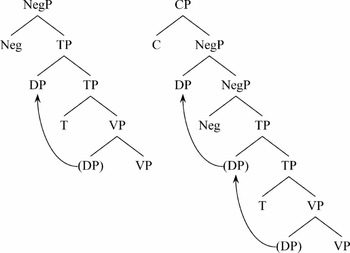
Thus, in Finnish negative sentences, the grammatical subject occupies the (Spec, NegP) position below CP but above TP. The negative head therefore possesses the EPP feature. Building on the model proposed in B&H, we predict that the subject DP should climb up to the position of grammatical subject (Spec, NegP) if and only if children have mastered the complementizer system. Their model also predicts that the DP should climb up to (Spec, TP) when the TP is selected by a negation, but when there is no complementizer. These two constructions are illustrated in (4a–b). In (4a), C is not present, so the subject should not raise to (Spec, NegP). In (4b), C is part of the structure, so the subject DP should raise to (Spec, NegP), and the negation should agree with it.
(4)
These predictions are illustrated also in Figure 1.
According to B&H, the position of the subject DP should depend on the presence of Neg and C.

The attracting head hypothesis, which says that the EPP feature is an intrinsic feature of one or several heads, such as T or v*, makes the prediction that there should be raising to (Spec, XP) irrespective of whether XP is c-commanded by a functional head, such as C or Neg. Hence, there should be no connection between the presence of the complementizer and the positioning of the subject DP. Specifically, this hypothesis predicts that we should find expressions such as (5a–b) in addition to (4a–b). In (5a), the subject DP has raised to (Spec, NegP) even if there is no overt complementizer; in (5b), the subject DP has remained in (Spec, TP) even if the overt complementizer is present.
(5)
We tested these predictions by relying on two previous samples available to us (Toivainen Reference Toivainen1980; Kauppinen Reference Kauppinen1982) and by collecting negative utterances from Finnish-speaking children aged between 1;1 and 5;6 (i.e. one year and one month and five years and six months). The sample and the methods are discussed in section 2.
1.3 Background assumptions
In this section, we make our background assumptions explicit. The discussion touches on e.g. the acquisition of complementizers and negation, and on the EPP and general clause structure in Finnish. None of this is strictly speaking necessary for understanding the results of this study, and may thus be skipped.
According to the so-called full competence hypothesis, children's finite clauses are adult-like from the beginning (at least from around two years of age), and thus contain both T- and C-projections (Poeppel & Wexler Reference Poeppel and Wexler1993). If this is true then we cannot separate constructions (4a–b) in our sample since, according to this hypothesis, C-less clauses do not exist. This hypothesis is still controversial and we will not attempt to enter into this debate here (for a relevant work on Finnish, see Clahsen, Eisenbeiss & Vainikka Reference Clahsen, Eisenbeiss and Vainikka1994). Instead, we rely on the presence of overt complementizers, since we know of no other way to assess the presence of C in child Finnish (Finnish is not a V2 language, for instance). We say that when the overt complementizers emerge, the child has mastered the ‘full complementizer system’. We return to this matter in the last section. However, this assumption is in line with B&H, which relies on Spell Out/PF-legilibity in their explanation of the EPP.
The second issue that needs a brief comment here is the acquisition of negation and negative expressions in Finnish and other languages. There is a remarkable amount of cross-linguistic variation in how negation is expressed in the world's languages (Boeckx Reference Boeckx2008:141–145). Ouhalla (Reference Ouhalla1991) and Zanuttini (Reference Zanuttini1997) make a rough distinction between languages in which the negation is merged above TP and languages in which it is merged below TP.Footnote 8 Finnish represents the former, while German and English represent the latter. Acquisition of negation in below-TP languages has perhaps received most of the attention in the L1 literature (Braine Reference Braine1963; Bellugi Reference Bellugi1967; Klima & Bellugi Reference Klima, Bellugi, Lyons and Wales1967; Bloom Reference Bloom1970; McNeill Reference McNeill1970; Bowerman Reference Bowerman1973; Radford Reference Radford1990; Pierce Reference Pierce1992; Clahsen et al. Reference Clahsen, Penke and Parodi1993; Déprez & Pierce Reference Déprez and Pierce1993, Reference Déprez and Pierce1994; Harris & Wexler Reference Harris, Wexler and Clahsen1996; Drozd Reference Drozd2002; Joseph & Pine Reference Joseph and Pine2002). A consensus view has emerged which assumes that children acquiring a below-TP language, such as French and German, never entertain the wrong above-TP grammar. Although it was at some point held that children acquiring English would pass through an above-TP phase (Bellugi Reference Bellugi1967; Klima & Bellugi Reference Klima, Bellugi, Lyons and Wales1967; Bloom Reference Bloom1970; Brown Reference Brown1973), this view has been questioned (Drozd Reference Drozd1995; Stromswold Reference Stromswold1996, Reference Stromswold1997).
Kauppinen (Reference Kauppinen1982) conducted a longitudal diary study of the emergence of negation in Finnish of one child between ages 1;2 and 3;1. We found that within the 45 non-anaphoric multiword utterances with the negative word e- produced by the child and reported in the study, the negation precedes the subject, main verb and the auxiliary verb. Bowerman (Reference Bowerman1973) studied two Finnish-speaking children, Seppo and Rina, in their early stages of language acquisition, first stage (1;11, MLU (mean length of utterance) = 1.42) and second stage (2;2/2;1, MLU 1.81/MLU 1.83). This study was not concerned specifically with the syntax of negation, but Bowerman, too, suggests that children acquiring Finnish position the negation before nouns, verbs and adjectives. Both studies suggest that children acquiring Finnish converge to the above-TP grammar very early.
Toivainen (Reference Toivainen1980) conducted a detailed study on the acquisition of inflectional affixes in Finnish which extended to almost three years of age and for which we have the full corpus available. Since his corpus was available to us, it will be included in the results of the present study.
Another issue requiring comment concerns the linguistic items that are assumed to belong to the category of complementizers. Rizzi (Reference Rizzi and Haegemann1997, Reference Rizzi and Belletti2004) and Chomsky (Reference Chomsky2008) take C to be a meta-label for a cartography of left-peripheral functional projections. Rizzi (Reference Rizzi and Haegemann1997) proposes that the left periphery is constituted by the following functional heads:
(6) Force Top Foc Top Fin IP
Most important to the present concerns are Force and Fin, the functional heads encoding sentential force and finiteness, respectively. Moreover, according to Rizzi (Reference Rizzi and Haegemann1997), these are always present in the CP-layer, while Top and Foc heads are optional. This framework is followed by Kaiser (Reference Kaiser2006) in her analysis of the discourse functions of word order variations in Finnish negative sentences. Holmberg & Nikanne (Reference Holmberg and Nikanne2002) argue that in Finnish, there is a finiteness head Fin0/AgrS0 above the NegP (FP in the case of Holmberg & Nikanne Reference Holmberg and Nikanne2002). When the negation, auxiliary or the verb raises to Fin0/AgrS0, it obtains agreement. According to this analysis, Fin0/AgrS0 has the EPP feature, since the subject is located at (Spec, FinP). This model is represented in (7).
(7)
Following Rizzi (Reference Rizzi and Haegemann1997, Reference Rizzi and Belletti2004) and Holmberg & Nikanne (Reference Holmberg and Nikanne2002), we assume that overt complementizers such as that or Finnish että are located at the Force head, which is the highest functional head within the elaborated CP-layer. This assumption is supported by the fact that no constituent can move above complementizers in Finnish. As far as the present discussion is concerned, it does not matter whether we assume that Finnish negative clauses contain the Fin0/AgrS0 projection; what matters is whether the presence of Force/C triggers movement to the specifier of the functional head below it. For simplicity, we do not make a distinction between Fin0/AgrS0 and Neg until the last section, where we return to this matter.
Finally, we want to say a word about the EPP and Finnish. Holmberg & Nikanne (Reference Holmberg and Nikanne2002) and Holmberg (Reference Holmberg2005) have argued convincingly that there are functional heads in Finnish which have the EPP property that must be satisfied by merging or moving a phrase into the specifier position of that functional head. Brattico & Huhmarniemi (Reference Brattico and Huhmarniemi2006) argue for the same conclusion. On the other hand, Finnish is a partial pro-drop language that allows the subject pronoun to be dropped in first and second person. This entails that finite clauses in Finnish may appear without an overt subject. Holmberg (Reference Holmberg2005) argues that these sentences nevertheless contain the (little) pro satisfying the EPP, and we follow this model here.
2. METHODS
The data came from three sources. One source was Toivainen (Reference Toivainen1980), which contains transcripts of the language production by monolingual Finnish-speaking children between the ages 1;1 and 2;11. Another source was Kauppinen (Reference Kauppinen1982), from which we included the 48 reported negative expressions. We also collected cross-sectional data from a local day-care center by recording two groups of children,Footnote 9 one which contained children between the ages 2;5 and 3;11 and another between 3;10 and 5;6. We assumed, based on previous research, that this sample is sufficient to see the emergence of overt complementizers. These groups contained a total of 29 children, 16 boys and 13 girls. This constituted ten hours of videotaped conversation. Together, these samples provided data from 53 children between the ages 1;1 and 5;6. In Toivainen's sample, the children held a conversation with an adult, one at a time, whereas in our sample they played mostly together in small groups or, occasionally, in the presence of an adult.
Using these sources, we collected all utterances which contained the Finnish negative verb e- or its imperative form äl-. This constituted a total of 1378 transcribed negative utterances from 53 children, which formed the basic corpus of our study. When it was impossible to be certain about the identity of a particular word or part of the word in the videotape, it was marked with brackets in the corpus (e.g. John loves (Mary) or John loves Ma(ry)). Single word utterances, such as no!, were encoded as single utterances. Subordinate clauses were collected together with their matrix clause (e.g. I believe that John took the toy) and counted as single expressions. Interrupted expressions were marked with ‘-’ (e.g. John loves Ma-). When a particular expression or a phrase was repeated, it was transcribed as such (e.g. John loves John loves Mary) and encoded as a single utterance. For the purposes of computing the MLU, repeated words were not counted. In this sample, the MLUs of the subjects varied from 1.0 (Saana) to 5.64 (Jussi).
We thus sampled only negative utterances from a large amount of raw data. The result is a large sample of negative utterances taken from several children from various ages, but some, especially the younger children, contributed only few expressions. For this reason, the utterances were grouped into seven age-groups based on the chronological age of the child who provided the utterance, rather than on the basis of the MLUs of the individual children. We report the MLUs of these groups as a whole.
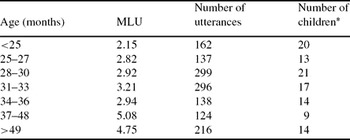
Seven age-groups were established for data analysis. The seven age-groups were selected so that each contained more than 100 expressions, the data came from more than nine children, and each of them spanned a similar age. These guidelines produced the following grouping. All of the children less than 25 months of age were assigned to the first group. The MLU in this group was close to two (2.15). The next four groups all spanned three months (25–27, 28–30, 31–33, 34–36) while the last two groups spanned eleven months (37–48) and sixteen months (49–65), respectively. The last group was assumed to approximate the adult grammar, hence also the linguistic input available to the children. We call this group the ‘control group’.Footnote 10 Finally, since the data gathering took more than one month, some children produced utterances for several age-groups. The sample is characterized in Table 2. The table shows all the age-groups together with MLU, the number of utterances, and the number of children who contributed those utterances, for each group.
Properties of the present sample, as a function of the age groups used in presenting the data.

*Due to the length of data collection, one child may have provided expressions to several age groups.
Our analysis depends on the selection of utterances that contain an overt complementizer. The following complementizer-like elements occur in our sample: kun ‘when’ (67 tokens), mutta ‘but’ (8), että ‘that’ (3), koska ‘because’ (3), jos ‘if’ (5), vaan ‘though’ (3), niin ‘then’ (3). Since we take the CP-layer to be a cartography of a larger inventory of grammatical elements, we will initially include all of these into our analysis. These are all elements which occupy a position above TP and Neg.
Many of the expressions with an overt complementizer were anaphoric negations. For instance, out of the 67 expressions that contained complementizer kun ‘when’, 48 were anaphoric negations of the type illustrated in (8). Anaphoric negation differs from sentential negation in that in an anaphoric negation, the sentence itself is affirmed, while some other sentence salient in the discourse is rejected.
(8)
These were included in the original sample for two reasons. First, it has been claimed in the L1 literature that many of the children's first negative expressions are anaphoric negations (Drozd Reference Drozd1995). The second reason is that in Finnish, many anaphoric expressions contain an overt complementizer kun ‘when’:
(9)
These expressions are therefore important for the present research agenda. That said, we report the results in such a manner that it is possible to perform separate analyses for different complementizer types if there is some reason to do so.
2.1 Predictions and analyses
In this section we briefly summarize the analyses we performed on the data together with the various predictions of the results made on the basis of the sandwich EPP hypothesis presented in B&H. First, we investigated how many of the negative expressions containing an overt complementizer had subject DP at (Spec, NegP). Brattico & Huhmarniemi (Reference Brattico and Huhmarniemi2006) predicts that a major portion of them should occur in this position since, according to this this proposal, the presence of C should suffice to trigger subject movement into (Spec, NegP). Pearson's chi-square (χ2) test will is used to test the results against the null hypothesis – predicted by the attracting head hypothesis – that no such connection exists.
In the second analysis, we assessed whether the DPs raise to a pre-negation position even if there is no complementizer. If they do, it can be concluded that the presence of complementizer is not necessary to trigger movement, while B&H predicts that it should be. If DPs do not raise to (Spec, NegP) without the presence of complementizer, we can conclude that the presence of the complementizer is also necessary for movement. Together this and the above test is used to test the hypothesis that the full complementizer system is both sufficient and necessary to trigger movement into (Spec, NegP). If so, it becomes possible to argue that the EPP feature at Neg/T is inherited from the presence of complementizer.
Brattico & Huhmarniemi (Reference Brattico and Huhmarniemi2006) not only predicts that the presence of the complementizer is both sufficient and necessary to trigger movement into (Spec, NegP). Their model also predicts that when TP is selected by negation, the subject DP should climb to (Spec, TP) (see Figure 1). To investigate whether this prediction holds, we looked at counterexpressions in which the subject DP did not raise to (Spec, TP) position when the negation was present.
3. RESULTS AND DISCUSSION
Before proceeding to the discussion of B&H's sandwich EPP hypothesis, we will deal with the question of whether child Finnish positions Neg above TP, as in adult Finnish, or below TP. There is a straightforward method of addressing this question: if child Finnish develops through a stage in which the negation is located below TP, we should find occurrences of expressions where it occurs after the auxiliaries or the verb, as in English or French (e.g. John does not sleep). In our sample there were none. As in adult Finnish, negation is always positioned before verbal elements. We will thus assume that when there is negation in child Finnish, it is always in a higher position than the verbal element.
Our sample confirms the observation that complementizers are acquired late, at around three years of age (Lebeaux Reference Lebeaux1988; Radford Reference Radford1990; Meisel & Müller Reference Meisel, Müller and Meisel1992; Clahsen et al. Reference Clahsen, Penke and Parodi1993). No overt complementizers were found before 27 months of age. They begin to occur between 28 and 36 months (34 tokens), while the remaining 59 tokens appeared after 37 months. Furthermore, almost all of the early complementizers occurring between 28 and 36 months involve the anaphoric negation construction (see example (9) above).
Next, we will investigate how many of the negative utterances containing an overt complementizer have Comp + DP order, as in (10a), and how many have Comp + Neg/V order, as in (10b).
(10)
There were 74 clauses headed by a complementizer that also contains a verb. In 62 expressions out of the total 74, the overtly filled complementizer occurs with a pre-negation subject DP. A sample of these expressions is provided in (11a–c).
(11)
Thus, out of the total of 74 expressions with complementizers, in 12 cases the complementizer was not followed by the subject DP. Yet, most of these cannot be used to argue against B&H. Two of these were impersonal passives, hence they lack the subject DP and contain possibly a phonologically empty impersonal subject pro. Another two were imperatives, thus constructions that do not usually have subjects. We therefore put these four expressions aside, as they cannot be used to argue either against or in favor of the B&H proposal. In five additional cases, the sentence lacked the subject DP for no apparent grammatical reason, and hence the complementizer could not be followed by an overt subject. These tokens are listed in (12).Footnote 11
(12)
Finally, in three cases, there was a subject present, but it did not occur after the complementizer. These genuine counterexamples to B&H are shown in (13a–c).
(13)
Therefore, in an overwhelming majority of cases, the complementizer is followed by the subject if an overt subject is present in the first place. Even if we include the subjectless expressions in (12) as counterexamples to the sandwich EPP hypothesis of B&H, this data does not favor the null hypothesis that the distribution of Comp + DP and Comp + Neg orders have the same frequency (χ2(1) = 33.784, p < .001). Thus, the presence of an overt complementizer appears to constitute a sufficient condition for phrasal movement to (Spec, NegP).
Since in matrix finite clauses the complementizer is often phonologically null, there is no easy way to investigate whether the DP + Neg order implies the presence of a complementizer. However, we can investigate whether DP + Neg orders are common when there is no overt complementizer. Three types of constructions which did not contain an overt complementizer were examined: expressions in which the DP was positioned before the negation (DP + Neg), where the DP followed the negation (Neg + DP), and where the negation was followed by the main verb. Further, the Neg + V constructions were such that the DP either followed the verb or was missing (Neg + V + (DP)). Examples of these constructions are given in (14a–c). Notice that other expressions besides the subject DP, negation and the verb were ignored when assessing the word order between the three.
(14)
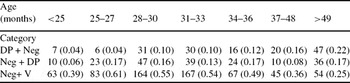
The frequency and number of these construction types as a function of the age-group are summarized in Table 3.
Token numbers and frequencies (in brackets) of DP + Neg, Neg + DP and Neg + V constructions as a function of chronological age.

Beginning with the figures in the last category (age >49 months), which we take to represent the closest equivalent in our sample to the adult grammar, all variations are represented with approximately the same frequency. No statistically significant difference between the number of tokens in these groups was detected (χ2(2) = 3.606, p = .165). But, as seen from Table 3, all other age-groups are dominated by expressions which are headed by the negation (Neg + V and Neg + DP). Thus, the DP does not appear to raise to the subject position. Together, these two analyses suggest that in child Finnish the presence of an overt complementizer is both necessary and sufficient for the subject to raise to (Spec, NegP). When there is no complementizer, a vast majority of constructions are such that the subject DP does not raise to (Spec, NegP).
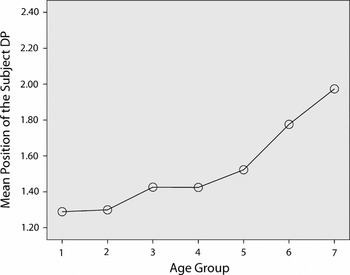
There is a noteworthy systematic trend present in the acquisition data in Table 3: the subject seems to climb gradually higher and higher in the structure as a function of the age-group. Figure 2 shows how the ‘average position’ of the subject evolves over time. The averge position was computed so that three possible positions were encoded in numbers as follows: DP + Neg + V (position 3), Neg + DP + V (position 2), Neg + V (+DP) (position 1).
Mean position of the subject with respect to the negation and the verb, here shown as a function of the age in months. The position was encoded numerically so that 3 = DP + Neg + V, 2 = Neg + DP + V, 1 = Neg + V (+DP), and the mean for each age-group was taken over the resulting numbers.

The data can be subjected to one additional analysis. The initial grammar is dominated by expressions which begin with a negative word (see Table 3). The subject DP seems to climb to the clause-initial subject position only gradually. Brattico & Huhmarniemi (Reference Brattico and Huhmarniemi2006) predict that the subject DP should climb up to (Spec, TP) if there is another head above TP. Neg, the negation head, is merged to TP, so we can test this prediction by comparing the frequencies of orders Neg + V + DP (not predicted in B&H) and Neg + DP + V (predicted in B&H) in contexts in which the DP should not normally occur in a post-verbal position (or in other words, we want to exclude situations in which the DP represents an object). We include in our analysis constructions that have a DP in the subject nominative case, (15a–b), or in the locative case, (15c) (for locative subjects, see Collins Reference Collins1997 and Holmberg Reference Holmberg2000), but exclude postverbal partitive or accusative DPs because for the object case DPs it is harder to ascertain that they ‘should have been in the subject position’. Notice that in examples (15a–b) the nominative subject occurs in a post-verbal position, while in (15c) the locative phrase is also post-verbal.
(15)
We also assume that to qualify the construction has to involve agreement between the DP and the negation, and the default agreement in the case of locatives and plural DPs, as in adult Finnish.
In total, there were 42 expressions of the type Neg + V + DP such that the DP should not have occurred in the post-verbal position according to the above criteria, and 191 expressions of the type Neg + DP + V. Tested against the null hypothesis that the distribution of Neg + V+ DP orders and Neg + DP + V orders is equal, the observed difference is statistically significant (χ2(1) = 95.283, p < .001). The presence of negation above TP therefore constitutes one factor in determining whether the subject raises to (Spec, TP). The distribution of the tokens as a function of age-groups is shown in Table 4.
Token numbers and frequencies (in brackets) of *Neg + V + DP orders and Neg + DP + V orders as a function of chronological age.

This shows that when (at around two years of age) the children position the subject DP in the sentence, it is likely to appear in the correct position before the verb rather than after. The model proposed in B&H offers one explanation for this phenomenon: the subject DP raises to (Spec, TP) because of the presence of Neg, but not to (Spec, NegP) because the complementizer system has not fully matured. However, this time the counterexamples are numerous enough in our opinion to warrant an explanation. We found no syntactic property to distinguish Neg + V + DP and Neg + DP + V constructions from each other, leading us to speculate that there is a currently unknown factor causing the subject to remain at the end of the sentence, presumably inside of the VP (or vP).
4. EPP AND FUNCTIONAL HEADS
Grammatical movement is directional in the sense that it targets elements inside lexical domains, where they receive their thematic roles, and moves them into the domain of functional heads, where they participate in a feature exhange (both A-position and A-bar positions appearantly involve agreement, see Reintges, La Sourd & Chung Reference Reintges, LeSourd and Chung2006). It has thus been assumed that grammatical movement has something to do with functional heads, Case and ϕ-features.
The standard assumption has been that functional heads possess an attracting feature, call it EPP, that compels elements to move into their specifier position. We call this view the attracting head hypothesis. The data presented here challenges that view. In Finnish negative clauses, the negation that appears between C and TP possess the EPP feature. The data reported here suggests that during language acquisition, the subject DP raises to (Spec, NegP) if and only if the full complementizer system has matured and an overt complementizer is present. When the complementizer is not present, the subject DP raises to a position between Neg and T. Overall, this evidence suggests that it is not single functional heads that require their specifier position to be filled, but rather two functional heads which require the position between them to be filled. An explanation of the EPP thus calls for a reason why two functional heads cannot appear too close to each other.
How should these results be interpreted in the light of the more elaborate theory of the left periphery? Both Chomsky (Reference Chomsky2008) and B&H assume that C values nominative Case and is linked with finiteness. Both link it semantically with force (declarative, interrogative, imperative, etc.). In addition, Chomsky assumes that it has tense and ϕ-features. Interpreted under the theory of Rizzi (Reference Rizzi and Haegemann1997, Reference Rizzi and Belletti2004), Holmberg & Nikanne (Reference Holmberg and Nikanne2002) and Kaiser (Reference Kaiser2006), these properties of C seem to designate the finiteness-head Fin. Assume, then, that it is Fin which is related to finiteness and nominative Case. On the other hand, we found that (under these assumptions) the EPP feature of Fin was activated only after overt complementizers emerged. Thus, interpreted under the more elaborated C-system, Fin does not attract without the presence of Force. It remains to be explained why this connection exists. The following is a possibility. Since it is known that children make a distinction between finite and non-finite clauses from very early on (Clahsen Reference Clahsen1991; Pierce & Déprez Reference Pierce and Deprez1993; Hyams Reference Hyams1994), we could assume that FinP emerges early. In child Finnish, the negation is moved to Fin. The emergence of overt complementizers corresponds to the emergence of Force and/or other functional projections higher than Fin. Then the EPP feature of Fin emerges when Force is layered on the top of Fin. Within this terminology, the properties of finiteness spread over two heads: agreement and nominative Case to Fin and EPP to Force.
The more finely structured model of the CP may be relevant in addressing certain problems associated with the acquisition of the CP-layer. We pointed out earlier that there is much evidence that the CP-layer matures later, and indeed we found supporting evidence from our own corpus for this proposition. Hyams (Reference Hyams1994) takes issue with the claim that the CP-projection matures later, on the basis of the fact that children distinguish finite and non-finite clauses from very early on, and that their grammars seem to contain a position above IP to which the verb can move (V2 phenomenon). She argues that children have the full clause structure CP–IP–VP available from the earliest stages and claims that the late emergence of overt complementizers is due to a delay in lexical learning. Although controversial, let us suppose that Hyams' hypothesis is true. The following problem now emerges. On the basis of our observation that overt complementizers trigger movement to (Spec, NegP), we would be inclined to reject the idea that the emergence of complementizers would be due to lexical learning. It appears that there is some grammatical mechanism that is being acquired that goes in tandem with the emergence of overt complementizers. On the other hand, if we assume that Hyams' data and interpretation are correct and that children indeed have some above-IP projection available, we are led to assume the full clause structure from the beginning and hence no acquisition of C. These two observations thus conflict, but the Force–Fin structure may provide a reconciliation. We could take the position that overt complementizers emerge when the Force projection becomes available, while the evidence cited by Hyams for the full clause structure could be attributed to the presence of Fin projection. In other words, perhaps the Fin–IP–VP structure is initially available, while the Force projection is acquired later.
Another possibility is to follow Penner (Reference Penner1994), who cites similar data from the V2 phenomenon but makes the following suggestion:
The overall impression is that the ‘knowledge’ of the COMP system at the initial stage is in some sense incomplete. At first glance, it seems that the COMP system is available at the level of feature instantiation, but is inoperative at the level of Spell Out. In other words, the COMP projection is part of the grammatical representation, but neither COMP nor Spec-CP are allowed to surface. (Penner Reference Penner1994:178)
Characterizing the maturation of the CP-layer as something to do with Spell Out, rather than with lexical acquisition, leaves room for the possibility that it interacts with grammatical principles and hence explains, at least in principle, why the emergence of overt complementizers would be related to the EPP. For instance, B&H explicitly suggests that the EPP follows from Spell Out properties.
We think that other studies in language acquisition support rather than reject the view argued in this paper. Klima & Bellugi (Reference Klima, Bellugi, Lyons and Wales1967) observed that in English negative sentences, children often fail to raise the subject:
- (16)
a. No I see truck.
b. No Fraser drink all tea.
This phenomenon, in which the subject remains lower in the structure if compared to the target grammar, is well-documented in several languages (Dáprez & Pierce Reference Déprez and Pierce1994). The present data confirms the pattern that subjects sometimes fail to raise and further adds that this movement might have something to do with the presence of C. However, it is well-known that in addition to failing to raise, the subject may be completely lacking (Rizzi Reference Rizzi1994). Since the EPP can be satisfied either by moving or expletive-insertion, the fact that children omit subjects suggests an EPP-related explanation.
Chomsky (Reference Chomsky2008) proposes that T inherits some of its tense features from C. We take issue with this hypothesis on the grounds that in Finnish, C selects a negation that does not show tense information. This data would be compatible with the tense-inheritance view only if the whole negation projection were transparent for the traveling tense features, but this assumption raises more questions that it answers. For instance, if tense information can travel through projections without overt effect, why does it stop at T? Why does it not leave any visible sign on Neg? Which features, overall, are capable of lowering in the phrase structure without any overt effect? On balance, since it is known that tense information is sometimes overtly present in the complementizer, as in Irish, we are led to suggest that in this case the complementizer picks the features from tense, rather than vice versa.
A variety of complementizer-like constituents, some of which are clear instances of complementizers such as että ‘that’, and others which look like coordinate conjunctions, were assumed in this study to reside within the CP-layer. The reason for this assumption is that these are all elements which occupy higher position in the clause structure than the negation, hence they must reside in the CP-layer. Furthermore, semantically these elements encode mood, illocutionary force, and other sentential-level features that belong to the CP-layer. However, the question arises whether the results would have been different had this selection been done differently. It seems to us that the results would not change no matter how the selection is done, since there were only three clear counterexamples to B&H. Two of these involved että ‘that’, one involved jos ‘if’. Since että is a clear instance of complementizer, filtering some complementizer-like expressions out from the analysis would not eliminate the counterexamples. On the other hand, with only three counterexamples (in (13a–c)) there is no meaningful filter that would eliminate enough of the positive cases to change the results.
An anonymous NJL reviewer points out that there is another interpretation of the data. Recall that we found that the presence of complementizer triggers the Comp + DP + Neg order, while the lack of complementizer triggers the Neg + DP + V order instead. It is possible that in a clause without the overt complementizer, the complementizer (or functional structure higher than T or Neg) is present but it is the negation that is raised to C. This hypothesis explains why the subject is left into a post-negation position even if it had been raised originally to (Spec, NegP). It seems to us, however, that this alternative scenario is also consistent with B&H. If Neg raises to C, and the subject DP is in the subject (Spec, NegP) position, then we can still maintain that it is the C–T system that has triggered phrasal movement to (Spec, NegP). We therefore acknowledge this as a possibility. On the other hand, we would be hard-pressed to assume that in every child Finnish sentence that begins with a negation but lacks a complementizer the negation has raised to a higher functional head. It is certainly possible to think that the negation raises to Fin/AgrS, but then there is no explanation why this movement takes place if and only if there is no overt complementizer. A better bet would be to say that the negation raises to C/Force, since then one can explain without further ado why complementizers are absent in such constructions. However, Finnish is not a V2 language and does not require head movement to C if there is no overt complementizer. This proposal would require, therefore, strong independent support. We leave this question, which is somewhat independent of the sandwich EPP hypothesis, for future research.
5. CONCLUSIONS
By examining child Finnish we found evidence that the subject DP moves to the position of grammatical subject if and only if the full complementizer system is matured so that there are overt complementizers present. Furthermore, we found that when the complementizer system was not yet in place, the DPs were located between two functional heads, Neg and V. We explained this data by relying on the sandwich EPP hypothesis, which says that grammatical movement is not triggered by features of single heads, but depends on a more complex interplay between two functional heads.
ACKNOWLEDGEMENTS
We would like to thank Anne Vainikka and Saara Huhmarniemi for their colloboration, and three anonymous NJL reviewers for their valuable feedback.