Introduction
Tracheoesophageal puncture is an important part of voice rehabilitation for the total laryngectomy patient, and was originally described as a secondary procedure following laryngectomy.Reference Singer and Blom1 Within two years of Singer and Blom's ground-breaking paper,Reference Singer and Blom1 it was noted that tracheoesophageal puncture could be performed primarily.Reference Maves and Lingeman2–Reference Lau, Wei, Ho and Lam5 Primary tracheoesophageal puncture can eliminate the need for a second procedure following laryngectomy and can facilitate more rapid acquisition of tracheoesophageal speech. Following laryngectomy and prior to manual suture closure of the pharynx, the puncture is created and maintained with a feeding tube or other catheter, with voice prosthesis placement taking place at a later date. To facilitate acquisition of fluent tracheoesophageal speech, cricopharyngeal myotomy is frequently performed concurrently.Reference Elmiyeh, Dwivedi, Jallali, Chisholm, Kazi and Clarke6
In concert with these developments in voice restoration, Halevy and Sade reported the first use of staplers in performing total laryngectomy in 1983.Reference Halevy and Sade7 In stapler-assisted laryngectomy, a linear stapler is used to cut and close the pharynx, with concomitant excision of the larynx. This shortens operative time, simplifies and standardises pharyngeal closure, prevents salivary spillage and wound contamination, and affords fistula rates comparable to or better than those for conventional pharyngeal closure via suture.Reference Wolfensberger and Simmen8–Reference Dedivitis, Aires, Pfuetzenreiter, Castro and Guimarães17
Following stapler-assisted laryngectomy, the pharynx is closed; therefore, the surgeon must rely on endoscopic methods for creation of the tracheoesophageal puncture. Leahy and Tufano described a flexible fibre-optic technique for tracheoesophageal puncture creation used concurrently with stapler-assisted laryngectomy in 2010, but to date no further work in this regard has been published.Reference Leahy and Tufano18
Herein, we describe our initial experience with a method that combines stapler-assisted laryngectomy and primary tracheoesophageal puncture, with concurrent prosthesis placement and cricopharyngeal myotomy. This method of tracheoesophageal puncture has been published previously and is referred to as the hybrid tracheoesophageal puncture procedure.Reference Damrose, Cho and Goode19
Materials and methods
This study was conducted with the approval of the Stanford University Medical Center Institutional Review Board.
Patients
The charts of patients who underwent total laryngectomy and a hybrid tracheoesophageal puncture procedure between January 2009 and March 2015 were reviewed. Charts were reviewed for demographic data, surgical data, complications, ability to achieve voicing and time to valve failure.
Procedure
The feeding tube port from the Blom–Singer tracheoesophageal puncture set is removed, and the Provox® Guidewire is coapted to the remnant guidewire and dilator to create the hybrid device (Figure 1), as previously described.Reference Damrose, Cho and Goode19
(a) Provox Guidewire (left) and InHealth Technologies dilator (right). (b) Provox Guidewire coapted to the InHealth Technologies dilator to create the hybrid device.

To facilitate cricopharyngeal myotomy after completing stapler-assisted laryngectomy, a 7.0 wire-reinforced endotracheal tube is passed carefully via the mouth, and advanced sequentially into the pharynx then the oesophagus. The cuff is inflated proximal to the stoma and inferior to the staple line, and residual muscle is cut with a number 15 blade to perform a complete myotomy (Figure 2).
Cricopharyngeal myotomy is performed after inserting endotracheal tube and inflating cuff.
The puncture needle and jacket taken from the Blom–Singer tracheoesophageal puncture set is used to create the puncture in the lumen of the endotracheal tube (Figure 3). The needle and endotracheal tube are withdrawn, leaving the jacket in place in the puncture site.
The puncture needle and jacket taken from the Blom–Singer tracheoesophageal puncture set is used to puncture the lumen of the endotracheal tube.
The wire end of the Blom–Singer tracheoesophageal puncture device is passed in a retrograde fashion, delivering the jacket, wire, dilator and Provox Guidewire through the mouth. The Provox Guidewire is detached from the Blom–Singer tracheoesophageal puncture set, and the indwelling voice prosthesis, either Atos Provox or InHealth Technologies®, is then inserted onto the Provox Guidewire. The valve is then passed in an anterograde fashion and inserted into the puncture site (Figure 4).
The valve is passed in an anterograde fashion and inserted into the puncture site.
Results
Thirty-nine patients underwent total laryngectomy performed by the senior author (EJD) for malignancy of the larynx and/or pharynx, with either primary or secondary tracheoesophageal puncture for voice restoration. Of these, nine patients underwent stapler-assisted laryngectomy; seven of these nine patients concurrently underwent a hybrid tracheoesophageal puncture procedure and stapler-assisted laryngectomy with cricopharyngeal myotomy. These seven patients were the focus of this review.
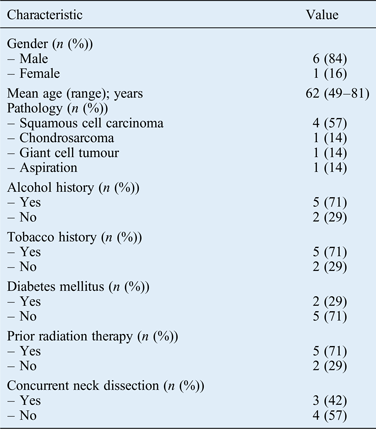
Demographic and clinical data are shown in Table I. Five of the seven patients (71 per cent) had undergone prior radiation therapy. None of the patients had a history of hypothyroidism or had undergone prior chemotherapy. The procedure was successfully attempted and accomplished in all patients. The average length of hospital stay was 6 days (range, 2–10 days). One patient developed a pharyngocutaneous fistula and one patient developed a haematoma. No patient required a subsequent operative procedure to replace or repair their tracheoesophageal prosthesis.
Demographic and clinical data*
*For the seven patients who underwent stapler-assisted laryngectomy with hybrid tracheoesophageal puncture
All seven patients achieved voicing. Mean time to first documented phonation was 30 days (range, 7–77 days). Mean time to first valve change was 90 days (range, 35–177 days) and mean follow-up time was 118 months (range, 88–145 months). The most common reason for valve change was leakage through the prosthesis.
Discussion
The utility of staplers for pharyngeal closure was originally recognised in 1969, when they were used in the resection of hypopharyngeal diverticulae,Reference Hoehn and Payne20 but it was not until 1983 that Halevy and Sade described their applicability in the performance of total laryngectomy.Reference Halevy and Sade7 Stapler-assisted total laryngectomy affords simultaneous laryngeal excision with pharyngeal closure, shortening and simplifying the procedure. The fistulisation rates are equivalent or superior to those of conventional closure. Furthermore, sealing the pharynx and resecting the larynx concurrently eliminates the risk of salivary wound contamination, and theoretically reduces the risk of tumour seeding.Reference Wolfensberger and Simmen8–Reference Dedivitis, Aires, Pfuetzenreiter, Castro and Guimarães17
In conventional laryngectomy and pharyngeal closure, the puncture is created and any residual cricopharyngeal muscle is cut prior to closing the pharynx. This method allows easy creation of the puncture with placement under direct visualisation by a single operator. With stapler-assisted laryngectomy, however, the pharyngeal and oesophageal lumen cannot be accessed through the neck, and therefore endoscopic techniques must be employed.
In the only publication to address primary tracheoesophageal puncture in patients undergoing stapler-assisted laryngectomy, Leahy and Tufano described a two-operator method using a flexible fibre-optic oesophagogastroduodenoscope passed into the cervical esophagus.Reference Leahy and Tufano18 Following transillumination and insufflation, a guidewire and breakaway dilator system were employed to create the puncture, with patency of the tract maintained by the final introduction of a red rubber catheter. Voice prosthesis placement was then undertaken two to three weeks later in clinic, with all patients achieving alaryngeal speech.
Cricopharyngeal myotomy is frequently performed with or after laryngectomy to enhance phonation. Phonation enhancement is the result of optimisation of the vibrations of the pharyngoesophageal segment used in tracheoesophageal speech.Reference Hamaker, Singer, Blom and Daniels3–Reference Elmiyeh, Dwivedi, Jallali, Chisholm, Kazi and Clarke6 In the hybrid tracheoesophageal puncture procedure, a cuffed endotracheal tube is used to facilitate myotomy. As described by Chodosh in 1975 for the treatment of dysphagia secondary to cricopharyngeal spasm, the tube is easily advanced along the pharynx and cervical oesophagus.Reference Chodosh21 Cuff inflation allows ready distension of the target muscle fibres and a firm platform on which to carefully section them.Reference Chodosh21 When passed along the pharynx following stapler-assisted laryngectomy, the stapled suture line is more than strong enough to allow passage of the tube without fear of perforation. The endotracheal tube is also helpful for creation of the puncture.
• The utility of primary hybrid tracheoesophageal puncture procedure in stapler-assisted laryngectomy with cricopharyngeal myotomy has not been previously evaluated
• This retrospective review demonstrates that the procedure is successful in this population, including voicing outcomes
• The hybrid tracheoesophageal puncture procedure is simple, and a single operator can achieve primary tracheoesophageal puncture and valve placement
• In addition, the procedure facilitates concurrent cricopharyngeal myotomy
It is possible to puncture directly into the lumen of the endotracheal tube using a needle, as originally described by Maniglia in 1982,Reference Maniglia22 and subsequently with slight modification by Cannon in 2001.Reference Cannon23 This obviates the risk of perforating the posterior oesophagus and subsequently allows passage of a guidewire into the pharynx. In our experience with the hybrid tracheoesophageal puncture procedure, the tip of the endotracheal tube can be readily seen as a dimple in the tracheoesophageal party wall, and allows for precise puncture placement. Leahy and Tufano readily recognised the advantages of stapler-assisted laryngectomy over conventional pharyngeal closure, and theorised that primary tracheoesophageal puncture was still possible in these patients.Reference Leahy and Tufano18
This particular study is a retrospective review of a new technique and is subject to bias. In addition, the number of patients included is not large. Nonetheless, it is evident that the hybrid tracheoesophageal puncture procedure affords several additional advantages over conventional pharyngeal closure. This is a single-operator as opposed to a two-operator procedure. It allows for concomitant puncture and valve placement. In addition, it enables the easy accomplishment of pharyngeal myotomy. Overall, it is helpful in the acquisition of fluent tracheoesophageal speech.
Conclusion
The hybrid tracheoesophageal puncture procedure is a simple and reliable method of performing tracheoesophageal puncture with simultaneous placement of a voice prosthesis. The technique is readily applicable for use in stapler-assisted total laryngectomy through the insertion of an endotracheal tube into the sealed pharynx. This manoeuvre not only assists puncture and valve placement but also enables concomitant cricopharyngeal myotomy. The staple line is more than robust to permit the passage of the tube. Combining the hybrid tracheoesophageal puncture procedure and stapler-assisted laryngectomy may help to simplify and optimise the techniques of total laryngectomy and primary tracheoesophageal puncture.