The coronavirus pandemic has caused more than 500 million confirmed cases and more than 6 million deaths worldwide, and approximately 12 billion doses of vaccine have been administered.1 With the development of the COVID-19 vaccine, the approval of its application by the society was also seen as an important process. In 2019, WHO stated that vaccine hesitancy and rejection were among the threats to global health. This situation came to the fore again with the COVID-19 pandemic.Reference Erkekoğlu, Köse and Balcı2, Reference Pogue, Jensen and Stancil3 It was stated that the increasing rate of vaccination in health care workers was effective in protecting not only themselves but also patients.Reference Li, Luo and Watson4, Reference Manning, Gerolamo and Marino5 Psychological factors were also reported to have an impact on individual attitudes toward vaccination.Reference Al-Sanafi and Sallam6
COVID-19 caused individual and social measures to be taken at the global level, and swiftly changed the social life.Reference Berk, Öner and Sarıkaya7, Reference Timurtaş, Avcı and Ayberk8 These changes, which affected the lives of individuals, were likely to affect quality of life, which is the expression of life satisfaction,Reference Batawi, Tarazan and Al-Raddadi9 Quality of life is affected by many factors, such as interpersonal relations, the environment, and psychological and physical conditions.Reference Cihan and Şahbaz Pirinççi10 It is stated in the literature that anxiety affects quality of life, and as depression increases, quality of life decreases.Reference Strine, Kroenke and Dhingra11 Psychosocial stressors, such as disruptions in routines, inadequacy in daily needs, little health information about COVID-19, and uncertainty about the epidemic, along with fear of direct health, were associated with increased levels of anxiety and depression.Reference Fiorillo and Gorwood12, Reference Taylor13 Individuals who were less concerned about the viral outbreak were less likely to follow hygiene behaviors (for example, hand washing), social distancing, and be vaccinated if the vaccine was available.Reference Taylor13 On the other hand, individuals with extreme anxiety were more likely to engage in socially harmful behaviors, such as excessive avoidance, and were even home-bound for fear of the contagion.Reference Taylor13, Reference Asmundson and Taylor14, Reference Taylor, Landry and Paluszek15 The unhindered increase in the spread of the epidemic, pandemic conditions, behavioral changes, and the fear of getting sick have affected the psychological processes of individuals and society.Reference Zeybek, Bozkurt and Aşkın16, Reference Kaya Ciddi and Yazgan17, Reference Zandifar and Badrfam18
During the pandemic process, there have been changes relaed to quality of life of individuals due to both limitations and disease concerns.Reference Ferreira, Pereira and da Fé Brás19 It was understood that individual behavioral reactions of individuals had a direct effect on social outcomes in the COVID-19 pandemic.Reference Öztürk20 It was thought that evaluating the emotions, thoughts, behaviors, and measures taken by individuals related to COVID-19, as well as their psychological state, could guide protective and preventive studies along with the treatment of the physiological problems encountered. Determining to what extent the COVID-19 pandemic has affected people’s quality of life would be beneficial in obtaining information that will be used by all disciplines and in producing solutions to the difficulties faced.Reference Ferreira, Pereira and da Fé Brás19 Therefore, this study aims to determine the feelings, thoughts, and behaviors related to the disease and quality of life of individuals who applied to the COVID-19 vaccine unit of a state hospital.
Method
Study Design
This descriptive and cross-sectional study was conducted in the COVID-19 vaccine unit of a state hospital in a city center of Western Türkiye between December 2021 and February 2022, when widespread vaccination was carried out around the country.
Participants
The population of the study was determined as all individuals who could be reached that applied to the COVID-19 vaccine polyclinic between the dates of the study. The sample of the study was determined as all individuals who applied to the COVID-19 vaccine polyclinic, who met the inclusion criteria, and volunteered to participate and could be reached. Inclusion criteria for the study were: being an individual over the age of 18, not having a communication problem, having applied to the COVID-19 vaccine polyclinic during the pandemic period, volunteering to participate in the research, and not having any physical and mental health problems that may affect the quality of life. The minimum number to be reached with 50% unknown prevalence, 0.05 error, and at a 95% confidence interval was calculated as 384 in the Epi Info program. In the study, 360 individuals were reached. 94% of the calculated sample number were reached.
Data Collection
In the study, the data were collected by the method of questionnaire study with volunteers who met the inclusion criteria. The application time lasted about 10-15 minutes. Data were collected through the Individual Information Form, the Multidimensional COVID-19 Scale, and the Impact of COVID-19 on Quality of Life Scale.
Ethical Considerations
Ethical approval was obtained on September 29, 2021 with the no. 965 (20 478 486) from a state university Medical Faculty Health Sciences Ethics Committee for the research. As it is a COVID-19 study, an online research permit application was made to the T.R. Ministry of Health Scientific Research Platform and approval was received via email. Permission was obtained from the authors through email for the Multidimensional COVID-19 Scale and the Impact of COVID-19 on Quality of Life Scale. The principles of the Declaration of Helsinki were complied with at all stages of the study, and the study was conducted with those who volunteered to participate and gave informed consent.
Instruments
Individual Information Form
Questions containing sociodemographic characteristics of individuals were prepared by the researcher in line with the literatüre.Reference Strine, Kroenke and Dhingra11, Reference Kaya Ciddi and Yazgan17, Reference Güngör, Atik and Akyol21 It consisted of 13 questions containing information such as age, gender, marital status, educational status, COVID-19 test-diagnosis status, and opinion on the vaccine.
Multidimensional COVID-19 Scale
The scale was developed by Durak Batigün and Şenkal Ertürk (2020) and consists of a total of 39 questions that were thought to express feelings, thoughts, behaviors, and precautions regarding COVID-19.Reference Durak Batıgün and Şenkal Ertürk22 The 11th question of the scale was prepared as the reverse item on a 1-5 Likert-type scale and Cronbach alpha reliability coefficients determined for the Multidimensional COVID-19 Scale were 0.90 for the total score, 0.88 for the feelings and behaviors sub-dimension related to COVID-19, 0.77 for the thoughts about COVID-19 sub-dimension, and 0.75 for the measures taken regarding COVID-19 sub-dimension. An increase in the score obtained was interpreted as the presence of positive emotions, thoughts, and behaviors related to COVID-19. The Cronbach’s alpha coefficients of the scale in this study were calculated as 0.94, 0.91, 0.81, and 0.89, respectively.
The Impact of COVID-19 on Quality of Life Scale
The scale was developed by Repišti et al. (2020) and its Turkish validity and reliability was performed by Sümen and Adibelli (2021) on individuals with and without a diagnosis of COVID-19.Reference Repišti, Jovanović and Kuzman23, Reference Sümen and Adibelli24 It consists of 6 items covering the basic quality of life areas related to mental health in a 5-point Likert type. The higher the score, the greater the impact of the pandemic on the individual’s quality of life. The Cronbach’s alpha coefficient of the scale was found to be 0.91 for the data obtained from the general population, 0.90 for the undiagnosed sample, and 0.85 for the diagnosed sample.Reference Sümen and Adibelli24 The Cronbach’s alpha coefficient of the scale in this study was calculated as 0.86.
Statistical Analyses
SPSS 20.0 package program was used to evaluate the data. In the analysis of the data, number percentage distribution and descriptive statistics were made to define the demographic characteristics. The relevance of the data to the normal distribution was checked with the Kolmogorov-Smirnov test of normality. Kolmogorov Smirnov test value was 0.083, P<0.001. Because the data did not show normal distribution, the Mann Whitney U test, Kruskal Wallis test, and Spearman correlation analysis were used.
Results
It was found that 27.5% of the participants were between the ages of 25-34, 50% were women, 31.1% were high school graduates, 58.9% were married, 64.2% were employed, 54.3% of the employees worked in the public sector, 47.8% had incomes equal to their expenditures, 85.8% lived with their families, 84.4% did not have a chronic disease, and 42.1% of those with chronic diseases had cardiovascular disease. It was determined that 73.9% of the participants were not diagnosed with COVID-19, 66.7% had a COVID-19 test, 69.2% of their relatives were diagnosed with COVID-19, 76.7% did not lose their relatives due to COVID-19, and 51.7% of them fully believed in the benefit of the COVID-19 vaccine.
The participants’ multidimensional COVID-19 scale score was 83.00 (24.00), the feelings and behaviors related to COVID-19 sub-dimension score was 31.50 (12.00), the thoughts on COVID-19 sub-dimension score was 31.00 (8.00), and the measure taken for COVID-19 sub-dimension score was 20.00 (6.00). The participants’ score on the scale of the impact of COVID-19 on their quality of life was determined to be 3.16 (1.46) (Table 1).
Distribution of the participants’ Multidimensional COVID-19 Scale scores and its sub-dimensions
COVID-19 Impact on Quality of Life Scale scores (n=360)

IQR: Inter QuartileRange.
It was determined that there was a significant difference between the other sub-dimensions and total scores except for the age of the participants and thoughts about COVID-19 (z: −3.580; P<0.05). It was found that the participants aged 35 and over had higher scores than those under the age of 35. According to the gender of the participants. it was determined that the scores of women were higher than the average scores of men (z: −3.439; P<0.05). It was detected that elderly people and women had more positive perceptions about COVID-19 (Table 2).
Comparison of the sociodemographic characteristics and experiences of the participants with the COVID-19 epidemic and the scores of the Multidimensional COVID-19 Scale and its sub-dimensions (n=360)

*P<0.05.**P value obtained as a result of Bonferronicorrection, P=0.008. IQR: interquartile range. z: Mann Whitney U test. x 2: Kruskal Wallis test.
There was a significant difference between the scores of the marital status of the participants and the scores of their feelings and behaviors related to COVID-19 and the measures taken for COVID-19 sub-dimensions (z: −2.222; P<0.05); scores of the single individuals were lower than the scores of the married individuals (z: −2.324; P<0.05). It was determined that the perceptions of those who were married were more positive (Table 2).
In the sub-dimension of feelings and behaviors related to COVID-19, the scores of individuals living with family were higher than the scores of individuals living alone. In the measures taken regarding the COVID-19 sub-dimension, the scores of individuals living with family were higher than the scores of individuals living alone or with friends (x 2: 8.592; P<0.05). There was a significant difference (x 2: 9.023; P<0.05) between the the total scores of individuals the participants live with and the multidimensional COVID-19 scale (Table 2). It was seen that the perceptions of individuals living alone were more negative.
The total scores of the multidimensional COVID-19 scale and sub-dimensions of the participants with chronic disease were higher than the scores of the participants without chronic disease (z: −3.153; P<0.05) (Table 2). It was detected that there was a significant difference between the participants’ opinions on the COVID-19 vaccine and the mean score of the measures taken regarding the COVID-19 sub-dimensions (z: 15.714; P<0.05). The scores of the individuals who fully believed in the benefit of the vaccine were higher than the scores of the individuals who partially believed in the benefit (Table 2). It was determined that the perceptions of those who had a chronic disease and who fully believed in the benefit of the vaccine were more positive.
When the effect of COVID-19 on the quality of life of the participants was examined, it was determined that the scores of women were higher than the average scores of men (z: −3.433; P<0.05). It was seen that the scores of the employed individuals were lower than the scores of the unemployed individuals (z: −2.822; P<0.05). It was found that the mean scores of individuals with chronic disease were higher than the scores of individuals without chronic disease (z: −3.361; P<0.05) (Table 3). It was observed that the quality of life of women, unemployed individuals, and those who had chronic diseases were more affected.
Comparison of the sociodemographic characteristics of the participants and the scale scores of the impact of COVID-19 on quality of life (n=360)

* P < 0.05. IQR: interquartile range. z: Mann Whitney U test. x 2: Kruskal Wallis test.
There was no significant difference between the participants’ experiences of the COVID-19 pandemic and the score of the impact of COVID-19 on the quality of life scale (P>0.05).
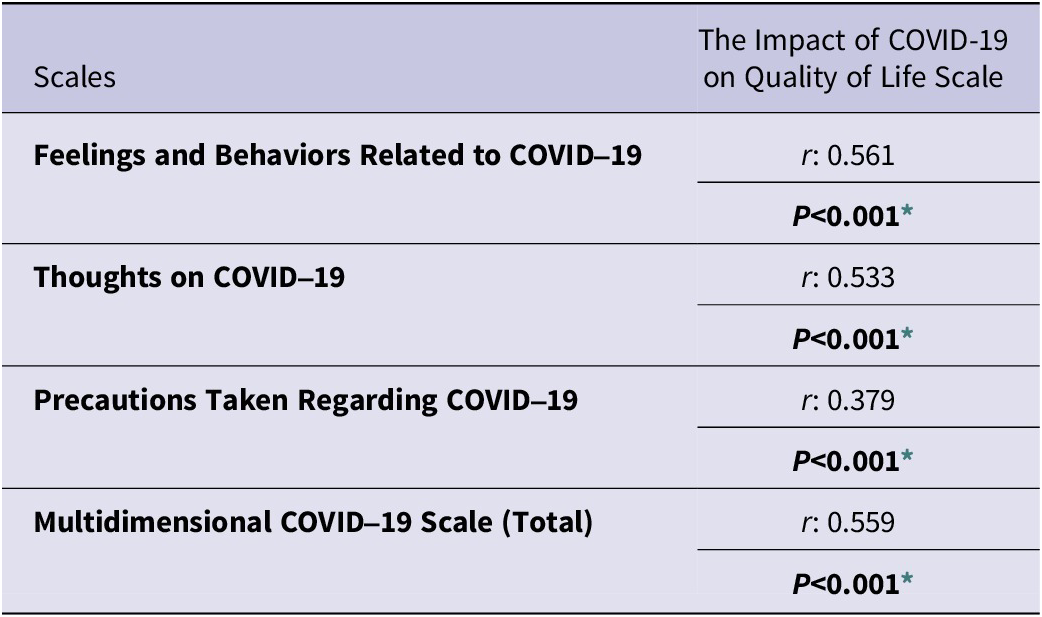
In the correlation analysis conducted to evaluate the relationship between the participants’ multidimensional COVID-19 scale, its sub-dimensions, and the scale of the impact of COVID-19 on quality of life, it was determined that there was a moderate positive correlation between the feelings and behaviors related to COVID-19, the thoughts about COVID-19 sub-dimensions and multidimensional COVID-19 scale, and the COVID-19 impact on quality of life scale (r: 0.561, P<0.001; r: 0.533, P<0.001; r: 0.559, P<0.001, respectively). It was found that there was a weak positive correlation between the measures taken for the COVID-19 sub-dimension and the scale of the impact of COVID-19 on the quality of life (r: 0.379; P<0.001) (Table 4).
Correlations between participants’ Multidimensional COVID-19 Scale scores and its sub-dimensions and COVID-19 Impact on Quality of Life Scale scores (n= 360)

* P < 0.05. r: Spearman Correlation Analysis.
Discussion
The findings obtained in this study were discussed in line with the literature. It was determined that most of the participants who applied to the vaccination polyclinic were not diagnosed with COVID-19 and their relatives were diagnosed with the disease, had tests done, and some of them lost their relatives due to the disease. Wang et al. (2020) found in their study that 75% of the participants feared that their family members would be diagnosed with the disease.Reference Wang, Pan and Wan25 In another study, it was concluded that participants whose relatives were diagnosed with the disease experienced more COVID-19 anxiety.Reference Özşahin and Aksoy26 In another study, it was determined that whether or not their relatives were diagnosed with COVID-19 did not make a significant difference in the anxiety of the participants.Reference Çölgeçen and Çölgeçen27 In a study conducted on nurses, it was determined that 94.8% were afraid of their relatives being diagnosed with COVID-19.Reference Kaya Meral and Kendirkıran28 It was thought that the difference between the studies was due to the fact that the infection differed according to the course of the disease. Anxiety and uneasiness levels were likely to increase due to the diagnosis of the relatives of the participants. In this study, although it was not significant, it was observed that those who lost their relatives because of COVID-19 took more measures related to the disease.
The cornerstone of vaccination worldwide is to achieve population immunity to protect the majority of the population.Reference Mahdi and Almukhtar29 In a study conducted at the beginning of the pandemic, 49% of the participants stated that they would be vaccinated against infection if a vaccine was developed for the disease. Those who previously had had seasonal flu vaccines stated that they were more likely to be vaccinated against COVID-19.Reference Akarsu, Canbay Özdemir and Ayhan Baser30 In a study conducted in England in July 2020 with 1504 individuals, 64% of the participants stated that they would receive a COVID-19 vaccine with high probability, 27% were undecided, and 9% would with low probability.Reference Sherman, Smith and Sim31 When the information about the vaccine content and side effects is provided in a well-equipped manner, the negative opinions of health officials against the vaccine will decrease and the rate of vaccination of the public can be increased.Reference Akarsu, Canbay Özdemir and Ayhan Baser30 It was determined that the positive attitude toward the vaccine obtained in the study complied with the literature.
In some of the literatüre, no significant relationship was determined between age and fear of COVID-19.Reference Badahdah, Khamis and Mahyijari32, Reference Bakioğlu, Korkmaz and Ercan33 However, it was observed that participants over the age of 50 had higher anxiety and depression scores.Reference Kong, Zheng and Tang34 Although the existence of inconsistent results was observed when the literature was examined, studies with similar findings with this study were also found. It is possible to say that with increasing age, individuals are more likely to develop chronic diseases. Thus, it is an expected result that they feel at risk and tend to take more precautions. However, by strengthening the coping skills of young individuals, it may be possible to turn their perceptions toward a positive direction.
It was determined that the depression scores of men were higher than that of women.Reference Yazıcı and İmamoğlu35 In another study, women’s fear of COVID-19 was found to be higher than that of men.Reference Bakioğlu, Korkmaz and Ercan33 In various studies, it was determined that women’s anxiety and risk perceptions were higher than those of men.Reference Wang, Pan and Wan25, Reference Kong, Zheng and Tang34, Reference Ekiz, Ilıman and Dönmez36, Reference Kurt, Deveci and Oguzoncul37, Reference Özdin and Bayrak Özdin38 The findings obtained in this study were accordant with the literature and the perceptions of women were more positive. The fact that women were less affected by this process might be due to their ability to cope with difficulties as directed by the societal gender perceptions.
In the study conducted by Gencer (2020), it was observed that the scores of single participants in terms of fear of COVID-19 were significantly higher than the scores of married and divorced participants.Reference Gencer39 It was reported that married participants had higher depression scores than single participants, and that their anxiety scores were lower.Reference Yazıcı and İmamoğlu35 There are also studies where no significant difference was found between these variables.Reference Wang, Pan and Wan25, Reference Badahdah, Khamis and Mahyijari32, Reference Kong, Zheng and Tang34, Reference Kurt, Deveci and Oguzoncul37, Reference Tönbül40 When the literature was evaluated with the findings obtained, both consistent and inconsistent results were found. In this case, it is possible to say that other sociodemographic characteristics of the sample group may be effective.
In a study conducted on adults in Türkiye, most of the participants expressed that staying at home negatively affected them, and 25.6% of the participants mentioned that their relationships with the individuals they lived with were negatively affected.Reference Bilge and Bilge41 When the findings were evaluated, it was observed that the participants were afraid of being alone, in accordance with the literature. It is possible to say that the participants living at home with their family and friends during the pandemic are afraid of infecting their loved ones by paying more attention to the issue of taking precautions.
During this period, having a chronic disease, living in compliance with the measures to avoid catching the disease, and experiencing problems in health checks due to chronic diseases adversely affected the psychology of individuals.Reference Chudasama, Gillies and Zaccardi42 In a study conducted in Türkiye, it was determined that participants with chronic diseases had high levels of depression, anxiety, and health concerns.Reference Özdin and Bayrak Özdin38 The participants with chronic diseases felt the psychological effects of the pandemic and stress, anxiety, and depression at higher levels.Reference Wang, Pan and Wan25 Consistent with the literature, it is possible to say that there are effects on COVID-19 in participants with chronic diseases. It can be mentioned that the fact that individuals with chronic diseases are included in the risk group affects this situation. It can be emphasized that the perceptions of those with chronic diseases are more positive because they take precautions.
Significant differences were determined in the sub-dimensions of psychological health, social relations, and universality in men.Reference Çoban, Bayazıt and Uca43 When the results were evaluated, it was understood that there was no consistency in studies examining the relationship between gender and quality of life. The quality of life of women was more affected, and it was thought that this situation might have been caused by the effect of the physical and mental responsibilities that women took during the pandemic process due to their social roles. In addition, due to their social roles, it can be stated that women’s fatigue in decision-making processes around eating, drinking, hygiene, and clothing also affected the process.
In a study conducted in the US, it was determined that participants with chronic diseases, compared to the general population, reached a higher level of stress due to being in the risk group with poor health outcomes due to COVID-19.Reference Umucu and Lee44 Loneliness and social alienation in isolation were interpreted with worse psychological health and lower quality of life in individuals.Reference Chan, Ho and Li45 In a study conducted to investigate the effects of quarantine on the lifestyle and medical problems of the participants during the COVID-19 pandemic in India, it was stated that 87% of the participants with type 2 diabetes experienced mental stress.Reference Ghosh, Arora and Gupta46 In this study, in compliance with the literature, participants with chronic diseases had positive perceptions about the process, but it was thought that future concerns related to complications may have affected their quality of life more.
Some of the preventive behaviors (for example, hand hygiene, wearing a mask, etc.) created an optimistic mood among the participants, while others (for example, individual social isolation, etc.) negatively affected the quality of life of the participants.Reference Wang, Pan and Wan25, Reference Brooks, Webster and Smith47 In a study, some of the participants perceived quarantine as restriction, boredom, and helplessness during the COVID-19 period, while others perceived it as being responsible and feeling safe.Reference Bozdağ48 In a study conducted with participants diagnosed with COVID-19, it was stated that loneliness caused a significant decrease in the quality of life as a result of living isolated from people. In the study conducted by Holmes et al. (2020) during the pandemic period, in which the psychological and social consequences of the pandemic were evaluated, it was announced that social isolation and loneliness were experienced very often, which reduced the quality of life of the participants.Reference Holmes, O’Connor and Perry49 Looking at the results of the literature, inconsistencies were observed. It can be said that the size of the sample group had an effect on the lack of significant results in this study.
The main factors affecting the quality of life are the health and emotional state of the individuals, self-esteem, knowledge and experience, welfare level, economic, and social status.Reference Dürüst50 The quality of life of the participants was adversely affected by sudden emergent situations that threatened people’s lives. During the pandemic, uncertainties regarding symptoms and consequences, high rate of contamination and death, quarantine, and being unable to be with the patient may have caused an increase in various emotional, cognitive, and behavioral reactionsReference Brooks, Webster and Smith47 and bio-psychosocial problems in terms of family members.Reference Dürüst50 In this study, considering the sub-dimensions of thought, emotion, and behavior related to COVID-19, the conclusion that it had an effect on quality of life is a finding consistent with the literature. It can be emphasized that positive or negative perceptions, attitudes, and behaviors about a situation and the measures taken affect quality of life.
Limitations of the Research
After determining the place as the Emergency Service Unit of a state hospital in a city center in which the research was conducted, it was changed as the COVID-19 Vaccine Polyclinic according to the result of the Ethics Committee. Due to few references related to the Multidimensional COVID-19 Scale, one of the scales used, another limitation was that the discussion was based on close concepts.
Conclusion
In the evaluation of perceptions regarding COVID-19 obtanined through the Multidimensional COVID-19 Scale, it was determined that women and participants with chronic diseases had higher scores in all sub-dimensions. It was observed that those who were aged 35 and older, married, and living with a family had higher scores in other sub-dimensions except for the Thoughts sub-dimension. It was determined that the participants who fully believed in the benefit of the COVID-19 vaccine had a higher score on the Precautions taken for COVID-19 sub-dimension. It was observed that individuals with this characteristic had more positive feelings, behaviors, thoughts, and precautions regarding the pandemic.
It was determined that the quality of life of female participants, participants who did not work in any job, and participants with chronic diseases were more affected. The participants’ feelings, behaviors, and thoughts about COVID-19 had a moderate effect on their quality of life. It was concluded that the measures taken for COVID-19 had a weak effect on quality of life. Individual perceptions of individuals are important in maintaining their quality of life and behaviors related to staying healthy. Empowering individuals to take responsibility for personal health can be considered as an important community mental health promotion intervention. Being aware of society’s perceptions of COVID-19 and the impact of the pandemic process on quality of life, the trainings to be provided by nurses and other health professionals may affect the continuity of protective measures regarding the management of COVID-19 or future pandemics. Interventional studies can be planned to improve the quality of life of groups that are more affected by the COVID-19 process (e.g., men, singles, young individuals, employees, those living alone) during the post-pandemic period.
Data availability statement
Data may be evaluated via ethical committee permission.
Author contribution
C.C.E.: Made substantial contributions to conception and design, or acquisition of data, or analysis and interpretation of data. Involved in drafting the manuscript or revising it critically for important intellectual content. Given final approval of the version to be published. Each author should have participated sufficiently in the work to take public responsibility for appropriate portions of the content. Agreed to be accountable for all aspects of the work in ensuring that questions related to the accuracy or integrity of any part of the work are appropriately investigated and resolved.
D.A.: Made substantial contributions to conception and design, or acquisition of data, or analysis and interpretation of data. Involved in drafting the manuscript or revising it critically for important intellectual content. Given final approval of the version to be published. Each author should have participated sufficiently in the work to take public responsibility for appropriate portions of the content. Agreed to be accountable for all aspects of the work in ensuring that questions related to the accuracy or integrity of any part of the work are appropriately investigated and resolved.
Acknowledgements
This study received an oral presentation award (third place) at the 4th International Clinical Nursing Congress (December 8-11, 2022).
Funding statement
This research received no specific grant from any funding agency in the public, commercial, or not-for-profit sectors.
Competing interests
No conflict of interest has been declared by the author(s).
Ethical standard
Ethical approval was obtained on September 29, 2021 with the no. 965 (20 478 486) from a state university Medical Faculty Health Sciences Ethics Committee. The principles of the Declaration of Helsinki were complied with at all stages of the study, and the study was conducted with those who volunteered to participate.