This article draws upon Van Maanen's (Reference Van Maanen1988) advice by providing a ‘tale from the field’ to help teachers of history and social studies in New Zealand and Australia reflect upon their own perceptions of place and Indigenous histories. This tale draws upon this writer's observations of a Year 10 social studies lesson (2002), which prompted the identification of the research problem central to this writer's doctoral research that also explored the potential of place conscious pedagogies (Manning, Reference Manning2009).
The lesson focused on two famous Te Ātiawa leaders (Te Whiti o Rongomai and Tohu Kākahi) and the passive resistance of the Parihaka community — against the settler government's creeping confiscation of ancestral lands. It unfolded in ways that indicated the teachers were oblivious to the whakapapa (genealogical) ties that existed between some of the (Māori) students in that school and the historical figures concerned. It also ignored the Te Ātiawa tribe's ancestral connections to the whenua (land) upon which that school sits.
This article proposes that, despite its limitations, Bronfenbrenner's (1979) ecological systems model can provide a theoretical framework to support initiatives to enhance the teaching of Indigenous histories. It begins by providing a description and map of the Port Nicholson Block area that encompasses the school site where this ‘tale from the field’ unfolded. It then describes the lesson central to that ‘tale’ before summarising the contextual levels integral to Uri Bronfenbrenner's model that will provide the framework for discussing the wider trans-Tasman implications of the lesson observed. The article concludes by discussing four recurring issues that need to be addressed in both countries.
He Whenua Tautohetohe: A Contested Landscape
The historical figures concerned are still held in high regard by Te Ātiawa people residing in the Hutt Valley, previously named Heretaunga. Heretaunga is located at the northern end of Te Whanganui a Tara (the great Harbour of Tara); more widely known as Wellington Harbour. In 1839, Te Whanganui a Tara and its surrounds were included in the New Zealand Company's dubious purchase of the so-called Port Nicholson Block, which was the focus of the Waitangi Tribunal's (2003): Te Whanganui a Tara me Ona Takiwā: Report on the Wellington district.
The Waitangi Tribunal is a Crown court of inquiry which investigates contemporary and historical Māori grievances regarding alleged Crown breaches of the Treaty of Waitangi, signed in 1840. The Port Nicholson Block today includes Hutt City (Heretaunga) and Wellington City (bordering the southern and western shores of Te Whanganui a Tara). When attempting to define the boundaries of the Port Nicholson Block, the Waitangi Tribunal (pp. 57–58) acknowledged that it is “impossible to make an accurate map of the lands included in the New Zealand Company's deed.” It did, however, provide the map shown in Figure 1 (p. 15) to roughly illustrate the boundaries of that area (shaded grey).
Map of areas within the Port Nicholson Block (Waitangi Tribunal, 2003: p. 15). Courtesy of Max Oulton (Cartographer), Waitangi Tribunal, Wellington; New Zealand Ministry of Justice.

Despite any geographical confusion that might have existed about the exact boundaries of the Port Nicholson Block, there is no doubt that its environs were contested by different tribes prior to the arrival of British settlers in 1839. Thirteen separate, but often overlapping, claims were lodged by various individuals and trial groupings in relation to that area. While different tribal groupings claim customary rights within the Port Nicholson Block area, this article will only focus upon Te Ātiawa because this was the iwi (tribe) central to the lesson.
A ‘Tale from the Field’ of Teacher Education: The Lesson Observed
Tolich (Reference Tolich2002) cited Van Maanen (Reference Van Maanen1988) to suggest that retelling ‘tales from the field’ is a good means of addressing a research problem, while making for a dramatic beginning. So here is a tale from the field of teacher education to illustrate how easy it was for an Indigenous (preservice) teacher, and her more experienced non-Indigenous colleague (associate teacher), to overlook local tribal knowledge when delivering a lesson about historical figures connected to Te Ātiawa. The lesson observed (2002) was a cathartic experience. It recalled this writer's own formative experiences as a dutiful younger teacher and prompted this writer to seek the involvement of Te Ātiawa friends in the design and development of a doctoral research project, which involved their iwi.
The lesson sought to explain how and why Te Whiti o Rongomai and Tohu Kākahi led the Parihaka community's passive resistance to the government's ‘creeping confiscation’ of tribal lands in the Taranaki region during the 1870s onwards (Keenan, Reference Keenan2015). During the prelesson briefing the preservice teacher shared that she believed she had been asked to teach this lesson simply because she was a Māori woman. She alleged that her senior Pākehā (Non-Māori) associate (mentor) teacher was uncomfortable with the content of this lesson. The associate teacher later confirmed that she was ‘uncomfortable’ and she did believe that the younger ‘Māori’ teacher would possess ‘more cultural knowledge’. From the perspective of the preservice teacher, her colleague's assumptions equated to a form of cultural taxation similar to that described by Padilla (Reference Padilla1994), Reid and Santoro (Reference Reid and Santoro2006) and Torepe (Reference Torepe2011).
This was problematic because the preservice teacher was affiliated to another iwi who occupy lands far-removed from Heretaunga. She advised me that she did not have any whakapapa (genealogical) links to local Te Ātiawa people and that, as Keenan (Reference Keenan, Dalley and Labrum2000 p. 41) also advised; “whakapapa cannot be avoided in any meaningful study of Māori histories”. Consequently, both teachers were unfamiliar with local Te Ātiawa historical narratives and cultural landmarks.
Both teachers assumed that the Takiwā (territory) of Te Ātiawa was limited to northern Taranaki. This was incorrect because, as a result of the disruptive influences of colonization, Te Ātiawa migrated to other regions and became a people of numerous places — with communities located in Te Tau Ihu o te waka a Maui (the prow of the canoe of Maui, or upper South Island) and Te Upoko o te Ika a Maui (The head of the Fish of Maui, or lower North Island). Moreover, both teachers were surprised to learn that Te Ātiawa are now widely considered as tangata-whenua (people of the land) in the area immediately surrounding their school.
Although the associate teacher had mostly lived in Heretaunga, she was surprised to discover that Te Whiti o Rongomai and Tohu Kākahi were both affiliated to the ‘local tribe’. Meanwhile, what little the preservice (Māori) teacher knew about the Parihaka community, she had learned from course literature during one of her university history courses. However, she advised me (prior to the lesson) that she still felt well-equipped to teach this topic. She believed the lesson plan and resources given to her by her senior colleague would provide students with ample information. So, she followed her associate's advice and dutifully used the school's preprepared lesson plan and textbooks.
She also screened a relevant video extract from Professor James Belich's televised documentary series, The New Zealand Wars — provided to the school in a resource kit developed by the New Zealand Ministry of Education (2000). The lesson proceeded with the preservice teacher slowly guiding the students through a chapter of the textbook whilst individual students were selected to read aloud to their classmates. At the conclusion of each passage, the preservice teacher asked a series of questions to diagnose whether her class had comprehended key historical concepts central to that passage. To my concern, this was typical of many history and social studies lessons this writer had also dutifully taught and observed since 1990.
Although the extract from the Belich documentary series was consistent with the textbook content; it did not stimulate the sort of lively discussion the preservice teacher had anticipated. During the lesson, I roamed around the class asking students whether they felt any ‘connection’ between their lived experiences and the historical figures and the Parihaka community. They all replied ‘no’. That was unfortunate because many of the school's students played sports at Te Whiti Park, opposite a local wharenui (meeting house) affiliated to Te Ātiawa (and other tribes with ancestral links to Taranaki). The name of this meeting house is Te Arohanui ki te Tangata (goodwill to all mankind), which underlines the philosophy of passive resistance practiced by the people of Parihaka when protecting their ancestral lands (Keenan, Reference Keenan2015). Moreover, I knew that some students in that school were descendants of the historical figures central to that lesson.
The students, however, had not been enabled to draw connections between themselves and the name of a local sports park, the name of a prominent wharenui or the genealogy of some of their school friends. Yet, when I was invited to speak to the class, towards the end of that lesson; I drew these (largely non-Indigenous) students’ attention to connections existing between themselves and Te Whiti Park, its neighbouring wharenui and some of their school friends. They suddenly became animated, asking questions because they could now see tangible links between themselves, their suburban landscape and the lesson's historical content. But the lesson soon ended. The associate teacher sent her students off to their next class, leaving many questions unanswered. The following passage will accordingly draw upon the theories of Bronfenbrenner and international literature to consider some of the wider trans-Tasman implications of that lesson.
The Ecological Systems Model and the Lesson Observed
This passage initially provides a description and critique of the ecological systems model. It then uses the structure of that model to scaffold a trans-Tasman discussion about the wider implications of the lesson observed (i.e., for the teaching of Indigenous histories in both countries).
The Ecological Systems Model
While it is important to acknowledge the complexities of Bronfenbrenner's work until his death in 2005 (see Darling, Reference Darling2007, Tudge, Mokrova, Hatfield & Karnik, Reference Tudge, Mokrova, Hatfield and Karnik2009), this article unapologetically focuses upon Bronfenbrenner's earlier work (Reference Bronfenbrenner1979–89). This appears to be more easily understood by trainee teachers encountered by this writer (since 1999) who have often struggled to critique their own cultural-locatedness. As Santoro's (Reference Santoro2009) research suggests a lack of critical-reflection culminates in a mono-cultural pedagogy. A mono-cultural pedagogy, however, does not evolve in an historical void. As Bird and Drewery (2000, p. 13) observed, “Bronfenbrenner's emphasis on the influences of society and culture on the child's development makes the important point that development is always grounded in a particular society at a particular time in history”.
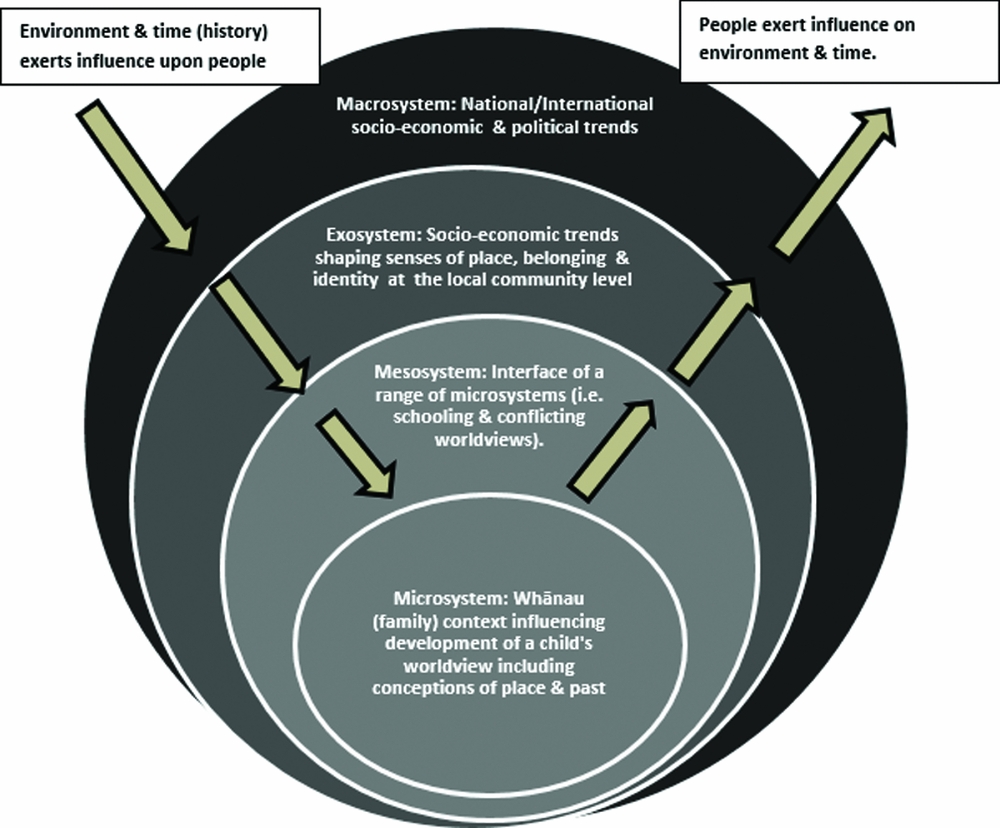
Bronfenbrenner initially employed concepts interlinking social systems to talk about four kinds of social systems that enclose the development of a child (much like a Russian Doll). Bird and Drewery (op. cit.) explained that this systems approach began with the microsystem which referred to a child's immediate environment, such as members of the family or members of class at school. The outer mesosystem, they described as referring to a ‘system of connections’ that linked microsystems together, such as, “relationships between parents and teachers that bring the world of home and school together.”
Bird and Drewery noted that the third outer concentric structure, the exosystem, referred to, “larger social systems which include public media such as television, communities and neighbourhoods.” Finally, the fourth outermost structure, the macrosystem, was described by Bird and Drewery as referring to: “large cultural patterns which include social class and the political system of the country”. Later, Bronfenbrenner added a fifth outer level — the chronosystem. The chronosystem addresses the transitions and changes that inevitably occur in one's lifespan and the influences of the outer sociohistorical contextual levels in these changes at each of the inner levels of the ecological systems model (Tudge & Mokrova et al., Reference Tudge, Mokrova, Hatfield and Karnik2009). To give further clarity, the illustration of Bronfenbrenner's ecological systems model has been provided in Figure 2.
Author's adaptation of Bronfenbrenner's ecological systems model.

Although the ecological systems model was a revolutionary development in the evolution of western psychology, it was anthropocentric in scope (Manning, Reference Manning2009) and not without its Indigenous critics. Notably, MacFarlane (Reference Macfarlane, Bird and Drewery2000, pp. 46–47) claimed, from a Māori perspective, that the encircling social systems of Bronfenbrenner's ecological systems model were not new ideas:
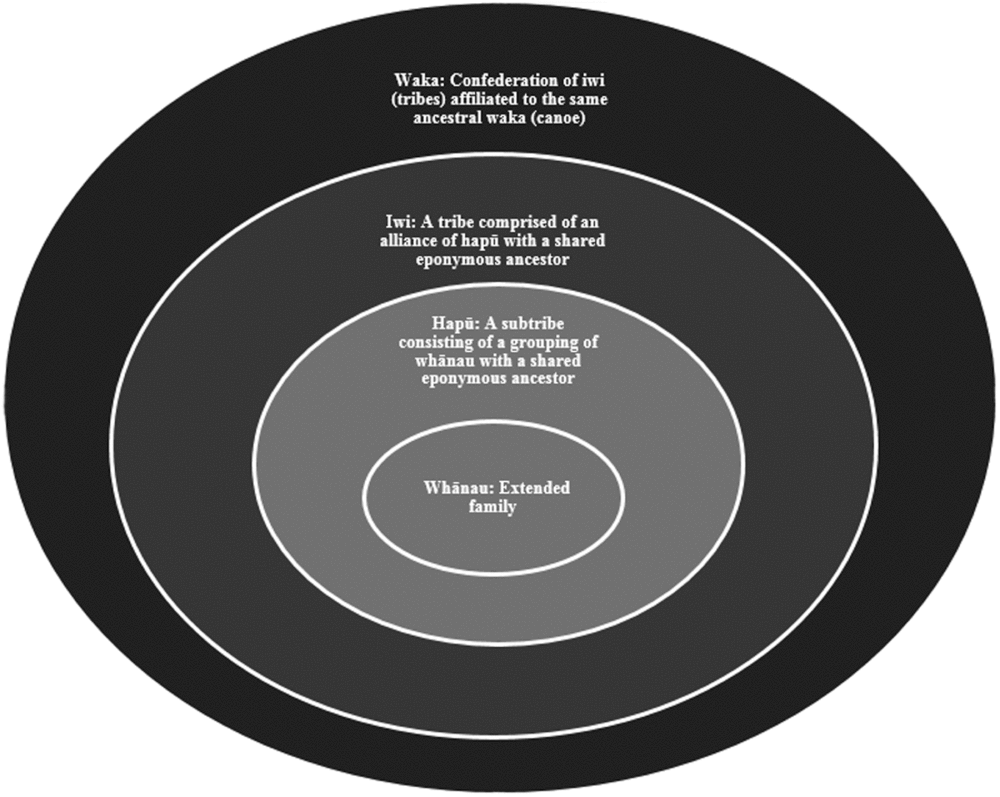
In the late Nineteenth Century, at about the time Piaget and Vygotsky were beginning to write about developmental processes, another scholar, Makereti, also known as Maggie Papakura, was writing about a Māori ecological perspective of development. Makereti (1986) described Māori as a culture that put people before the self. She considered this to be a key factor of Māori development. Makereti referred to the individual as being absorbed in the whānau [family], just as the whānau was absorbed in the hapū [subtribe], and the hapū in the iwi [tribe]. . .
. . . It is a stunning realization that it is only in recent decades that psychologists have recognized the quintessential role of culture in the field of human development. The introduction of psychology in Aotearoa [New Zealand] was part of the imposition of a colonial tradition that systematically undermined Māori social and cultural lore in favour of a Western worldview. The quality and integrity of Māori knowledge, and principles, was hierarchically relegated by Western psychological paradigms (Moeke-Pickering, Paewai, Turangi-Joseph, and Herbert, Reference Moeke-Pickering, Paewai, Turangi-Joseph, Herbert, Ballack and Hersen1996) from the time of contact to very recent years.’
Hence, Macfarlane (Reference Macfarlane, Bird and Drewery2000, p.18) concluded that Bronfenbrenner's ecological theory is, ‘no more sophisticated than Maggie Papakura's absorbing communities theory, except that the latter thought of it first’ (Makereti, Reference Makereti1938). To further assist readers to visualise Makareti's theory, the diagram has been provided in Figure 3.
Author's interpretation of Makareti's (Reference Makereti1938) absorbing communities theory.

The ecological systems model is also limited in that it is not consistent with traditional Indigenous epistemologies, which do not separate humanity from the natural world or spiritual domains (Cajete, 2003; Manning, Reference Manning2009; Hokari, Reference Hokari2011; Sommerville & Perkins, Reference Sommerville and Perkins2011). However, it still provides a tool used strategically by Indigenous academics. For example, Berryman, Walker, Reweti, O'Brien and Weiss (Reference Berryman, Walker, Reweti, O'Brien and Weiss2000, p. 35) argued that Māori people and their respective ‘micro-cultures’ are not usually regarded by teachers as ‘autonomous partners’ in curriculum design, delivery, assessment and evaluation processes. Similar arguments have been made about the experiences of Indigenous Australians (Harrison & Greenfield, Reference Harrison and Greenfield2011; Harrison, Reference Harrison2013).
So the discussion will now centre on how the ecological systems model can help identify the trans-Tasman implications of the lesson concerned. It begins with a focus on Bronfenbrenner's microsystem context because this provides the most logical starting point for consideration given the observed lesson's failure to build upon students’ personal experiences and local indigenous peoples’ familial narratives.
The Lesson's Microsystem Implications
Bronfenbrenner (Reference Bronfenbrenner1979, p. 22) specifically described the microsystem as a, “pattern of activities, roles, and inter-personal relations experienced by the developing person in a given setting with particular physical and material characteristics”. In relation to the value placed upon lived-experience in Māori ecological contexts, Johnson and Christensen's work (Reference Johnson and Christensen2000) suggested that, irrespective of cultural boundaries, lived-experiences still determine how people relate to each other and how they are predisposed by each other. With regard to tensions that often exist between teacher and student predispositions towards the teaching and learning of history, Rosenszweig and Thelen's research (Reference Rosenzweig and Thelen1998, p. 6) observed that many Americans felt ‘alienated’ after studying history at school (particularly Native American adults). Whilst considering the implications of Rosenzweig and Thelen's survey for Australian history educationalists; Taylor, Young, Hastings, Hincks and Brown (Reference Taylor, Young, Hastings, Hincks and Brown2003: p. 6) advised that many of their own Australian survey respondents also:
. . .. spoke of feeling excluded from lesson content and activities because of their teachers’ unwillingness to hear views and stories other than their own. On the other hand, others spoke with admiration about teachers who helped them to investigate the past, involving them as participants rather than spectators, and creating opportunities to explore questions of morality, their own lives, relationships and identity.
The lesson observed by this writer mirrored problems found by researchers in the United States and Australia. Like Manning's New Zealand research (Manning, Reference Manning2009); Clark (Reference Clark2008) found that many Australian teachers felt uncomfortable dealing with Indigenous subject matter. They, like the New Zealand teachers interviewed by Manning; were struggling to motivate students to engage with Indigenous histories taught via repetitive textbook-driven lessons. She also found (again like Manning) evidence of overt student racism — probably a reflection of prevailing family (microsystem) and community (exosystem) attitudes. This was most evident when Clark (Reference Clark2008, pp. 69–70) recalled:
I was shocked by how fiercely some kids reacted to this [Indigenous] topic. Samantha's response was probably the most extreme. She goes to an independent girls’ school in Melbourne and complained that ‘“invasion” is a guilt trip’ teachers pull on their students. ‘Like we're meant to feel that our ancestors came and like killed a billion Aborigines’, she said, ‘and took over a country and gave them diseases’ . . . ‘It's kinda bad enough that we're a convict country’, Samantha continued, ‘but then when it's drilled into us that we killed everything good in this country it's like, not fun.’
However, most students Clark interviewed criticized the lack of depth and variation in pedagogy rather than the inclusion of Indigenous content. They saw little relevance between the passive learning of textbook-driven lessons to their own lived experiences. The research of Harrison and Greenfield (Reference Harrison and Greenfield2011, p. 74) drew similar conclusions to those of Clark (Reference Clark2008) and Manning (Reference Manning2009); especially when they observed that:
Aboriginal knowledge is told and relived in that [Indigenous] community [i.e. exosystem] and hence learning is local, it is produced in context and place. When this knowledge is packaged in a book and read in other places [i.e. school mesosystem settings] it can be understood as an objectified narrative, which is alienated from the place of its production.
If the research cited in this passage suggests that young people do appreciate history teachers who help them to investigate the past in a manner that involves them as participants and not spectators (i.e., by drawing upon lived-experiences in real-world settings); the following passage considers the political nature of a ‘pedagogical triangle’ shaped around the relationships that exist between students, parents and teachers in Australian and New Zealand schools.
The Lesson's Mesosystem Implications
As Taylor et al. (Reference Taylor, Young, Hastings, Hincks and Brown2003, p. 6) argued — history teachers and students, due to their diverse familial experiences, bring different (microsystem) ‘capacities’ and ‘beliefs’ into history classrooms (mesosystems) and consequently the value placed on certain historical subject matter. They posited that the teacher, learner and subject matter “are the core ingredients in teaching and learning’ and that the ‘relationship between these three elements has been described as a ‘pedagogical triangle’ in which the teacher and learner communicate almost solely through the medium of subject matter”. Also, that the emphasis of the construction of historical knowledge is placed upon subject matter, while teacher and learner relationships remain ‘crucial’. Taylor et al. added (Reference Taylor, Young, Hastings, Hincks and Brown2003, p. 6) that the teacher and learner bring to the classroom different ‘capacities’ and ‘beliefs’:
The teacher brings personal [micro/exosystem] and professional [mesosystem] histories, knowledge about subject matter and pedagogy, beliefs about students, their families and communities, and ideas and about the purposes of teaching history. This professional knowledge frames teachers’ decisions about what content, strategies and resources to select for teaching purposes. In particular, teachers’ perceptions of their students have a powerful influence on classroom climate and practice.
Taylor et al. reiterated that these personal ‘perceptions’ are influenced by longstanding (micro/exosystem) beliefs about their students’ sociocultural backgrounds and academic capabilities. This can often result in deficit-theorizing whereby teachers consciously and subconsciously construct academic and behavioural profiles of their students and plan teaching and learning experiences accordingly. Additionally, Taylor et al. noted that Australian history students (like their New Zealand counterparts) also carry ‘capacities’ and ‘beliefs’ into classrooms:
Learners bring to the classroom [mesosystem] their home [micro/exosystem] backgrounds and ideas about the purposes of school history. Research provides ample evidence that young people arrive at the classroom door with their own versions of the past, and views about the importance of particular events and people drawn from home, community, popular culture and the media [i.e. overlapping microsystem, exosystem & macrosystem influences].
As a result, Taylor et al. (Reference Taylor, Young, Hastings, Hincks and Brown2003, p. 6) explained that for students of history to make sense of ‘their own learning experiences’, they must attempt to reconcile their personal understandings about the world with the concepts and pedagogical resources their teachers compel them to understand. This is highly problematic because when students’ prior knowledge is ‘excluded from classroom conversation and debate, reconciliation often fails to occur, and history learning becomes, at best, a matter of mastery’. They concurred that it is only logical that the first step in connecting learners with the history curriculum rests in recognising and expanding on their prior knowledge.
Thus Taylor et al. suggested that it was within various (mesosystem) settings that predominantly non-Indigenous teachers will decide ‘how’ to connect students’ ‘lived-experiences’ with significant historical content about Indigenous peoples and it is the lived experiences of these teachers that will consciously and/or subconsciously determine their pedagogical decisions. This stance was supported by Levstik and Barton (Reference Levstik and Barton1997, p. 12) who earlier explained, ‘learning is not passive: people have to compare what they encounter to what they already know’. Accordingly Levstik and Barton's description of ‘disciplined inquiry’ (which they described as an antidote to ‘passive’ learning) informed the depiction of ‘authentic inquiry’ provided by Taylor et al. (Reference Taylor, Young, Hastings, Hincks and Brown2003, pp. 7–8).
It also aligned with this writer's doctoral research findings (Manning, Reference Manning2009) which found that, globally, Indigenous communities often prefer authentic learning activities which require active engagement within their own communities and ancestral landscapes, heightening their levels of place-consciousness (see Kawagley & Barnhardt, Reference Kawagley, Barnhardt, Smith and Williams1999; Penetito, Reference Penetito2004; Harrison, Reference Harrison2011, pp. 17–58, 130–145 & Manning, pp. 184–199). It was also an absence of any ‘authentic inquiry’ during the lesson observed which prompted this writer's doctoral research. During that lesson, no attempt was made, as recommended by Taylor et al. (Reference Taylor, Young, Hastings, Hincks and Brown2003, p. 8), to ‘integrate new subject matter with students’, ‘prior knowledge’ or to ‘make learners prior knowledge explicit’.
Ultimately, a textbook and video defined how the preservice teacher would teach about the Indigenous historical figures central to that school's preprepared lesson plan as opposed to teaching with the tribe concerned. Hence, a text and video was privileged over local peoples’ narratives about their own ancestors. This problem was not unique to that school (mesosystem) or the New Zealand schooling (i.e., macro) system. Taylor et al. (Reference Taylor, Young, Hastings, Hincks and Brown2003, p. 7) drew upon the research of Rosenzweig and Thelen to challenge the authenticity of textbooks and advised Australian history teachers against ignoring students’ familial (microsystem) and community (exosystem) backgrounds. They also drew attention to Seixas’ (Reference Seixas1997) research to propose that Australian ‘learners’, like their North American and New Zealand counterparts, approached the notion of ‘historical significance’ from three positions.
First, some ‘learners’ ascribed significance to events as told to them by ‘objective authorities’ which were none other than textbooks and the limited life experiences of the teachers themselves. Second, other ‘learners’ approached the idea of historical significance from the position of their own ‘personal interests’. Third, others applied ‘criteria’ that reflected the conscious and subconscious values of their own ethnic groupings and/or group membership. Taylor et al. (op. cit.) claimed that Seixas’ (op. cit.) research held serious ‘implications’ for Australian teachers of history — especially those with cohorts of students from ‘ethnic’ and ‘minority’ backgrounds. A conclusion supported by other Australian academics (Clark, Reference Clark, MacIntyre and Clark2003, Reference Clark2006, Reference Clark2008; Harrison & Greenfield, Reference Harrison and Greenfield2011; Harrison, Reference Harrison2013).
However, what Taylor et al. did not address in their analysis of the pedagogical triangle was the mesosystem power struggles that do occur between history teachers with differing levels of professional experience or between teachers from differing sociocultural (i.e., exosystem) backgrounds. Following the lesson I observed, the associate (Pākehā) teacher revealed that she enjoyed her position as a head of department — primarily because she could control her mesosystem (i.e., workplace) settings to determine what history and social studies topics were taught (and where).
This confirmed the validity of Hunter and Farthing's research in the Waikato region of New Zealand (Reference Hunter and Farthing2004, pp. 56–57); which found that experienced Waikato history teachers also enjoyed a considerable degree of ‘agency’. Of particular interest, Hunter and Farthing (op. cit.) concluded that a ‘traditional’ and ‘elitist’ (Eurocentric) history curriculum was all-too-often evident in Waikato schools (another finding echoed by Manning, Reference Manning2009). They claimed (p. 85) that this might be the result of ‘experienced’ (usually non-Indigenous) teachers having differing beliefs and being able to exercise ‘too much agency’ at the expense of younger teachers:
There is considerable difference in beliefs about the purpose of history in the curriculum between older experienced teachers, and recently qualified less experienced history teachers. Recently qualified teachers bring in a range of research experiences to history teaching, and they are able to articulate a sense of connectedness to personal identity and the past in relation to their lived experiences. Ideas of the functional purpose of history including more social contexts and more critical approaches to history were strong features of their narratives. Experienced older teachers view history within intellectual frameworks with emphasis placed on the development of their students as whole persons. Very experienced teachers expressed views about the subject history as prestigious or academic in contrast with other curriculum areas, particularly those in the social sciences.
These findings draw attention to the imbalance of power that existed within the professional relationship between the ‘experienced’ (Pākehā) associate teacher and the ‘inexperienced’ (Māori) preservice teacher that this writer observed. During the post-lesson de-briefing session, the younger teacher was asked if she would like this writer's support to engage with the associate teacher and local Te Ātiawa experts to enhance the school's lesson plan. Although she appreciated what was being offered, she was ‘afraid’ to appear to be questioning the authority of her experienced colleagues. She feared she might later receive an unforgiving appraisal of her overall teaching performance — possibly undermining her ability to gain future employment.
Again, Hunter and Farthing's research suggested that this (Indigenous) preservice teacher's fear was not unique. Her response mirrored the ‘assimilation’ process simultaneously occurring in Waikato schools identified by Hunter and Farthing (Reference Hunter and Farthing2004, p. 86), who noted: “Research evidence . . . shows that newly qualified teachers with understandings of recent historical theory and scholarship, and interests across a breadth of historical contexts, become assimilated into existing traditional history programmes”.
In consideration of these mesosystem power struggles played-out in New Zealand (and possibly Australian) school staffrooms; the next passage explores the trans-Tasman implications of the lesson observed with regard to Bronfenbrenner's overlapping exosystem and macrosystem settings. It pays close attention to the strained relationship between dislocating national curriculum guidelines and Indigenous peoples’ traditional ways of constructing knowledge of the past — often in direct relation to significant places.
The Lesson's Exosystem and Macrosystem Implications
A lack of Indigenous place-consciousness in national curriculum design processes is problematic because, as Penetito (Reference Penetito2004) suggested, it raises questions about which ethnic group holds the most value when formulating a national (macrosystem) history curriculum or deciding how to implement it at the community (exosystem) level. After the cathartic experience of observing the lesson concerned, I noted that the New Zealand history syllabus of that time was riddled with many ‘should’ statements which failed to provide adequate motivation to persuade teachers to give concrete effect to official statements affirming the Crown's ongoing Treaty of Waitangi (1840) obligations to Māori. I therefore conducted doctoral research that sought to identify those historical environmental (i.e., chronosystem) trends which informed contemporary cultural politics at the national (i.e., macrosystem) level that, in turn, informed the design, delivery and evaluation of the New Zealand history syllabus at the local Port Nicholson Block communities level (i.e., exosystems).
My doctoral research (Manning, Reference Manning2009) focused upon the status of Te Ātiawa histories of place in Port Nicholson Block secondary schools. It explored how participants viewed the teaching of New Zealand, local and Māori histories; particularly in relation to their own lived-experiences (Manning). Nine Te Ātiawa adults selected from a pool of potential expert interviewees participated in this research. Nine senior history teachers also participated. Both groups of participants were invited to individually reflect upon cultural continuities and discontinuities they experienced throughout their lives in relation to what and how local, Māori and New Zealand histories were taught in their familial and secondary school settings (if, indeed, they were taught).
All of the Te Ātiawa participants shared painful experiences of cultural discontinuities, whereas only one teacher participant had experienced a similar form of discontinuity. She was also the only teacher who did not identify herself as a New Zealander of European descent. The research participants were also asked to identify what topics they felt should be taught in Port Nicholson Block secondary schools today and how. Whilst they generally agreed that more local, Māori and New Zealand content should be added to the national curriculum; the two groups of participants differed on how this should happen — reflecting the cultural politics of curriculum control so eloquently described by Smith (Reference Smith, Codd, Harker and Nash1990, p. 193) below:
The control over what is regarded as valuable knowledge and, therefore, what is to be taught in schools, is maintained by numerically dominant Pākehā people who occupy positions of decision-making within the education system . . . Where consultation has occurred with minority interest groups, it has more often only been to seek answers which conform to the liberal preconceptions of ‘state dominate’ Pākehā interests . . . In this way, the real power lies within the dominant Pākehā population who are able to control what will be taught, how it will be taught and by whom it will be taught.
With Smith's analysis (above) in mind, a survey was developed to identify topics taught in 24 state-funded Port Nicholson block secondary schools (2005). These results were related to a survey conducted that same year by the New Zealand History Teachers’ Association (NZHTA). The NZHTA survey (2005) produced 126 schools’ responses to questions regarding topics taught at National Certificate of Educational Achievement (NCEA) Levels 1–2, while 121 school respondents responded to a question about NCEA Level 3 topics. This writer's survey findings reflected those of the NZHTA. Both surveys supported Smith's analysis, above. They indicated that local tribal and other Māori content was often side-stepped by (predominantly Pākehā) teachers of history and this continues to hold wider (macrosystem) political implications that have been discussed elsewhere (Manning, Reference Manning2009).
Furthermore, my interviews with New Zealand teachers of history (2009) indicated that they and Australian teachers of history have presented similar arguments when discussing Indigenous histories. New Zealand teachers, like those interviewed by Clark (Reference Clark2008), and Harrison and Greenfield (Reference Harrison and Greenfield2011); lamented that they felt they did not possess sufficient knowledge or ‘the right’ to teach about Indigenous people's histories. To overcome a pedagogical paralysis of analysis, 6 of the 12 schools in Harrison and Greenfield's study employed teachers who were collaborating with each other and their local Indigenous communities to address Indigenous histories. As Harrison and Greenfield noted (Reference Harrison2011, p. 72), this collaborative approach positions Indigenous peoples’ knowledge in the school as “alive, performative and reflective of the place where it is produced”.
Each teacher interviewed by Manning also felt they needed to collaborate with Te Ātiawa custodians of historical knowledge. They said they felt ill-equipped to deliver ‘Māori’ histories and stipulated that government funding was urgently needed to acquire support in the form of professional development. Each of the teachers expressed reservations about the development of teaching resources that would only gather dust in resource rooms. Moreover, they feared losing control of ‘their’ curriculum. This stance was best encapsulated by one teacher who said:
There's major ‘pros’ and ‘cons’ . . . if a local iwi [tribe] comes along and says . . . ‘you should be teaching this’, but it's not part of the official curriculum, you can't do it! Then they, [the local iwi] turn around and say, ‘well, we told you what to teach!’ But, if you are constrained by the curriculum then there's no way that we can put that into place! However, if Te Ātiawa has an education officer that knows the ‘whys’ and ‘wherefores’ of the education system and can say, ‘look, we can work it this way’ and ‘here's what's happened there, in that place, well, it could be done. But if . . . Te Ātiawa comes along and says, ‘we don't believe what you're doing is correct, well, it's not actually very helpful because it's a two sided thing’. (Manning, 2009: p. 207)
Te Ātiawa participants, likewise, believed that mandated Te Ātiawa people must assist local history teachers to teach about events that involved their own ancestors. They wanted meaningful input into curriculum design, delivery, assessment and evaluation procedures. They feared that not having such input would consolidate public misconceptions about their tribe — created by years of historical (i.e., chronosystem) misinformation transmitted in their community (i.e., exosystem) by local media and schooling. This stance was typified by one Te Ātiawa participant (p. 196) who said:
For students to make any real sense of Te Ātiawa history, their teachers have to go to the source of it and hopefully find someone who has the knowledge and time to share some of that information with their students and the time to assess it. If you don't have that tribal history properly assessed [e.g. by a Te Ātiawa nominee] you're not really delving very far beneath the surface of New Zealand's history. New Zealand history, as a subject, tends to provide students with a very general and misleading account of the past because Māori weren't a pan-tribal entity and a one-size-fits all account of Māori history is misleading.
Another Te Ātiawa participant, below, best-explained the pedagogical merits of the land-based (place-conscious) pedagogy that all the Te Ātiawa participants preferred to support any potential collaboration with local schools:
When the Wellington Tenths Trust [which manages tribal land leases] had a meeting to discuss our [land] claims in Palmerston North they took us there and showed us what land is ours and what we've done with it and things like that. So, yeah, I think it's really important that teachers would also be able to actually see what we're talking about, to see the place we're going to study. Learning about historical events and places out of a book is ok, but if you don't know where that place is situated, where that place is, well; it's totally out of mind or meaningless! But if you've actually been to that certain area, or river, whatever; it's there and it's ‘locked in your head’. You know, it's a bit like me [visiting Palmerston North]: I've been there and I know exactly what they're talking about in that [Tenths Trust] book.
Harrison and Greenfield's research (Reference Harrison2011, p. 74) echoed the sentiments of this Te Ātiawa participant in the sense that they, too, saw Indigenous histories as forms of narrative performance that are reflective of the places where they are produced. They, too, concluded that Indigenous community (exosystem) involvement is critical to the effective teaching of Indigenous histories in ways that are ‘difficult to assess’:
It is through the telling of these stories . . . that Aboriginal people are performing a relationship to place, while children are learning to understand what a place might mean to the Aboriginal person telling the story. Of course what the Aboriginal person has in mind and what the children learn (as understanding of an Aboriginal person's relationship to place and history) may be entirely different and this represents the difficulty of assessing such learning. Such performances constituted through the telling of local stories and histories characterize the very essence that is most difficult to transmit and teach in the classroom. The essence is the interaction itself. An understanding of this interaction can be produced between Aboriginal parents and Elders and children and teachers in the classroom and through their mutual planning and negotiations to include Aboriginal knowledge in the curriculum. These interactions will also represent the unconscious work of reconciling Aboriginal and non-Aboriginal children in schools.
While affirming Harrison and Greenfield's pursuit of a more inclusive schooling system — this article concludes by questioning whether all New Zealand and Australian students of history can engage meaningfully in their wider societies’ attempts to achieve the (problematic) political goal of ‘reconciliation’ between Indigenous and non-Indigenous peoples. Especially, if their schools restrict them to engaging with Indigenous knowledge that is delivered out of context — off local lands and without interactions with local Indigenous custodians of knowledge.
Conclusion
By drawing upon Bronfenbrenner's ecological systems model, this article has illuminated some recurring issues resulting from the teaching of Indigenous histories in New Zealand and Australian schools. Like Harrison (Reference Harrison2013), it draws attention to four key issues that need to be resolved in both countries.
I would first conclude that the New Zealand national history curriculum (see Ministry of Education, 2010) like its Australian counterpart — still privileges a western epistemology, “that relies on the reproduction of knowledge as disembodied; and employs concepts that are culturally-bound, for example, cause and consequence, empathy, evidence and linear thinking” (Harrison, Reference Harrison2013: p. 218). While many teachers in both countries seek to be creative and use various pedagogical techniques to bring the (outside) Indigenous people's world into their classrooms; I would echo Harrison's conclusion that the ‘meaning’ created through such pedagogies remains an ‘artefact’ of the Indigenous world sitting beyond the school gates. They are no substitute for place/land based learning exercises which require students and teachers to actively engage with Indigenous worldviews which emerge like a breath of fresh air from the landscape beyond the windows of musty classrooms.
Second, I support Harrison (Reference Harrison2013, p. 219) in concluding that the teaching of Indigenous histories (in both countries) supports, a ‘contention’ of knowledge as a ‘priori’. It accepts that knowledge is there and historical significance is constructed through individual analyses. The significance of a text is reinforced as an individual search, and the teacher's ‘task is to show students where to look to locate the evidence’. As Harrison indicated (Reference Harrison2013, pp. 218–219), this approach might suit a ‘majority’ of ‘middle class’ Australian and New Zealand history students, but not necessarily those, ‘who associate a system of meaning making with the social construction of literacy (Gee, Reference Gee2004, Reference Gee2005; Luke, Reference Luke1994)’.
Third, I share Harrison's concern (Reference Harrison2013, p. 219) that a prevalent conceptual approach to the teaching of history, “undermines those students [in Australia & New Zealand] who rely on narrative as their primary form of communication”. A hierarchy of texts also exists in New Zealand schools, which is, “reinforced through a conceptual framework, where argumentative and expository texts are privileged above narrative”. Fourth, this writer concurs with Harrison that the application of the history curriculum too-often disadvantages students in both countries who live in places far removed from the ‘making of history’ and especially the ‘making’ of Indigenous histories; which only seems to occur elsewhere.
Harrison (Reference Harrison2013, p. 219) quoted former Australian Prime Minister John Howard to underline the value of local knowledge in producing ‘historical significance’. In an Australia Day speech, Howard (Reference Howard2006) distinguished that, ‘young people are at risk of being disinherited from their community if that community lacks the courage to teach its history’. As Harrison (Reference Harrison2013, p. 219) observed:
The purpose for teaching history is quite clear here, at least for John Howard, in that it allows the student to locate him or herself in relation to a place that he or she recognizes. Howard (Reference Howard2006) argued that young people get their place and identity through their interactions with family and community. History indeed comes from somewhere, and to objectify it further surely plays into the hands of those who would argue that ‘history is fiction’. (Curthoys & Docker, Reference Curthoys and Docker2010)
In consideration of the risk of many young New Zealanders also becoming further ‘disinherited’ from their communities, as a result of a hidden or null history curriculum; this article concludes with the following salient observation. It was originally presented by the Waitangi Tribunal in its (2004) report on the Tūranganui a Kiwa (Gisborne) claims. The Tribunal wished New Zealanders to possess a greater ‘consciousness’ of ‘historical memory of place’ and concluded (2004, p. 740) that:
We cannot help but think that the unsettled state of relations between Māori and Pākehā in this country is in part due to the fact that these stories are remembered only by tangata whenua [people of the land] and a few historians who specialise in New Zealand history. While only one side remembers the suffering of the past, dialogue will always be difficult. One side commences the dialogue with anger and the other side has no idea why. Reconciliation cannot be achieved by this means. Thus it seems no more than common sense that if stories such as these from Tūranga were more widely known in the community, particularly local communities more directly affected, the need to heal the wounds of the past before moving forward would be better understood by all.
Statement of Originality
This manuscript is an original work that has not been submitted to nor published anywhere else. (Dr Richard Manning, 25 April, 2016).
About the Author
Dr Richard Manning is a former secondary school teacher (1991–2004) who has also worked as a researcher for the Department of Māori Affairs and the Iwi Transition Agency (1989–1990). He has also served as an education advisor at the New Zealand State Services Commission (2005–2006) and as a researcher and (Treaty) claims inquiry facilitator at the Waitangi Tribunal (2006–2007). Richard is a senior lecturer and currently coordinates the Treaty of Waitangi Education Programme at the University of Canterbury College of Education Health and Human Development (New Zealand). He also teaches about the Social Studies curriculum.