In 2009, the Treaty of Lisbon established a stronger inclusion of national parliaments in European politics through the instrument of the early warning system (EWS). Since this institutional change became effective in 2010, the European Commission has been instructed to forward every proposed piece of legislation to the chambers of all national parliaments. The chambers can scrutinize the proposals and formally state their concerns if they conclude that the new law will violate the principle of subsidiarity (henceforth, such a statement is called an individual ‘veto’ action). If the national chambers reach a certain quorum of reasoned opinions that state a subsidiarity concern, the Commission is forced to review the proposal again.
This is a new quality of legislative power, where national legislators have a say in supranational politics, as they can effectively act as a collective veto player in an international organization – if a sufficient number of parliaments agrees to veto a proposal. Our article provides the first systematic analysis of the determinants of interdependent veto behavior of national parliaments in this system. More specifically, we explain the sequence of individual parliamentary vetoes and, thereby, the occurrence of veto success in the scrutiny process.
Existing research on the EWS tries to explain veto participation mainly by focusing on the attributes of the national parliaments.Footnote 1 These attributes are, for example, EU dispersion in government, left-right dispersion, general EU attitudes, the capacity of the chamber and duration of EU membership. Such a perspective rests on the assumption that veto actions are independent of each other and that they are conditional only on the properties of the parliaments (and possibly the legislative proposals). That is, national parliamentary chambers ignore the positions of other chambers when they decide whether to reject a legislative proposal by the Commission or not.
In contrast, we argue that a temporal network perspective is crucial for analyzing their interdependent behavior. The threshold character of the EWS creates a collective action problem for national parliaments, where coordination becomes necessary for joint veto success. We argue that parliamentary chambers influence each other through their joint party families and thereby try to overcome the collective action situation posed to them. However, even if parliamentary chambers reject the same legislative proposals due to shared partisan leaning (‘homophily’), the causal mechanism underlying this homophily pattern is yet unclear. Do parliaments with the same majority party family influence each other over the course of a decision-making period (‘social influence’), or do parliaments reject the same proposals because of their shared prior partisan preferences (‘social selection’)? The timing of individual vetoes crucially matters for determining whether parliaments influence each other along partisan lines or merely engage independently in the same veto actions because their shared underlying party majority breeds similar substantive policy interests.
Therefore the factor of primary interest to us relates to the dependencies between chambers through the network, while we also control for characteristics of chambers and of proposals under scrutiny. As the timing of the vetoes is known, we present an innovation in inferential network analysis that permits us to incorporate the timing of vetoes into the analysis: we merge a two-mode relational event model (REM) with a new temporal permutation approach in order to infer the difference between social selection and social influence from the sequence of the vetoes. This combines inferential network analysis and survival analysis with causal inference.Footnote 2 If we find a random temporal order of vetoes per decision-making process, this is an indicator of mere social selection. If, however, parliaments with the same partisan leaning reject the same proposals in close temporal order, this is an indicator of the diffusion of veto actions between parliaments (‘social influence’).
We deliver quantitative evidence on the influence of party politics at the EU level, which can be interpreted as a new layer of politicization of the EU. So far, such evidence exists only for the European Council and the European Parliament. More broadly, studying the temporal dynamics of the chamber–veto network is important for understanding the role of homophily in political networks.Footnote 3
PARLIAMENTARY VETOES AND NETWORK EFFECTS
The Early Warning System
The European Union is the first supranational organization to establish institutional rules for the inclusion of national parliaments in the supranational decision-making process.Footnote 4
The most recent upgrade of national parliaments is the introduction of a subsidiarity control, commonly referred to as the ‘early warning system’ (EWS), in the Treaty of Lisbon in 2009. For every legislative proposal by the Commission, Article 6 of Protocol 2 (‘Principles of Subsidiarity’) grants national parliaments the right to issue a ‘reasoned opinion stating why it considers that the draft in question does not comply with the principle of subsidiarity’ within eight weeks from the date of transmission of a draft legislative act.Footnote 5 Parliamentary chambers are supposed to veto a proposal if they come to the conclusion that the content of the proposed legislation is better regulated at the national than at the European level and therefore violates the Union’s principle of subsidiarity.Footnote 6 The democratic aspect of the EWS is hence not linked to classic democratic functions of parliaments like increasing governments’ accountability or linking the citizens to the political system of the EU.Footnote 7 Rather, the EWS introduces a device for exercising new network and gatekeeping functions of national parliaments.Footnote 8
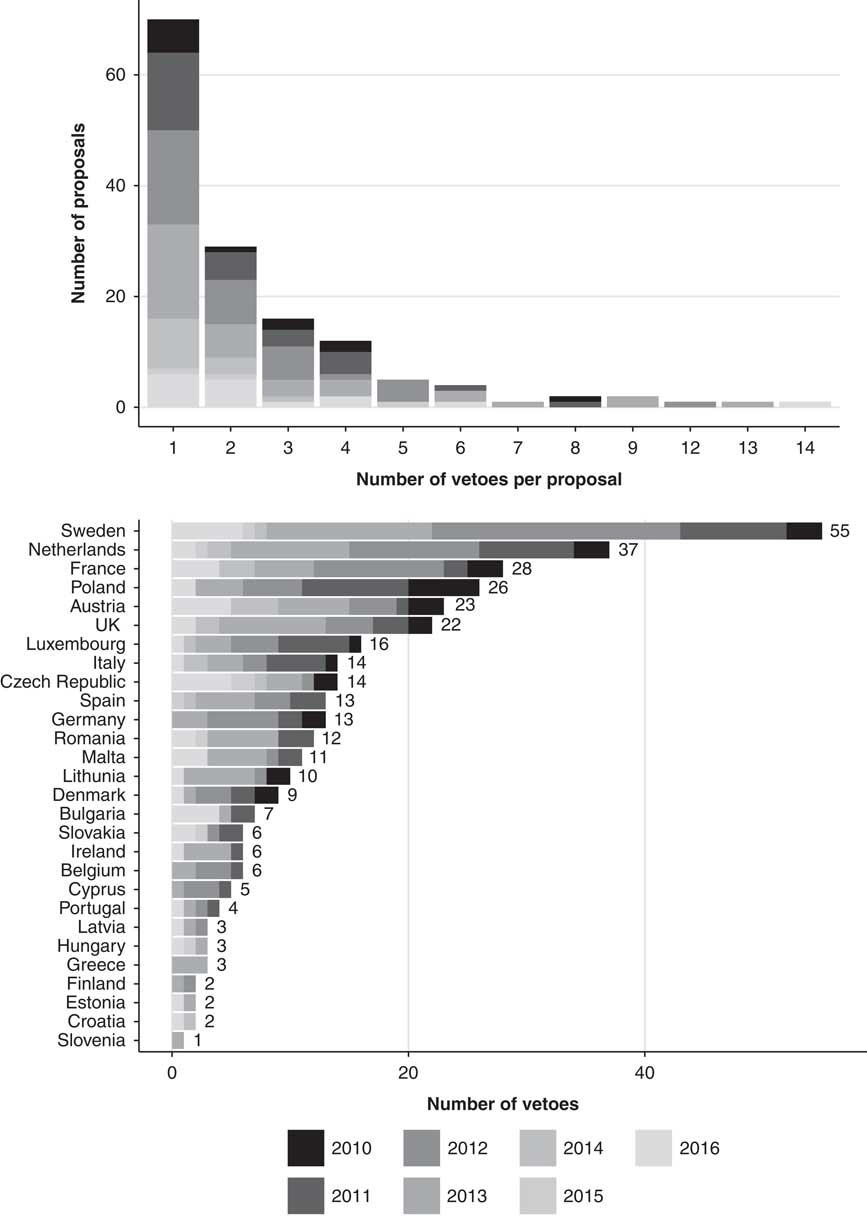
The innovative part of the EWS is the threshold character required to enforce an official reaction by the Commission. Each national parliamentary chamber has one vote, in a unicameral system two votes, resulting in fifty-six votes in total. If draft legislation is interpreted as a violation of the subsidiarity principle, as argued in reasoned opinions by at least one-third of the votes of all chambers (nineteen votes), the European Commission has to review the draft, although it can maintain the original version after review. So far, this institutional change has led to three so-called yellow cards. However, most of the time the quorum is not reached. Figure 1 shows that out of all 140 vetoed proposals, more than half are vetoed only by a single chamber, with a steep decrease in the likelihood for every additional veto (top row). Overall, national chambers vetoed 353 times between January 2010 and September 2016, with the Swedish Riksdagen being most active as compared to several chambers from the newer member states who were almost absent in the EWS (see bottom row of Figure 1). Whereas previous research has already tried to explain the variance between the general veto activity of chambers,Footnote 9 only anecdotal evidence exists about the reasons why more than one chamber vetoes the same proposal.
Legislative proposal activity (top) and parliamentary activity (bottom) per year

The day-to-day operation of the EWS serves as a good starting point for the theoretical development of our argument on partisan network influence across parliaments in the EWS. In a first step, the Commission sends all draft legislative proposals, consultation and information documents to all national parliamentary chambers. Additionally, these drafts are uploaded to the InterParliamentary EU information eXchange platform (IPEX). Here, every parliamentary chamber can generate and receive up-to-date information on the actual review process of a given proposal, that is, start a dialogue with the Commission, upload information for other parliaments, state a subsidiarity concern, track what the other chambers do, and look up the subsidiarity deadline for every proposal. In practice, only the parliamentary adminstration and a sectoral committee are concerned with a specific proposal, rather than the whole parliament. There are different organizational structures across the European legislatures. In some chambers, the EU draft is discussed in the respective sectoral committees whereas in others the European Union Affairs Committee is in charge of all EU drafts and only consults other sectoral committees sporadically. Since all sectoral committees represent the majorities in the parliament, the ideological preferences of the whole institution are also present in the committees. It is therefore usually the parliamentary majority that should matter for the veto activity in the EWS.Footnote 10
Conceptually, this has three implications for our analysis. First, compared to the traditional ex-post control function of parliaments,Footnote 11 the new competency represents an ex-ante control of the legislative activity because it takes place before the proposals are sent out to the European legislative institutions (European Parliament and the Council of the EU). Second, the parliamentary administration plays a key role in pre-selecting documents for scrutiny. Most legislative proposals have a rather technical focus, and the experts in the parliamentary administration are the focal actors for the evaluation of the subsidiarity concerns. Högenauer and Christiansen regard the administration as a ‘nodal point for the information flow’ with relatively wide autonomy; it selects only between 15 per cent and 50 per cent of the documents for further scrutiny by the parliaments.Footnote 12 The national parliamantary administration in charge of the EWS is partly based in a Brussels network of National Parliamentary Representatives (NPRs) with the function of ensuring informal, day-to-day information exchange between the chambers.Footnote 13 Third, through this early stage of policy making and the rather technical character of the issues, the role of parliaments in the EWS is considered to be that of policy shapers or European players (as compared to the classic watchdog or public forum function).Footnote 14
As a consequence, the functional set-up of the EWS,Footnote 15 the timing early on in the process,Footnote 16 the technical nature of many European policy issuesFootnote 17 and the political composition of the organizational units dealing with the EWSFootnote 18 require parliaments to interact with, and engage in learning from other parliaments with similar interests.
Parliamentary Coordination and Collective Action
Analytically, the EWS has prompted a new conceptualization of national parliaments as ‘virtual third chambers’Footnote 19 or a ‘multilevel parliamentary field’.Footnote 20 With the introduction of the EWS, the institutional role of national parliaments has to be reinterpreted as follows.
In the sense of Tsebelis, national parliaments become a de facto veto player without agenda-setting power.Footnote 21 However, the object of a veto has changed from the national to the European executive, resulting in an asymmetric vetoing relation. Additionally, while the statement of a veto is made by a single chamber, a successful veto requires a form of collective action to reach the quorum. Hence, we consider national parliaments as collective veto players in an asymmetric veto relationship.
The interpretation of the veto process as a form of collective action involves autonomous national parliaments incurring transaction costs like time and resources to process information on EU policies to the national benefit.Footnote 22 The costs of vetoing primarily emerge at two different stages in the process. First, it costs (administrative) resources to screen all documents that could be potentially scrutinized, which are several thousand each year. These costs can be minimized by considering which legislative proposals other countries set up for scrutiny. Second, once a proposal is interpreted as a possible violation of the subsidiarity principle, it costs resources of the respective parliamentary committee to formulate a reasoned opinion that states why exactly the chamber perceives the proposal as a violation of subsidiarity. Specific knowledge of other chambers’ activities would reduce these costs. Thus both stages provide incentives for parliaments to learn from other parliaments.
Collective action theory posits that actors engage in a waiting game around parliamentary veto actions. As parliaments that remain inactive benefit (or suffer) irrespective of their involvement in the collective action as long as the threshold for a yellow or orange card is met, they have incentives to wait and freeride on other parliaments’ veto actions, given the costs an individual veto action would bring about.Footnote 23 Even if confronted with ‘immediate or impending problems, people seem to be waiting around to see if anything will happen’.Footnote 24 There are three implications for parliamentary veto actions. First, veto actions are relatively scarce. Second, in rare cases, if an individual parliament’s interest in a specific policy is particularly strong, the parliament will not play the waiting game. Third, since a veto only becomes binding if a certain threshold of chambers is reached, dedicated chambers have incentives to influence peer chambers to overcome the waiting game. Thus, they will communicate and monitor the policy problems and search for a mutually beneficial solution. Therefore parliaments must actively seek allies for a veto by influencing the cost/benefit calculation of other parliaments. This is possible because some parliaments have less vested interests in specific legislative proposals than others, which creates incentives for widespread coordination activities among parliaments.
There is qualitative evidence for such coordination activities in the existing literature on the EWS. As Cooper showed in a case study for the first yellow card, parliaments mutually influence their decisions to (co-)veto specific proposals through coordination.Footnote 25 In particular, he points out that the chair of the sectoral committee of the chamber who issued the first reasoned opinion for Monti II (the Danish Folketing) ‘realized that the measure’s odium made it a likely target of widespread opposition among NPs, and thus a good candidate for the first yellow card’.Footnote 26 In a comparative case study, Pintz emphasizes the importance of active leadership in the veto process of the second yellow card.Footnote 27 She reports that the first two chambers to issue a reasoned opinion (the House of Commons and the Tweede Kamer) ‘engaged in lobbying, encouraged other NPs to join the scrutiny process, provided substantive information, and monitored the other NPs regarding the vote count’.Footnote 28 Miklin reports from the Austrian parliament that additional pressure arose from inter-parliamentary co-operation under the EWS because ‘[t]ime and again, the activities of other chambers put pressure on Austrian MPs to become active, too’.Footnote 29 This qualitative evidence suggests a strong consciousness of the collective action problem involved and a strong effect of network structures that underlie the EWS process.
An alternative proposition to our conceptualization of the EWS as a collective action problem is the use of vetoes as a signal to the constituency. Studies on negative voting in the Council of the EU emphasize this individual signaling of aversion toward a policy.Footnote 30 However, there is no existing evidence for this constituency signaling perspective in the EWS. Research on the parliamentary dimension of EU politics generally assumes that the EWS is neither used as a public forum nor as a means to control the national government. This led to a major academic critique of the EWS: from a vote-seeking perspective, there are few reasons to expect much parliamentary engagement since the salience of the topics is low and the attention of the public absent.Footnote 31 Hence, chambers that are active in the EWS are considered to be either ‘policy shapers’ or ‘European players’.Footnote 32 We therefore assume that the primary goal of parliaments is the circumvention of an undesired policy for the nation and the EU, and not a signal to a constituency with the goal of increasing the probability of re-election.
Network interdependence can be crucial for resolving collective action problems.Footnote 33 Besides the links between parliaments through information exchange and participation in common meetings, parliaments are linked through specific actions: their individual vetoes of legislative proposals. A chamber can perceive which other chambers are connected to the same legislative proposals through vetoes and what characteristics these other chambers have. If this local topology of the network matters for the decision of an individual chamber to veto a proposal (at a specific point in time), then this is what we call a network effect. We therefore look for the different factors through which network effects among parliaments could take place, like joint ideology, shared institutional properties or pre-existing relations like trade flows, and analyze if they can predict that two given chambers would veto the same proposal. We model parliamentary chambers and legislative proposals as nodes in a two-mode network. Reasoned opinions are the edges, or ties, that connect nodes across these two modes. The topology of these reasoned opinions is the explanandum in our study.
This network perspective is closely related to the literature on policy diffusion between statesFootnote 34 or, more recently, between individual members of a legislative institution.Footnote 35 Both branches of the literature have similar conceptualizations of the different mechanisms that may play a role when units display similar attributes.Footnote 36 Here, we employ causal inference techniques combined with inferential network analysis and survival analysis to distinguish between two mechanisms. We call them ‘social selection’ and ‘social influence’ in line with network science terminology and subsequently translate these concepts into the terminology employed in diffusion research.
Selection and Social Influence as Competing Mechanisms
In the study of networks, homophily is the principle that a contact between similar actors occurs at a higher rate than among dissimilar actors.Footnote 37 By conceptualizing the EWS as a network, we argue that homophily can be observed between parliamentary chambers in the sense that two chambers co-veto a given legislative proposal if they share an attribute, such as partisan ideology. However, a general finding in the literature on homophily in networks is that causality can run into both directions – from joint attributes to tie formation (‘selection’) or from the existence of network ties to the emergence of joint attributes (‘social influence’) – and that the two causal pathways cannot be easily disentangled in observational data.Footnote 38
In our study of the EWS, we argue that social influence is at work because parliaments influence each other in their veto actions. In other words, actor i vetoes proposal j because i observes the veto actions of other actors k and discovers similarities with k. This leads to imitation of k by i because i faces uncertainty over its optimal veto choices and learns from k’s choices because actors k and i are similar.Footnote 39 Most importantly, parliamentary chambers receive the signals from chambers with the same party family majority and follow their example.
In contrast, social selection may be an alternative explanation of partisan homophily in the EWS network because two parliamentary chambers may veto the same legislative proposals just because they have similar interests and institutions, irrespective of actual coordination between them. That is, i and k both connect to proposal j, but one action is not the result of the other action. For example, if two parliaments have the same majority party family, they may develop the same policy preferences and eventually veto the same proposals, even though there is no signaling or awareness between them.
However, it is possible to discriminate between the two causal mechanisms by taking into account the timing of individual veto actions. If selection is at work, time should not play a role in the veto event sequence; vetoes take place at random time points between proposal date and deadline (potentially conditional on individual-level factors like work capacity); vetoes occur in no particular order because parliaments do not learn from previous actions of others – they act as if all veto decisions were made simultaneously. In contrast, if social influence and thus coordination is at work, time should play a role in the sense that parliamentary chambers learn from recent, previous actions of peers. One should be able to observe temporal clustering of vetoes according to homophily patterns like joint party family because vetoes trigger peer vetoes.
Applied to the EWS, an earlier veto can serve as a signal to other chambers with the same attribute to concentrate veto activities on the same proposal (social influence). According to Saam and Sumpter, attribute similarity can also lead to ex-ante peer orientation:Footnote 40 For example, chambers with the same ruling party choose each other as co-operation partners and try to find a common solution, either horizontally or vertically with the European party group (social influence). In contrast, a selection effect can occur if some issues appear salient to multiple countries and therefore they are willing to take the costs of vetoing. In this case, these countries’ probabilities of vetoing the proposal are high, but they are independent of each other conditional on the chambers’ preference or interest distribution that is formed by antecedent variables like location or GDP per capita.Footnote 41 The third yellow card about the posting of workers directive, which was vetoed exclusively by member states from the 2004 and 2007 membership cohort with lower wage minimum standards (and Denmark), can serve as an example.
The literature on diffusion distinguishes between similar kinds of mechanisms, but the terminology differs slightly. For example, Lindstädt, Vander Wielen, and Green distinguish between ‘contagion’, ‘social influence’ and ‘social learning’.Footnote 42 In short, contagion means transmission of attributes between units because of contact or proximity; social influence means adoption of an attribute by a unit due to the perception of popularity of attributes among the other units; and social learning means adoption of attributes by a unit as a consequence of observing other units’ successful adoptions of the attribute.Footnote 43 The mechanism we call ‘social influence’ is consistent with any of these mechanisms because in all three cases there is a causal relationship between the adoption by one unit and a later adoption by another unit. Based on temporal observational data, we cannot distinguish further whether the second adopting unit is more proactive (‘social learning’) or the first adopting unit is more active or important in exerting an influence on the second unit (‘contagion’). Our theory states that both should occur and, ultimately, a unit can only influence another unit if that other unit is willing to learn from the former, for example, because of transaction costs or uncertainty. In contrast, what we call ‘social selection’ is a completely separate mechanism because there is no diffusion or transmission between units involved. Rather, two units have similar characteristics and independently adopt the same attributes because of that. There is considerable confusion with regard to terminology across the different branches of the literature. In line with our exposition, Shalizi and Thomas denote any kind of diffusion as ‘social influence’.Footnote 44 Readers should be aware that these differences in terminology exist and that we distinguish diffusion (‘social influence’ in network terms) from non-diffusion (‘selection’ in network terms). In our terminology, ‘homophily’ is the overarching phenomenon that any two units have similar characteristics and then both adopt the same attributes, whether because of social influence or selection. There are some expositions in network science, however, where ‘homophily’ is equated with social selection.Footnote 45
Partisan Ideology and Network Homophily
Our main theoretical argument is that the EWS is characterized by social-influence-type network effects among parliaments along partisan lines. This entails (i) that network homophily is at work in the EWS, (ii) that partisan ideology is an important factor in shaping this homophily, and (iii) that social influence is the guiding mechanism through which partisan ideology determines the occurrence of vetoes in the EWS.
We argue that the causal mechanism at work is the reduction of transaction costs based on party homophily. As laid out earlier, chambers are overwhelmed by the amount of European legislation that is sent to them on a daily basis, so they use information from other chambers on which proposals to scrutinize and how a veto could be motivated. These network effects between parliaments work best if they are politically and ideologically compatible. Political parties as ideological and organizational structure offer the basis for political compatibility.Footnote 46 If a party in country 1 has developed political preferences and a good argument on why a certain proposal violates the subsidiarity principle, it is likely that a party from the same party family in country 2 subsequently adopts this position (so diffusion may take place between the Labour Party in Britain and the Social-Democrats in Germany because they belong to the same party family). Studies on voting in the Council of the EU find these partisan patterns for national governments. Hagemann, Hagemann and Høyland, and Mattila identify a left–right cleavage as a conflict dimension in the Council.Footnote 47
Similarly, we assume that parliamentary chambers perceive activities of peer chambers on the basis of their party family affiliation. In some cases, chambers are pushed by an initiator from the same party family to adopt the behavior of an early adopter. In other cases, imitation may take place without actual communication, but through increased awareness of other chambers’ recent actions when their majority parties belong to the same party family. Whether i learns from k merely by observing k’s veto actions or by receiving further information from k after k’s veto does not matter for the argument presented here. Future research may disentangle the precise micro-level mechanisms through which social influence operates. In either case, social influence leads to sequences of vetoes by chambers with similar political majorities over time, rather than a temporally random allocation of vetoes (given the cross-sectional network homophily patterns), because parliaments directly respond to their peers by means of imitation. The implication is that temporally local interactions can be identified between partisan peers:
[HYPOTHESIS 1a: Partisan influence.] The more chambers ruled by the same party family veto a proposal, the more likely it is that a chamber ruled by a party from the same party family vetoes the proposal shortly after.
As an alternative hypothesis centering around the idea of selection, we test for a temporally random partisan homophily effect. It may be the case that partisan ideology is at work through shared prior information sets rather than co-ordination strategies in order to reduce transaction costs and overcome obstacles related to collective action. In other words, it is possible that two national parliaments have the same party family and therefore independently make similar decisions on what legislative proposals to veto.
Although there are different tools that should enable parliaments and parties to co-ordinate, like the COSAC meetings and the IPEX internet platform for information exchange,Footnote 48 some authors suggest interpreting joint vetoing as a coincidental sum of otherwise unrelated events rather than as a co-ordinated, goal-oriented action sequence.Footnote 49 According to this proposition, chambers choose on their own which proposals to veto, but due to shared attributes that cause the veto decision, a similar veto pattern occurs.
This ultimately leads to a static homophily network pattern, where temporal clustering of homophilous events cannot be detected in the sequence of individual veto actions:
[HYPOTHESIS 1b: Partisan selection.] Chambers ruled by the same party family have a tendency to veto the same proposals, regardless of the timing of vetoes.
Other Dimensions of Homophily
There are several other plausible dimensions along which chambers could coordinate, especially around EU accession and physical proximity. These alternative dimensions are inspired by the literature on conflictual voting in the Council of Ministers.
First, the literature on the formation of coalitions of national governments in Council negotiations suggests one common result: there is a clustering of countries from the same EU enlargement rounds that structures voting patterns.Footnote 50 The reason for this finding is still open to interpretation. Some argue for a redistributive cleavage,Footnote 51 others maintain the free-market versus regulated capitalism divide,Footnote 52 while a third group proposes shared political culture or similar preferences on the future of integrationFootnote 53 because the Eastern enlargement finally brought about a cleavage line between old and new members on the dimension of financial subsidies.Footnote 54 All of these explanations empirically boil down to the temporal dimension ‘duration of EU membership’.Footnote 55 Countries from the same enlargement round share more similarities than across enlargement rounds. We test whether a chamber vetoes a proposal with a higher probability if chambers from the same enlargement round have vetoed the given proposal recently (social influence, Hypothesis 2a) and whether chambers from member states that joined the EU in the same enlargement round cluster around the same proposals, irrespective of timing (selection, Hypothesis 2b).
Second, we also expect geographic proximity to increase the benefits and reduce the costs of joint vetoing. Geography can be viewed as an alternative explanation to the enlargement round phenomenon. Whereas Bailer, Mattila, and Schneider emphasize that the geographical pattern of coalition building cannot offer a convincing causal mechanism for member states’ voting profile, several studies find a significant spatial pattern.Footnote 56 Kaeding and Selck and Mattila uncover a north–south division in the Council voting patterns, as do Naurin and Lindahl in Brussels-based diplomatic communication and Veen in exchange on policy platforms.Footnote 57 We assume, more specifically, that countries that are located physically close to one another often share geographic features that impose common preferences for policies. For example, a shared sea border influences the preferences for regulation on migration.Footnote 58 This can play out as a social influence effect (Hypothesis 3a) or as a selection effect where geographic proximity leads to similar problems and preferences without any influencing taking place (Hypothesis 3b).
DATA AND METHOD
The Dependent Variable
The dependent variable consists of chamber–proposal veto events. These events are stored in a time-stamped edge list where one row represents one edge in the two-mode network of chambers (network mode 1) and legislative proposals (mode 2). Each tie in the network edge list is associated with a specific date on which the action was carried out. Parliaments only have a short time span of eight weeks for their formulation of a veto. There are two distinct dates in the vetoing process: the political decision to adopt a reasoned opinion and its formal adoption (its transmission to the European Commission). We use the transmission date for two reasons. First, the transmission date reflects the direct communication of the political decision via the IPEX website to all other chambers. Therefore the transmission should be regarded as the signal to the other chambers. If a chamber is keen on communicating its own veto, we assume that they will transmit the political decision as soon as possible. Second, the transmission date has the advantage over the decision date that it is more consistently reported. Cooper shows that the political decision and formal adoption date can vary between chambers, but his data also show that the sequence of political decision and formal adoption are congruent in almost all cases.Footnote 59 For the empirical analysis presented here, the exact date does not matter as long as the order of events is accurate.
The transmission date was obtained by a complete coding of parliamentary action on the IPEX homepage.Footnote 60 We coded all vetoes between January 2010 and September 2016. The Treaty of Lisbon was signed at the end of 2009, so the start date 2010 is naturally given. Our coding efforts resulted in 140 proposals with 353 reasoned opinions by thirty-nine chambers. The Supporting Information online contains summary statistics (sections 4 and 6) and outlier decisions (section 7).
Relational Event Model for Two-mode Networks
In order to take into account both the timing of vetoes and dependencies between actors, we estimate a relational event model (REM).Footnote 61 Our model is essentially a Cox regression model with user-defined covariates that capture network dependencies. On the one hand, adding such dependency terms to the survival model is necessary because the model would otherwise violate the iid assumption. On the other hand, we need these dependency terms to operationalize our network theory. Estimating a survival model is necessary because our theory does not just conceptualize cross-sectional dependencies but also crucially differentiates between two fine-grained temporal network mechanisms. The choice of a Cox proportional hazards model is due to the fact that we need an event-history model that incorporates exogenous covariates, but a priori the functional form of the survival curve is unknown. Even though we have exact time stamps for each event, the sequence is best modeled with a discrete-time model instead of a continuous-time model. In the continuous-time model, the number of days between two events would be calculated and used as a measure for event duration. However, the dates of the parliamentary meetings are partly determined exogenously, therefore the actual durations between events cannot be interpreted in a meaningful way, and we need to rely on a model for ordinal time. The dependent variable in the REM is therefore not the time to the next event, but rather the exact sequence of events, forming a dummy variable of event occurrence conditional on the event not having occurred in the past. This event occurrence can be estimated using a discrete-time conditional logit or Cox model.Footnote 62
Time is counted since publication of the respective legislative proposal in order to standardize waiting times across proposals. For each individual veto action, additional non-events for previous dates in the event sequence (coded 0 in the dummy variable of event occurrence) are created and grouped into the same so-called risk set. The additional non-events start with the first event after the publishing date of the respective legislative proposal. Conditional on the composition of these risk sets, the probability that an event occurs at the next time step – that is, a chamber vetoes a proposal – can be conveniently estimated using a conditional logit model,Footnote 63 a popular estimation technique for Cox models.
Factors that affect the probability of event occurrence can be tested by introducing exogenous covariates and covariates that capture endogenous processes. Given the flexible nature of the data, the covariates may be time-varying. Formulating temporal network statistics across the network of past events as sufficient statistics was proposed by Butts and has been expanded ever since.Footnote 64 In our exposition of the model, we follow Lerner et al.Footnote 65 The network of past events is given as
 $$G_{t} =G_{t} (E)=\left( {U,V,w_{t} } \right).$$
G t consists of all events (or individual vetoes) E that have occurred before time t. These events consist of parliamentary chambers u∈U, legislative proposals v∈V and a temporal weight function w t that is applied to each of the past events. The reason we need temporal weighting is that more recent veto events presumably matter more for current veto activity. The weight function counts the number of past events between a chamber and a proposal and weights them according to how long ago they happened:Footnote 66
 $$w_{t} (i,j)=\mathop{\sum}\limits_{e:u_{e} \,=\,i,v_{e} \,=\,j} {\left| {w_{e} } \right| \cdot e^{{{\minus}\left( {t{\minus}t_{e} } \right) \cdot {{ln(2)} \over {T_{{1/2}} }}}} \cdot {{ln(2)} \over {T_{{1/2}} }},} $$
where w e is the event weight (usually a constant set to 1 for each event), t is the current event time, t e is the past event time, and T 1/2 is a halflife parameter. As the time span between the focal event and the past event increases, the weight w e decreases exponentially, depending on the halflife parameter. We set halflife to be ten because it slightly outperforms other parameter values, as measured by a decreasing Bayesian Information Criterion (BIC) of our final model.Footnote 67 The results are quite resilient to different halflife specifications. Every endogenous network term used in the REM is calculated with the help of this weight function, as detailed in the next section.
Estimation of the two-mode REM is carried out using the rem package,Footnote 68 which is part of the xergm suite of packages,Footnote 69 in conjunction with the survival packageFootnote 70 in R. Regression tables were created using the texreg packageFootnote 71 and the xtable package.Footnote 72
CONSTRUCTION OF MODEL TERMS: THE INDEPENDENT VARIABLES
We construct endogenous statistics that operationalize hypotheses 1 to 3 and the relational controls. For Hypothesis 1, we use the classification of ‘party families’ of the majority party as coded by the Manifesto ProjectFootnote 73 for every chamber. In countries where the majority party changed over time, the party family value was adjusted to fit the respective date in the event sequence (in the form of an exogenous time-varying variable). To capture majority party homophily among chambers through their vetoes of the same legislative proposals, we construct an endogenous model term that we call a sender node-match on attribute x,
 $$h_{{{\rm snm}}}^{t} (i,j)=\mathop{\sum}\limits_{e\in E^{t} } {w_{t} \left( {i_{e} ,j_{e} } \right)} \left[ {j_{e} =j} \right]\left[ {i_{e} \,\ne\,i} \right]\left[ {x_{{i_{e} }} =x_{i} } \right]$$
where i is the current chamber, j is the current proposal, e is an edge from the set of edges E t in the network of past veto events up to the present time point t (as contained in G t ), i e and j e are the chamber and proposal contained in edge e, x i denotes the attribute value of chamber i (in this case the name of the majority party family), and square brackets denote indicator functions that yield 1 if the expression within the brackets is true and 0 otherwise.
As each chamber can only veto a specific proposal once, the statistic counts the number of other chambers with the same majority party family as i that have already vetoed the same proposal, weighted by how long ago the respective veto occurred, with smaller weights for vetoes that occurred long ago. The weights are determined according to the exponential decay function described by Equation (2). The statistic therefore captures whether the sequence of events supports our ideological homophily hypothesis, that is, whether chambers indeed take into account the previous actions of other chambers with the same party family majority. As explained in the next section, we use a permutation approach on the event sequence to distinguish between Hypotheses 1a and 1b.
Hypothesis 2 is tested with the same statistic, but this time x represents the enlargement round in which the respective member state joined the EU (based on a total of eight rounds).
For Hypothesis 3, we employ a similar model term that we call a sender–sender covariate:
 $$h_{{{\rm ssc}}}^{t} (i,j)=\mathop{\sum}\limits_{e\in E^{t} } {w_{t} (i_{e} ,j_{e} )\left[ {j_{e} =j} \right]\left[ {i_{e} \,\ne\,i} \right]X_{{ii_e}} } $$
Here, X is a square ∣U∣×∣U∣ matrix with a relational covariate. In this case, X contains values of 1 where the row and column chamber are located in neighboring countries and 0 in all other cells. This model term tests whether chambers look at recent actions of chambers in adjacent countries when they consider vetoing a proposal.
Finally, we add several control variables: Institutional homophily captures to what extent social influence or selection takes place between parliaments with similar institutional design. Abs. diff. in GDP controls for similar or dissimilar interests between parliaments in a bill because they have similar/dissimilar wealth levels. Main effects are introduced for both homophily terms as well as the homophily terms from hypotheses 1–3 (such as the effect of a conservative party majority on veto likelihood). Further main effects for the chambers, such as institutional characteristics, euro-skepticism, capacity, etc., and for the bills, such as issue specificity and salience, are introduced as control variables. Sections 1, 5, and 6 of the Supporting Information online contain details on all control variables, their theoretical motivations, their measurement and data sources, summary statistics for all model terms, and correlations between all variables.
To facilitate interpretation of the endogenous network statistics, all variables are rescaled by dividing them by a constant before they enter the model. For the homophily variables as well as the activity variable, the constant represents an increase in the variable due to an additional veto issued by a chamber ten days before. All homophily variables are rescaled using the same constant and the size of the coefficient can be compared across these variables. The absolute difference in GDP variable is rescaled in a similar way using an additional veto issued ten days prior by a country with which the focal chamber differs in GDP by $10,000. The trade variable is rescaled using an additional veto issued ten days ago by a country from which the focal chamber imports $1,000,000 worth of goods. Section 3 of the Supporting Information online contains more information on these transformations and the interpretation of coefficients.
DISTINGUISHING SOCIAL INFLUENCE FROM SELECTION
We exploit the temporal order of individual veto events to discriminate between social selection and social influence. The selection mechanism posits that joint properties like shared ideology independently lead to similar behavior. An implication is that veto events of chambers with the same attribute should be distributed approximately equally in a random way along the time axis for each legislative proposal. In contrast, if social influence is at work, we should expect to see a temporal order of events where vetoes by chambers with the same attribute are temporally proximate because one event triggers another event.
A REM alone can test whether homophilic patterns occur in the event network. It cannot, however, discriminate between selection or influence because even a prior occurrence of a peer veto in a temporally random order of events might increase the coefficient of a homophily term and potentially lead to a significant homophily effect. This is the case because the weights in Equation (2) take into account all events up to the current time point. The problem is that the REM statistics confound network effects and temporal effects to a certain extent: they are increased when a prior event was both recent and matched with regard to homophily, but the statistics are still somewhat increased if an event was less recent but still matches the network pattern of interest. With enough data points, this might lead to a significant result even if selection is at work.
For comparison, a purely cross-sectional network model like the exponential random graph model (ERGM)Footnote 74 cannot discriminate between the two effects either because it merely tests for the association between a veto event and a homophily pattern, but it equally takes into account all events along the temporal sequence, whether recent or not, and whether they occur before or after the focal event. Section 10 of the Supporting Information online reports the results of an ERGM as a robustness check; the results are in line with the findings reported here.
However, we do have leverage over the data-generating process if and only if (i) such a cross-sectional model indicates a significant homophily effect (because then we know that the network effect is at work), and (ii) the REM does not yield a significant result for the same association because the temporal pattern is not compatible. In precisely this situation, we can conclude that selection is at work rather than social influence.
We exploit this finding in a simulation where we randomly permute the temporal sequence of events and re-estimate the REM. More precisely, for each event in the event sequence, we randomly assign a date within the deliberation periodFootnote 75 for the respective proposal. With this random event sequence, we re-estimate the REM and save the resulting coefficients. By repeating this procedure 1,000 times, we generate a distribution of the coefficients for the endogenous network variables where the order of events is randomly determined. Then we test if the original REM coefficients significantly deviate from the means of their respective random coefficient distributions in order to imitate a comparison between a REM and a cross-sectional model. This counterfactual experiment is similar to the quadratic assignment procedure that is well-known in the literature on inferential network analysis.Footnote 76 This identification strategy rectifies an important problem in inferential network analysis: the distinction between selection and influence, which are ‘generically confounded with each other’ in observational studies.Footnote 77
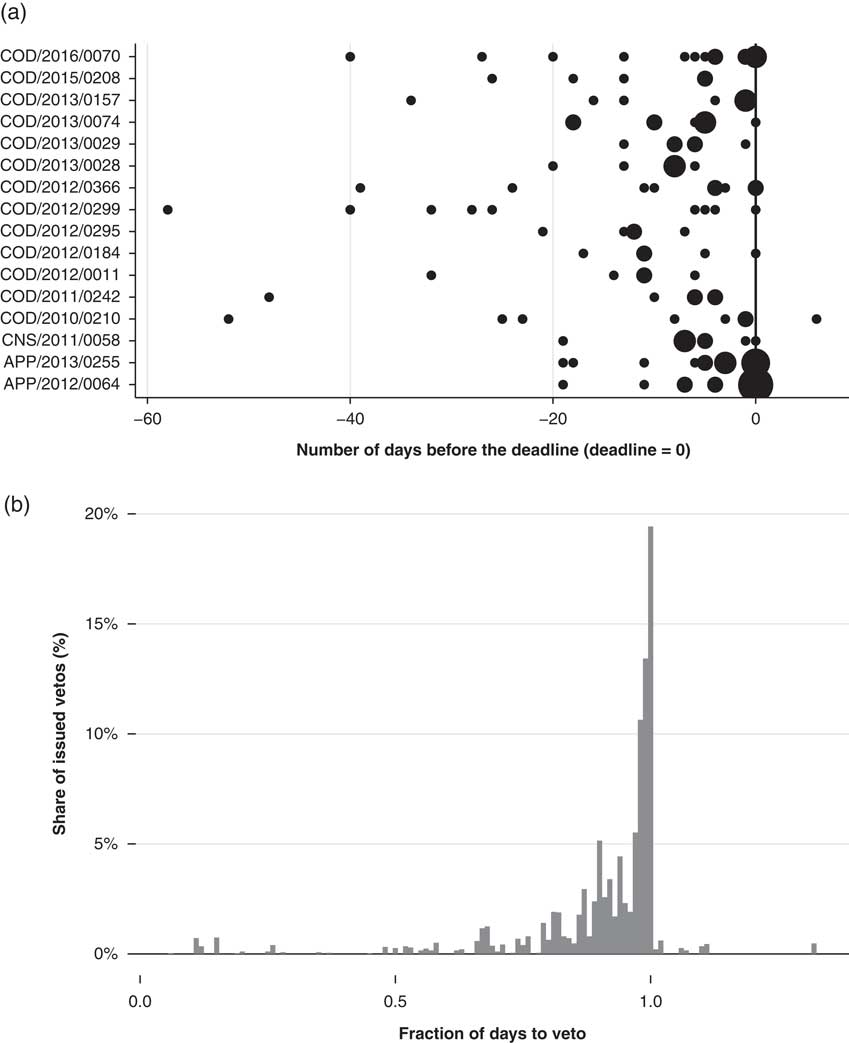
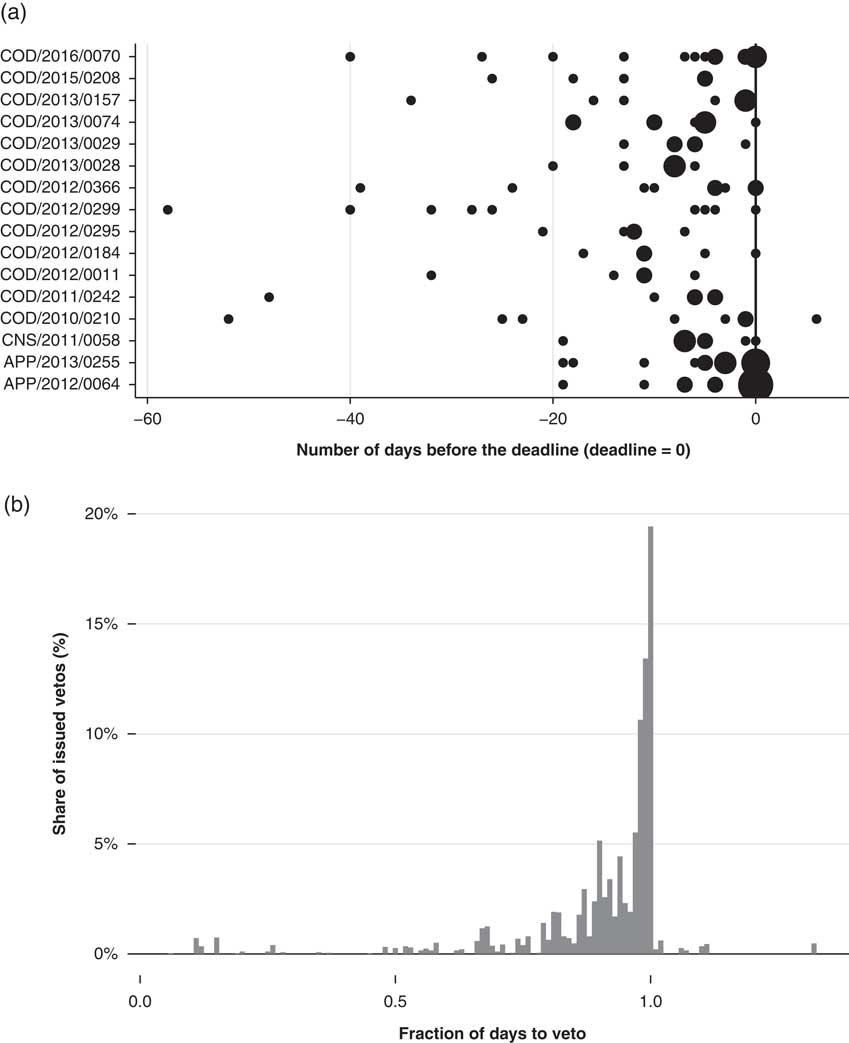
We report the permutation test as a separate column in the regression table (Table 1). Values smaller than 0.05 indicate that imitation or coordination rather than selection is at work. The table reports two separate permutation tests: one for a random temporal alignment of individual vetoes after a respective law has been proposed by the Commission and one that preserves the temporal distribution of veto actions in the aggregated dataset. Testing against a uniform temporal distribution may be inaccurate because empirically the bulk of vetoes takes place towards the end of the respective time window of eight weeks as parliaments need some time to evaluate the respective proposal (see the temporal distribution of vetoes in Figure 2), potentially leading to a type I error. Therefore we run a second permutation test where the probability that a veto takes place on a certain day is proportional to the relative frequency of that date in the whole dataset. This is a much stricter test that avoids these type I errors. However, at the same time, this test is too conservative and potentially introduces type II errors because, in principle, chambers would have had the freedom to make a veto earlier than the artificial constraint we impose on them in this second test. As such, we should take into consideration that the first permutation test may be too lax and the second one too strict, and the true p value is likely located between the two values that are reported. Yet, the joint interpretation of the three values should enable us to get a good sense of whether selection, influence, or none of them is at work: none of them if the first p value of the REM does not indicate significance, selection if only the REM p value but not the two permuted p values indicate significance, and influence if the REM p value and the first permutation p value indicate significance and the second permutation p value is relatively small, but not necessarily below 0.05.
Timing of the Vetoes
Notes: (a) Dots indicate how many days before the deadline chambers issued a veto. Dot size is proportional to the number of events occurring on the same day. A selection of proposals with at least four vetoes is shown (N=89). (b) Histogram showing when chambers are most likely to issue a veto. Distribution of time between the adoption date (=0) and the veto (=1) is shown (N=353).
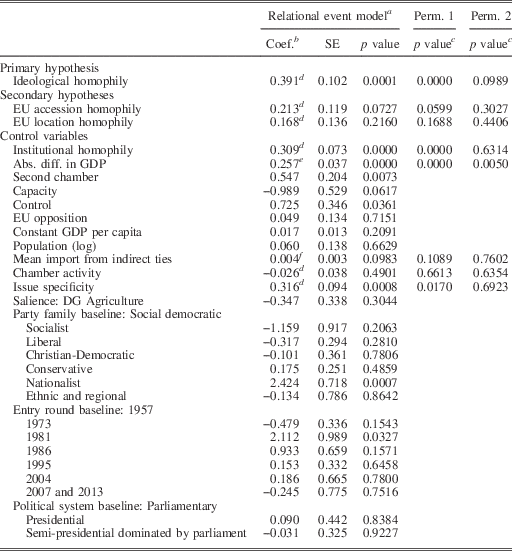
Results of the Conditional Logit Regression on Issued Vetoes between January 2010 and September 2016

aPseudo R 2=0.08 (max. R 2=0.35); McFadden pseudo R 2=0.194; b Coefficients can be interpreted as log odds; c Permuted p values are only reported where the permutation changes the event sequence; d Network variable is rescaled by a constant representing an additional past event, occurring ten days before constant=(exp(−(10)·log (2)/10)·log (2)/10)). e Abs. diff. in GDP variable is rescaled by a constant representing an additional past event, occurring ten days ago with a difference in GDP per capita levels of 10,000. f Mean import from indirect ties variable is rescaled by a constant representing an additional past event, occurring ten days ago with an import value of one million.
INTERPRETATION OF RESULTS
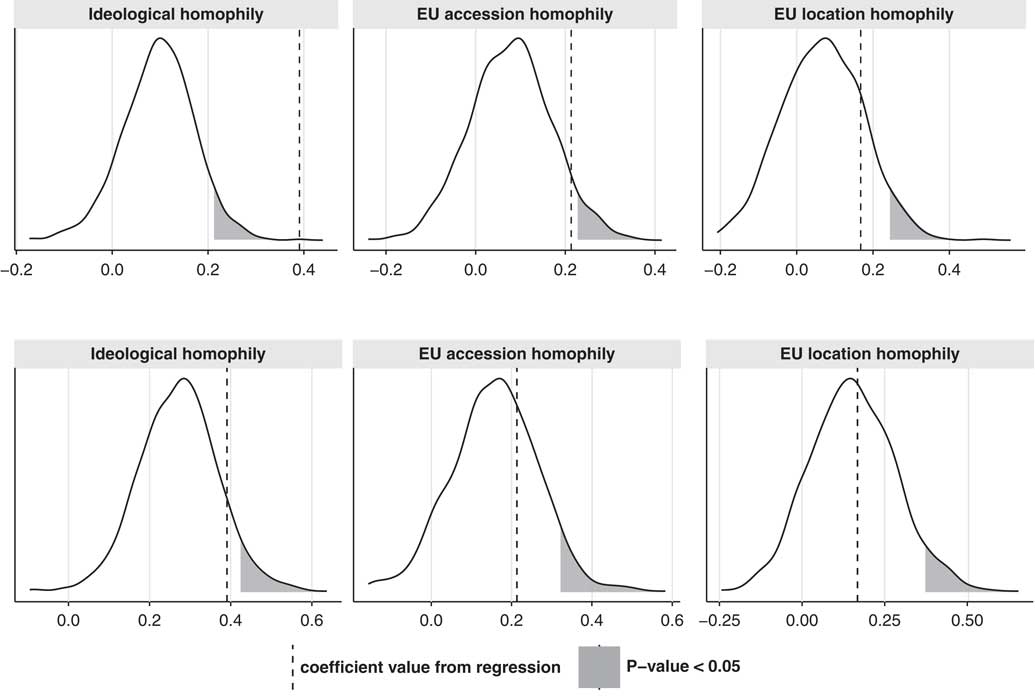
The results are presented in Table 1. Figure 3 displays the permutation results for the three hypotheses graphically.
Permutation Results for Primary and Secondary Hypotheses: Distribution of Coefficients Across 1,000 Permutations Notes: Upper row: Dates of reasoned opinions are randomly assigned within the allotted period of deliberation. Lower row: Date assignment probability is weighted according to the time-to-event distribution found in the aggregated data (see Figure 2). The size of the unpermuted coefficient is represented by dashed vertical lines.

The model supports Hypothesis 1. As indicated by the original p value and the positive coefficient, ideological homophily is at work. Chambers veto legislative proposals at much higher rates if other chambers with a majority party from the same party family vetoed the same proposal. Permutation 1 indicates that this is a temporal network pattern, not just a cross-sectional one. Permutation 2 applies an even more conservative test, which is likely too strict because it constrains chambers to become active only at predefined time points. Yet, even here, the model produces an almost significant p value of 0.099, which is a strong indicator that social influence rather than selection is at work. It is not just the case that chambers with the same party family majority show the same veto behavior, as in the social selection effect posited by Hypothesis 1b; it is rather coordination that explains the veto sequence between chambers, as stated by Hypothesis 1a. Therefore, partisan homophily plays a central role in governing the scrutiny processes and, on top, we find that the mechanism by which homophily works is social influence. Substantively, we have good reasons to believe that chambers solve the collective action problem of vetoing by turning to their peer chambers with majorities from the same party family. The temporally clustered sequence suggests that our assumption about the reduction of transaction costs based on party congruence holds. Chambers either actively try to convince other chambers with the same majority to veto the same proposal, or they act as initiator by issuing an early veto that is followed by ideologically congruent chambers. In other words, as far as partisan ideology is concerned, parliaments act in interdependent ways rather than independently.
The explanatory power of the party dimension for the observed interdependent behavior of parliaments in overcoming the collective action problem posed by the EWS has notable consequences for the interpretation of the EU as a functioning democratic system. First, while some authors argue that through the technical nature of most EU legislation the EWS has rather led to a non-political increase in administrative power,Footnote 78 our results show that when it comes to the substantive decision which proposal to veto, the party politics dimension should not be neglected. The political party delivers the organizational and ideological basis for collective action. On the basis of political ideology, chambers form alliances in their attempts to influence or stop undesired policy. This can be interpreted as a positive signal for the general legitimacy of the EWS: although parliaments struggle most of the time with the completion of the collective action set-up of the EWS, the party dimension can be considered the most promising pathway to a succesful veto. Second, party positions were a rather weak and inconsistent predictor at the European level. This led researchers to diagnose a democratic deficit because of the missing party cleavage line at the European level. To the contrary, our results suggest that at least co-operation between national legislatures is heavily dependent on the party dimension. This speaks to the scholarly community interested in the politicization of the European Union. We deliver evidence on what is called the politicization of institutions, namely ‘when party politicians gain a tighter grip on their operations leading to increasing prominence of party political conflict’.Footnote 79 Our results show that parties as ideological units act not only as conflict generators, but also as organizational structures that make the new governance instrument EWS more effective.
We hypothesized additionally that the similarity of chambers will lead to joint vetoes for two alternative chamber characteristics: enlargement cohort and spatial location. The results indicate that there are no significant homophily effects in terms of the time any two countries joined the EU or their location.
We do, however, find a significant institutional homophily pattern – but with unclear evidence for social influence versus selection – and a significant pattern for GDP heterophily and social influence. Additional details and results related to the control variables are discussed in section 2 of the Supporting Information online. Model comparisons with and without network variables are reported in section 9 of the Supporting Information online and show a drastic increase in the predictive power of the model including network terms.
CONCLUSION
Overall, our results demonstrate the impact of the institutional changes brought about by the Treaty of Lisbon. This study has delivered empirical support for the influence of party politics at the supranational level outside of the European Parliament and the European Council. Partisan influence shapes the decisions of national parliaments to co-veto legislative proposals by the European Commission. Chambers do not just act individually; their actions diffuse from parliament to parliament along partisan lines and, likely, along institutional and economic lines.
How do these effects shape collective action? Once a parliament has started vetoing a proposal, our results indicate that peer chambers tend to follow in close temporal order. This may lead to interesting and complex veto sequences with substantial heterogeneity as multiple parallel or sequential chains of homophilous vetoes may be initiated on different chamber attributes. For example, veto sequences may emerge around trade cliques and conservative cliques. These network mechanisms mitigate collective action problems parliaments would face in a dyadic independence setting. Most importantly, the partisan dimension is an effective organizational brace that facilitates learning and co-ordination among multiple parliaments that would otherwise fail to solve the collective action problem. Partisan cues, along with influence along economic and institutional lines, are effective pathways in structuring joint veto activities and overcoming the stasis imposed on the parliaments by the institutional lack of collective action incentives.
Effectiveness, however, must be interpreted in relative terms. So far, the EWS has created three yellow cards, and the distribution of veto activity per bill is highly skewed. These social influence mechanisms therefore structure veto diffusion around certain bills, but often still fail to achieve a critical mass. In other words, while partisan social influence among parliaments significantly explains co-ordination of vetoes around bills, these co-ordination efforts are often not sufficient for veto success. Future research should look into cases where parliaments that match the partisan, economic and institutional patterns do not adopt the veto actions of their peers, in order to explore the limits of collective action in the EWS.
A related question pertains to the motivations for first movers when there is no prior event sequence. Our analysis covers the diffusion of veto actions among parliaments through partisan social influence. However, we can only assume that the parliaments which issue the first veto in any sequence must have strong idiosyncratic motivations for overcoming the collective action problem imposed on them by the threshold character of the EWS in the respective situation. Future research should examine if these first movers are in fact driven by strong material interests or if other reasons prevail. It may be the case that a strategic element should be added: if parliaments anticipate that being a first mover might cause peers to follow them, this should significantly mitigate collective action problems, and we should in fact expect to see many cases where lively interactions take place. Future research should therefore look more closely at these strategic considerations of first movers vis-à-vis myopic interest-based explanations.
The sparse realization of three yellow cards in six years of the EWS first led scholars to diagnose its inefficency and to suggest a redirection of national parliaments’ resources to more salient matters like European economic governance.Footnote 80 However, the collective action problem is of a general nature. Do national parliaments have the general ability to act as a collective entity? Our results suggest they do. It may be the case that, until now, the incentives for parliaments to participate in the EWS have been rather low since the pay-offs were uncertain and the system was not built around classic parliamentary functions. However, the most recent political developments could lead to a reinforcement of the usage of the EWS. Before Brexit, the latest deal of the British government with the EU opened the possibility to introduce a ‘red card’ that could block EU legislative proposals by a 55 per cent majority of national parliaments. Even now that Great Britain has announced it is leaving the EU, the signal for more parliamentary involvement in supranational governance has been sent. If the yellow card system has not proved strong enough, the proposed developments could provide stronger incentives for parliaments to engage in the EWS and to act collectively. Additionally, our results suggest that the observation of politicization of the EU holds for the national legislative dimension of the European project. Parties could be able to form a democratic backbone of the European governance process.
Methodologically, our use of recent techniques from network science coupled with an innovative causal inference design permitted us to study the nature and effect of a new institution. Network science allowed us to operationalize the diffusion patterns between parliaments within this institution, and our temporal permutation approach could distinguish between different causal network mechanisms. We expect that other institutions could be studied in similar ways. In particular, institutions that are based on elements like collective action problems, transaction costs of agents and/or principal–agent relationships may benefit from a systematic analysis of relationships as demonstrated here. The network perspective adds a genuine theoretical lens to the study of institutions: it can serve to develop and test arguments about how institutional design facilitates, constrains or changes the interactions taking place between political actors in their pursuit of influencing politics – one of the core missions of the discipline. Future methodological research should assess in how far relational event models are applicable to political science questions, examine and compare estimation strategies for REMs, and apply our permutation approach to other situations where social influence and selection need to be disentangled.
More generally, our research contributes to ongoing work on the role of homophily in political network dynamics.Footnote 81 We contribute to this discussion by describing an institutional arrangement in which homophily between collective actors drives the behavior of the system. Our contribution suggests that homophily may come in very different flavors like social influence (that is, diffusion), shared third-party influences or merely identical action due to shared attributes. Future research needs to pay attention to the exact causal mechanisms that are at work in a given context. Conceptually, disentangling these mechanisms will be an important contribution. Similar conceptual and causal distinctions are prevalent in the literature on policy diffusion,Footnote 82 and researchers who deal with policy diffusion and those who deal with political networks should recognize the potential for diffusion among these two branches of literature.Footnote 83