Personality development involves the coordinated integration of two fundamental developmental psychological processes: the development of a capacity for interpersonal relatedness and the development of an integrated and differentiated self-definition (Blatt, Reference Blatt1991, Reference Blatt2008). The synergistic development of these two fundamental psychological processes is essential for healthy personality development. This normal synergistic developmental process, however, can be disrupted, and this disruption can be expressed in high levels of Self-Criticism and/or Dependency (Blatt, Reference Blatt2004; Blatt & Homann, Reference Blatt and Homann1992; Coyne & Whiffen, Reference Coyne and Whiffen1995; Quimette & Klein, Reference Quimette, Klein, Masling and Bornstein1993) leading to increased vulnerability to stress and psychopathology (Blatt & Zuroff, Reference Blatt and Zuroff1992).
Considerable empirical research, including cross-sectional (e.g., Besser & Priel, Reference Besser and Priel2003, Reference Besser and Priel2005; Campos, Besser, & Blatt, Reference Campos, Besser and Blatt2010), longitudinal (e.g., Besser, Priel, Flett, & Wiznitzer, Reference Besser, Priel, Flett and Wiznitzer2007; Besser, Vliegen, Luyten, & Blatt, Reference Besser, Guez and Priel2008; Yao, Fang, Zhu, & Zuroff, Reference Yao, Fang, Zhu and Zuroff2009) and experimental studies (e.g., Besser, Guez, & Priel, Reference Besser, Guez and Priel2008; Franche & Dobson, Reference Franche and Dobson1992; Zuroff & Mongrain, Reference Zuroff and Mongrain1987), as well as several meta-analyses (e.g., Nietzel & Harris, Reference Nietzel and Harris1990; Quimette & Klein, Reference Quimette, Klein, Masling and Bornstein1993), demonstrated that high levels of Dependency and/or Self-Criticism create vulnerability to depression as well as to distress and neuroticism (e.g., Bagby & Rector; Reference Bagby and Rector1998, Quimette & Klein, Reference Quimette, Klein, Masling and Bornstein1993), anxiety (e.g., Overholser & Freiheit, Reference Overholser and Freiheit1994; Mongrain & Zuroff, Reference Mongrain and Zuroff1995) and increased hostility (e.g., Zuroff & Lorimier, Reference Zuroff and Lorimier1989). High levels of Dependency and Self-Criticism are also differentially related to modes of adaptation including motivational, relational and coping styles and defensive mechanisms (e.g., Aube & Whiffen, Reference Aube and Whiffen1996; Blatt & Homann, Reference Blatt and Homann1992; Blatt & Zuroff, Reference Blatt and Zuroff1992; Campos, Besser, & Blatt, Reference Campos, Besser and Blatt2011; Mongrain & Zuroff, Reference Mongrain and Zuroff1995).
These constructs of Dependency and Self-Criticism can be assessed by the Depressive Experiences Questionnaire (DEQ) a 66-item questionnaire that assesses everyday life experiences common in depressed individuals (Blatt et al., Reference Blatt, D’Afflitti and Quinlan1976). The DEQ was develop within a psychodynamic framework that assumes a continuity between depressive affect in non-clinical and clinical populations (Blatt, Reference Blatt1974, Blatt et al., Reference Blatt, D’Afflitti and Quinlan1976; Freud, 1917/1980) in which clinical depression is viewed as the extreme expression on a continuum with normal affective experiences. The DEQ was constructed to assess, not the symptoms of depression, but the everyday life experiences reported by depressed individuals in both clinical and non-clinical samples (see Blatt, Reference Blatt2004 for review). Based on a review of the classic literature on depression (e.g., Bibring, Reference Bibring and Greenacre1953; Cohen, Baker, Cohen, From-Reichman, & Weigert, Reference Cohen, Baker, Cohen, From-Reichman and Weigert1954; Freud, 1917/1980), Blatt and colleagues collated 120 statements of common life experiences described by depressed individuals - how they relate to others, feel about themselves, their preoccupations and how they conduct their lives. Sixty-six of these statements were selected by several judges as describing phenomenological experiences typical of depressed individuals, and are presented to subjects as 7 point Likert scales ranging from strongly disagree to strongly agree.
The DEQ yields two factors of depressive experience, Dependency and Self-Criticism (Blatt et al., Reference Blatt, D’Afflitti and Quinlan1976; Blatt & Zuroff, Reference Blatt and Zuroff1992) which are consistent with the two depressive dimensions previously discussed by Blatt (Reference Blatt1974) based on clinical experience. The DEQ also yields a third factor, Efficacy. These three factors were derived from a Principal Component Analysis (PCA) conducted with an American standardization sample of 500 female and 160 male undergraduate college students (Blatt et al., Reference Blatt, D’Afflitti and Quinlan1976; Blatt et al., Reference Blatt, D’Afflitti and Quinlan1979). Blatt et al. (Reference Blatt, D’Afflitti and Quinlan1976) retained these three factors because additional factors “accounted for too little variance (< 5%) to be of psychological or statistical consequence” (Blatt et al., Reference Blatt, D’Afflitti and Quinlan1976, p. 384). The three factors accounted for 25.5% of the variance. This factor structure has been replicated many times with a wide range of subjects in many different cultures (see Blatt, Reference Blatt2004).
The first DEQ factor, Dependency, includes concerns about close and dependent interpersonal relationships, fears of abandonment and object loss, and feelings of helplessness and loneliness (e.g., “Many times I feel helpless” and “I become frightened when I feel alone”). The items loading on the second factor, Self-Criticism, reflect preoccupation with issues of failure, ambivalent feelings about self and others, and intense and harsh Self-Criticism (e.g., “I often feel guilty” and “I tend not to be satisfied with what I have”). In addition to these two factors, a third factor was revealed, labeled Efficacy. Items on the Efficacy factor reflect goal-oriented strivings, but not excessive competition with others (e.g., “I often feel what I have to say is important”). The majority of the studies using the DEQ has focused on the first two factors because of their direct relevance for maladaptive functioning as well as the empirical limitations of the Efficacy factor (i.e., that only 5 items load heavily [>. 40], on this factor).
Each of the 66 DEQ items is multiplied by its factor weight coefficient on each of the three DEQ factors. Thus, all 66 items, relative to their factor coefficients, contribute to the score on each of the three factors. Consistent with procedures in the majority of research with the DEQ (see Blatt, Reference Blatt2004), the factor weight coefficients for females in the original sample were used in the present study.
Extensive research (see summary in Blatt, Reference Blatt2004) indicates that the two fundamental dimensions assessed by the first two DEQ factors, Dependency and Self-Criticism, assess two major vulnerabilities to depression. The focus in the DEQ on life experiences, rather than symptoms of depression, has enriched understanding of depression in both clinical and non clinical populations.
The original clinical observations by Blatt (Reference Blatt1974) and the subsequent development of, and findings with the DEQ (e.g., Blatt et al., Reference Blatt, D’Afflitti and Quinlan1976; Blatt et al., Reference Blatt, D’Afflitti and Quinlan1979; Blatt, Quinlan, Chevron, McDonald, & Zuroff, Reference Blatt, Quinlan, Chevron, McDonald and Zuroff1982) have influenced other theorists (e.g., Arieti & Bemporad, Reference Arieti and Bemporad1980; Beck, Reference Beck, Clayton and Barret1983) to propose similar formulations as well as the development of other scales (e.g., the Sociotropy and Autonomy Scale; [SAS]; Beck, Epstein, Harrison, & Emery, Reference Beck, Epstein, Harrison and Emery1983), and the Personality Style Inventory (PSI; Robins et al., Reference Robins, Ladd, Welkowitz, Blaney, Diaz and Kutcher1994) to assess similar distinctions in depression (e.g., sociotropy and autonomy; Beck, Reference Beck, Clayton and Barret1983). Results with these measures have provided considerable support for Blatt’s (Reference Blatt1974) original clinical observations of these two primary dimensions in depression (see Blatt Reference Blatt2004; Nietzel & Harris, Reference Nietzel and Harris1990) and have also contributed to research on personality organization and other forms of psychopathology (e.g., Blatt & Shichman, Reference Blatt and Shichman1983).
A number of studies have demonstrated acceptable psychometric properties for the DEQ in both clinical and non clinical samples: adequate internal consistency, test-retest stability, and validity (see reviews in Blatt, Reference Blatt2004; Desmet et al., Reference Desmet, Vanheule, Groenvynck, Verhaeghe, Vogel and Bogaerts2007; Desmet et al., Reference Desmet, Verhaeghe, Van Hoorde, Meganck, Vanheule and Murphy2009). Cronbach’s alphas range from .65 to .83, and the Dependency and Self-Criticism factors have correlated significantly with a number of other measures of psychological functioning and psychopathology (e.g., Beck Depression Inventory [BDI] and the CES-D). The Self-Criticism factor correlates highly with conventional measures of depression, but the Dependency factor yields lower, sometimes non-significant, correlations with these other measures. Importantly, in both clinical and non clinical samples, Dependency and Self-Criticism remain independent factors (e.g., see a review in Blatt, Reference Blatt2004).
Luyten et al. (Reference Luyten, Sabbe, Blatt, Meganck, Jansen, De Grave and Corveleyn2007), for example, compared the DEQ scores of patients with major depressive disorder (MMD) with mixed psychiatric patients, university students, and community adults and found that Dependency was specifically associated with MDD, whereas Self-Criticism did not differ between depressed and mixed psychiatric patients. Severity of depression, however, was more clearly linked to Self-Criticism than to Dependency. Dependency and Self-Criticism were related to theoretically predicted clusters of depressive symptoms. The authors concluded that both Dependency and Self-Criticism were associated with MDD, severity of depression, and specific depressive symptoms.
Dunkley et al. (Reference Dunkley, Schwartzman, Looper, Sigal, Pierre and Kotowycz2012) studied Self-Criticism, personal standards and Dependency as specific personality vulnerabilities that might contribute to a better understanding of numerous psychosocial problems relevant to coronary artery disease. Participants were 123 patients diagnosed with coronary heart disease (CHD). Hierarchical regression demonstrated the incremental utility of Self-Criticism, personal standards and Dependency in relation to maladjustment, over and above aggression/anger/hostility, negative affectivity, and social inhibition (see also Blatt, Cornell, & Eshkol, 1983, for a discussion of the role of Self-Criticism in CHD and Dependency in immunological disorders). Campos, Besser, and Blatt (Reference Campos, Besser and Blatt2012) found that Dependency and Self-Criticism were vulnerability factors to distress (hostility, anxiety, depression and interpersonal sensitivity), which could, in turn, result in increased vulnerability for suicidality (see also Beck, Reference Beck, Clayton and Barret1983; Blatt, Reference Blatt1995; Blatt et al., Reference Blatt, Quinlan, Chevron, McDonald and Zuroff1982; Fazaa & Page, Reference Fazaa and Page2003).
Despite the wide acceptance of the DEQ and the considerable research findings with this instrument, some investigators questioned its validity (e.g., Coyne & Whiffen, Reference Coyne and Whiffen1995; Coyne, Thompson, & Whiffen Reference Coyne, Thompson and Whiffen2004; Desmet, Vanheule, & Verhaeghe, Reference Desmet, Vanheule and Verhaeghe2006; Lehman et al., Reference Lehman, Ellis, Becker, Rosenfarb, Devine, Khan and Reichler1997; Viglione, Philp, Clemmey, & Camenzuli, Reference Viglione, Philip, Clemmey and Camenzuli1990). Coyne et al. (Reference Coyne, Thompson and Whiffen2004), for example, stated that the DEQ does not measure the psychoanalytic constructs it claims to measure. Desmet et al. (Reference Desmet, Verhaeghe, Van Hoorde, Meganck, Vanheule and Murphy2009) concluded that their study yielded no evidence for a divergence of the findings with the DEQ and Blatt’s theoretical formulations, but that more research is needed to evaluate the sex-specific validity of the DEQ factors. Zuroff, Mongrain, and Santor (Reference Zuroff, Mongrain and Santor2004), however concluded that Blatt’s concepts are continuous, nearly orthogonal dimensions that can be identified and measured independently from neuroticism, depression, and social context.
To overcome some of the difficulties of the DEQ, specially the low explained variance (25%), and to seek an alternative for its complex factor scoring procedure, several shortened versions of the DEQ have been constructed, some with a unit, rather than a factor weighted scoring procedure (e.g., the revised DEQ; Welkowitz, Lish, & Bond, Reference Welkowitz, Lish and Bond1985), the reconstructed DEQ (Bagby, Parker, Joffe, & Buis, Reference Bagby, Parker, Joffe and Buis1994) and the McGill DEQ (Santor, Zuroff, & Fielding, Reference Santor, Zuroff and Fielding1997; Santor, Zuroff, Mongrain, & Fielding, Reference Santor, Zuroff and Fielding1997). But Zuroff et al. (Reference Zuroff, Mongrain and Santor2004), based on extensive review, recommend the use of the original DEQ whenever possible.
Given the great amount of research conducted within the framework of two basic dimensions of interpersonal relatedness and self-definition in personality and psychopathology (Blatt, Reference Blatt2008), especially depression, several efforts were undertaken to translate the DEQ into several languages including French, German, Hebrew, Spanish, Russian, Sweden, Croatian, Arabic, and, recently, Japanese and Chinese. Kuwabara, Sakado, Sakado, Sato, and Someya (Reference Kuwabara, Sakado, Sakado, Sato and Someya2004), for example, found that the Japanese version of the DEQ had reliability values similar to those obtained with the original DEQ. Comparing subjects with and without lifetime histories of major depression, they found that subjects with a history of depression had significantly higher scores on Self-Criticism, concluding that the Japanese DEQ assesses a depression-prone personality. Yao et al. (Reference Yao, Fang, Zhu and Zuroff2009), using the Chinese version of the DEQ, found that Dependency and Self-Criticism predicted depression over a one month period in a non-clinical sample, concluding that the Chinese version of the DEQ had satisfactory construct and predictive validity, and was appropriate for assessing vulnerability to depression in Chinese college students.
The present study examines the relationship of Dependency and Self-Criticism to depression and psychopathology more generally, in clinical and non-clinical Portuguese samples with a Portuguese version of the DEQ. We conducted an assessment of the psychometric properties of the Portuguese DEQ: its measurement equivalence, reliability (internal consistency and test-retest stability), factor structure, gender differences and comparison of the DEQ scores of Portuguese and American individuals. We also evaluated convergent, discriminant, criterion and predictive validity of the Portuguese DEQ in clinical and non-clinical samples.
Method
The validation program
The DEQ was translated into Portuguese and administered to six samples: a bilingual sample to test measurement equivalence; three non clinical samples (a college student sample and two community samples) to test for internal consistency and factor, convergent and discriminant validity; a sample of psychiatric patients to test for criterion validity, and a longitudinal sample of college students to examine test-retest reliability and predictive validity. Two additional measures, the Center for the Epidemiologic Studies of Depression Scale (CESD; Radloff, Reference Radloff1977) and the Brief Symptom Inventory (BSI; Derogatis, Reference Derogatis1993) were used to evaluate convergent validity of the Portuguese DEQ.
The ethical guidelines of the Portuguese Psychologists Board were followed throughout, and all participants gave signed informed consent.
Translation of the Depressive Experiences Questionnaire
The translation of the DEQ into Portuguese was conducted in several stages: a preliminary translation, the evaluation of this translation by clinical specialists with proficiency in English, back-translations and their subsequent evaluation (see Campos, Reference Campos2000 for a detailed presentation of these procedures).
In the preliminary translation, the original DEQ items and instructions were maintained. The items were translated in the most literal way, and when this was not possible, we tried to maintain the meaning of the original item following the guide-lines of van de Vijver and Hambleton (Reference Van de Vijver and Hambleton1996). The preliminary translation was evaluated by four clinical psychologists. Then, an English translator back-translated the Portuguese form into English without having access to the original DEQ, and another translator compared the back-translation with the original form. Differences in a few items were modified. Finally, before a pilot study was conducted with 20 participants to assess the comprehension of the items, a second back-translation was conducted. Following this second back-translation, no further changes were made to the questionnaire. Although some items present wording different from the original DEQ because some items are extensive and complex, these differences did not warrant modification because the meaning of the translated items was identical to the original item. Moreover, in a close reading by one of the authors (RCC), all “key-words” of the original items seemed well translated into Portuguese.
Administration of the DEQ to a Bilingual sample
Twenty six senior college students in an English translation course in a Portuguese university (16 females and 10 males), ranging in age from 21 to 26 years old, were given the two forms of the DEQ in randomized order. Half of the participants were first given the Portuguese version and the other half were first given the original English version of the DEQ. To limit memory bias, participants were given three other questionnaires (containing a total of 105 items), between their responses to the two forms of the DEQ.
Administration of the DEQ to College Students’ Sample I (N = 488)
Four hundred eighty eight college students from several Portuguese universities volunteered to participate. Three hundred and fifty nine (73.6%) were female and 129 (26.4%) were male, ranging in age from 18 to 29 years (M = 20.4, SD = 4.9). Students, in groups of 15 to 50 students, responded to the Portuguese version of the DEQ, usually at the beginning or the end of their class. After a brief explanation about the purpose of the study, participants completed the DEQ.
Administration of the DEQ to Community Sample I (N = 405)
A community sample of 405 adults, the great majority living in the district of Évora, Portugal, volunteered to participate in the validation program. Two hundred and three participants were male and 202 were female, ranging in age from 19 to 69 years (M = 35.3, SD = 11.6). The majority of the participants were Caucasian and their education levels ranged from 6 to 19 years (M = 12.1, SD = 3.4). The socio-economic status was in the average range. Participants responded to requests for volunteers to take part in a study concerning personality and mood. All protocols were collected in individual sessions by trained research assistants and instructions were presented in written form. Participants were not paid or compensated for their participation.
To assess depressive symptoms, participants also responded to the Portuguese version (Gonçalves & Fagulha, Reference Gonçalves and Fagulha2004) of the Center for Epidemiologic Studies Depression Scale (CES-D; Radloff, Reference Radloff1977). The CES-D has acceptable internal consistency and convergent validity. The Portuguese version has good psychometric characteristics. The Cronbach alpha in different samples ranged between .87 and .92.
Administration of the DEQ to Community Sample II (N = 105)
A second community sample consisted of 105 adults, living in several Portuguese districts (51 males and 54 females), ranging in age from 19 to 64 years (M = 36.3, SD = 11.5), with educational levels ranging from 6 to 19 years (M = 12.1, SD = 3.1). The majority of the participants were Caucasian. The socio-economic status was in the average range. Like with the previous sample, participants responded to requests for volunteers to take part in a study concerning personality and mood, and protocols were collected in individual sessions by trained research assistants. Participants were again not paid or compensated for their participation.
Participants responded to the DEQ as well as the Portuguese version of Brief Symptom Inventory (BSI), a 53-item self-report inventory that assesses symptom distress in a number of domains on five point Likert scales. The psychometric properties of the BSI for specific symptom subscales as well the total score are provided in the manual (Derogatis, Reference Derogatis1993). Given the specific aim of our validation program, we used four BSI subscales: Anxiety, Depression, Hostility and Interpersonal Sensitivity. The BSI had been adapted for the Portuguese population by Canavarro (Reference Canavarro2007). Cronbach alphas varied between .62 and .80 for the nine symptom scales, and the scales correlate significantly with expected measures as well as differentiate patients from non patients.
Administration of the DEQ to a Clinical Sample (N = 50)
The fifth sample included 50 psychiatric patients: 13 (16%) were male and 37 (74%) were female, ranging in age from 23 to 65 years (M = 44.0, SD = 12.2) with a mean educational level of 10.1 years. Participants were recruited from psychiatric departments of two Portuguese hospitals. Criteria for inclusion were: being older than 18 and having a defined diagnosis of a psychiatric disorder excluding dementia or other conditions that would invalidate their response to self-report measures. Twenty eight (56%) had a diagnosis of depressive disorder, 10 (20%) an anxiety disorder, 8 (14%) a bipolar disorder, and 5 (10%) other diagnoses. All participants volunteered to participate and gave informed consent. All protocols were collected in individual sessions by trained research assistants and instructions were presented in written form.
Administration of the DEQ to college students’ sample II (N = 63)
Sixty three female students from a psychology course of the Universidade de Évora, ranging in age from 18 to 35 years (M = 21.2, SD = 3.5), volunteered to participate and gave informed consent. Participants in small groups of about 20 students responded to the Portuguese version of the DEQ and the Portuguese version of the CES-D on two occasions, with an interval of six months between administrations.
Statistical analysis
To test for measurement equivalence correlations between results of the bilingual participants on both American and Portuguese forms of the DEQ were computed. Gender differences and comparisons with the American students were tested using t-test, correlations between DEQ factors were performed using Pearson correlations, the factor structure of the DEQ was evaluated using Principal Component Analysis (PCA) with Varimax rotation, and internal consistency was tested with Cronbach’s alpha. Convergent and discriminant validity were tested by Pearson correlations between DEQ factors as well as with the CES-D and the BSI scales. Criterion validity was tested comparing the clinical sample and the community sample II, test-retest stability was assessed computing correlations between DEQ factors over a six month interval, and finally predictive validity was tested by the correlation between DEQ factors at Time 1 and CES-D at Time 2, controlling for depression at Time 1.
Results
Measurement equivalence
In the bilingual sample, the correlations between each of the three factors of the original and the three correspondent factors of the Portuguese forms of the DEQ were, .85, .85 and .90 for the Dependency, Self-Criticism and Efficacy, respectively.
Gender differences
Comparisons of the means of male and female students on Dependency, Self-Criticism and Efficacy, consistent with earlier findings, indicate that Dependency was higher in female, t(486) = 6.14, p < .001 than in male students, but no significant differences were found for Self-Criticism, t(486) = 1.49, ns and Efficacy, t(486) = .80, ns. Female community participants scored significantly higher than male participants on the Dependency factor, t(403) = 5.26, p < .001, but no significant differences were found for Self-Criticism and Efficacy.
Comparison with American students
We also compared the scores of Portuguese males and females students from the college student sample I with the American sample on the three DEQ factors. Portuguese female students scored significantly higher than American female students on Dependency, t(1136) = 2.86, p < .01, but no significant differences were found for male students. Portuguese students, both male, t(500) = 2.31, p < .05 and female, t(1136) = 3.52, p < .001, scored significantly lower than American students on Self-Criticism. Portuguese students, both male, t(500) = 4.5, p < .001, and female, t(1136) = 6.03, p < .001 also scored significantly lower than the American students on the Efficacy factor.
Internal consistency and test retest reliability
For the total sample of students the Cronbach’s alphas were .80 and .78 and .70 for the Dependency, Self-Criticism and Efficacy factors, respectively, and .77, .79 and .70 for females and .82, .78 and .71 for males, for Dependency, Self-Criticism and Efficacy factors, respectively. For the Community sample I, Cronbach’s alphas were .73, .79 and .71, respectively for Dependency, Self-Criticism and Efficacy for the total sample. For females, alphas were .73, .80 and .71, and for males, alphas were .70, .78 and .72. For the community sample II, Cronbach’s alphas were .72, .76 and .78, respectively for Dependency, Self-Criticism and Efficacy scales in the total sample. For females, alphas were .76, .68 and .69 and for males .66, .81 and .83, respectively for the three DEQ factors.
In the college student sample II, Dependency at time one correlates significantly with Dependency at time two (r = .72, p < .001), Self-Criticism at time one also correlates significantly with Self-Criticism at time two (r = .74, p < .001) as did the Efficacy factor (r = .68, p < .001).
Factor structure
Regarding factor structure, like Blatt (Blatt et al., Reference Blatt, D’Afflitti and Quinlan1976; Zuroff, Quinlan & Blatt, Reference Zuroff, Quinlan and Blatt1990), we conducted a Principal Component Analysis (PCA) with a Varimax rotation with the college student sample I. For comparability with the extensive research on a three factor solution, we extracted three factors, which was consistent with the Scree Plot Test that indicated retaining just the first three factors.
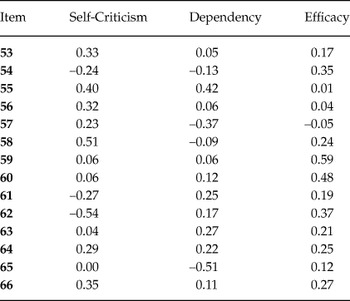
After rotation, the first three factors in our sample yielded Eigenvalues of 9.05, 4.59 and 3.53, explaining 11.4%, 9.0% and 5.6% of the variance, respectively, for 26.0% of the total variance. Additional factors account for a little percentage of variance, with Eigenvalues of: 2.24, 2.00, 1.68, 1.65, 1.51, 1.47, 1.36, 1.27, 1.22, 1.21, 1.18, 1.14, 1.11, 1.07 and 1.03. The total percentage of explained variance is similar to the 25.5% explained variance in the original study (Blatt et al., Reference Blatt, D’Afflitti and Quinlan1976) and with the 24.2% in the replication study (Zuroff et al., Reference Zuroff, Quinlan and Blatt1990). Items with factor loadings greater than .40 on the three factors were similar to the items reported by Blatt et al. (Reference Blatt, D’Afflitti and Quinlan1979). These factor loadings are reported in the appendix A (Table 2). However, the order of the factors emerging from the present solution was somewhat different from the original sample. In our sample Self-Criticism, (factor II) emerged as the first factor, Dependency (Factor I) as the second factor and Efficacy (Factor III) as the third factor.
Loadings of the 66 DEQ items in the 3 factors for the Student’s sample

A PCA with a Varimax rotation on the DEQ responses of the community sample I yielded Eigenvalues of the first three factors of 8.38, 4.08 and 3.49, explaining 11.5%, 6.7% and 5.8% of the variance, respectively, for a total of 24.0% of the variance. Additional factors account for a little percentage of variance, with Eigenvalues of 2.64, 2.10, 1.82, 1.57, 1.48, 1.43, 1.38, 1.34, 1.29, 1.27, 1.19, 1.18, 1.12, 1.08, 1.07, 1.04 and 1.01. Once again, the total percentage of explained variance was similar to the percentage of explained variance in the original study (Blatt et al., Reference Blatt, D’Afflitti and Quinlan1976) and in the replication study (Zuroff et al., Reference Zuroff, Quinlan and Blatt1990). Also, items with factor loadings greater than .40 on the three factors were similar to those obtained with our college students. Using the Orthosim-2 (Barrett, Reference Barrett, Beauducel, Biehl, Bosnjak, Conrad, Schönberger and Wagener2005) to compare the factor solutions of our student and community samples we found that the overall congruence coefficient was .92 and that the congruence coefficients for Dependency, Self-Criticism and Efficacy were .97, .94 and .90, respectively.
Convergent and discriminant validity
The Portuguese version of the CES-D correlated significantly with Self-Criticism both for the male (r = .47, p < .001) and female (r = .41, p < .001) participants of the community sample I. Dependency and Efficacy scales did not correlate significantly with the CES-D. In the clinical sample, the Portuguese CES-D correlated significantly with Self-Criticism (r = .43, p < .005) and with Dependency (r = .35, p < .01), but not with Efficacy.
Research (Blatt, Zohar, Quinlan, Zuroff, & Mongrain, Reference Blatt, Zohar, Quinlan, Zuroff and Mongrain1995; Blatt, Zohar, Quinlan, Luthar, & Hart, Reference Blatt, Zohar, Quinlan, Luthar and Hart1996; Rude & Burnham, 1995) indicates that two sub-factors are embedded in the DEQ Dependency Factor—a less adaptive sub-factor labeled, Neediness; and a more adaptive sub-factor labeled Connectedness (or Relatedness). Neediness, but not Connectedness, in the community sample correlated significantly with the CES-D (r = .30, p < .01 for females and r = .42, p < .001 for males).
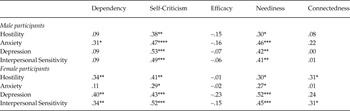
In the community sample II, Dependency, Self-Criticism and Efficacy factors were correlated with the four scales of the BSI (Anxiety, Depression, Interpersonal sensitivity and Hostility). These values are presented in Table 1. Correlations were higher for Self-Criticism than for Dependency. Correlations with Efficacy were non significant. Neediness, but not Connectedness, correlated significantly with all distress scales of the BSI (except for hostility and interpersonal sensitivity for women) for both male and female (see Table 1).
Zero-Order Correlations among DEQ scales and BSI scales for male and female Participants of the community sample II

Note:
N = 105. *p < .05, two-tailed. **p < .01; two-tailed. ***p < .001; two-tailed.
Dependency and Self-Criticism did not correlate significantly in both males students (r = –.16, ns) and females students (r = –.05, ns) in the college students sample I. In the community sample I, Dependency and Self-Criticism also did not correlate significantly with each other in males, but correlated negatively to a marginally significant degree in females (r = –.16, p < .05).
Criterion validity
We compared the scores on the three DEQ factors in the clinical sample with these scores in the community sample II. Patients scored significantly higher on Dependency, t(153) = 2.73, p < .01 and Self-Criticism, t(153) = 4.76, p < .001 and lower on Efficacy, t(153) = 2.26, p < .05. Patients scored significantly higher on Neediness, t(153) = 5.02, p < .001 but not on Connectedness, t(153) = .07, ns.
Predictive validity
In the college students sample II, Dependency at Time 1 do not predict depressive symptoms assessed at Time 2 by the CES-D controlling for the depressive symptoms at Time 1 (β = .20, ns) but Self-Criticism at Time 1 predicts depressive symptoms at Time 2, controlling for depressive symptoms at Time 1 (β = .37, p < .05), like Neediness (β = .34, p < .05) but not Connectedness (β = .19, ns).
Discussion
The Portuguese version of DEQ demonstrated acceptable psychometric properties (reliability and validity) in all six samples (a bilingual sample, two college student samples, two community samples, and a clinical sample). Results in the bilingual sample indicate measurement equivalence (Schweizer, Reference Schweizer2010) of the original English and Portuguese versions of the DEQ. Acceptable levels of internal consistency were obtained in both community samples and in the sample of college students, similar to the results with the original version of the DEQ and with the Chinese DEQ (Yao et al., Reference Yao, Fang, Zhu and Zuroff2009). Results also indicate acceptable levels of test-retest reliability of the three DEQ factors and that the three DEQ factors measure stable personality characteristics that predict depressive symptoms over a six month period.
Female students and female community participants had higher scores than males on the Dependency factor, consistent with earlier findings (e.g., Aube & Whiffen, Reference Aube and Whiffen1996; Chevron, Quinlan, & Blatt, Reference Chevron, Quinlan and Blatt1978; Dunkley, Blankstein, & Flett, Reference Dunkley, Blankstein and Flett1997; Overholser, Reference Overholser1992; Zuroff & Fitzpatrick, Reference Zuroff and Fitzpatrick1995; Zuroff et al., Reference Zuroff, Quinlan and Blatt1990). Also consistent with earlier findings, males in our samples scored somewhat, but not significantly, higher than females on Self-Criticism (e.g., Aube & Whiffen, Reference Aube and Whiffen1996; Overholser, Reference Overholser1992; Zuroff & Fitzpatrick, Reference Zuroff and Fitzpatrick1995), but contrary to other studies that found significant gender differences on the Self-Criticism factor (Chevron et al., Reference Chevron, Quinlan and Blatt1978; Dunkley et al., Reference Dunkley, Blankstein and Flett1997; Zuroff et al., Reference Zuroff, Quinlan and Blatt1990).
Portuguese female students scored significantly higher than American female students on the Dependency factor. Portuguese students, both male and female, scored significantly lower than American students on Self-Criticism. Both male and female Portuguese students scored lower on Efficacy than American students. In contrast, Chinese female students (Yao et al., Reference Yao, Fang, Zhu and Zuroff2009) scored lower than American students on Dependency, and both male and female Chinese students scored higher on Self-Criticism. Chinese students, like Portuguese students, scored lower than the American students on the Efficacy factor. These interesting cross-cultural differences await further exploration and potentially contribute to further cross-cultural research on the rote of interpersonal relatedness and self-definition in adaptive personality functioning in various social contexts (e.g., Triandis, Reference Triandis1995, Reference Triandis2001).
Except for Dependency, Portuguese students were lower than American students on the other two DEQ factors, often resulting negative values on the DEQ factors for Portuguese subjects.
Though alternatives to the complex DEQ scoring procedure have been proposed including unit, rather than factor weighted scoring procedures (e.g., Welkowitz et al., Reference Welkowitz, Lish and Bond1985), the original factor scoring system importantly maintains the statistical independence of the three factors as well as the contribution of each item to the three factors (Desmet, Vanheule, Groenvynck et al., Reference Desmet, Vanheule, Groenvynck, Verhaeghe, Vogel and Bogaerts2007). Though Desmet, Vanheule, Groenvynck et al. (Reference Desmet, Vanheule, Groenvynck, Verhaeghe, Vogel and Bogaerts2007), using a confirmatory factor analysis, concluded that the reconstructed DEQ (Bagby et al., Reference Bagby, Parker, Joffe and Buis1994) provided a simple and valid scoring procedure as compared to the more complex factor DEQ scoring procedure, Desmet, Vanheule, Meganck, Verhaeghe, and Bogaerts (Reference Desmet, Vanheule, Groenvynck, Verhaeghe, Vogel and Bogaerts2007) proposed an alternative scoring system based on the factor solution of a clinical sample, concluding that their results did not support the use of original DEQ student-based scoring program with a clinical sample. It should be pointed however, that the original DEQ and its scoring system have been used with a wide range of subjects in many cultures, world-wide, with results supporting its validity. In contrast, the various short versions of the DEQ are based on only a few published studies and Zuroff et al. (Reference Zuroff, Mongrain and Santor2004), based on an extensive review of the research literature on the DEQ and in a rebuttal to the criticisms of the DEQ by Coyne and Wiffen (Reference Coyne and Whiffen1995), strongly recommend, whenever possible, to use the full DEQ.
As regard the DEQ’s factor structure, coefficients of congruence between factor solutions of our college sample and our first community sample provide important evidence of factor equivalence. The percentages of the total explained variance of the three factors’ solution in our samples are very similar to the percentage of explained variance obtained by Blatt and colleagues (Blatt et al., Reference Blatt, D’Afflitti and Quinlan1976; Zuroff et al., Reference Zuroff, Quinlan and Blatt1990). Our results clearly replicate the factor structure obtained with the original DEQ. Items with higher factor loadings on the three factors were similar to those reported by Blatt et al. Several other studies also support the three factor solution and replicate the percentage of explained variance (e.g., Fuhr & Shean; Reference Fuhr and Shean1992; Yao et al., Reference Yao, Fang, Zhu and Zuroff2009; Zuroff et al., Reference Zuroff, Quinlan and Blatt1990).
The correlation of the Dependency and Self-Criticism factors in both the college students sample I and the community sample I are consistent with the literature; with most studies reporting non-significant correlations between the DEQ factors in non-clinical samples (e.g., Blaney & Kutcher, Reference Blaney and Kutcher1991; Blatt, Reference Blatt2004; Rude & Burnham, Reference Rude and Burnham1993; Zuroff & Fitzpatrick, Reference Zuroff and Fitzpatrick1995; Zuroff et al., Reference Zuroff, Quinlan and Blatt1990).
The Self-Criticism factor of the Portuguese DEQ correlates significantly with the CES-D both in the community sample I and the clinical sample, consistent with the findings obtained with other traditional measures of depression in both clinical and in non clinical samples (e.g., Beck Depression Inventory, Zung Depression Scale) (e.g., Blatt, Reference Blatt2004; Dunkley et al., Reference Dunkley, Blankstein and Flett1997; Quimette & Klein, Reference Quimette, Klein, Masling and Bornstein1993; Overholser, 1991; Santor et al., Reference Santor, Zuroff and Fielding1997).
Correlations of the Dependency factor with traditional measures of depression are, on average, lower (and often non-significant) especially in non-clinical populations (e.g., Aube & Whiffen, Reference Aube and Whiffen1996; Blatt, Reference Blatt2004; Dunkley et al., Reference Dunkley, Blankstein and Flett1997; Fuhr & Shean, Reference Fuhr and Shean1992; Overholser & Freiheit, Reference Overholser and Freiheit1994; Robins et al., Reference Robins, Ladd, Welkowitz, Blaney, Diaz and Kutcher1994).
Nietzel and Harris (Reference Nietzel and Harris1990) noted that traditional measures of depression usually contain more items measuring a cognitive dimension of depression than interpersonal problems, thus explaining higher correlations of these measures with Self-Criticism than with Dependency. Though the correlation between CES-D and Dependency was non-significant in our community sample I, this correlation was significant in our clinical sample, as was the correlation with the BSI depression scale in our second community sample. The correlations of these symptom measures of depression are always higher with Self-Criticism than with Dependency. However, our results highlight the importance of considering less and more adaptive sub-factors in the DEQ Dependency Factor. According to our results, Neediness but not Connectedness correlates with the CES-D in the community sample I and predicts depression six months later in the college student sample II. This differential relationship with measures of depression is consistent with earlier findings with these two sub-factors (Besser & Pirel, Reference Besser and Priel2005, Reference Besser and Priel2008; Blatt et al., Reference Blatt, Zohar, Quinlan, Zuroff and Mongrain1995; Campos et al., Reference Campos, Besser and Blatt2010; Campos, Besser, Ferreira, & Blatt, Reference Campos, Besser and Blatt2012). These studies indicate that the Dependency factor contains both vulnerability and resilience components (e.g., Blatt et al., Reference Blatt, Zohar, Quinlan, Zuroff and Mongrain1995; Blatt et al., Reference Blatt, Zohar, Quinlan, Luthar and Hart1996; Campos et al., Reference Campos, Besser and Blatt2011; Priel & Besser, Reference Priel and Besser1999; Rude & Burnham, Reference Rude and Burnham1993) and the importance of differentiating the maladaptive and adaptive sub factors, Neediness and Connectedness within the Dependency factor (e .g., Campos, Besser, Ferreira et al., Reference Campos, Besser and Blatt2012).
Correlations between the DEQ factors and the BSI distress scales also provided evidence of convergent validity for the Portuguese DEQ. As expected, Self-Criticism correlated with the BSI depression, hostility, interpersonal sensitivity, and anxiety subscales, suggesting that the Self-Criticism factor is a better measure of distress than the Dependency factor, especially in men. In this sample, Dependency correlated significantly only with BSI anxiety. Thus, Dependency may correlate with different types of distress in women and men, while Self-Criticism is a better predictor of depression and distress in both women and men. But once again, our results also highlight the importance of considering the more and less adaptive sub-factors embedded within the DEQ Dependency Factor. Our results indicate that Neediness, but not Connectedness (except in women for Hostility and Interpersonal Sensitivity), correlates with all BSI distress scales in both women and men, indicating that Neediness can also be an important powerfully factor in distress, similar to Self-Criticism.
Our results suggest that dependent men may be more vulnerable to anxiety rather than depression, and dependent women may be more vulnerable to depression than anxiety (see Smith, Jenkins, & O’Keeffe, Reference Smith, O’Keeffe and Jenkins1988). This intriguing result warrant further exploration of gender differences. With a Chinese sample, Yao et al. (Reference Yao, Fang, Zhu and Zuroff2009) concluded that Dependency predicted levels of depressive symptoms, but only in females. Dependency seems to be a vulnerability factor primarily in women (see Blatt, Reference Blatt2004).
Finally, participants in the clinical sample scored significantly higher on Dependency, especially Neediness, as well as Self-Criticism, and lower on Efficacy than participants in the community sample I, indicating criterion validity of the DEQ. Consistent with earlier findings, Efficacy seems to measure a capacity for resilience (see Blatt, Reference Blatt2008; Campos, Besser, & Blatt, Reference Campos, Besser and Blatt2012).
Overall, the data obtained in the present study indicate acceptable psychometric properties for the Portuguese version of the DEQ. Results also contribute to the overall research on the relationship between personality factors and depression, indicating that Self-Criticism, Dependency and Efficacy as assessed on the DEQ are reliable independent personality dimensions that clarify gender and cultural differences in the relationship between personality dimensions and depression.
Results are also consistent with findings obtained with other translations of the DEQ, suggesting that Dependency and Self-Criticism, especially Self-Criticism, are stable personality factors that are related to several forms of distress and predict the occurrence of depressive symptoms, and that these relationships are more pronounced in clinical populations than in non clinical populations.
Other results with the Portuguese version also support its validity. Campos, Besser, and Blatt (Reference Campos, Besser and Blatt2010), for example, found that Self-Criticism and Dependency mediate the association between perceptions of maternal caring and depressive symptoms and that Dependency and Self-Criticism were related with maladaptive defense mechanism, namely turning against self (Campos et al., Reference Campos, Besser and Blatt2011).
Efficacy appears to be a protective or resilience factor. It is less pronounced in patients and is unrelated to several forms of distress. Bers, Harpaz-Rotem, Besser, and Blatt (Reference Bers, Besser, Harpaz–Rotem and Blatt2013) found that DEQ Efficacy is significantly correlated with the cognitive structural organization within which adolescent women conceptualize themselves and each of their parents. The Efficacy factor, however, appears to be limited because it is based on only a few (about 5) DEQ items that make substantial contributions to this factor. But it is noteworthy that Efficacy is factorially independent of Dependency and Self-Criticism, leading Fuhr and Shean (Reference Fuhr and Shean1992) to conclude that Efficacy may be useful in investigating issues in non-clinical samples beyond just the absence of Dependency or Self-Criticism. In addition, Nietzel and Harris (1992), consistent with the findings of Blatt et al. (Reference Blatt, Quinlan, Chevron, McDonald and Zuroff1982), proposed that Efficacy in clinical samples may measure hypomanic behavior and mechanisms that emerges in the context of a denial of Dependency (Blatt et al., Reference Blatt, Quinlan, Chevron, McDonald and Zuroff1982). But Efficacy in non-clinical samples may assess a higher, more adaptive, developmental level of self-definition than Self-Criticism (Blatt, Reference Blatt2008). Consistent with these observations, some results (e .g. Shahar, Gallagher, Blatt, Kuperminc, & Leadbeater, Reference Shahar, Gallagher, Blatt, Kuperminc and Leadbeater2004) suggest a possible synergistic interaction between high Self-Criticism and low Efficacy in predicting depression. These diverse results indicate the need for a fuller exploration of the Efficacy factor as a measure of resiliency.
Another limitation of the present study is the reduced number of participants in the clinical sample and in the second college student sample. Though these findings with Portuguese samples are consistent with findings with samples in a number of other countries, additional reliability and validity data are needed with larger, and diverse clinical samples.
Though a larger sample of male students would be necessary to establish DEQ factor structures for males and females separately, the factor structure for the total student sample indicates high congruence with our community sample and with earlier findings reported by Blatt and colleagues based on their female sample (Blatt et al., Reference Blatt, D’Afflitti and Quinlan1976; Zuroff et al., Reference Zuroff, Quinlan and Blatt1990). Particularly noteworthy, however, the present study, consistent with the majority of the studies with the DEQ, replicates the initial factor structure of the DEQ, and thus its value in studies of the interaction between the personality factors of Dependency, Self-Criticism and Efficacy and disrupted psychological functioning in both women and men in different cultures (e.g., Triandis, Reference Triandis1995, Reference Triandis2001).