Executive functions (EF), also referred to as cognitive control, comprise processes that are necessary for goal-oriented behavior. They include at least three broad categories of basic executive processes: working memory/maintenance, response inhibition and cognitive flexibility, and higher-order EF (e.g., planning) built upon combinations of these three components (for review see Diamond, Reference Diamond2013; Etkin, Gyurak, & O’Hara, Reference Etkin, Gyurak and O’Hara2013). Most psychiatric disorders involve disruption of some aspects of EF (Eisenberg & Berman, Reference Eisenberg and Berman2010; Hosenbocus & Chahal, Reference Hosenbocus and Chahal2012; Roca, Vives, López-Navarro, García-Campayo, & Gili, Reference Roca, Vives, López-Navarro, García-Campayo and Gili2015; Unoka & Richman, Reference Unoka and Richman2016). Furthermore, there is evidence that executive dysfunction may represent a potential core endophenotype of severe mental illnesses across traditional diagnostic categories (Etkin et al., Reference Etkin, Gyurak and O’Hara2013). Accordingly, intense effort is directed toward searching for associations between genes and neuropsychological measures of EF in both clinical and non-clinical populations (for reviews see Barnes, Dean, Nandam, O’Connell, & Bellgrove, Reference Barnes, Dean, Nandam, O’Connell and Bellgrove2011; Logue & Gould, Reference Logue and Gould2014). At the same time, researchers have been questioning the sensitivity and ecological validity of neuropsychological EF variables (Rabin et al., Reference Rabin, Roth, Isquith, Wishart, Nutter-Upham, Pare and Saykin2006; Vriezen & Pigott, Reference Vriezen and Pigott2002). Based on the lack of significant relations between self-reported executive functioning in daily life and neuropsychological data, it has been suggested that the self-report measures may add unique information, over and above that obtained through traditional laboratory measures (Rabin et al., Reference Rabin, Roth, Isquith, Wishart, Nutter-Upham, Pare and Saykin2006). It is therefore of interest to examine whether specific genes contributing to variability of neuropsychological indicators of EF also influence subjective EF scores.
In an effort to integrate neuroscience and psychopathology, the U.S. National Institute of Mental Health developed the Research Domain Criteria (RDoC) framework (Cuthbert & Insel, Reference Cuthbert, Insel, Charney, Buxbaum, Sklar and Nestler2013). It asks investigators to consider psychopathology in terms of maladaptive extremes along a continuum of normal functioning, focusing on basic dimensions of functioning (termed Constructs) instead of symptoms. The RDoC matrix provides constructs of interest along with promising units of their analysis including genes, molecules, cells, circuits, physiology, behavior, self-reports, and functional tasks. Within this framework, the COMT, BDNF, DISC1, HTR2A, DRD2, DRD4, SLC6A4, CHRM4, DAT1, and MAO-A genes were considered as candidates for the Cognitive Control construct, while the Behavior Rating Inventory of Executive Function (BRIEF), the most commonly used multifaceted rating scale for everyday EF assessment, was suggested as one of the self-report measures for this domain (NIMH, 2011). To our knowledge, the associations between the RDoC’s candidate genes and the BRIEF have not been investigated so far.
The aim of the present study was to test the associations of an adult version of the inventory (BRIEF-A; Roth, Isquith, & Gioia, Reference Roth, Isquith and Gioia2005) with RDoC’s candidate loci for cognitive control in non-clinical population, with focus on dopaminergic and serotoninergic systems. The well-characterized functional polymorphisms in the COMT, DRD2, DRD4, SLC6A4, and HTR2A genes were investigated. The dopaminergic system has long been viewed as involved directly in executive functions. Though being contradictory, data suggest a potential role of the dopaminergic genes DRD2, DRD4 and COMT in variability of different EF components, including performance monitoring, response inhibition, cognitive flexibility, and working memory (Barnes et al., Reference Barnes, Dean, Nandam, O’Connell and Bellgrove2011; Logue & Gould, Reference Logue and Gould2014; Weiss et al., Reference Weiss, Schulter, Fink, Reiser, Mittenecker, Niederstätter and Papousek2014). Serotonin (5-HT) also participates in neurotransmission in the prefrontal cortex and may influence EF. Accordingly, a variable number of tandem repeats (short [S] vs long [L]) in the promoter region of the serotonin transporter gene (5-HTTLPR) and functional variants in the HTR2A gene have been associated with EF in healthy individuals and psychiatric patients (Fallgatter et al., Reference Fallgatter, Herrmann, Roemmler, Ehlis, Wagener, Heidrich and Lesch2004; Holmes, Bogdan, & Pizzagalli, Reference Holmes, Bogdan and Pizzagalli2010; Lane et al., Reference Lane, Liu, Huang, Hsieh, Chang, Chang and Chang2008; Weiss et al., Reference Weiss, Schulter, Fink, Reiser, Mittenecker, Niederstätter and Papousek2014). It should be noted that the data for each gene are inconsistent as regard to relations with particular aspects of EF. Given this, we did not generate specific hypotheses and conducted an exploratory analysis of the associations between each gene and all BRIEF-A scales measuring different EF components.
In addition, we were interested in cognitive and personality variables that could mediate or modulate gene effects on BRIEF-A scores. On this account, relationships of BRIEF-A scores with neuropsychological indicators of EF and self-report measures reflecting a spectrum of psychological problems at the personality level were examined and statistically controlled for in the association analysis. Based on previous studies of older and clinical populations (Ciszewski, Francis, Mendella, Bissada, & Tasca, Reference Ciszewski, Francis, Mendella, Bissada and Tasca2014; Garlinghouse, Roth, Isquith, Flashman, & Saykin, Reference Garlinghouse, Roth, Isquith, Flashman and Saykin2010; Rabin et al., Reference Rabin, Roth, Isquith, Wishart, Nutter-Upham, Pare and Saykin2006), we hypothesized that anxious or depressive mood rather than cognitive difficulties might impact experience of executive functioning problems in healthy individuals.
Method
Participants
Participants were 100 healthy adults of European ancestry (61% women) between 19 and 72 years of age (M 39.3; SD 13.3); 78% of them were university students or had higher education. Participants were recruited as part of a larger research on genetics of psychiatric disorders. In brief, subjects were sampled from the community by word of mouth. Each individual was asked about his/her psychiatric, neurologic or substance use history. Individuals who reported such conditions were not included into the sample. The entire research design required subjects to sign an informed consent for participation in the study, to donate blood samples for DNA extraction, and to complete a set of inventories. Subjects were also invited to attend a neuropsychological session. The research protocol was approved by the Mental Health Research Center’s Ethic Committee.
For administrative and personal reasons not all inventories and tests were completed by each subject. Those subjects who completed the BRIEF-A among other inventories were included in the present study. Of them, 91 participants (age M 39.4; SD 12.7; 65% women) were also tested on a battery of neuropsychological tasks.
Assessment
The BRIEF-A is a 75-item questionnaire assessing executive functioning in daily life over the prior month. It includes nine clinical scales which generate two indices/factors, the Behavioral Regulation (BRI) and Metacognition (MI), and one summary composite, the Global Executive Composite (GEC). The BRI encompasses the Inhibit, Shift, Emotional Control, and Self-Monitor scales. The MI is composed of the Initiate, Working Memory, Plan/Organize, Task Monitor, and Organization of Materials scales. There are also three validity scales: Negativity, Inconsistency, and Infrequency. In the present study, no participants had elevated Negativity or Infrequency scales. The Inconsistency scale was elevated for three subjects. However, their BRIEF-A protocols showed no atypical response patterns and were retained for subsequent analyses. Standard T- scores were calculated for each of the clinical scales, indices, and for the summary composite. T-scores are based on data from a U.S. normative sample of 1050 adults and take into account respondent’s age. Higher scores reflect poorer executive functioning.
To assess other psychological problems, 18 variables derived from Russian versions of the Schizotypal Personality Questionnaire (SPQ-74), State-Trait Anxiety Inventory (STAI), and Minnesota Multiphasic Personality Inventory (MMPI) were used. The SPQ-74 is a self-report measure modeled on DSM-III-R schizotypal personality disorder criteria (Raine, Reference Raine1991). A total score as well as Interpersonal, Cognitive-Perceptual and Disorganized factors’ scores were calculated for each subject. A 20-item scale from the STAI was used to assess trait anxiety (Spielberger & Gorsuch, Reference Spielberger and Gorsuch1983). A 377-item version of the MMPI (Berezin, Miroshnikov, & Rozhanets, Reference Berezin, Miroshnikov and Rozhanets1976) yielded scores on three validity (L, F, and K) and 10 clinical scales including Hypochondriasis, Depression, Hysteria, Psychopathic Deviate, Masculinity/Femininity, Paranoia, Psychasthenia, Schizophrenia, Hypomania, and Social Introversion.
During the neuropsychological session a widely used tests of executive functioning, including the Semantic Verbal Fluency Test, Trail Making Test - Part B (TMT-B), Serial Subtractions, and Golden’s Stroop Color and Word Test, were administered among others (for a review of neuropsychological tests see Diamond, Reference Diamond2013; Spreen, Strauss, & Sherman, Reference Spreen, Strauss and Sherman2006). The semantic fluency and TMT-B assess initiation and set-shifting (cognitive flexibility). In the semantic fluency task, subjects are required to generate words belonging to a designated category within 1 min. In the present study, “animals” and “fruits” were used and the sum of all admissible words was calculated. The TMT-B involves switching between connecting letters and numbers in their respective orders. The total time to complete the test was reported. The Serial Subtractions Test, which is a modification of the well-known mental tracking test “serial sevens”, requires participants to count backwards out loud by twos and fives from two hundred. This version creates a considerable working memory load. The number of correct subtractions performed within 1 min was recorded. The Stroop Test assessing response inhibition included reading names of colors printed in black ink, naming colors of ink in which groups of letters “X” were printed, and naming colors of ink in which names of other colors were printed. A standard interference score was calculated.
Genotyping
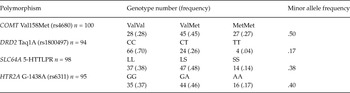
DNA was extracted from blood samples using a phenol-chloroform method. The following polymorphisms were genotyped using previously described methods and primers: DRD4 48bp-VNTR and COMT Val158Met (rs4680) (Alfimova, Korovaitseva, Lezheiko, & Golimbet, Reference Alfimova, Korovaitseva, Lezheiko and Golimbet2014), DRD2 Taq1A (rs1800497) (Monakhov, Golimbet, Abramova, Kaleda, & Karpov, Reference Monakhov, Golimbet, Abramova, Kaleda and Karpov2008), HTR2A -1438 G/A (rs6311) (Golimbet, Alfimova, & Mityushina, Reference Golimbet, Alfimova and Mityushina2004), SLC6A4 5-HTTLPR (Golimbet et al., Reference Golimbet, Korovaitseva, Brusov, Faktor, Ganisheva and Dmitriev2010). For technical reasons different genotypes were available for different numbers of participants. The number of available genotypes for each polymorphism is presented in Table 1.
Genotypes and alleles frequencies

Data analysis
Data analysis was performed with Statistica 10.0 for Windows. Distribution of the behavioral measures did not deviate from normality with the exception of the BRIEF-A Self-Monitor (Kholmogorov-Smirnov d = .14, P < .05) and SPQ-74 Disorganized factor (d = .16, P < .05) scores. To test genetic associations, a two-way factorial multivariate analysis of variance (MANOVA) was conducted, where genotype and gender were the between subjects factors and all twelve BRIEF-A measures served as dependent variables. Gender was controlled for due to the data suggesting its moderating role in gene effects (e.g., Cerasa et al., 2014). A separate MANOVA was run for each gene. Genotypes were grouped as follows: at least one minor allele of any biallelic polymorphism vs. homozygosity for its major allele; at least one DRD4 long allele (≥ 6 repeats) vs. homozygosity for shorter alleles. Partial eta squared (η2) or R 2 was calculated in order to investigate effect sizes. To investigate a potential mediating or modulating role of cognitive and personality variables in genetic associations, we first calculated Pearson correlations between these variables and those BRIEF-A measures for which a genotype effect was found during the first stage of the analysis. The significance level for raw P-values was set at .05, two-tailed. To address the multiple testing problem, we controlled false discovery rate (FDR) for MANOVA omnibus effects and Pearson correlations using Benjamini and Hochberg’s procedure at the level of q < .10. Next, a backward stepwise linear regression method was used to select the most powerful predictors of the BRIEF-A measures among cognitive and personality parameters which were significantly correlated with the respective BRIEF-A measure. Finally, the MANOVA was repeated, with significant cognitive or personality predictors being added into the model. As the number (n) of individuals in each analysis slightly varied by availability of cognitive and personality data or genotypes, all (n) are presented with the results.
Results
BRIEF-A Data
Sixteen (16%) of the summary composite scores were within the clinically elevated range (defined as a T score of 65 or greater), and 56 of 100 individuals had at least one clinically elevated BRIEF-A scale. Analysis of Pearson correlations and t-tests demonstrated that BRIEF-A scores did not depend on age or gender.
Genetic associations
Table 1 presents genotype and minor allele frequencies for biallelic polymorphisms. The genotype frequencies were in Hardy-Weinberg equilibrium (all P > .05). Among DRD4 alleles, the four-repeat allele was the most common (.71), followed by the seven-repeat allele (.19). Frequencies of the other alleles were .05 for 2R, .04 for 3R, .01 for 5R, and .005 for 6R. These were similar to allele frequencies reported for other cohorts of European origin.
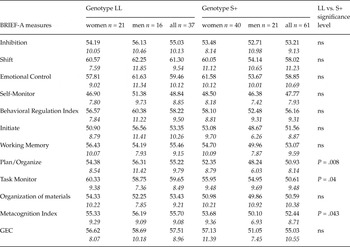
The MANOVA revealed a main effect of the 5-HTTLPR polymorphism (n = 98, Wilk λ = .76, F 12, 83 = 2.21, P = .018, η2 = .24) on the BRIEF-A measures which survived the FDR-correction (P corrected = .09) (Table 2). Within the MANOVA, the genotype main effect was significant for the Plan/Organize (F 1, 94 = 7.34, P = .008, η2 = .07), Task Monitor (F 1, 94 = 4.33, P = .04, η2 = .04), and MI (F 1, 94 = 4.21, P = .043, η2= .04). Carriers of the short allele reported significantly fewer problems than individuals homozygous for the long allele.
Means and SD of BRIEF-A scores by gender and 5-HTTLPR genotype

Notes: LL - homozygosity for the long allele of the 5-HTTLPR polymorphism; S+ - at least one short allele in genotype; ns – not significant.
We subsequently ran the same analysis using co-dominant (LL vs. LS vs. SS) and recessive (LL+LS vs. SS) models of inheritance. In both cases MANOVA revealed neither genotype main effect nor effect of its interaction with gender on the BRIEF-A measures (all uncorrected P-values > .05).
Potential mediating and moderating variables
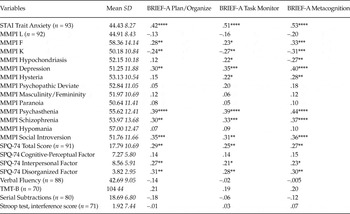
None of the three measures (Plan/Organize, Task Monitor, MI) was correlated with the neuropsychological indicators. At the same time, all three were tightly related to personality variables reflecting negative affect, schizotypy and response style (Table 3).
Means and SD of personality and cognitive measures and their correlations with the BRIEF-A scales

Notes: *P corrected < .10; ** < .05; *** < .01, **** = .001.
The regression analysis showed that trait anxiety was a single significant predictor of the BRIEF-A measures. It correlated positively with the Plan/Organize (n = 93, β = 0.46, t 88 = 4.40, P = .001, R 2 adj = .17), Task Monitor (β = 0.57, t 88 = 5.58, P = .001, R 2 adj = .25), and Metacognition (β = 0.57, t 88 = 5.82, P = .001, R 2 adj = .27).
We then repeated the MANOVA, which was based on the LL vs. S+ grouping of 5-HTTLPR genotype, adding the trait anxiety as a categorical variable into the model. To do this, participants were divided into low-anxious and high-anxious individuals using a median split on the Trait Anxiety scale (high trait anxiety > 44 scores). The Trait Anxiety value was significantly associated with the BRIEF-A scores overall (n = 91, Wilk λ = .71, F 12, 72 = 2.48, P = .009, η2 = .29) and with each of the twelve BRIEF-A measures (all P < .05). The genotype effect remained significant overall (Wilk λ = .73, F 12, 72 = 2.19, P = .021, η2 = .27) and for the Plan/Organize (F 1, 83 = 5.15, P = .026, η2 = .06) and Task Monitor (F 1, 83 = 4.51, P = .037, η2 = .05), but not MI (F 1, 83 = 3.51, P = .06, η2 = .04). There were no “genotype X trait anxiety” interaction effects. Of importance, the categorical trait anxiety measure was not related to 5-HTTLPR genotype (n = 91, Pearson χ2 = 1.76, df = 1, P = .18).
A pilot comparison of the LL and S+ genotype carriers on all the personality and neuropsychological measures with the t-test showed that the LL homozygotes had higher scores on most personality scales, with differences on the MMPI Depression and Social Introversion scales reaching the significance level (n = 91, Depression, t = 2.97, P corrected = .028; Social Introversion, t = 2.48, P corrected = .083). In addition, they performed worse on the Semantic Verbal Fluency test and TMT-B (verbal fluency, n = 88, t = 3.11, P corrected = .028; TMT-B, n = 69, t = 3.14, P corrected = .028) (Suppl. table 1).
Discussion
Our results indicate that the 5-HTTLPR polymorphism in the serotonin transporter gene may influence self-rating of everyday executive functioning in healthy individuals. Participants with at least one S allele showed lower scores on the Plan/Organize and Task Monitor scales and Metacognition index of the BRIEF-A than individuals homozygous for the long allele. The Metacognition index represents the ability to cognitively manage problem solving. Its Plan/Organize scale contains items related to setting a goal and selecting methods and steps to attain it, along with bringing order to goal-relevant information, actions or materials. The Task Monitor scale measures the ability to keep track of one’s own success and failure during the task-oriented activity.
The serotonin transporter is an important regulator of 5-HT transmission as it mediates the intracellular reuptake of released serotonin and modulates the concentration of serotonin in extracellular fluids. The 5-HTTLPR polymorphism is supposed to influence the serotonin transporter functions, though the evidence is not completely uniform (Lesch et al., Reference Lesch, Bengel, Heils, Sabol, Greenberg, Petri and Murphy1996; Mann et al., Reference Mann, Huang, Underwood, Kassir, Oppenheim, Kelly and Arango2000). Specifically, the presence of one or two S alleles is associated with reduced transcriptional efficiency of the gene that results in a significant decrease in serotonin reuptake (Lesch et al., Reference Lesch, Bengel, Heils, Sabol, Greenberg, Petri and Murphy1996). The S allele has been previously linked to enhanced emotional reactivity and vulnerability to depression (Karg, Burmeister, Shedden, & Sen, Reference Karg, Burmeister, Shedden and Sen2011; Pergamin-Hight, Bakermans-Kranenburg, van Ijzendoorn, & Bar-Haim, Reference Pergamin-Hight, Bakermans-Kranenburg, van IJzendoorn and Bar-Haim2012). Growing evidence also suggests that the 5-HTTLPR modulation extends to cognitive processes including EF (Homberg & Lesch, Reference Homberg and Lesch2011). While a number of studies have shown that the S allele is associated with a relative impairment of cognitive processes (Holmes et al., Reference Holmes, Bogdan and Pizzagalli2010; Weiss et al., Reference Weiss, Schulter, Fink, Reiser, Mittenecker, Niederstätter and Papousek2014), other authors have reported improved EF in the S allele carriers compared to individuals homozygous for the long allele (Borg et al., Reference Borg, Henningsson, Saijo, Inoue, Bah, Westberg and Farde2009; Enge, Fleischhauer, Lesch, Reif, & Strobel, Reference Enge, Fleischhauer, Lesch, Reif and Strobel2011; Landrø et al., Reference Landrø, Jonassen, Clark, Haug, Aker, Bø and Stiles2015). Our findings are consistent with these latter results, in that we observed that individuals carrying the short allele rated their problems in task planning and monitoring lower than individuals with the LL genotype.
A tendency to report fewer executive problems, however, could have various sources, including true high executive functioning, as well as hypoawareness of owns problems, or a response bias. In the present study, in accordance with the initial hypothesis, subjective rating of executive functioning was not related to performance on neuropsychological EF tasks, though the LL genotype carriers showed inferior results in tasks involving set-shifting (Verbal Fluency and TMT-B) as compared to individuals possessing the S-allele. At the same time, the subjective EF rating did correlate with individual’s self -reported negative affect as well as with a spectrum of other self-reported psychological problems and response style indicators. In particular, the BRIEF-A measures correlated positively with anxiety-related traits and negatively with the MMPI K scale reflecting a tendency to present oneself in the best possible way. In addition, the S-allele carriers rated themselves lower on most personality scales. Overall, these results are in accord with the ideas that a response style, which itself might be related to anxiety level (Linden, Paulhus, & Dobson, Reference Linden, Paulhus and Dobson1986), can influence BRIEF-A scores and that lower BRIEF-A scores in carriers of the S allele could be explained, in part, by their increased social conformity (Homberg & Lesch, Reference Homberg and Lesch2011). However, when we controlled for an anxiety level, the association of the 5-HTTLPR polymorphism with metacognition characteristics remained significant. This suggests that negative affect and/or response bias do not fully mediate or moderate the above association in healthy individuals. Moreover, the evidence of the 5-HTTLPR polymorphism’s association with self-reported task planning and monitoring is in line with previous event-related potential and functional magnetic resonance imaging studies that have shown a 5-HTTLPR role in performance monitoring using behavioral paradigms (Althaus et al., Reference Althaus, Groen, Wijers, Mulder, Minderaa, Kema and Hoekstra2009; Fallgatter et al., Reference Fallgatter, Herrmann, Roemmler, Ehlis, Wagener, Heidrich and Lesch2004; Fischer, Endrass, Reuter, Kubisch, & Ullsperger, Reference Fischer, Endrass, Reuter, Kubisch and Ullsperger2015; Holmes et al., Reference Holmes, Bogdan and Pizzagalli2010), however, see (Olvet, Hatchwell, & Hajcak, Reference Olvet, Hatchwell and Hajcak2010). Specifically, the short allele was related to either an enhanced error-related negativity (Althaus et al., Reference Althaus, Groen, Wijers, Mulder, Minderaa, Kema and Hoekstra2009; Fallgatter et al., Reference Fallgatter, Herrmann, Roemmler, Ehlis, Wagener, Heidrich and Lesch2004), an electrophysiological correlate of error processing, or to post-error slowing (Fischer et al., Reference Fischer, Endrass, Reuter, Kubisch and Ullsperger2015). These findings suggested that carriers of the short allele processed errors more intensively. However, no associations between the 5-HTTLPR polymorphism and post-error accuracy were found (Fallgatter et al., Reference Fallgatter, Herrmann, Roemmler, Ehlis, Wagener, Heidrich and Lesch2004; Fischer et al., Reference Fischer, Endrass, Reuter, Kubisch and Ullsperger2015). Furthermore, as a whole, data on the relationships between these correlates of error-processing and post-error improvements in accuracy are contradictory (Danielmeier & Ullsperger, Reference Danielmeier and Ullsperger2011). Thus, it is not quite clear whether the enhanced error processing in carriers of the S allele should correspond to higher or lower self-rating of the ability to keep track of one’s own success and failure.
It is worth noting that our results point to the dominance for the lower functioning S-allele, which is in accord with some other studies (e.g., Stoltenberg & Vandever, Reference Stoltenberg and Vandever2010). At the same time the directionality of the 5-HTTLPR associations with the BRIEF-A and personality measures may seem unexpected as the short allele is supposed to be associated with vulnerability to depression and biased processing of negative stimuli (Karg et al., Reference Karg, Burmeister, Shedden and Sen2011; Pergamin-Hight et al., Reference Pergamin-Hight, Bakermans-Kranenburg, van IJzendoorn and Bar-Haim2012). Our result can be interpreted based on the hypothesis, according to which rather than predisposing to development of anxiety-related traits the short allele is associated with greater responsiveness to environment and, in the presence of positive life events, may be related to an increased life-satisfaction and decreased depression (Belsky et al., Reference Belsky, Jonassaint, Pluess, Stanton, Brummett and Williams2009; Kuepper et al., Reference Kuepper, Wielpuetz, Alexander, Mueller, Grant and Hennig2012). Thus, the lower scores of the S-allele carriers on scales measuring psychological problems including depressive mood could be explained by the fact that our sample was comprised of healthy, well-educated and apparently problem-free subjects.
The present study is a pilot one and has some limitations. First of all, the sample size was relatively small, having about 62% power to reveal effects of .05 (as computed for GEC with Quanto). So the study may have insufficient power to reveal associations of the BRIEF-A with the dopaminergic and 5-HTR2A genes, which could be found in a larger sample. Further, our data indicate that there are a number of factors, including a response style, depressive mood and trait anxiety that may influence the BRIEF-A scores and presumably their associations with different genes. Though we controlled for some of potential confounders, there could exist others which were not taken into account in the present study. Clearly, further work is required to confirm and fully characterize the effect of 5-HTTLPR genotype on self-reported executive functioning. In particular, future research needs to take into account other polymorphisms in the serotonin transporter gene, especially the single nucleotide polymorphism (SNP) rs25531 located in the close proximity to the 5-HTTLPR. This SNP has been reported to modulate transcriptional activity of the L allele so that the LG variant is functionally equivalent to the S-allele (Hu et al., Reference Hu, Lipsky, Zhu, Akhtar, Taubman, Greenberg and Goldman2006). Since the LG variant is relatively rare in Caucasians (9–15%), it is unlikely that it has affected the result of the present study. However, it would be interesting to assess its influence on self-reported executive functioning in larger samples. In addition, given that the relationships between self-reported and objective measures of task planning and monitoring are not clear, future studies may benefit from investigating behavioral and subjective indicators of these abilities in the same individuals.
In summary, we investigated for the first time the associations between several candidate genes for cognitive control and self-reported executive functioning in daily life. The study provides evidence that the 5-HTTLPR polymorphism may influence self-report measures of executive functions and further supports the notion that performance monitoring may be influenced by the serotonin transporter gene. In addition, the results underscore the necessity to control for negative mood and a response bias while examining associations between genes and executive functioning measured with the self-report version of the BRIEF-A.
Supplementary Material
To view supplementary material for this article, please visit https://doi.org/10.1017/sjp.2017.6.