Introduction
Over the last two decades, work–family balance (WFB) policies have emerged as a pivotal topic in social policy scholarship. This transformation has primarily been driven by the increasing participation of women in the workforce and evolving family structures (Lewis, Reference Lewis1992, Reference Lewis2001; Randall, Reference Randall2000; Lewis and Campbell, Reference Lewis and Campbell2007; Walker and Foster, Reference Walker and Foster2014). WFB policies encompass a range of strategies, such as parental leave, flexible working arrangements, and caregiving services, aimed at assisting individuals in managing the competing demands of their professional and personal lives (Jiang et al., Reference Jiang, Chua, Wong and Im2024). Over time, the focus has expanded to encompass a broader understanding of work–life balance (WLB) (Lewis and Campbell, Reference Lewis and Campbell2008). Nevertheless, it is crucial to acknowledge that, in practice, these policies often centre on the challenges faced by women, particularly emphasising the experiences of working mothers (Lewis and Campbell, Reference Lewis and Campbell2008; Yuda and Rezza, Reference Yuda and Rezza2021).
Despite the growing body of literature surrounding WFB, much of the existing research predominantly reflects the experiences of Organisation for Economic Co-operation and Development (OECD) countries and a select few economically developed East Asian nations (Crompton and Lyonette, Reference Crompton and Lyonette2006; Den Dulk et al., Reference Den Dulk, Peters and Poutsma2012; Den Dulk et al., Reference Den Dulk, Groeneveld, Ollier-Malaterre and Valcour2013; Pulignano, Reference Pulignano2017; Wiß, Reference Wiß2017). Within this framework, WFB is frequently regarded as part of a broader initiative aimed at reducing reliance on families for caregiving tasks and promoting a fairer distribution of caregiving responsibilities (Abrahamson, Reference Abrahamson2016; Yang, Reference Yang2016; Drobnič et al., Reference Drobnič, Kusnierz and Huinink2021; Yuda and Kühner, Reference Yuda and Kühner2023). However, there has been relatively less emphasis on examining how these policies are implemented within welfare systems that remain deeply rooted in familial values, characterised by significant informal work arrangements and a strong focus on economic productivity.
In many Asian societies, including Indonesia, families continue to serve as the primary source of welfare support (Ochiai, Reference Ochiai, Ochiai and Hosoya2014; Raymo et al., Reference Raymo, Park, Xie and Yeung2015; Papadopoulos and Roumpakis, Reference Papadopoulos and Roumpakis2017; Yeung et al., Reference Yeung, Desai and Jones2018; Peng, Reference Peng2020). Cultural values that promote family cohesion, shared responsibilities, and traditional gender roles contribute to a persistent division of household labour (Jones, Reference Jones and Esping-Andersen1996; Peng and Wong, Reference Peng, Wong, Castles, Leibfried, Lewis, Obinger and Pierson2010). Simultaneously, nations experiencing rapid industrialisation and urbanisation have begun to adopt WFB rhetoric as part of strategies to sustain labour supply and ensure demographic stability (Ozawa, Reference Ozawa and Aspalter2016; Izuhara, Reference Izuhara2016; Abrahamson, Reference Abrahamson2017; Hwang and Chung, Reference Hwang and Chung2017). In this context, WFB transcends mere care work redistribution and instead focuses on supporting women’s continued participation in the workforce while reinforcing the family’s role as the primary source of social support.
This article begins with this context and posits that the implementation of WFB policies in Indonesia does not signify a shift towards a fully gender-equal or defamilialised welfare model. Rather, it aligns with what is defined as a compromised productivist welfare regime. In this framework, while family-friendly language and flexible work arrangements are incorporated, these concepts remain intimately connected to productivity demands and familial obligations. Consequently, WFB policies primarily aim to enhance women’s economic contributions without effectively addressing the unequal distribution of domestic responsibilities.
Drawing on qualitative interviews with working mothers in Jakarta’s formal sector, along with insights from relevant policy stakeholders, this study addresses two key questions:
-
1. How is WFB institutionalised and framed within Indonesia’s productivist–familialist governance context?
-
2. How do working mothers navigate and compensate for institutionalised limitations in WFB provision?
By bridging the gap between policy discourse and everyday realities, this research seeks to enrich the conversation surrounding productivist welfare regimes, illustrating how these frameworks adapt rather than dissipate in the context of gender equality and family-friendly reforms across Southeast Asia.
Work–family balance within a compromised productivist welfare framework
Over the past decade, WFB has become a key issue in social policy and gender equality discourse in developing countries (Mackenzie et al., Reference Mackenzie, O’Brien and Garavan2025). To understand the development of WFB in Indonesia, this policy needs to be placed within the context of the welfare regime that shaped it. Literature categorises many countries in the region as productivist welfare regimes, systems in which social policy is subordinated to the goal of economic growth (Holliday, Reference Holliday2000; Kühner, Reference Kühner2015; Yuda and Kühner, Reference Yuda and Kühner2023). In this configuration, social policy is oriented not toward redistribution but toward optimising productivity. The family is positioned as the primary provider of social protection, with traditional gender roles relatively maintained as care delivery mechanism (Croissant, Reference Croissant2004; Udasmoro and Setiadi, Reference Udasmoro and Setiadi2021).
The literature suggests that Indonesia exhibits this pattern. Some characteristics that characterise this pattern include a strong familialisation logic, where childcare and eldercare responsibilities are primarily borne by the family (Abrahamson, 2017; Daulay, Reference Daulay2017; Yuda and Reza, Reference Yuda and Rezza2021; Toneli et al., Reference Tonelli, Drobnič and Huinink2021). Within this framework, males are positioned as primary breadwinners and women as caregivers, so policies rarely function as defamilialisation mechanisms (Lewis, Reference Lewis1992; Leitner, Reference Leitner2003).
However, Indonesia does not fully reflect the classic productivist model as Holliday’s (Reference Holliday2000) initial description. Indonesian social policy, instead, increasingly adopts the language of gender equality and family-friendly rhetoric, shaping the regimes toward what we call a compromised productivism. The term ‘compromised’ refers to a situation where the productivity logic remains institutionally dominant but is discursively compromised by narratives of equality and family well-being. This compromise is instrumental, not structural, illustrating women’s labour participation is supported to maintain productivity, without institutionalising the redistribution of care work.
Another important dimension is the norm of hegemonic masculinity (Connell, Reference Connell2005), which associates men with the role of breadwinner and minimal involvement in care work (Yeung, Reference Yeung2013). This norm reinforces women’s double burden and influences the design of WFB policies. Even when paternity leave is available, men are often reluctant to use it due to pressures from gender norms (Doucet, Reference Doucet2006), ultimately widening the career gap for women (Daulay, Reference Daulay2017).
At the governance level, the state – along with the family and the market (Esping-Andersen, Reference Esping-Andersen1999) – defines family and well-being through administrative policies. As the definitions are rooted in familialist logic, policies tend to debunk traditional roles through defamilisation measures, for example, through a focus on maternity leave with equal support for fathers (Lewis, Reference Lewis1992; Leitner, Reference Leitner2003; Lewis and Campbell, Reference Lewis and Campbell2008).
However, in many transitioning societies, the WFB expansion has actually reinforced the domestication of women because it is designed within the framework of productivity and demographic stability (Ozawa, Reference Ozawa and Aspalter2016; Yeung et al., Reference Yeung, Desai and Jones2018). In Indonesia, for example, the National Population and Family Planning Board (BKKBN) initiative demonstrates how WFB is linked to the sustainability of a productive population, rather than solely an agenda of gender emancipation. As such, WFB policies in Indonesia reflect more of a rationalisation of the family as the primary provider of welfare than a transformation of gender relations (Putri, Kafaa and Yuda, Reference Soenarto Putri, Kafaa and Yuda2020; Magriasti et al., Reference Magriasti, Subono and Kosandi2022). Women’s workloads remain high, and gender disparities persist (Lohmann and Zagel, Reference Lohmann and Zagel2016; Chau et al., Reference Chau, Yu, Foster and Lau2017; Roumpakis, Reference Roumpakis2020). This conceptualisation of a compromised productivist welfare regime is then tested through the empirical experiences of working mothers and policy stakeholders in Jakarta.
Methodology
Research design and context
This study explores how WFB policies are understood, negotiated, and implemented in the context of familialist regimes and managerial masculinity, by integrating the experiences of working mothers and stakeholders who adopt WFB. The main focus is on how institutional logic, subjective experience, and power dynamics shape the adoption and design of WFB policies, especially in the urban formal sector.
The data used in this research was obtained from collaborative research between the Department of Social Development and Welfare, Universitas Gadjah Mada, and the School of Social and Political Sciences, The University of Melbourne, under the umbrella project ‘Maximizing Women’s Human Capital: Mapping Out the Attitudes of Working Mothers, Employers, and Policy Makers Toward Childcare and Parental Leave Provision in Indonesia’. Supported by the ANU Indonesia Project, the Australian National University (2024–2025), the project included a quantitative survey involving 300 working mothers and forty in-depth interviews in various cities. However, this article specifically focuses the analysis on qualitative data (ten working mothers and nine stakeholders in the WFB policy process) from Jakarta’s urban area, in line with the main purpose of in-depth exploration of the dynamics of experiences, perceptions, and narratives of working mothers in urban areas – transitions that cannot be fully revealed through numbers or statistical distribution.
Jakarta was selected as the focus of this research as it represented the highest concentration of female workers in the formal sector. Data from Statistics Indonesia (BPS) shows that the female labour force participation rate in DKI Jakarta (Jakarta Province) in 2023 reached 55.8%, higher than the national average of 54.4%. Jakarta’s urban characteristics – having the highest population density in Indonesia (around 15,978 inhabitants/km2) – provide a complex context for work arrangements, mobility, and access to childcare services.
In addition, Jakarta has a significant level of penetration of multinational companies and the services sector, where policies related to parental leave and childcare are often influenced by a combination of national regulations, global company practices, and local labour market dynamics. The city is also the main location for various local government, non-government organisations (NGO), and private sector initiatives in the provision of childcare services, thus creating observable variations in service models.
From a methodological perspective, the demographic diversity in Jakarta – with residents coming from diverse ethnic, socio-economic, and educational backgrounds – allows researchers to capture a broad spectrum of experiences and perceptions. This is in line with the research objective of understanding the narrative dynamics that cannot be fully represented by quantitative data in examining the interaction between policies, work practices, and personal experiences of working mothers.
Furthermore, the study’s focus on women in the formal sector is justified by the sector’s clearer labour regulatory framework, which encompasses official provisions for maternity leave, parental leave, and potential childcare support. In addition, formal sector workers tend to have more structured access to company facilities, social security, and career opportunities, thus providing a rich context to examine the extent to which existing policies are implemented in a tangible manner and have an impact on the well-being of working mothers. This approach also facilitates a comparative analysis of international practice standards and national regulations, as the formal sector is often a benchmark for employment policy development in Indonesia.
The qualitative approach also allows researchers to understand the social context as well as the latent factors that influence the attitudes and decisions of working mothers in negotiating career and family life, which are very relevant to answer this research question. Thus, qualitative analysis provides richer and contextualised interpretive space, complementing quantitative findings published separately within the same research framework.
Data collection
As indicated above, the research design intentionally combines two levels of analysis: (1) the everyday experiences of working women in managing work and family roles, and (2) the institutional logics that shape the direction of WFB policy formulation and advocacy. This approach was chosen because the study aims not only to describe individual experiences but also to explain how these experiences are shaped by broader policy and governance configurations.
Participant recruitment and characteristics
Participants were recruited through a combination of institutional access and snowball sampling techniques. Initial contacts were obtained through the researcher’s professional network and through workplace intermediaries in many formal sector organisations in Jakarta. These organisations included private companies and semi-public institutions with formal work structures and documented leave provisions. Following the initial interview, participants were further recommended by previous informants to ensure a good fit between their work backgrounds and the institutional context.
All female participants work in the formal sector, primarily at lower- to mid-level professional and managerial levels. This position has relative access to leave policies, work flexibility, and childcare facilities, making it relevant to examine how WFB is implemented in practice. In other words, this study focuses on the segment of the formal workforce that is institutionally most impacted by WFB policies.
Besides, all mothers interviewed have one child. This was not a selection criterion, but rather an empirical characteristic that emerged from the participant networks accessed. This condition is also consistent with urban fertility trends in Jakarta, where declining birth rates and a tendency to delay childbearing are increasingly common among working middle-class women.
Data collection process
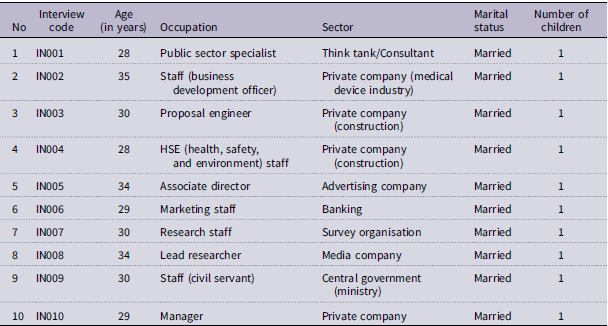
Data collection was conducted in two stages. In the first stage, in-depth interviews were conducted with ten working-age women working in the formal sector from various socioeconomic backgrounds (see Table 1). These interviews were intensive and explored personal narratives related to caregiving experiences, workload, strategies for managing dual roles, and views on leave policies and childcare services in the workplace.
Profiles of in-depth interview of working mother

Table 1. Long description
A table with ten rows and six columns detailing profiles of in-depth interviews of working mothers. The columns are labeled No, Interview code, Age (in years), Occupation, Sector, Marital status, and Number of children. Each row provides specific information for each interviewee. Row 1: No, 1; Interview code, IN001; Age (in years), 28; Occupation, Public sector specialist; Sector, Think tank/Consultant; Marital status, Married; Number of children, 1. Row 2: No, 2; Interview code, IN002; Age (in years), 35; Occupation, Staff (business development officer); Sector, Private company (medical device industry); Marital status, Married; Number of children, 1. Row 3: No, 3; Interview code, IN003; Age (in years), 30; Occupation, Proposal engineer; Sector, Private company (construction); Marital status, Married; Number of children, 1. Row 4: No, 4; Interview code, IN004; Age (in years), 28; Occupation, HSE (health, safety, and environment) staff; Sector, Private company (construction); Marital status, Married; Number of children, 1. Row 5: No, 5; Interview code, IN005; Age (in years), 34; Occupation, Associate director; Sector, Advertising company; Marital status, Married; Number of children, 1. Row 6: No, 6; Interview code, IN006; Age (in years), 29; Occupation, Marketing staff; Sector, Banking; Marital status, Married; Number of children, 1. Row 7: No, 7; Interview code, IN007; Age (in years), 30; Occupation, Research staff; Sector, Survey organisation; Marital status, Married; Number of children, 1. Row 8: No, 8; Interview code, IN008; Age (in years), 34; Occupation, Lead researcher; Sector, Media company; Marital status, Married; Number of children, 1. Row 9: No, 9; Interview code, IN009; Age (in years), 30; Occupation, Staff (civil servant); Sector, Central government (ministry); Marital status, Married; Number of children, 1. Row 10: No, 10; Interview code, IN010; Age (in years), 29; Occupation, Manager; Sector, Private company; Marital status, Married; Number of children, 1.
Data saturation was identified in the final two interviews when no significant new thematic categories emerged. Thus, the number of participants was deemed adequate for the exploratory purposes of this study.
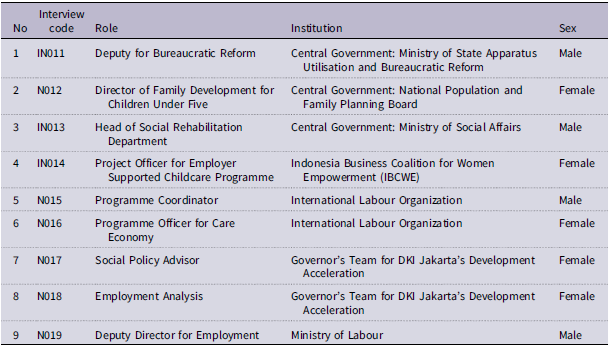
The second phase was conducted after the main thematic patterns of the working mothers’ group were identified. In this phase, elite interviews were conducted with nine key actors involved in the formulation and advocacy of the family-friendly policy, both in the public and private sectors (see Table 2). These interviews aimed to capture the institutional logic, policy incentives, and challenges of implementing the family-friendly agenda.
Profiles of elite interview informants: policymakers and stakeholders
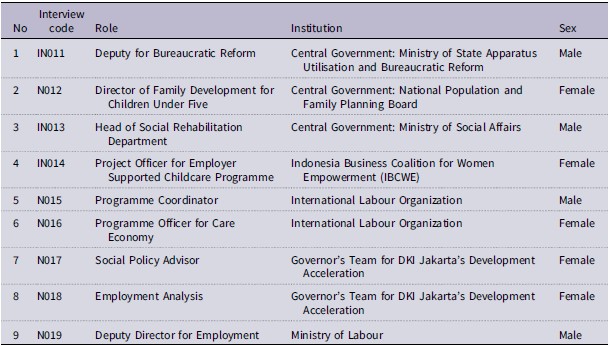
Table 2. Long description
A table with nine rows and four columns detailing profiles of elite interview informants. The columns are labeled No, Interview code, Role, Institution, and Sex. Row 1: No 1, Interview code IN011, Role Deputy for Bureaucratic Reform, Institution Central Government: Ministry of State Apparatus Utilisation and Bureaucratic Reform, Sex Male. Row 2: No 2, Interview code N012, Role Director of Family Development for Children Under Five, Institution Central Government: National Population and Family Planning Board, Sex Female. Row 3: No 3, Interview code IN013, Role Head of Social Rehabilitation Department, Institution Central Government: Ministry of Social Affairs, Sex Male. Row 4: No 4, Interview code IN014, Role Project Officer for Employer Supported Childcare Programme, Institution Indonesia Business Coalition for Women Empowerment (IBCWE), Sex Female. Row 5: No 5, Interview code N015, Role Programme Coordinator, Institution International Labour Organisation, Sex Male. Row 6: No 6, Interview code N016, Role Programme Officer for Care Economy, Institution International Labour Organisation, Sex Female. Row 7: No 7, Interview code N017, Role Social Policy Advisor, Institution Governor’s Team for DKI Jakarta’s Development Acceleration, Sex Female. Row 8: No 8, Interview code N018, Role Employment Analysis, Institution Governor’s Team for DKI Jakarta’s Development Acceleration, Sex Female. Row 9: No 9, Interview code N019, Role Deputy Director for Employment, Institution Ministry of Labour, Sex Male.
These two-stage designs complement, not separate, each other. Interviews with working mothers provide insights into how the policy is understood and negotiated in practice, while elite interviews shed light on the institutional rationales that shape its design. Thus, this study simultaneously analyses everyday experiences and institutional processes, enabling a more comprehensive understanding of the configuration of family-friendly policies in the Jakarta context.
Data analysis
A qualitative analysis was conducted using a reflective thematic analysis approach (Braun and Clarke, Reference Braun and Clarke2019), applied iteratively to ensure depth of interpretation. All interviews (ten working mother informants and nine elite informants) were recorded with the consent of the participants, then transcribed verbatim with the help of five research assistants. The researchers familiarised themselves with the data by repeatedly reading the transcripts while compiling field memos that captured interactional context and salient non-verbal cues.
The open coding stage was conducted inductively, identifying meaning units related to the definition of ‘family-friendly’, work flexibility, household gender roles, multiple-role negotiation strategies, and policy barriers. These initial codes were then grouped through axial coding into broader categories, such as ‘policies as moral appeals’, ‘flexibility in productivity logic’, or ‘the influence of women’s leadership’.
Themes and subthemes were derived from these categories and then linked across participants to identify narrative patterns. This process was accompanied by a triangulation of sources, comparing the perspective of working mothers with those of policymakers and stakeholders. Differences in interpretations across groups were retained to highlight the discrepancies between policy design and its implementation in practice.
Furthermore, the researchers linked the identified themes with the theoretical framework of the productivistic welfare regime, familisation, and institutional masculinity. For example, WFB as a productivity-oriented policy instrument is interpreted as a reflection of the productivist welfare regime, while male leaders’ personal experiences of parenting are viewed as an entry point for value transformation in managerial masculinity.
Representative quotes from the interviews were chosen to strengthen the arguments, retaining the original context without disclosing the participants’ identities. This was a back-and-forth process, switching between data, code, and theory until data saturation was achieved, namely the point at which additional interviews no longer generated new themes.
This approach ensures that the resulting findings not only describe the experiences of working mothers and policy actors but also map the complex relationships between subjective experiences and institutional configurations that shape WFB policies in the urban formal sector.
Findings
Summary
This study explicitly answers two research questions: first, how is WFB institutionalised and framed within Indonesia’s productivist–familialist governance context? Second, how do working mothers navigate and compensate for institutionalised limitations in WFB provision?
Research question one is answered with findings showing that WFB in Indonesia is not institutionalised as a gender-equality-based social right, but rather as a compromise within a productivist–familialist regime. Specifically, institutionally, WFB is framed as a productivity instrument. The data reveal that work flexibility is provided as long as performance targets are met, indicating that family needs are accommodated within the bounds of managerial rationality (IN013).
Furthermore, WFB is also seen as a moral and cultural agenda. The Ministry of Administrative and Bureaucratic Reform (Kemenpan RB) emphasises the formation of ‘social habitus’ and exemplary behaviour in the workplace (IN011), indicating that WFB is positioned as a family ethic, rather than a structural redistribution of care work.
Finally, WFB occupies its place as a demographic and economic instrument. Our interviews clearly demonstrate that the narratives of government and business actors position WFB as an investment to maintain productivity, reduce absenteeism, and respond to declining fertility (IN012). Private sector support is also driven more by reputational and ESG incentives than regulatory obligations (IN015).
From the findings above, we can argue that WFB is institutionalised as an incentive-based policy and moral framing, rather than as a welfare reform that transforms gender relations.
The second research question is answered by findings that demonstrate that within this limited institutional context, working mothers develop adaptive strategies that rely heavily on social class resources. For example, our data demonstrates the importance of work flexibility, which is interpreted as a space to continue fulfilling domestic obligations as wives and mothers (IN003). Thus, WFB actually strengthens moral responsibility rather than disrupts the gender division of labour.
Related to these findings, there are also indications that upper-middle-class women compensate for limited institutional support by delegating care work to informal domestic workers or private daycare providers (IN005). This pattern allows for high levels of work participation without altering the structure of gender relations or class inequality in the care economy.
From these findings, we can conclude that WFB in practice operates as a stabilisation mechanism – not a transformational one – that maintains women’s work participation while maintaining feminised domestic responsibilities.
Understanding WFB from policymaking stakeholders’ perspective
One of the most prominent findings is WFB’s conceptual shift from an instrumental approach towards a more cultural approach. Initially, WFB was often understood narrowly as the provision of workplace facilities such as daycare, childcare centres, or playrooms. However, there is now a growing understanding that a ‘family-friendly’ work environment goes far beyond the mere provision of amenities. It includes efforts to create an organisational culture that supports the well-being of the family as a whole. Therefore, the meaning of ‘family friendly’ has shifted from the mere provision of services to the establishment of values and work norms that strengthen healthy social relationships, both within the family and in the workplace.
The Ministry of State Apparatus Utilisation and Bureaucratic Reform (Kemenpan RB) explicitly affirms this ethical and social dimension. A work environment that supports work–family balance should be a place ‘that sets a good example for children’, where ‘co-workers’ behaviour can serve as a model’, and where there is ‘respectful communication’ as well as ‘mutually appreciative relationships’. ‘…we want to create a workplace that sets a good example for children… for instance, co-workers’ behaviour can serve as a model… respectful communication… building mutually appreciative relationships. So it is not only about working hour arrangements, but also about fostering a social habitus that supports families’ (IN011).
The above quote clearly shows that WFB policies in the public sector no longer only rely on technical aspects such as working hours, but also on the formation of social habits that support family well-being. This is a strong indication that WFB is beginning to be viewed as an integral part of the broader organisational culture, rather than simply a list of facilities or technical regulations.
Work flexibility emerged as the next strategic element in supporting WFB, especially for women workers. However, this flexibility remains embedded within the framework of bureaucratic efficiency. The schemes offered by Kemenpan RB, such as flexible working hours for working mothers (e.g. arriving to work later as long as the total working hours are still met), show that flexibility is framed within a logic of productivity and measurable output. This indicates a compromise between family values and the bureaucratic performance management system. Flexibility is allowed, provided that productivity and bureaucratic targets continue to be met. This reflects pragmatism in policy implementation, in which individual needs are accommodated to the extent that they do not interfere with organisational goals: ‘…for example, working mothers may clock in 2–3 hours later as long as their working hours are still met… that is considered flexibility, but there are still productivity measures… we are compromising between family needs and bureaucratic targets’ (IN013).
In the business sector, views and policy initiatives on WFB have also begun to undergo transformation. The Indonesia Business Coalition for Women Empowerment (IBCWE), as a strategic partner of the Indonesian Employers Association (APINDO), actively advocates for and conducts research on family-friendly policies. IBCWE actively advocates for and conducts research on family-friendly policies in the workplace, especially to support the involvement of women in caregiving roles, both for children and older adults. They expanded the definition of family-friendly policies from those previously limited to physical facilities, to policies that are flexible, adaptive, and cost-efficient – such as flexible working arrangements, information on affordable daycare, and decent lactation rooms: ‘…we encourage companies to not only provide physical facilities such as lactation rooms or daycare, but also flexible and adaptive policies… such as the Work from Anywhere arrangement, flexible working hours, and affordable daycare information… so that women can continue to play a role in caring for children and older adults’ (IN014).
However, challenges remain, especially as some business actors narrowly interpret family-friendly policies as a financial burden. The prevailing stance is still one of ‘wait and see’, especially within domestic firms that have yet to feel the push of global market demands. In contrast, export-oriented companies – particularly those exporting to Europe – tend to be better prepared and more compliant with family-friendly workplace policy standards, driven by strong pressures to implement Environmental, Social, and Governance (ESG) principles and to uphold a reputation as socially responsible businesses: ‘…most local companies still see this as an additional cost… they are still in a wait-and-see mode… unlike those oriented towards exports to Europe, who already understand the demands of ESG and family-friendly policies’ (IN012).
Public–private coordination has been relatively strong. However, the IBCWE noted that public policies related to WFB tend to stagnate and have not been sufficiently responsive to the dynamics of modern parenting needs. IBCWE emphasised the importance of a policy incentive mechanism that can attract business actors to actively participate. Instead of relying solely on normative regulations or administrative sanctions, governments can design fiscal incentives such as tax reductions or offer reputational rewards that enhance corporate branding in the areas of CSR and ESG. …if we only rely on regulations or administrative sanctions, it doesn’t really work… there needs to be incentives, such as tax reductions or awards that strengthen a company’s CSR or ESG branding… that would be more appealing to them’ (IN015).
Key characteristics of the WFB feature – insights from working mothers
In the last two decades, the WFB policy has undergone a significant discourse transformation. However, little research has examined how WFB is translated in the context of developing countries.
Findings from the cases examined in this study show that behind the progressive rhetoric and family-friendly narrative, the WFB policy operates primarily as a moral appeal rather than a commitment to gender equality values. In other words, WFB is not a priority in the public policy architecture, but rather a voluntaristic approach dependent on the discretion of each organisation, indicating that its presence often reflects an organisational strategic response. We observed that WFB largely reflects the importance of optimising women’s economic participation in the job market, while also recognising the dual roles they carry – balancing responsibilities of care work and wife-centred domestic work. This argument is supported by informants who explained that the flexibility provided in the workplace is seen as a space that enables them to continue fulfilling and even enhancing their moral responsibilities as wives at home:
…For example, when my husband comes home… usually at home, he spends more time with the child… we also share responsibilities. Even before getting married, I had already made it clear – because I saw it in my own parents’ experience – that I didn’t want it to be like that. So if I work, when I come home, I still want to cook, take care of the house… even if I’m tired because that is my responsibility as a wife. (IN003)
The ways in which women workers manage this dual burden are also strongly shaped by their social class. Women from the upper-middle group tend to shift the burden of caregiving to daycare institutions or, more commonly, to domestic workers, who are recruited through informal networks with salaries and duties negotiated on a flexible, informal basis. This practice illustrates the informal delegation of care work to other women who are more economically vulnerable, without changing the structure of gender relations either in the household or in the workplace:
…For me, since I have a domestic worker, things are much easier… there’s always someone at home to look after the child… during school holidays sometimes we also use daycare… The domestic worker was recommended through personal contacts, not through an official agency, so her salary is arranged by mutual agreement… her tasks are also flexible, sometimes handling housework, sometimes focusing on the child… depending on what is needed… (IN005)
In addition, voluntary adoption of WFB by the private sector confirms the notion that the primary purpose of WFB is to increase the productivity of working mothers. BKKBN, as the leading agency in promoting WFB, positions the policy primarily as a demographic instrument – a technocratic tool to maintain the sustainability of a productive population – rather than as a vehicle for social emancipation:
…we recently had discussions with BKKBN as well since they currently have a policy encouraging state-owned enterprises to provide daycare. Although in reality, there are still many regulations and barriers to implementing this… Daycare facilities, parental leave, flexible working arrangements… are seen as integral to creating a gender-equal workplace… investment in such policies can increase productivity, reduce absenteeism, and also improve productivity in managing household responsibilities. Especially now, fertility rates are gradually declining, and we don’t want to face the same situation as [Japan]… (IN012)
This institutional framework of WFB, embodying productivity compromises and incentive-based governance, becomes visible in the everyday strategies of working mothers. The following section illustrates how these logics translate into lived experiences.
Underlying conditions and causes of WFB development in the regime of managerial masculinity
The findings highlight an important element that reveals potential space for change in male-dominated organisational leadership when it comes to promoting WFB. These findings suggest that when men in managerial positions experience their own difficult/conflicting situations in negotiating their roles as workers and as fathers, they develop greater empathy towards WFB. Personal experiences – such as the challenges of childcare, the strain of dual roles, or burnout – have led some men to reimagine what it means to be a male manager.
A representative case is that of Jakarta’s Governor, Anies Baswedan, whose WFB policy was influenced by his personal experience of searching for daycare while living in the United States. This experience, which may feel unfamiliar to many male leaders in Asia who are accustomed to extended family or domestic worker support, forced him to confront the practical challenges of balancing work and family. This difficulty became a critical moment shaping his understanding of the importance of WFB as an organisational culture.
…this most likely came up when… Pak Anies studied in the US… he brought his first daughter there…there was no support system for Bu Feri [Anies’ wife]. I think from that point it became clear that it is important for a father to accompany and support his wife… the experience in the US… was gradually applied later in Jakarta… (IN017)
Furthermore, his wife played a significant role in influencing his thinking. This shows that knowledge of, and exposure to, WFB issues often arises from repeated practices in the micro space of the family. In other words, discussions and shared experiences with a spouse who upholds values of equality in the household have strong potential to encourage leaders to adopt more progressive perspectives when shaping public policy or organisational culture. ‘…several issues, especially concerning women and children, most likely came directly from discussions between Pak Anies and Bu Feri themselves…’
The experience of a Bank Mandiri executive who frequently relocated for work and struggled to manage WFB also illustrates a similar pattern. High career mobility creates significant challenges in negotiating WFB, particularly in Indonesia, where family support may not always be available when relocating to remote areas. Although the details differ from the case of Anies Baswedan, this too reflects a personal encounter with the difficulties of balancing work and family life – an experience that becomes a formative factor in shaping leadership supportive of WFB: ‘…the high career mobility of my superior shaped his management style and office policies [to be more WFB-friendly]… He also shared that after returning from long work trips, he usually spent more time with his children and family, because it was so difficult to manage his time…’ (IN018).
However, experience alone is not enough. Our findings further indicate that exposure to ideas and knowledge brought by the presence of a certain number of women in managerial teams has become another important factor in shaping WFB policies. This shows the importance of knowledge translation – that is, how progressive ideas about WFB can be internalised through the presence of women in high-level decision-making positions, as illustrated in the following interview: ‘…this organisation has long been male-dominated… Many men were chosen…because they were assumed to have no family responsibilities. But now there is growing awareness… that productivity cannot be measured by whether someone is a man or a woman. Both are the same, and here too, many female decision-makers influence my superior’s choices’ (IN017).
These accounts demonstrate that when women enter the organisational elite, policy orientation begins to shift – not only in terms of organisational efficiency but also sustainability and equality in the workplace. In other words, the presence of women does not merely bring new perspectives but also disrupts the normalisation of masculine work cultures that have long dominated organisational practices. Women’s leadership at the strategic level broadens the organisational horizon to include family and care responsibilities – domains traditionally excluded from the sphere of work.
Discussion
Our findings show that WFB policies and practices within the context of familial society in Indonesia are not designed to reconstruct domestic work along more equitable lines, but rather to optimise women’s contributions to the labour market. Available WFB measures – whether in the form of parental leave, flexible work, or family incentives – are shaped more by a logic of productivity than by a logic of redistributing care work. In other words, WFB policies are enacted to ensure that women can continue to ‘function’ as workers without displacing their traditional roles within the household. In practice, as our findings illustrate, caregiving and domestic responsibilities remain largely relegated to the family, and the burden is almost always carried by working mothers – even when they possess equal or greater economic capacity than their male partners.
Women’s strategies in managing this double burden are also strongly shaped by social class. Middle- and upper-class women tend to delegate caregiving responsibilities to daycare institutions or, more commonly, to domestic workers, who are recruited through informal networks with wages and tasks negotiated flexibly. This practice reflects an informal delegation of care work to economically more vulnerable women, without altering the structure of gender relations either at home or in the workplace.
These findings affirm that WFB in Indonesia operates within an ambivalent space between normative commitments to gender equality and the demands of economic productivity. The situation is further complicated by the structure of Indonesia’s labour market, which is dominated by the informal sector (Yuda and Kühner, Reference Yuda and Kühner2023). Women in particular face limited access to labour protections and welfare policies. As noted in welfare regime literature, high levels of informality in Global South countries – including Indonesia – directly affect the quality and reach of social policies, particularly for women workers (ILO, 2022). Within this context, women bear compounded burdens: limited access to formal employment, exclusion from social protection, and persistent expectations of fulfilling dual roles within the family.
The intersection between informality and gender shows that WFB policies in developing countries cannot be reduced merely to questions of time balance, but must be understood as part of the broader structure of social reproduction that sustains women’s subordination. As Mínguez (2012) notes, women’s role in sustaining unpaid care work is an invisible yet vital element underpinning the sustainability of welfare capitalism. This inequality is deeply rooted not only in systems of production but also in social reproduction – an issue not fully resolved even in advanced welfare states (Roumpakis, Reference Roumpakis2020).
Nevertheless, male leaders’ personal experiences of work–family conflict can serve as critical junctures, sparking new awareness and shifting perspectives on the importance of WFB policies. When male leaders are shaped by their own family experiences and live in more egalitarian relationships with their partners, they tend to be more open to fostering work environments supportive of shared caregiving. In this study, exposure to global WFB discourses and the presence of women in decision-making roles also emerged as catalysts for institutional change from within. However, such changes remain sporadic and contingent on individual sensitivity rather than anchored in binding structural norms.
These findings align, to some extent, with Ellingsæter and Gulbrandsen (Reference Ellingsæter and Gulbrandsen2007), who highlight the critical role of change agents – particularly working mothers – in creating momentum for policy reform. Shifts in women’s labour market participation and their demands for WFB have been a driving force for policy change. This shows that WFB does not develop in a vacuum but rather emerges as a response to complex social and economic pressures. The findings carry important implications for understanding the policymaking process: rather than being a passive response to social needs, policy is revealed here as dynamically shaped by reciprocal interactions between social change and institutional design (see also Goerres and Tepe, Reference Goerres and Tepe2012; Abrassart and Bonoli, Reference Abrassart and Bonoli2015).
As Esping-Andersen (Reference Esping-Andersen1999) emphasised, the family is not merely a normative institution but also a social actor capable of collectively driving institutional change. When most families adopt dual-income arrangements and more egalitarian household relations, both the institution of the family and society as a whole undergo transformation. However, in the Indonesian context, this transformation remains hampered by the state’s limited interventions in redistributing care work and its continued failure to recognise domestic labour as a core component of welfare.
Advancing comparative welfare state scholarship
This research not only enriches our understanding of the implementation of WFB in Indonesia and countries with similar contexts but also offers conceptual novelty to the comparative debate on productivist welfare regimes. Classic literature on productivist welfare regimes emphasises the subordination of social policy to the goals of economic growth and industrial development (Holliday, Reference Holliday2000; Abrahamson, 2017). Within this framework, family policy is generally understood as an instrument to support capital accumulation and labour force stability. However, the Indonesian case demonstrates a more compromised variant, where gender equality and family-friendly rhetoric are adopted ‘symbolically’, but the institutional design remains embedded in the logic of productivity and family responsibilities. Several premises underlie this argument, including:
First, support for WFB relies heavily on informal domestic workers. In contrast to the defamilisation model in many OECD countries, which expands public care services (Lewis, Reference Lewis1992, Reference Lewis2001; Drobnič et al., Reference Drobnič, Kusnierz and Huinink2021), in Indonesia, the redistribution of care work occurs more through informal market mechanisms and personal relationships (Yuda and Kühner, Reference Yuda and Kühner2023; Yuda and Munir, Reference Yuda and Munir2023; Asmorowati and Yuda, Reference Asmorowati and Yuda2024; Yuda and Ahmada, Reference Yuda, Ahmada and Aspalter2026). This pattern suggests that, rather than defamilisation, a class-based delegation of care emerges within a framework of persistent familialism (Ochiai, Reference Ochiai, Ochiai and Hosoya2014; Peng, Reference Peng2020). Thus, the state does not institutionally take over care functions, but rather allows private solutions to develop within a structure with minimal regulation.
Second, WFB develops in a labour market context with high levels of informality. The literature on WFB generally assumes a relatively well-established formal employment system (Den Dulk et al., Reference Den Dulk, Peters and Poutsma2012; Pulignano, Reference Pulignano2017). In the Indonesian context, this policy exists within an economic structure where the majority of workers are in the informal sector, making coverage selective. This demonstrates that productivism is not only associated with growth orientation but also with access restrictions – where policy support is effectively directed at labour segments deemed strategic for productivity.
Third, WFB is framed as a demographic instrument. In the context of concerns about the sustainability of the demographic dividend and declining fertility, family-friendly policies are positioned as a strategy to maintain productive population stability (Ozawa, Reference Ozawa and Aspalter2016; Hwang and Chung, Reference Hwang and Chung2017; Abrahamson, 2017). This dimension expands the comparative literature, which has previously emphasised the redistribution of care work or individual welfare, by demonstrating that in productivist regimes, family policies also function as population management tools.
Fourth, the policy framing is more moral than rights-based. In line with the characteristics of Asian familialism, which emphasises collective family responsibility (Jones, Reference Jones and Esping-Andersen1996; Peng and Wong, Reference Peng, Wong, Castles, Leibfried, Lewis, Obinger and Pierson2010; Pholpark and Srithamrongsawat, Reference Pholpark and Srithamrongsawat2026), support for WFB is often understood as a form of institutional concern, rather than a universally institutionalised social right. This contrasts with the defamilialising tendencies of Western welfare states, where family policies are increasingly treated as social entitlements (Lewis and Campbell, 2008; Drobnič et al., Reference Drobnič, Kusnierz and Huinink2021).
Theoretically, this configuration demands a conceptual expansion of productivist welfare regimes. Existing literature tends to refer to the relatively coherent and institutionalised model of East Asian developmental states (Holliday, Reference Holliday2000). Findings from Indonesia suggest that productivism can also operate in more fragmented, selective, and normative forms, combining the rhetoric of gender equality with practices that continue to centre responsibility on the family and the individual (Ewalt and Jennings, Reference Ewalt and Jennings2004). Thus, this article proposes the category of compromised productivist welfare regime: a configuration in which social policy is not explicitly subordinated to economic growth but remains constrained by the logic of productivity, selectivity of access, and moral framing that inhibits the institutionalisation of care redistribution.
This contribution expands the typology of welfare regimes by demonstrating that the hybridity between productivism and familialism is not simply an empirical deviation, but rather a systematic institutional pattern in developing country contexts with high levels of informality. Thus, comparative debates on welfare need to move beyond the classic dichotomy between defamilisation vs familialism and consider how the logic of productivity adapts and transforms in the context of the Global South societies.
Conclusion
This study critically examines the implementation and perceptions of WFB initiatives within Jakarta’s managerial–familialist regime. The central argument is that current WFB policies, while ostensibly designed to support balance between work and family, in practice reflect the productivist logic rather than the principle of redistributing care work. WFB is structured primarily to optimise women’s economic participation, without fundamentally altering disparities in domestic labour. As a result, the burden of parenting and household chores disproportionately remains the primary responsibility of working mothers.
Empirical findings support this argument, showing that WFB policies (such as parental leave, flexible work, and family incentives) are designed chiefly to ensure women remain ‘functional’ as workers. This is evident from the fact that, despite WFB policies, caregiving roles and domestic work remain delegated to families and almost always fall on working mothers, even when women have equal or greater economic capacity than their male partners.
Besides, the study highlights the phenomenon of informal delegation, whereby middle- and upper-class women outsource caregiving to daycare centres or, more commonly, to domestic workers recruited informally under negotiated conditions of pay and tasks. This practice reveals an informal transfer of care work to more economically vulnerable women, without any significant changes in structural gender relations in either households or workplaces. The implication is that WFB initiatives in Indonesia operate in an ambivalent space between normative commitments to gender equality and economic demands for productivity – exacerbated by the dominance of the informal sector. Women face layered burdens: limited access to formal employment, inadequate social protection, and persistent expectations of dual roles within families, all of which collectively entrench their subordination in social reproduction.
Yet, amid this ambivalence, the study also identifies progressive trajectories in the evolution of WFB. Specifically, findings show that male leaders’ personal encounters with work–family conflict, exposure to global WFB discourses, and the increasing presence of women in decision-making roles can foster awareness and shifts in perspective. Still, these changes remain sporadic and dependent on individual sensitivity rather than institutionalised norms. Based on this analysis, WFB in Indonesia can be understood as a compromised productivist welfare regime: distinct from its earlier authoritarian variant, yet continuing to frame WFB as an investment expected to yield returns.
Theoretically, this research contributes to WFB literature by enriching understanding of how compromised productivist welfare regimes function in developing countries, particularly within Asian familialist contexts. This study empirically shows that WFB in Indonesia serves to rationalise the role of the family as the main provider of welfare rather than addressing gender inequality. This highlights how informality and gender intersect to sustain women’s subordination in social reproduction – an issue not yet resolved even in advanced welfare states. Moreover, it adds nuance to discussions of change agents within organisations by underscoring the role of personal experience and gender representation in leadership, albeit with the caveat that such changes remain individualistic rather than institutionalised.
Practically, the study offers lessons for designing WFB policies in structures shaped by Asian familialism and informal economies: First, mindfulness-based interventions (consciousness-raising) are needed to build empathy and awareness among male leaders about work–family challenges – such as through workshops or mentoring programmes that normalise open discussions of personal experience. Second, organisations should cultivate workplace cultures that encourage leaders – particularly men – to speak candidly about their struggles balancing work and family, thereby creating legitimacy for internal policy reform. Third, the state must play a more active role through structural policies that expand access to formal care services and social protection, while also encouraging men’s involvement in domestic work via equal parental leave, childcare subsidies, and other institutional incentives. Taken together, such measures would allow WFB to move beyond serving as a tool of market productivity and towards becoming part of a broader project of social emancipation, balancing work and family in more meaningful ways.
Acknowledgements
The authors are grateful to the ANU Indonesia Project–SMERU Collaborative Research Grant 2024-25 for supporting the broader research project “Maximising Women’s Human Capital: Mapping Out the Attitudes of Working Mothers, Employers and Policy Makers toward Childcare and Parental Leave Provision in Indonesia”, from which this article draws.
Competing interests
The authors declare none.