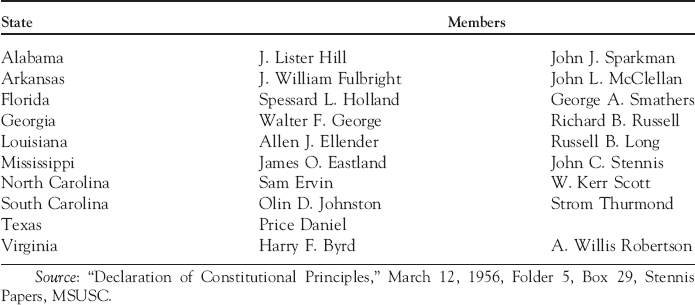
We have individually devoted a great deal of serious thought to the Supreme Court's decision of May 17, 1954, in the school segregation cases. We condemn the illegal and unconstitutional decision of the Court. In solemn unity and determination, we shall fight for the preservation of the Constitution under which we hold office by will of the people.
Statement by the Senate Southern CaucusFootnote 1
If we can organize the Southern States for massive resistance to this order, I think in time the rest of the country will realize that racial integration is not going to be accepted in the South.
Senator Harry F. Byrd of VirginiaFootnote 2
I. Introduction
More than two generations after the Supreme Court declared “[s]eparate educational facilities [] inherently unequal,” Brown v. Board of Education remains a lodestar in the nation's political mythology.Footnote 3 Hailed at the time by liberals as an “earth-shattering milestone,” the decision is said to have galvanized the civil rights movement––spurring landmark protests like the Montgomery bus boycott and validating decades of painstaking advocacy by the NAACP (Mann Reference Mann1997, 154; see Garrow Reference Garrow1986, Reference Garrow1994; Tushnet Reference Tushnet1987). But even as Brown's priority of place in the constitutional canon becomes ever more secure, there is also growing consensus that Brown incited a new politics of massive resistance. On this account, Brown mobilized not only the forces intent on tearing down Jim Crow, but also those seeking to preserve it.
Indeed, Brown has become a paradigmatic example of judicial backlash (Klarman Reference Klarman1994, Reference Klarman2004, Reference Klarman2005, Reference Klarman2013; Lewis Reference Lewis2006; Keck Reference Keck2009). Citing the rise of White Citizens’ Councils and the eruption of racial violence across the region in the wake of the decision, backlash theorists argue that Brown “crystallized southern resistance to racial change … [and] propelled politics in virtually every southern state several notches to the right on racial issues” (Klarman Reference Klarman1994, 82). Focusing on grassroots resistance, these studies assume that popular preferences were the engine of southern defiance. In her critique of the backlash thesis, Vesla Weaver writes that “the main actors of consideration are the masses, the voting population which prompt elites to undertake certain policy positions with race in the foreground” (2007, 238).
Adopting this bottom-up view, Michael Klarman—perhaps the most prominent historian of judicial backlash—argues that “in most of the South, it was not politicians who were primarily responsible for massive resistance” (2004, 409). Rather, “as southern blacks, inspired by the Court's ruling, filed school desegregation petitions and law suits, southern whites mobilized extraordinary resistance in response” (464). Many scholars have since accepted this “tidy chain of causation” (Lewis Reference Lewis2006, 23). As George Lewis has characterized the backlash thesis, “Brown's fundamental achievement was in catalyzing … a tidal wave of racial hysteria that swept the South that, in turn, created a situation in which the region's politicians could––and did––make political capital out of appeals to the region's rekindled racial extremism.” Bolstered by “a willing constituency,” southern politicians “brazenly defied federal authority and brutally suppressed civil rights campaigns” (23).
Thus, proponents of the thesis contend that “social movements should avoid reliance on judicial politics because [it] will often spark political countermobilization that will set the movement further back than where it started” (Price and Keck Reference Price and Keck2015, 884). Likewise, courts should avoid “declar[ing] a winner in … divisive public law debates,” for doing so risks “rais[ing] the stakes of an issue where primordial loyalties [run] deep” (Eskridge Reference Eskridge2005, 1312). As Klarman concludes, “by outpacing public opinion on issues of social reform,” courts may unintentionally “mobilize opponents, undercut moderates, and retard the cause they purport to advance” (2005, 482).
But as we will argue, massive resistance—the coordinated, and sometimes violent, local opposition to racial integration that emerged in the wake of Brown—was not fundamentally a populist phenomenon “independent of the machinations of politicians” (Klarman Reference Klarman2004, 409). Rather, we will show that variation in local resistance, or backlash, to desegregation was primarily the result of top-down direction from a cadre of southern political elites in Congress. Certainly, the preferences of the South's white voters likely constrained the range of responses, or “repertoires of contention,” elites could adopt in reaction to Brown (Tarrow Reference Tarrow1993, Reference Tarrow2008). However, public opinion dictated neither the substance nor the intensity of the region's countermobilization. Indeed, leveraging a range of archival materials drawn from the personal papers of southern senators and representatives, as well as the Congressional Record and period newspapers, we will argue that patterns in state-level resistance to Brown were as much the product of national lawmakers’ strategic choices as the inevitable consequence of southern whites’ ingrained prejudices.
We are not the first to emphasize the “centrality of the internal maneuverings” of the South's political oligarchy (Lassiter and Lewis Reference Lassiter, Lewis, Lassiter and Lewis1998, 12). As Matthew Lassiter and Andrew Lewis observe, earlier generations’ “predominant focus on political elites”––as articulated in works by V. O. Key, Numan Bartley, and Harvie Wilkinson, among others––has now become “a persistent and recurring theme throughout the historiography of … massive resistance” (8, 12). More contemporary scholars have also emphasized the efforts of southern lawmakers to defend Jim Crow before and after Brown (e.g., McMahon Reference McMahon2004; Finley Reference Finley2008; Katznelson Reference Katznelson2013). Nor do we contend that treatments of massive resistance as a manifestation of public opinion wholly ignore the role played by politicians in further stoking the flames of racial animus. Klarman, for instance, readily acknowledges that the post-Brown radicalization of southern public opinion encouraged opportunistic politicians to “maneuver[] against one another to occupy the most extreme point on the segregationist spectrum,” arguing that it was only when George Wallace “felt the shifting political winds” that he “became an ardent segregationist” (2005, 454–56).
Nevertheless, our intervention here is distinct in two respects. First, we argue, there is little evidence that southern elites waited for public opinion to “crystallize[]” before responding to Brown (Klarman Reference Klarman1994, 82). Rather, the South's political leaders were the first movers in conceiving of and orchestrating massive resistance.Footnote 4 Second, while others have pointed to the importance of local elites in directing opposition to desegregation, we show that it was often the region's national representatives who issued marching orders to southern statehouses.
Attention to the agency of national political elites in shaping massive resistance can help refine our understanding of Brown—and the politics of judicial backlash—in several important ways. First, although desegregation was widely opposed by southern whites, the scope and substance of organized resistance was only loosely bounded, and certainly not foreordained, by public opinion. As we will see, individual southern senators and representatives directly shaped where and how local resistance would unfold in their jurisdictions. In this respect, while we do not discount the role played by southern governors and state lawmakers in shaping massive resistance (see, e.g., Walker Reference Walker2009), we contend that the hierarchical structure of southern politics limited their capacity to act autonomously––that is, without support or guidance from their state's senators and representatives in Washington.
Moreover, the role of elite agency in Brown suggests that studies of judicial backlash to other landmark Court cases should consider discarding the idea that backlash is necessarily a “fundamentally populist reaction” (Weaver Reference Weaver2007, 238). In so doing, theorists of backlash need not jettison the concept altogether as Weaver proposes, but may instead work to refine it by adopting a more sophisticated treatment of elite incentives and public opinion. Although partisan competition and the electoral connection may help explain some episodes of popular resistance to controversial decisions, they offer more limited analytic traction in others (Greenhouse and Siegel Reference Greenhouse and Siegel2011; Day Reference Day2014). Moving beyond a voter-driven model of backlash is all the more important in light of findings by scholars of political behavior that citizens rarely form unmediated opinions about even high-profile Supreme Court cases (Persily Reference Persily, Persily, Citrin and Egan2008, 9; Linos and Twist Reference Linos and Twist2016). Indeed, recent empirical work finds little evidence that Supreme Court decisions “lead[] to increased opposition … by the general public or by any other group” (Bishin et al. Reference Bishin, Hayes, Incantalupo and Smith2015, 633). Nor do citizens appear to distinguish between Court-driven policy change and congressional action (Fontana and Braman Reference Fontana and Braman2012). In sum, while “citizens engaged in backlash” may well be situated within a “dense network of communicative exchange,” we suggest that elites are often the ones directing the conversation (Post and Siegel Reference Post and Siegel2007, 389).
Second, our empirical account should caution backlash theorists from concluding that massive resistance to Brown signaled the triumph of racial conservatives. As we will see, southern lawmakers’ response to Court-ordered desegregation granted both moderate and conservative wings of the southern bloc considerable latitude to shape the contours of massive resistance in their home states, including license to avoid taking action altogether. While congressional moderates failed to dissuade their conservative colleagues from working to nullify the decision, the latter failed to impose their goal of aggressive, uniform protest across the Solid South. Even in conservative Mississippi, hard-line segregationists recognized that some level of compromise would be required to maintain a unified front with moderates (Crespino Reference Crespino2007, 49–74).
Although southern lawmakers labored to conceal their differences, Brown exacerbated existing divisions over how to effectively answer liberal calls for desegregation. In this way, Brown strengthened the hand of pro-civil-rights advocates by destabilizing the status quo, shifting the familiar legal terrain on which Jim Crow's defenders had fought since the Court's 1896 Plessy v. Ferguson decision. Brown, of course, was not the first case to have this effect on the South's ruling elite. As Robert Mickey notes, a decade before Brown, the Supreme Court's decision in Smith v. Allwright, outlawing racially exclusionary primary elections, “induced such chaos within [Georgia's] ruling party that its leaders would opt to keep the party on the sidelines of the Dixiecrat revolt” (2015, 119). These decisions provide strong evidence that even a “constrained” Court can profoundly undermine the governing regime's organized opposition, even without the means to implement its edicts (Rosenberg Reference Rosenberg1991, 10; Reference Rosenberg2008, 21).Footnote 5 Over the past several decades, law-and-courts scholars have shown how the Court can either fortify a governing coalition or “expose the weaknesses of that alliance by exacerbating its internal tensions.” However, we know significantly less about the Court's capacity to fracture the regime's opposition, or to sow dissent within a constitutive faction of the dominant coalition (McMahon Reference McMahon2011, 9; Graber Reference Graber1993, Gillman Reference Gillman2002, Pickerill and Clayton Reference Pickerill and Clayton2004, Whittington Reference Whittington2005). Here, we strive to bring together two different streams of scholarship––synthesizing regime-based approaches to the study of the Supreme Court with accounts of midcentury southern political history––to refine our understanding of both judicial backlash and the political consequences of the Court's decisions. As we will see, Brown “ignited a firestorm” not only within the Democratic Party, but also within a key constitutive faction: southern political elites (McMahon Reference McMahon2011, 11).
Third, a close study of elite reaction to Brown can help us gain a better understanding of the “who,” and not just the “what,” of popular constitutionalism. Put another way, we can begin to “dissect[]” the identities of the actors advocating alternatives to judicial supremacy, while separating that question from the specific alternative to judicial supremacy they envision––be it departmentalism, nullification, or lay interpretation by “we, the people” (Beienburg and Frymer Reference Beienburg and Frymer2016, 244).
Like judicial backlash, popular constitutionalism––regardless of the nature of the alternative to judicial supremacy it invokes––is not always driven by an upwelling of previously latent mass preferences, nor must it involve “ordinary people … shaping constitutional law” (Kramer Reference Kramer2005, 233). Rather, at least in the case of Brown, resistance to the Court's “monopoly on constitutional interpretation” was carefully stoked by southern lawmakers in Congress (229), who made it possible for their white constituents to transcend the “political and structural limitations that frequently limit [] a peoples’ ability to adequately articulate their voice and mobilize behind their claims” (Beienburg and Frymer Reference Beienburg and Frymer2016, 244). Southern senators and representatives who had once promoted fidelity to the rule of law now questioned the Court's final say over constitutional matters in the weeks and months following Brown, promoting instead the interpretive authority of the states and the people. To the extent that interposition and nullification (but not departmentalism)—the vocabulary southern elites relied on to challenge the Court's constitutional authority—reentered Dixie's political lexicon in the midcentury, it was by dint of the deliberate effort of the region's congressional leaders in Washington. As we will see, unlike past confrontations with the Court, southern lawmakers’ condemnation of Brown moved beyond the substance of the decision or its political ramifications to strike at the Court's very legitimacy in a system of constitutional government and, in particular, its right to, in Chief Justice Marshall's famous formulation, “say what the law is.”Footnote 6
The remainder of this article proceeds in five steps. First, we lay out in greater detail the argument that massive resistance to Brown was conceived of and substantively directed by southern political elites in Congress, and we underline the stakes of this claim for studies of judicial backlash. Next, we describe southern lawmakers’ search for an “appropriate” response to the Court's directive, in particular their decision to draft the Declaration of Constitutional Principles, a resolution—better known as the Southern Manifesto—that publicly protested forced desegregation.Footnote 7 We then examine the link between national elites’ instruction and the patchwork development of grassroots resistance to integration across the South through case studies of massive resistance in Mississippi, Louisiana, Virginia, and Arkansas. The penultimate section describes southern lawmakers’ rejection of the federal courts as a venue in which to safeguard Jim Crow and their subsequent embrace of popular constitutionalism as an alternative means to obstruct the advance of civil rights. The final section offers concluding remarks.
II. Linking Elite Reaction to Local Resistance
Many accounts of southern resistance to Brown emphasize the electoral connection between southern voters and their elected leaders, casting politicians as essentially reactive to popular opposition to desegregation rather than entrepreneurial in its development. Klarman, for example, identifies “the electoral incentives of southern politicians” as the fundamental driver of resistance to the Court's desegregation decision (2004, 462; see also Garrow Reference Garrow2004, 713). On his account, it was the “desire of nearly all southern whites to preserve segregation if possible” that first “helped foster massive resistance” (409). Southern members of Congress did not themselves prompt massive resistance, but instead channeled their constituents’ preferences. “Given dominant public opinion in the South,” he writes, “the only conceivable position [elites] could take was to support segregation and to condemn Brown” (463). Popular pressure to preserve segregation affected even those officials “ordinarily inclined toward racial moderation,” who were forced to “become more extremist to survive” (409). Thus, Klarman concludes: “Virtually no southern politician could survive [in the post-Brown] political environment without toeing the massive resistance line, and in most states, politicians struggled against one another to occupy the most extreme position on the racial spectrum” (1994, 98).Footnote 8
Klarman is not alone in emphasizing the importance of the electoral connection in shaping massive resistance. In his classic study of Brown, Gerald Rosenberg posits that southern recalcitrance was driven by fixed popular preferences for reactionary pro-segregation policies. Citing an earlier study of gubernatorial races in the South from 1950 to 1973, he argues that “after Brown, ‘ambitious politicians, to put it mildly, perceived few incentives to advocate compromise’” (Rosenberg Reference Rosenberg1991, 78).Footnote 9 In his analysis of the Southern Manifesto, John Kyle Day also adopts an “electoral-connection”-based framework, arguing that the “South's congressional incumbents … feared that if they did not block Brown's implementation … their white constituents would support opposing candidates” (2014, 3–4). And highlighting the “importance of concerned segregationists at the grassroots,” Lewis argues against what he characterizes as a now-outdated view that massive resistance was exclusively “a top-down, elite-led phenomenon” (2006, 8, 24).
Rooted in democratic responsiveness, this bottom-up view of judicial backlash has obvious normative appeal. However, at least as concerns Brown, it is misguided. For, as scholars of southern politics have long understood, the American South at midcentury was exceptionally undemocratic, comprised of a confederation of “authoritarian enclaves” out of sync with the rest of the nation (Mickey Reference Mickey2015, 33). Indeed, as V. O. Key described in his foundational study, Southern Politics in State and Nation, the region's system of one-party factionalism excluded not just “a substantial sector of the have-not population—the Negroes—from effective participation in politics,” but also “substantial numbers of whites” (1984, 307).Footnote 10 Moreover, the South lacked many of the institutional mechanisms necessary to translate popular preferences into legislative outcomes. As Mickey chronicles in his careful study of the one-party South, the region's Democrats “did not develop partisan, vote-seeking operations, usually did not hold issue-oriented campaigns, and often lacked durable factions” (2015, 44). Furthermore, the region's electoral laws were explicitly designed to restrict electoral participation by “blacks and poorer whites,” permitting poll taxes and literacy requirements that enabled local election supervisors to exercise significant control over who could vote (55–56). In Virginia, for example, Lassiter and Lewis observe that “the difficulty of challenging the [Byrd] Organization's authority contributed to an enervated political sphere” (1998, 14). Whether “out of frustration or complacency … many Virginians paid insufficient attention to the shrill calls for massive resistance to the 1954 Brown decision” (14). Perhaps most crucially, “restrictions on civil liberties” were enforced across the South by “physical coercion,” including “imprisonment, expulsion, … destruction of property, … torture, murder, and state execution” (Mickey Reference Mickey2015, 57).
This is not to suggest that the region's political elites were entirely insulated from constituent demands. Though suffrage restrictions limited participation, primary elections nevertheless loosely bounded elite discretion (Mickey Reference Mickey2015; Caughey Reference Caughey2016; Schickler Reference Schickler2016). Nevertheless, as Klarman acknowledges, “southern politics was … absurdly antimajoritarian” (2004, 451). With few institutional mechanisms linking voters to their ostensible representatives, southern politicians “often ha[d] no incentive to appeal” to popular preferences (Key Reference Key1984, 308).
If this account of southern politics is correct, the claim that backlash to Brown was a populist reaction may require substantial revision. As we will see, massive resistance “was not a knee-jerk response by white leaders in the South to overwhelming massive white racism” (Badger Reference Badger and Webb2005, 46). Instead, Brown changed the defense of Jim Crow from the “top down” (46). Southern senators and, to a lesser extent, representatives stood atop a rigid political hierarchy. Although the Court's 1944 decision in Allwright–followed six years later by the two main precursors to Brown, Sweatt v. Painter and McLaurin v. Oklahoma State Regents––signaled that opponents had begun to chip away at the legal pillars sustaining the former Confederacy's authoritarian enclaves, Dixie's representatives in Congress remained the region's uncontested political overlords (Mickey Reference Mickey2015). Fulcrums for coordinating resistance to Brown, southern lawmakers in Congress, assisted by state-level political actors, took the lead in developing oppositional strategies, planning obstructionist tactics, and facilitating communication among state and local officials.Footnote 11
Thus, to understand how backlash to Brown took shape, we must consider how the South's national political elite reacted to the decision in the weeks and months following the Court's twin pronouncements—the first, in May 1954, declaring that separate but equal educational arrangements were no longer constitutional, and the second, in June 1955, ordering southern school districts to desegregate “with all deliberate speed.”Footnote 12 As we will demonstrate, both Brown decisions significantly and directly altered the political and legal calculations of these “tutelary geniuses” (Bartley Reference Bartley1969, 76).
Reconceptualizing judicial backlash as an elite-driven phenomenon, we argue, should prompt us to reevaluate two core assumptions underlying existing accounts. First, backlash theorists often take as given that when a judicial decision proves controversial, the popular opposition it provokes will be “immediate and hostile” (Keck Reference Keck2009, 156), as well as organized and effective (Klarman Reference Klarman2005, 482). In the case of Brown, the claim is that southern whites’ shared aversion to the prospect of desegregation coalesced without elite prodding into a grassroots movement to nullify the Court's decision through legal means. Only afterward did elected officials, responsive to the electoral election, intervene. But such accounts give short shrift to the difficulties inherent in “radicaliz[ing] southern politics” (Klarman Reference Klarman2004, 385). As political behaviorists and social movement theorists have argued for decades, popular movements rarely emerge organically from mass discontent. Rather, they must be carefully cultivated and tended by political entrepreneurs, be they government officials or grassroots activists (Dorf and Tarrow Reference Dorf and Tarrow2014). Given the challenges of collective action and the authoritarian character of southern politics in the midcentury, the contention that massive resistance was largely the work of southern white voters strains credulity.
Second, the backlash thesis leaves little room for factional discord within the opposition's ranks. In the case of Brown, accounts of backlash discount the significant struggles within the coalition of southern whites mobilized against desegregation to define the movement's immediate goals and longer-term strategies (but see Crespino [Reference Crespino2007] for a study of class divisions and their impact on reactions to Brown among white Mississippians). While acknowledging a central cleavage between southern moderates and conservatives, Klarman, for example, argues that the Court's decision empowered the region's “diehard segregationists” and forced “those who were ordinarily inclined toward racial moderation [to become] more extremist to survive.” “Few moderate voices [were] heard in the South after Brown” (2004, 408–09). But the decision did not uniformly silence those who sought to accommodate the Court's desegregation edict. Rather, fracturing the hard-won detente that moderate and conservative elected officials had forged in the years after the New Deal, Brown compelled both camps to negotiate a new accord. Contingent on the actions of key southern leaders in Congress, the content of that accord did much to shape the patchwork development of massive resistance across the region.
III. Anatomy of Backlash
By overestimating the capacity of ordinary citizens to organize and by ignoring conflict within the ranks of Dixie's defenders, students of Brown have produced a theoretically and empirically skewed account of the anatomy of judicial backlash.Footnote 13 Here, we offer new historical evidence that a cadre of southern senators and representatives in Congress, together with allied state-level officials, directed the backlash against Brown. By examining private correspondence between southern senators and representatives, including extensive correspondence between southern members of Congress and state and local leaders, we can identify the full range of responses to Brown that were considered, not simply those publicly espoused. These archival materials allow us to explore the anatomy of backlash from a process- rather than an outcome-based orientation. These records also offer what may be a more accurate picture of the motivations and strategies underlying public modes of political expression, which are often the product of strategic position-taking and behind-the-scenes maneuvering as much as they are faithful indications of ideology or belief.
The archival materials are primarily drawn from the collected papers of the senators and representatives of the four states we explore––Mississippi, Louisiana, Virginia, and Arkansas. These states are presented as two sets of paired comparisons, with Mississippi and Louisiana offering variation in patterns of massive resistance in the Deep South, and Virginia and Arkansas offering the same in the Upper South. The collections consulted include the papers of moderate southerners like Representative Brooks Hayes of Arkansas and Senator Russell Long of Louisiana, as well as those of more committed segregationists like Representative William Colmer of Mississippi and Senator Harry Byrd of Virginia. They also capture differences in seniority, including the papers of senior leaders of the southern bloc, like Senator Richard Russell of Georgia, and more junior members, like Senator John Stennis of Mississippi.
We recognize that these records may overestimate the role of elite leadership in structuring massive resistance because individuals may well inflate the importance of their own contribution. However, as the finding aids for these materials reflect, the offices of southern senators and representatives maintained rigorous preservation procedures, filing all outside correspondence into subject folders and logging internal memoranda, press materials, and communications between state officials and national lawmakers. As a result, these records are more complete than those kept by White Citizens’ Councils or local Klan affiliates, including those maintained by state sovereignty commissions. Though all historical work is subject to preservation bias, we contend that the sheer quantity of material available within the collections consulted tends to mitigate this risk.
We show that the debate over the region's response to Brown took place within the confines of the two legislative intraparty organizations formed in the late 1930s to stanch liberal attacks on Jim Crow: the Southern Caucus in the Senate, and the Southern Delegations in the House (Bloch Rubin Reference Bloch Rubin2017). The first and most important product of this debate was the Southern Manifesto, issued in early 1956. Although, like other critical episodes in the history of the Second Reconstruction, that document has received considerable scholarly attention, the rich archival record left by members of the Southern Caucus and Southern Delegations has remained largely untapped by students of judicial backlash.
Legal scholars and political historians have long viewed the Manifesto as a successful bid on the part of southern conservatives to coerce their moderate colleagues into opposing desegregation (Klarman Reference Klarman2004, 385–86, 409). However, a careful study of the archival record suggests that the Manifesto represented an equitable compromise between the two ideological flanks of the southern congressional bloc. Indeed, the statement was neither an obvious victory for conservatives, nor an indication that moderates now had the upper hand (Driver Reference Driver2014, 1092). Emphasizing the rights of local communities to respond to the Supreme Court's instructions in their own way, the Manifesto accorded conservative lawmakers full license to mobilize resistance in their home states as they desired. At the same time, the Manifesto also granted moderate southerners the latitude to avoid taking action all together. Though characterized by the press as the “monolithic opinion” of the region's senators and representatives, the Southern Manifesto effectively concealed fundamental ideological differences within the southern bloc (Ward Reference Ward2011).Footnote 14
The compromises inherent in the Southern Manifesto would shape the patchwork development of massive resistance (Mickey Reference Mickey2015, 184). Scholars have often tried to explain state-by-state variation with a loose metric of popular tolerance for desegregation. For example, Klarman argues that “Mississippi, Louisiana, South Carolina, and Georgia would massively resist Brown was never seriously in doubt. That the border states would desegregate with relative ease was equally certain” (2004, 397). But this analysis is both misleading and insufficient. First, it conceals intraregional variation within the former Confederacy. Even the states of the Deep South did not resist in equal manner or measure. Whereas organized opposition to desegregation flourished in Mississippi, where White Citizens’ Councils and state officials launched collaborative campaigns against Brown, policy makers in Louisiana butted heads over state nullification drives and, in some cases, sought to deter popular resistance. Likewise, the intensity of Virginia's resistance to Brown surpassed that of neighboring states, where segregationists organized, but officials refrained from passing laws aimed at circumventing or nullifying the decision. To explain this curious pattern of southern resistance, we must look to how individual legislators exploited the flexibility of the Manifesto to orchestrate massive resistance in their individual fiefdoms as they saw fit.
Finally, we demonstrate that the Court's unanimous ruling in Brown forced southern lawmakers to admit they could no longer rely on the federal courts to guard against the forces promoting desegregation. Prior to Brown, many of Jim Crow's defenders believed they could count on the federal judicial system to resolve and diffuse integrationist fervor. But after the Court overturned Plessy v. Ferguson's “separate but equal” holding, they would have to identify alternative means to forestall the advance of civil rights. As Christopher Schmidt writes, “Brown dissolved any illusions that … defenders of segregation might have had that the Supreme Court was on their side” (2015, 1192).
As we will see, the South's elected officials would turn instead to a rhetoric of popular constitutionalism, emphasizing “individual liberty, wariness of the national government, and federalism” where they had once promoted fidelity to the rule of law (Driver Reference Driver2014, 1128). The southerners’ embrace of popular constitutionalism was a sharp break with past practice. Even when they suffered losses in the Court, most notably in Allwright, southern lawmakers had refrained from attacking the Court's legitimacy as the nation's final arbiter of constitutional matters, choosing instead to castigate the Roosevelt-appointed justices for abandoning “the principles of the Democratic party” (Mickey Reference Mickey2015, 111–12; see also McMahon Reference McMahon2004).
After Brown, however, southern legislators launched a frontal assault on the Court's ultimate authority to interpret the Constitution, working with editorialists like the Richmond News Leader's James J. Kilpatrick to advance nullification and lay interpretation as alternatives to judicial supremacy. That decision was not without significant cost. Indeed, the forces marshaled against desegregation still possessed real advantages in the federal courts, including the financial support of pro-segregation state legislatures and the legal talents of lawyers educated under Jim Crow (Patterson Reference Patterson2001, 94–95).Footnote 15 Consistent with those advantages, southerners continued to use the courts to “delay[] and limit[] the scope of court-ordered desegregation plans,” and to prosecute civil rights demonstrators for violating local ordinances (Schmidt Reference Schmidt2015, 1180). Nevertheless, with litigation no longer serving as the “centerpiece” of the South's “resistance strategy,” (1190) southern lawmakers were free to assail the Court's “supremacy in constitutional law” (Kramer Reference Kramer2005, 234).
These findings yield three important insights about how the “terrain for political struggle” is reshaped in the aftermath of a controversial court decision (Hacker and Pierson Reference Hacker and Pierson2014, 643). First, like other social movements, judicial backlash requires active and strategic planning by elite actors. Even very strong public discontent cannot be primarily responsible for mobilizing opposition to a court decision. Although popular pressure to preserve segregated educational institutions undoubtedly created propitious conditions for massive resistance, it was not sufficient for a coordinated movement to resist Brown to emerge. Instead, top-down direction from the region's elected officials was the primary mechanism driving massive resistance. Consequently, we argue, judicial backlash is both more calculated and contingent than existing accounts suggest—more calculated because it is the result of deliberate elite machination, and more contingent because patterns of backlash are dependent on the idiosyncratic compromises worked out behind closed doors.
Second, whereas regime theorists have long appreciated the Court's capacity to destabilize a national governing coalition (McMahon Reference McMahon2011), our empirical account reveals that Court decisions may prove equally destabilizing to the regime's opponents, or to constitutive factions within the dominant coalition. We argue that the Court can fracture existing political equilibria, exposing not only interfactional cleavages within the dominant coalition, but also previously latent intrafactional cleavages among the elites who may ultimately form the vanguard of a backlash movement.Footnote 16 Just as Brown galvanized racial liberals by providing a new constitutional scaffolding for their cause, driving a wedge between northern and southern Democrats, the decision undermined southern solidarity, forcing Dixie's representatives to take sides on the legitimacy of a federal intervention they had long feared. Indeed, southern leaders had carefully preserved regional unity by working to forestall the federal government's involvement on racial issues.
Prior to Brown, moderate and conservative members of the Southern Caucus and Southern Delegations—despite disagreeing over the wisdom of gradual integration—could collectively defend Jim Crow on the grounds that separate-but-equal segregation was constitutional, and thus that the region's repressive racial order was consistent with federal law. But the Court's edict upset this arrangement. While conservative members urged their colleagues to reject Brown and the rule of law, the region's more moderate representatives balked at pressure to disavow the legitimacy of the federal government. As Anders Walker concludes, “the struggle against Brown was not simply a struggle between segregationists and the Supreme Court but also a struggle among segregationists over the best possible strategy for evading … the Court” (Walker Reference Walker2009, 8).
Third, a close study of southern lawmakers’ decision to abandon a judicial defense of segregation suggests an important corrective to existing theories of popular constitutionalism. To the extent that they are interested in the “who” of popular constitutionalism, scholars are often silent on how exactly “ordinary citizens” go about seizing a “central and pivotal role in implementing their Constitution” (Kramer Reference Kramer2005, 5). As one recent study suggests that “popular constitutionalism is little more than a platitude without a more careful delineation of the realities of ‘popular politics’” (Beienburg and Frymer Reference Beienburg and Frymer2016, 244). Here, we suggest that, like backlash, the mechanism underlying popular constitutionalism is elite diffusion. On our account, even if the Constitution is not “a lawyer's contract,” neither is it “a layman's instrument of government” (248). As we will see, calls for nullification and interposition following Brown—core challenges to the Court's monopoly on constitutional interpretation—gained popular traction only after they had been made by the region's political leadership. Against this backdrop, we turn now to a detailed account of southern strategy post-Brown.
IV. A Framework for Opposition
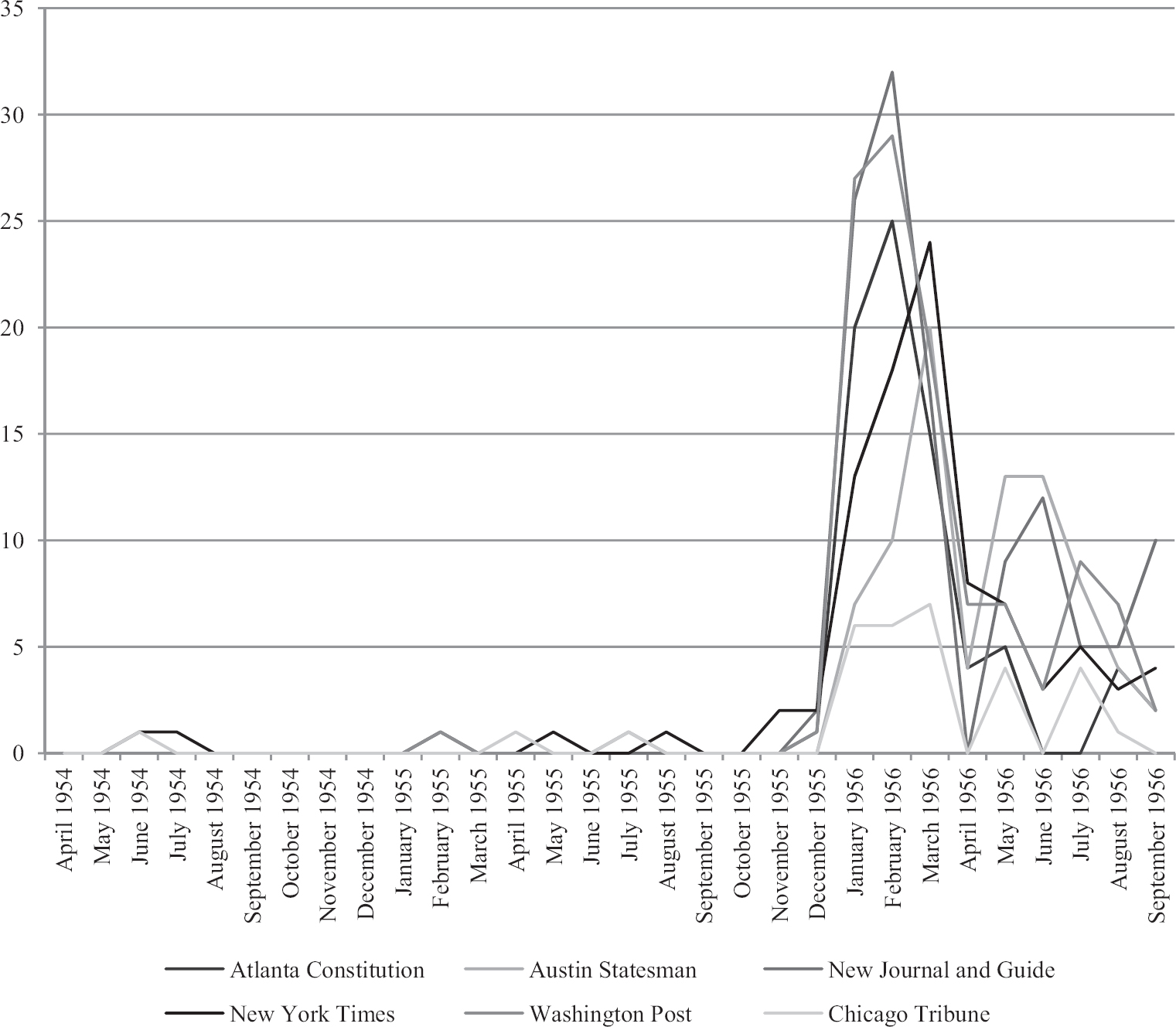
In the weeks following the first Brown decision, southern conservatives in Congress hurried to publicize their opposition to the ruling and voice their support for statewide resistance.Footnote 17 Some took to the House and Senate floor to denounce the decision, while others worked to assure their anxious constituents that “we … have been working together trying to draw up a plan whereby something could be done to help the Southern people.”Footnote 18 But in fact, little immediate action was taken. Both the Southern Caucus and Southern Delegations—the official organs of the southern congressional bloc—declined to issue a formal response until the Court specified a remedy to the constitutional violation it had identified. Then, in 1955, the justices announced the implementation phase of the decision, unanimously calling for “a prompt and reasonable start toward full compliance” and instructing school districts to integrate “with all deliberate speed.”Footnote 19
While the majority of conservative members of the Southern Caucus and Southern Delegations viewed this edict as a call to arms, many of their moderate colleagues feared that the magnitude of northern support for Brown betrayed the futility of southern resistance. As Senator Stennis of Mississippi confided to a constituent in June 1954: “What has overwhelmed us since the May decision has been the sentiment reflected throughout the country by groups and organizations … referr[ing] to it with warm approval or outright applause.” Although the senator would ultimately promote a campaign of massive resistance, he predicted that national opinion would win the day. “I cite these things to show you what we are up against here so far as public sentiment is concerned, except in small areas of the country.”Footnote 20 Others openly praised the Court's decision. For Representative Jim Wright of Texas, “hatred is evil in the sight of God. The Negro is a child of God, as am I and as are my kinsmen.”Footnote 21
Instead of violent defiance, southern moderates preached restraint. “Once before,” Senator J. William Fulbright of Arkansas warned his colleagues and constituents, “when the South disagreed with the policies of the Federal Government, we took matters into our own hands but did not succeed very well … we will have to find some better way to meet this difficulty.”Footnote 22 Senator Long of Louisiana seconded Fulbright's call for restraint: “Although I completely disagree with the decision, my oath of office requires me to accept it as law.”Footnote 23 Even Senator Allen Ellender, by no means a moderate on racial issues, agreed with his fellow Louisianan. “I frankly can see no good results [from a plan of revolt].”Footnote 24 Instead, moderate lawmakers advocated accommodation at the local level, where “we can find the necessary elbow room” to avoid “distasteful or unpleasant associations.”Footnote 25 They believed southern municipalities should comply with the Court decision, but in a manner reflecting the “local facts on the ground” (Fite Reference Fite1991, 332).
Predictably, the region's conservative lawmakers disagreed. In their view, segregated education was a bulwark of the southern racial order, to be defended at all cost. For these members, Brown represented “a flagrant abuse of judicial power.”Footnote 26 Arguing that the ruling violated the “plainly guaranteed rights [of states] to direct their most vital local affairs,” conservatives pressed their colleagues to join in a united campaign of “massive resistance.”Footnote 27 Spearheaded by Senators Byrd of Virginia and James Eastland of Mississippi, the conservative plan called for popular civil disobedience, as well as the “mandatory closing of desegregated schools, and the cut off of State funds if they reopened on a desegregated basis.”Footnote 28
Despite their “many, many differences,” both moderate and conservative southerners believed it imperative to maintain “a solid front … against the Court.”Footnote 29 Indeed, throughout the South, elected officials had long understood that southern power required regional unanimity. For example, as Alabama Governor Frank Dixon observed a decade before Brown: “We [the] people of the South have had our divisions … But we want, and we must have, if we are to have any hope of success … the South united.”Footnote 30 As we will see, Brown forced the region's senators and representatives to devise public displays of solidarity, even as they privately debated whether and how each state should oppose the ruling (Badger Reference Badger1999, 518). Their efforts to address the competing concerns of the two southern wings culminated in the Southern Manifesto.
Forging Senate Compromise
Determined to “obtain a unity of action,” Senator Russell of Georgia, the Southern Caucus's leader, searched for a way to satisfy both conservatives and moderates.Footnote 31 Russell believed that, at minimum, the Senate's southern conservatives would require a “public statement condemning the decision,” while moderates would cooperate only if the statement did not commit them to a specific plan of action.Footnote 32 In February 1956, the Southern Caucus convened a special meeting to discuss Brown II.Footnote 33 “Attended by practically all of the Southern Senators who had been active in opposing the various legislative proposals aimed at the Southern states,” the group voted to appoint a committee to draft a statement condemning the Court's decision.Footnote 34 Experts in constitutional, as opposed to racial, defenses of segregation, Senators Sam Ervin of North Carolina, Russell, and Stennis were selected “to consider all the various problems regarding the segregation decision of the Supreme Court.”Footnote 35
Endeavoring to compose a statement that would garner the support of a majority of southern senators, the committee “requested all of the members who desired to do so to submit their ideas as to what the draft should contain.”Footnote 36 Some members of the Caucus, Russell acknowledged, “actually favor the [Brown] decision. To get something respectable that most of our Southern Senators can sign, when you run into 5 or 6 who are unwilling to denounce the decision as illegal and unconstitutional, is discouraging.”Footnote 37 Whereas Russell worried that these moderate Caucus members were hindering group solidarity, the moderates believed that conservatives exercised disproportionate and detrimental influence over the drafting committee.Footnote 38 “Senator Byrd, I believe, is inspiring an extreme position,” Fulbright confided. “Under [his] leadership, some 12 or 15 of the Senators [are] determined to make a statement, so the best we [can] do [is] try to keep it within reasonable bounds.”Footnote 39
In early March 1956, a final draft was completed that “utiliz[ed] suggestions from nearly all of the papers that had been submitted.”Footnote 40 Although Russell and the drafting committee had avoided most of the incendiary language proposed by their conservative colleagues, the statement still had “some objectionable spots” in the eyes of Caucus moderates.Footnote 41 According to Russell, “several Senators including Senator Fulbright, [Spessard] Holland and [Price] Daniel thought that the language … originally suggested was, as one of them expressed it, ‘too bitter’ and these three [s]enators made some revisions, changing a few words to a softer meaning.”Footnote 42 For example, both Fulbright and Daniel objected to language in an early draft describing Brown as an “illegal and unconstitutional seizure of power,” preferring instead the phrase “unwarranted construction of the Constitution.” Believing the moderates’ suggestion to be too weak, the drafting committee agreed to substitute the phrase “contrary to the Constitution” (Day Reference Day2014, 106). Substantively, the revised draft pledged “to use all lawful means to bring about a reversal of [the Brown] decision [and] to prevent the use of force in its implementation.” Whereas earlier drafts had endorsed interposition explicitly, the final statement reflected moderate members’ unwillingness to commit to anything beyond “commend[ing] those states which have declared the intention to resist forced integration.”Footnote 43
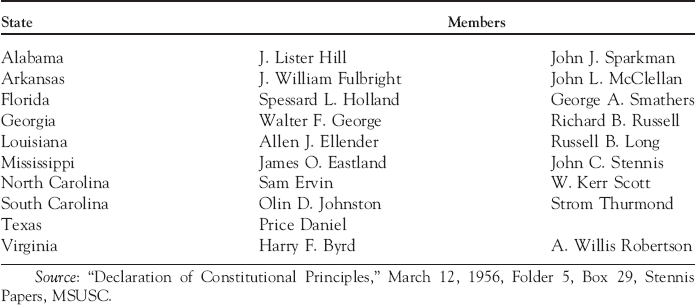
However, bowing to pressure from the group's more moderate members, the Manifesto pledged only that “the States [would have their] support in using every lawful means of resistance against the decision of the Court.” With this formulation, the senators agreed, conservatives would be free to encourage defiance of the Court's edict by legislative or more aggressive means, while their moderate colleagues would have latitude—and political cover—to refrain from engaging in meaningful opposition (Mickey Reference Mickey2015, 181). Satisfying both conservative and moderate senators, the Southern Manifesto “was signed by all of the 19 members of [the] group” (see Table 1).Footnote 44
Senate Members of the Southern Caucus and Signatories of Southern Manifesto
| State | Members | |
|---|---|---|
| Alabama | J. Lister Hill | John J. Sparkman |
| Arkansas | J. William Fulbright | John L. McClellan |
| Florida | Spessard L. Holland | George A. Smathers |
| Georgia | Walter F. George | Richard B. Russell |
| Louisiana | Allen J. Ellender | Russell B. Long |
| Mississippi | James O. Eastland | John C. Stennis |
| North Carolina | Sam Ervin | W. Kerr Scott |
| South Carolina | Olin D. Johnston | Strom Thurmond |
| Texas | Price Daniel | |
| Virginia | Harry F. Byrd | A. Willis Robertson |
Source: “Declaration of Constitutional Principles,” March 12, 1956, Folder 5, Box 29, Stennis Papers, MSUSC.
On March 12, 1956, the Southern Caucus released the text of the “Declaration of Constitutional Principles,” and the group's senior statesmen presented the document to the Senate body. “In solemn unity and determination,” the southerners vowed to “fight for the preservation of the Constitution.”Footnote 45 Eschewing racial appeals in favor of a comprehensive constitutional argument, the Manifesto faulted the Court for reversing its earlier ruling that “the ‘separate but equal’ principle is within the discretion of the State in regulating its public schools and does not conflict with the [Fourteenth A]mendment.” “This interpretation, restated time and again, became a part of the life of the people of many of the States and confirmed their habits, customs, traditions, and way of life.”Footnote 46 Thus, the senators charged, the Court “didn't interpret the Constitution, it amended it.”Footnote 47
Rallying Southern Representatives
As in the Senate, Brown aggravated existing tensions between conservative and moderate southern representatives. Like their Senate colleagues, many within the Southern Delegations were resigned to the idea that resistance to desegregation would be in vain and might, in fact, prompt further federal intervention. Although a fiercely committed segregationist, Representative Colmer of Mississippi saw little point in opposing the Court's decision: “I am alarmed … [but] the trouble is that Congress can do very little about it.” With limited power to protest the decision at the federal level, Colmer argued that a patchwork, state-by-state campaign to defend segregation was the only option, telling constituents: “The various states are going to have to find ways to work their own problems out.”Footnote 48
Other conservative members of the Southern Delegations objected to this “fatalistic” view of the “southern situation.” “The least we can do,” they argued, “is assert ourselves and hope that an aroused public opinion will make itself felt in opposing future encroachment. Playing ostrich will not suffice.”Footnote 49 Condemning the “tragic situation menacing education and race relations in the South,” the representatives vowed to join their Senate colleagues in supporting a forceful campaign of massive resistance, declaring “the South will not stand for any break through to compulsory social amalgamation.”Footnote 50
Despite their differences, both moderate and conservative members agreed the situation necessitated a unified southern response. As Representative William Tuck of Virginia reminded his colleagues and constituents: “The only solid force and sound bulwark now standing between the south and its enemies is … Congress. It is certainly important that we, as southerners, stand together.”Footnote 51
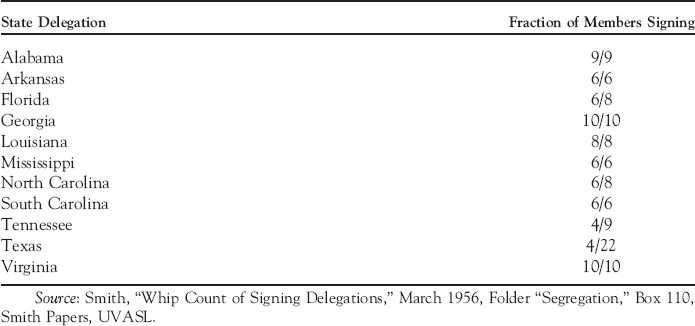
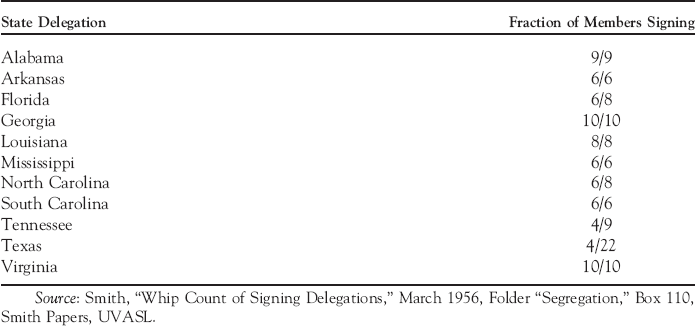
Recognizing the southern bloc's limitations in the House, the leaders of the Southern Delegations appealed to their Senate colleagues for help. According to Russell, “a meeting was held … attended by Senator Byrd and perhaps another Senator and by Representatives Howard Smith of Virginia, James C. Davis of Georgia, William Colmer of Mississippi, and perhaps one or two other members of the House.” As the senator recounted, “after they had read the manifesto the Representatives accepted it just as written, [and] carried it to the House.”Footnote 52 Eager to obtain unanimous support for the statement, Colmer appointed Smith to “whip” the senior congressmen from each participating southern delegation to secure the signatures of their more junior colleagues. Ultimately, Smith was able to secure signatures from 75 of the 106 members of the Southern Delegations (see Table 2).Footnote 53
Support for Southern Manifesto by State Delegation, March 1956
| State Delegation | Fraction of Members Signing |
|---|---|
| Alabama | 9/9 |
| Arkansas | 6/6 |
| Florida | 6/8 |
| Georgia | 10/10 |
| Louisiana | 8/8 |
| Mississippi | 6/6 |
| North Carolina | 6/8 |
| South Carolina | 6/6 |
| Tennessee | 4/9 |
| Texas | 4/22 |
| Virginia | 10/10 |
Source: Smith, “Whip Count of Signing Delegations,” March 1956, Folder “Segregation,” Box 110, Smith Papers, UVASL.
For many southern voters, the “Southern Manifesto evidenced … a truth frequently ignored by some—that the South is unanimous … in its love for the fundamental rights and liberties so clearly enunciated in the Constitution.”Footnote 54 But for southern lawmakers, the Manifesto was itself a necessary compromise. As we shall see, the ideological differences the statement concealed would manifest themselves in the patchwork development of massive resistance across the South.
V. Shaping Southern Backlash
Belying the Solid South's reputation for regional consensus, the nature and intensity of local reaction to Brown varied considerably from state to state. To be sure, much of the most violent segregationist protest took place in the Deep South (Black Reference Black1976, 90). However, even there, the manner and magnitude of resistance varied. In Mississippi, for example, state officials vehemently opposed integration and, under the direction of their senators and representatives in Washington, implemented a series of privatization schemes that aimed to preserve separate school facilities legally. Together with White Citizens’ Councils, Mississippi's political elite worked to intimidate black communities, sometimes threatening—and, occasionally, carrying out—acts of violence to dissuade liberal agitation for integration and civil rights. In Louisiana, by contrast, segregationist forces received “minimal cooperation” from the state's senators and representatives in Congress (Fairclough Reference Fairclough and Webb2005, 59). Without strong support from the state's top elected officials, Louisiana's White Citizens’ Councils battled racial moderates on roughly even terrain. Though segregationists successfully blocked integration of public primary and secondary schools, they failed repeatedly to roll back desegregation of the state's public colleges and universities.
In the Upper South, patterns of massive resistance were similarly mixed. In Fulbright's Arkansas, elected officials endeavored to discourage racial violence and encouraged municipalities to pursue integration at their own pace (Patterson Reference Patterson2001, 89). Thus, moderate districts “mobilized under the banners of legal compliance and preserving public education,” while conservative parts of the state “condemned token integration as an oxymoron and lambasted moderates for capitulating to the forces of integration and federal tyranny” (Lassiter and Lewis Reference Lassiter, Lewis, Lassiter and Lewis1998, 4). Byrd's Virginia, conversely, adopted a far more uniform and aggressive pattern of massive resistance, as guided by the state's congressional leadership (5–6).
To trace the linkage between elite instruction and patterns of massive resistance, we briefly sketch the development of segregationist mobilization in four southern states: Mississippi, Louisiana, Virginia, and Arkansas. By comparing the patchwork development of massive resistance, we will see that both moderate and conservative members of the Southern Caucus and Southern Delegations exploited the compromises inherent in the Southern Manifesto to encourage, or deter, organized opposition to integration as they desired. On this account, the intensity and breadth of southern backlash to Brown were not necessarily preordained by regional intolerance or a product of the Court's legal prescription. Rather, as Tony Badger writes: “Southern leaders had the opportunity to go in another direction, but instead they worked to convince white southerners that the Supreme Court could be defied” (2005, 52).
Cultivating Massive Resistance in Mississippi
Accounts of massive resistance in Mississippi tend to credit the state's infamous White Citizens’ Councils for inciting and enforcing opposition to Brown, overlooking the key role that Senators Eastland and Stennis played in planning and coordinating the state's militant refusal to desegregate. As we will see, in the months after Brown I, Mississippi's senators carefully laid the statutory groundwork for state officials to maintain segregated schools, anticipating the difficulties that would accompany widespread school closures should the Court mandate immediate integration. With a legal framework to defend Jim Crow in place, Eastland and Stennis worked together with state officials to cultivate grassroots support for school closure. Frequently appearing at White Citizens’ Councils’ meetings and rallies, the senators encouraged segregationists to quash nascent integrationist sentiment and black political mobilization.
In the days and weeks after the first Brown decision, Eastland and Stennis urged Mississippi's officials to “prepare as best we can” for a Court order requiring the enforcement of desegregation.Footnote 55 Instructing members of the state school board to identify a strategy “that will preserve public support for our system and assure a continuity of our schools even though we may be driven to the abolishment of the public school system as such,” the senators were determined that Mississippi would not again permit the Court to take it by surprise. “Let's not get caught and have to agree to something on an emotional basis.” Although Stennis wished to avoid amending the state's constitution to eliminate its mandatory public education provision, he was ultimately willing to explore “every possibility” to obstruct integration.Footnote 56 But whereas Eastland preached outright defiance, Stennis hoped to preserve segregation by informal means, proposing to the head of Mississippi's Democratic Party that “trustworthy white citizens” could perhaps meet with “a representative group of negroes” to “decide on a place of unofficial separate education at the county level.”Footnote 57
By the fall of 1954, Mississippi's legislature voted to implement Stennis's plan of “last resort,” authorizing the abolition of “the entire public school system.”Footnote 58 To avoid school closures, the legislature adopted the senator's proposal to administer “a system of grants and a leasing of property” in lieu of traditional public education financing.Footnote 59 In a special December election, voters ratified the legislative measure by a solid majority (Bartley Reference Bartley1969, 76).
With this measure on the books, the senators barnstormed across the South, speaking frequently at rallies to encourage white Mississippians and their fellow southerners to defy the Court (Bloom Reference Bloom1987, 97). Indeed, it was Eastland who urged the formation of a “people's organization … [that would] mobilize and organize public opinion” against desegregation, and the state's first White Citizen's Council formed in Indianola, the seat of the senator's home county.Footnote 60 Further reflecting the senator's position as the “Councils’ titular spokesman,” Eastland offered the keynote address at the groups’ first statewide meeting on December 1, 1955 (Day Reference Day2014, 9, 30). The senator proved an effective leader. After a Council rally in Montgomery, Alabama in early February 1956, the chairman of the Alabama association told Eastland that his group had “picked up 1500 new members and ha[d] requests for new organizations in twelve counties.”Footnote 61
Stennis, too, spoke out in support of local resistance, reiterating his commitment to segregation. “We are not going to comply with the Supreme Court decision of putting whites and blacks together.”Footnote 62 The senator also continued to work behind the scenes to direct the state's formal campaign of resistance. He helped to “draft Mississippi's interposition resolution in the weeks before its formal adoption by the legislature [in February 1956] and regularly consulted state officeholders on strategies and tactics” (Day Reference Day2014, 30).Footnote 63
Sanctioned by Mississippi's political elites, the state's White Citizens’ Councils embarked on an often-violent campaign to suppress civil rights agitation and to quell African American political participation. As one white Mississippian proclaimed: “There's open season on the negroes now. They've got no protection and any peckerwood who wants can go out and shoot himself one.”Footnote 64 Although Mississippi may well be a case where the success of massive resistance was overdetermined, at minimum, Stennis's and Eastland's support made it easier for white supremacists to seek to block integration of the state's entire educational system. Indeed, as we will see in the next section, Louisiana's White Citizens’ Councils—acting without the imprimatur of their state's highest-ranking officials—were unable to achieve such sweeping results.
Limiting Segregationist Sway in Louisiana
Unlike in neighboring Mississippi, Louisiana's congressional leaders would not embrace the full-scale resistance demanded by their state's White Citizens’ Councils. As a result, although Louisiana's legislature roundly condemned Brown as an “unwarranted and unprecedented abuse of power” and passed a variety of laws to circumvent the Court's desegregation order, the scale and intensity of massive resistance differed in important ways from the segregationist fervor of Mississippi.Footnote 65
Concerned that actively defying Brown would turn national public opinion against the South, Louisiana's Senators Ellender and Long urged voters to accept the Court's pronouncement. As Ellender wrote to one constituent: “We will have violence [that] would worsen rather than improve our position.”Footnote 66 Although he expressed sympathy for segregationists, Long, too, counseled southerners to abide by the decision, believing there was little reason that resistance would durably sustain Jim Crow. “General Robert E. Lee accepted the verdict of a decision made in blood and pleaded with all of his beloved comrades to accept once and for all the authority of the Union. Anyone who would make us pay the price of learning that hard lesson again will have to do it against my advice.”Footnote 67 Louisiana's conservative governor echoed these concerns, warning that no good could come from “getting out on a limb” and agitating against the federal government.Footnote 68
Without the support of the state's top elected officials, segregationists were left to battle Louisiana's powerful political moderates under their own auspices. Albeit a minority in the state legislature, racial moderates had long been a fixture of Louisiana politics. Dating back to the days of Huey Long, the state boasted an indigenous populist tradition characterized by significant black political participation. Indeed, with Louisiana's politics polarized into “pro-Long and anti-Long factions,” blacks were encouraged “to seek the ballot” and “many white politicians [were incentivized] to allow them to vote” (Fairclough Reference Fairclough and Feldman2004, 156–57; see also Lewis Reference Lewis2006, 60–61). Aided by the abolition of the poll tax in 1934, African Americans grew to constitute 15 percent of registered voters by 1954. Forging a biracial coalition with white moderates, black voters won significant pre-Brown victories, desegregating Louisiana's flagship university without strife in 1950, and graduating the school's first black lawyer in 1954 (Fairclough Reference Fairclough and Webb2005, 57, 61).
Undaunted, Louisiana's segregationists embarked on an ambitious legislative campaign to preserve the state's repressive racial regime. Defying the governor's tacit acceptance of Brown, conservative members of the state legislature pushed to create a Joint Legislative Committee to Maintain Segregation. The legislature also passed a measure authorizing the state school board to mandate segregation in primary and secondary facilities and criminalizing violations (Bartley Reference Bartley1969, 74–75). Led by state Senator William Rainach, the committee “coordinated the burgeoning Citizens’ Council movement, which by 1956 claimed 80,000 members,” roughly equivalent to 8 percent of the state's registered voters (Fairclough Reference Fairclough and Webb2005, 58). Like Eastland, Rainach believed “the only real solution [lay] in organizing our people completely from the ground up.”Footnote 69 Together, Rainach and the newly formed White Citizens’ Councils spearheaded a statewide referendum to designate enforcement of segregation as an “inherent police power of the state.”Footnote 70
In the end, neither side would emerge triumphant. Retaking the state house in 1956, moderates—led by newly elected Governor Earl Long—convinced voters to reject a statewide measure championed by White Citizens’ Councils to limit black suffrage (Fairclough Reference Fairclough and Webb2005, 59). Criticizing Rainach, Long observed: “It's easy to say nigger and scare everybody … I don't think you should run for office on it.”Footnote 71 Under Long's leadership, moderates also thwarted efforts to resegregate the state's public colleges and universities, and opened a new campus of Louisiana State University in New Orleans to black students. Public transportation and parks in the city were also desegregated (Patterson Reference Patterson2001, 107). At the same time, segregationists successfully passed an array of bills prohibiting racial mixing in a variety of public accommodations (Fairclough Reference Fairclough and Webb2005, 66). Though New Orleans schools first desegregated in the fall of 1960, “advocates of desegregation found little to cheer about … during the next few years” (Patterson Reference Patterson2001, 109).
It seems clear that many whites in Louisiana were as hostile to integration as their counterparts in Mississippi. What differentiated the path of massive resistance in Louisiana was the absence of support from the state's most senior leaders, which helped create what one historian calls an “often bewildering political atmosphere” (Lewis Reference Lewis2006, 61). In the resulting power vacuum, segregationists were forced to jockey with racial moderates to control the state's response to Brown. Although they succeeded in delaying integration in primary and secondary schools, there would be no James Meredith in Louisiana.
The Rise of Massive Resistance in Virginia
It is in Virginia that the power of southern leaders to shape massive resistance is most evident. As in other states “outside of the Deep South,” Virginia officials initially responded “to Brown I with restraint” (Klarman Reference Klarman2004, 389). Pledging to “abide by the law of the land,” the state school board began to consider plans for a gradual but systematic integration of public schools (Turpin Reference Turpin1976, 85). But this was not to be. Determined to resist the Court's desegregation order at all costs, Byrd and other senior members of the state's congressional delegation “reacted immediately and furiously against Brown” (Patterson Reference Patterson2001, 79). Calling the decision “the most serious blow that has been struck against the rights of the States in a manner vitally affecting their authority and welfare,” Byrd and his allies vowed to “use every legal means … to continue segregated schools in Virginia.”Footnote 72 Willing to jettison the state's entire public school system to preserve Jim Crow, even in the face of constituent outcry, Byrd used his political machine to engineer opposition to the Court's desegregation order for nearly half a decade.
Immediately following the first Brown decision, many of Virginia's elected officials declared their fidelity to the rule of law and willingness to comply with the Court's desegregation order (Lassiter and Lewis Reference Lassiter, Lewis, Lassiter and Lewis1998, 6). The superintendent of public instruction stated there would be “no defiance of the Supreme Court … We are trying to teach children to abide by the law of the land, and we will abide by it.” The state's attorney general seconded this call for compliance, saying: “The highest court in the land has spoken and I trust that Virginia will approach the question realistically and endeavor to work out some rational adjustment.”Footnote 73 A day after the decision was handed down, even the state's conservative governor expressed his willingness to “work toward a plan which would be … in keeping with the edict of the court.”Footnote 74
When word got out that Virginia officials were willing to accept Brown, Byrd's colleagues recalled that “the top blew off of the U.S. Capitol.”Footnote 75 Adamant that his state resist all orders to desegregate, Byrd turned the considerable resources of his “autocratic machine” toward what he termed “massive resistance” (Bartley Reference Bartley1969, 111; Key Reference Key1984, 19). With Byrd's intervention, the state's approach to desegregation would change radically. Refusing to allow Virginia to comply with the Court's order to integrate, the senator pressed the governor and school superintendent to reverse course. The effects were immediate; in June 1954, the governor retracted his previous statement and declared his commitment to opposing integration. “Byrd would countenance no deviation from absolute segregation … The end result was that … [state lawmakers] were forced to take public positions on the segregation issue that they would not by choice have normally taken” (Lewis Reference Lewis2006, 58–59; Reed Reference Reed2014, 38).
Privatizing education was the centerpiece of Byrd's response to Brown. As the senator wrote Virginia's attorney general: “It is very important … to give every possible aid to the Superintendent of Schools … in making the use of private schools a success.”Footnote 76 Working together with the state's junior senator, A. Willis Robertson, and senior members of Virginia's congressional delegation, Byrd's organization “threw its influence behind tuition grants” rather than an alternative plan that emphasized local discretion (Wilkinson Reference Wilkinson1968, 126; Reed Reference Reed2014, 37–40).Footnote 77 Through these efforts, tuition grants were endorsed by a statewide constitutional referendum and the Virginia legislature authorized the governor to close any schools that complied with Brown's integration orders (Wilkinson Reference Wilkinson1968, 127). Pleased with these results, Byrd remained committed to the belief that “a completely segregated school system could be maintained” (Black Reference Black1976, 113).
But, pressure from both constituents and “the great industries in Virginia” to “preserve respect for the law” and abide by the Court's desegregation order ultimately proved too great.Footnote 78 As Virginia's attorney general warned Smith, the state's senior congressman, “the people are not going to surrender [their public school system] without a struggle.”Footnote 79 In fact, grassroots opposition to Byrd's hard-line stance grew substantially as the costs of massive resistance became clear (Lassiter and Lewis Reference Lassiter, Lewis, Lassiter and Lewis1998, 14–15; Lewis Reference Lewis2006, 55). Byrd himself received dozens of letters from constituents opposed to continued obstruction. As one Virginian wrote: “Many people do not believe in thwarting the lawful decisions of our federal courts … We will not refight the Civil War or raise banners for another lost cause. Let us be realistic.”Footnote 80 Prominent groups within the state, including ministerial associations, local parent teacher associations, and the League of Women Voters, along with influential members of the media, also called for an end to full-scale massive resistance (Black Reference Black1976, 321).
Although Byrd remained stalwart in his support for continued intransigence—even at the cost of a lengthy public school shutdown—other elected officials did not, eventually acquiescing to the integration of the state's public schools. Virginia's governor would later recall that “closing the public schools was ‘too big a price to pay’ for maintaining segregation,” for it “would have a most deleterious effect on the operation of existing industries and the attraction of new industry.”Footnote 81 On this account, far from inciting massive resistance, popular pressure helped to end efforts to delay integration, while elites were the prime movers in orchestrating southern defiance.
Sanctioning Local Discretion in Arkansas
While the crisis in Little Rock continues to resonate as a symbol of southern hostility to Brown, “Arkansas's preeminent stature among the defiant states … is as undeserved as it was unexpected” (McMillen Reference McMillen1971, 95). With the notable exception of Governor Orval Faubus, the state's top elected officials promoted a “laissez-faire” approach to desegregation, “leaving each district to work out its own racial problems” (Bartley Reference Bartley1969, 262; Anderson Reference Anderson2010, 25–26). While Virginia's political elite directed statewide massive resistance, Arkansas's senators and representatives uniformly condemned massive resistance as “an extreme position which may well result in great harm to the South and the nation.”Footnote 82
Led by Fulbright, Arkansas's congressional delegation reluctantly joined their colleagues in signing the Southern Manifesto. Pessimistic that massive resistance would prevail, Fulbright urged his colleagues and constituents to resign themselves to integration. “Under our system of government, the Supreme Court is specifically given the authority to interpret the Constitution, and no matter how wrong we think they are, there is no appeal from their decision.”Footnote 83 Faubus's predecessor offered similar counsel, declaring from the statehouse steps after the first Brown decision was issued: “Arkansas will observe the law. It always has.” Little Rock's school superintendent also pledged compliance (Anderson Reference Anderson2010, 26). “We have felt for a long time that it was not a matter of ‘if’ but ‘when’ segregation would end.”Footnote 84 Sheltered by the state's political elite, five school districts in northwest Arkansas desegregated in the fall of 1954, another five declared their intention to desegregate by 1957, and Little Rock, too, publicized plans to desegregate over a period of six years (Bartley Reference Bartley1969, 263; Vinzant Reference Vinzant2010, 59).
Nevertheless, local discretion left room for more conservative forces to agitate against integration (Cope Reference Cope2015, 113–14). Without direction from the state's congressional delegation, officials lacked a statewide plan for intervention if local skirmishes over integration were to break out. Indeed, Faubus had studiously avoided taking a position on integration while campaigning for office in 1954 and 1956. Much like Fulbright and Representative Brooks Hays, Faubus emphasized that it was up to localities “to work out a definite plan of action in accordance with the needs of the district and the demands of its patrons.”Footnote 85 Even in the days before black students were scheduled to integrate Little Rock schools, Faubus publicly declared “he had no plans concerning Little Rock,” indicating privately that “he intended to let city officials deal with the problem” (Bartley Reference Bartley1969, 264). Thus, when the governor ultimately resolved to intervene, he did so haphazardly, calling out the National Guard to enforce segregation only to withdraw it several weeks later after intervention by the federal courts (Vinzant Reference Vinzant2010, 68–79). In the aftermath, local school administrators were left to pick up the pieces.
While the peaceful integration of many Arkansas school districts demonstrated the virtue of local discretion, the crisis in Little Rock made clear the dangers of “the state's policy of drift” (Bartley Reference Bartley1969, 263). Unwilling to sanction massive resistance but unable to enforce statewide compliance, Arkansas's national leaders abdicated, believing that districts would inevitably integrate. In the absence of centralized leadership, decision-making authority was devolved to municipalities.
VI. Embracing Popular Constitutionalism
Brown did more than prompt strident segregationist protest. The decision forced southern elected officials to face the reality they had long been avoiding—that the Supreme Court was no longer a reliable venue to resolve and diffuse civil rights fervor. For members of the Southern Caucus and Southern Delegations, Brown proved definitively that liberal interests had seized control of the Court and were unlikely to relinquish it. Even if southern lawmakers could, in the short term, slow the decision's implementation and preserve the Plessy doctrine in fields outside of education, they would have to abandon “what had been an offensive litigation campaign against civil rights protestors” (Schmidt Reference Schmidt2015, 1181). Southern apartheid would have to be preserved by other means.Footnote 86
In their search for a new institutional breastwork from which to defend Jim Crow, southern lawmakers would turn to a tried and true “repertoire of contention”—popular constitutionalism (Tarrow Reference Tarrow1993, Reference Tarrow2008). Like their antebellum forebears, the South's political elite now openly questioned the Supreme Court's “final say” over the meaning of the Constitution in the wake of Brown, insisting instead that citizens and states had the ultimate right to “press their own visions” (Kramer Reference Kramer2005, 208–09). To be sure, we are not the first to note that southern rhetoric post-Brown “drip[ped] with the words of ‘interposition’ and ‘nullification,’” as Martin Luther King, Jr. famously described.Footnote 87 But scholars have been slow to recognize that, as was true for massive resistance, the South's embrace of popular constitutionalism was not exclusively driven by an upwelling of widespread hostility to the Court. Rather, we argue, popular constitutionalism was a strategic choice made by the South's political elite. To the extent that calls for lay interpretation, nullification, and interposition reentered white southerners’ political vocabulary in the aftermath of Brown, they did so by dint of elite priming.
For much of the late nineteenth and early twentieth centuries, southern lawmakers relied on the federal courts to ward off liberal efforts to reform and reconstruct their region's racial regime. Indeed, in the decades after the Civil War, the Supreme Court rolled back the laws and constitutional protections that liberal Republicans had passed to recognize African Americans as citizens of the United States.Footnote 88 Under the Court's benevolent eye, southern states imposed a variety of literacy tests, cumulative poll taxes, and lengthy residency requirements to thwart the Fifteenth Amendment and essentially eliminate black voter registration.
Buttressed by the federal judiciary, southern lawmakers in the pre-Brown era routinely framed their criticism of civil rights legislation in traditional constitutional terms. In the late 1930s, for example, southern senators and representatives deftly deployed constitutional rationales to defeat several antilynching resolutions. Citing the Civil Rights Cases, they argued that the Fourteenth Amendment could not serve as a foundation for federal antilynching laws because it applied to “state action and state action alone.”Footnote 89 Because no southern state had a law on the books that sanctioned lynching, it was individuals—not the state—who were responsible for the crime. Moreover, noting that lynching, as a form of murder, was already illegal under local law, southern lawmakers cautioned that “[the antilynching bill] may cause the people of the states who are striving to promote the cause of law and order to lose their interest or resent efforts to interfere with the States in their jurisdiction of murder cases.”Footnote 90
In 1942, southern legislators turned again to constitutional arguments to defeat a federal poll tax ban. Citing Article 1, Section 2 of the Constitution, they argued that individual states had the right to determine voter qualifications in both federal and local elections. “The question is not whether we favor the poll tax, the question is simply whether or not each state, within its own sovereign rights, shall determine the question whether there should be a poll tax.”Footnote 91 Time and again, southern lawmakers eschewed racist demagoguery and nongermane exposition and relied instead on secular or constitutional criticism of the bill, frequently citing the Court itself. Even after the Court had agreed to hear Brown, the South's political elite remained hopeful “that the common sense … of the Court, as well as the firmly established precedents, will cause the Court to uphold the rights of the state to segregate their students.”Footnote 92
Prior to Brown, on the occasions that the Court did rule against “southern democracy,” southerners expressed opposition, but refrained from attacking the Court's interpretive authority. For example, responding to the Court's Allwright decision, Representative John Rankin of Mississippi declared that one of his “greatest fears ha[d] been realized.”Footnote 93 Though the South's Democratic lawmakers felt “betrayed” by a Supreme Court composed of Roosevelt loyalists, who, in their view, had “repudiated the principles of the Democratic party,” their vows to “do whatever we can to protect our white primaries” did not question the Court's right to issue the decision.Footnote 94 Constitutional disagreement fell short of outright constitutional defiance.
Brown changed this calculus. When the Court unanimously concluded that black school children were being “deprived of the equal protection of the laws guaranteed by the Fourteenth Amendment,” the Constitution, at least as interpreted by the Warren Court, could not insulate the South from liberal interference.Footnote 95 As Stennis would confide to constituents several weeks after Brown I: “It is very clear now that if we go to the courthouse in any kind of contest with a member of the colored race on any question … that we will lose, because in such matters we no longer have courts but groups of social engineers.”Footnote 96 Unable to count on the federal courts to serve as a reliable redoubt from which to defend Jim Crow, Virginia's Tuck concluded: “The South is [now] in an isolated and exposed position.”Footnote 97 Alabama's attorney general, too, recalled: “We concluded then that we could never win the legal battle defending segregation … The best for us to do would be to never admit that, of course, but to fight a delaying action in the courts.”Footnote 98 A change in institutional venue was necessary.
Congress had long been a critical source of southern power in national politics, but, as the leaders of the Southern Caucus and Southern Delegations were quick to recognize, it, too, could not serve as the bulwark they needed to forestall civil rights. Southern Democrats were increasingly marginalized in the House and Senate, as liberals from both parties mobilized against Jim Crow. As Stennis wrote to a constituent: “My firm conclusion [is] that there is no chance to get a Congressional Act [to uphold segregation] … My further conclusion [is] that the overwhelming political sentiment is that [any] legislation would most likely wind up implementing the Supreme Court decision rather than overruling it.”Footnote 99 As leader of the Southern Caucus, Russell concurred. “So much emotion has been aroused with the Supreme Court decision … that the rest of the country seems willing to lose all of their rights and liberties if they can only impose their own views on the South. Our situation is becoming increasingly serious.”Footnote 100 Without the votes to impeach Chief Justice Earl Warren, or pass a constitutional amendment overruling the Court—and with President Eisenhower expressing sympathy for civil rights advocates—southern lawmakers rapidly transitioned to a rhetoric of popular constitutionalism.
In their personal correspondence and public speeches in the months preceding the release of the Southern Manifesto in March 1956, members of the Southern Caucus and Southern Delegations began to emphasize the right of the people of the South themselves to defy judicial edicts and interpret the Constitution, where they had once promoted fidelity to the rule of law as pronounced by the Supreme Court. Speaking to a crowd of Virginians in November 1955, Byrd argued: “Those who are attempting to integrate … should realize that the Negro children will suffer the most if some substitute school system is forced upon … localities. We are facing a great crisis and citizens at the grass roots should make the momentous decision.”Footnote 101 Several months later, in February 1956, Robertson echoed Byrd's calls for local resistance. In a statement circulated to Richmond newspapers, Robertson said, “I believe thoughtful citizens throughout the nation are disturbed by the current trend of the Federal Government to assume jurisdiction over matters heretofore reserved to the States and by the attitude of the Supreme Court which has, in effect, claimed the right to become an unrestricted policy making body.” Southerners, the senator urged, would need to fight to “maintain a proper division of powers between the Federal Government and the forty-eight sovereign states.”Footnote 102 And in May of that year, Louisiana's Senator Long wrote in his constituent newsletter: “The Supreme Court has become a lawmaking body. It has undertaken in a number of instances to change the Constitution of the United States without the consent of the people.”Footnote 103
In the days after the Manifesto was signed, elite calls for popular constitutionalism intensified. Texas Representative Ovie Clark Fisher, for example, implored his constituents to stand against the Court regardless of their “being for or against segregation.” “The least we can do,” Fisher told his constituents, “is assert ourselves and hope that an aroused public opinion will make itself felt in opposing future encroachment.”Footnote 104 Likewise, Virginia's Smith published an editorial in local newspapers that condemned “the temporary occupants of high offices in the Judicial branch” for “deviat[ing] from the limitations imposed by the Constitution,” and called upon readers to help “right this wrong.”Footnote 105
To be clear, we are not suggesting that southern politicians did not criticize the Brown decision prior to the spring of 1956. Indeed, as early as the summer of 1954, elected officials were articulating their adamant, but inchoate, opposition to the decision. For example, Texas's incumbent governor Allan Shivers “emphasized his hostility to desegregation” and characterized Brown as “the greatest invasion of local rights in the history of the Supreme Court.”Footnote 106 That same summer, Georgia Governor Herman Talmadge declared: “I do not believe in Negroes and whites associating with each other, either socially or in school systems, and as long as I am governor, it won't happen.”Footnote 107 However, their critiques were not cast in the language of popular constitutionalism until the South's leaders in Washington had themselves begun to question the Supreme Court's institutional authority, and to work with editorial writers, such as the Richmond News Leader's Kilpatrick––often credited with “breathing new life into the ostensibly moribund” doctrine of interposition––to promote it (Thorndike Reference Thorndike, Lassiter and Lewis1998, 51). Indeed, Kilpatrick, who “considered his campaign a critical component of the Byrd Organization's evolving resistance program,” corresponded with the senator to obtain his approval for the “interposition campaign.” Commenting on Kilpatrick's editorial offensive, Byrd responded: “I only wish we could have gotten started on this sooner.”Footnote 108
With a common language to articulate their dissent, southern governors and local elected officials followed suit, transitioning from a rhetoric of reactive hostility to ostensibly more principled statements emphasizing the primacy of lay constitutional interpretation. This change in language is important. The essence of popular constitutionalism, Kramer tells us, is “publicly repudiating Justices who say that they, not we, possess ultimate authority to say what the constitution means” (2005, 247). It is not simply registering disagreement with the decision the Court issues.
Understanding the timing of elected officials’ pivot to popular constitutionalism is critical. We have argued that southern lawmakers are responsible for the South's rhetorical turn to interposition and nullification. Perhaps, however, southern lawmakers only began to “urge all States to exhaust every effort within the law to reverse … this decision” when they learned that their constituents were advocating the same.Footnote 109 As appealing as this notion of popular constitutionalism may be, it is not borne out by the evidence. A careful look at news coverage post-Brown I—but before elite calls for interposition and nullification—does not reveal an uptick in public appeals to either idea. In fact, we find the opposite. As shown in Figures 1 and 2, both northern and southern news outlets began to engage with principles of popular constitutionalism only after southern lawmakers shifted their rhetoric, around the time of the release of the Southern Manifesto.Footnote 110
Nor do we find much evidence that constituents were articulating principles of popular constitutionalism in their letters to lawmakers prior to the publication of the Manifesto. Although archival preservation is imperfect, our examination of constituent correspondence prior to the spring of 1956 does not indicate that constituents invoked interposition or nullification as possible responses to the Court's decision. However, and tellingly, we think, letters following Brown II do take up ideas of lay interpretation and judicial overreach, often crediting lawmakers for developing these critiques of the Court. As one Virginian wrote to Smith: “You … are to be congratulated for evidencing to the Nation … couched in language to which no one can object … that the South is unanimous … in its love for those fundamental rights and liberties so clearly enunciated in the Constitution.”Footnote 111 Such letters offer suggestive evidence of elite diffusion.
News Coverage of “Interposition,” 1954–1956
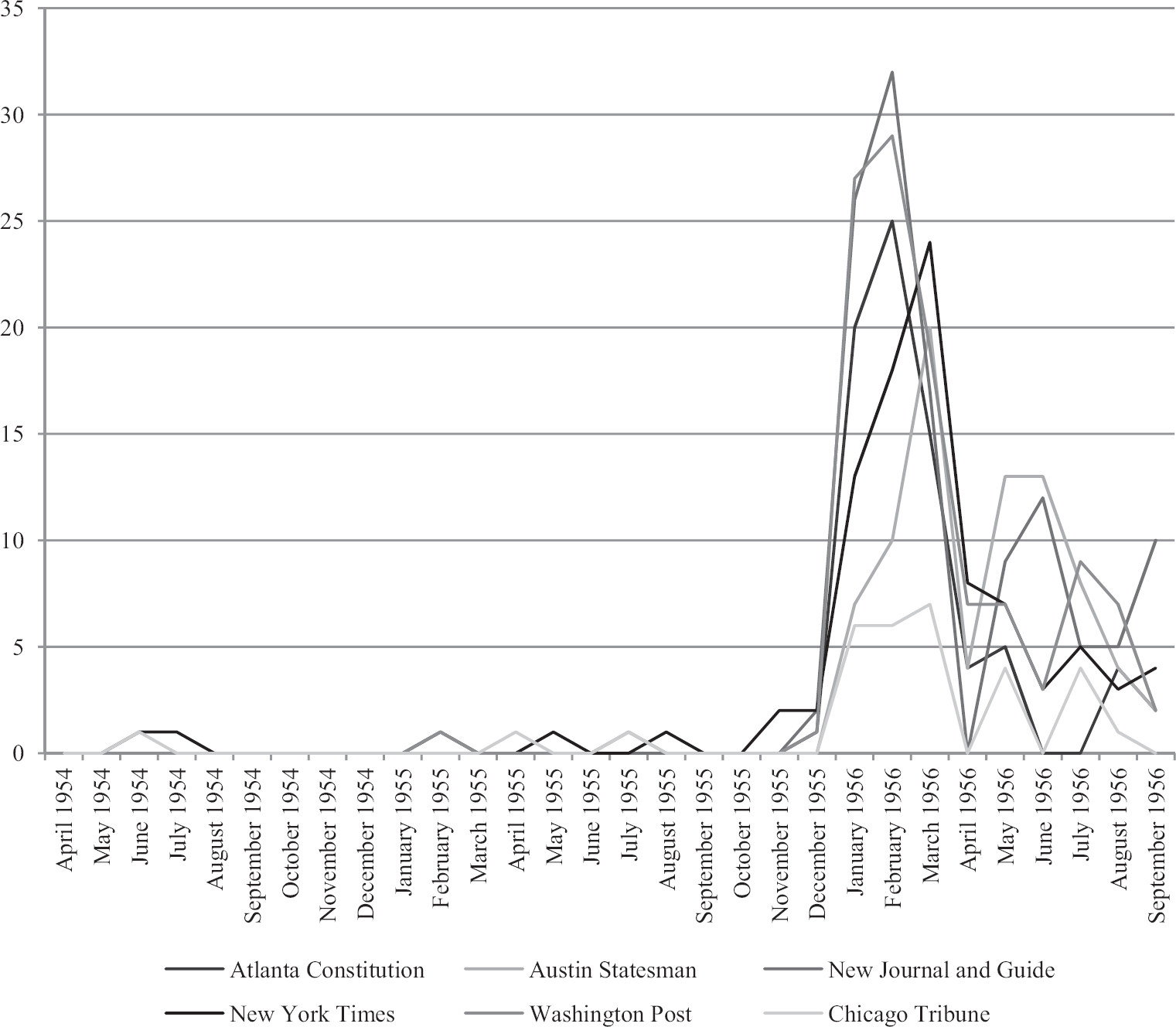
Doubtless, the South's response to Brown is only one example of popular constitutionalism in action, and it is important not to overstate our case. Nevertheless, Brown suggests that popular constitutionalism will sometimes be less about “the people themselves,” and more about strategic elite behavior. On occasions where ordinary citizens come to assert their discomfort with “handing their Constitution over” to the Supreme Court, it is because they have been primed to do so by politicians opposed to the judiciary's actions (Kramer Reference Kramer2005, 247).
VII. Conclusion
Brown fundamentally reshaped the political terrain on which the battle for civil rights would be fought. It did so by convincing those at the top of the South's political hierarchy—Dixie's senators and representatives—that the federal courts could no longer serve as the centerpiece of their campaign to defend Jim Crow. Nevertheless, determined to preserve the South's repressive racial regime, the region's lawmakers embraced popular constitutionalism. Adopting a rhetoric of interposition and lay interpretation, they challenged the singular authority of the Supreme Court to “ascertain [the Constitution's] meaning.”Footnote 112 As we have seen, Brown exposed core ideological divisions within the ranks of the South's national leadership. Determined to maintain a public facade of unity, they crafted the Southern Manifesto. Often misunderstood as an attempt to communicate with audiences outside the halls of Congress, the document was first and foremost an effort to preserve southern solidarity by granting individual members of the Southern Caucus and Southern Delegations wide latitude to encourage or discourage resistance to integration as they believed necessary. Attending in this way to the Manifesto's purpose and structure allows us to better understand the true source of variation in the nature and intensity of local reaction to Brown. On our account, within- and across-state differences in massive resistance are attributable to differences in elite preferences and elites’ corresponding choices in directing opposition to the Court's desegregation orders.
News Coverage of “Nullification,” 1954–1956
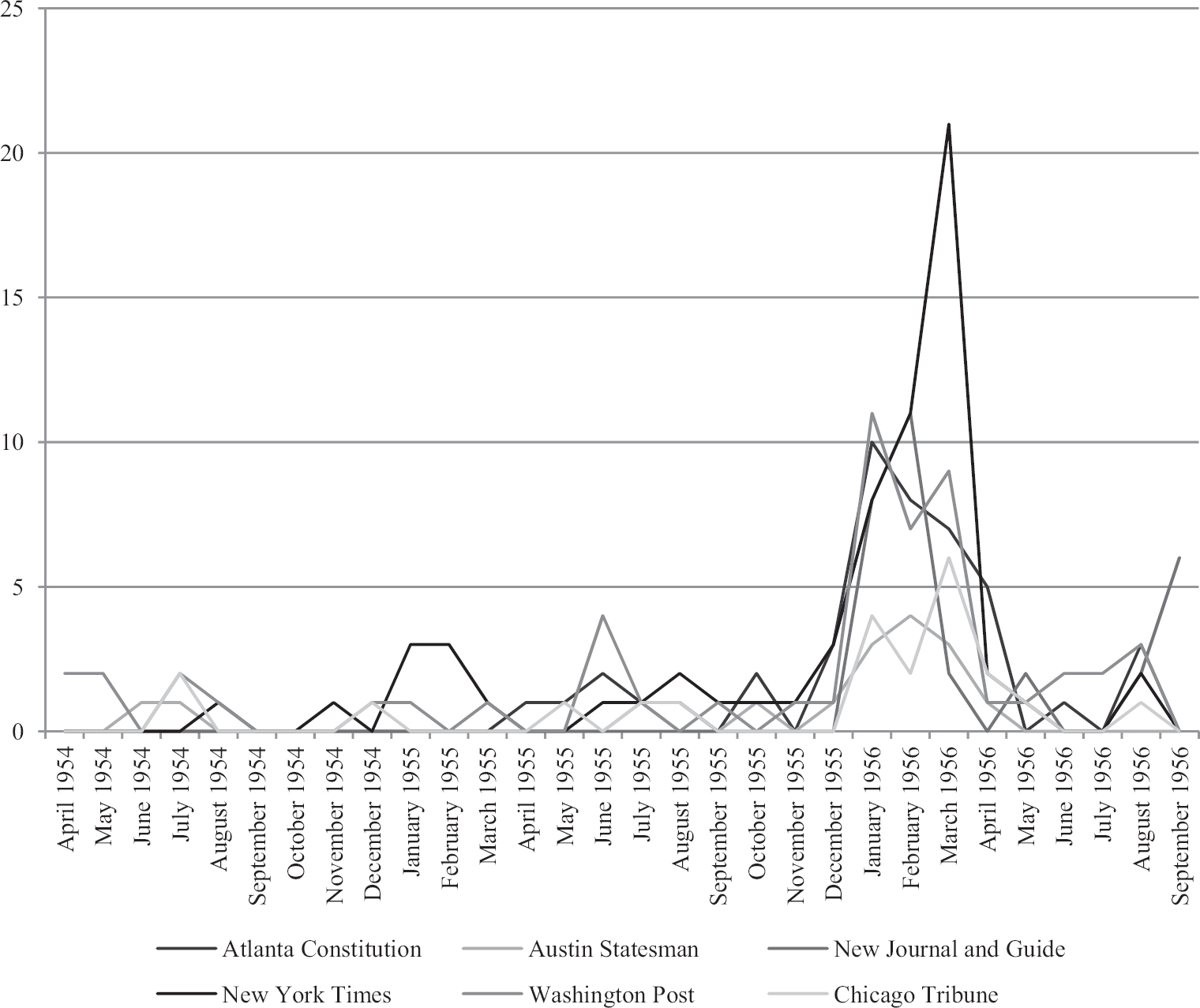
For students of judicial backlash, these findings suggest that greater attention must be paid to the ways in which controversial Court decisions fracture—rather than galvanize—the regime's opposition and, perhaps more importantly, the constitutive factions of the dominant coalition. In the case of Brown, the decision threatened to publicly expose cleavages within the Southern Caucus and Southern Delegations. How southern lawmakers responded would profoundly shape the region's politics for decades to come.
Over the past few decades, many, including Supreme Court justices themselves, have advocated “judicial restraint” on the grounds that incrementalism best safeguards the country against dangerous and damaging backlash. As perhaps the most prominent public champion of this justification for judicial caution, Justice Ruth Bader Ginsburg recently chided the Roe v. Wade majority for giving “opponents of access to abortion a target to aim at relentlessly.” Rather than legalize abortion across the country in one decision, the Court should have “put its stamp of approval on the side of change and let that change develop in the political process.”Footnote 113 It is understandable, and even tempting, to believe that judges and justices can control the nature and pace of reaction to their decisions.
But, these appeals to judicial restraint are implicitly grounded in a bottom-up view of judicial backlash. If, in fact, judicial backlash is driven by popular disaffection, it may be possible to mitigate it by slowly acclimating the populace to changes in the law. However, if judicial backlash, like popular constitutionalism, is an elite-driven and contingent process, we suggest there may be less the Court, or courts, can do to diminish its likelihood. Given that citizens are unlikely to form unmediated opinions about even high-profile cases, what politicians say an opinion does may often be more important than what judges say it does. Indeed, at least in the case of Brown, the Court's cautious instruction to integrate with “all deliberate speed” was wholly inadequate to preempt southern lawmakers from using the decision to further their own political ends (Rosenberg Reference Rosenberg2006). Whatever the virtues of incrementalism, limiting the probability of judicial backlash is unlikely to be one of them.