Introduction
Lichen-associated homobasidiomycetes are known to occur in at least five major clades, the Agaricales (Arrhenia, Gamundia), Atheliales (Athelia), Boletales (Leucogyrophana), Corticiales (Laetisaria, Marchandiobasidium and Marchandiomyces) and Cantharellales (Burgella, Burgoa and Minimedusa) (Lawrey et al. Reference Lawrey, Binder, Diederich, Molina, Sikaroodi and Ertz2007; Barrasa & Rico Reference Barrasa and Rico2010; Lawrey & Diederich Reference Lawrey and Diederich2013). Many of these species form bulbils, minuscule sclerotia-like structures that are always sterile, with no known basidiomata or conidiomata. Lichenized basidiomycetes species are also known from many of these same lineages, the Agaricales (Acantholichen, Cyphellostereum, Dictyonema, Lichenomphalia), Atheliales (Athelia), Corticiales (Marchandiomphalina), Cantharellales (Multiclavula) and Lepidostromataceae (unknown order) (Lepidostroma) (Jülich Reference Jülich1978; Lawrey et al. Reference Lawrey, Binder, Diederich, Molina, Sikaroodi and Ertz2007, Reference Lawrey, Lücking, Sipman, Chaves, Redhead, Bungartz, Sikaroodi and Gillevet2009; Ertz et al. Reference Ertz, Lawrey, Sikaroodi, Gillevet, Fischer, Killmann and Sérusiaux2008), and in two lineages, the Cantharellales and Agaricales, lichenized species produce lichenized bulbils (Multiclavula and Lichenomphalia). In both the Cantharellales and Corticiales, lichenicolous species are also closely related to lichenized species, which led Lawrey et al. (Reference Lawrey, Binder, Diederich, Molina, Sikaroodi and Ertz2007) to propose the hypothesis that lichenized species may have evolved from lichenicolous ancestors, and that the production of bulbils may promote the evolution of the lichenized habit. This and other interesting hypotheses cannot be tested fully until more is learned about the phylogenetic relationships of lichenized and lichen-associated basidiomycetes. A review of all known bulbil-forming species was provided by Diederich & Lawrey (Reference Diederich and Lawrey2007), with the description of several new taxa within the Cantharellales and Corticiales. One of those species, belonging to the Ceratobasidiaceae, was not formally described in that paper, as the authors preferred to wait for more material and additional sequences to confirm the placement in that family. The aim of this paper is to formally describe this species in Ceratobasidium and to describe several additional, at least facultatively lichen-associated, species in the Cantharellales.
Material and Methods
Morphological study
Specimens from the herbaria B, BAFC, BR, E, KRAM, M, LPB, STU and UPS, and from the private collections of R. Cezanne & M. Eichler, P. Diederich, A. Flakus, J. Etayo, Z. Palice and P. van den Boom were examined. Dry herbarium specimens were examined and measured under a binocular microscope Leica MZ 7.5 (magnification up to ×50), and photographed using a Canon 40D camera and a Nikon BD Plan 10 microscope objective, StackShot (Cognisys) and Helicon Focus (HeliconSoft) for increasing the depth of field. Entire unsectioned bulbils, more rarely sections of bulbils (Bulbilla applanata), were studied on material mounted in water, 5% KOH, lactophenol cotton blue (LCB), Phloxine B or Congo Red, either without or with pressure on the coverslip. Microscopic photographs of bulbils in LCB were prepared using a Leica DMLB microscope and a Leica EC3 camera, and using Helicon Focus.
Isolation of fungal cultures
Cultures of Burgella flavoparmeliae (Flakus 23513), Burgellopsis nivea (Coppins 21845) and Ceratobasidium bulbillifaciens (Eichler-Cezanne 8193, 8067) were isolated from freshly collected material. Isolation techniques are discussed in Lawrey (Reference Lawrey, Kranner, Beckett and Varma2002). Bulbils were removed from lichens using sterile pin tools and placed in 70% ethanol for c. 30 s, after which time they were placed on culture media. All fungi grew on either malt/yeast agar (MYA), potato dextrose agar (PDA) or Sabouraud's dextrose agar (SDA). Mycelial outgrowths were subcultured monthly. After 2 weeks, c. 2 µg dry mycelial mass was harvested from liquid cultures and extracted for DNA analysis.
Molecular techniques
Cultures of Burgellopsis nivea (Coppins 21845) and the Ceratobasidium bulbillifaciens specimens from Germany (Eichler-Cezanne 8193, 8067) were sequenced at George Mason University using standard fluorescent sequencing methods. Genomic DNA was extracted from isolated fungal tissue using the Bio 101 Fast DNA Spin Kit (Qbiogen, Illkirch, France) according to the manufacturer's protocol, with slight modifications. Approximately 10 ng of extracted DNA was subjected to either a standard PCR in a 25 µl reaction volume using Taq Gold polymerase (Applied Biosystems Inc., Foster City, California, USA) or a Bio-X-Act Long Mix (Bioline USA, Inc., Taunton, Massachusetts, USA), according to the manufacturer's protocol. Different methods of PCR were used depending on the size of the target fragment. After visualizing the PCR products on a 1% agarose gel with ethidium bromide and confirming the size, the products were purified with Agencourt Ampure magnetic beads solution (Beckman Coulter, Inc., Indianapolis, IN, USA). The purified PCR products were used in standard sequencing reactions with BigDye Terminator Ready Reaction Mix v3.1 (Applied Biosystems Inc.). The sequencing reactions were purified using Sephadex G-50 (Sigma-Aldrich, St. Louis, Missouri, USA), dried in Automatic Environmental Speed Vac System (Savant Instruments, Inc., Holbrook, NY), denatured in HiDi Formamide (Applied Biosystems Inc.), and run on an ABI3130-xl capillary sequencer (Applied Biosystems Inc.). The data collected were analyzed using Sequencing Analysis v5.4 software (Applied Biosystems Inc.). In the region of 500–700 bases were obtained for each primer used. These sequences were analyzed with Sequencher v4.7 (Gene Codes Corporation, Ann Arbor, Michigan, USA) software for manual base calling and to make contiguous alignments of overlapping fragments.
Sequence data were obtained from the nuclear rDNA internal transcribed spacer 1, 5.8S and internal transcribed spacer 2 (collectively referred to as ITS), and c. 1700 bases of the 5′ end of the nuclear large subunit rDNA (nuLSU) using the 5.8SR, LR0R, LR3R, LR8R, LR5, LR7, LR16, and ITS2, ITS3, ITS4, ITS5 primers available from the Duke University Mycolab web site (http://www.biology.duke.edu/fungi/mycolab/primers.htm).
The culture of Burgella flavoparmeliae (Flakus 23513) was sequenced in the National Botanic Garden of Belgium following the methods used by Ertz et al. (Reference Ertz, Bungartz, Diederich and Tibell2011), but with primer LIC15R only to obtain a single strand sequence of c. 800 bases.
The method of direct PCR as explained in Lawrey et al. (Reference Lawrey, Binder, Diederich, Molina, Sikaroodi and Ertz2007: 780) was performed on bulbils of Burgella lutea (Etayo 27623), using primers LROR and LR7 for amplification of nuLSU, and primers ITS1 and ITS4 for amplification of ITS. In addition, primers LR3R and LR3 were used for the sequencing of nuLSU.
Multitag pyrosequencing (MTPS)
We employed the multitag pyrosequencing (MTPS) process to characterize the fungal components from the two Bolivian specimens (Flakus 16422, 16424) that did not produce a clean sequence with standard Sanger sequencing methods. Specifically, we used a set of fusion primers that contain 454 emulsion PCR linkers (Roche Diagnostics corp., Indianapolis, IN, USA) and a unique 8-base barcode on the forward primer to recognize each sample after sequencing. Each sample was amplified with a uniquely barcoded set of forward ITS1F primers and a reverse ITS2 primer. Both ITS1F and ITS2 primers are universal fungal primers and the reverse primer was FAM (6-carboxyfluorescein) labelled to fingerprint the products and quantify them before emulsion PCR for pyrosequencing (Sikaroodi & Gillevet Reference Sikaroodi and Gillevet2012). The PCR products were pooled based on quantification of individual Fam-labelled samples using Genemapper software v4.1 (Applied Biosystems Inc.). They were then quantified as a pool on a DTX880 Multimode Fluorescene detector (Beckman Coulter, Indianapolis, IN, USA), subjected to emulsion PCR and pyrosequenced using a GS Junior sequencing instrument (Roche Diagnostics corp., Indianapolis, IN, USA). Original Roche protocols were used for emulsion PCR and the pyrosequencing process, with slight modifications for optimization (Sikaroodi & Gillevet Reference Sikaroodi and Gillevet2012). Sequence data from each pooled sample were sorted into bins using custom PERL scripts based on the unique barcodes, and the Bulbilla sequences, which were distinct from those of the host lichens, were extracted and used in phylogenetic analyses.
Phylogenetic analyses
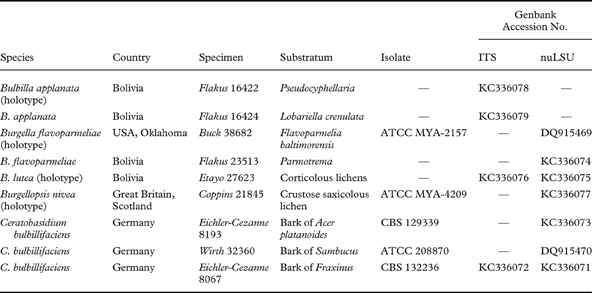
The nuLSU dataset consisted of sequences obtained from all specimens except the two Bolivian specimens of Bulbilla applanata (Flakus 16422, 16424), sequences from a nuLSU alignment of sclerotial and bulbil-forming lichenicolous members of the Cantharellales published previously (Lawrey et al. Reference Lawrey, Binder, Diederich, Molina, Sikaroodi and Ertz2007), and those downloaded from GenBank. GenBank sequences were obtained following BLAST searches using as queries the new sequences of Burgella-like specimens and excluding sequences of uncultured/environmental samples. After retrieval, duplicated sequences were identified in BioEdit 7.1.5 (Hall Reference Hall2007) and deleted. The final nuLSU dataset contained 62 ingroup terminals and sequences from Basidiodendron caesiocinereum, Exidia glandulosa, Pseudohydnum gelatinosum, Tilletiaria anomala and Platygloea disciformis were used as an outgroup (GenBank accession numbers in Table 1 for new sequences and Fig. 1 for published sequences).
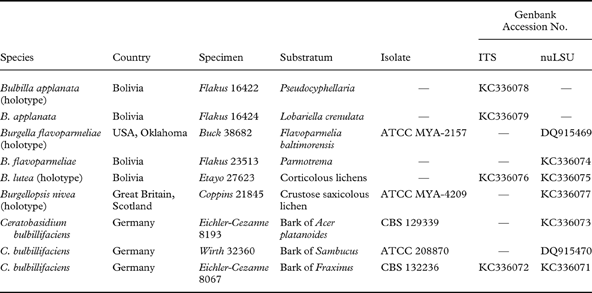
Specimens and newly acquired cultures and sequences featured in the study
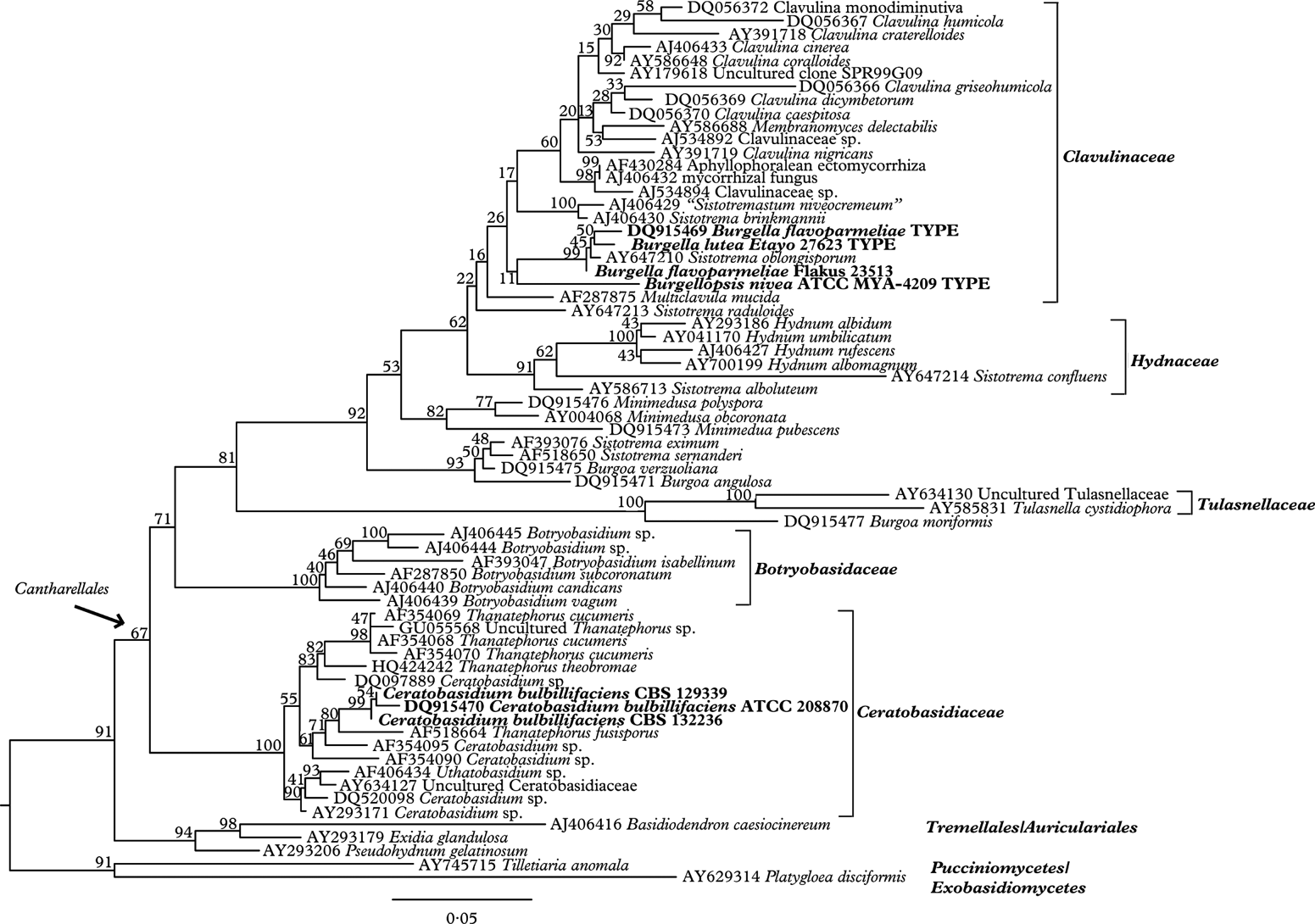
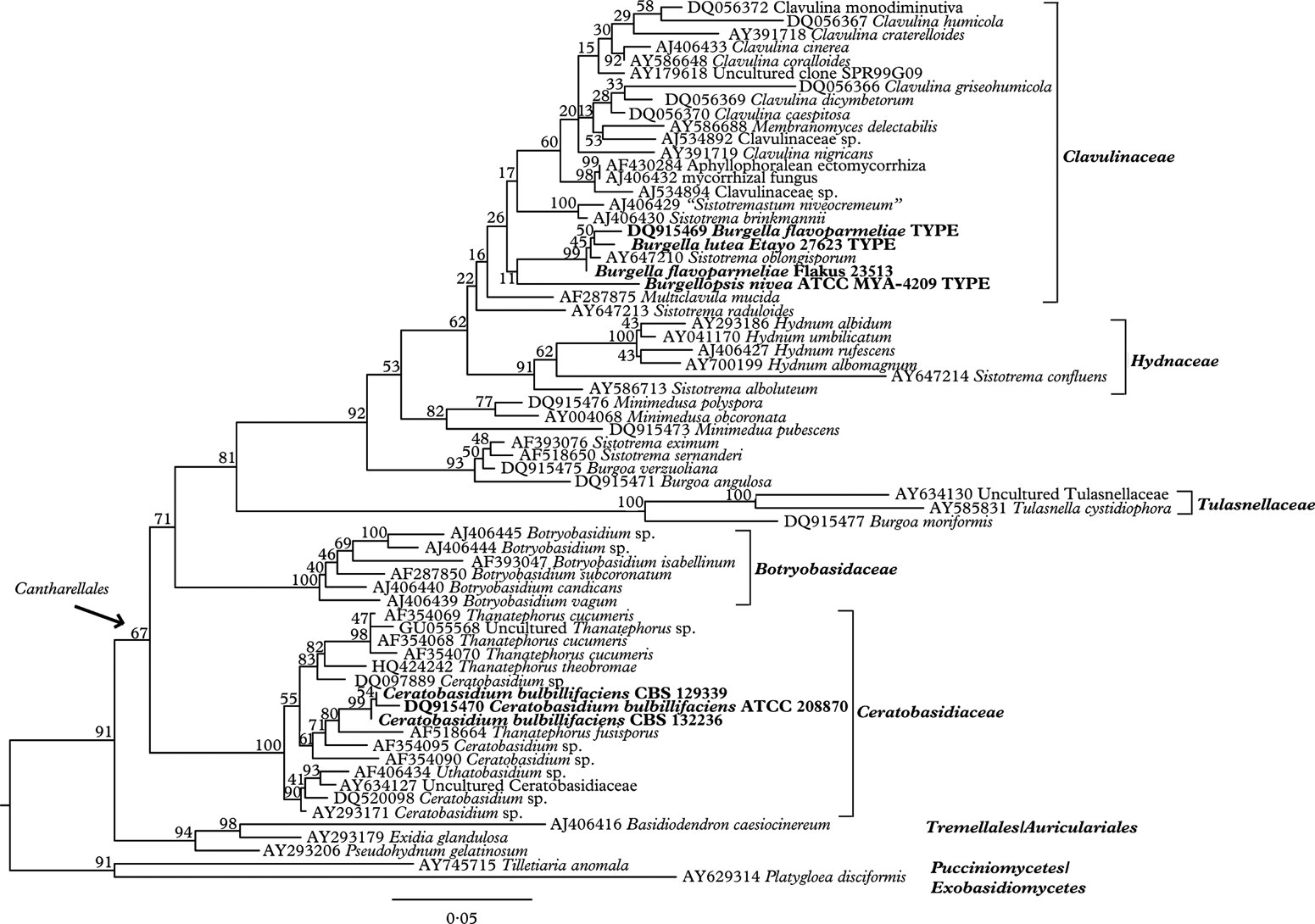
Best-scoring maximum-likelihood tree of the nuLSU alignment of selected Cantharellales including new bulbil-forming Burgella, Burgellopsis and Ceratobasidium species. Scale indicates expected substitutions per site, and numbers at nodes are bootstrap values based on 500 replicates. GenBank accession numbers for sequences obtained in this study (in bold) are provided in Table 1.
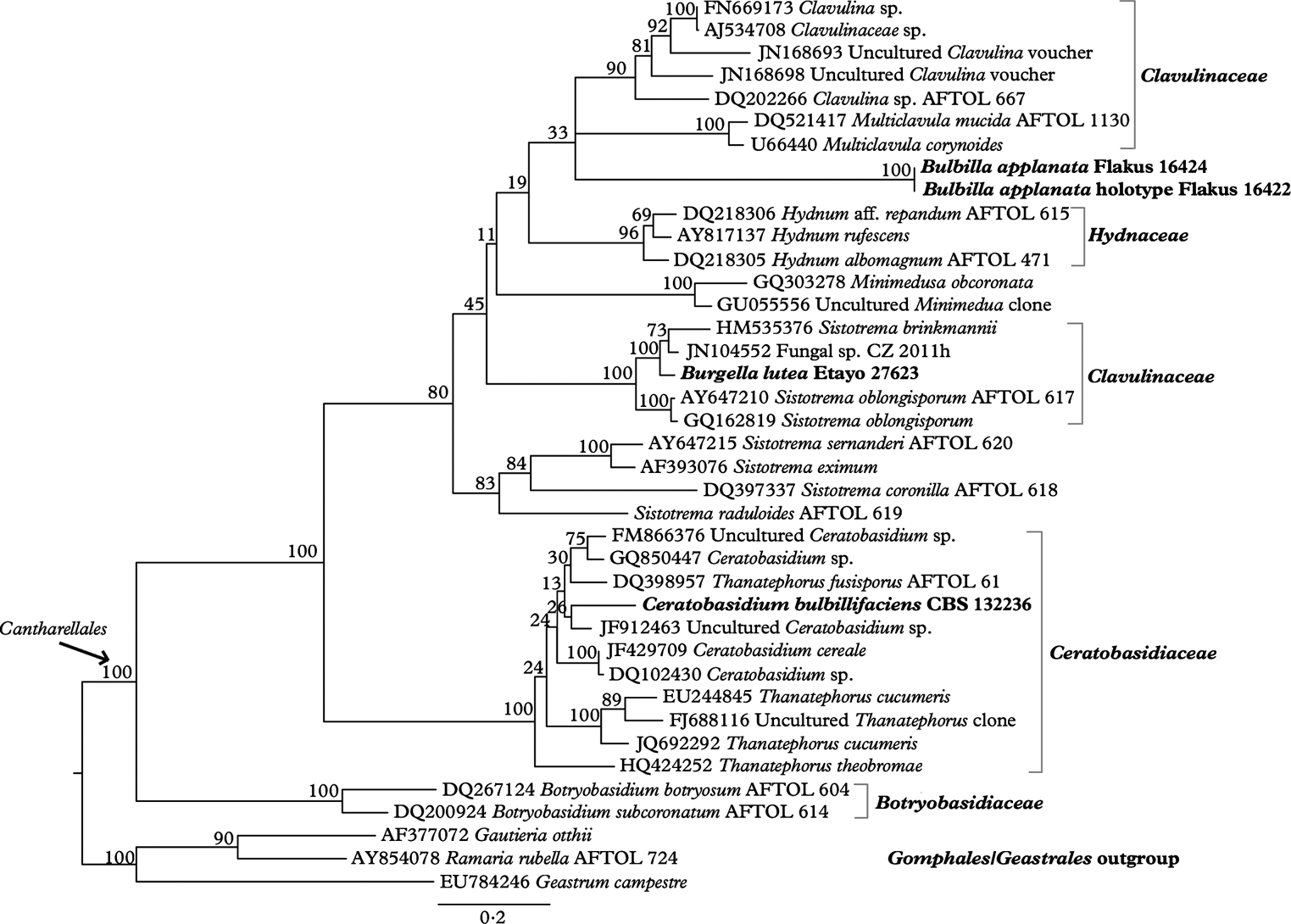
ITS sequences from Burgella lutea, the two Bolivian specimens of Bulbilla applanata obtained by 454 pyrosequencing, and two bulbil-forming specimens of Ceratobasidium bulbillifaciens from Germany were added to those from GenBank, representing most families of the Cantharellales. BLAST searches were carried out using ITS of Ceratobasidium bulbillifaciens and the Burgella-like specimens as query sequences, and excluding sequences of uncultured/environmental samples. In a preliminary alignment of the ITS sequences representing identified members of the Ceratobasidiaceae, it was discovered that most were duplicates, and so all but one of these were deleted from the final dataset. ITS sequences of Cantharellus spp. and members of the Tulasnellaceae proved to be unusually difficult to align and were dropped from the dataset. BLAST searches of Bulbilla applanata sequences obtained by 454 pyrosequencing (Bolivian specimens Flakus 16422, 16424) indicated they were members of the Cantharellales but not similar to Burgella species in our dataset, so the closest ITS sequences from BLAST searches were added to the dataset, the final version of which contained 36 ingroup terminals, with sequences of Gauthierea otthii, Ramaria rubella and Geastrum campestre used as an outgroup (GenBank accession numbers in Table 1 for new sequences and Fig. 2 for published sequences).
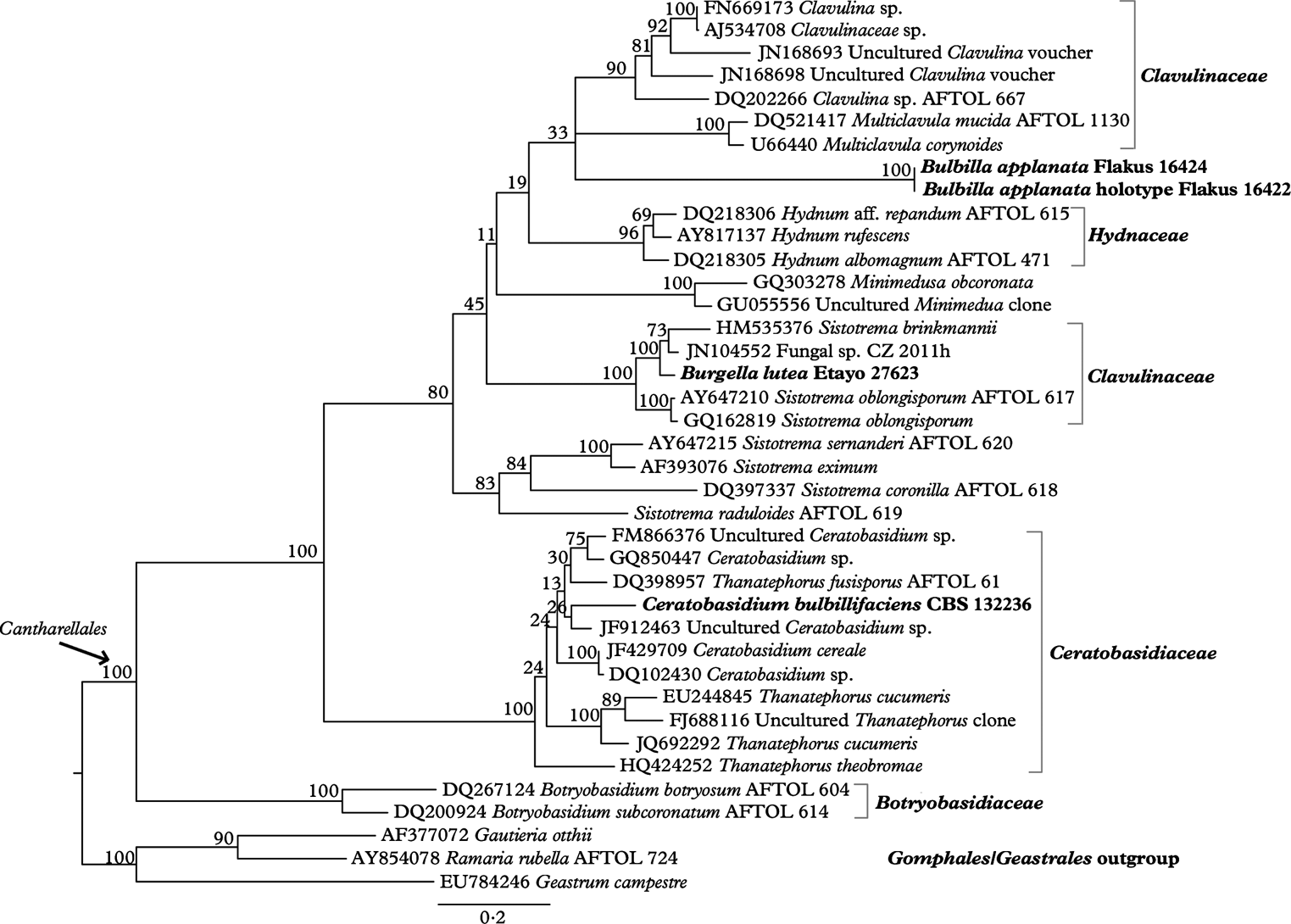
Best-scoring maximum-likelihood tree of the ITS alignment of selected Cantharellales including new bulbil-forming Bulbilla, Burgella and Ceratobasidium species. Scale indicates expected substitutions per site, and numbers at nodes are bootstrap values based on 500 replicates. GenBank accession numbers for sequences obtained in this study (in bold) are provided in Table 1.
Sequences were arranged into multiple sequence alignments for each gene using BioEdit 7.1.5 (Hall Reference Hall2007) and automatically aligned with MAFFT 6.850b using the --auto option (Katoh & Toh Reference Katoh and Toh2005, Reference Katoh and Toh2010). The individual nuLSU and ITS alignments were subjected to analysis of ambiguously aligned regions using the GUIDANCE webserver (Penn et al. Reference Penn, Privman, Ashkenazy, Landan, Graur and Pupko2010a , Reference Penn, Privman, Landan, Graur and Pupko b ) and introns and regions aligned with low confidence, particularly in the ITS, were removed. This resulted in an alignment length of 985 for the nuLSU and 1130 for the ITS. The two datasets contained sequences representing different species and specimens and were therefore analyzed separately. The alignments were subjected to maximum likelihood (ML) searches using RAxML 7.2.6 (Stamatakis et al. Reference Stamatakis, Ludwig and Meier2005; Stamatakis Reference Stamatakis2006), with parametric bootstrapping using 500 replicates under the GTRGAMMA model.
Results
Phylogenetic analyses
The best-scoring nuLSU ML tree indicated a monophyletic but weakly-supported Cantharellales with bulbil-forming species represented in two clades (Fig. 1). Sequences representing the new species Ceratobasidium bulbillifaciens were recovered in a strongly supported clade that includes Thanatephorus fusisporus as its closest relative and two unidentified Ceratobasidium species. The new Burgella lutea was recovered in a strongly-supported clade containing two separate sequences of Burgella flavoparmeliae, the type from the USA and another from Bolivia, and a sequence of Sistotrema oblongisporum. This clade was sister to another new species, Burgellopsis nivea, but without support, and the entire Burgella + Burgellopsis clade was sister to another, consisting of Sistotrema brinkmannii and a sequence labelled “Sistotremastum niveocremeum” (probably misidentified, but correct identification unknown, see Moncalvo et al. Reference Moncalvo, Nilsson, Koster, Dunham, Bernauer, Matheny, Porter, Margaritescu, Weiss and Garnica2006) and a much larger, weakly supported assemblage representing the Clavulinaceae. The nuLSU alignment contained relatively few ambiguous regions (overall GUIDANCE alignment score=0·9656), and support for the backbone of the tree is moderately strong, but since our alignment was designed to emphasize mainly the groups known to harbour our specimens, support for other groups tended to be weaker.
The best-scoring ITS ML tree (Fig. 2) indicated a well-supported Cantharellales with bulbil-forming specimens observed in the same clades as in the nuLSU tree, but with weaker support. A single sequence representing Ceratobasidium bulbillifaciens (Eichler-Cezanne 8067) was recovered in the Ceratobasidiaceae, but another sequence (Eichler-Cezanne 8193) proved to be too short to be reliably placed phylogenetically. The new species Burgella lutea was recovered in a weakly supported clade containing members of Sistotrema s. lat., and the new genus and species Bulbilla applanata (represented by ITS only) was recovered in a poorly-supported polytomy containing members of the Clavulinaceae, Multiclavula spp. and Hydnum spp. The highly length-variable ITS1 and ITS2 regions may be partly responsible for this uncertainty (overall GUIDANCE alignment score=0·7056), but these same groups were also not well resolved in the nuLSU tree.
Discussion
Phylogenetic analysis of nuLSU sequences (Fig. 1) places a Bolivian specimen developing on Parmotrema (Flakus 23513), morphologically similar to the lichenicolous Burgella flavoparmeliae (described from Flavoparmelia), as sister to the type of B. flavoparmeliae, suggesting that both specimens are either conspecific or represent two closely related species. These two sequences, together with Sistotrema oblongisporum and the new Burgella lutea, form a strongly supported clade. Bulbils of both species of Burgella are ochraceous or yellow-coloured and in microscopical preparations, orange lipid droplets emerge from cells, especially when examined in LCB, and these might be responsible for the bulbil colour. Basidiomata of Sistotrema oblongisporum, on the contrary, are greyish white, without any yellowish tinge. Moncalvo et al. (Reference Moncalvo, Nilsson, Koster, Dunham, Bernauer, Matheny, Porter, Margaritescu, Weiss and Garnica2006) have shown that Sistotrema is a polyphyletic complex of morphologically similar wood saprophytes that need further study. The type species, S. confluens, is more closely related to Hydnum than to most other Sistotrema species, and therefore major nomenclatural changes will be needed in this group. Although our phylogenetic results suggest that S. oblongisporum belongs to Burgella, we do not formally combine the species in that genus, leaving such a decision for future studies focusing on the entire genus Sistotrema.
The new Burgellopsis nivea is sister to the Burgella clade, but with low support. Bulbils are pure white and no yellowish lipid drops are visible under microscopical examination, unlike in species of Burgella. Consequently, a new genus, Burgellopsis, is described for this species.
From a rather common lichenicolous, bulbil-forming species developing over Peltigerales in South America that we describe as the new Bulbilla applanata, no cultures and no nuLSU sequences could be obtained. Instead, short ITS sequences obtained from two specimens by 454 pyrosequencing, and a phylogenetic analysis of these (Fig. 2), clearly places them within Cantharellales, but not close to any other species. A more accurate phylogenetic placement will require additional genes to be sequenced. As the species is morphologically distinct from all other bulbil-forming genera of Cantharellales, the new species is therefore included in a new genus Bulbilla.
An undescribed bulbil-forming species clustering with Ceratobasidium was studied by Lawrey et al. (Reference Lawrey, Binder, Diederich, Molina, Sikaroodi and Ertz2007). Our new phylogenetic analyses, including sequences from three specimens (Figs 1 & 2), confirm that the species, here newly described as Ceratobasidium bulbillifaciens, belongs to the Ceratobasidium-Thanatephorus complex, which initially included Ceratobasidium D. P. Rogers, Thanatephorus Donk and Uthatobasidium Donk. These three genera were primarily differentiated on ecological characters, the latter two being morphologically indistinguishable, leading Knudsen & Hansen (Reference Knudsen and Hansen1996) to unite them, with Uthatobasidium becoming a synonym of Thanatephorus. Morphological characters to separate the genus Thanatephorus (including Uthatobasidium) from Ceratobasidium, and also to distinguish individual species, are mainly based on basidiomata, which are unfortunately unknown in the new species. Roberts (Reference Roberts1999) revised the species of Ceratobasidium and Thanatephorus having Rhizoctonia anamorphs and presented modern descriptions of many species. He furthermore explained that the generic type of Ceratobasidium, C. calosporum D. P. Rogers, is morphologically not close to the other species of the genus and possibly not even related to them, but no sequences of this taxon are available yet. In a recent phylogenetic analysis using ITS sequences, Veldre (Reference Veldre2011, fig. 2) showed that the genus Thanatephorus represents a single, well-defined clade, whilst Ceratobasidium species are spread over several clades. Our nuLSU tree (Fig. 1) recovers the Thanatephorus-clade, with the generic type T. cucumeris and T. theobromae, which is sister to a clade comprising the new C. bulbillifaciens, two unidentified Ceratobasidium species and Thanatephorus fusisporus, and these two clades together are sister to another clade including several unidentified sequences labelled Ceratobasidium and Uthatobasidium. Our ITS tree (Fig. 2) presents similar results. Although one of the Thanatephorus species (T. fusisporus) does not group with the generic type T. cucumeris, our results nevertheless suggest that an inclusion of the new species in Ceratobasidium is the best choice.
Following Veldre (Reference Veldre2011), species of the Ceratobasidium-Thanatephorus complex “spend most of their life in morphologically simple asexual stages during which they can only be macroscopically observed as irregular sclerotia less than a centimetre in size”. Sclerotia were mentioned from several species studied by Roberts (Reference Roberts1999), but these are all much bigger than the minuscule bulbils of the new species (up to 0·2 mm diam.). Sclerotia of C. anceps (Bres. & Syd.) H. S. Jacks. are much larger, up to 5 mm diam., cream at first then dark brown; C. bicorne J. Erikss. & Ryvarden develops sclerotia in culture, up to 0·9 mm diam., ‘fulvous to umber’ aggregating into larger clusters; sclerotia of C. cornigerum (Bourdot) D. P. Rogers are pale to brown, 0·5–3·0 mm diam.; sclerotia of C. setariae (Sawada) Oniki et al. are 0·5–2·0 mm diam., composed of subglobose hyphal compartments 13–30 µm diam.; Thanatephorus cucumeris (A. B. Frank) Donk produces sclerotia up to 8 mm diam.; and T. ochraceus (Massee) P. Roberts produces loose, white sclerotia in culture (Roberts Reference Roberts1999).
Taxonomy
Bulbilla applanata Diederich, Flakus & Etayo gen. et sp. nov.
MycoBank Nos.: MB807650 (genus), MB807651 (species)
Characterized by relatively large [200–400(–500) µm diam.], lichenicolous, beige, greyish yellow to greyish orange, translucent, basally constricted, applanate bulbils, internally of adherent polyhedral cells, without clamps.
Type: Bolivia, Dept. La Paz, Prov. Nor Yungas, Coroico village, Yungas montane forest, 16°11′10″S, 67°43′16″W, alt. 1550 m, on epiphytic Pseudocyphellaria, 6 June 2010, A. Flakus 16422 & P. Rodrigues F. (KRAM—holotype; LPB, hb. Diederich—isotypes).
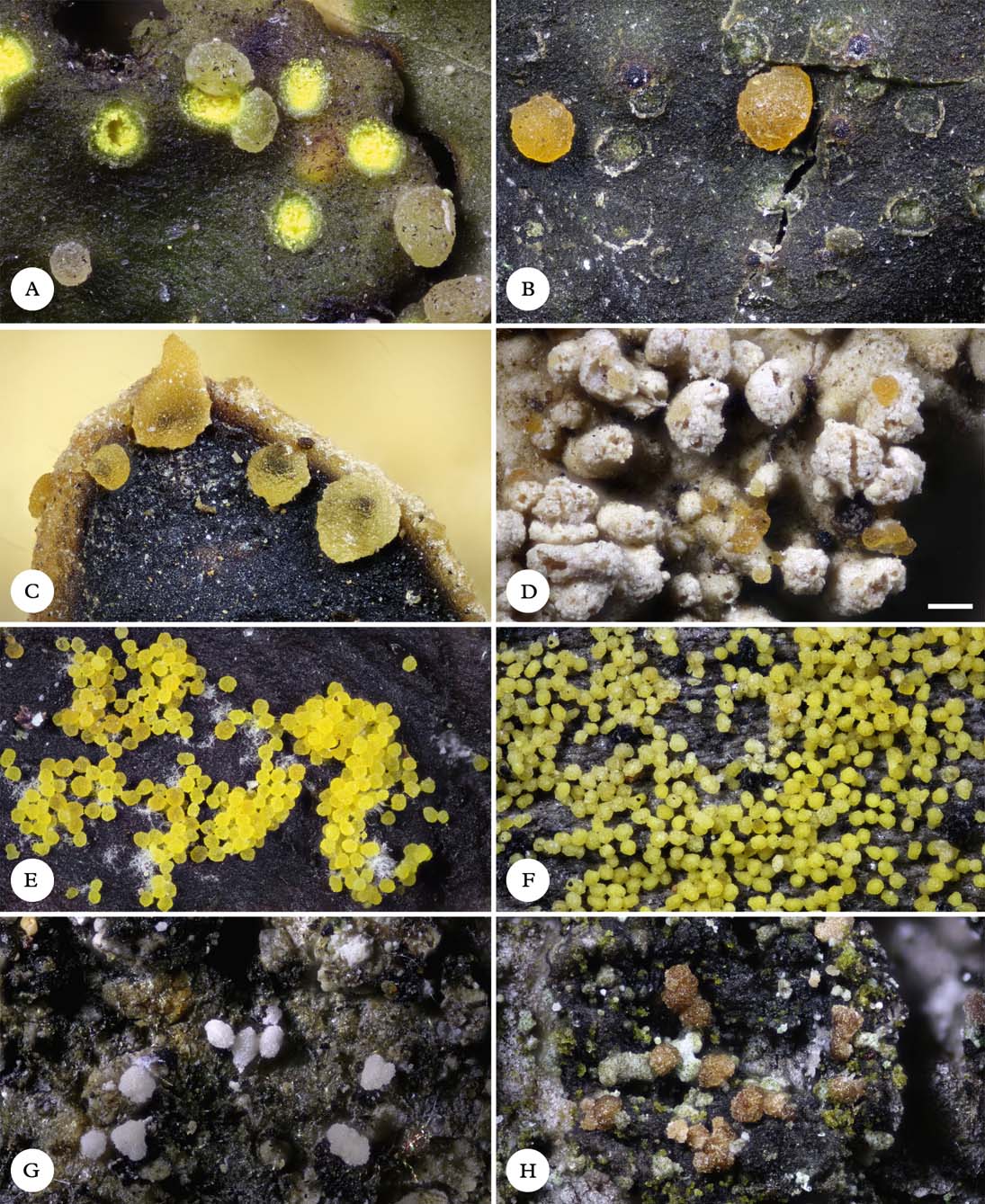
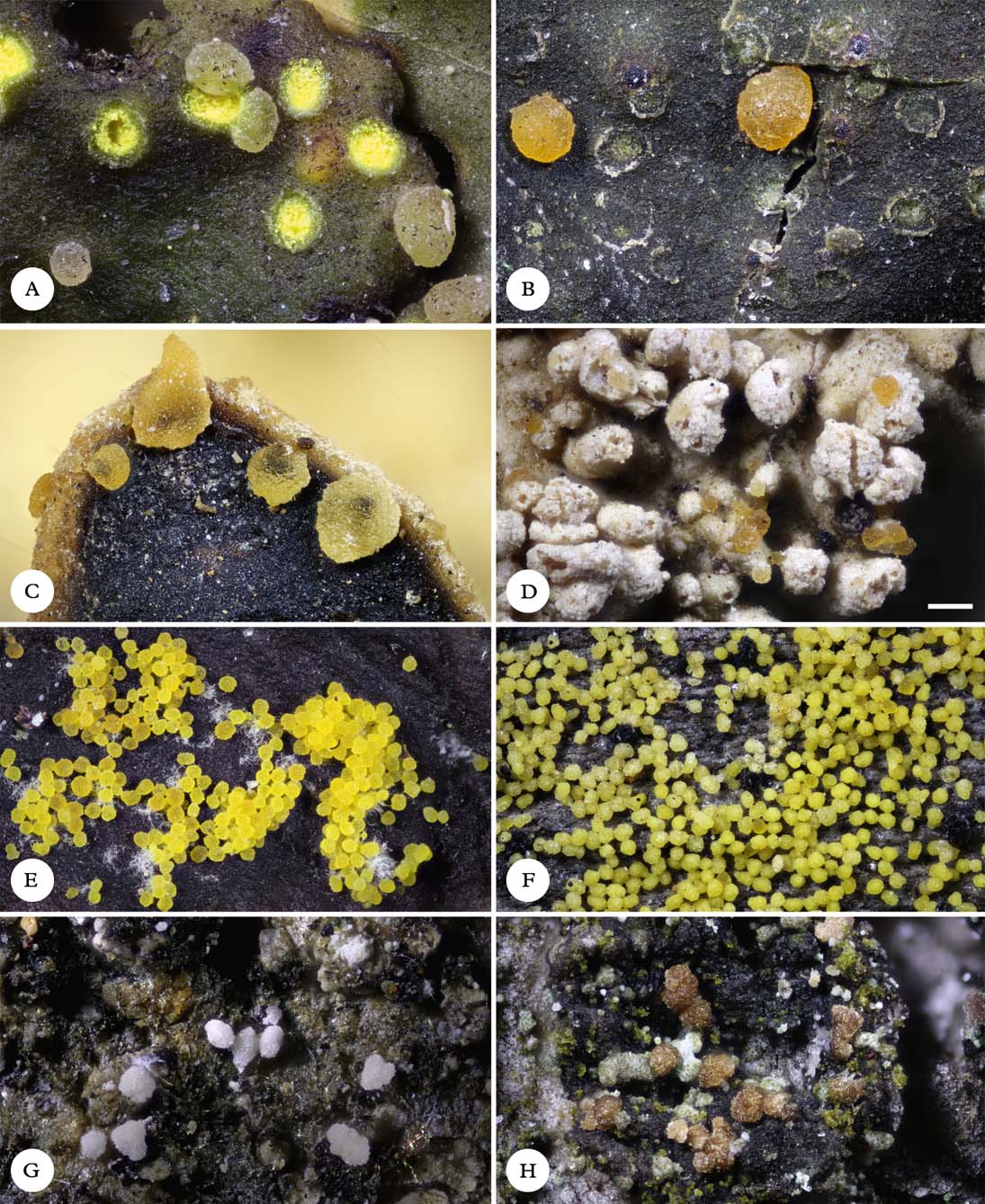
A, Bulbilla applanata on the thallus of Pseudocyphellaria (holotype); B, B. applanata on the thallus of Sticta, leaving distinct scars when removed (Etayo 26437); C, B. applanata on apothecia of Pseudocyphellaria faveolata (Etayo 23562); D, Burgella flavoparmeliae on the thallus of Flavoparmelia baltimorensis (holotype); E, Burgella lutea on the thallus of Sticta (holotype); F, B. lutea on Butia yatay (Capdet & Romero 51690); G, Burgellopsis nivea over sterile, saxicolous lichen (holotype); H, Ceratobasidium bulbillifaciens on dying lichenized crust and young Physcia tenella (holotype). Scale (the same for all photographs)=200 µm.
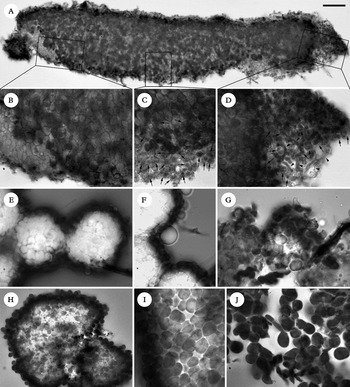
A–D, Bulbilla applanata (holotype) on Pseudocyphellaria; A, section through flattened bulbil in LCB; B–D, details of A at a higher magnification; B, lower part of bulbil not in contact with host, showing polyhedral cells; C, lower part of bulbil in contact with host thallus, showing a mixture of polyhedral cells of bulbil and photobiont cells of host (arrows); D, lower part of bulbil in loose contact with host, showing polyhedral cells of bulbil, photobiont cells (arrows) and host hyphae (arrow heads). E–G, Burgella lutea (holotype); E, bulbils in LCB (only outer parts of bulbils stained), showing ellipsoid cells; F, the same at a higher magnification, showing emerging oil drops and (indistinctly) hyphae with clamps; G, the same bulbils after pressure on cover glass, slightly separating inner, ellipsoid cells. H–J, Burgellopsis nivea (holotype); H, bulbils in LCB, showing subspherical to ellipsoid cells; I, bulbil (surface view) at a higher magnification; J, bulbil after pressure on cover glass, separating inner cells. Scales (the same for all photographs): A, E & H=50 µm; B–D, F, G, I & J=20 µm.

Basidiomata and conidiomata unknown. Colonies appearing as dispersed bulbils overgrowing lichen thalli or more rarely apothecia. Mycelium not observed. Bulbils slightly to distinctly immersed in the host thallus, usually leaving conspicuous scars in the thallus when removed, pale beige, greyish yellow or greyish orange, translucent, and colour consequently varying with the colour of the host thallus, not or faintly shiny, without hairs, roundish to shortly ellipsoid, 200–400(–500) µm diam., sometimes confluent and up to 700 µm, flattened, c. 200 µm tall, basally strongly constricted; bulbils externally without specialized cells, cells in surface view polyhedral, smooth, mainly 5–12 µm diam.; bulbils internally composed of strongly adherent, more or less roundish to ellipsoid or polyhedral cells separating only with difficulty, 4–11(–14) µm diam., clamps not observed; agglomerations of small crystals visible in polarized light present on the bulbil surface in some specimens examined.
Distribution and ecology
This species is known from several South American countries (Bolivia, Chile and Ecuador), where it parasitizes thalli, more rarely apothecia, of large, cyanobacterial macrolichens belonging to the Peltigerales (Lobariella, Peltigera, Pseudocyphellaria, Sticta). Infected thalli often, but not always, change colour (e.g., in the type collection, the brown thallus of Pseudocyphellaria turns dark green, surrounded by a blackish necrotic line), suggesting that the new species may be a virulent parasite on some hosts. This reaction on the host thallus, the observation that bulbils are slightly immersed in the thallus and often (but not always) leave holes when removed, and the host choice suggest a long evolutionary history between the new Bulbilla species and the Peltigerales hosts, and let us speculate that the species is strictly lichenicolous. Thin sections through bulbils reveal at their base a zone mainly composed of Bulbilla cells, intermixed with photobiont cells of the host (Fig. 4A–D), suggesting that some kind of interaction takes place between bulbils and their hosts.
Observations
This species differs from all other known lichenicolous, bulbil-forming basidiomycetes by the particularly large bulbils, typically reaching 400 µm in diam. Bulbils are slightly translucent, show some variability in colour, and are often (but not always) applanate. We hesitated to describe this species, as no cultures could be obtained. However, small ITS sequences obtained by 454 pyrosequencing clearly included the species within the Cantharellales. Our phylogenetic analysis (Fig. 2) did not allow us to recognize the closest relatives of the new species, but clearly excluded it from the genus Burgella. Although no ITS sequences of Burgoa species are available, the closest relatives of the generic type Burgoa verzuoliana, viz. Sistotrema eximum and S. sernanderi (see Fig. 1), are only distantly related to the new species (Fig. 2). Similarly, no ITS sequences of Minimedusa are available, but these species strongly differ morphologically from the new species (Diederich & Lawrey Reference Diederich and Lawrey2007). Consequently, a new genus Bulbilla is described to accommodate this characteristic species.
Additional specimens examined. Bolivia: Same locality as type, on epiphytic Lobariella crenulata, Flakus 16424 & Rodriguez F. (LPB, hb. Flakus).—Chile: Región de Los Lagos: Valdivia, P. N. Vicente Pérez Rosales, subida al volcán Osorno, bosque de grandes Nothofagus dombeyi, 41°07′59″S, 72°32′18″W, alt. 920–980 m, on Nothofagus, on Pseudocyphellaria faveolata, 2006, Etayo 23562 (hb. Etayo).—Ecuador: Prov. Loja: Parque Nacional Podocarpus, on Peltigera, 1999, Palice 3166 (hb. Palice, hb. Etayo 23468). Prov. Tungurahua: entre Pondoa y Tungurahua, bosque nublado, alt. 2400–3800 m, on Peltigera, 1999, Etayo 25914 & Palice (hb. Etayo); Río Verde (c. 13 km E of Baños), descent waterfalls at the confluence of Río Pastaza and Río Verde (Pailón del Diablo), 2°24′03″S, 78°17′43″W, on Sticta, 2003, Etayo & Palice 8564 (hb. Palice, hb. Etayo). Prov. Zamora-Chinchipe: N.R. of Estación Científica San Francisco, S of road Loja-Zamora, primary montane forest on steep slope, c. 40 km from Loja, 3°58′S, 79°04″W, 1945 m, on Hyeronima asperifolia, on Lobariella crenulata, 2004, Sipman 52521 (B, hb. Etayo).
Burgella flavoparmeliae Diederich & Lawrey
Mycol. Progress 6: 64 (Reference Diederich and Lawrey2007).
(Fig. 3D)
This species was originally described from three specimens from the USA on Flavoparmelia baltimorensis (Diederich & Lawrey Reference Diederich and Lawrey2007). Here we report morphologically similar populations from South America growing on another host genus, Parmotrema. Sequences from bulbils on both hosts group together in our phylogeny (Fig. 1), but they form two rather long branches on a short, unsupported branch, leaving some doubt as to whether they are really conspecific. Due to the similar morphology, we provisionally include the material on Parmotrema in Burgella flavoparmeliae, awaiting additional populations on both hosts being sequenced. It is interesting to note that Flavoparmelia belongs to the Parmotrema clade in a recent molecular phylogeny of parmelioid genera (Crespo et al. Reference Crespo, Kauff, Divakar, del Prado, Pérez-Ortega, Amo de Paz, Ferencova, Blanco, Roca-Valiente and Núñez-Zapata2010).
Specimens examined. Bolivia: Dept. La Paz: Prov. Franz Tamayo, between Apolo and Mapiri villages, 13 km from Apolo, 14°50′51″S, 68°21′38″W, 1530 m, savannah with scattered trees and shrubs, along stream, on Parmotrema sp., 2011, Flakus 23037 & Kukwa (BR, KRAM, LPB, hb. Flakus). Dept. Santa Cruz: Prov. Cordillera, between Tucavaca and Roboré, 18°36′11″S, 59°53′06″W, 320 m, transition between Chaqueño and Chiquitano forests, on thallus of Parmotrema sp., 2011, Flakus 23513 & Kukwa (KRAM, LPB, BR). Dept. Tarija: Prov. O'Connor, Lomas de Soledad, road between Entre Ríos and Chiquiacá, 21°39′38″S, 64°07′31″W, 1670 m, Tucumano-Boliviano altimontano forest, on Parmotrema sp., 2012, Etayo 28110, Flakus & Kukwa (LPB, hb. Etayo).—Ecuador: Imbabura: Otavalo, Reserva bosque nublado INTAG, La Delicia, bosque nublado, 2700 m, con Gunnera y helechos arborescentes, on Parmotrema, 2003, Etayo 25640 & Palice (hb. Etayo).
Burgella lutea Diederich, Capdet, A. I. Romero & Etayo sp. nov.
MycoBank No.: MB807652
Characterized by superficial, yellow to orange-yellow, roundish bulbils 50–80 µm diam., internally of adherent polyhedral cells, clamps in mycelium present, in bulbils unknown.
Type: Bolivia, Dept. La Paz, Prov. Franz Tamayo, near Apolo village, small valley amongst meadows, 14°50′15″S, 68°26′58″W, alt. 1430 m, pre-Andean Amazon forest, on corticolous lichens, 17 May 2011, J. Etayo 27623, A. Flakus, M. Kukwa & U. Schiefelbein (LPB—holotype; hb. Etayo, hb. Diederich—isotypes).
Basidiomata and conidiomata unknown. Colonies appearing as dispersed or agglomerated bulbils overgrowing lichen thalli, ascomycete perithecia or rotten woody parts of palms. Mycelium superficial, 3·0–3·5 µm thick, with clamps. Bulbils superficial, yellow to orange-yellow (Kornerup & Wanscher Reference Kornerup and Wanscher1984: 3A5–8, 4A6–8; colours based on dry herbarium material), without hairs, surface at a high magnification (×50) rather rough, with individual convex cells slightly distinguishable, slightly shiny, roundish to shortly ellipsoid, 50–80 µm diam.; bulbils externally without specialized cells, cells in surface view polyhedral, smooth, mainly 7–15 µm diam.; bulbils internally composed of strongly adherent, more or less roundish to ellipsoid or polyhedral cells, 7–15 µm diam., clamps not observed; large, orange-coloured oil drops are present in these cells and emerge from them when examined in lactophenol cotton blue; no crystals visible in polarized light.
Distribution and ecology
This species is known from Argentina and Bolivia. In the type collection (Bolivia), it develops over contiguous corticolous thalli of Sticta weigelii, Heterodermia sp., cf. Pertusaria sp. (sterile, without soralia or isidia), or directly on the supporting bark, where bulbils probably spread from the nearest infected lichen thalli. Infected portions of Sticta weigelii are darker brown, partly with a superficial mycelium, but it is not known if these necrotic areas are caused by the fungus, or if bulbils preferably colonize dying parts of the host. On Heterodermia also, only brown dying parts of the host are covered by bulbils. The cf. Pertusaria thallus is not visibly damaged. No scars are left on the host thalli. In a second Bolivian locality, the species grows over Hypotrachyna. The Argentinian material is not associated with lichens: bulbils densely cover the rotten fallen foliar rachis and spathe of Butia yatay and also the ascomycete Cannonia australis developing on the spathe. In all these populations, bulbils are only loosely attached to the substrata, and they are easily removed using a dissecting needle. No visible interactions between bulbils and hosts could be detected. As the new species has repeatedly been observed overgrowing lichen thalli, but also ascomata of a pyrenomycete and rotten parts of plants, it may be considered as facultatively lichenicolous or fungicolous.
Observations
The new species is well characterized by the abundant, yellow to orange-yellow bulbils, 50–80 µm diam., covering the substratum. Phylogenetically, it is very close to the generic type Burgella flavoparmeliae, with which it shares most morphological and anatomical characters, including the orange oil drops present in the cells. Burgella flavoparmeliae differs in the slightly larger (60–110 µm diam.), honey-coloured bulbils that appear to be strictly lichenicolous over parmelioid lichens, on the thallus of which they leave distinct scar-like holes when removed. In the type collection of B. lutea, a second, unidentified bulbil-forming species is present, but is readily distinguished by the pale, almost translucent bulbils developing over the bark. Bulbils in three-year old herbarium specimens of the non-lichenicolous Argentinian material are more matt and light yellow than those of the holotype (Fig. 3E & F), but the original colour of fresh material was deep yellow to orange-yellow; otherwise they are almost identical, morphologically and anatomically. Unfortunately, no sequences could be obtained from those populations.
Additional specimens examined. Argentina: Prov. Entre Ríos: Dept. Colón, Parque Nacional El Palmar, Sendero Yatay, 31°53′24″S, 58°14′35″W, on spathe of Butia yatay and on Cannonia australis, 2009, Capdet & Romero 51690 (BAFC 51690; hb. Diederich); ibid., El Mollar, 31°51′45″S, 58°12′44″W, on foliar rachis of Butia yatay, 2009, Capdet & Romero 51689 (BAFC 51689; hb. Diederich).—Bolivia: Dept. La Paz: Prov. Nor Yungas, P. N. y A. N. M. I. Cotapata, between Tunkini and Chairo villages, above Tunkini, near Biological Station, 16°11′S, 67°52′W, 1300–1600 m, Yungas montane forest, on Hypotrachyna, 2011, Etayo 27717, Flakus, Kuwka, Plata & Schiefelbein (LPB, hb. Etayo).
Burgellopsis nivea Diederich & Lawrey gen. et sp. nov.
MycoBank Nos.: MB807653 (genus), MB807654 (species)
Characterized by superficial, white, roundish to irregular bulbils 100–220 µm diam., internally of indistinctly catenate, roundish to polyhedral cells, clamps absent.
Type: Great Britain, Scotland, VC 82, East Lothian, Lammermuir Hills, Lamb Burn, on small stone in scree, over sterile, sorediate, crustose lichen, 36(NT)604·630, alt. 350 m, 6 April 2006, A. M. & B. J. Coppins 21845 (E—holotype). Ex-type culture: ATCC MYA-4209.
Basidiomata and conidiomata unknown. Colonies appearing as dispersed bulbils overgrowing lichen thalli. Mycelium not observed. Bulbils superficial, white, without hairs, surface at a high magnification (×50) rather rough, with individual convex cells slightly distinguishable, slightly shiny, roundish to shortly ellipsoid or rarely irregular in form, 100–220 µm diam.; bulbils externally without specialized cells, cells in surface view polyhedral, smooth, mainly 8–15 µm diam.; bulbils internally composed of indistinctly catenate, more or less roundish to ellipsoid or polyhedral cells, 8–15 µm diam., clamps not observed; no oil droplets emerging from cells when observed in lactophenol cotton blue; no crystals visible in polarized light. Colonies on agar plates showing white aerial hyphae; bulbils not observed.
Distribution and ecology
As the new species is known only from the type specimen from Scotland, little is known about its biology and its trophic stages. Most bulbils develop over the thallus of a sterile, sorediate saxicolous lichen, whilst some are found between thalline squamules. They are rather loosely attached to the substratum and can easily be removed using a dissecting needle. No visible interactions between bulbils and hosts could be detected. Therefore, the species might be considered as facultatively lichenicolous, without causing any visible damage to the host.
Observations
In our phylogenetic analysis (Fig. 1), this species is sister to the clade containing Burgella, but with low support. It differs from the generic type Burgella flavoparmeliae and also from B. lutea by the absence of any yellowish or ochraceous pigments, the absence of yellow oil drops emerging from cells in microscopical preparations, and by the distinctly larger bulbils (60–110 µm in B. flavoparmeliae and 50–80 µm in B. lutea). As the new species is genetically rather distant from Burgella (long, unsupported branch in LSU analysis, Fig. 1), and shows clear morphological differences to the two Burgella species, it cannot be included in that genus. Burgoa angulosa Diederich et al., a species also producing white bulbils, differs by the more irregular, often angulose bulbils, and anatomically by the distinctly catenate arrangement of cells and the presence of clamps. Two of the three known Minimedusa species differ morphologically by the conical outer cells of the bulbils. Both Burgoa and Minimedusa species are only distantly related to the new species in our phylogenetic analysis (Fig. 1). The new genus Bulbilla strongly differs morphologically from the new Burgellopsis nivea (bulbils larger, differently coloured, translucent); furthermore, the closest relatives of B. nivea in our analysis of LSU sequences (Fig. 1) are Burgella species, and the generic type Burgella lutea does not group with Bulbilla applanata in our analysis of ITS sequences (Fig. 2). Consequently, a new genus, Burgellopsis, has to be described to accommodate the new species B. nivea.
Ceratobasidium bulbillifaciens Diederich & Lawrey sp. nov.
MycoBank No.: MB807655
Characterized by superficial, greyish yellow to dark brown, matt, roundish bulbils 100–200 µm diam., internally of branched chains of subspherical to elongate cells, clamps absent.
Type: Germany, Hessen, GieÞen, Parkplatz bei Sporthalle im Süden von Heuchelheim, alt. 155 m, on Acer platanoides, on unidentified, dying lichenized crust, also on young thalli of Physcia tenella, 6 September 2010, R. Cezanne & M. Eichler 8193 (BR—holotype; hb. Diederich—isotype). Ex-type culture: CBS 129339.
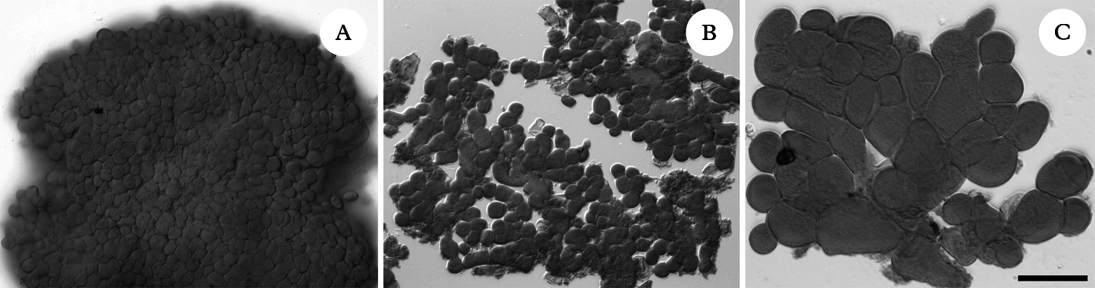
(Figs 3H, 5; figs 3d and 4c in Diederich & Lawrey Reference Diederich and Lawrey2007)
Ceratobasidium bulbillifaciens (holotype); A, bulbil in a KOH-Congo Red-Phloxine mixture, showing subspherical outer cells; B, the same, after pressure on cover glass, showing catenate, ellipsoid cells; C, the same, at a higher magnification. Scales (the same for all photographs): A & B=50 µm; C=20 µm.
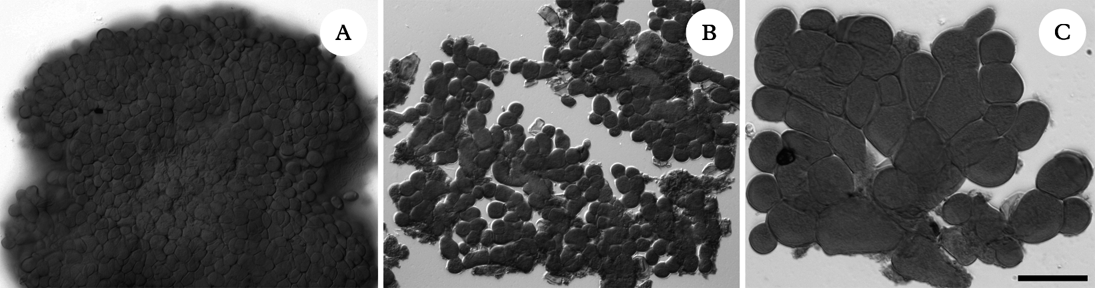
Basidiomata and conidiomata unknown. Colonies appearing as dispersed bulbils growing over or between corticolous lichen thalli. Mycelium not observed. Bulbils superficial, dispersed, roundish to shortly ellipsoid, greyish yellow when young (Kornerup & Wanscher Reference Kornerup and Wanscher1984: 4B3–5B4), brown when mature (6D6–7E8), dark brown when old (7F6) (colour ±unchanged in old herbarium specimens), matt, not translucent, without hairs, 100–200 µm diam.; bulbils externally without specialized cells; bulbils internally composed of branched chains of subspherical to elongate, hyaline cells, 7–23×6–10 µm, septa without clamps, crystals absent in polarized light. Colonies on agar plates showing white aerial hyphae; bulbils not observed; hyphae hyaline, septate, straight, rarely branched or anastomosed, 3·5–4·5 µm thick; septa without clamp connections.
Distribution and ecology
This species is widespread in Europe and is known from Belgium, France, Germany, Luxembourg, the Netherlands and Sweden. Bulbils develop over or between lichen thalli, frequently on unidentified, lichenized crusts, not visibly damaging the lichen thalli, usually in Xanthorion communities. Most specimens have been collected on the bark of various trees, but one, from the Netherlands, was growing over concrete. Owing to the inconspicuous colour of the small bulbils, the species is difficult to recognize in the field. Therefore, it is surely much more common than the specimens examined might suggest. In all these populations, bulbils are only loosely attached to the substratum, and they are easily removed using a dissecting needle. No visible interactions between bulbils and hosts could be detected. As the new species has repeatedly been observed overgrowing lichen thalli, it may be considered as facultatively lichenicolous.
Observations
Lawrey et al. (Reference Lawrey, Binder, Diederich, Molina, Sikaroodi and Ertz2007) included sequences of one specimen of this species in a phylogenetic analysis of bulbil-forming fungi and found it belongs to the subclade of the Cantharellales containing Ceratobasidium and Thanatephorus (i.e. the Ceratobasidiaceae). Diederich & Lawrey (Reference Diederich and Lawrey2007) provided a description and illustrations of the species, without naming it. As more specimens became available in the meantime, and especially as sequences of two additional specimens could be obtained, we decided to formally describe the species here.
The species is characterized by small, brown, dispersed bulbils, less than 200 µm diam., internally composed of branched chains of subspherical to elongate, hyaline cells, and by the absence of clamps. Bulbils of Bulbilla, Burgella, Burgellopsis, Burgoa and Minimedusa species are internally composed of polyhedral, subspherical or elongate cells, rarely of branched chains of cells (Burgoa moriformis), and clamps are always present in these species. The species should not be confused with sclerotia of Athelia arachnoidea, which are typically much larger, over 500 µm diam., and often associated with a superficial white mycelium or thin, resupinate basidiomata.
Additional specimens examined (if not otherwise indicated, on unidentified, lichenized crusts). Belgium: Meise, National Plantentuin, on ×Chitalpa tashkentensis, xi 2011, Van den Broeck s. n. (BR).—France: Pyrénées-Orientales: Targassonne, Chaos de Targassonne, on Populus, on Phaeophyscia orbicularis, 1985, Diederich 6561 (hb. Diederich).—Germany: Baden: Oberrhein, Kleinkems, Gewann Kroatenschanze, on Sambucus, 1998, Wirth 32360 (STU-Wirth; specimen lost?; culture ATCC 208870). Hessen: Allmendfeld, Freifläche vor dem Bürgerhaus (TK 6217-1), on Acer platanoides, 2012, Cezanne & Eichler 8680 (hb. Diederich). Bayern: Spessart, Südrand von Röllbach (TK 6221-1), on Fraxinus, 2010, Cezanne & Eichler 8067 (hb. Cezanne-Eichler, hb. Diederich; culture CBS 132236).—Luxembourg: W of Schengen, Grouf, on Populus, over Candelariella reflexa, C. xanthostigma and Phaeophyscia orbicularis and on bark, 1987, Diederich 8442 (hb. Diederich); ibid., 1997, Diederich 13475 (hb. Diederich).—The Netherlands: Friesland: Schiermonnikoog, W side of the village, on Ulmus, 1996, Aptroot 40082 (M–6826). Noord-Brabant: SW of Greveschutven, fish-nursery, concrete of diver, 1997, van den Boom 19742 (hb. van den Boom); SW of Leende, S of Molenheide, on Sambucus, on X. parietina, 2006, van den Boom 37312 (hb. van den Boom).—Sweden: Jämtland: Brunflo par., Torvalla, on Salix caprea, 1948, Santesson 48.502 (d) (UPS).
We would like to thank the curators of herbaria and the collectors enumerated under Material and Methods for the loan of specimens, the Director of Herbario Nacional de Bolivia, Instituto de Ecología, Universidad Mayor de San Andrés, La Paz, for cooperation, and two anonymous referees for useful comments. Sequencing was partially supported by grant DEB 0841405 from the National Science Foundation (USA), and fieldwork was partially supported by grant NCBiR 92/L–1/09 under the LIDER Programme (Poland). In regard to M. Capdet, S. Pereira and A. I. Romero, this is publication No 194 of the PRHIDEB–PROPLAME-CONICET.