

Introduction
This paper discusses the workforce implications for adult social care providers of an increase in the use of personal budgets (PBs). PBs are user-controlled budgets provided to service users for the purchase of social care support. The term PBs is used as an umbrella term, encompassing direct payments (DPs), In Control allocations and individual budgets (IBs). Whilst PBs have been taken up so far by a minority of social care users and for a narrow range of services, this is likely to change dramatically following their roll-out throughout England (HM Government, 2007).
Local authorities (LAs) have shaped the practice of many social care providers through their large-scale purchasing and reliance on care managers to arrange support on behalf of service users. The new policy landscape, in which service users’ priorities are likely to exert more direct influence on demand, could radically alter the structure of the market and drive the subsequent development of providers. While many PB users to date have opted to purchase support directly from personal assistants (PAs), it is likely that, as PBs are rolled out, more (especially older) people will use them to purchase support from provider organisations, either directly, or indirectly through budgets held by a care manager. Many self-funders also purchase support from care agencies. Thus, provider organisations will retain a significant role in the provision of support for many service users.
The paper begins with an outline of the policy background, followed by a description of the two studies on which the paper draws, and their methods. The findings are then presented under four headings: financial and workforce planning, the impact of PBs on recruitment and retention, workforce training and service user/provider relationships. The paper concludes with a discussion.
Policy background
The market for social care support, and the supply side of the home care market in particular, has seen enormous changes since the community care reforms of the early 1990s. While the size and structure of the home care provider market is well documented, information about the wider social care market is limited.
LA-run (‘in-house’) services were the main providers of home care in 1992, in contrast to recent figures showing that independent agencies now provide over two thirds of publicly funded home care (Mathew, Reference Mathew2004; Commission for Social Care Inspection, 2006). By 2008, 75 per cent of all home care agencies were privately owned, the vast majority being small-scale enterprises; 58 per cent have fewer than 10 employees and a further 29 per cent have less than 50 (Department of Health, 2009). The proportion of providers reliant on LA business has increased, with many smaller providers dependent entirely on LAs (McClimont and Grove, Reference McClimont and Grove2004).
In 2006–07, spending on home care accounted for 46 per cent of all community services expenditure. Over a million adults and older people were supported at home in 2007–08; the single largest user group was older people (67 per cent of all users), followed by people with physical disabilities (17 per cent) (Commission for Social Care Inspection, 2009).
However, the configuration of the market may change as users of LA-funded social care are given greater opportunities for choice and control over the way their needs are met (Department of Health, 2005, 2006). Since 1997, many service users have had the option to receive their social care in the form of cash DPs rather than as directly provided services, but take-up remains low (7 per cent of net expenditure on community services) (Commission for Social Care Inspection, 2009). Their use is lowest amongst older people and younger adults using mental health services, although the total number of adults and older people using DPs has increased to 55,900 (Commission for Social Care Inspection, 2009). Other methods of giving disabled and older people greater control and independence have also been introduced. The In Control programme (Poll et al., Reference Poll, Duffy, Hatton, Sanderson and Routledge2006) was first set up for people with learning difficulties and, amongst other innovations, permitted greater freedom in the use of user-held budgets than DPs. The In Control blueprint laid the foundations for a more ambitious pilot, between 2005 and 2007, of individual budgets for a wider range of service user groups and other funding streams in addition to the social care budget (Glendinning et al., Reference Glendinning, Challis, Fernandez, Jacobs, Jones, Knapp, Manthorpe, Moran, Netten, Stevens and Wilberforce2008). In 2007, the Government announced the roll-out of personal budgets for everyone eligible for publicly funded adult social care in England (HM Government, 2007).
The IB model can be used as an illustration of how PBs are likely to work. With IBs, service users drafted support plans outlining the way in which they wished to use their allocated budget. They were encouraged to think creatively about the services that best met their support needs, helped by the development of brokerage and specialist support planning services. Budgets were often used for a wider range of support than personal care, for example social and leisure activities such as gym membership; and equipment such as kitchen aids to assist independence in the home. IBs could also be managed in ways other than holding cash budgets. These included provider-held budgets (which enabled users to ‘call off’ services as and when needed) and virtual budgets managed by LA care managers. While many people are likely to take PBs as cash direct payments (67 per cent of IB holders in the national evaluation took their IB in this way (Glendinning et al., Reference Glendinning, Challis, Fernandez, Jacobs, Jones, Knapp, Manthorpe, Moran, Netten, Stevens and Wilberforce2008)), these other mechanisms should enable those who do not want to manage a direct payment nevertheless to have greater control and more flexible support.
The roll-out of personal budgets, if successful, will mean that every service user in England will have control over their care budget. This will affect not only service users, but also the providers of those services and their workforce. To date, LAs have been the main purchasers of services from agencies, and agencies have been the main source of employment for care workers. With PBs, the importance of service users as purchasers will grow and the importance of agencies as employers of care workers may fall. To maintain a viable workforce, providers will need to ensure that they offer the types of support that PB users desire, and that working for agencies is more attractive to care workers than being employed directly by a PB user.
An ageing population and increased demand for PAs, combined with continued demand for agency-employed care workers, will place further pressure on the home care workforce which, in England, stands currently at 503,000 – a third of the total adult social care workforce. Despite increases in the number of independent sector care workers from 988,000 to 1,070,000 in the year to 2007–08, and the number of personal assistants from 113,000 to 152,000 (Department of Health, 2009), staff recruitment and retention in social care remains difficult. Annual turnover in the adult care sector as a whole is high (19 per cent) (Skills for Care, 2007a). The workforce is predominantly low paid and low status, even though care workers need a range of skills (Fleming and Taylor, Reference Fleming and Taylor2007). Hourly pay rates for many care workers are improving but remain close to the minimum wage (Skills for Care, 2007b, 2009). Tight spending limits within LA contracts mean providers are unable to attract workers by raising wages (Yeandle et al., Reference Yeandle, Shipton and Buckner2006).
Home care providers face high overheads (Skills for Care, 2007a); agency-employed care workers must undergo induction training and Criminal Records Bureau (CRB) checks, and all newly appointed home care workers delivering personal care are required to register for a National Vocational Qualification (NVQ) in the first six months of employment if they do not already have one (Department of Health, 2003). Directly employed PAs, however, are not required to be trained or have CRB checks and so have fewer overheads, making the hourly cost of PAs less than that of their agency-employed equivalents. Adams and Godwin (Reference Adams and Godwin2008) found only 54 per cent of service users recruiting a PA conducted a CRB check and 50 per cent took up references. Furthermore, just 6 per cent had paid for or arranged training for their PA. By bypassing agencies and employing PAs direct, PB holders can save themselves money but at the same time pay PAs more than the minimum wage they would most likely receive by working for an agency. PAs in 2007 earned on average £7.60 per hour (Adams and Godwin, Reference Adams and Godwin2008), compared to the national minimum wage of £5.35 (for workers aged 21+) at that time. This creates additional competition for providers and may exacerbate recruitment and retention problems; it is estimated that almost 15 per cent of individuals working as PAs for DP holders have left home care or nursing agencies in order to do so (Adams and Godwin, Reference Adams and Godwin2008).
Increases in the number of older people and the intensity of support needed for the very old and frail will mean further rises in demand for social care; the government expects that an additional 1.7 million adults will require care and support in 20 years time (HM Government, 2009). Plans to enable people employing their own support staff to do so more simply and with greater confidence (Department of Health, 2009) will further increase the pressures, making it imperative to take seriously the challenges facing social care providers.
The studies and research methods
This paper draws on findings from two studies conducted concurrently but intended to complement each other. One study explored the perceived risks and opportunities for home care providers of an increase in the use of PBs (Baxter et al., Reference Baxter, Glendinning, Clarke and Greener2008); the other was an in-depth exploration of the effects of IBs on providers in four of the 13 IB pilot sites (Glendinning et al., Reference Glendinning, Challis, Fernandez, Jacobs, Jones, Knapp, Manthorpe, Moran, Netten, Stevens and Wilberforce2008). To distinguish between the findings from the two studies, we refer to the former as providers ‘outside the IB pilots’ and the latter as ‘IB pilots’.
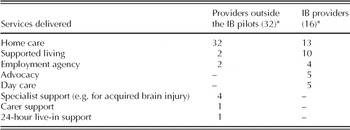
Both studies used qualitative methods, which aim to reflect diversity rather than statistical generalisability (Barbour, Reference Barbour2001). The aim of each study was to elicit the range of experiences, expectations and possible actions by providers in response to the roll-out of personal budgets. Semi-structured interviews with managers of provider organisations were used to elicit views on the impact of greater use of PBs or IBs. Fieldwork took place in late 2007. For the study of home care providers outside the IB pilots, four LAs in England were selected to represent a diverse range of characteristics, including take-up rate of DPs, levels of deprivation and rural/urban settings. Eight home care providers from each LA were selected from those that expressed an interest in taking part (32 in total). A manager of each agency was interviewed. For the IB study, interviews were held with 16 managers of non-residential social care providers in four pilot sites. They were selected for inclusion specifically because they had most engagement with users of IBs. Providers in both studies were chosen to include a range of different characteristics including: size; client group served; sector of ownership; and types of services delivered. Table 1 illustrates the range of services delivered.
Services delivered by providers in each study

Note: *Some providers offered more than one service.
Most providers in the two studies relied heavily on LA contracts but also had experience, albeit more limited, of self-funders and DP users purchasing their services. Most providers in the IB study were delivering services to between five and 20 IB holders. The experience of DPs among home care providers outside the IB pilots was limited often to a handful of clients. Thus, although the views given by all providers are based on limited experiences of PBs, those of the providers outside the IB pilots are more so.
The topic guides used in each study contained similar questions. Both included sections on the impact and experiences of DPs/IBs so far and the expected implications of roll-out on the wider social care market. Interviews for both studies were transcribed and coded with the aid of a computerised qualitative software package. The coding frames were based broadly on the topic guides with additional codes added where new themes were identified. The analyses were undertaken separately. For the purposes of this paper, the main workforce-related issues were compared and contrasted.
Findings
The findings are presented under four separate themes, each linked by an underlying concern by providers about their future financial stability should large or long-term LA contracts be phased out. Within each section, the findings are presented first for the providers outside the IB pilots and then for those in the IB study.
Anticipated impact on financial and workforce planning
Providers in both studies felt that the shift from the relative financial security of providing services under large LA contracts to a greater volume of direct purchasing by individual clients would have implications for both short- and long-term planning. A strong belief from providers outside the IB pilots was that financial planning in the short term would become increasingly difficult if individually purchasing clients gave short periods of notice that they no longer wished to receive services or exercised greater flexibility by using services on an intermittent basis. Further, although some LAs paid a retainer for up to three weeks while service users were in hospital or respite care, private purchasers and DP users did not; providers felt vulnerable should the intermittent use of services occur in large numbers.
IB providers raised similar fears about unplanned withdrawals, and also expressed concerns about organising staff rotas to meet short notice or unplanned requests for care; such requests were common from IB holders. Managers attributed these requests to social workers advertising IBs to service users in ways which raised unreasonable (in their view) expectations. As one said:
We'd have to work totally different to how we're working now. We'd have to completely change the rostering system . . . I worry that the service users will sit there and say ‘Actually, I think I'd like to go here’ and just make the call to the agency and think that it's going to happen just like that. ‘Oh don't send anyone today; I don't want her after all’. . . this is a totally different, almost alien way of working. (IB provider)
Providers outside the IB pilots agreed that DP users expected to be able to make requests at unrealistically short notice. One noted that the only way to offer complete flexibility to clients was to pay carers to be on-call, waiting for requests. An IB provider with experience of trying to meet unexpected demands predicted that working in this way would require a three-fold increase in the agency workforce. A strong view among both groups of providers was that it was important for PB users to have a clear understanding from the outset about their own requirements, but also to have a clear understanding about the capacity of providers. Self-funders were also reported to have unrealistic expectations but providers felt able to manage these from the start. Providers outside the IB pilots wanted LAs to act as mediators in managing the expectations of PB holders; IB providers concurred but were more specific in their desire for social workers to reduce their emphasis on the flexibility that providers could offer.
Although most providers in the IB pilots were not concerned about maintaining the size of their client base in the long run, providers in both studies were concerned about maintaining appropriate capacity. LA contracts were highly valued and had enabled providers to plan staffing levels a number of years ahead. Without the security of a longer-term guaranteed income from a large LA contract, providers felt they would find themselves in a ‘chicken and egg’ situation of not being able to recruit staff until there was sufficient demand (and thus funds), but being unable to recruit staff quickly enough when the demand did arise.
The prospect of large LA contracts ending was a very real possibility within the IB pilots; they had already ceased in one LA (though interim payments to cushion the impact were in place) and their end was planned in a second. Two providers had considered introducing staff contracts without guaranteed hours to offset the risk of not having an LA contract. One felt that some types of carers would enjoy not having contractually bound hours; another felt that quality staff would not accept such terms.
Anticipated impact on care worker recruitment and retention
There were mixed views on whether greater use of PBs would help or hinder staff recruitment and retention. Outside the IB pilots, about a third of providers had experienced a small number of care workers leaving to be employed directly by DP users, although an increasing number of adverts for private workers, offering higher rates of pay than agencies, were noted. Many of the staff losses were reported to be from DP users ‘poaching’ agency care workers with whom they had longstanding relationships and employing them privately as PAs. Losses experienced to date had not had big impacts on providers, but added to an already difficult labour market.
Providers were generally not concerned about staff leaving. They believed that the difficulties care workers would experience as PAs in finding sufficient hours of work, and sufficiently flexible hours, would mean they would remain with or return to work for agencies. Indeed, providers outside the IB pilots reported care workers who had already returned after initial forays into private care work for direct payment users. Although the reasons for their return were not always clear to agency managers, some believed their new employers proved too demanding. The benefits of working for an agency, such as offering care workers choice over which hours they worked on which days or opportunities to swap shifts with colleagues, were highlighted as sufficient to persuade care workers not to leave. Similarly, about a third of IB providers had experienced losing staff to become PAs, but, like providers outside the pilots, were fairly sanguine about the overall risks to their business, feeling that even when PBs were rolled out only a minority of staff would leave. However, where staff had left, there was frustration over repeatedly incurring recruitment and training costs.
PBs can be used to purchase any type of support that meets users’ desired outcomes; using IBs to purchase help with domestic tasks, gardening and companionship for social activities outside the home was common. IB providers disagreed over how the image of care work would be affected if PB holders chose to purchase a wider range of tasks from care agencies than the personal care typically purchased through LA contracts. While there was concern that IBs might de-professionalise care workers, there was an argument that IBs might actually improve recruitment and retention by offering more rewarding work, enabling care workers to build better rapport with clients. Contrasting the “before and after” one provider said:
‘Carers are very demoralised by what they do because they are not recognised enough . . . they're just classed as providing basic personal care to someone’ . . . [But] when I interview recruits now I do stress the need for flexibility around care, it's not going to be the same as it always was. Most of them love it. They absolutely love it. [The member of staff] that I put on this Individual Budget yesterday, she's absolutely thrilled to bits. (IB provider)
To retain staff, providers outside the IB pilots were placing clauses into contracts forbidding clients and staff from entering into direct employment relations until six months after leaving the agency, with threats of fines if they did so. Managers were unsure about the enforceability of these clauses; they were seen primarily as a deterrent.
As well as these controls, providers in both studies planned to motivate care workers to stay with them by highlighting the non-financial benefits of agency employment compared to direct employment by a PB holder, including training, free uniforms, guaranteed weekly hours of work, flexible shifts, supervision and mentoring. IB providers felt that the support and security of working for a formal care provider was the main reason that care workers would remain with them.
Anticipated impact on workforce training
Providers outside the IB pilots were concerned that they would lose valuable trained staff to PB holders. They expected also that overall training costs could rise if staff chose to join agencies, benefit from their compulsory training, but leave soon afterwards to work directly for PB holders. As one provider noted:
So we'd be paying our competition . . . train[ing] up people who'd be directly competing with us. (Provider outside the IB pilots)
Providers in both studies believed strongly that DPs had introduced an uneven playing field. Agencies were obliged to meet national care standards and staff training requirements, whereas DP holders employing their own PAs faced none of these hurdles. In addition, the pressures on agency care workers to be trained to NVQ Level 2 were perceived by providers outside the IB pilots to be encouraging some care workers to leave agency employment in favour of direct employment by a DP holder, therefore avoiding the requirement for formal training. Nevertheless, one IB provider guaranteed to train new recruits to NVQ Level 3; this was achievable because the agency's LA block contracts allowed them to plan three to five years ahead. However, the provider expected it would have to end this guarantee as PBs were rolled-out, current contracts expired and it became more difficult to forecast demand and finances more than a few months in advance.
Providers from both studies recognised that, with more use of PBs, demand would increase for a wider range of services, such as shopping, domestic work and social support. Some believed that a different type of care worker, possibly less skilled, would be needed, and there were hopes that training requirements for these workers might be less strict. However, some forms of care resulting from new demands for healthcare-related roles, such as assisting with specialist feeding techniques, were recognised as more skilled, with additional training requirements. In either case, managers felt demand for different types of care workers might offer the opportunity to change the skill mix of their workforce.
Anticipated impact on service user/provider relations
Both groups of providers were concerned that current working practices might be challenged by PB users requesting different forms of support. There were concerns from providers outside the IB pilots about losing some of the professional distance that they tried to maintain between their care workers and clients. Providers in both studies selected staff most suited to clients’ particular needs or rotated staff regularly to prevent clients becoming over-dependent on individual workers. Providers believed the caring nature of care workers sometimes meant that they overstepped the professional boundaries of relationships, for example by taking clients to their own homes. Providers were concerned that these distinctions would become blurred and there would be pressure on providers to encourage a relaxation of these boundaries if PB users came to expect caring relationships more akin to friendships.
IB providers expressed related concerns. Two agencies specialising in providing support to mental health service users argued that some of the freedoms and choices associated with IBs might, paradoxically, slow the journey to independence. Mental health support workers were trained to challenge the decision-making processes of their clients in order to help motivate and encourage them to take more control over their lives. One explained that if a service user ‘doesn't feel up to’ paying their bills or cleaning their house, then the worker will intervene to encourage a more pro-active attitude. The providers speculated that this approach might be resisted in the short term and, to their long-term detriment, IB holders may no longer demand this type of support.
Discussion
The findings presented in this paper are based on interviews with two samples of managers of domiciliary and community-based social care providers with experience of direct user purchasing through DPs or IBs. Experience was limited; this was inevitable given the pilot nature of IBs, the predominance of LA contracts (even in areas piloting IBs) and the fact that the take up of DPs was low, particularly in the older age groups who were most likely to receive home care. In addition, fieldwork for both studies took place prior to the announcement that PBs were to be rolled out across England. However, the evidence presented is strengthened by the fact that the views of those that had experience of IBs tended to confirm the expectations of those that had not. This paper has highlighted a number of workforce-related impacts that social care providers anticipated from an increase in the number of people using PBs, with implications not only for care agencies but also care workers, service users and LAs.
The findings show a major concern of providers was the potential loss of financial stability and subsequent opportunities to plan staff recruitment, training and capacity to provide a range of support for PB users. These concerns resonate with findings from other studies that show care workers themselves worry about the impact on their own financial security of a client's death or move into residential or hospital care (Fleming and Taylor, Reference Fleming and Taylor2007; Timonen and Doyle, Reference Timonen and Doyle2007). In the findings presented here, concerns about intermittent use of services suggest agencies would prefer clients to pay retainer fees, thus transferring some of this risk back to the client. What is not clear is whether care workers would benefit from this transfer by being guaranteed wages should one of their regular clients temporarily withdraw from care. There is no assurance that this will happen; evidence from those considering introducing employment contracts with no guaranteed hours suggests that it may not. The implications are that the service users and care workers would bear the threat of financial losses, while provider organisations would minimise their own risks.
Although managers expressed concerns about PB holders ‘poaching’ care workers from agencies, a bigger issue for provider organisations was that they felt that they and PB holders were competing for care workers under different rules. Providers believed that the training and regulatory framework to which they were subject may act as a barrier to recruiting workers who did not wish to be trained formally. In contrast, PB users were free to employ untrained care workers and were not required to carry out any background checks – a right that disability lobbyists have argued for (Sawyer, Reference Sawyer2008). There is evidence also that people using DPs prefer to train their PAs themselves and prefer them not to be too ‘professionalised’ (Glendinning et al., Reference Glendinning, Rummery, Halliwell, Jacobs and Tyrer2000). Unless measures are taken to ensure directly employed care workers are subject to the same safety checks and training as agency workers, or agencies can employ some care workers who are less highly trained, the playing field will remain uneven. This could lead to a two-tier care workforce: trained and regulated workers employed by agencies, possibly under better terms and conditions; and a less qualified and unregulated workforce employed directly by individual service users. The result of this stratification for clients will be that choice of care worker from an agency will be limited to those that are highly trained and possibly more expensive, perhaps with implications for the characteristics of care provided and the volume that can be afforded with a PB.
Providers were aware also of the challenge of maintaining the professionalism of their staff whilst competing with less conventional forms of support provided by independent PAs to newly empowered PB users. There are undoubtedly opportunities for providers to develop what have been seen as unresponsive services into more diverse and imaginative types of support (Sawyer, Reference Sawyer2008), which may include roles more akin to friendships. Furthermore, there is evidence that the right balance between professional support and friendship (Beresford et al., Reference Beresford, Croft and Adshead2008), and relationships that foster a sense of security, belonging and continuity (Ryan et al., Reference Ryan, Nolan, Reid and Enderby2008) are valued by both service users and care workers. Thus, a regulatory environment that gives agency care workers the confidence and freedom to work with clients in a less instrumental, more relational way, but within clearly defined boundaries, could enable providers to compete more effectively with independent PAs while also increasing care worker job satisfaction and reducing staff turnover.
The higher hourly rates that PB holders may be able to pay directly employed care workers make providers’ plans to retain staff by emphasising the non-financial benefits of agency work all the more important. This is consistent with evidence from Fleming and Taylor (Reference Fleming and Taylor2007) that the main reasons home care workers consider leaving the profession are unsociable hours, lack of management support and workload. Guaranteed hours are also shown to be more important for retention than overall remuneration, thus a higher hourly rate of pay may be less important to care workers when considered alongside job security. Guaranteed hours is one of the benefits that some agencies highlighted in their attempts to attract and retain care workers, but it is not clear whether they will be able to do so in the future if LA block contracts are phased out and providers’ own income streams become less certain.
As LA contracts are phased out, the roles of care managers will change. Providers wanted to see care managers mediating where service user expectations were, in their opinion, unrealistic. However, if care managers no longer arrange care packages, PB users may find themselves in a relatively weak position, purchasing from providers that are able to influence their choices through the range of services they offer. Without care managers or other advocates, the greatest risk may not be agencies facing unrealistic demands, but PB users facing an insufficient range of support options.
Finally, what is clear from the findings presented in this paper is that the lack of certainty about the impact of PBs is putting providers in a position of feeling unable to plan effectively in relation to their staff numbers and training. To meet policy aims of enabling service users to have choice over how their support is delivered, social care providers need information about service user demand in order to plan workforce capacity and development effectively. A recent survey has shown that few LAs have systems in place for capturing information on purchasing choices or the needs of individuals to inform future market shaping, but many are developing them (Jerome et al., Reference Jerome, Doherty, Hills and Williams2009). This is an important role for LAs; it is vital that both providers and service users have relevant information to enable planning and service development.
Acknowledgements
Both research projects on which this paper is based were funded by the Department of Health. The views expressed here are those of the authors and not necessarily those of the funding body. We would like to thank the other members of both project teams and the managers of the provider organisations who made this research possible by sharing their experiences and expectations.