INTRODUCTION
Ascidians form an ever-present portion of benthic communities in shallow tropical and temperate communities. Although great diversity can be found in the Caribbean Sea, most islands like Trinidad and Tobago and much of the coastal southern Caribbean still have not been extensively surveyed for ascidian species (Rocha et al., Reference Rocha, Faria and Moreno2005, Reference Rocha, Guerra-Castro, Lira, Pauls, Hernandez, Pérez, Sardi, Perez, Herrera, Carbonini, Caraballo, Salazar, Díaz and Cruz-Motta2010; Bonnet & Rocha, Reference Bonnet and Rocha2011). Only recently though, there has been a checklist of ascidians of Tobago published (Cole, Reference Cole2012).
The class Ascidiacea, commonly referred to as tunicates or sea squirts consists of sessile tunicates of which both solitary and colonial forms occur. There are three orders within the class Ascidiacea: Aplousobranchia, Phlebobranchia and Stolidobranchia (Rocha et al., 2012a). Ascidians are classified by the position of their digestive tract, morphology and position of the gonads as well as the structure of their pharynx. For colonial species, the morphology of larvae is also important for species identification. Colonial species usually incubate the larvae while solitary ascidians release mature eggs and sperm that develop in about 12–24 h, into swimming larvae; with an average larval duration of 12–24 h. Since the larval stage is so short (sometimes only a few minutes between release and settlement in colonial forms), the primary mode of anthropogenic transport is probably the rafting of adult ascidians on boat hulls or other fouled floating surfaces (Lambert, Reference Lambert2002).
Introductions of non-indigenous ascidians into harbours in both tropical and temperate waters are now commonplace, with the pace of introductions increasing (Monniot et al., Reference Monniot, Monniot and Laboute1991; Coles et al., Reference Coles, DeFelice, Eldredge and Carlton1999; Lambert, Reference Lambert2007).
A study of recreational boats as potential vectors of non-indigenous species into the waters of Trinidad was carried out in May–June 2008 (Gobin et al., in preparation). Several groups of marine specimens were collected and identified, each adding to the marine biodiversity collection for Trinidad and Tobago. One of the groups collected was the Ascidiacea and here we report on the species identified for this group. The species are commonly found in the general Caribbean region. However, it would be difficult to say for certain whether these species are in fact native to Trinidad's waters, since natural substrates have never been previously surveyed and the only previous ascidian record for the island is Ecteinascidia minuta (Berrill, 1932) (Millar, Reference Millar1962). Further, all the vessels surveyed had ports of call along the chain of Caribbean islands before ending their journey in Trinidad and the individuals found could have attached themselves from any of these islands. A comparison was however done between the species list for Tobago (Cole, Reference Cole2012) and those specimens collected on the hulls of the recreational boats in Trinidad.
MATERIALS AND METHODS
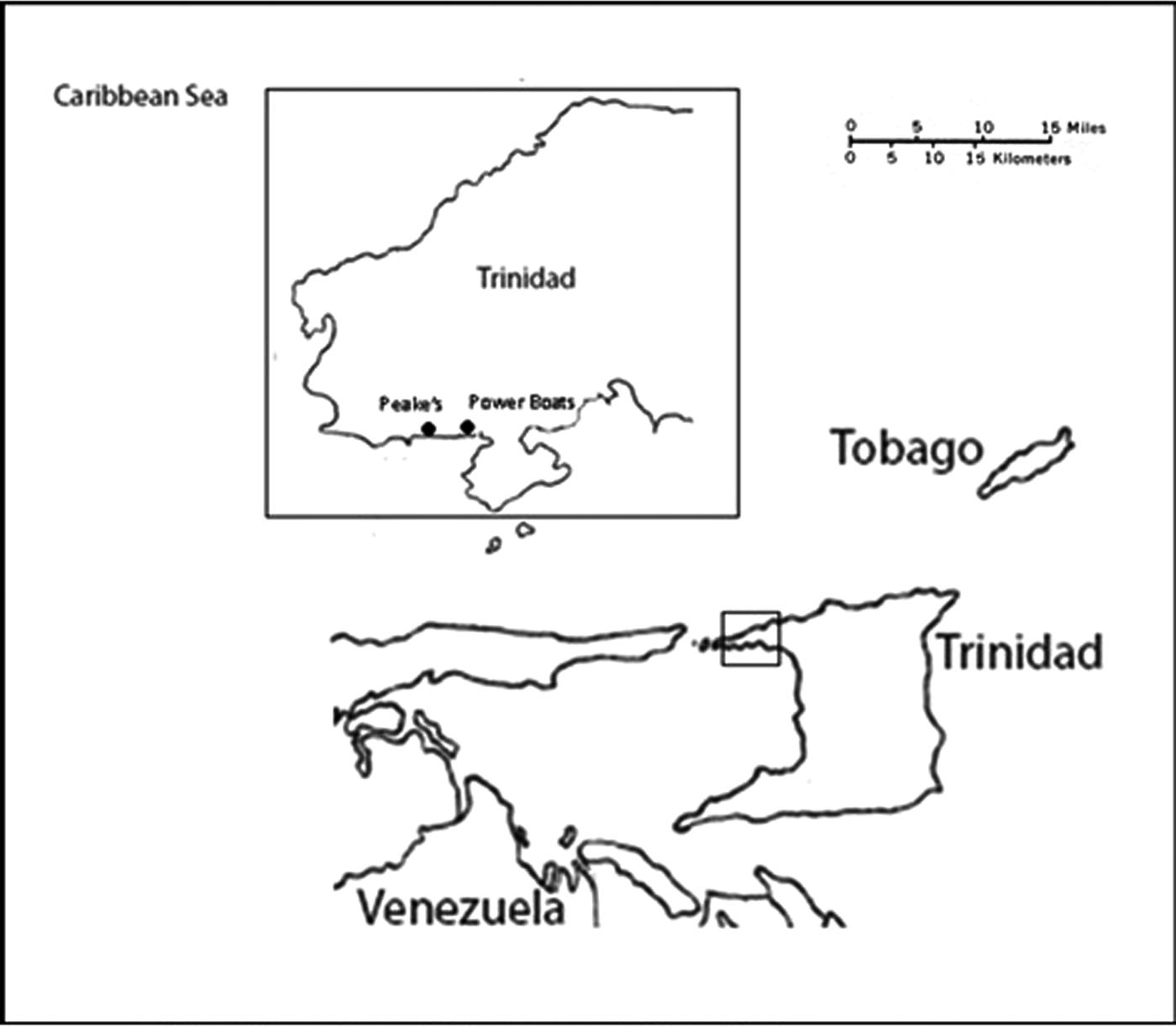
The focus of the original Trinidad study (Gobin et al., in preparation) was to document the potential for non-native species being transported attached to hulls of recreational boats. In that study, a qualitative survey of macrofaunal organisms fouling boat hulls was carried out at two of the largest marinas in Trinidad (Peakes and Power Boats) in Chaguaramas (Figure 1). Twenty-seven (27) recreational vessels were sampled during the period between 27 May and 18 June 2008. Scrapings (using chisels, forceps and scrapers) of representative faunal samples were collected off each of the hulls. These were placed in labelled plastic bags and preserved with a 10% formalin solution, and all samples were returned to the laboratory for processing and taxonomic identifications (Gobin et al., in preparation). All organisms were sorted into taxonomic groups and preserved in 70% alcohol. The ascidians were all identified to species level. Identifications followed taxonomic literature from Monniot & Monniot (Reference Monniot and Monniot1972) and Rocha et al. (Reference Rocha, Zanata and Moreno2012a). Additionally, for the original study (Gobin et al., in preparation) yacht owners or custodians were interviewed on-site for general information about the boat (size/type of vessel) and its journey (ports-of-call, last date vessel was scraped or cleaned, etc.).
Location of study area in Trinidad.

RESULTS
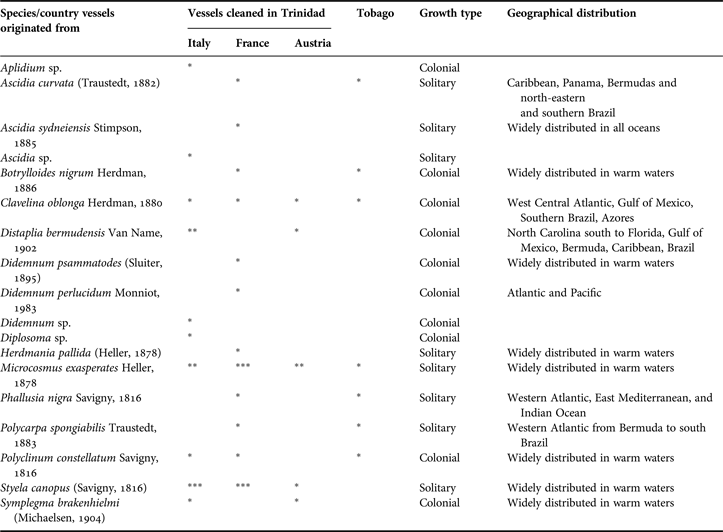
Of the twenty-seven (27) boats sampled only four (4) had ascidians attached: one (1) from Austria; one (1) from Italy; and two (2) from France. Table 1 shows the ascidian data compiled for this study. Additionally it shows those species which were also found in Tobago (Cole, Reference Cole2012). Of the eighteen species (18) collected, ten (10) were colonial species of which seven (7) were identified to species level. Of the eight (8) solitary species, seven (7) were identified to species level. Clavelina oblonga was common to the four (4) vessels but was not as abundant (number of colonies/individuals) as Styela canopus and Microcosmus exasperatus which were also common to all of the vessels. However, C. oblonga and M. exasperatus were the only ascidian species found on both the vessels in Trinidad and in the natural habitats in Tobago (Cole, Reference Cole2012).
Ascidian species collected in Trinidad from vessels: a comparison was made with the ascidian checklist of Tobago (Cole, Reference Cole2012).

*, rare (1–2 individuals in sample); **, abundant; ***, very abundant.
DISCUSSION
The ascidians collected in Trinidad (this study) were all typically found in the Caribbean (Rocha et al., Reference Rocha, Faria and Moreno2005) even though the vessels originated in Europe (Table 1). In fact, most of the completely identified ascidians here are known to belong to a common port fauna of cosmopolitan species present around the world: Ascidia sydneiensis, Didemnum perlucidum, D. psammatodes, Herdmania pallida, Microcosmus exasperatus, Phallusia nigra, Polyclinum constellatum, Styela canopus and Symplegma brakenhielmi (Monniot et al., Reference Monniot, Monniot and Laboute1985; Monniot & Monniot, Reference Monniot and Monniot1994; Rocha et al., Reference Rocha, Dias and Lotufo2011).
Given that only Styela canopus was also found in a comprehensive survey along ports and marinas in Southern California (where waters are colder) (Lambert & Lambert, Reference Lambert and Lambert2003), it appears that the rest of species are common only in tropical ports. Styela canopus is a small styelid ascidian, common worldwide and which deserves more detailed molecular study for species verification. This is because the variation in size, colours and even number of gonads, as well the wide temperature tolerance suggest a complex of species under the same name.
Seven (7) of the fourteen (14) named species found on the vessels in Trinidad were not reported in the Tobago species list (Cole, Reference Cole2012). Among them, H. pallida was probably present, but likely misidentified as H. momus in the Tobago study. A review of Herdmania species showed that H. momus is not present in the Atlantic (Monniot, Reference Monniot2002) and subsequent surveys agreed that only H. pallida is currently present in the Caribbean Sea (Rocha et al., Reference Rocha, Faria and Moreno2005, Reference Rocha, Guerra-Castro, Lira, Pauls, Hernandez, Pérez, Sardi, Perez, Herrera, Carbonini, Caraballo, Salazar, Díaz and Cruz-Motta2010). Previous studies have commonly misidentified this species (Rocha et al., Reference Rocha, Faria and Moreno2005, Reference Rocha, Guerra-Castro, Lira, Pauls, Hernandez, Pérez, Sardi, Perez, Herrera, Carbonini, Caraballo, Salazar, Díaz and Cruz-Motta2010). In addition, Symplegma viride is very similar to S. brakenhielmi, and possibly the same species (Rocha et al., Reference Rocha, Guerra-Castro, Lira, Pauls, Hernandez, Pérez, Sardi, Perez, Herrera, Carbonini, Caraballo, Salazar, Díaz and Cruz-Motta2010). However, this hypothesis still needs to be tested with a taxonomic revision. Additionally, Diplosoma sp. found in Trinidad is probably D. listerianum, a common fouling species widespread in the Atlantic and which was recorded in Tobago. The lack of larvae prevented us (this study) from confirming this species with confidence. Given these taxonomic suggestions, both faunas (Trinidad and Tobago) would be even more similar than they appear now.
It is intriguing that Styela canopus has not been found in Tobago (only 30.6 km away), given that it was reported from more than half of the Caribbean Islands and coasts within ascidian studies (Rocha et al., Reference Rocha, Faria and Moreno2005). This especially since Cole (Reference Cole2012) reported on ascidians from only natural habitats such as mangrove roots and coral reefs, and the species has been previously reported on mangrove roots in Panama and Venezuela (Rocha et al., Reference Rocha, Faria and Moreno2005, Reference Rocha, Guerra-Castro, Lira, Pauls, Hernandez, Pérez, Sardi, Perez, Herrera, Carbonini, Caraballo, Salazar, Díaz and Cruz-Motta2010). A possible reason for its absence in Tobago may be due to the fact that this species is probably introduced in the region and has still not spread to all islands. This explanation could also be true for the absence in Tobago of Ascidia sydneiensis, a putative introduced species in the region (Rocha et al., Reference Rocha, Guerra-Castro, Lira, Pauls, Hernandez, Pérez, Sardi, Perez, Herrera, Carbonini, Caraballo, Salazar, Díaz and Cruz-Motta2010).
Populations of Clavelina oblonga have recently been studied along the western Atlantic and showed a lack of cytochrome oxidase 1 (COI) variation. One single haplotype is present in Panama, South Brazil and Azores, although more haplotypes were identified within Florida populations (Rocha et al., Reference Rocha, Kremer and Fehlauer-Ale2012b). That study (Rocha et al., Reference Rocha, Kremer and Fehlauer-Ale2012b) was not conclusive about where the native geographical distribution for the species is, because of the small sample size in the Caribbean. Therefore, it would be interesting to sample the Clavelina oblonga populations present in both Trinidad and Tobago.
The authors were not able to identify to species level, four (4) ascidian individuals since they were juveniles and their gonads and/or larvae were lacking. These structures are essential for the identification of ascidians at the species level. This rapid survey revealed a number of species known to other tropical marine ports although it is not clear at the moment if they also belong to the ascidian fauna of Trinidad's natural habitats. The next step for confirmation would be to carry out a comprehensive survey of ascidians along Trinidad's coastline to compile a complete species list for the island. It would then be interesting to observe what proportion of these species found in this present study occurs in the natural communities. Additionally, it would be interesting to compare the ascidian fauna of both islands (Trinidad and Tobago). Such data are also necessary in order to compile baseline information for future monitoring surveys to determine possible marine invasions. These ascidians could also be used as potential indicators of coastal water quality (Carballo & Naranjo, Reference Carballo and Naranjo2002). Since they are filter feeders, the potential for their accumulation of heavy metals is high (Philip et al., Reference Philip, Leung and Bradley2003). In this respect, contaminants in the marine environment in Trinidad are a major issue, because of the number of industrial firms that are located along the western coastline.
ACKNOWLEDGEMENTS
One of the authors (J.F. Gobin) acknowledges a Campus Research Grant (CRP.3.May07.9) from the University of the West Indies, St Augustine, Trinidad and Tobago. The grant was used to fully fund the research. R.M. Rocha also received a research grant from Conselho Nacional de Desenvolvimento Científico e Tecnológico—CNPq (304768/2010-3) for taxonomic studies.