INTRODUCTION
As team learning increases team members’ knowledge and skills, as well as benefits team performance and creativity (Edmondson, Bohmer, & Pisano, Reference Edmondson2001; Gino, Argote, Miron-Spektor, & Todorova, Reference Gino, Argote, Miron-Spektor and Todorova2010), a burgeoning interest among scholars has occurred in regard to understanding how to promote such learning. Considerable research has focused on the antecedents of team learning, among which leadership behavior has been considered one of the most important impetus factors (Yukl & Van Fleet, Reference Yukl and Van Fleet1992; Kasl, Marsick, & Dechant, Reference Kasl, Marsick and Dechant1997). Holding most of the power within the team, and serving as role models, team leaders determine the flow of resources and information within the team and, as such, hold great influence over the team members’ behaviors (Dionne, Sayama, Hao, & Bush, Reference Dionne, Sayama, Hao and Bush2010). Scholars have called for additional research to determine the mechanisms linking leader behaviors to team learning (Savelsbergh, Poell, & van der Heijden, Reference Savelsbergh, Poell and van der Heijden2015). Although previous studies have examined the effects that some traditional, top-down leadership approaches, such as charismatic leadership and transformational leadership, have had on team learning (e.g., García-Morales, Jiménez-Barrionuevo, & Gutiérrez-Gutiérrez, Reference García-Morales, Jiménez-Barrionuevo and Gutiérrez-Gutiérrez2012), some scholars have criticized these traditional leadership approaches as ‘failing to fully appreciate and model the dynamism and complexities of team leadership’ (Owens & Hekman, Reference Owens and Hekman2016: 1089). Therefore, our research aims to unveil the influence of the nontraditional, bottom-up leadership approach of leader humility on team learning.
To capture the external, expressed properties, humility has been defined as an ‘interpersonal characteristic that emerges in social contexts that connotes (a) a manifested willingness to view oneself accurately, (b) a displayed appreciation of others’ strengths and contributions, and (c) teachability’ (Owens & Hekman, Reference Owens and Hekman2016: 1088). According to this definition, leader humility can be manifested as a set of power equalizing behaviors that generally involves how leaders view themselves and new information or ideas. These behaviors consist of acknowledging their own limitations, faults, and mistakes, spotlighting followers’ strengths and contributions, and modeling teachability (Ou et al., 2014). As this conception of humility includes a dimension of ‘teachability’ and team leaders have great influence in regard to directing team members, the conception of humility suggests a strong relationship between leader humility and team learning in theory. While some research on leader humility has also mentioned that leader humility fosters the ability of team members to learn (Owens & Hekman, Reference Owens and Hekman2012) and reinforces employee learning motivation (Owens, Johnson, & Mitchell, Reference Owens, Johnson and Mitchell2013), no empirical research has been done to identify these consequences of leader humility. Despite theorists who suggest that expressing humility is becoming more critical for leaders (Vera & Rodriguez-Lopez, 2004; Morris, Brotheridge, & Urbanski, Reference Morris, Brotheridge and Urbanski2005), we still know little about how and why leader humility helps one to direct team learning.
In addition, the majority of previous research on leader humility has focused on the individual; that is, the researchers have confirmed the value of leader humility in regard to promoting employees’ organizational commitment, job satisfaction, and performance (Dutton, Roberts, & Bednar, Reference Dutton, Roberts and Bednar2010; Greer, Reference Greer2013). However, little attention has been paid to the effects of leader humility on team-level outcomes (Owens & Hekman, Reference Owens and Hekman2016). Even though previous studies have confirmed that leader humility creates positive effects for team members at the individual level, it is still hard to say that these effects will be brought to the team at the same time. As many differences exist between individuals and their teams, exploring the effects created by leader humility at the team level will contribute to our understanding of the nature of leader humility. In light of the above gap in knowledge, the main purpose of this study is to answer when and why leader humility promotes team learning. Specifically, we try to examine the relationship between leader humility and team learning. In addition to that, we attempt to uncover potential intervening and moderating variables related to this connection.
Team learning refers to team processes through which team members acquire new skills and knowledge. These processes include team members’ behaviors, such as seeking information, reading, raising questions, and looking for feedback. As team learning is an interpersonal process, team leaders’ directions and team members’ recognition of the team may have a strong influence on this process. Owens and Hekman (Reference Owens and Hekman2016) argued that leader humility can stimulate a shared collective humility. These humble behaviors, when shared by team members, may have a critical impact on collective cognition and sequentially influence team processes and behaviors. Specifically, according to the social cognitive theory, teams’ shared mental models, which indicate the tacit agreements that exist among team members, are typical factors that mirror teams’ shared cognition. Therefore, a team’s shared mental model may serve as an important mechanism to link leader humility and team learning. Moreover, because a team’s cognition forms in a team atmosphere, a team’s collective regulatory focuses determine how team members react to leaders’ behaviors (Klimoski & Mohammed, Reference Klimoski and Mohammed1994; Owens & Hekman, Reference Owens and Hekman2016). Therefore, to address the issues of when and why leader humility promotes team learning, this study will try to examine the mediating effect of shared mental models and the moderating effect of collective regulatory focuses on the leader humility/team learning relationship.
The present study contributes to the leader humility literature in the following manners. First, despite arguments that a strong link exists between leader humility and team learning (e.g., Owens & Hekman, Reference Owens and Hekman2012), few studies have examined the relationship between these two variables. This study provides theoretical and empirical evidence for this link. Second, drawing from the social cognitive theory perspective, we propose that shared mental models serve as important mechanisms for revealing why leader humility can help teams learn. Third, previous studies of leader humility have mostly examined its effects at the individual level (e.g., individual performance) without considering the team level (Owens & Hekman, Reference Owens and Hekman2016). The current study centers on the effects of leader humility at the team level (i.e., team learning) and reveals the mechanism behind the effect. Fourth, previous studies have provided strong evidence that a team climate is an important factor in regard to leaders’ effects on individuals’ behaviors (e.g., Hofmann, Morgeson, & Gerras, Reference Hofmann, Morgeson and Gerras2003; Wang & Rode, Reference Wang and Rode2010). Therefore, we also investigate the moderation effect of team climate. Specifically, we investigate the boundary conditions of collective regulatory focuses. In summary, the purposes of present study are to examine the team learning effects as stimulated by leader humility, reveal why this effect exists, and reveal when the effect can be amplified or attenuated.
THEORETICAL BACKGROUND AND HYPOTHESES
Humility is rooted in Greek philosophy and derived from the Latin term ‘humilitas,’ meaning ‘of the Earth’ or ‘on the ground’ (Owens & Hekman, Reference Owens and Hekman2012). It has been regarded as a virtue and founding principle for many religions as it means to have a ground view of oneself and others that acknowledges one’s own strengths and limitations without feeling superior or inferior to others, which leads to a more objective and accurate view of oneself (Morris, Brotheridge, & Urbanski, Reference Morris, Brotheridge and Urbanski2005; Nielsen, Marrone, & Slay, Reference Nielsen, Marrone and Slay2010). In organizational psychology research, humility is recognized as a positive strength of individuals (Rowatt et al., Reference Rowatt, Powers, Targhetta, Comer, Kennedy and Labouff2006; Davis et al., Reference Davis, Hook, Worthington, Van Tongeren, Gartner, Jennings and Emmons2011). Research indicates that individuals who are humble usually show a desire to learn and are more open to new ideas, advice from others, and feedback (Owens, Rowatt, &Wilkins, 2011). Individuals with this personality are community-focused instead of self-focused (Tangney, Reference Tangney2000). This change in focus allows individuals to value others’ contributions and create more harmonious relationships with others (Means, Wilson, Sturm, Biron, & Bach, Reference Means, Wilson, Sturm, Biron and Bach1990; Morris, Brotheridge, & Urbanski, Reference Morris, Brotheridge and Urbanski2005).
Research in leadership has conceptually linked humility with many positive leadership styles, such as empowering leadership, participative leadership, and servant leadership (Conger & Kanungo, Reference Conway and Lance1988; Somech, Reference Somech2003; Van Dierendonck, Reference Van Dierendonck2011). Solid theoretical foundations have been laid by Morris, Brotheridge and Urbanski (Reference Morris, Brotheridge and Urbanski2005) for humility in leadership and organizational management. In contrast to most of the previous research that focuses on leader humility as an individual-level trait in leadership (e.g., Reave, 2005; Nielsen, Marrone, & Slay, Reference Nielsen, Marrone and Slay2010), Owens and Hekman (Reference Owens and Hekman2012) first conceptualized leader humility from the perspective of leader behavior. Their conceptualization of leader humility captured the ‘manifested, external, and expressed or interpersonal properties of humility’ (Owens & Hekman, Reference Owens and Hekman2012: 1518). Using the behavior-based conception of leader humility, Owens, Johnson, and Mitchell (Reference Owens, Johnson and Mitchell2013) identified the positive effects of leader humility on individual performance. More recently, Owens and Hekman (Reference Owens and Hekman2016) examined leader humility at the team level and discovered how leader humility influences team performance. Although the literature on leadership suggests the importance of leaders’ humility, little research has been conducted to confirm the influence of leader humility on important organizational outcomes, especially on team-level outcomes (Owens & Hekman, Reference Owens and Hekman2016). Therefore, our study attempts to examine the effects of leader humility on team learning with the goal of revealing the mechanism behind the effects.
The relationship between leader humility and team learning
Team learning involves a set of behaviors, such as seeking information, reading, raising questions, looking for feedback, exploring, and experimenting (Gibson & Vermeulen, Reference Gibson and Vermeulen2003; Wong, Reference Wong2004). Previous studies (e.g., Edmondson, Reference Edmondson, Dillon and Roloff2008; Bucic, Robinson, & Ramburuth, Reference Bucic, Robinson and Ramburuth2010) have indicated that factors, such as leadership behaviors and team climates, are important in regard to influencing team learning. For example, Edmondson (Reference Edmondson2003) studied the effect of team leaders on team learning behaviors and found that the leaders’ behaviors that promoted and inhibited psychological safety played an important role in the learning process. Sarin and McDermott (Reference Sarin and McDermott2003) also focused on team leaders and surveyed 52 product development teams. They found that team leader behaviors, such as involving subordinates in decision-making, setting clear team goals, and providing support for inside learning and boundary spanning, can effectively promote team learning.
Conceptually, leader humility is highly relevant to team learning. Owens and Hekman (Reference Owens and Hekman2012) proposed that leader humility has important effects on followers’ behaviors in three ways: (1) legitimizing the developmental journey of the followers, (2) psychological freedom, and (3) followers’ engagement. First, humble leaders are willing to legitimize the developmental journey of their followers, which makes leaders put themselves on the subordinates’ shoes and think about what employees really need for their vocational development. This concern may bring employees to a clear set of goals and, thus, employees will exert more effort to learn and achieve self-enhancement. By placing themselves at a lower status level, humble leaders create a climate of psychological freedom, which involves psychological safety and can be a great promotion for team learning (Edmondson, Reference Edmondson2003). In addition, humble leaders tend to value the contributions of others. This behavior increases the team members’ senses of identity, which entices them to learn more and contribute to the team. Finally, humble leaders express a willingness to accept others’ suggestions and an eagerness to learn, which makes them strong role models for employees. Being such a role model may, in turn, improve team learning. Hence, we propose the following hypothesis.
Hypothesis 1: Leader humility is positively related to team learning.
The mediating role of the shared mental model
The shared mental model was first proposed by Cannon-Bowers, Salas, and Converse (Reference Cannon-Bowers, Salas and Converse1990). They discovered that some tacit agreements always existed among team members in high work performance teams. These agreements are key factors that may help teams survive and achieve competitiveness in complicated, dynamic, and vague environments because a shared understanding helps team members explain and predict each others’ behaviors and outcomes, which can greatly decrease team conflict and depletion and, thus, may be beneficial for team performance and efficiency (Langan-Fox, Wirth, Code, Langfield-Smith, & Wirth, Reference Langan-Fox, Wirth, Code, Langfield-Smith and Wirth2001). Klimoski and Mohammed (Reference Klimoski and Mohammed1994) defined a shared mental model as the shared knowledge among team members concerning the structural and overall behaviors of the system in the organizational situation, such as knowledge about tasks, interactional relationships, organizational cultures, and leaders’ and co-workers’ behavioral styles. The shared mental model serves as a tool used to describe, explain, and predict the behaviors that are taking place in the team system (Denzau & North, Reference Denzau and North1994). As such, the shared mental model includes many aspects. However, as our study focuses on team learning behaviors, we only focused on team members’ cognitive and physical abilities as they are related to engaging in, practicing with, and interacting with teammates; team communication; and team coordination (Johnson, Lee, Lee, O’Connor, Khalil, & Huang, Reference Johnson, Lee, Lee, O’Connor, Khalil and Huang2007).
Studies have shown that the shared mental model is important for team processes and, thereby, promotes team effectiveness and performance (Mathieu, Heffner, Goodwin, Salas, & Cannon-Bowers, Reference Mathieu, Heffner, Goodwin, Salas and Cannon-Bowers2000; Smith-Jentsch, Mathieu, & Kraiger, Reference Smith-Jentsch, Mathieu and Kraiger2005). Team learning, as one of the important team processes (Edmondson, Dillon, & Roloff, Reference Edmondson, Bohmer and Pisano2007), may be highly impacted by the team members’ shared mental model. First of all, a shared mental model is beneficial because it increases the understanding of each of the team members (Mohammed, Klimoski, & Rentsch, Reference Mohammed, Klimoski and Rentsch2000) letting all of the members know what knowledge each member holds, allowing the members to develop their learning more pertinently. Second, team members’ understanding each other helps them to explain and predict system changes, which may not only be a great improvement for team members’ job security and satisfaction, but also way to promote team trust. The harmonious climate produced by the shared mental model can reduce team conflict and increase individuals’ willingness to learn and receive teammates’ opinions (Kellermanns, Floyd, Pearson, & Spencer, Reference Kellermanns, Floyd, Pearson and Spencer2008). Third, studies suggest that team learning plays an important role in forming shared mental models because it increases interaction and helps team members understand each other (Van den Bossche, Gijselaers, Segers, Woltjer, & Kirschner, Reference Van den Bossche, Gijselaers, Segers, Woltjer and Kirschner2011). In addition, teams that benefit from team learning may be more likely to enhance their shared mental models.
Dionne et al. (Reference Dionne, Sayama, Hao and Bush2010) suggested that leadership serves as an important factor that affects mental model convergence and, thus, influences team performance. In the shared mental model convergence process, three key phases have been identified: orientation, differentiation, and integration (McComb, Reference McComb2007). Within these three phases, the team is involved in a variety of activities, including information acquisition, exchange, assimilation, and reconciliation. As teams’ information and resources are, to some extent, controlled by leaders, team leaders play an important role in directing team members’ behaviors (Dionne et al., Reference Dionne, Sayama, Hao and Bush2010) and, therefore, influence team learning. Leaders who embody leader humility serve as role models for their teams and help create humble climates. Within such climates, team members are more likely to engage in team learning activities (Owens & Hekman, Reference Owens and Hekman2012). Thus, leader humility is not only beneficial for the shared mental model, but also serves as a booster for team learning. Besides, the bottom-up leadership style utilized by humble leaders helps leaders more easily secure team members’ trust because they value others and respect team members’ opinions and abilities (Owens, Johnson, & Mitchell, Reference Owens, Johnson and Mitchell2013). These behaviors of leader humility may create a climate that motivates team members to share different opinions with each other, respect teammates’ advice, and be more willing to think from others’ perspectives. Therefore, leader humility promotes a shared mental model and thus provides benefits for team members for team learning. Based on these analyses, we propose the following hypothesis.
Hypothesis 2: A team’s shared mental model mediates the positive relationship between leader humility and team learning.
The moderating role of collective regulatory focus
The theory of regulatory focus was first proposed by Higgins (Reference Higgins1997). Following the principle that people naturally favor pleasure over pain, he proposed the concept of regulatory focus, which referred to two behavioral approaches: promotion focus (i.e., approaching reward) and prevention focus (i.e., approaching non-punishment). Higgins (Reference Higgins1997) indicated that people with a promotion focus are motivated to seek desired end-states, especially those end-states concerned with advancement, growth, and accomplishment. They concentrate on gain–non-gain situations and are sensitive to the presence or absence of positive outcomes. They are more inclined to use an aggressive strategy to achieve better performance or goals than others. In contrast, people with a prevention focus are motivated to avoid undesired end-states as they care about protection, safety, and responsibility. They concentrate on non-loss–loss situations and are sensitive to the presence or absence of negative outcomes. They are more inclined than others to utilize avoidance as their strategic behavior (Higgins, Reference Higgins1998).
It is also important to note that regulatory focus can be activated by the environment, as different surroundings may evoke different regulatory focuses from the same person (Moss, Reference Moss2009). Some scholars have taken the concept of regulatory focus into the team level (i.e., collective regulatory focus) and manipulated it in laboratory groups (e.g., Dimotakis, Davison, & Hollenbeck, Reference Dimotakis, Davison and Hollenbeck2012; Beersma, Homan, Van Kleef, & De Dreu, Reference Beersma, Homan, Van Kleef and De Dreu2013). Based on previous work measuring individual differences in regard to regulatory focus (Higgins, Friedman, Harlow, Idson, Ayduk, & Taylor, Reference Higgins, Friedman, Harlow, Idson, Ayduk and Taylor2001; Lockwood, Jordan, & Kunda, Reference Lockwood, Jordan and Kunda2002; Ouschan, Boldero, Kashima, Wakimoto, & Kashima, Reference Ouschan, Boldero, Kashima, Wakimoto and Kashima2007), Imai (Reference Imai2012) developed a way by which to measure collective promotion and prevention focus. Scholars have defined collective promotion focus as a shared team focus on giving efforts related to approaching opportunities to achieve the team’s highest potential, motivating team members to pay attention to what they want to achieve rather than what could go wrong. In contrast, collective prevention focus has been conceptualized as a shared team focus related to avoiding a team’s potential loss, motivating team members to pay more attention to what could go wrong than to what they want to achieve (Rietzschel, Reference Rietzschel2011; Imai, Reference Imai2012; Owens, Wallace, & Waldman, Reference Owens, Wallace and Waldman2015).
As different regulatory focuses stimulate different strategic behaviors, team members in different collective regulatory focuses might respond differently to leader humility. For teams with a collective promotion focus, members may be inclined to treat humble leaders’ behaviors as opportunities because individuals with a promotion focus are concerned with positive outcomes and pay attention to gain–non-gain situations. Leaders practicing leader humility respect team members’ ideas and abilities, as well as value their team members’ contributions. These behaviors may motivate team members with a promotion focus to believe that acquiring more knowledge and skills will induce a higher status in the team and team members who contribute more to team performance will gain more respect from others. In addition, humble leaders tend to put themselves on an equal status level with their followers, which can give the followers psychological freedom. This psychological freedom may stimulate team members to share information and knowledge with each other and, thus, help form a shared mental model within the team. However, for teams with a collective prevention focus, team members are likely to avoid mistakes and loss. As such, they tend to pay attention to negative outcomes and concentrate on non-loss–loss situations, which inhibit leader humility from stimulating the team members from sharing with each other and creating a shared mental model. Based on these analyses, we propose the following hypotheses.
Hypothesis 3a: The positive relationship between leader humility and shared mental model is weaker for teams having a low rather than a high collective promotion focus.
Hypothesis 3b: The positive relationship between leader humility and shared mental model is weaker for teams having a high rather than a low collective prevention focus.
As mentioned above, followers of the different collective regulatory focuses may respond differently to their leaders’ behaviors. Team members in a collective promotion focus are more active and positive. As such, this type of focus may benefit a humble leader attempting to help team members form a shared mental model, which may, in turn, benefit team learning. On one hand, team members in the team who have a collective promotion focus would be more likely to pay attention to what they want to achieve and, thus, may be more ready to learn from the team’s leader. In this context, leader humility would stimulate the team members’ abilities to express humility in order to value other team members’ abilities and contributions. On the other hand, team members affected by teams’ collective promotion focus would be likely to take chances expressing their ideas and showing their abilities to achieve value. As leader humility encourages team members to participate in decisions and value team members’ abilities, a collective promotion focus would promote the stimulating effect of the leader’s humility on the team members’ expressions of their own ideas and abilities. Not only would the team members express their own ideas and abilities, but they would also value other’s abilities and contributions, which would further stimulate the team members to get to know each other and form a shared mental model. Furthermore, because this shared mental model is stimulated by leader humility and forces the team members to figure out what knowledge each team member holds and who is good at what, the team members gain knowledge related to whom to learn from or discuss problems with, which will benefit team learning.
In contrast, team members who focus the majority of their attention on avoiding faults may be more negative and passive, which may inhibit the effects of leader humility on the shared mental model and, thus, in turn, influence the effects of the leader’s humility on team learning. On one hand, team members in the team who have a collective prevention focus may pay attention to what could go wrong in order to prevent the team’s potential loss. As such, they may think more about whether the leader’s behavior is right and not easily learn from the leader when to express humility. This lack of learning will impede the team members’ abilities to value each other’s expertise and learn from each other. On the other hand, a collective prevention focus will promote team members’ abilities to take chances related to pointing out problems. Thus, in this context, leaders express humility in order to encourage employees to participate in decision-making, which may induce conflict among team members. The hesitation and conflict among team members is triggered by a collective prevention focus that will hinder leader humility related to promoting shared mental models. This issue will mitigate team learning. Taking the above reasons into consideration, we propose the following hypotheses.
Hypothesis 4a: A team’s shared mental model mediates the interactive effect of leader humility and collective promotion focus on team learning.
Hypothesis 4b: A team’s shared mental model mediates the interactive effect of leader humility and collective prevention focus on team learning.
RESEARCH METHODS
Sample and procedures
Our data were collected from eight Chinese companies in the Hubei, Guangdong, Shenzhen, and Zhejiang provinces. We chose these companies because they were in the same industry (i.e., internet service industry) and had clear staff structures within which most department teams were led by a specific leader. At the start of the study, we contacted the top managers of these companies in order to gain their agreement to participate in the study. Then, after short interviews with the managers, in order to learn about the organizations’ staff structures and company work patterns, we invited 472 employees in 91 teams to participate in the study. As the employees were Chinese, we used the back-translation method to translate the measurement into Chinese. In order to reduce bias, our survey was conducted in three stages and all of the data were collected under the guidance of our researchers. During the initial stage of the study, leader humility and regulatory focus were rated. Of the surveys handed out, 393 (83.3%) were returned with complete answers. In the second stage, we distributed a questionnaire focused on the shared mental model 1 month after the distribution of the first survey. Of these surveys, 345 (87.8%) were returned with complete answers. After 1 month the second questionnaire was handed out, a questionnaire on team learning was distributed to the 345 employees who responded with valid answers during the second stage. Of these employees, 305 (88.4%) returned valid questionnaires. Finally, we used the data from these 305 employees in 89 teams as our analytical sample.
In the sample, the employees’ mean age was 30.73 and 48% of these employees were female. The majority of these employees held bachelor’s degrees. The mean tenure of these employees was 5.25 years. As to the team leaders, their mean age was 35.63 and 36% of the leaders were female. Almost all of the leaders had master’s degrees. The mean tenure of these leaders was 5.79 years. The mean team size was 16.79 employees.
Measures
Leader humility
We rewrote Owens, Johnson and Mitchell’s (Reference Owens, Johnson and Mitchell2013) 9-item scale for expressing humility in order to assess the participants’ perception of leader humility. One sample item was ‘My leader actively seeks feedback even if it is critical.’ The items were rated from 1=‘strongly disagree’ to 5=‘strongly agree.’ As this scale was rated by team members, we aggregated the data to the team level. In support of this aggregation, the ICC (1)=0.18, ICC (2)=0.78, and R wg=0.87. The α reliability coefficient was 0.92. These statistics indicated that the data for this variable were valid and could be aggregated to the team level.
Collective regulatory focus
We used the 9-item scale presented by Imai (Reference Imai2012) to assess the team members’ promotion and prevention focuses and then aggregated the data to the team level in order to evaluate the collective regulatory focus. All of the items were rated from 1=‘strongly disagree’ to 5=‘strongly agree.’ The measurement for the promotion focus contained five items. One sample item was ‘Team members focus on fulfilling their ideals and aspirations’ (α=0.86, ICC (1)=0.12, ICC (2)=0.70, R wg=0.82). For the prevention focus, we used four items. One sample item was ‘Team members focus on avoiding negative outcomes’ (α=0.82, ICC (1)=0.12, ICC (2)=0.70, R wg=0.81). The statistical results provided sufficient support for the aggregation of these two variables.
Shared mental model
We used one dimension from Johnson et al.’s (Reference Johnson, Lee, Lee, O’Connor, Khalil and Huang2007) scale, which focused on general team skills and team communication skills, to assess the shared mental model. Seven items were selected from the original scale and rewritten to fit our research. Sample items included ‘My team understands that they have the skills necessary to do various team tasks’ and ‘My team consistently demonstrates effective listening skills.’ All of the items were rated by the team members and scored from 1=‘strongly disagree’ to 5=‘strongly agree.’ The α reliability coefficient was 0.92, while the ICC (1)=0.19, ICC (2)=0.80, and R wg=0.93, indicating that this variable could be aggregated to the team level.
Team learning
We adopted Edmondson’s (1999) learning behavior scale to assess team learning. In consideration of our research context, we deleted the reverse scoring item and included the other six items in our measurement. Sample items were ‘We regularly take time to figure out ways to improve our team’s work process’ and ‘Team members go out and get as much information as possible from others – such as from customers or other parts of the organization.’ The measurements were rated by the team members and scored from 1=‘strongly disagree’ to 5=‘strongly agree.’ The α reliability coefficient was 0.82, while the ICC (1)=0.16, ICC (2)=0.76, and R wg=0.86, supporting the reliability of the measurement and the legitimacy of the data aggregation.
Control variables
As previous literature has indicated that leaders’ demographic backgrounds are important factors that influence employees’ behaviors (e.g., DelliFraine, Menachemi, Zoller, & Lemak, Reference DelliFraine, Menachemi, Zoller and Lemak2016), and team size has already been identified as having an influence on employees’ learning behaviors (Magjuka & Baldwin, Reference Magjuka and Baldwin1991), the majority of previous studies that have focused on the relationship between leaders’ behaviors and employees’ behaviors have controlled for leaders’ demographic backgrounds and team size (e.g., Srivastava, Bartol, & Locke, Reference Srivastava, Bartol and Locke2006; Li & Zhang, Reference Li and Zhang2016). Therefore, we controlled for leader gender, leader age, leader tenure, leader education, and team size in our study. In addition, because the data were nested within firms, we tried to control them using firm dummies. However, we found that the regression containing the firm dummies resulted in the firm dummies not being related to the dependent variable. As scholars suggest, if the control variables included in the model do not capture outcome variable differences, the model could be misspecified. In other words, adding too many unrelated control variables may increase estimation bias. As such, scholars suggest reducing unrelated control variables in a model in order to increase its estimated accuracy (e.g., Huselid, Jackson, & Schuler, 1997). Therefore, we decided to only control for leader gender, age, tenure, and education, as well as team size.
RESEARCH ANALYSIS
Descriptive statistics and correlations
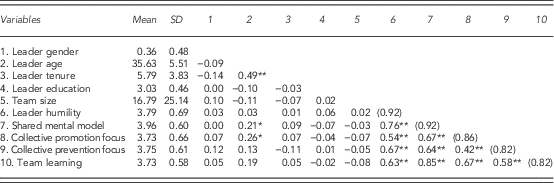
Table 1 presents the mean, standard deviations of each variable, and correlations between the variables. As shown in the table, leader humility was positively related to shared mental model (r=0.76, p<.01) and team learning (r=0.63, p<.01). In addition, shared mental model was positively related to team learning (r=0.85, p<.01). These results provided initial support for our Hypotheses 1 and 2.
Means, SD, and correlations

Notes: n=89.
Cronbach’s α appears along the diagonal in the brackets.
Gender is coded ‘0’=male, ‘1’=female.
*p<.05, **p<.01, two-tailed.
Discriminant validity
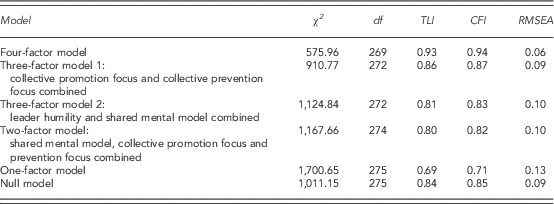
We conducted a confirmatory factor analysis model to test the discriminant validity of all of our independent variables. The results are presented in Table 2. As shown in the table, the four-factor model demonstrated a good fit to the data (χ2 (269)=575.96, p<.01; comparative fit index=0.94; Tucker–Lewis index=0.93; root mean square error of approximation=0.06) and all of the factor loadings were significant, indicating that the model had acceptable convergent and discriminant validities.
Results of confirmatory factor analysis for the measures of the variables studied

CFI=comparative fit index; RMSEA=root mean square error of approximation; TLI=Tucker–Lewis index.
Comment method bias and multicollinearity test
Although the variables were measured in two waves, the problem of a common method bias might still be present. We used Harman’s single factor to test the common method bias. This method is one of the most widely used by researchers to address the issue of common method bias (Podsakoff, MacKenzie, Lee, & Podsakoff, 2003). Six factors emerged from the factor analysis. The first unrotated factor contributed 42.5% of the covariance among the measures, does not exceed 50%. Therefore, the estimation bias caused by the common method bias was slight and not significant. In addition, because the correlations between some of the variables were relatively high, such as leader humility and shared mental model, we also conducted regression analyses on team learning with all of the related variables added into the model to test multicollinearity. The variance inflation factors were examined in the regression analyses to determine whether multicollinearity was operating. The highest variance inflation factor was 3.25. According to Neter, Wasserman, and Kutner (Reference Neter, Wasserman and Kutner1990) suggestion, these statistics indicate that multicollinearity is unlikely to be problematic.
Tests of hypotheses
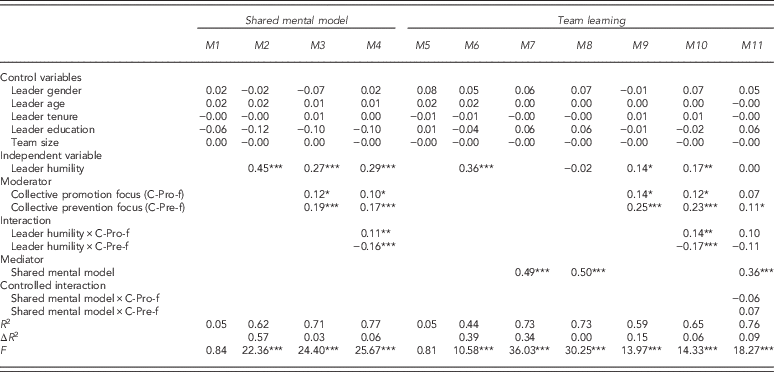
As all of the variables were at the team level, we employed a hierarchical regression for the data analysis. Some top journal researchers who focus on team-level factors have also employed this method to conduct data analyses (e.g., Dirks, 2000; Kirkman, Rosen, Tesluk & Gibson, 2004). We conducted a linear regression model to test our hypotheses step-by-step. First, the control variables were added to the model. Second, we added leader humility and followed with the shared mental model to test the direct and indirect effects. Finally, we added the collective promotion focus, collective prevention focus, and interaction terms to test the moderating effects of Hypotheses 3 and 4. Table 3 presents the regression results. As shown in the table, the coefficient of leader humility was significant (r=0.36, p<.001; ΔR 2=0.39; Model 6), and adding leader humility accounted for a 39% increase in the interpretation power relative to the control model (R 2=0.05; F=81, ns; Model 5). Hence, Hypothesis 1, which proposed that leader humility was positively related to team learning, was supported. Hypothesis 2 proposed that the shared mental model mediated the relationship between leader humility and team learning. As shown in Table 3, the shared mental model was positively related to team learning (r=0.49, p<.001; ΔR 2=0.34; Model 7). After adding leader humility, the coefficient of the shared mental model was still significant, whereas the coefficient of leader humility was no longer significant (r 1=−0.02, ns; r 2=0.50, p<.001; Model 8). These results supported Hypothesis 2.
Results of hierarchical regression analyses

Notes: n=89.
*p<.05, **p<.01, ***p<.001, two-tailed.
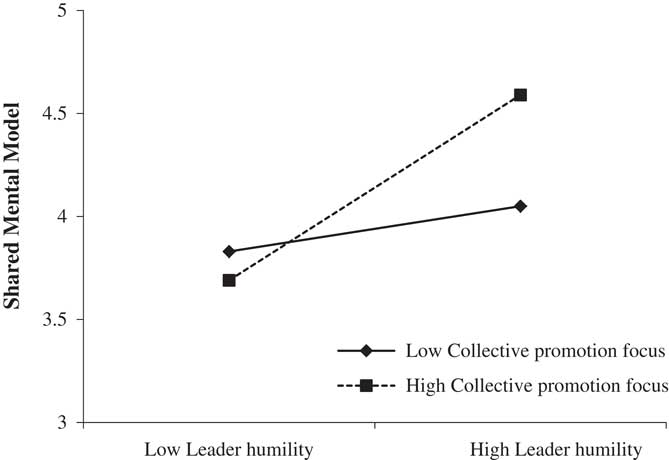
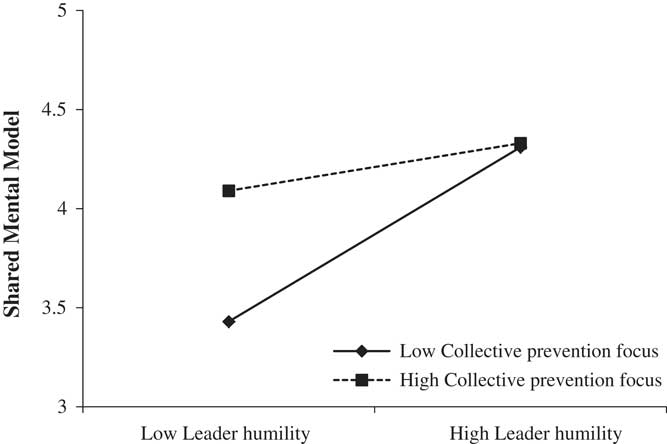
Hypotheses 3a and 3b proposed that a team’s regulatory focus moderated the relationship between leader humility and shared mental model. As shown in Model 4, the coefficient of the interaction terms of leader humility×collective promotion focus and leader humility×collective prevention focus were significant (r 1=0.11, p<.01; r 2=−0.16, p<.001; Model 4). Adding the interaction terms accounted for a 15% increase in the interpretation power relative to Model 2. In addition, following Aiken and West’s (1991) method, we plotted the interaction effect in both the high (i.e., 1 SD above the mean) and low (i.e., 1 SD below the mean) situations according to the coefficients in Model 4. As shown in Figure 1, the positive relationship between leader humility and shared mental model was much more distinct in high collective promotion focus (β=0.39, p<.001) then low collective promotion focus (β=0.18, p<.05). As shown in Figure 2, the positive effect of leader humility on shared mental model was more distinct in low collective prevention focus (β=0.44, p<.001) rather than in high collective prevention focus (β=0.13, ns). Taking these results into consideration, Hypotheses 3a and 3b were supported.
Interaction of leader humility and collective promotion focus on shared mental model

Interaction of leader humility and collective prevention focus on shared mental model

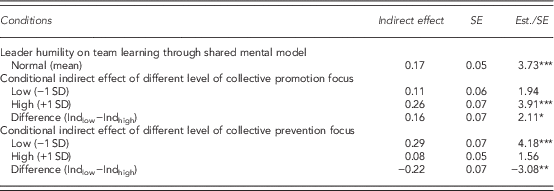
Hypotheses 4a and 4b proposed that the shared mental model mediated the interactive effect of leader humility and collective regulatory focus on team learning. As shown in Model 10, the coefficient of the interaction terms of leader humility×promotion focus (r=0.14, p<.01) and leader humility×prevention focus (r=−0.17, p<.001) were significant. However, after adding shared mental model into the model, the coefficient of leader humility and the interaction terms were no longer significant, indicating that shared mental model mediated the interaction effects. To confirm these mediated moderation effects further, we used the bootstrap method to conduct indirection effect tests in different situations using Mplus 6.0. The results are presented in Table 4. As shown in the table, the interaction effects were significant in both high collective promotion focus (Ind=0.26, p<.001) and low collective prevention focus (Ind=0.29, p<.001). The slope difference between the high and low situations were significant for both collective promotion focus (Inddiff=0.16, p<.05) and collective prevention focus (Inddiff=−0.22, p<.01).
Indirect effects test of different conditions (bootstrap=2,000)

Notes: n=89.
*p<.05, **p<.01; ***p<.01, two-tailed.
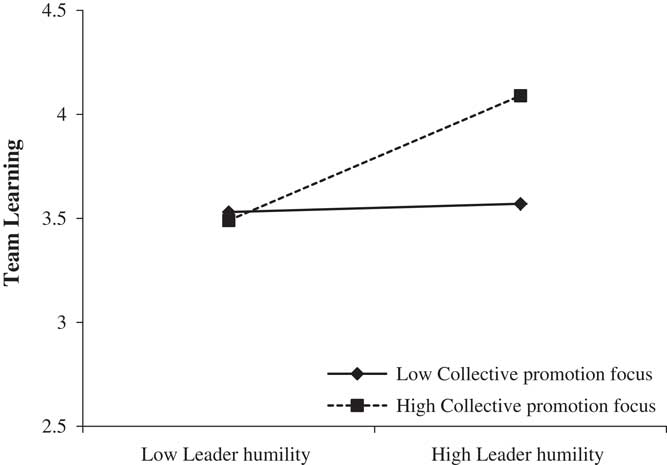
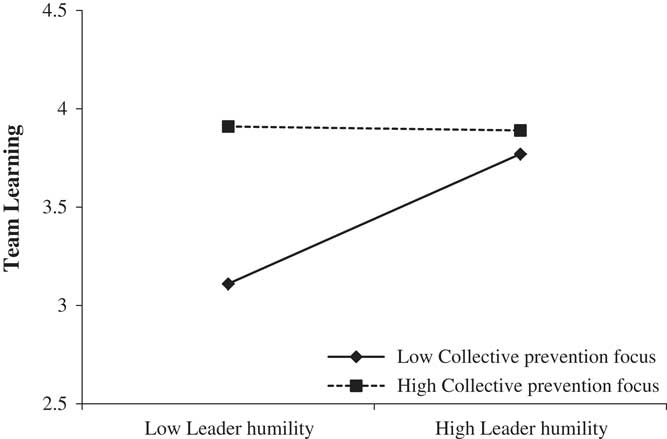
We plotted the indirect effects of leader humility on team learning in both of the regulatory situations. As shown in Figure 3, the positive relationship between leader humility and team learning was more distinct in high collective promotion focus than in low collective promotion focus. Figure 4 indicated that the relationship between leader humility and team learning was more positive in low collective prevention focus then in high collective prevention focus. Therefore, Hypotheses 4a and 4b were strongly supported.
Interaction of leader humility and collective promotion focus on team learning

Interaction of leader humility and collective prevention focus on team learning

DISCUSSION
Previous studies have argued that leader humility has different effects on team behaviors and organizational outcomes such as team learning (Owens & Hekman, Reference Owens and Hekman2012). However, most of these arguments lack the support of empirical evidence. Therefore, scholars have called for the exploration of the effects of leader humility on some organizational outcomes as well as the mechanisms (Owens, Johnson, & Mitchell, Reference Owens, Johnson and Mitchell2013). To answer this call, our study examined the relationship between leader humility and team learning and explored the meditating and moderating effects of leader humility on team learning to reveal when and why leader humility helps teams to learn. Our findings confirm that leader humility is strongly related to team learning, and this relationship is mediated by a shared mental model. In other words, the reason that humble leaders are able to lead teams’ learning is because of forming a shared mental model. The behaviors of humble leaders can form and shape the shared cognition of the team, which help teams learn. In addition, a team’s collective regulatory focus moderates the indirect effect of leader humility on team learning via a shared mental model, such that the indirect effect is amplified for teams with a collective promotion focus. In turn, this indirect effect is weakened for teams with a collective prevention focus.
Theoretical implications
The present study contributes to the extant theory in a number of ways. First, our study represents the first study to link leader humility and team learning. To our knowledge, although previous studies have mentioned that leader humility can promote team learning behaviors, scant of studies have considered this effect directly. Reviewing previous literatures, we found that past studies had examined how leader humility benefitted team and individual performances (Owens & Hekman, Reference Owens and Hekman2012, 2013), increased team members’ job satisfaction and engagement, and promoted followers’ creativity and innovation (e.g., Owens, Johnson, & Mitchell, Reference Owens, Johnson and Mitchell2013). Although some scholars stated that leader humility is not only teachable, but can also facilitate team members to learn (Morris, Brotheridge, & Urbanski, Reference Morris, Brotheridge and Urbanski2005; Owens, Rowatt, & Wilkins, 2011; Owens, Johnson, & Mitchell, Reference Owens, Johnson and Mitchell2013), little attention has been paid to examining this effect. Our study provides empirical evidence to support that leader humility can lead teams to learn effectively due to the formation of a shared mental model among team members.
Second, our study contributes to the literature by connecting leader humility with team learning from the shared cognitive perspective. Previously, Owens, Johnson, and Mitchell (Reference Owens, Johnson and Mitchell2013) examined job satisfaction as a mediator linking leader humility and voluntary turnover. This study proposes a mechanism that links leader humility and organizational outcomes from the perspective of the individual’s attitude, as well as the collective attitude. In addition, a study conducted by Owens and Hekman (Reference Owens and Hekman2016) verified that collective humility plays an important role in the process of leader humility as collective humility is related to promoting team performance. Their study suggested a mechanism from the team process perspective to reveal why leader humility has a positive effect on team performance. However, our findings indicate that team members’ collective cognition serves as an important mechanism for leader humility to bring about positive outcomes. Hence, our study contributes to the literature by providing a new angle related to understanding leader humility.
Third, our study contributes to the leader humility theory by examining the moderating factors between leader humility and team learning. As argued by Owens, Johnson, and Mitchell (Reference Owens, Johnson and Mitchell2013), although scholars have called for leaders in teams to behave humbly, little empirical research has been conducted to understand the impact of the humble leader on important organizational outcomes. Scholars have suggested exploring some boundary factors to understand the effects of leader humility on critical organizational outcomes. Our findings suggest that a team’s regulatory focus plays an important moderating role between leader humility and team learning. Previous studies that have attempted to explore the boundary conditions of leader humility have only examined limited variables, such as general mental ability (Owens, Johnson, & Mitchell, Reference Owens, Johnson and Mitchell2013). These studies have considered the boundary conditions from the perspectives of personality and pressure, while our study reveals that team regulatory focus should also be considered important boundary contexts in regard to understanding the effective mechanism of leader humility.
Managerial implications
Our findings offer some important implications for managers and organizations. First, our results indicate that leaders play critical roles in regard to leading team learning. Therefore, managers in modern enterprises, where knowledge is important, can use the leader humility theory to stimulate team learning; specifically, managers should have a ground view of themselves, have an objective understanding of their own strengths and limitations, and encourage employees to participate in decision-making. It is important for managers to keep teachable manners, value others’ suggestions and contributions, and openly learn from others (Morris, Brotheridge, & Urbanski, Reference Morris, Brotheridge and Urbanski2005; Owens & Hekman, Reference Owens and Hekman2012; Owens, Johnson, & Mitchell, Reference Owens, Johnson and Mitchell2013). Such behaviors can cause leaders to become role models for team members and make team members express humility to others, which, in turn, may help them form collective humility climates on their teams (Owens & Hekman, Reference Owens and Hekman2016). Such climates will convince team members to learn each other’s limitations and strengths, as well as learn from each other in a humble manner, which will ultimately enhance team learning.
In addition, as strong links exist between team learning and shared mental models, our findings indicate that leaders can promote team learning via the promotion of shared mental models. As shared mental models can help team members learn their peers’ core expertise and behavior styles, these models will help the team members determine who to go to when they come across problems. As this shared knowledge and cognition is shaped by leader humility, the shared mental model helps to form a teachable and harmonious context, which promotes team members’ abilities to value other team members’ ideas and suggestions. These abilities promote team learning. As such, organizations should be designed in such a way as to encourage employees’ participation in decision-making and knowledge sharing. These tools are important for advancing shared mental models (DeChurch & Mesmer-Magnus, Reference DeChurch and Mesmer-Magnus2010).
Our results also indicate that the relationship between leader humility and team learning is strengthened in a team with a collective promotion focus. Therefore, managers and organizations should pay attention to the boundary effects of teams’ collective regulatory focuses. Managers should encourage teams to form collective promotion focuses instead of collective prevention focuses. As collective promotion focuses emphasize team members’ focusing on what to achieve rather than what may go wrong, managers could create contexts that provide more psychological freedom to employees and encourage them to pay attention to the improvement, growth, and advancement of their jobs. Managers could also encourage employees to take risks and provide support and resources to employees who make efforts to achieve the teams’ goals. Finally, organizations should be designed in such a way as to create contexts that motivate employees to achieve goals and prove their own abilities, such as delineating visions of their organizations or teams toward greatness because of their efforts.
Limitations and future research directions
The present study intends to link leader humility and team learning, as well as explore potential moderating factors. However, some limitations exist in the research process. First, although the data were collected at three different time points, all of the questionnaires were rated by employees and then aggregated to the team level, which may bring about common method biases. While Conway and Lance (Reference Conger and Kanungo2010) argued that it is a misconception that rating sources (e.g., the self and the other) constitute measurement methods and that, if the variables are rated by the right person, a common bias will be decreased, some researchers have insisted that data from different sources are superior to data from the same source (e.g., Judge & Hulin, Reference Judge and Hulin1993). As such, future research may wish to repeat this study and examine our findings using other methods, such as experimentation and simulation.
In addition, the shared mental model can be measured using different methods, such as concept mapping, similarity rating, and cart sorting. Different types of shared mental models, such as task-related and team-related models, have also been proposed by some researchers (e.g., Mathieu et al., Reference Mathieu, Heffner, Goodwin, Salas and Cannon-Bowers2000). Our study only concentrated on the team-related shared mental model, which focuses on team skills and team communication skills (Johnson et al., Reference Johnson, Lee, Lee, O’Connor, Khalil and Huang2007). Future studies may use different measurements in order to examine whether differences exist among different types of shared mental models, thus serving as a mediator between leader humility and team learning.
In order to broaden our understanding of the leader humility theory further, future research could study this theory from several angles. First, scholars could explore other mechanisms from different perspectives to reveal how and why leader humility affects team learning. For example, humble leaders’ behaviors, such as having a ground view of their own selves and valuing others’ suggestions and contributions, may stimulate changes in the social network among team members. By doing so, future researchers could reveal differences within the social network between teams with leader humility and teams with leaders following other leadership styles.
Second, because the concept of leader humility was only recently proposed and accepted by scholars, additional quantitative work must be completed in order to understand the influence of this leadership style on important organizational outcomes (Owens, Johnson, & Mitchell, Reference Owens, Johnson and Mitchell2013). In addition, exploring other critical boundary factors is important to expanding this theory. For example, goal orientation, power distance, and the abilities of leaders can also be considered moderating factors. These factors focus on different aspects of the organizational context.
Third, cultural differences should also be considered important factors. People from different cultures may have different responses to the same leader humility behaviors. Moreover, the definition of humility varies across different culture contexts. As such, future studies could pay attention to the critical differences caused by cultures as related to applying certain theories.
Acknowledgements
This paper was funded by National Natural Science Foundation of China, project numbers: 71502175, 71172090, 71572066, 71232001, and National Social Science Fund of China: No. 14BGL199, No. 10YJC630386.