INTRODUCTION
Ligand-gated chloride channels (LGCCs) are a group of neurotransmitter receptors responsible for mediating fast inhibitory neurotransmission in both vertebrates and invertebrates (Unwin, Reference Unwin1993; Raymond and Sattelle, Reference Raymond and Sattelle2002). These channels are members of the cysteine or Cys-loop family of ligand-gated ion channels (LGICs) which includes both cation and anion channel members. Individual subunits that form these channels have a standard architecture which includes a large N-terminal ligand-binding domain, containing the Cys-loop, as well as 4 hydrophobic membrane-spanning domains (Ortells and Lunt, Reference Ortells and Lunt1995). Five of these subunits are arranged in a ring that forms a central aqueous pore in the plasma membrane of cells. In mammals, the anion channel members of this family include γ-aminobutyric acid (GABA) and glycine-gated chloride channels (Ortells and Lunt, Reference Ortells and Lunt1995). However, in invertebrates, particularly nematodes and arthropods, there appears to be a more diverse group of LGCC subunit types (Raymond and Sattelle, Reference Raymond and Sattelle2002). Molecular cloning and pharmacological characterization have unveiled several members of this family, which include channels activated by GABA (Bamber et al. Reference Bamber, Beg, Twyman and Jorgensen1999; Feng et al. Reference Feng, Hayashi, Beech and Prichard2002), glutamate (Cully et al. Reference Cully, Vassilatis, Liu, Paress, Van der Ploeg, Schaeffer and Arena1994; Dent et al. Reference Dent, Davis and Avery1997; Horoszok et al. Reference Horoszok, Raymond, Sattelle and Wolstenholme2001), serotonin (Ranganathan et al. Reference Ranganathan, Cannon and Horvitz2000), histamine (Gisselmann et al. Reference Gisselmann, Pusch, Hovemann and Hatt2002; Zheng et al. Reference Zheng, Hirschberg, Yuan, Wang, Hunt, Ludmerer, Schmatz and Cully2002), acetylcholine (Putrenko et al. Reference Putrenko, Zakikhani and Dent2005) and even changes in pH (Schnizler et al. Reference Schnizler, Saeger, Pfeffer, Gerbaulet, Ebbinghaus-Kintscher, Methfessel, Franken, Raming, Wetzel, Saras, Pusch, Hatt and Gisselmann2005). The role(s) of this diverse array of subunit types in the inhibitory nervous system of invertebrates, such as nematodes, is currently unknown. It is possible that these channels, in addition to a presumed neurotransmission role, serve a chemosensory role (Dent, Reference Dent2006), analogous to the prokaryote LGIC-like proteins which have been suggested to play a role in chemotaxis (Tasneem et al. Reference Tasneem, Iyer, Jakobsson and Aravind2004).
Much of the current knowledge on the diversity of LGCCs in nematodes has emerged from research on the free-living nematode Caenorhabditis elegans, which has been used largely as a model for studying receptor function in parasitic nematodes. The completion of the C. elegans genome sequencing project (The C. elegans Sequencing Consortium, 1998) unveiled a large number of LGCC subunit genes, which encode many channels of unknown function. Recent evidence based on amino-acid sequence data suggests that there are at least 6 groups of LGCCs in C. elegans; these include 3 groups of GABA receptors, the glutamate-gated chloride channels (GluCls), the serotonin/acetycholine chloride channels and a group of orphan channels, referred to as ‘C. elegans Group 1’ which appears to be unique to nematodes (Dent, Reference Dent2006). Interestingly, the latter group is characterized as having a putative second cysteine loop in the ligand-binding domain which is shared only with glycine, glutamate and histamine-gated chloride channels and is thought to be important for ligand-binding (Rajendra et al. Reference Rajendra, Vandenberg, Pierce, Cunningham, French, Barry and Schofield1995).
Investigations into the function of LGCC subunits in parasitic nematodes have emerged largely through studies of the mode of action of the anti-parasitic drug ivermectin (Wolstenholme and Rogers, Reference Wolstenholme and Rogers2005). Research in this area has lead to the identification and characterization of several ivermectin receptors, specifically GluCls, from various parasitic nematodes, including Haemonchus contortus (=the barber's pole worm of small ruminants), Cooperia oncophora, Cylicocyclus nassatus, Ascaris suum and Dirofilaria immitis (see Delany et al. Reference Delany, Laughton and Wolstenholme1998; Forrester et al. Reference Forrester, Hamdan, Prichard and Beech1999; Jagannathan et al. Reference Jagannathan, Laughton, Critten, Skinner, Horoszok and Wolstenholme1999; Njue et al. Reference Njue, Hayashi, Kinne, Feng and Prichard2004; Yates and Wolstenholme, Reference Yates and Wolstenholme2004b; Tandon et al. Reference Tandon, LePage and Kaplan2006). However, apart from the GluCls and a couple of other LGCC polypeptide sequences (Laughton et al. Reference Laughton, Amar, Thomas, Towner, Harris, Lunt and Wolstenholme1994; Yates and Wolstenholme, Reference Yates and Wolstenholme2004a), relatively little is known about the diversity of LGCCs in parasitic nematodes. A comprehensive understanding of the various LGCC subtypes may unveil new anthelmintic targets (Raymond and Sattelle, Reference Raymond and Sattelle2002).
As part of an ongoing investigation into the inhibitory nervous system of parasitic nematodes, this paper describes the cloning of a novel member of the LGCC gene family from H. contortus called HcLGCC1 (H. contortus ligand-gated chloride channel 1). Amino-acid sequence analysis suggests that HcLGCC1 is a member of the Cys-loop family of channels and is anion selective. Furthermore, the N-terminal ligand-binding domain of HcLGCC1 exhibits an extra pair of cysteine residues which is shared only with glycine, glutamate and histamine-gated chloride channels.
MATERIALS AND METHODS
Synthesis of cDNA
H. contortus adult worms were provided by Professor Roger Prichard (Institute of Parasitology, McGill University). RNA was isolated using Trizol (Invitrogen), and cDNA was constructed using the RevertAid™ minus first strand cDNA synthesis kit (Fermentas). A modified oligo-dT anchor primer (5′CCTCTGAAGGTTCACGGATCCACATCTAGATTTTTTTTTTTTTTTTTTVN3′; where V is either A, C, or G and N is either A, C, G, or T) (Weston et al. Reference Weston, Patel and Van Voorhis1999) was used to construct the cDNA used for the isolation of HcLGCC1.
Cloning and sequencing
To isolate novel LGCC gene sequences from H. contortus, several known LGCC genes from C. elegans, Drosophila melanogaster and humans were used to search for raw H. contortus genome sequence reads using the server at the Sanger Institute, Cambridge, UK (http://www.sanger.ac.uk/cgi-bin/blast/submitblast/h_contortus). Using this approach, several sequences with similarity to the LGCC family were identified (data not shown). One sequence (haem-250o10.p1k) was used for the design of gene-specific primers for 5′ and 3′ rapid amplification of cDNA ends (RACE) (Frohman et al. Reference Frohman, Dush and Martin1988).
To isolate the 3′ end of HcLGCC1, 2 gene-specific forward primers and 2 reverse primers that target the anchor sequence incorporated by the modified oligo-dT anchor primer, were used in a nested PCR using a PTC-100 Programmable Thermal Controller (MJ Research, Inc). Cycling conditions were 20 sec at 94°C; 30 sec at 55°C; 1 min at 72°C for 29 cycles and a final 5 min extension at 72°C. The resultant amplicon of the expected size was subcloned into the plasmid vector pGEM-T Easy (Promega) and sequenced. To amplify the 5′ end of HcLGCC1, a sense primer that targets the nematode splice leader 2 (SL2) sequence (Huang and Hirsh, Reference Huang and Hirsh1989) together with 2 gene-specific reverse primers were used in a nested PCR under the same cycling conditions as employed for the 3′ RACE. An amplicon of the expected size was subcloned and sequenced. Based on the sequences obtained, the full-length cDNA fragment was amplified using gene-specific primers to the 5′ and 3′ untranslated regions (UTR) in a nested PCR.
Sequence analyses
Database searches were used to determine overall sequence similarity. For phylogenetic analysis, several LGCC subunit sequences from different species were aligned using the program MacVector (MacVector Inc., North Carolina, USA), and the resultant alignment was edited to remove gaps and adjusted manually to maximize the homology. The resultant 130 residues containing conserved regions of the N-terminal domain and transmembrane regions (M1–M4) were then subjected to phylogenetic analysis using the neighbour-joining (NJ) algorithm in MacVector.
Reverse transcription-PCR (RT-PCR)
The transcription of the HcLGCC1 gene was examined using RT-PCR. Total RNA (1·2 μg) from H. contortus eggs, third-stage larvae (L3) and adult males was DNAse-treated (Fermentas) and then subjected to reverse transcription, followed by a standard PCR (20 sec 94°C, 30 sec 55°C, 30 sec 72°C, 35 cycles) using primers designed to amplify a 326 bp fragment of the HcLGCC1 cDNA. The sense primer sequence was 5′TTTTGGATTGCCTCAAGTCAGC3′ and the antisense primer sequence was 5′TGGATGAACGACCACCTTTCG3′. Each sample was tested simultaneously (in a separate reaction) by PCR using a house-keeping gene (α-tubulin) (GenBank Accession No. L02108) to monitor the quality of the cDNA synthesized. The sense primer to the α-tubulin gene was 5′GCCAAATGCCGTCAGATAAATC3′ and the antisense primer was 5′ACACAAGGAAACCCTGGAGTCC3′. PCRs were performed in triplicate. Experiments were repeated using a second batch of cDNA samples representing all of the life-stages listed above, employing the phosphofructokinase (house-keeping) gene (GenBank Accession no. M59805) as a control.
RESULTS
Using a modified oligo-dT anchor primer and the 5′ and 3′ RACE procedures, a 1758 bp cDNA, designated HcLGCC1, was isolated. This cDNA was predicted to include 50–150 bp of UTR at the 5′ end. There was some length variation in the 5′ RACE clones; 4 clones had 52 bp of UTR, 2 had 100 bp, and 1 had 136 bp (data not shown). However, the start of the coding sequence of these 5′ RACE clones was the same. The 3′ end contained 80 bp of UTR including a poly-adenylation signal sequence before ending with a poly-A tail.
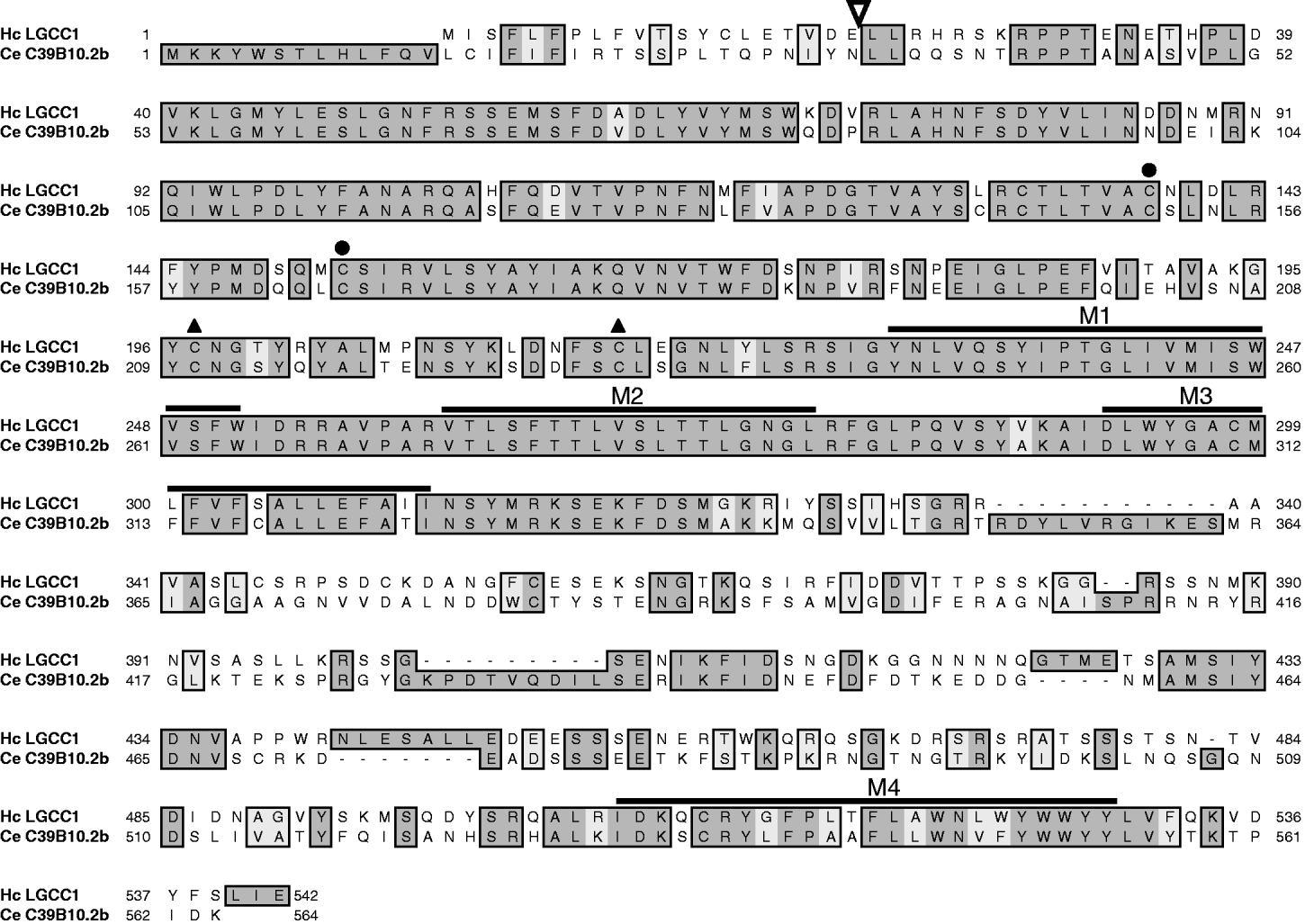
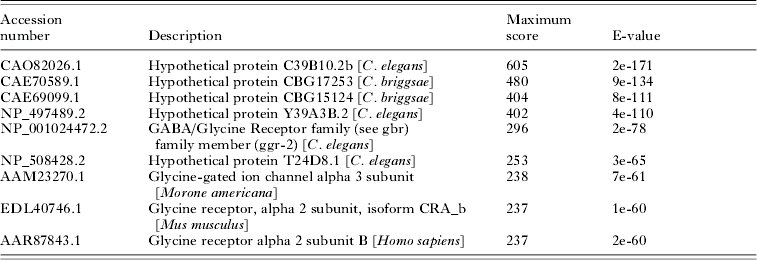
The predicted open reading frame of HcLGCC1 encodes a polypeptide of 542 amino acids. The amino acid sequence was analysed using the CBS prediction server (http://www.cbs.dtu.dk/services) and predicted to contain an N-terminal signal peptide sequence (Nielsen et al. Reference Nielsen, Engelbrecht, Brunak and von Heijne1997) and 4 hydrophobic membrane-spanning domains (M1-4) (Fig. 1). BLASTp analysis indicated that HcLGCC1 was most similar to an uncharacterized putative LGCC subunit from C. elegans (code C39B10.2b), with an overall amino acid sequence similarity of 66% (Fig. 1). Other ‘top hits’ included some uncharacterized C. elegans subunits, a C. elegans subunit designated GABA/glycine receptor (GGR-2), and various vertebrate glycine receptors (see Table 1). Comparison of HcLGCC1 and C39B10.2b revealed that, although the two sequences shared a high degree of similarity in the N-terminal ligand-binding domain and the membrane-spanning domains, the sequences diverged considerably in the large putative loop between regions M3 and M4 (Fig. 1).
Amino acid sequence alignment of HcLGCC1 with the Caenorhabditis elegans polypeptide C39B10.2b. The 2 cysteine residues that make up the cysteine loop (CX13C) are indicated (●). Two additional cysteine residues that form a putative second cysteine loop are also indicated (▲). The 4 membrane-spanning domains (M1–M4) are underlined and the predicted signal peptide cleavage site is indicated by ( ). Dark shading indicates identity and light shading indicates similarity. Sections of amino acid sequence that are present in only 1 of the 2 sequences are also shaded.

BLASTp search results using the HcLGCC1 polypeptide sequence. For space limitations, not all of the “top hits” were included.

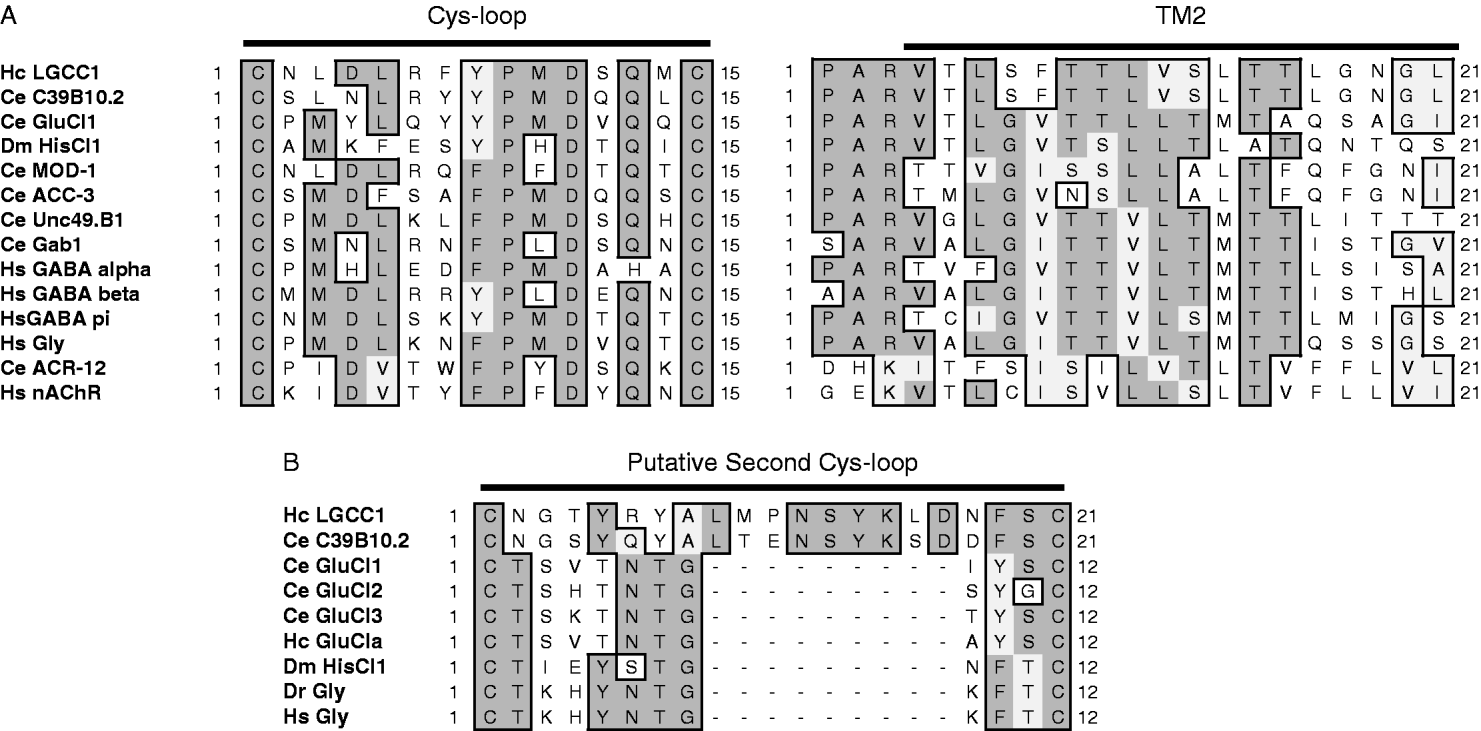
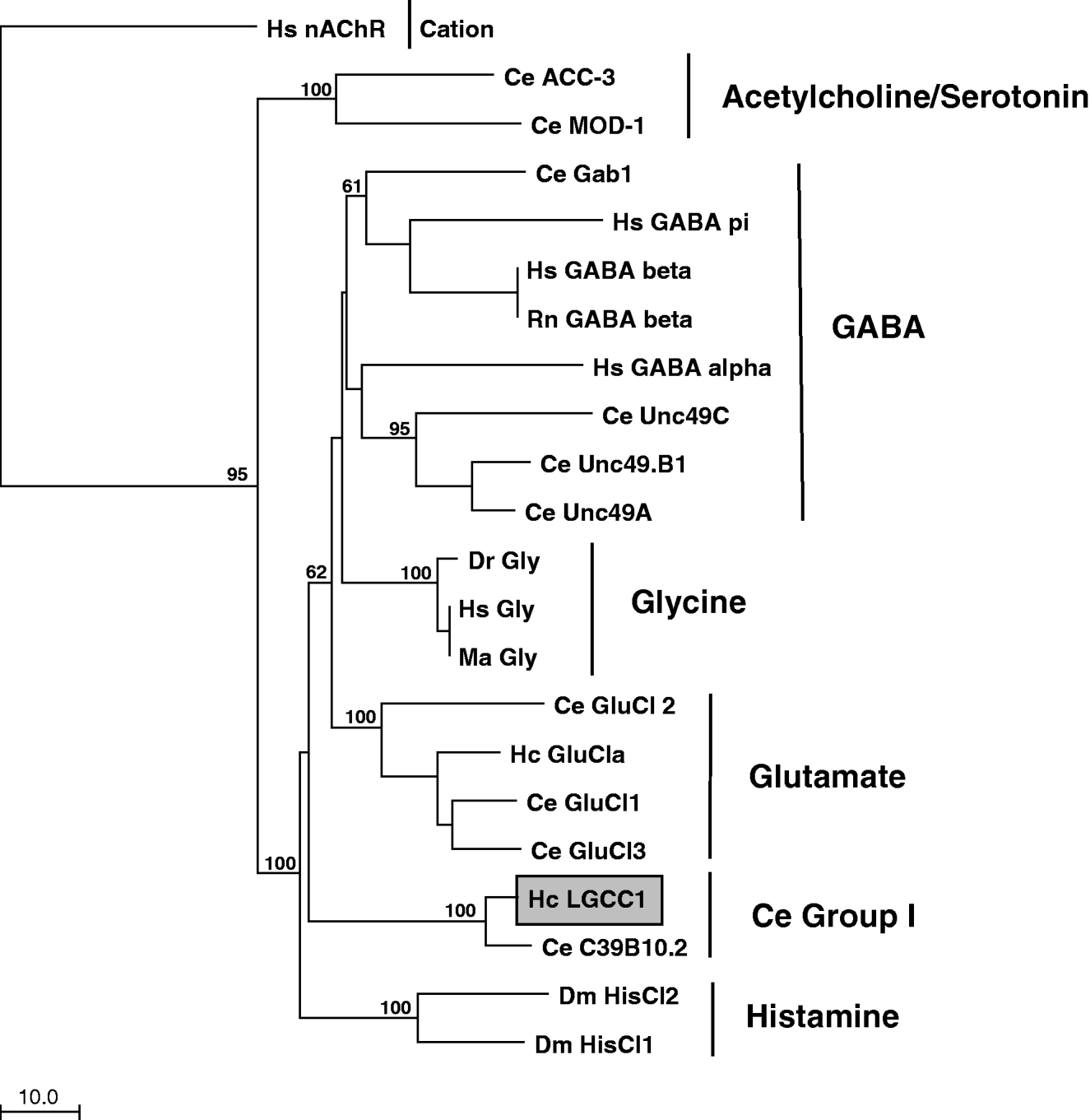
The N-terminal ligand-binding domain contained 2 cysteine residues, separated by 13 amino acids (CX13C), which forms a loop which is conserved among all LGICs representing the Cys-loop family of channels (see Figs 1 and 2A). The ligand-binding domain also contained 2 additional cysteine residues that may form a second Cys-loop. This putative second loop in HcLGCC1 was 71% identical to C39B10.2 and 10 residues larger than the other LGCC subunits used for comparison (Fig. 2B). The M2 region, which determines ion selectivity, exhibits the PAR-motif which is characteristic of anion channels (Galzi et al. Reference Galzi, Devillers-Thiery, Hussy, Bertrand, Changeux and Bertrand1992) (Fig. 2A). Phylogenetic analysis revealed that HcLGCC1 was most closely related to C39B10.2 (100% bootstrap support). These two subunits did not group with any of the previously characterized LGCCs, but instead formed a unique group within the LGCC family (Fig. 3).
Key elements of the HcLGCC1 polypeptide in comparison to other LGIC sequences. (A) Alignment of the Cys-loop and M2 region of HcLGCC1 and various anion and cation channels. The Caenorhabditis elegans nicotinic acetylcholine receptor (Ce ACR-12) and human nicotinic acetylcholine receptor (Hs nAChR) are included for comparison. (B) Alignment of the putative second Cys-loop of HcLGCC1, Ce C39B10.2 and glycine, glutamate and histamine-gated chloride channels. Dark shading indicates identity and light shading indicates similarity. The GenBank Accession numbers of the sequences included in the analysis are as follows: Ce C39B10.2 (NP_509753), Ce GluCl 1 (AAA50785), Ce GluCl 2 (NP_491470), Ce GluCl 3 (CAB51708), Hc GluCla (AAD13405), Dm HisCl 1 (AAL66186), Ce MOD-1 (NP_741580), Ce ACC-3 (AAW34234), Ce Unc49.B1 (AAD42383), Ce Gab 1 (O18276), Hs GABA alpha (P14867), Hs GABA beta (NP_000803), Hs GABA pi (NP_055026), Hs Gly (AAC39919), Dr Gly (NP_571477), Ce ACR-12 (AAC98095), Hs nAChR (NP_000734).

Phylogenetic analysis of various members of the LGCC family. Hs nAChR is used as an out-group and HcLGCC1 is shaded. Bootstrap values are indicated. The GenBank Accession numbers of the sequences included in the analysis are as follows: Hs nAChR (NP_000734), Ce ACC-3 (AAW34234), Ce MOD-1 (NP_741580), Ce Gab1 (O18276), Hs GABA pi (NP_055026), Hs GABA beta (NP_000803), Rn GABA beta (NP_037088), Hs GABA alpha (P14867), Ce Unc49C (AAD42386), Ce Unc49B.1 (AAD42383), Ce Unc49A (AAD42382), Dr Gly (NP_571477), Hs Gly (AAC39919), Ma Gly (AAM23270), Ce GluCl 2 (NP_491470), Hc GluCla (AAD13405), Ce GluCl1 (AAA50785), Ce GluCl3 (CAB51708), Ce C39B10.2 (NP_509753), Dm HisCl2 (AAL66188), Dm HisCl1 (AAL66186).

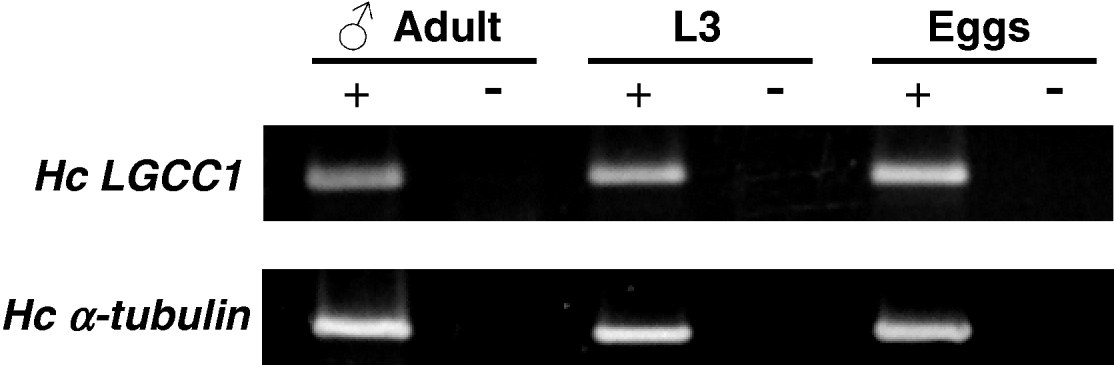
HcLGCC1 transcripts were reproducibly detected in 3 developmental stages of H. contortus (eggs, L3 and adult male). No PCR products were detected in negative controls that lacked reverse transcriptase, confirming that there was no genomic DNA contamination in the cDNA samples (Fig. 4). Similar results were obtained using the phosphofructokinase gene as a house-keeping gene.
Reverse transcription-PCR analysis of HcLGCC1 transcripts in adult male, third-stage larvae (L3) and eggs of Haemonchus contortus; α-tubulin (Hc α-tubulin) was used as a control house-keeping gene to determine cDNA quality. Samples were generated by either the presence (+) or absence (−) of reverse transcriptase. Experiments were performed in triplicate.

DISCUSSION
A novel member of the LGCC family from the parasitic nematode H. contortus was identified and characterized. HcLGCC1 was predicted to encode an anion-selective channel, being a member of the Cys-loop family of subunits. Analyses suggested that HcLGCC1 is a member of the ‘C. elegans Group I’ family of subunits, characterized as having a putative second cysteine loop which is also present in glutamate, histamine and glycine-gated chloride channels (Dent, Reference Dent2006). Interestingly, this second loop in HcLGCC1 and its predicted C. elegans orthologue, C39B10.2b, are 71% identical suggesting functional similarity. However, while HcLGCC1 is clearly similar in sequence to C39B10.2b, it is not yet known whether the two polypeptides have the same function in vivo. HcLGCC1 and C39B10.2b may each form a homomeric channel in vivo or partner with a different set of subunits from the same clade to form a hetero-multimeric channel. The identification and characterization of other H. contortus subunits from this clade may allow us to determine the function of this group of channels.
HcLGCC1 transcripts were readily detected in all developmental stages, suggesting that this gene is important for both free-living and parasitic stages of H. contortus. The expression of HcLGCC1 in the egg stage of H. contortus suggests that this gene is essential for the early developmental stages of the parasite (possibly L1 to L3). However, currently, we can only speculate as to the in vivo function of HcLGCC1. It is possible that this subunit forms a chloride channel that is activated by a neurotransmitter, for example, that regulates neuron firing responsible for larval movement. On the other hand, the subunit may have additional or other specific functions. In addition, the specific function of C39B10.2b remains to be determined, as no phenotypic effects have been recorded by gene silencing (i.e. RNA interference) (see WormBase; www.wormbase.org). Therefore, the localization of HcLGCC1 subunits to specific tissues and functional characterization are required.
Analysis of the diversity of LGCCs in parasitic nematodes, such as H. contortus and C. elegans, should provide insights into the evolution of these channels in invertebrates. In addition, comparisons of neurotransmitter receptors, such as LGCCs, between parasitic and free-living nematodes may provide further information on the divergence of these different life-styles. While free-living and parasitic nematodes share orthologous genes for several LGCC subunits, there are at least 2 subunits, namely HcGluCla and Di-LGR-1, which appear to be unique to parasitic nematodes (Forrester et al. Reference Forrester, Hamdan, Prichard and Beech1999; Yates and Wolstenholme, Reference Yates and Wolstenholme2004a). Whether chloride channels such as these reflect differences between a parasitic and free-living life-style requires further investigation. Therefore, a functional analysis of this large group of LGCCs will elucidate the various roles that they serve in the biology of parasitic nematodes, which could assist the discovery of new anthelmintic targets.
The authors thank Vijay Rao for extracting the H. contortus RNA used in the RT-PCR experiments and Meetu Bhogal for conducting some of the preliminary work. This research was funded by grants from the Natural Science and Engineering Research Council of Canada (NSERC) and the Canadian Foundation for Innovation (CFI) to S. G. F.