Introduction
Osteoarthritis (OA) is the most common of the joint disorders affecting older people.Reference Felson, Naimark and Anderson 1 It has been estimated that OA affects over 26 million people in the United States, and around 1.6–3.4 million in England and Wales.Reference Lawrence, Felson and Helmick 2 , Reference Lord, Victor, Littlejohns, Ross and Axford 3 The economic burden of OA is significant, largely due to the effects of disability associated with OA, along with comorbid diseases and the cost of treatment.Reference Lord, Victor, Littlejohns, Ross and Axford 3
OA is a degenerative joint disease, involving the articular cartilage and many of the surrounding tissues.Reference Litwic, Edwards, Dennison and Cooper 4 OA occurs when the equilibrium between breakdown and repair of joint tissue is disrupted, leading to the loss of articular cartilage, remodelling of subchondral bone, osteophyte formation, ligament laxity, periarticular muscle weakening and occasionally synovitis.Reference Hutton 5 The principal symptom of OA is pain, which in turn leads to stiffness and restricted movement. Any joint can be afflicted by OA, but most commonly the hands, feet, facet joints and large weight bearing joints, such as the knees and hips, are affected.Reference Litwic, Edwards, Dennison and Cooper 4
Although OA mainly occurs in later life, studies have linked growth in early life to musculoskeletal health in late adulthood. Specifically, a study by Jordan et al. Reference Jordan, Syddall, Dennison, Cooper and Arden 6 showed an association between the presence of lumbar spine osteophytes and a low birth weight in 392 healthy subjects born in the 1920s in Hertfordshire, UK.Reference Jordan, Syddall, Dennison, Cooper and Arden 6 Furthermore, a prospective cohort study of 13,687 people born in England, Scotland and Wales in March 1946 showed that hand OA was significantly associated with lower weight at birth in men.Reference Sayer, Poole and Cox 7 In this study, we sought to extend these observations by investigating relationships between growth in early life and self-reported, clinical and radiological diagnoses of OA at the hand, knee and hip among participants from the Hertfordshire Cohort Study (HCS).
Methods
The participants in this study were 222 men and 222 women recruited from the HCS: a population-based sample of men and women, born between 1931 and 1939 in Hertfordshire, who still lived there in adult life when the cohort study was initiated in 1998. The participants had previously been recruited for a study that examined the relationship between infant growth rates and the risk of chronic diseases, such as osteoporosis (OP) in later life.Reference Syddall, Sayer and Simmonds 8 The original selection procedure for the individuals who comprise the HCS was, briefly, as follows: from 1911 onwards, all births which occurred in the county of Hertfordshire were notified by the attending midwife.Reference Barker, Winter, Osmond, Margetts and Simmonds 9 Upon notification, the following information was recorded: the name and address of the baby; the date of birth; and the birth weight. The baby was also followed up periodically in the first year by a health visitor, who documented whether the baby was breast fed or not, and its weight at one year of age. With the assistance of the National Health Service Central Registry at Southport, and Hertfordshire Family Health Service Association, men and women who were born between 1931 and 1939, and still lived there, were traced.
In 2011, written permission was obtained from each of the subjects’ General Practitioners. Following this, each subject was then contacted by letter, asking them if they would like to participate in the study and be contacted by a research nurse. Upon agreement, they were visited at home by a research nurse, who administered a structured questionnaire, and performed a clinical examination of the hands, knees and hips to ascertain presence of OA. The questionnaire included demographics and lifestyle questions (alcohol intake and smoking status).
Of the 1482 individuals from East Hertfordshire, who agreed to the baseline study in 1998, a subgroup of 643 attended a follow-up clinic in 2005. Between 2005 and 2011, 51 people became ineligible for the study, as they had either moved out of Hertfordshire or had died. The remaining 592 men and women were approached and 444 consented to a further survey, which forms the basis of this study.
Clinical OA was defined based on algorithms developed by the American College of Rheumatology.Reference Altman 10 Clinical diagnosis of hand OA was based on both history and physical examination. To evaluate pain in the hand, the Australian/Canadian OA Hand Index (AUSCAN) pain and stiffness subscale was employed. The AUSCAN subscale contains five items relating to the pain experienced when performing certain hand functions (at rest, gripping, lifting, turning, and squeezing objects) in the past 48 hours.Reference Bellamy, Campbell and Haraoui 11 Pain was defined as a score of three or more. For a patient to be diagnosed with clinical hand OA they must have pain plus two of the following: (1) hard tissue enlargement of two or more of the 2nd and 3rd distal interphalangeal (DIPs), 2nd and 3rd proximal interphalangeal (PIPs), or 1st carpometacarpal (CMC) joints of at least one hand; (2) hard tissue enlargement of two or more DIPs of at least one hand; or (3) deformity of at least one of the 2nd and 3rd DIPs, 2nd and 3rd PIPs, or 1st CMC joints of at least one hand.Reference Van der Pas, Castell and Cooper 12
A clinical diagnosis of hip OA was made if pain, as evaluated by the Western Ontario and McMaster Universities OA Index (WOMAC) pain subscale score, was present in addition to all of the following: (1) pain associated with hip internal rotation in at least one side; (2) morning stiffness lasting <60 min evaluated by the WOMAC stiffness subscale (score from ‘mild’ to ‘extreme’); and (3) age of over 50 years.Reference Van der Pas, Castell and Cooper 12 The WOMAC is a 24-item questionnaire with three subscales measuring pain (five items), stiffness (two items), and physical function (17 items).Reference Bellamy 13
A clinical diagnosis of OA of the knee was made if patients experienced knee pain and any three of the following: (1) bony tenderness in at least one side; (2) crepitus on active motion in at least one side; (3) <30 min of morning stiffness, evaluated by the WOMAC stiffness subscale; (4) no palpable warmth of synovium in both knees; (5) age over 50 years; or (6) bony enlargement in at least one side.Reference Altman, Asch and Bloch 14 For all of the above, pain was evaluated using WOMAC: a 24-item questionnaire with three subscales measuring pain (five items), stiffness (two items), and physical function (17 items).Reference Bellamy 13
Participants in the study had radiographs taken of their knees and hips, and these were graded according to osteophyte number (with subjects defined as osteophyte positive if they scored 2 or above), and overall Kellgren and Lawrence (KL) score. KL defined OA in four grades (0 normal, to 4 severe). The KL grading system is briefly described as follows: grade 1 – unlikely narrowing of the joint space and possible osteophytes on the radiograph; grade 2 – small osteophytes and possible narrowing of the joint space; grade 3 – multiple, moderately sized osteophytes, definite joint space narrowing, some sclerotic areas and possible deformation of bone ends; and grade 4 – multiple large osteophytes, severe joint space narrowing, marked sclerosis and definite bony end deformity.Reference Kellgren and Lawrence 15
Statistical analysis
Stata version 12.1 was used for all analyses. Study participants’ characteristics were summarized using means and standard deviations (s.d.) for continuous variables, and numbers and percentages for binary and categorical variables. Where required, variables were transformed to ensure normality of distributions. Logistic regression was used to model the association between self-reported OA, clinical OA and oestophyte presence with (i) birth weight and (ii) weight at one year. These analyses were completed with and without adjustment for age, sex, body mass index (BMI), alcohol intake and smoking status.
Results
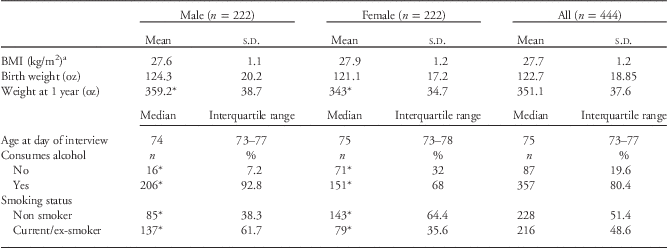
Table 1 shows the summary characteristics of the study population. The median age of the 444 subjects participating in this study was 75 years (interquartile range 73–77). The geometric mean BMI was 27.7 kg/m2 (s.d. 1.2). The mean birth weight was 124.3 oz in men and 121.1 oz in women; the mean weight at 1 year was 359.2 oz in men and 343 oz in women. Twenty (9.1%) men and 42 (18.9%) women had a clinical diagnosis of hand OA; 26 (12.0%) men and 41 (18.9%) women had a diagnosis of clinical knee OA while 7 (3.2%) men and 13 (6.0%) women had a clinical diagnosis of hip OA. Tables 2 and 3 show the relationship between the different diagnoses of OA with birth weight and weight at one year, respectively.
Summary statistics

BMI, body mass index.
a Geometric mean and s.d.
Difference between men and women *P<0.001.
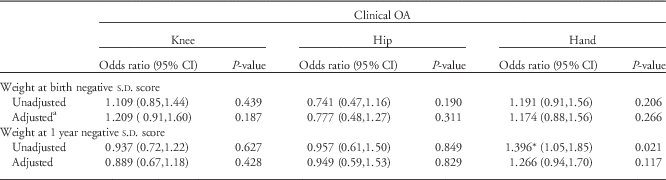
Relationship between birth weight and weight at 1 year negative s.d. scores and clinical OA

a Adjusted for sex, age, body mass index, smoking status and alcohol.
*P<0.05.
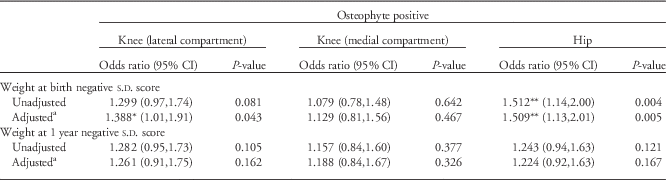
Relationship between birth weight and weight at 1 year negative s.d. scores and osteophyte growth

a Adjusted for sex, age, body mass index, smoking status and alcohol.
*P<0.05, **P<0.01.
Clinical OA
A lower weight at one year, but not birth weight, increased the risk of clinical hand OA (birth weight: OR 1.191, 95% CI 0.91, 1.56, P=0.206; weight at one year: OR 1.396, 95% CI 1.05, 1.85, P=0.021). The strength of this relationship was, however, weakened by adjustment for confounders such as age, sex, BMI, alcohol intake and smoking status (weight at one year: OR 1.266, 95% CI 0.94, 1.70, P=0.117). However, no relationship was observed between weight at birth and at one year, and clinical hip OA (birth weight: OR 0.741, 95% CI 0.47, 1.16, P=0.190; weight at one year: OR 0.957, 95% CI 0.61, 1.50, P=0.849) or clinical knee OA (birth weight: OR 1.109, 95% CI 0.85, 1.44, P=0.439; weight at one year: OR 0.937, 95% CI 0.72, 1.22, P=0.627) (Table 2).
Radiological OA
A lower birth weight appeared to increase the risk of developing osteophytes at the hip, and this observation remained robust following adjustment for confounders (pre-adjustment for confounders: OR 1.512, 95% CI 1.14, 2.00, P=0.04; post adjustment for confounders: OR 1.509, 95% CI 1.13, 2.01, P=0.005). This relationship was not observed with weight at one year (pre-adjustment for confounders: OR 1.243, 95% CI 0.94, 1.63, P=0.121; post adjustment for confounders: OR 1.224, 95% CI 0.92, 1.63, P=0.167). There was no significant relationship observed between osteophytic number and birth weight and weight at one year in the lateral compartment of the knee (birth weight: OR 1.299, 95% CI 0.97, 1.74, P=0.081; weight at one year: OR 1.282, 95% CI 0.95, 1.73, P=0.105). However, a significant association between birth weight and osteophytes in the lateral compartment of the knee became apparent following adjustment for confounders (birth weight: OR 1.388, 95% CI 1.01, 1.91, P=0.043). There was no significant relationship observed between osteophytes and birth weight and weight at one year in the medial compartment of the knee (birth weight: OR 1.079, 95% CI 0.78, 1.48, P=0.642; weight at one year: OR 1.157, 95% CI 0.84, 1.60, P=0.377) and this remained unchanged following adjustment for confounders (birth weight: OR 1.129, 95% CI 0.81, 1.56, P=0.467; weight at one year: OR 1.188, 95% CI 0.84, 1.67, P=0.326) (Table 3). When the full KL grading system was applied to the radiographs of the hip and knee, no significant trend was observed between birth weight and weight at year one and the likelihood of having a KL score of above 2.
Discussion
In this study we have found further evidence of a relationship between early life factors and adult OA. Specifically, lower weight at one year was associated with higher rates of clinical hand OA. This trend was additionally reflected in data obtained from radiographs of the hip and knee of our cohort: a lower birth weight was associated with a larger number of osteophytes at the hip, and at the lateral compartment of the knee. To consider the additional contribution of early life factors to adult demographic and lifestyle influences, we performed a log likelihood test to consider the goodness of fit of the statistical models, that did or did not include early life. These confirmed that for radiological OA, the hip osteophyte model was significantly improved by inclusion of birth weight; similarly the knee osteophyte model was significantly improved by inclusion of weight at one year.
Our study is limited in that there was only a moderate number of participants (222 men and 222 women), limiting our power to detect statistically significant relationships. The direction of association of our findings is consistent for all diagnoses of OA in this study, and with previous studies of this subject matter, suggesting that our positive findings are not due to chance. The results may not be entirely representative of the wider U.K. population, since all recruited participants were born in the county of Hertfordshire and had continued to reside there until they were 75 (as had been the case in previous studies).Reference Oliver, Jameson, Sayer, Cooper and Dennison 16 It has, however, been previously demonstrated that this cohort are a good representation of the general population with regard to body build and lifestyle factors, such as smoking and alcohol intake, therefore suggesting that selection bias was minimalReference Egger, Duggleby, Hobbs, Fall and Cooper 17 and all the comparisons undertaken were internal. While we have no data regarding the representativeness of birth weight and weight at one year among participants from the HCS relative to the United Kingdom, we have no reason to suppose that a bias is operating. Furthermore, because our comparisons are internal, the relationship between growth and risk of OA should not be affected by selective participation in this study.
Our radiological findings are consistent with, and expand further upon, a previous report by Jordan et al. Reference Jordan, Syddall, Dennison, Cooper and Arden 6 who adopted a similar approach when investigating any association between birth weight and weight at year one with osteophytic lesions at the lumbar spine. In keeping with our observations at the hip and knee, the investigators found that the presence of osteophytes was significantly more likely in men with a low birth weight and low weight at one year.Reference Jordan, Syddall, Dennison, Cooper and Arden 6 Our finding that clinical hand OA is associated with a low weight in early life accords with the work of Sayer et al. Reference Sayer, Poole and Cox 7 who looked at this relationship in a cohort of 13,687 births in England, Scotland and Wales.Reference Sayer, Poole and Cox 7
Our study shows further evidence of a relationship between early life factors and the development of adult OA. OA therefore appears to be one of several diseases, including coronary heart disease, hypertension, type 2 diabetes and OP,Reference Syddall, Sayer and Simmonds 8 , Reference Lucas 18 for which a low birth weight is predictive. The mechanism by which a hostile uterine environment could ultimately result in OA will require further investigation; however, there is evidence that the vitamin D receptor gene (VDR) plays an important role. A significant interaction between birth weight, the VDR genotype, and lumbar spine osteophytes, has been observed in the same Hertfordshire cohort.Reference Jordan, Syddall, Dennison, Cooper and Arden 6 Furthermore, several studies of knee OA have shown VDR associations with osteophytosis.Reference Uitterlinden, Burger and van Duijn 19 , Reference Uitterlinden, Burger and Huang 20 One might expect that babies of higher birth weight should grow into heavier adults, with a higher risk of knee OA. Our results would not support this, but highlight poorer growth earlier in life (even after adjustment for adult BMI) as a risk factor for this important musculoskeletal condition. Furthermore, when we examined relationships between birth weight and adult BMI in this cohort, they were non-significant, suggesting that adult obesity in lower birth weight individuals is not the explanation for our findings in this cohort.
The relationship between OA and OP is a controversial one. A number of cross-sectional studies have suggested that OA is associated with increased bone mineral density (BMD).Reference Burger, van Daele and Odding 21 – Reference Nevitt, Lane and Scott 24 Thus, it has been traditionally thought that the development of OA is inversely related to OP.Reference Im and Kim 25 However, the relationship between weight in early life and the development of OA in our study mirrors the findings of some previous studies, which have suggested that higher weight at birth or at one year is associated with higher bone mineral content (BMC) or BMD values at the lumbar spine and femoral neck in late adulthood.Reference Cooper, Cawley and Bhalla 26 – Reference Yarbrough, Barrett-Connor and Morton 28 Hence, our findings contradict the assertion that OA and OP development are always inversely related and suggest that adverse early life events could be a common cause for both diseases. Some recent studies would support this assertion: in a population of 473 women from Framingham, United States, it has been shown that high BMD and BMC gain decreased the risk of progression of radiographic knee OA.Reference Zhang, Hannan and Chaisson 29 The relationship between OA and OP is complex, and further work is required to elucidate the exact nature of their interaction and whether there are common factors which occur in early life that predispose an individual to both diseases.
In conclusion, the development of OA in the hand, hip and knee is associated with lower weight at birth and at one year, as shown through a combination of questionnaires, clinical diagnoses and radiological studies. These findings are consistent with previous studies and mirror the trend seen with other chronic diseases such as type 2 diabetes, hypertension and OP.
Acknowledgements
The Hertfordshire Cohort Study was supported by the Medical Research Council of Great Britain, Arthritis Research UK, and the International Osteoporosis Foundation. The work herein was also supported by the NIHR Nutrition BRC, University of Southampton and the NIHR Musculoskeletal BRU, University of Oxford. The authors thank all of the men and women who took part in the Hertfordshire Cohort Study, the HCS Research Staff, and Vanessa Cox who managed the data. Michael Clynes was supported by the University of Southampton National Institute of Health Research Academic Foundation Programme Scheme.
Conflicts of Interest
None.